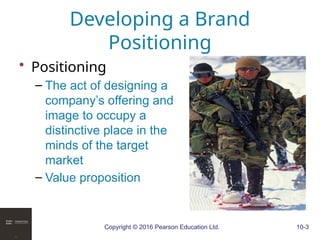
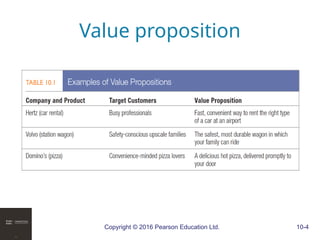
#3 The goal is to locate the brand in the minds of consumers to maximize the potential benefit to the firm. A good brand positioning helps guide marketing strategy by clarifying the brand’s essence, identifying the goals it helps the consumer achieve, and showing how it does so in a unique way. One result of positioning is the successful creation of a customer-focused value proposition, a cogent reason why the target market should buy a product or service. As introduced in Chapter 1, a value proposition captures the way a product or service’s key benefits provide value to customers by satisfying their needs.
#4 Table 10.1 shows how three companies—Hertz, Volvo, and Domino’s—have defined their value proposition through the years with their target customers.
#5 Decisions about the competitive frame of reference are closely linked to target market decisions. Deciding to target a certain type of consumer can define the nature of competition because certain firms have decided to target that segment in the past (or plan to do so in the future) or because consumers in that segment may already look to certain products or brands in their purchase decisions.
A good starting point in defining a competitive frame of reference for brand positioning is category membership—the products or sets of products with which a brand competes and that function as close substitutes. The range of a company’s actual and potential competitors, however, can be much broader than the obvious. Using the market approach, we define competitors as companies that satisfy the same customer need. Chapter 2 described how to conduct a SWOT analysis that includes a
competitive analysis. A company needs to gather information about each competitor’s real and perceived strengths
and weaknesses. Once a company has identified its main competitors and their strategies, it must ask: What is each competitor seeking in the marketplace? What drives each competitor’s behavior?
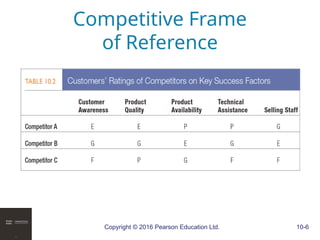
#6 Table 10.2 shows the results of a company survey that asked customers to rate its three competitors, A, B, and C, on five attributes. Competitor A turns out to be well known and respected for producing high-quality products sold by a good sales force, but poor at providing product availability and technical assistance. Competitor B is good across the board and excellent in product availability and sales force. Competitor C rates poor to fair on most attributes. This result suggests that in its positioning, the company could attack Competitor A on product availability and technical assistance and Competitor C on almost anything, but it should not attack B, which has no glaring weaknesses. As part of this competitive analysis for positioning, the firm should also ascertain the strategies and objectives of its primary competitors.
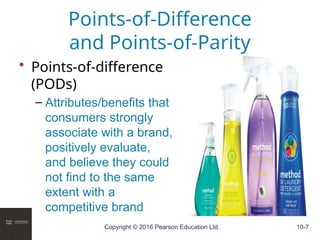
#7 Associations that make up points-of-difference can be based on virtually any type of attribute or benefit. Strong brands often have multiple points-of-difference.
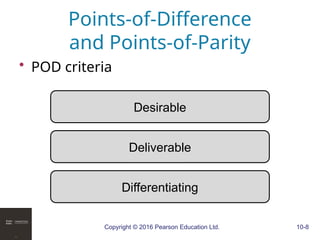
#8 Three criteria determine whether a brand association can truly function as a point-of-difference: desirability, deliverability, and differentiability. Desirable to consumer. Consumers must see the brand association as personally relevant to them. Deliverable by the company. The company must have the internal resources and commitment to feasibly and profitably create and maintain the brand association in the minds of consumers. The product design and marketing offering must support the desired association. Differentiating from competitors. Finally, consumers must see the brand association as distinctive and superior to relevant competitors.
#9 Regardless of the source of perceived weaknesses, if, in the eyes of consumers, a brand can “break even” in those areas where it appears to be at a disadvantage and achieve advantages in other areas, it should be in a strong—and perhaps unbeatable—competitive position. Consider the introduction of Miller Lite beer—the first major light beer in North America.
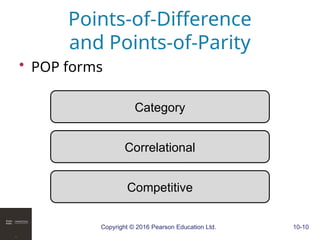
#10 POP associations come in three basic forms: category, correlational, and competitive. Category points-of-parity are attributes or benefits that consumers view as essential to a legitimate and credible offering within a certain product or service category. In other words, they represent necessary—but not sufficient— conditions for brand choice. Correlational points-of-parity are potentially negative associations that arise from the existence of positive associations for the brand. Competitive points-of-parity are associations designed to overcome perceived weaknesses of the brand in light of competitors’ points-of-difference.
#11 It is not uncommon for a brand to identify more than one actual or potential competitive frame of reference, if competition widens or the firm plans to expand into new categories. For example, Starbucks could define very distinct sets of competitors, suggesting different possible POPs and PODs as a result: some potential POPs and PODs for Starbucks are shared across competitors; others are unique to a particular competitor.
Occasionally, a company will be able to straddle two frames of reference with one set of points-of-difference and points-of-parity. In these cases, the points-of-difference for one category become points-of-parity for the other and vice versa. Straddle positions allow brands to expand their market coverage and potential customer base.
#12 Michael Porter urged companies to build a sustainable competitive advantage. Competitive advantage is a company’s ability to perform in one or more ways that competitors cannot or will not match. But few competitive advantages are inherently sustainable. At best, they may be leverageable. A leverageable advantage is one that a company can use as a springboard to new advantages, much as Microsoft has leveraged its operating system to Microsoft Office and then to networking applications. In general, a company that hopes to endure must be in the business of continuously inventing new advantages that can serve as the basis of points-of-difference.
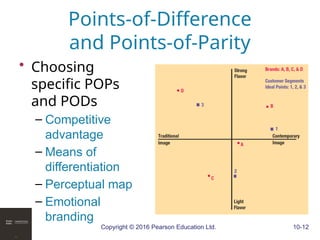
Any product or service benefit that is sufficiently desirable, deliverable, and differentiating can serve as a point-of-difference for a brand. The obvious, and often the most compelling, means of differentiation for consumers are benefits related to performance (Chapters 13 and 14). For choosing specific benefits as POPs and PODs to position a brand, perceptual maps may be useful. Perceptual maps are visual representations of consumer perceptions and preferences. They provide quantitative pictures of market situations and the way consumers view different products, services, and brands along various dimensions. By overlaying consumer preferences with brand perceptions, marketers can reveal “holes” or “openings” that suggest unmet consumer needs and marketing opportunities. Many marketing experts believe a brand positioning should have both rational and emotional components. In other words, it should contain points-of-difference and points-of-parity that appeal to both the head and the heart. A person’s emotional response to a brand and its marketing will depend on many factors. An increasingly important one is the brand’s authenticity.
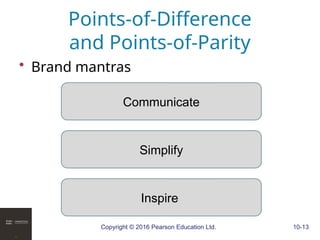
#13 To further focus brand positioning and guide the way their marketers help consumers think about the brand, firms can define a brand mantra. A brand mantra is a three- to five-word articulation of the heart and soul of the brand and is closely related to other branding concepts like “brand essence” and “core brand promise.”
Here are the three key criteria for a brand mantra:
Communicate. A good brand mantra should clarify what is unique about the brand. It may also need to Define the category (or categories) of business for the brand and set brand boundaries.
Simplify. An effective brand mantra should be memorable. For that, it should be short, crisp, and vivid in meaning.
Inspire. Ideally, the brand mantra should also stake out ground that is personally meaningful and relevant to as many employees as possible.
#14 Often a good positioning will have several PODs and POPs. Of those, often two or three really define the competitive battlefield and should be analyzed and developed carefully. A good positioning should also follow the “90–10” rule and be highly applicable to 90 percent (or at least 80 percent) of the products in the brand. Attempting to position to all 100 percent of a brand’s product often yields an unsatisfactory “lowest common denominator” result. The remaining 10 percent or 20 percent of products should be reviewed to ensure they have the proper branding strategy and to see how they could be changed to better reflect the brand positioning.
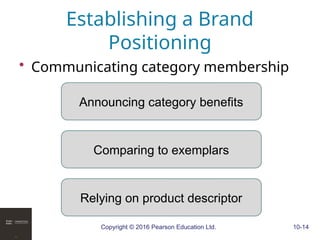
When a product is new, marketers must inform consumers of the brand’s category membership. Sometimes consumers may know the category membership but not be convinced the brand is a valid member of the category. Brands are sometimes affiliated with categories in which they do not hold membership. There are three main ways to convey a brand’s category membership:
Announcing category benefits—To reassure consumers that a brand will deliver on the fundamental reason for using a category, marketers frequently use benefits to announce category membership.
Comparing to exemplars—Well-known, noteworthy brands in a category can also help a brand specify its category
Membership.
3. Relying on the product descriptor—The product descriptor that follows the brand name is often a concise means of conveying category origin.
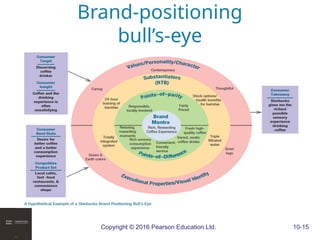
#15 Once they have fashioned the brand positioning strategy, marketers should communicate it to everyone in the organization so it guides their words and actions. One helpful schematic with which to do so is a brand-positioning bull’s-eye. “Marketing Memo: Constructing a Brand Positioning Bull’s-eye” outlines one way marketers can formally express brand positioning without skipping any steps.
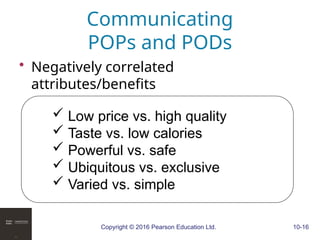
#16 One common challenge in positioning is that many of the benefits that make up points-of-parity and points-of-difference are negatively correlated. ConAgra must convince consumers that Healthy Choice frozen foods both taste good and are good for you. Unfortunately, consumers typically want to maximize both the negatively correlated attributes or benefits. Much of the art and science of marketing consists of dealing with trade-offs, and positioning is no different. The best approach clearly is to develop a product or service that performs well on both dimensions.
#17 it is important to regularly research the desirability, deliverability, and differentiability of the brand’s POPs and PODs in the marketplace to understand how the brand positioning might need to evolve or, in relatively rare cases, be completely replaced. In assessing potential threats from competitors, three high-level variables are useful:
1. Share of market—The competitor’s share of the target market.
2. Share of mind—The percentage of customers who named the competitor in responding to the statement “Name the first company that comes to mind in this industry.”
3. Share of heart—The percentage of customers who named the competitor in responding to the statement “Name the company from which you would prefer to buy the product.”
#18 Rather than outlining specific attributes or benefits, some marketing experts describe positioning a brand as telling a narrative or story. Companies like the richness and imagination they can derive from thinking of the story behind a product or service. Based on literary convention and brand experience, the following framework is offered for a brand story:
Setting. The time, place, and context
Cast. The brand as a character, including its role in the life of the audience, its relationships and responsibilities, and its history or creation myth
Narrative arc. The way the narrative logic unfolds over time, including actions, desired experiences, defining events, and the moment of epiphany
Language. The authenticating voice, metaphors, symbols, themes, and leitmotifs
Douglas Holt believes that for companies to build iconic, leadership brands, they must assemble cultural knowledge, strategize according to cultural branding principles, and hire and train cultural experts. Experts who see consumers actively cocreating brand meaning and positioning even refer to this as “Brand Wikification,” given that wikis are written by contributors from all walks of life and points of view.
#19 Building brands is a challenge for a small business with limited resources and budgets. Nevertheless, numerous success stories exist of entrepreneurs who have built their brands up essentially from scratch to become powerhouse brands. When resources are limited, focus and consistency in marketing programs become critically important. Creativity is also paramount—finding new ways to market new ideas about products to consumers. Here are some specific branding guidelines for small businesses.