Introduction to Marketing
Conducting
Marketing Research
and Forecasting
Demand
Chapter Questions
1.1 What is Marketing Research?
1.2 The Marketing Research Process
1.3 Defining the Problem
1.4 Developing the Research Plan
1.5 Collecting Information
1.6 Presenting the Findings
1.7 Making the Decision
1.8 The Seven Characteristics of Good Marketing Research
The Marketing Research System
• Marketing research is the systematic design, collection,
analysis, and reporting of data and findings relevant to a
specific marketing situation facing the company.
Chapter Question 1:
What constitutes good
marketing research?
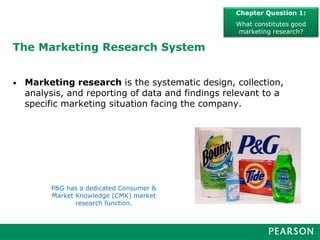
P&G has a dedicated Consumer &
Market Knowledge (CMK) market
research function.
The Marketing Research System
• Marketing research is often done by an
outside research firm.
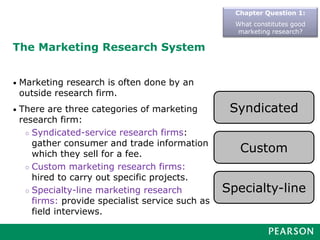
• There are three categories of marketing
research firm:
○ Syndicated-service research firms:
gather consumer and trade information
which they sell for a fee.
○ Custom marketing research firms:
hired to carry out specific projects.
○ Specialty-line marketing research
firms: provide specialist service such as
field interviews.
Chapter Question 1:
What constitutes good
marketing research?
Syndicated
Custom
Specialty-line
The Marketing Research System
• Small companies use creative and affordable ways to
conduct research such as:
– Engaging students or professors to design and carry out
projects
– Using the internet
– Checking out rivals. Many small companies routinely visit
their competitors
Chapter Question 1:
What constitutes good
marketing research?
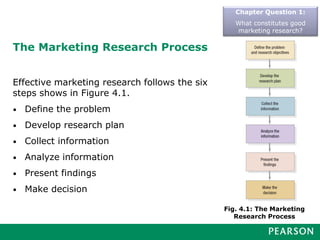
The Marketing Research Process
Effective marketing research follows the six
steps shows in Figure 4.1.
• Define the problem
• Develop research plan
• Collect information
• Analyze information
• Present findings
• Make decision
Chapter Question 1:
What constitutes good
marketing research?
Fig. 4.1: The Marketing
Research Process
Step 1: Define the Problem and
Research Objectives
• Define the problem
• Specify decision alternatives
• State research objectives
Chapter Question 1:
What constitutes good
marketing research?
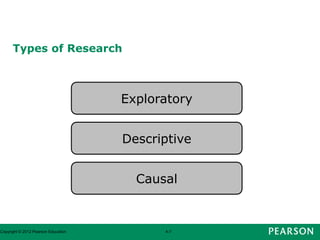
Types of Research
Copyright © 2012 Pearson Education 4-7
Exploratory
Descriptive
Causal
Step 2: Develop the Research Plan
• Outlines sources of data
• Spells out the specific:
– Research approach
– Contact methods
– Sampling plan
– Research instruments
Chapter Question 1:
What constitutes good
marketing research?
Data sources
• To design a research plan, we need to make decisions
about:
• Secondary data consists of information that already exists
somewhere, having been collected for another purpose.
• Primary data consists of information gathered for the special
research plan.
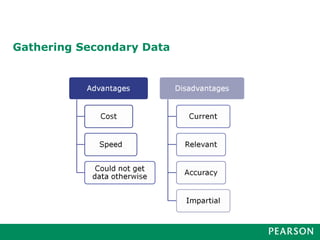
Gathering Secondary Data
Research Approach
• To design a research plan, we need to make decisions about
the research approach
• Research approaches – could involve:
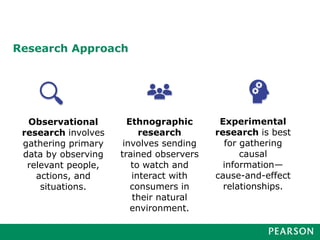
– Observational research
– Ethnographic research
– Focus-group research
– Survey research
– Behavioral data
– Experimental research
Research Approach
Observational
research involves
gathering primary
data by observing
relevant people,
actions, and
situations.
Ethnographic
research
involves sending
trained observers
to watch and
interact with
consumers in
their natural
environment.
Experimental
research is best
for gathering
causal
information—
cause-and-effect
relationships.
Research Approach
• Survey research is the most widely used method and is best
for descriptive information—knowledge, attitudes,
preferences, and buying behavior.
– Flexible
– People can be unable or unwilling to answer
– Gives misleading or pleasing answers
– Privacy concerns
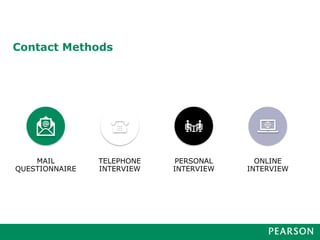
Contact Methods
MAIL
QUESTIONNAIRE
TELEPHONE
INTERVIEW
PERSONAL
INTERVIEW
ONLINE
INTERVIEW
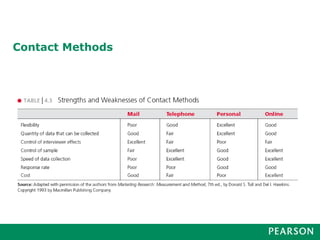
Contact Methods
Contact Methods
• Mail Questionnaires
– Large amount of respondents
– Low cost per respondent
– No interviewer bias
• Challenges:
– Not Flexible
– Low response rate
– Little sample control
Contact Methods
• Telephone Interviewing
– Gather information quickly
– Greater flexibility
• Challenges
– Higher cost per respondent
– Interviewer bias is a concern
Contact Methods
• Personal interviewing
– Individual interviewing
– Group interviewing (Focus Groups)
○ Six to 10 people with a trained moderator
• Challenges
– Expensive
– Difficult to generalize from small group
– Consumers not always open and honest
Contact Methods
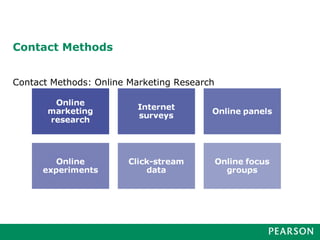
Contact Methods: Online Marketing Research
Contact Methods
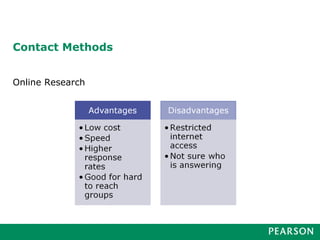
Online Research
Sampling Plan
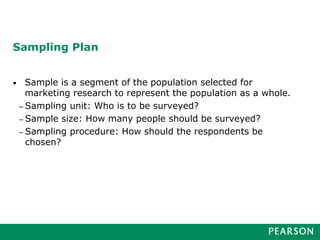
• Sample is a segment of the population selected for
marketing research to represent the population as a whole.
– Sampling unit: Who is to be surveyed?
– Sample size: How many people should be surveyed?
– Sampling procedure: How should the respondents be
chosen?
Sampling Plan
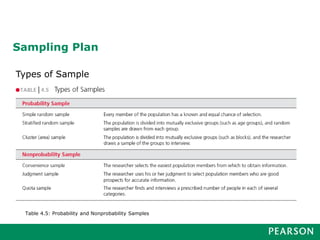
Types of Sample
Table 4.5: Probability and Nonprobability Samples
Research Instruments
• Questionnaires
– Most common
– Administered in person, by phone. Or online
– Flexible
– Research must be careful with wording and ordering
questions
Research Instruments
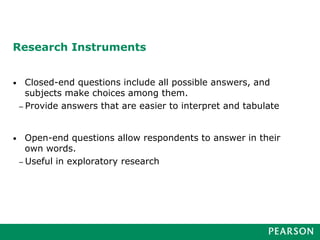
• Closed-end questions include all possible answers, and
subjects make choices among them.
– Provide answers that are easier to interpret and tabulate
• Open-end questions allow respondents to answer in their
own words.
– Useful in exploratory research
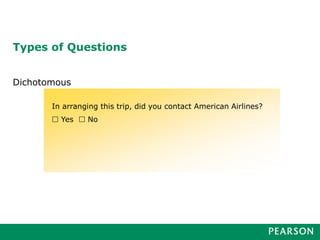
Types of Questions
Dichotomous
In arranging this trip, did you contact American Airlines?
 Yes  No
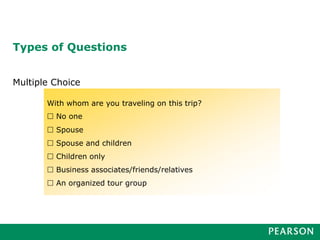
Types of Questions
Multiple Choice
With whom are you traveling on this trip?
 No one
 Spouse
 Spouse and children
 Children only
 Business associates/friends/relatives
 An organized tour group
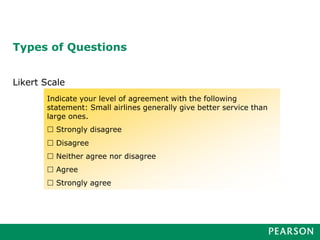
Types of Questions
Likert Scale
Indicate your level of agreement with the following
statement: Small airlines generally give better service than
large ones.
 Strongly disagree
 Disagree
 Neither agree nor disagree
 Agree
 Strongly agree
Types of Questions
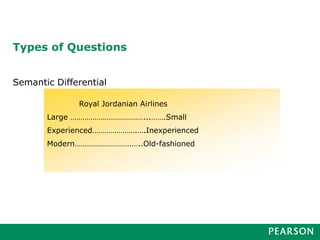
Semantic Differential
Royal Jordanian Airlines
Large ………………………………...…….Small
Experienced………………….….Inexperienced
Modern……………………….…..Old-fashioned
Types of Questions
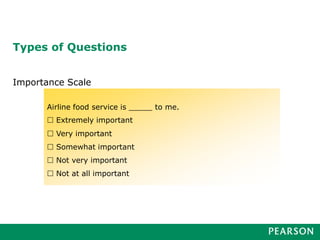
Importance Scale
Airline food service is _____ to me.
 Extremely important
 Very important
 Somewhat important
 Not very important
 Not at all important
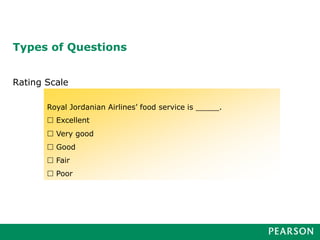
Rating Scale
Types of Questions
Royal Jordanian Airlines’ food service is _____.
 Excellent
 Very good
 Good
 Fair
 Poor
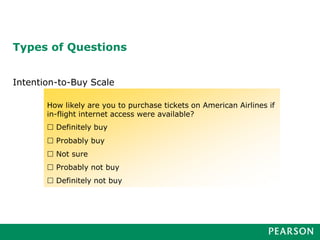
Types of Questions
Intention-to-Buy Scale
How likely are you to purchase tickets on American Airlines if
in-flight internet access were available?
 Definitely buy
 Probably buy
 Not sure
 Probably not buy
 Definitely not buy
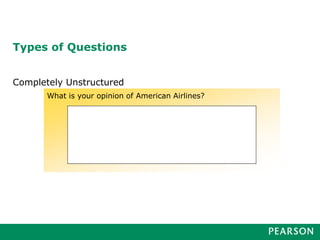
Types of Questions
Completely Unstructured
What is your opinion of American Airlines?
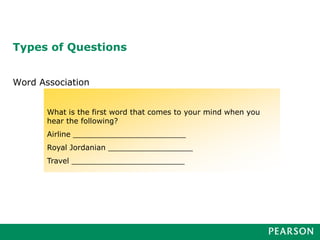
Types of Questions
Word Association
What is the first word that comes to your mind when you
hear the following?
Airline ________________________
Royal Jordanian __________________
Travel ________________________
Types of Questions
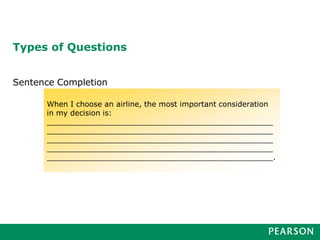
Sentence Completion
When I choose an airline, the most important consideration
in my decision is:
________________________________________________
________________________________________________
________________________________________________
________________________________________________
________________________________________________.
Types of Questions
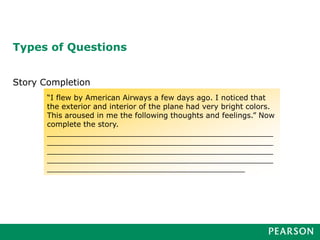
Story Completion
“I flew by American Airways a few days ago. I noticed that
the exterior and interior of the plane had very bright colors.
This aroused in me the following thoughts and feelings.” Now
complete the story.
________________________________________________
________________________________________________
________________________________________________
________________________________________________
__________________________________________
Types of Questions
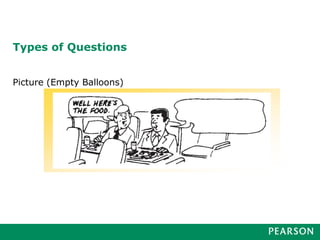
Picture (Empty Balloons)
Research Instruments
• Qualitative measures
– Word association
– Projective techniques
– Visualization
– Brand personification
– Laddering
Research Instruments
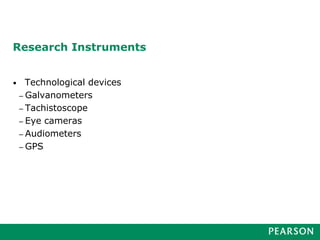
• Technological devices
– Galvanometers
– Tachistoscope
– Eye cameras
– Audiometers
– GPS
Step 3:
Collecting Information
Data-collection phase is generally the most
expensive and the most prone to error.
Problems collecting survey data include:
• Respondents not at home/not contactable
• Respondents refuse to cooperate
• Respondents give biased or dishonest answers
• Interviewers are biased or dishonest
Step 4:
Analyzing the Information
• Extract the findings by:
– Tabulating the data
– Working out averages and measures for spotting patterns
– Applying statistical techniques and decision models
– Testing different hypotheses and theories
– Applying sensitivity analysis to test strength of conclusions
Step 5:
Presenting the Findings
• Researcher presents findings relevant to the major
marketing decisions facing management.
• Researchers are often asked to add their opinion and
recommendations, to act as consultants.
Step 6: Making the Decision
• Many organizations use a marketing decision support
system (MDSS) to help marketing managers make better
decisions.
• A MDSS is a coordinated collection of data, systems, tools,
and techniques with supporting software and hardware by
which an organization gathers and interprets relevant
information from business and the environment and turns it
into a basis for marketing action.
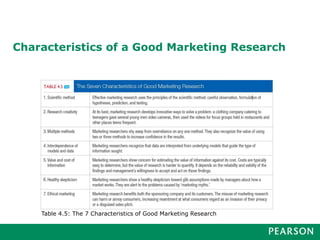
Characteristics of a Good Marketing Research
Table 4.5: The 7 Characteristics of Good Marketing Research

MM 2021 Chapter 4.pdf

  • 1.
    Introduction to Marketing Conducting MarketingResearch and Forecasting Demand
  • 2.
    Chapter Questions 1.1 Whatis Marketing Research? 1.2 The Marketing Research Process 1.3 Defining the Problem 1.4 Developing the Research Plan 1.5 Collecting Information 1.6 Presenting the Findings 1.7 Making the Decision 1.8 The Seven Characteristics of Good Marketing Research
  • 3.
    The Marketing ResearchSystem • Marketing research is the systematic design, collection, analysis, and reporting of data and findings relevant to a specific marketing situation facing the company. Chapter Question 1: What constitutes good marketing research? P&G has a dedicated Consumer & Market Knowledge (CMK) market research function.
  • 4.
    The Marketing ResearchSystem • Marketing research is often done by an outside research firm. • There are three categories of marketing research firm: ○ Syndicated-service research firms: gather consumer and trade information which they sell for a fee. ○ Custom marketing research firms: hired to carry out specific projects. ○ Specialty-line marketing research firms: provide specialist service such as field interviews. Chapter Question 1: What constitutes good marketing research? Syndicated Custom Specialty-line
  • 5.
    The Marketing ResearchSystem • Small companies use creative and affordable ways to conduct research such as: – Engaging students or professors to design and carry out projects – Using the internet – Checking out rivals. Many small companies routinely visit their competitors Chapter Question 1: What constitutes good marketing research?
  • 6.
    The Marketing ResearchProcess Effective marketing research follows the six steps shows in Figure 4.1. • Define the problem • Develop research plan • Collect information • Analyze information • Present findings • Make decision Chapter Question 1: What constitutes good marketing research? Fig. 4.1: The Marketing Research Process
  • 7.
    Step 1: Definethe Problem and Research Objectives • Define the problem • Specify decision alternatives • State research objectives Chapter Question 1: What constitutes good marketing research?
  • 8.
    Types of Research Copyright© 2012 Pearson Education 4-7 Exploratory Descriptive Causal
  • 9.
    Step 2: Developthe Research Plan • Outlines sources of data • Spells out the specific: – Research approach – Contact methods – Sampling plan – Research instruments Chapter Question 1: What constitutes good marketing research?
  • 10.
    Data sources • Todesign a research plan, we need to make decisions about: • Secondary data consists of information that already exists somewhere, having been collected for another purpose. • Primary data consists of information gathered for the special research plan.
  • 11.
  • 12.
    Research Approach • Todesign a research plan, we need to make decisions about the research approach • Research approaches – could involve: – Observational research – Ethnographic research – Focus-group research – Survey research – Behavioral data – Experimental research
  • 13.
    Research Approach Observational research involves gatheringprimary data by observing relevant people, actions, and situations. Ethnographic research involves sending trained observers to watch and interact with consumers in their natural environment. Experimental research is best for gathering causal information— cause-and-effect relationships.
  • 14.
    Research Approach • Surveyresearch is the most widely used method and is best for descriptive information—knowledge, attitudes, preferences, and buying behavior. – Flexible – People can be unable or unwilling to answer – Gives misleading or pleasing answers – Privacy concerns
  • 15.
  • 16.
  • 17.
    Contact Methods • MailQuestionnaires – Large amount of respondents – Low cost per respondent – No interviewer bias • Challenges: – Not Flexible – Low response rate – Little sample control
  • 18.
    Contact Methods • TelephoneInterviewing – Gather information quickly – Greater flexibility • Challenges – Higher cost per respondent – Interviewer bias is a concern
  • 19.
    Contact Methods • Personalinterviewing – Individual interviewing – Group interviewing (Focus Groups) ○ Six to 10 people with a trained moderator • Challenges – Expensive – Difficult to generalize from small group – Consumers not always open and honest
  • 20.
    Contact Methods Contact Methods:Online Marketing Research
  • 21.
  • 22.
    Sampling Plan • Sampleis a segment of the population selected for marketing research to represent the population as a whole. – Sampling unit: Who is to be surveyed? – Sample size: How many people should be surveyed? – Sampling procedure: How should the respondents be chosen?
  • 23.
    Sampling Plan Types ofSample Table 4.5: Probability and Nonprobability Samples
  • 24.
    Research Instruments • Questionnaires –Most common – Administered in person, by phone. Or online – Flexible – Research must be careful with wording and ordering questions
  • 25.
    Research Instruments • Closed-endquestions include all possible answers, and subjects make choices among them. – Provide answers that are easier to interpret and tabulate • Open-end questions allow respondents to answer in their own words. – Useful in exploratory research
  • 26.
    Types of Questions Dichotomous Inarranging this trip, did you contact American Airlines?  Yes  No
  • 27.
    Types of Questions MultipleChoice With whom are you traveling on this trip?  No one  Spouse  Spouse and children  Children only  Business associates/friends/relatives  An organized tour group
  • 28.
    Types of Questions LikertScale Indicate your level of agreement with the following statement: Small airlines generally give better service than large ones.  Strongly disagree  Disagree  Neither agree nor disagree  Agree  Strongly agree
  • 29.
    Types of Questions SemanticDifferential Royal Jordanian Airlines Large ………………………………...…….Small Experienced………………….….Inexperienced Modern……………………….…..Old-fashioned
  • 30.
    Types of Questions ImportanceScale Airline food service is _____ to me.  Extremely important  Very important  Somewhat important  Not very important  Not at all important
  • 31.
    Rating Scale Types ofQuestions Royal Jordanian Airlines’ food service is _____.  Excellent  Very good  Good  Fair  Poor
  • 32.
    Types of Questions Intention-to-BuyScale How likely are you to purchase tickets on American Airlines if in-flight internet access were available?  Definitely buy  Probably buy  Not sure  Probably not buy  Definitely not buy
  • 33.
    Types of Questions CompletelyUnstructured What is your opinion of American Airlines?
  • 34.
    Types of Questions WordAssociation What is the first word that comes to your mind when you hear the following? Airline ________________________ Royal Jordanian __________________ Travel ________________________
  • 35.
    Types of Questions SentenceCompletion When I choose an airline, the most important consideration in my decision is: ________________________________________________ ________________________________________________ ________________________________________________ ________________________________________________ ________________________________________________.
  • 36.
    Types of Questions StoryCompletion “I flew by American Airways a few days ago. I noticed that the exterior and interior of the plane had very bright colors. This aroused in me the following thoughts and feelings.” Now complete the story. ________________________________________________ ________________________________________________ ________________________________________________ ________________________________________________ __________________________________________
  • 37.
  • 38.
    Research Instruments • Qualitativemeasures – Word association – Projective techniques – Visualization – Brand personification – Laddering
  • 39.
    Research Instruments • Technologicaldevices – Galvanometers – Tachistoscope – Eye cameras – Audiometers – GPS
  • 40.
    Step 3: Collecting Information Data-collectionphase is generally the most expensive and the most prone to error. Problems collecting survey data include: • Respondents not at home/not contactable • Respondents refuse to cooperate • Respondents give biased or dishonest answers • Interviewers are biased or dishonest
  • 41.
    Step 4: Analyzing theInformation • Extract the findings by: – Tabulating the data – Working out averages and measures for spotting patterns – Applying statistical techniques and decision models – Testing different hypotheses and theories – Applying sensitivity analysis to test strength of conclusions
  • 42.
    Step 5: Presenting theFindings • Researcher presents findings relevant to the major marketing decisions facing management. • Researchers are often asked to add their opinion and recommendations, to act as consultants.
  • 43.
    Step 6: Makingthe Decision • Many organizations use a marketing decision support system (MDSS) to help marketing managers make better decisions. • A MDSS is a coordinated collection of data, systems, tools, and techniques with supporting software and hardware by which an organization gathers and interprets relevant information from business and the environment and turns it into a basis for marketing action.
  • 44.
    Characteristics of aGood Marketing Research Table 4.5: The 7 Characteristics of Good Marketing Research