

Chapter 3- slide 1
Chapter Three
Analyzing the Marketing
Environment
Chapter 3- slide 2
Copyright © 2010 Pearson Education, Inc.
Publishing as Prentice Hall
Analyzing the Marketing
Environment
• The Company’s Microenvironment
• The Company’s Macroenvironment
• Responding to the Marketing Environment
Topic Outline
Chapter 3- slide 3
Copyright © 2010 Pearson Education, Inc.
Publishing as Prentice Hall
The Marketing Environment
The marketing environment includes the
actors and forces outside marketing that
affect marketing management’s ability to
build and maintain successful relationships
with customers
Chapter 3- slide 4
Copyright © 2010 Pearson Education, Inc.
Publishing as Prentice Hall
The Marketing Environment
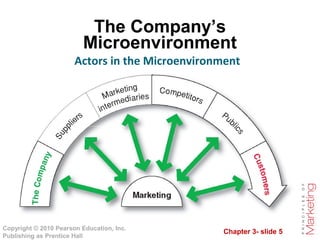
Microenvironment consists of the actors
close to the company that affect its ability
to serve its customers, the company,
suppliers, marketing intermediaries,
customer markets, competitors, and
publics
Chapter 3- slide 5
Copyright © 2010 Pearson Education, Inc.
Publishing as Prentice Hall
The Company’s
Microenvironment
Actors in the Microenvironment
Chapter 3- slide 6
Copyright © 2010 Pearson Education, Inc.
Publishing as Prentice Hall
The Company’s
Microenvironment
• Top management
• Finance
• R&D
• Purchasing
• Operations
• Accounting
The Company
Chapter 3- slide 7
Copyright © 2010 Pearson Education, Inc.
Publishing as Prentice Hall
The Company’s
Microenvironment
• Provide the resources to produce goods
and services
• Treated as partners to provide customer
value
Suppliers
Chapter 3- slide 8
Copyright © 2010 Pearson Education, Inc.
Publishing as Prentice Hall
The Company’s
Microenvironment
Help the company
to promote, sell and
distribute its
products to final
buyers
Marketing Intermediaries
Chapter 3- slide 9
Copyright © 2010 Pearson Education, Inc.
Publishing as Prentice Hall
The Company’s
Microenvironment
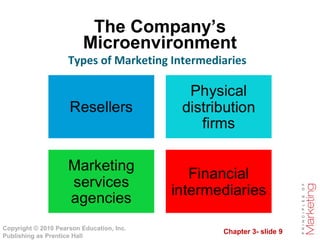
Types of Marketing Intermediaries
Chapter 3- slide 10
Copyright © 2010 Pearson Education, Inc.
Publishing as Prentice Hall
The Company’s
Microenvironment
• Firms must gain strategic advantage by
positioning their offerings against
competitors’ offerings
Competitors
Chapter 3- slide 11
Copyright © 2010 Pearson Education, Inc.
Publishing as Prentice Hall
The Company’s
Microenvironment
Publics
• Any group that has an actual or potential interest in
or impact on an organization’s ability to achieve its
objectives
– Financial publics
– Media publics
– Government publics
– Citizen-action publics
– Local publics
– General public
– Internal publics
Chapter 3- slide 12
Copyright © 2010 Pearson Education, Inc.
Publishing as Prentice Hall
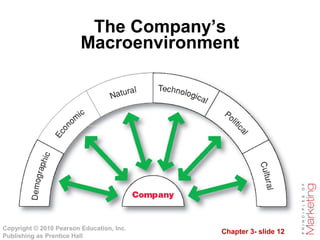
The Company’s
Macroenvironment
Chapter 3- slide 13
Copyright © 2010 Pearson Education, Inc.
Publishing as Prentice Hall
The Company’s
Macroenvironment
Demography is the study of human populations
in terms of size, density, location, age, gender,
race, occupation, and other statistics
• Demographic environment is important
because it involves people, and people make
up markets
• Demographic trends include age, family
structure, geographic population shifts,
educational characteristics, and population
diversity
Demographic Environment
Chapter 3- slide 14
Copyright © 2010 Pearson Education, Inc.
Publishing as Prentice Hall
The Company’s
Macroenvironment
• Increasing population
– Rapid growth in urban population in Asia
– In India, urban population to rise to 523 million
by 2025
Demographic Environment
Chapter 3- slide 15
Copyright © 2010 Pearson Education, Inc.
Publishing as Prentice Hall
The Company’s
Macroenvironment
• A growing middle class
– MGI has divided the Indian population into 5
economic classes
– Division based on real annual disposable
income
Demographic Environment
Chapter 3- slide 16
Copyright © 2010 Pearson Education, Inc.
Publishing as Prentice Hall
The Company’s
Macroenvironment
• Deprived households have an annual
disposable income of less than Rs 90,000
– The poorest economic class
– Mostly unskilled or semi-skilled workers on
daily wages
Demographic Environment
Chapter 3- slide 17
Copyright © 2010 Pearson Education, Inc.
Publishing as Prentice Hall
The Company’s
Macroenvironment
• Aspirers have an annual disposable
income in the range of Rs 90,000 to Rs
200,000
– Spend most of their income on basic
necessities
– Small-time retailers, small farmers, etc.
Demographic Environment
Chapter 3- slide 18
Copyright © 2010 Pearson Education, Inc.
Publishing as Prentice Hall
The Company’s
Macroenvironment
• Seekers have an annual disposable income
between Rs 200,000 and Rs 500,000.
Mostly white-collar employees, mid-level
government officials, newly employed
postgraduates, medium-scale traders
Demographic Environment
Chapter 3- slide 19
Copyright © 2010 Pearson Education, Inc.
Publishing as Prentice Hall
The Company’s
Macroenvironment
• Strivers have an annual income ranging
from Rs 500,000 to Rs 1,000,000
– Have a stable income source and access to
amenities
– Mostly professionals such as lawyers, CAs,
senior government officials, rich farmers
Demographic Environment
Chapter 3- slide 20
Copyright © 2010 Pearson Education, Inc.
Publishing as Prentice Hall
The Company’s
Macroenvironment
• Global Indians have an annual disposable
income in excess of Rs 1,000,000
– Creamy layer in society
– Globe-trotters with a high standard of living
Demographic Environment
Chapter 3- slide 21
Copyright © 2010 Pearson Education, Inc.
Publishing as Prentice Hall
The Company’s
Macroenvironment
Demographic Environment
• Growth in the rural population
• A changing family system
• The changing role of women
• Increasing diversity
Chapter 3- slide 22
Copyright © 2010 Pearson Education, Inc.
Publishing as Prentice Hall
The Company’s
Macroenvironment
Economic environment consists of factors
that affect consumer purchasing power and
spending patterns
• Industrial economies are richer markets
• Subsistence economies consume most of
their own agriculture and industrial output
Economic Environment
Chapter 3- slide 23
Copyright © 2010 Pearson Education, Inc.
Publishing as Prentice Hall
The Company’s
Macroenvironment
• The global financial crisis of 2007–2009 has
affected the consumption and production
of many products
• Value marketing involves ways to offer
financially cautious buyers greater value—
the right combination of quality and service
at a fair price
Economic Environment
Chapter 3- slide 24
Copyright © 2010 Pearson Education, Inc.
Publishing as Prentice Hall
The Company’s
Macroenvironment
• Ernst Engel—Engel’s Law
• As income rises:
– The percentage spent on food declines
– The percentage spent on housing remains
constant
– The percentage spent on savings increases
Economic Environment
Changes in Consumer Spending Patterns
Chapter 3- slide 25
Copyright © 2010 Pearson Education, Inc.
Publishing as Prentice Hall
The Company’s
Macroenvironment
Natural environment involves the natural
resources that are needed as inputs by
marketers or that are affected by marketing
activities
• Trends
– Shortages of raw materials
– Increased pollution
– Increase government intervention
– Environmentally sustainable strategies
Natural Environment
Chapter 3- slide 26
Copyright © 2010 Pearson Education, Inc.
Publishing as Prentice Hall
The Company’s
Macroenvironment
Technological Environment
• Most dramatic force in changing the
marketplace
• Creates new products and
opportunities
• Safety of new product always a
concern
Chapter 3- slide 27
Copyright © 2010 Pearson Education, Inc.
Publishing as Prentice Hall
The Company’s
Macroenvironment
Political environment consists of laws,
government agencies, and pressure groups
that influence or limit various organizations
and individuals in a given society
Political Environment
Chapter 3- slide 28
Copyright © 2010 Pearson Education, Inc.
Publishing as Prentice Hall
The Company’s
Macroenvironment
• Legislation regulating business
– Increased legislation
– Changing government agency enforcement
– New forms of nontariff barriers in trade
• Increased emphasis on ethics
– Socially responsible behavior
– Cause-related marketing
Political Environment
Chapter 3- slide 29
Copyright © 2010 Pearson Education, Inc.
Publishing as Prentice Hall
The Company’s
Macroenvironment
Cultural environment consists of
institutions and other forces that affect a
society’s basic values, perceptions, and
behaviors
Cultural Environment
Chapter 3- slide 30
Copyright © 2010 Pearson Education, Inc.
Publishing as Prentice Hall
The Company’s
Macroenvironment
Core beliefs and values are persistent and are
passed on from parents to children and are
reinforced by schools, religious institutions,
businesses, and government
Secondary beliefs and values are more open to
change and include people’s views of
themselves, others, organization, society,
nature, and the universe
Cultural Environment
Persistence of Cultural Values
Chapter 3- slide 31
Copyright © 2010 Pearson Education, Inc.
Publishing as Prentice Hall
The Company’s
Macroenvironment
• People’s view of themselves
– Yankelovich Monitor’s consumer segments:
• Do-it-yourselfers—recent movers
• Adventurers
• People’s view of others
– More “cocooning”
Cultural Environment
Shifts in Secondary Cultural Values
Chapter 3- slide 32
Copyright © 2010 Pearson Education, Inc.
Publishing as Prentice Hall
The Company’s
Macroenvironment
• People’s view of organizations
• People’s view of society
– Patriots defend it
– Reformers want to change it
– Malcontents want to leave it
Cultural Environment
Shifts in Secondary Cultural Values
Chapter 3- slide 33
Copyright © 2010 Pearson Education, Inc.
Publishing as Prentice Hall
The Company’s
Macroenvironment
Cultural Environment
Shifts in Secondary Cultural Values
• People’s view of nature
– Some feel ruled by it
– Some feel in harmony with it
– Some seek to master it
• People’s view of the universe
– Renewed interest in spirituality
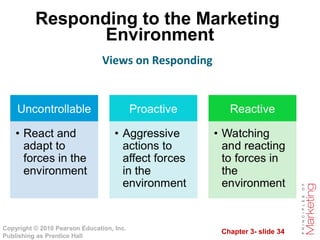
Chapter 3- slide 34
Copyright © 2010 Pearson Education, Inc.
Publishing as Prentice Hall
Responding to the Marketing
Environment
Views on Responding
Chapter 3- slide 35
Copyright © 2010 Pearson Education, Inc.
Publishing as Prentice Hall
All rights reserved. No part of this publication may be reproduced, stored in a
retrieval system, or transmitted, in any form or by any means, electronic,
mechanical, photocopying, recording, or otherwise, without the prior written
permission of the publisher. Printed in the United States of America.
Copyright © 2010 Pearson Education, Inc.Copyright © 2010 Pearson Education, Inc.
Publishing as Prentice HallPublishing as Prentice Hall

Chapter-3 Marketing: Analyzing the Marketing Environment

  • 1.
    Chapter 3- slide1 Chapter Three Analyzing the Marketing Environment
  • 2.
    Chapter 3- slide2 Copyright © 2010 Pearson Education, Inc. Publishing as Prentice Hall Analyzing the Marketing Environment • The Company’s Microenvironment • The Company’s Macroenvironment • Responding to the Marketing Environment Topic Outline
  • 3.
    Chapter 3- slide3 Copyright © 2010 Pearson Education, Inc. Publishing as Prentice Hall The Marketing Environment The marketing environment includes the actors and forces outside marketing that affect marketing management’s ability to build and maintain successful relationships with customers
  • 4.
    Chapter 3- slide4 Copyright © 2010 Pearson Education, Inc. Publishing as Prentice Hall The Marketing Environment Microenvironment consists of the actors close to the company that affect its ability to serve its customers, the company, suppliers, marketing intermediaries, customer markets, competitors, and publics
  • 5.
    Chapter 3- slide5 Copyright © 2010 Pearson Education, Inc. Publishing as Prentice Hall The Company’s Microenvironment Actors in the Microenvironment
  • 6.
    Chapter 3- slide6 Copyright © 2010 Pearson Education, Inc. Publishing as Prentice Hall The Company’s Microenvironment • Top management • Finance • R&D • Purchasing • Operations • Accounting The Company
  • 7.
    Chapter 3- slide7 Copyright © 2010 Pearson Education, Inc. Publishing as Prentice Hall The Company’s Microenvironment • Provide the resources to produce goods and services • Treated as partners to provide customer value Suppliers
  • 8.
    Chapter 3- slide8 Copyright © 2010 Pearson Education, Inc. Publishing as Prentice Hall The Company’s Microenvironment Help the company to promote, sell and distribute its products to final buyers Marketing Intermediaries
  • 9.
    Chapter 3- slide9 Copyright © 2010 Pearson Education, Inc. Publishing as Prentice Hall The Company’s Microenvironment Types of Marketing Intermediaries
  • 10.
    Chapter 3- slide10 Copyright © 2010 Pearson Education, Inc. Publishing as Prentice Hall The Company’s Microenvironment • Firms must gain strategic advantage by positioning their offerings against competitors’ offerings Competitors
  • 11.
    Chapter 3- slide11 Copyright © 2010 Pearson Education, Inc. Publishing as Prentice Hall The Company’s Microenvironment Publics • Any group that has an actual or potential interest in or impact on an organization’s ability to achieve its objectives – Financial publics – Media publics – Government publics – Citizen-action publics – Local publics – General public – Internal publics
  • 12.
    Chapter 3- slide12 Copyright © 2010 Pearson Education, Inc. Publishing as Prentice Hall The Company’s Macroenvironment
  • 13.
    Chapter 3- slide13 Copyright © 2010 Pearson Education, Inc. Publishing as Prentice Hall The Company’s Macroenvironment Demography is the study of human populations in terms of size, density, location, age, gender, race, occupation, and other statistics • Demographic environment is important because it involves people, and people make up markets • Demographic trends include age, family structure, geographic population shifts, educational characteristics, and population diversity Demographic Environment
  • 14.
    Chapter 3- slide14 Copyright © 2010 Pearson Education, Inc. Publishing as Prentice Hall The Company’s Macroenvironment • Increasing population – Rapid growth in urban population in Asia – In India, urban population to rise to 523 million by 2025 Demographic Environment
  • 15.
    Chapter 3- slide15 Copyright © 2010 Pearson Education, Inc. Publishing as Prentice Hall The Company’s Macroenvironment • A growing middle class – MGI has divided the Indian population into 5 economic classes – Division based on real annual disposable income Demographic Environment
  • 16.
    Chapter 3- slide16 Copyright © 2010 Pearson Education, Inc. Publishing as Prentice Hall The Company’s Macroenvironment • Deprived households have an annual disposable income of less than Rs 90,000 – The poorest economic class – Mostly unskilled or semi-skilled workers on daily wages Demographic Environment
  • 17.
    Chapter 3- slide17 Copyright © 2010 Pearson Education, Inc. Publishing as Prentice Hall The Company’s Macroenvironment • Aspirers have an annual disposable income in the range of Rs 90,000 to Rs 200,000 – Spend most of their income on basic necessities – Small-time retailers, small farmers, etc. Demographic Environment
  • 18.
    Chapter 3- slide18 Copyright © 2010 Pearson Education, Inc. Publishing as Prentice Hall The Company’s Macroenvironment • Seekers have an annual disposable income between Rs 200,000 and Rs 500,000. Mostly white-collar employees, mid-level government officials, newly employed postgraduates, medium-scale traders Demographic Environment
  • 19.
    Chapter 3- slide19 Copyright © 2010 Pearson Education, Inc. Publishing as Prentice Hall The Company’s Macroenvironment • Strivers have an annual income ranging from Rs 500,000 to Rs 1,000,000 – Have a stable income source and access to amenities – Mostly professionals such as lawyers, CAs, senior government officials, rich farmers Demographic Environment
  • 20.
    Chapter 3- slide20 Copyright © 2010 Pearson Education, Inc. Publishing as Prentice Hall The Company’s Macroenvironment • Global Indians have an annual disposable income in excess of Rs 1,000,000 – Creamy layer in society – Globe-trotters with a high standard of living Demographic Environment
  • 21.
    Chapter 3- slide21 Copyright © 2010 Pearson Education, Inc. Publishing as Prentice Hall The Company’s Macroenvironment Demographic Environment • Growth in the rural population • A changing family system • The changing role of women • Increasing diversity
  • 22.
    Chapter 3- slide22 Copyright © 2010 Pearson Education, Inc. Publishing as Prentice Hall The Company’s Macroenvironment Economic environment consists of factors that affect consumer purchasing power and spending patterns • Industrial economies are richer markets • Subsistence economies consume most of their own agriculture and industrial output Economic Environment
  • 23.
    Chapter 3- slide23 Copyright © 2010 Pearson Education, Inc. Publishing as Prentice Hall The Company’s Macroenvironment • The global financial crisis of 2007–2009 has affected the consumption and production of many products • Value marketing involves ways to offer financially cautious buyers greater value— the right combination of quality and service at a fair price Economic Environment
  • 24.
    Chapter 3- slide24 Copyright © 2010 Pearson Education, Inc. Publishing as Prentice Hall The Company’s Macroenvironment • Ernst Engel—Engel’s Law • As income rises: – The percentage spent on food declines – The percentage spent on housing remains constant – The percentage spent on savings increases Economic Environment Changes in Consumer Spending Patterns
  • 25.
    Chapter 3- slide25 Copyright © 2010 Pearson Education, Inc. Publishing as Prentice Hall The Company’s Macroenvironment Natural environment involves the natural resources that are needed as inputs by marketers or that are affected by marketing activities • Trends – Shortages of raw materials – Increased pollution – Increase government intervention – Environmentally sustainable strategies Natural Environment
  • 26.
    Chapter 3- slide26 Copyright © 2010 Pearson Education, Inc. Publishing as Prentice Hall The Company’s Macroenvironment Technological Environment • Most dramatic force in changing the marketplace • Creates new products and opportunities • Safety of new product always a concern
  • 27.
    Chapter 3- slide27 Copyright © 2010 Pearson Education, Inc. Publishing as Prentice Hall The Company’s Macroenvironment Political environment consists of laws, government agencies, and pressure groups that influence or limit various organizations and individuals in a given society Political Environment
  • 28.
    Chapter 3- slide28 Copyright © 2010 Pearson Education, Inc. Publishing as Prentice Hall The Company’s Macroenvironment • Legislation regulating business – Increased legislation – Changing government agency enforcement – New forms of nontariff barriers in trade • Increased emphasis on ethics – Socially responsible behavior – Cause-related marketing Political Environment
  • 29.
    Chapter 3- slide29 Copyright © 2010 Pearson Education, Inc. Publishing as Prentice Hall The Company’s Macroenvironment Cultural environment consists of institutions and other forces that affect a society’s basic values, perceptions, and behaviors Cultural Environment
  • 30.
    Chapter 3- slide30 Copyright © 2010 Pearson Education, Inc. Publishing as Prentice Hall The Company’s Macroenvironment Core beliefs and values are persistent and are passed on from parents to children and are reinforced by schools, religious institutions, businesses, and government Secondary beliefs and values are more open to change and include people’s views of themselves, others, organization, society, nature, and the universe Cultural Environment Persistence of Cultural Values
  • 31.
    Chapter 3- slide31 Copyright © 2010 Pearson Education, Inc. Publishing as Prentice Hall The Company’s Macroenvironment • People’s view of themselves – Yankelovich Monitor’s consumer segments: • Do-it-yourselfers—recent movers • Adventurers • People’s view of others – More “cocooning” Cultural Environment Shifts in Secondary Cultural Values
  • 32.
    Chapter 3- slide32 Copyright © 2010 Pearson Education, Inc. Publishing as Prentice Hall The Company’s Macroenvironment • People’s view of organizations • People’s view of society – Patriots defend it – Reformers want to change it – Malcontents want to leave it Cultural Environment Shifts in Secondary Cultural Values
  • 33.
    Chapter 3- slide33 Copyright © 2010 Pearson Education, Inc. Publishing as Prentice Hall The Company’s Macroenvironment Cultural Environment Shifts in Secondary Cultural Values • People’s view of nature – Some feel ruled by it – Some feel in harmony with it – Some seek to master it • People’s view of the universe – Renewed interest in spirituality
  • 34.
    Chapter 3- slide34 Copyright © 2010 Pearson Education, Inc. Publishing as Prentice Hall Responding to the Marketing Environment Views on Responding
  • 35.
    Chapter 3- slide35 Copyright © 2010 Pearson Education, Inc. Publishing as Prentice Hall All rights reserved. No part of this publication may be reproduced, stored in a retrieval system, or transmitted, in any form or by any means, electronic, mechanical, photocopying, recording, or otherwise, without the prior written permission of the publisher. Printed in the United States of America. Copyright © 2010 Pearson Education, Inc.Copyright © 2010 Pearson Education, Inc. Publishing as Prentice HallPublishing as Prentice Hall