Entrepreneurship 101!
Presented by: Jonathan Dogterom – Practice Lead, Cleantech


March 2012!
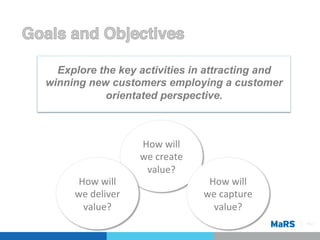
Explore the key activities in attracting and
winning new customers employing a customer
           orientated perspective.


                         How	
  will	
  
                         we	
  create	
  
                          value?	
  
      How	
  will	
                          How	
  will	
  
     we	
  deliver	
                        we	
  capture	
  
       value?	
                               value?	
  
                                                                Pg 3
Feed the Sales Pipeline!!

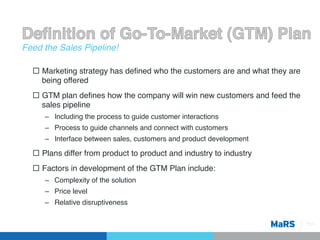
  ¨  Marketing strategy has defined who the customers are and what they are
      being offered!
  ¨  GTM plan defines how the company will win new customers and feed the
      sales pipeline!
     –  Including the process to guide customer interactions!
     –  Process to guide channels and connect with customers!
     –  Interface between sales, customers and product development!

  ¨  Plans differ from product to product and industry to industry!
  ¨  Factors in development of the GTM Plan include:!
     –  Complexity of the solution!
     –  Price level!
     –  Relative disruptiveness!
     !
                                                                              Pg 4!
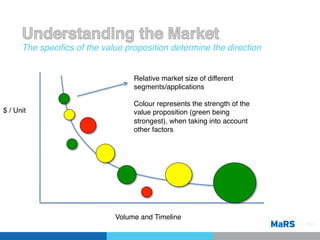
The specifics of the value proposition determine the direction!


                                  Relative market size of different
                                  segments/applications!
                                  !
                                  Colour represents the strength of the
$ / Unit!                         value proposition (green being
                                  strongest), when taking into account
                                  other factors!


                             Volume and Timeline!
                                                                          Pg 5!
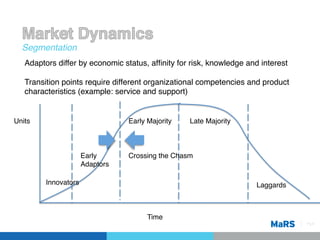
Segmentation!
   Adaptors differ by economic status, affinity for risk, knowledge and interest !
   !
   Transition points require different organizational competencies and product
   characteristics (example: service and support) !


Units!                           Early Majority!   Late Majority!


                   Early !       Crossing the Chasm!
                   Adaptors!

         Innovators!                                                  Laggards!


                                       Time!
                                                                                    Pg 6!
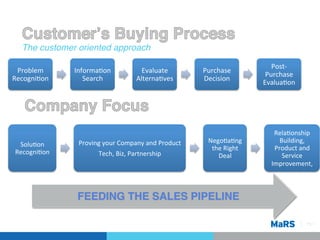
The customer oriented approach!

                                                                                               Post-­‐
 Problem	
        Informa7on	
                 Evaluate	
             Purchase	
  
                                                                                             Purchase	
  
Recogni7on	
         Search	
                Alterna7ves	
            Decision	
  
                                                                                            Evalua7on	


                                                                                                Rela7onship	
  
                   Proving	
  your	
  Company	
  and	
  Product	
       Nego7a7ng	
               Building,	
  
  Solu7on	
  
                                                                         the	
  Right	
         Product	
  and	
  
 Recogni7on	
            Tech,	
  Biz,	
  Partnership	
                    Deal	
                  Service	
  
                                                                                               Improvement,	


                                                                                                              Pg 7!
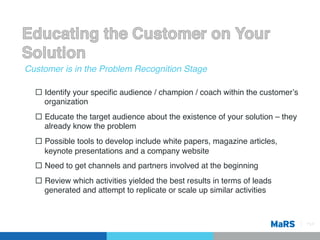
Customer is in the Problem Recognition Stage!

  ¨  Identify your specific audience / champion / coach within the customerʼs
      organization!
  ¨  Educate the target audience about the existence of your solution – they
      already know the problem!
  ¨  Possible tools to develop include white papers, magazine articles,
      keynote presentations and a company website!
  ¨  Need to get channels and partners involved at the beginning!
  ¨  Review which activities yielded the best results in terms of leads
      generated and attempt to replicate or scale up similar activities!


                                                                                Pg 8!
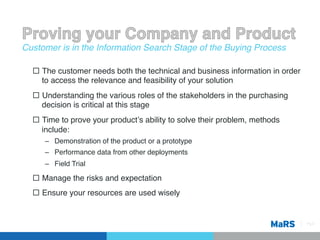
Customer is in the Information Search Stage of the Buying Process!

  ¨  The customer needs both the technical and business information in order
      to access the relevance and feasibility of your solution!
  ¨  Understanding the various roles of the stakeholders in the purchasing
      decision is critical at this stage!
  ¨  Time to prove your productʼs ability to solve their problem, methods
      include:!
     –  Demonstration of the product or a prototype!
     –  Performance data from other deployments!
     –  Field Trial!

  ¨  Manage the risks and expectation!
  ¨  Ensure your resources are used wisely!


                                                                                Pg 9!
Case Study – Backup Power!

                        •  Field trials to test value proposition assumptions and prove capabilities to the
                           customer – product performance, cost and logistics

                        10
                         9
                         8
Failure Duration [hr]


                         7
                         6
                         5
                        4
                         3
                         2
                         1
                         0
                             1 2 3 4 5 6 7 8 9 10 11 12 13 14 15 16 17 18 19 20 21 22 23 24 25 26 27 28 29 30 31 32 33 34 35 36 37 38 39 40 41 42 43 44 45 46 47 48 49 50


                                                                                                                                                                            Pg 10!
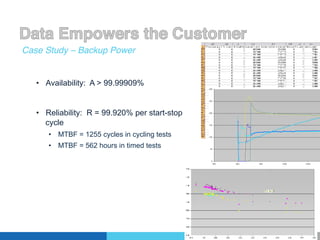
Case Study – Backup Power!


   •  Availability: A > 99.99909%


   •  Reliability: R = 99.920% per start-stop
      cycle
      •  MTBF = 1255 cycles in cycling tests
      •  MTBF = 562 hours in timed tests
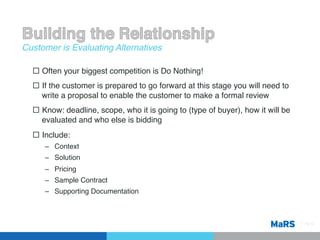
Customer is Evaluating Alternatives!

  ¨  Often your biggest competition is Do Nothing!!
  ¨  If the customer is prepared to go forward at this stage you will need to
      write a proposal to enable the customer to make a formal review!
  ¨  Know: deadline, scope, who it is going to (type of buyer), how it will be
      evaluated and who else is bidding!
  ¨  Include:!
      –  Context!
      –  Solution!
      –  Pricing!
      –  Sample Contract!
      –  Supporting Documentation!


                                                                                  Pg 12!
¨  Show them you understand their problem!
¨  Materials need to clearly articulate the value you are offering!
¨  References:!
   –  Analyst briefing—seeking third-party validation for your strengths is key (i.e.,
      appearing in Gartner, IDC or Forrester reports if you are in the IT industry)!
   –  Testimonials from similar customers!
   –  Well-documented reference projects which illustrate your strengths (can be
      displayed on website or even published in industry magazines) !

¨  White paper done with the customer – shows their thought leadership in the
    industry!
¨  Partnerships!!


                                                                                        Pg 13!
Moment of truth!

  ¨  People buy from people – cliché, but true – emotion plays a role in
      purchase decisions!
  ¨  Negotiation:!
     –  You should be reasonable in your expectations, as should your customer in
        their demands!
     –  Customer believes you can do the job and wants your product, just not at any
        terms and conditions – example: price!
     –  There is a give-and-take process in play whereby the seller can ask for an
        increased level of commitment every time the offer is improved!
     –  Preparation is the biggest success factor in negotiation. You should have: !
        !1) analyzed your own position on all key items (price, quantity, quality,
         timelines, etc.) to understand what your limits are!
        !2) analyzed the customerʼs position along the same lines so that you can
         anticipate their demands and defend your position !

                                                                                       Pg 14!
Sales and marketing feeds into service and product development!

 ¨  Now you have established trust and a track record!
 ¨  Word of mouth and repeat buying are two of your best marketing tools!
 ¨  Use your new understanding of the customer and market – reference site,
     data and customer feedback!
 ¨  Exceed expectations and build a strong “say do ratio”!


                                                                               Pg 15!
Sales activities must focus on building a scalable, repeat sales process!

  ¨  Focus on the customerʼs perspective !
  ¨  Involve all of your functional groups !
  ¨  Fully understand the customers problem!
  ¨  Know where your technology is going!
  ¨  Use data to prove your capabilities!
  ¨  Differentiate your solution and approach!
  ¨  Build a strong relationship with an internal champion/coach!


                                                                            Pg 16!
Jonathan J. Dogterom


jdogterom@marsdd.com!
Go-to-Market Strategy - Entrepreneurship 101

Go-to-Market Strategy - Entrepreneurship 101

  • 2.
    Entrepreneurship 101! Presented by:Jonathan Dogterom – Practice Lead, Cleantech
 
 March 2012!
  • 3.
    Explore the keyactivities in attracting and winning new customers employing a customer orientated perspective. How  will   we  create   value?   How  will   How  will   we  deliver   we  capture   value?   value?   Pg 3
  • 4.
    Feed the SalesPipeline!! ¨  Marketing strategy has defined who the customers are and what they are being offered! ¨  GTM plan defines how the company will win new customers and feed the sales pipeline! –  Including the process to guide customer interactions! –  Process to guide channels and connect with customers! –  Interface between sales, customers and product development! ¨  Plans differ from product to product and industry to industry! ¨  Factors in development of the GTM Plan include:! –  Complexity of the solution! –  Price level! –  Relative disruptiveness! ! Pg 4!
  • 5.
    The specifics ofthe value proposition determine the direction! Relative market size of different segments/applications! ! Colour represents the strength of the $ / Unit! value proposition (green being strongest), when taking into account other factors! Volume and Timeline! Pg 5!
  • 6.
    Segmentation! Adaptors differ by economic status, affinity for risk, knowledge and interest ! ! Transition points require different organizational competencies and product characteristics (example: service and support) ! Units! Early Majority! Late Majority! Early ! Crossing the Chasm! Adaptors! Innovators! Laggards! Time! Pg 6!
  • 7.
    The customer orientedapproach! Post-­‐ Problem   Informa7on   Evaluate   Purchase   Purchase   Recogni7on   Search   Alterna7ves   Decision   Evalua7on   Rela7onship   Proving  your  Company  and  Product   Nego7a7ng   Building,   Solu7on   the  Right   Product  and   Recogni7on   Tech,  Biz,  Partnership   Deal   Service   Improvement,       Pg 7!
  • 8.
    Customer is inthe Problem Recognition Stage! ¨  Identify your specific audience / champion / coach within the customerʼs organization! ¨  Educate the target audience about the existence of your solution – they already know the problem! ¨  Possible tools to develop include white papers, magazine articles, keynote presentations and a company website! ¨  Need to get channels and partners involved at the beginning! ¨  Review which activities yielded the best results in terms of leads generated and attempt to replicate or scale up similar activities! Pg 8!
  • 9.
    Customer is inthe Information Search Stage of the Buying Process! ¨  The customer needs both the technical and business information in order to access the relevance and feasibility of your solution! ¨  Understanding the various roles of the stakeholders in the purchasing decision is critical at this stage! ¨  Time to prove your productʼs ability to solve their problem, methods include:! –  Demonstration of the product or a prototype! –  Performance data from other deployments! –  Field Trial! ¨  Manage the risks and expectation! ¨  Ensure your resources are used wisely! Pg 9!
  • 10.
    Case Study –Backup Power! •  Field trials to test value proposition assumptions and prove capabilities to the customer – product performance, cost and logistics 10 9 8 Failure Duration [hr] 7 6 5 4 3 2 1 0 1 2 3 4 5 6 7 8 9 10 11 12 13 14 15 16 17 18 19 20 21 22 23 24 25 26 27 28 29 30 31 32 33 34 35 36 37 38 39 40 41 42 43 44 45 46 47 48 49 50 Pg 10!
  • 11.
    Case Study –Backup Power! •  Availability: A > 99.99909% •  Reliability: R = 99.920% per start-stop cycle •  MTBF = 1255 cycles in cycling tests •  MTBF = 562 hours in timed tests
  • 12.
    Customer is EvaluatingAlternatives! ¨  Often your biggest competition is Do Nothing!! ¨  If the customer is prepared to go forward at this stage you will need to write a proposal to enable the customer to make a formal review! ¨  Know: deadline, scope, who it is going to (type of buyer), how it will be evaluated and who else is bidding! ¨  Include:! –  Context! –  Solution! –  Pricing! –  Sample Contract! –  Supporting Documentation! Pg 12!
  • 13.
    ¨  Show themyou understand their problem! ¨  Materials need to clearly articulate the value you are offering! ¨  References:! –  Analyst briefing—seeking third-party validation for your strengths is key (i.e., appearing in Gartner, IDC or Forrester reports if you are in the IT industry)! –  Testimonials from similar customers! –  Well-documented reference projects which illustrate your strengths (can be displayed on website or even published in industry magazines) ! ¨  White paper done with the customer – shows their thought leadership in the industry! ¨  Partnerships!! Pg 13!
  • 14.
    Moment of truth! ¨  People buy from people – cliché, but true – emotion plays a role in purchase decisions! ¨  Negotiation:! –  You should be reasonable in your expectations, as should your customer in their demands! –  Customer believes you can do the job and wants your product, just not at any terms and conditions – example: price! –  There is a give-and-take process in play whereby the seller can ask for an increased level of commitment every time the offer is improved! –  Preparation is the biggest success factor in negotiation. You should have: ! !1) analyzed your own position on all key items (price, quantity, quality, timelines, etc.) to understand what your limits are! !2) analyzed the customerʼs position along the same lines so that you can anticipate their demands and defend your position ! Pg 14!
  • 15.
    Sales and marketingfeeds into service and product development! ¨  Now you have established trust and a track record! ¨  Word of mouth and repeat buying are two of your best marketing tools! ¨  Use your new understanding of the customer and market – reference site, data and customer feedback! ¨  Exceed expectations and build a strong “say do ratio”! Pg 15!
  • 16.
    Sales activities mustfocus on building a scalable, repeat sales process! ¨  Focus on the customerʼs perspective ! ¨  Involve all of your functional groups ! ¨  Fully understand the customers problem! ¨  Know where your technology is going! ¨  Use data to prove your capabilities! ¨  Differentiate your solution and approach! ¨  Build a strong relationship with an internal champion/coach! Pg 16!
  • 17.