The document discusses Reader Response Theory, which focuses on the reader's experience and role in constructing meaning from a text. Some key points:
1) According to Reader Response Theory, meaning is created through the interaction between the reader and the text, not inherent in the text itself.
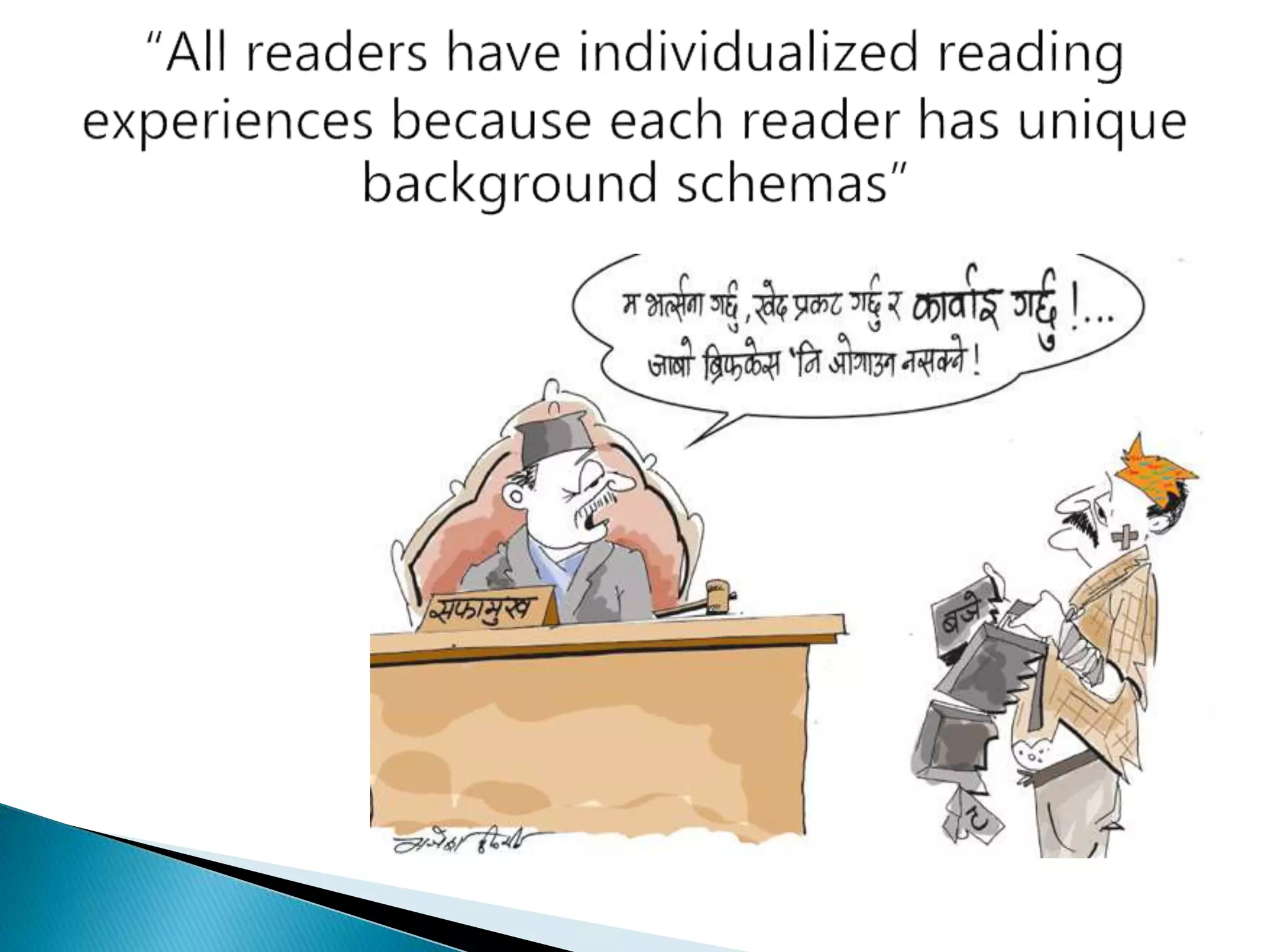
2) Readers are active participants who bring their own experiences and perspectives, rather than passively receiving meaning from texts.
3) Louise Rosenblatt influentially proposed that readers have both efferent responses, focused on extracting information, and aesthetic responses, focused on lived experience.
Introduces Reader Response Theory emphasizing reader-text interaction, different meanings, and highlights the reader's active role in shaping literary interpretation.
Discusses key theorists and concepts like Transactional Reader Response Theory, focusing on reader experiences, gaps in text interpretation, and communal meaning-making.
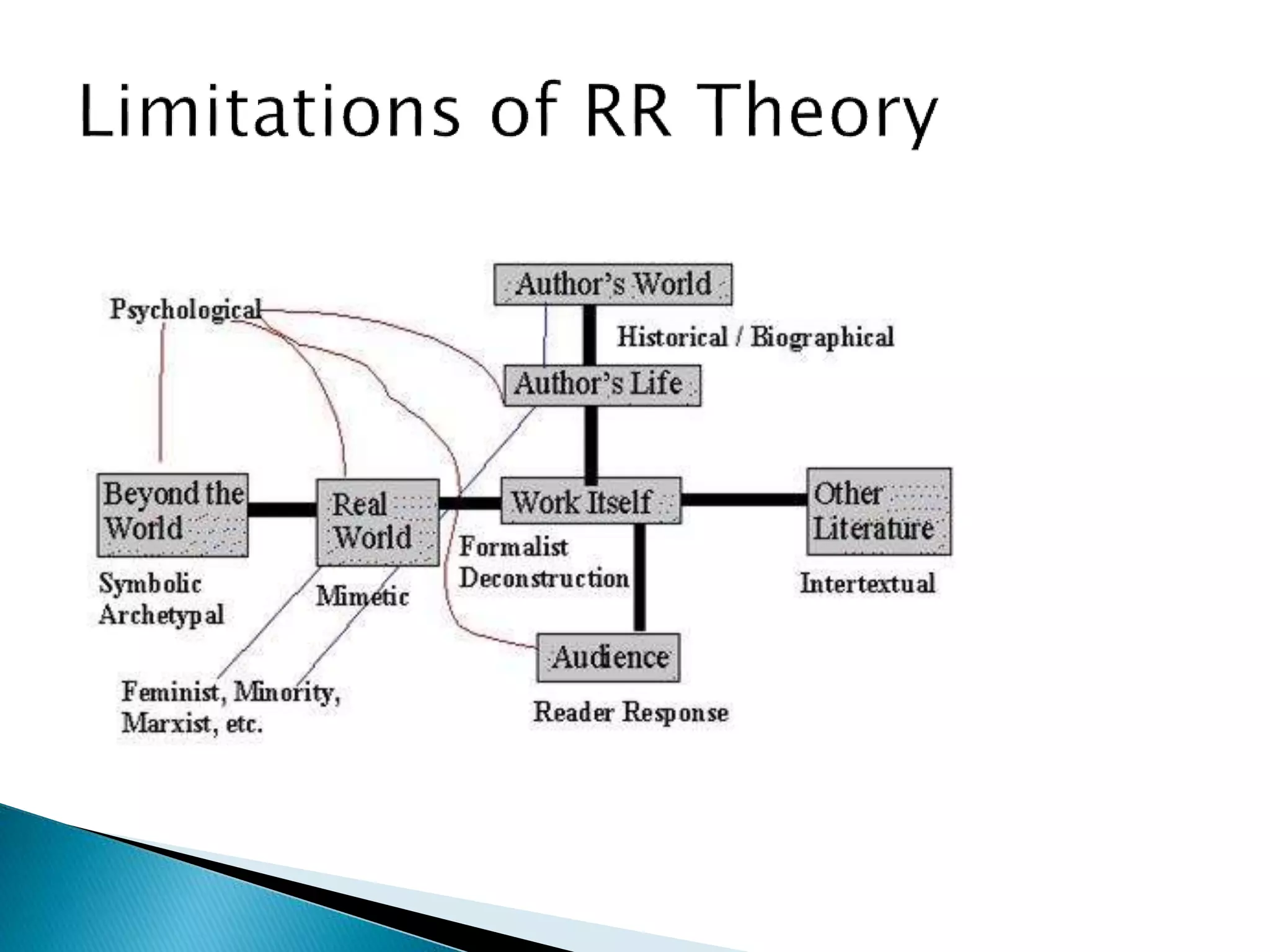
Explores psychological interpretations of texts, reader expectations, cultural influences, and socio-cultural contexts impacting literary responses.
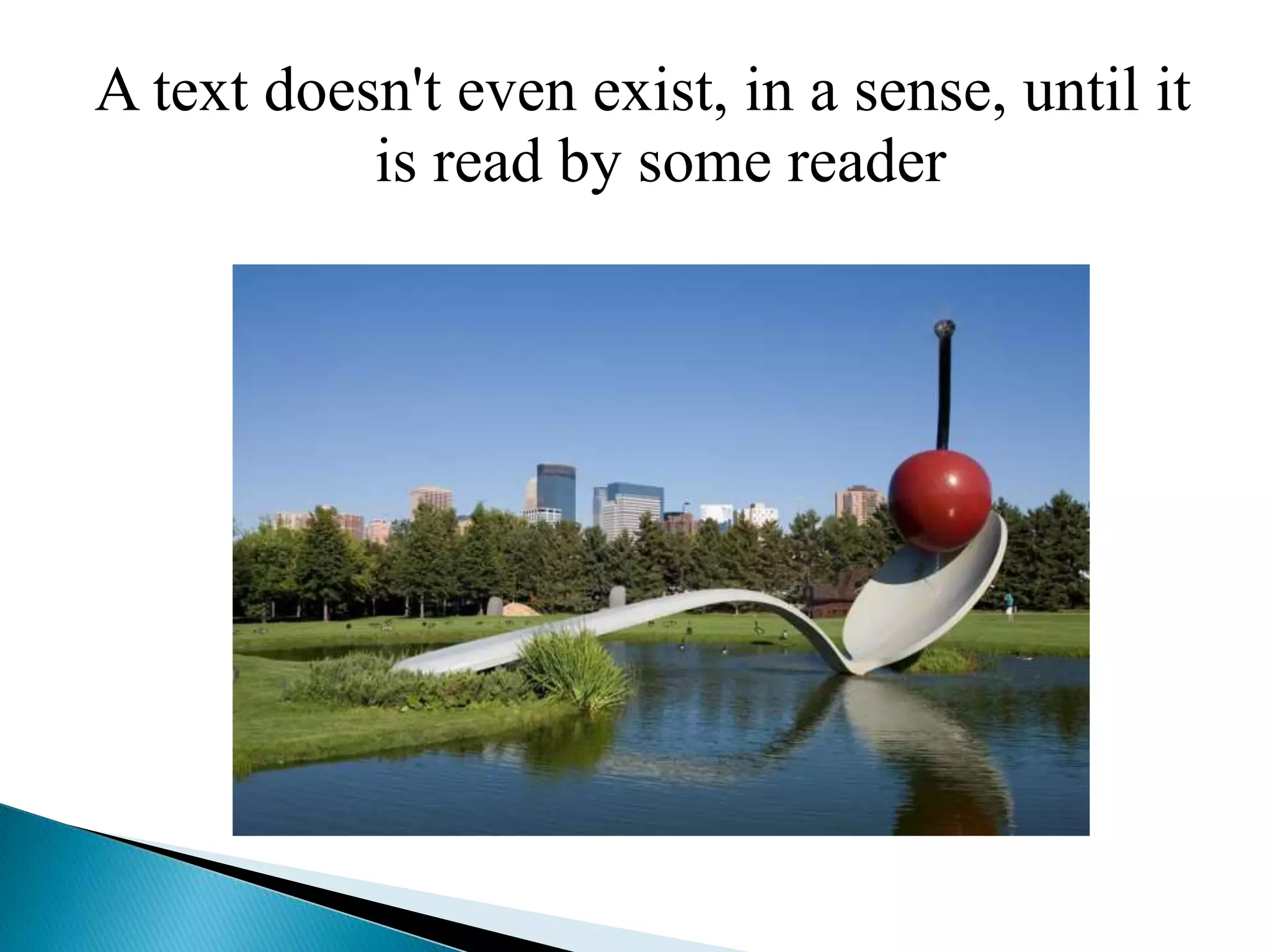
A text doesn'teven exist, in a sense, until it
is read by some reader
3.
Reception Theory isa version of Reader Response Literary
Theory
An important concept of RT is that media text – individual
movie or television program
Meaning is created as a result of interaction between the
reader/audience and the text/content.
4.
If atree falls in the forest and no one hears it, does it
make a sound?
a philosophical question
Unheard melodies are sweeter than the heard ones.
William wordsworth
oxfF slt ;flxTo 5 hf] g n]lvPsf] 5 g n]lvg] g} 5
.
nlIdk|;fb b]jsf]6f, s] g]kfn ;fgf] 5 <
5.
"Literary theorythat focuses on the reader
and his or her experience of a literary work"
Describes what goes on in the reader’s mind
while reading/viewing
The construction of the text within the reader
6.
Text isnot the most important component;
the reader is
(the reader creates the text as much as the author does)
Based on rhetoric, the art of persuasion
7.
◦ The roleof the reader cannot be omitted
from our understanding of literature.
◦ Readers do not passively consume the
meaning presented to them by an objective
literary text; rather, they actively make the
meaning they find in literature.
8.
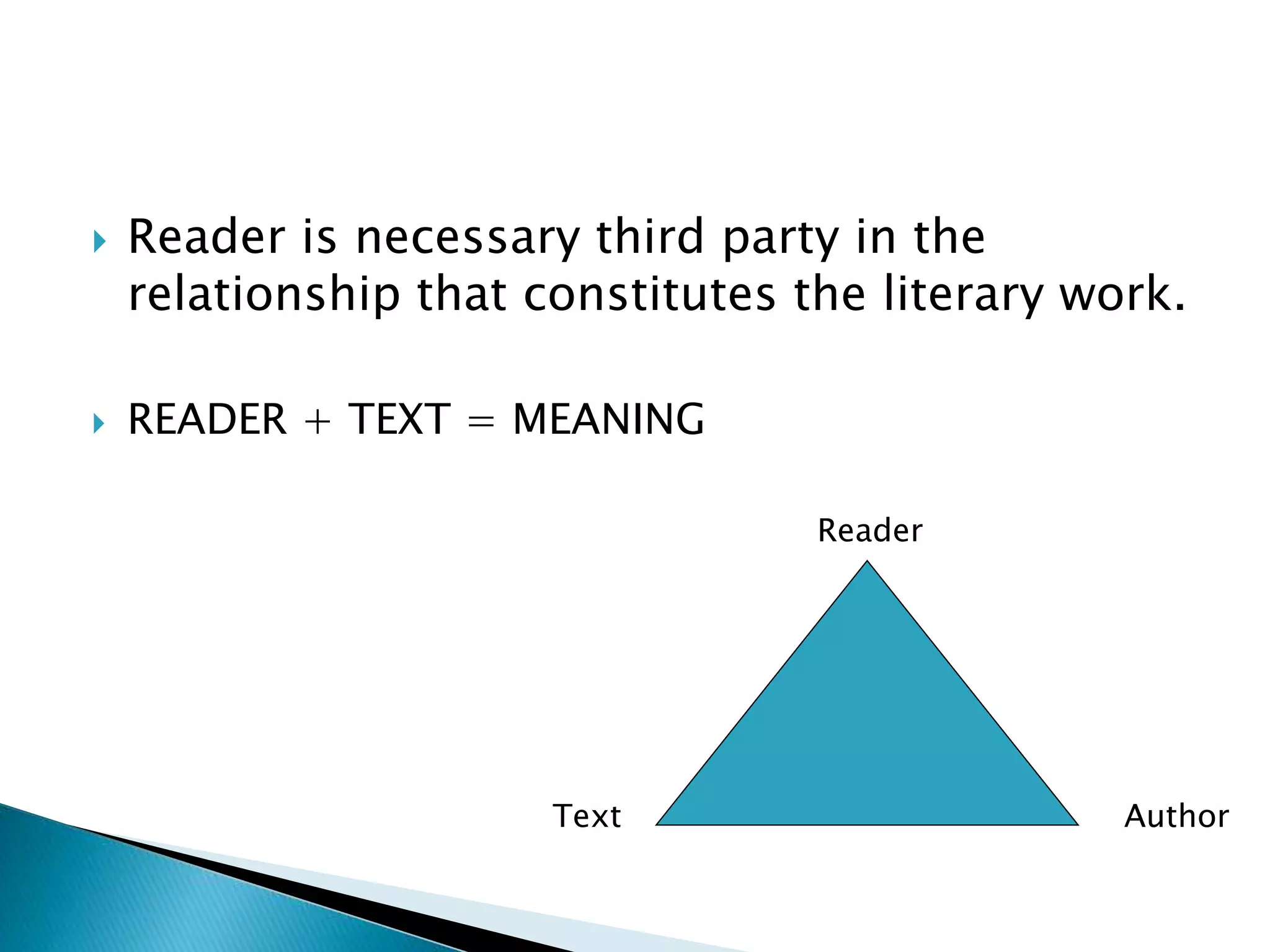
Reader isnecessary third party in the
relationship that constitutes the literary work.
READER + TEXT = MEANING
Text
Reader
Author
9.
…raises theoretical questionsabout
whether our responses to a text are the same as
its meanings,
whether a work can have as many meanings as
we have responses to it, and
whether some responses are more valid than,
or superior to, others.
10.
Attention toreading process emerged during
1930s as a reaction against the growing
tendency to reject the reader’s role in creating
meaning
New Criticism focuses on the text, finding all meaning and
value in it.
Formulated the TransactionalReader Response
Theory in 1978, although the groundwork was
laid much earlier.
According to this theory, there are 2 types of
responses that all readers have to text:
Efferent responses
Aesthetic responses
14.
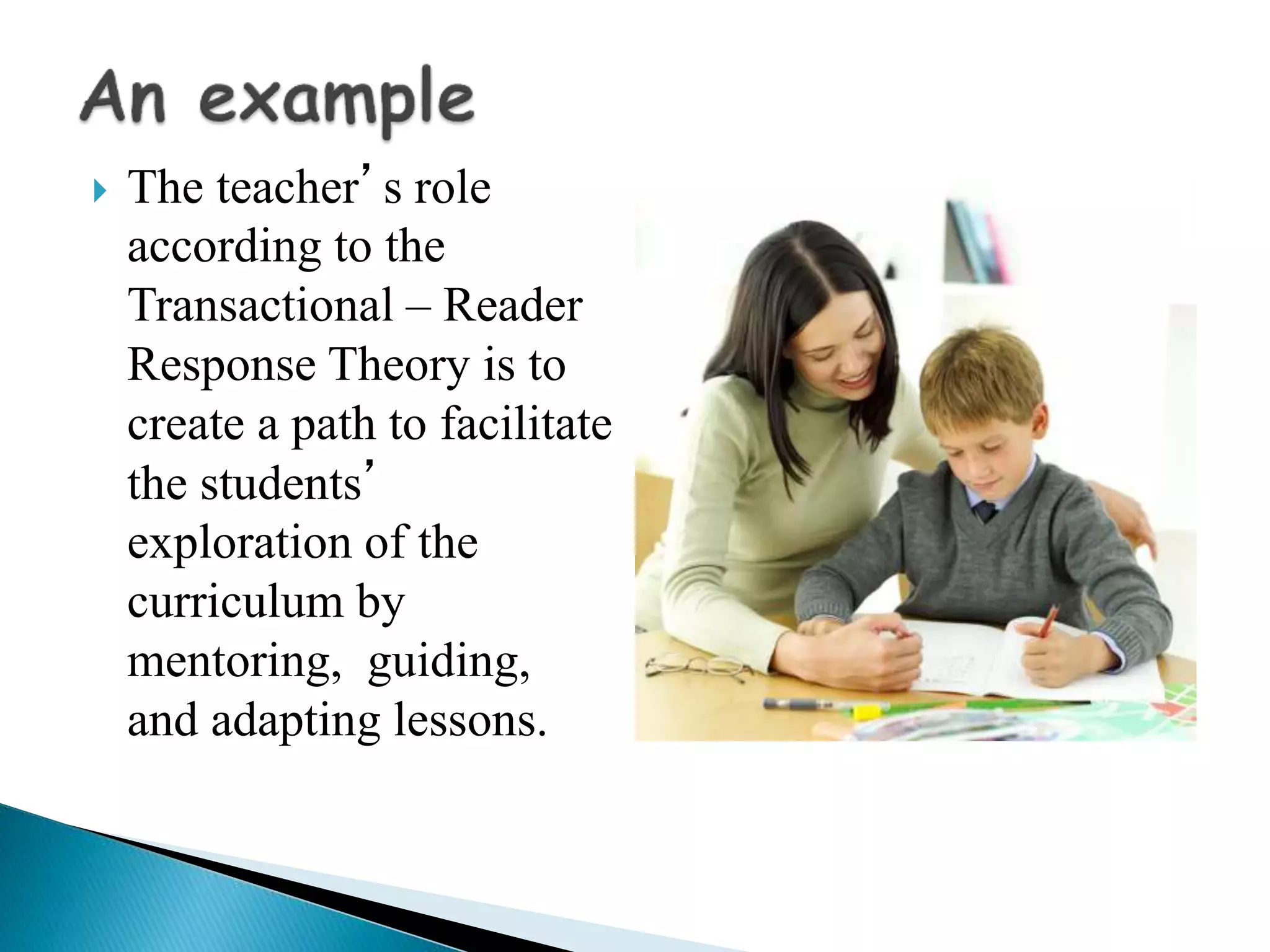
The teacher’srole
according to the
Transactional – Reader
Response Theory is to
create a path to facilitate
the students’
exploration of the
curriculum by
mentoring, guiding,
and adapting lessons.
15.
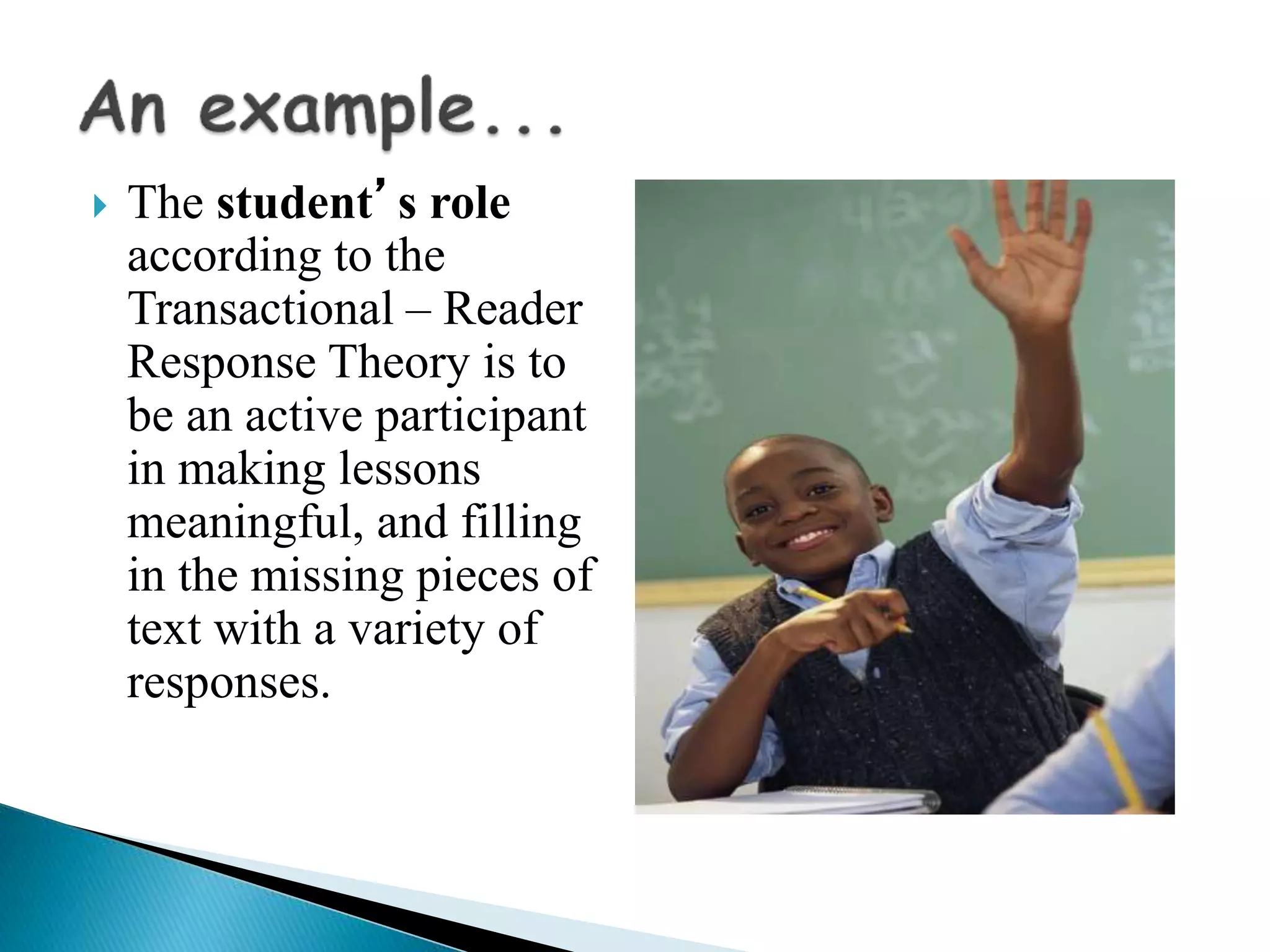
The student’srole
according to the
Transactional – Reader
Response Theory is to
be an active participant
in making lessons
meaningful, and filling
in the missing pieces of
text with a variety of
responses.
16.
Transactional-Reader ResponseTheory outlines the
importance of understanding the natural variability of
readers.
Every encounter with literature is different for every
person. The meaning, background, and responses to
the text are all drawn from individual experiences.
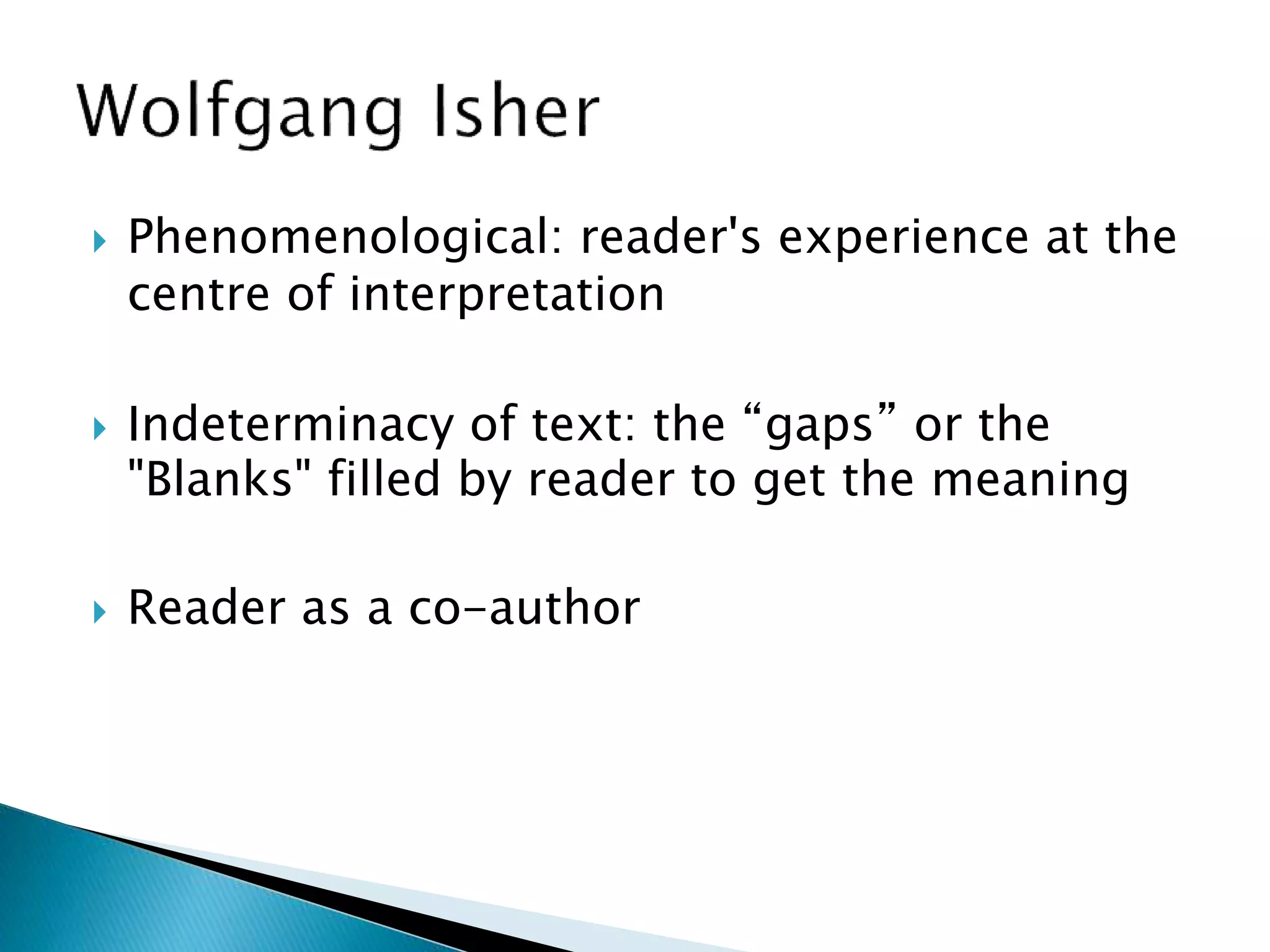
Phenomenological: reader'sexperience at the
centre of interpretation
Indeterminacy of text: the “gaps” or the
"Blanks" filled by reader to get the meaning
Reader as a co-author
19.
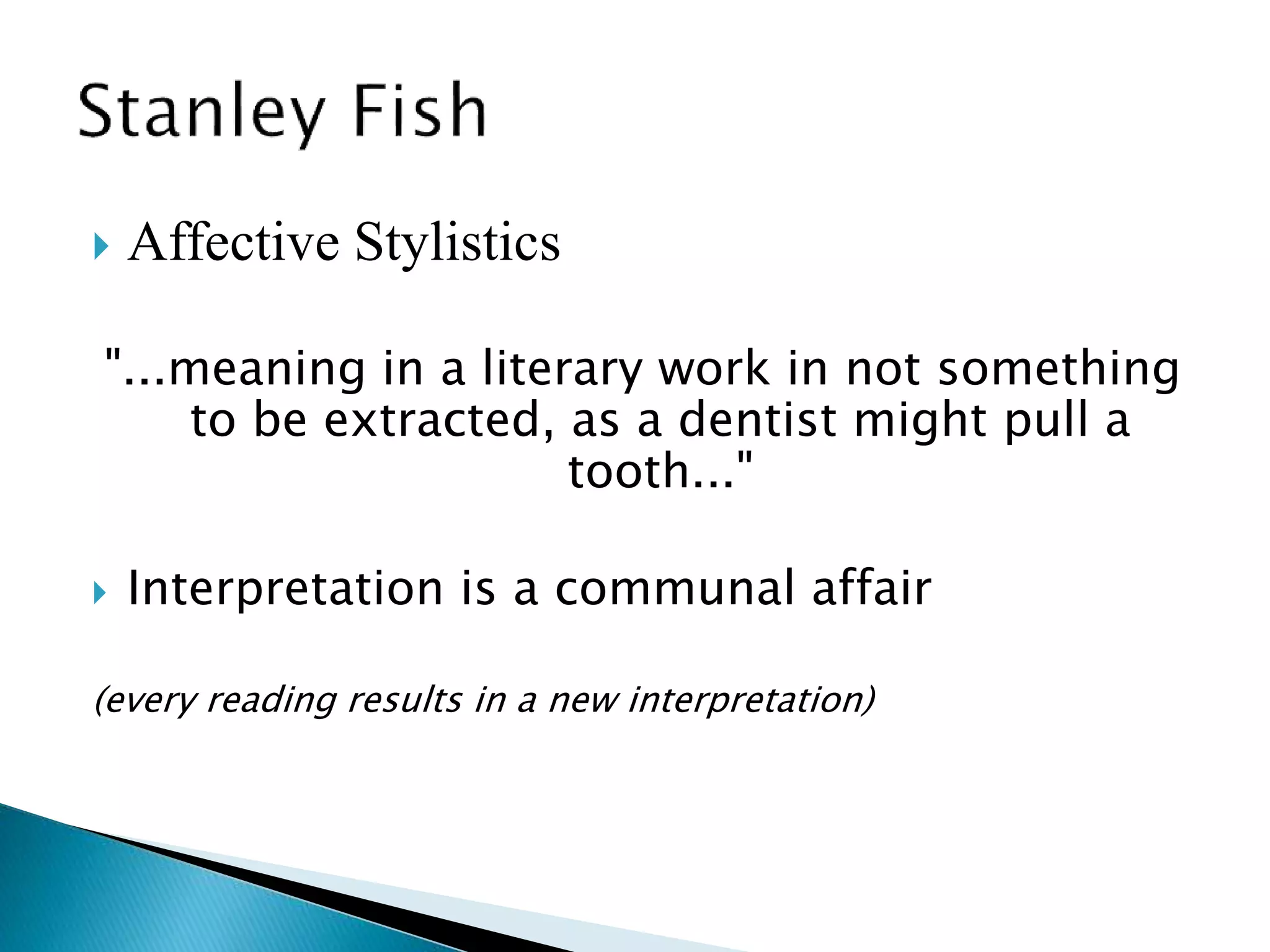
Affective Stylistics
"...meaningin a literary work in not something
to be extracted, as a dentist might pull a
tooth..."
Interpretation is a communal affair
(every reading results in a new interpretation)
20.
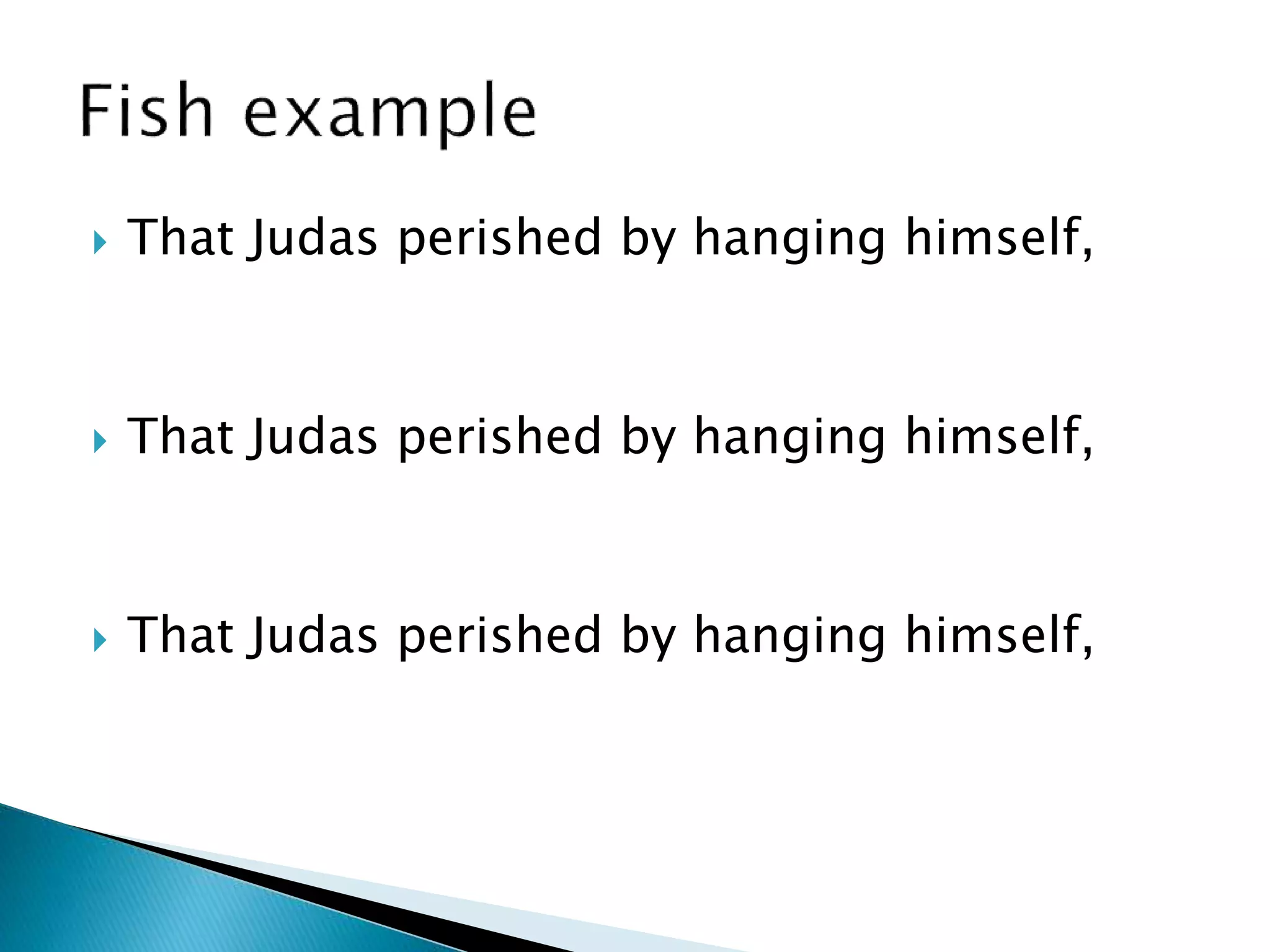
That Judasperished by hanging himself,
That Judas perished by hanging himself,
That Judas perished by hanging himself,
21.
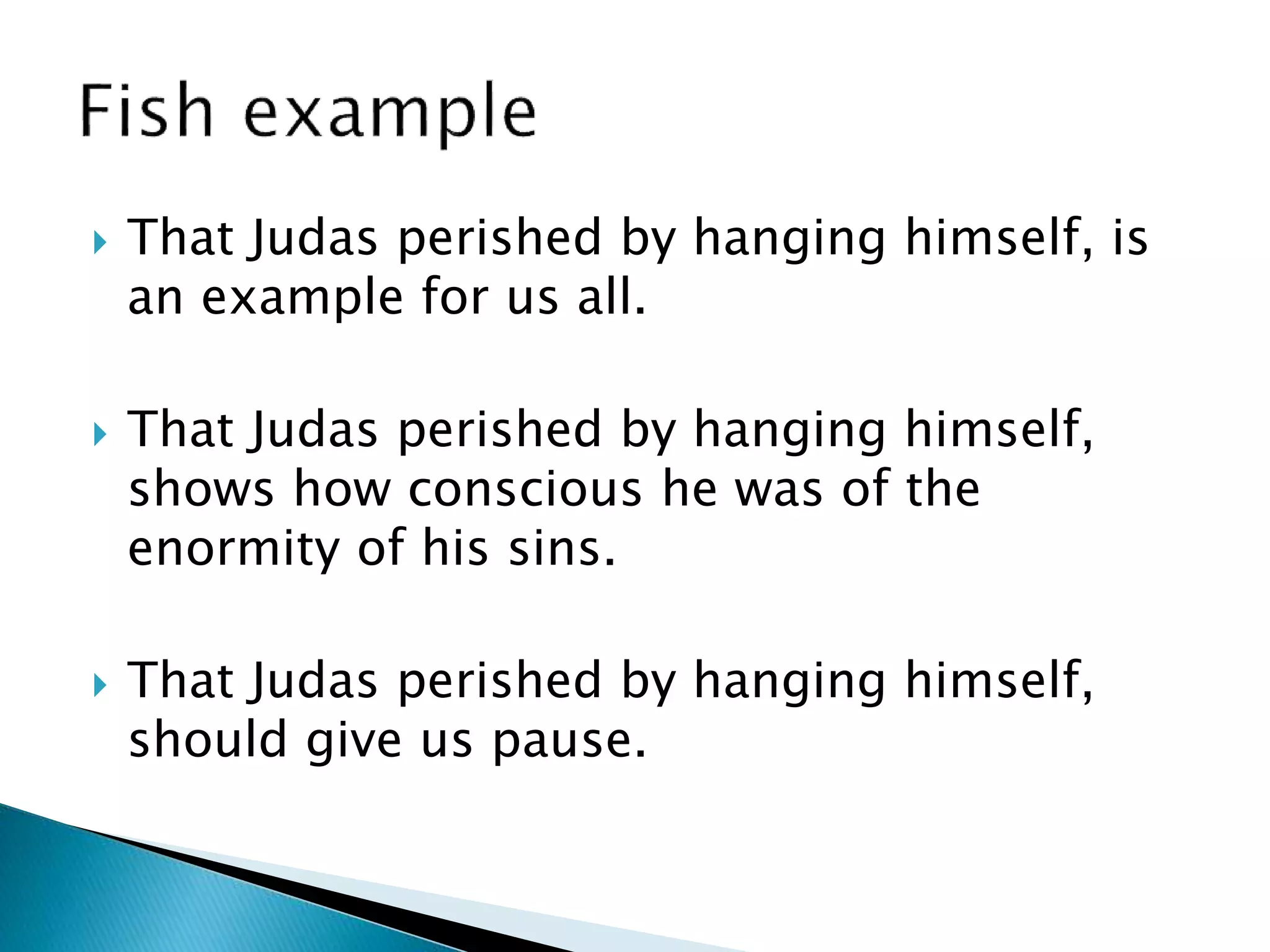
That Judasperished by hanging himself, is
an example for us all.
That Judas perished by hanging himself,
shows how conscious he was of the
enormity of his sins.
That Judas perished by hanging himself,
should give us pause.
Initial emotionalresponse
Interpretive
Analysis
Questions
Summary
Arguing with author (believability of text)
Intertextuality
Rethinking one part of text after reading another.
24.
Readers haveexpectations about how a character
will behave—expectations formed by cultures
which they live and work
Expectation of characters behaviour even though
they exist only in the literary transaction
Reader response reflect their cultural models
25.
Text-reader andcontext inseparable;
Literary response as a construction of text
meaning and reader stances and identities
within larger social-cultural context
Applying CAGE-KTM
(cast, age gender, ethnicity, knowledge,
Timeframe, Mind or psychology)
27.
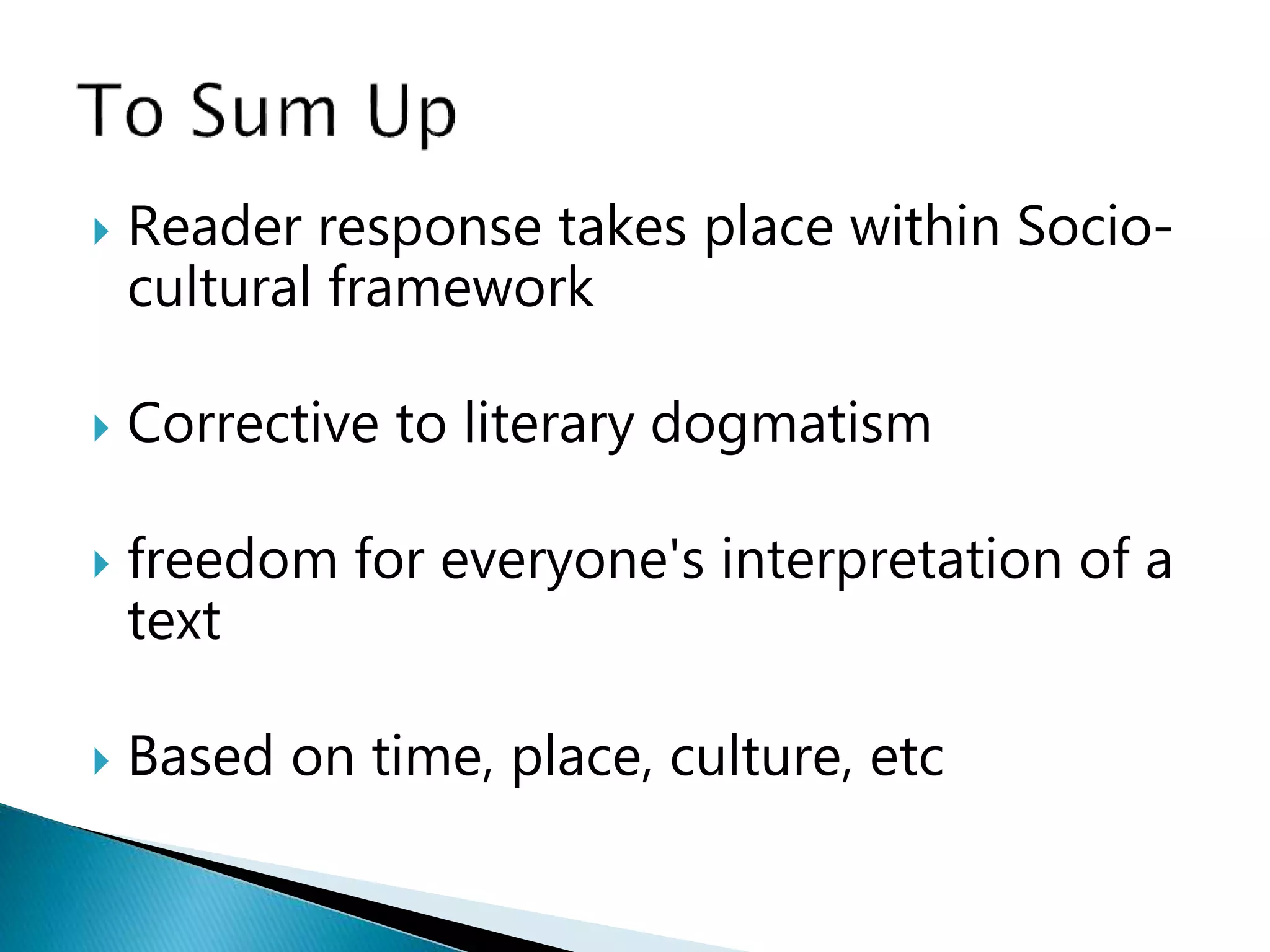
Reader responsetakes place within Socio-
cultural framework
Corrective to literary dogmatism
freedom for everyone's interpretation of a
text
Based on time, place, culture, etc
![ If a tree falls in the forest and no one hears it, does it
make a sound?
a philosophical question
Unheard melodies are sweeter than the heard ones.
William wordsworth
oxfF slt ;flxTo 5 hf] g n]lvPsf] 5 g n]lvg] g} 5
.
nlIdk|;fb b]jsf]6f, s] g]kfn ;fgf] 5 <](https://image.slidesharecdn.com/reader-response-theory-230320173356-da8ad457/75/reader-response-theory-ppt-4-2048.jpg)
![reader
text Transaction
cFWof/f] 5 rf/}lt/ w'Dd k¥of] ;fFem klg
laGtL aflx/ ghfpm ltdL le8Gt 5 cfh klg](https://image.slidesharecdn.com/reader-response-theory-230320173356-da8ad457/75/reader-response-theory-ppt-17-2048.jpg)