The term
‘Commonwealth’ …
The noun
‘commonwealth’,
meaning ‘public
welfare, general
good or
advantage, dates
from the 15th
century.
The term
‘commonwealth’
was first used
by Oliver
Cromwell, in
1649.
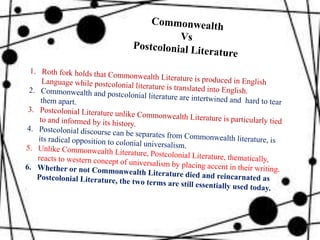
Salman Rushdie in his Commonwealth Literature does not Exist defines it as "a body
of writing created in the English language, by persons who are not themselves white
Britons, or Irish, or citizens of the United States of America”. Rushdie said
Commonwealth writers had more in common with the ‘magical realism’.
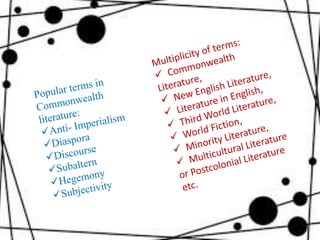
Commonwealth Literature, Post-Colonial Literature in English, New Literature in English,
World Writing in English – these are just some of the terms being used to describe the
writings of ‘members’ of the former British Empire.
‘Commonwealth Literature’ is sometimes used interchangeably with ‘post-colonial
literature’ although the latter could include literatures in other languages as well, such as
French or Portuguese.
Commonwealth Literature or
Postcolonial Literature ?
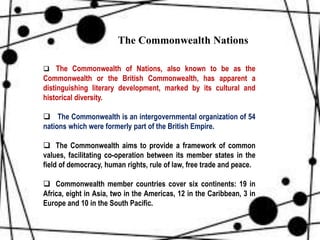
 The Commonwealth of Nations, also known to be as the
Commonwealth or the British Commonwealth, has apparent a
distinguishing literary development, marked by its cultural and
historical diversity.
 The Commonwealth is an intergovernmental organization of 54
nations which were formerly part of the British Empire.
 The Commonwealth aims to provide a framework of common
values, facilitating co-operation between its member states in the
field of democracy, human rights, rule of law, free trade and peace.
 Commonwealth member countries cover six continents: 19 in
Africa, eight in Asia, two in the Americas, 12 in the Caribbean, 3 in
Europe and 10 in the South Pacific.
The Commonwealth Nations
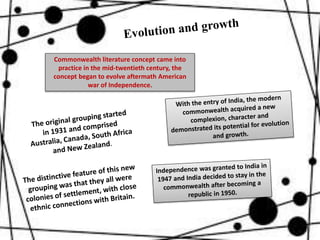
Commonwealth literature concept came into
practice in the mid-twentieth century, the
concept began to evolve aftermath American
war of Independence.
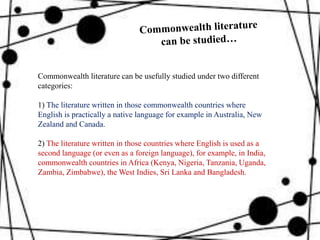
Commonwealth literature can be usefully studied under two different
categories:
1) The literature written in those commonwealth countries where
English is practically a native language for example in Australia, New
Zealand and Canada.
2) The literature written in those countries where English is used as a
second language (or even as a foreign language), for example, in India,
commonwealth countries in Africa (Kenya, Nigeria, Tanzania, Uganda,
Zambia, Zimbabwe), the West Indies, Sri Lanka and Bangladesh.
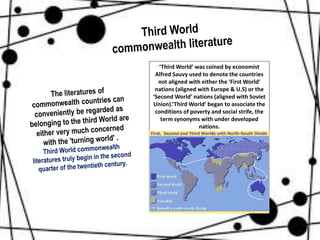
‘Third World’ was coined by economist
Alfred Sauvy used to denote the countries
not aligned with either the ‘First World’
nations (aligned with Europe & U.S) or the
‘Second World’ nations (aligned with Soviet
Union).‘Third World’ began to associate the
conditions of poverty and social strife, the
term synonyms with under developed
nations.
To a large extent commonwealth literature linked by
1. A common experience of British colonialism,
2. The use of English in contemporary life, and
3. The influence of the British literary tradition.
Unlike other literary categories, it cannot completely defined by
political ideology , historical period, geographical region or prevailing
literary trends. Commonwealth literature in many ways, a complex
combination of all these categories, and this enables it to bridge the
inevitable distinctions between writers from very different socio-cultural
backgrounds.
Commonwealth literature are distinguished by the examination
of physical and psychological displacement brought about as a result of
slavery, voluntary or forced migration and colonialism.
 Raja Rao,
 R. K. Narayan,
 Anita Desai,
 Mulk Raj Anand,
 Kamala Markandeya,
 A. K. Ramanujan,
 Vikram Seth,
 Nissim Ezekiel,
 Jayanta Mahapatra,
 Dom Moraes of India,
 Chinua Achebe,
 Wole Soyinka,
 Roy Campbell,
 David Nicholl,
 Clark of Africa,
 Ananda K. Coomaraswamy
of Sri Lanka,
 Brathwaite of the West
Indies,
Patrick White,
A. D. Hope,
Judith Wright of Australia,
Margaret Atwood,
Morley Callaghan of
Canada,
Katherine Mansfield of
New Zealand
And others have enriched
Commonwealth Literature.
☺Famous Commonwealth writers
includes many for example,
Salman Rushdie, R. K. Narayan,
Nayantara Sahgal and Ruth Prawer
Jhabvala as well as Japanese Nobel
Kazuo Ishiguro.
☺Salman Rushdie is one of the key representatives of
contemporary Commonwealth literature. As an Indian-British
novelist, he is world famous for his novel Midnight Children
(1981), which won the Booker prize. Most of his books are set in
India and have a particular emphasis on history. He is classified
as a magical realist writer.
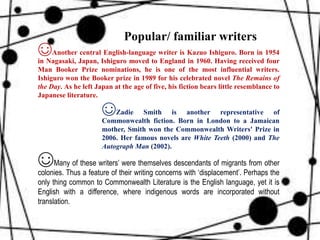
Popular/ familiar writers
☺Another central English-language writer is Kazuo Ishiguro. Born in 1954
in Nagasaki, Japan, Ishiguro moved to England in 1960. Having received four
Man Booker Prize nominations, he is one of the most influential writers.
Ishiguro won the Booker prize in 1989 for his celebrated novel The Remains of
the Day. As he left Japan at the age of five, his fiction bears little resemblance to
Japanese literature.
☺Zadie Smith is another representative of
Commonwealth fiction. Born in London to a Jamaican
mother, Smith won the Commonwealth Writers' Prize in
2006. Her famous novels are White Teeth (2000) and The
Autograph Man (2002).
☺Many of these writers’ were themselves descendants of migrants from other
colonies. Thus a feature of their writing concerns with ‘displacement’. Perhaps the
only thing common to Commonwealth Literature is the English language, yet it is
English with a difference, where indigenous words are incorporated without
translation.
Popular/ familiar writers
Commonwealth literature an outline

Commonwealth literature an outline

  • 3.
    The term ‘Commonwealth’ … Thenoun ‘commonwealth’, meaning ‘public welfare, general good or advantage, dates from the 15th century. The term ‘commonwealth’ was first used by Oliver Cromwell, in 1649.
  • 4.
    Salman Rushdie inhis Commonwealth Literature does not Exist defines it as "a body of writing created in the English language, by persons who are not themselves white Britons, or Irish, or citizens of the United States of America”. Rushdie said Commonwealth writers had more in common with the ‘magical realism’. Commonwealth Literature, Post-Colonial Literature in English, New Literature in English, World Writing in English – these are just some of the terms being used to describe the writings of ‘members’ of the former British Empire. ‘Commonwealth Literature’ is sometimes used interchangeably with ‘post-colonial literature’ although the latter could include literatures in other languages as well, such as French or Portuguese. Commonwealth Literature or Postcolonial Literature ?
  • 6.
     The Commonwealthof Nations, also known to be as the Commonwealth or the British Commonwealth, has apparent a distinguishing literary development, marked by its cultural and historical diversity.  The Commonwealth is an intergovernmental organization of 54 nations which were formerly part of the British Empire.  The Commonwealth aims to provide a framework of common values, facilitating co-operation between its member states in the field of democracy, human rights, rule of law, free trade and peace.  Commonwealth member countries cover six continents: 19 in Africa, eight in Asia, two in the Americas, 12 in the Caribbean, 3 in Europe and 10 in the South Pacific. The Commonwealth Nations
  • 7.
    Commonwealth literature conceptcame into practice in the mid-twentieth century, the concept began to evolve aftermath American war of Independence.
  • 8.
    Commonwealth literature canbe usefully studied under two different categories: 1) The literature written in those commonwealth countries where English is practically a native language for example in Australia, New Zealand and Canada. 2) The literature written in those countries where English is used as a second language (or even as a foreign language), for example, in India, commonwealth countries in Africa (Kenya, Nigeria, Tanzania, Uganda, Zambia, Zimbabwe), the West Indies, Sri Lanka and Bangladesh.
  • 9.
    ‘Third World’ wascoined by economist Alfred Sauvy used to denote the countries not aligned with either the ‘First World’ nations (aligned with Europe & U.S) or the ‘Second World’ nations (aligned with Soviet Union).‘Third World’ began to associate the conditions of poverty and social strife, the term synonyms with under developed nations.
  • 10.
    To a largeextent commonwealth literature linked by 1. A common experience of British colonialism, 2. The use of English in contemporary life, and 3. The influence of the British literary tradition. Unlike other literary categories, it cannot completely defined by political ideology , historical period, geographical region or prevailing literary trends. Commonwealth literature in many ways, a complex combination of all these categories, and this enables it to bridge the inevitable distinctions between writers from very different socio-cultural backgrounds. Commonwealth literature are distinguished by the examination of physical and psychological displacement brought about as a result of slavery, voluntary or forced migration and colonialism.
  • 11.
     Raja Rao, R. K. Narayan,  Anita Desai,  Mulk Raj Anand,  Kamala Markandeya,  A. K. Ramanujan,  Vikram Seth,  Nissim Ezekiel,  Jayanta Mahapatra,  Dom Moraes of India,  Chinua Achebe,  Wole Soyinka,  Roy Campbell,  David Nicholl,  Clark of Africa,  Ananda K. Coomaraswamy of Sri Lanka,  Brathwaite of the West Indies, Patrick White, A. D. Hope, Judith Wright of Australia, Margaret Atwood, Morley Callaghan of Canada, Katherine Mansfield of New Zealand And others have enriched Commonwealth Literature.
  • 12.
    ☺Famous Commonwealth writers includesmany for example, Salman Rushdie, R. K. Narayan, Nayantara Sahgal and Ruth Prawer Jhabvala as well as Japanese Nobel Kazuo Ishiguro. ☺Salman Rushdie is one of the key representatives of contemporary Commonwealth literature. As an Indian-British novelist, he is world famous for his novel Midnight Children (1981), which won the Booker prize. Most of his books are set in India and have a particular emphasis on history. He is classified as a magical realist writer. Popular/ familiar writers
  • 13.
    ☺Another central English-languagewriter is Kazuo Ishiguro. Born in 1954 in Nagasaki, Japan, Ishiguro moved to England in 1960. Having received four Man Booker Prize nominations, he is one of the most influential writers. Ishiguro won the Booker prize in 1989 for his celebrated novel The Remains of the Day. As he left Japan at the age of five, his fiction bears little resemblance to Japanese literature. ☺Zadie Smith is another representative of Commonwealth fiction. Born in London to a Jamaican mother, Smith won the Commonwealth Writers' Prize in 2006. Her famous novels are White Teeth (2000) and The Autograph Man (2002). ☺Many of these writers’ were themselves descendants of migrants from other colonies. Thus a feature of their writing concerns with ‘displacement’. Perhaps the only thing common to Commonwealth Literature is the English language, yet it is English with a difference, where indigenous words are incorporated without translation. Popular/ familiar writers