EWRT 1A
Day 11 3/4
P2 Review,
Formatting, Citation, and Works Cited,
Work Day
Agenda
 Starfish
 Revision Policy
 P2 Review and Tips
 How and When to Cite Sources
 Formatting
 Work Day / Individual Discussions
Starfish!
Revision Policy
 You may revise ONE essay for a
better grade. It will either be
Paper 1 or Paper 2.
 If you miss an essay due date, you
may submit that essay when the
revisions are due. This does
disqualify you from revising
another essay.
 Revised essays receive no
feedback.
 The due date for your revised
essay (P1 or P2) is the Friday of
Week 10 (March 16) by noon.
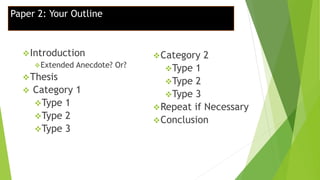
Paper 2: Your Outline
Introduction
Extended Anecdote? Or?
Thesis
 Category 1
Type 1
Type 2
Type 3
Category 2
Type 1
Type 2
Type 3
Repeat if Necessary
Conclusion
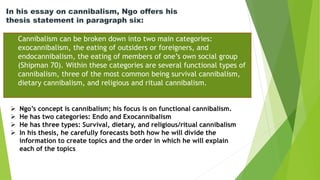
In his essay on cannibalism, Ngo offers his
thesis statement in paragraph six:
Cannibalism can be broken down into two main categories:
exocannibalism, the eating of outsiders or foreigners, and
endocannibalism, the eating of members of one’s own social group
(Shipman 70). Within these categories are several functional types of
cannibalism, three of the most common being survival cannibalism,
dietary cannibalism, and religious and ritual cannibalism.
 Ngo’s concept is cannibalism; his focus is on functional cannibalism.
 He has two categories: Endo and Exocannibalism
 He has three types: Survival, dietary, and religious/ritual cannibalism
 In his thesis, he carefully forecasts both how he will divide the
information to create topics and the order in which he will explain
each of the topics
Tips for writing your essay
 Begin with a long anecdote to draw the reader into your
essay.
 Write a thesis that includes all of the categories you will
discuss.
 Use examples and definitions to make your point.
 Use appositives to describe nouns and eliminate wordiness.
How and When to Cite Sources
 Avoiding Plagiarism
MLA format
MLA (Modern Language Association) style is most commonly used to
write papers and cite sources within the liberal arts and humanities.
MLA style specifies guidelines for formatting manuscripts and using the
English language in writing. MLA style also provides writers with a
system for referencing their sources through parenthetical citation in
their essays and Works Cited pages.
Writers who properly use MLA also build their credibility by
demonstrating accountability to their source material. Most
importantly, the use of MLA style can protect writers from accusations
of plagiarism, which is the purposeful or accidental uncredited use of
source material by other writers.
http://owl.english.purdue.edu/owl/resource/747/01/
Quoting and Summarizing:
Writers use sources by quoting directly and by summarizing.
Deciding Whether to Quote or Summarize
As a general rule, quote only in these situations:
(1) when the wording of the source is particularly memorable or vivid or
expresses a point so well that you cannot improve it.
(2) when the words of reliable and respected authorities would lend
support to your position.
(3) when you wish to cite an author whose opinions challenge or vary
greatly from those of other experts.
(4) when you are going to discuss the source’s choice of words.
• Summarize any long passages whose main points you wish to record
as support for a point you are making.
Short Quotations
 To indicate short quotations (fewer than four typed lines of prose or
three lines of verse) in your text, enclose the quotation within double
quotation marks.
 Provide the author and specific page citation (in the case of verse,
provide line numbers) in the text, and include a complete reference on
the Works Cited page.
 Punctuation marks such as periods, commas, and semicolons should
appear after the parenthetical citation.
 Question marks and exclamation points should appear within the
quotation marks if they are a part of the quoted passage but after the
parenthetical citation if they are a part of your text.
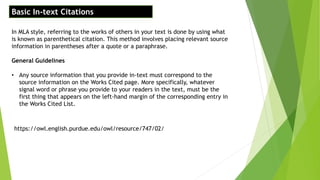
Basic In-text Citations
In MLA style, referring to the works of others in your text is done by using what
is known as parenthetical citation. This method involves placing relevant source
information in parentheses after a quote or a paraphrase.
General Guidelines
• Any source information that you provide in-text must correspond to the
source information on the Works Cited page. More specifically, whatever
signal word or phrase you provide to your readers in the text, must be the
first thing that appears on the left-hand margin of the corresponding entry in
the Works Cited List.
https://owl.english.purdue.edu/owl/resource/747/02/
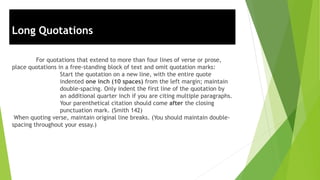
Long Quotations
For quotations that extend to more than four lines of verse or prose,
place quotations in a free-standing block of text and omit quotation marks:
Start the quotation on a new line, with the entire quote
indented one inch (10 spaces) from the left margin; maintain
double-spacing. Only indent the first line of the quotation by
an additional quarter inch if you are citing multiple paragraphs.
Your parenthetical citation should come after the closing
punctuation mark. (Smith 142)
When quoting verse, maintain original line breaks. (You should maintain double-
spacing throughout your essay.)
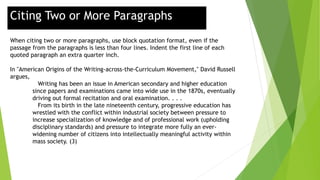
Citing Two or More Paragraphs
When citing two or more paragraphs, use block quotation format, even if the
passage from the paragraphs is less than four lines. Indent the first line of each
quoted paragraph an extra quarter inch.
In "American Origins of the Writing-across-the-Curriculum Movement," David Russell
argues,
Writing has been an issue in American secondary and higher education
since papers and examinations came into wide use in the 1870s, eventually
driving out formal recitation and oral examination. . . .
From its birth in the late nineteenth century, progressive education has
wrestled with the conflict within industrial society between pressure to
increase specialization of knowledge and of professional work (upholding
disciplinary standards) and pressure to integrate more fully an ever-
widening number of citizens into intellectually meaningful activity within
mass society. (3)
Citing Summarized Material
 In Randall Kennedy’s article “Racial Passing” in
the Ohio State Law Journal, he discusses such a
case in the journey of Ellen Craft, a black
woman who passed not only as white but as a
white man in order to smuggle her
husband north to avoid slavery (1).
Yes! You must cite summarized material!
https://www.youtube.com/watch?v=8xAc4yZ8VSA
 1” all around
 Go to “Layout” and adjust margins
or use custom settings
 Times New Roman 12
 Indent body paragraphs ½ inch
from the margin
 Double Click in Header Area
 Type your last name
 Justify right
 Go to “insert” and click on “page
number”
Margins and Formatting Header: Last Name 1
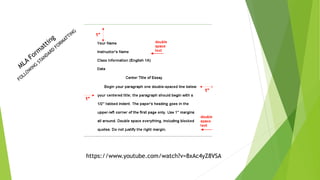
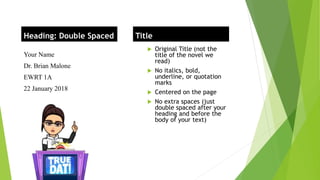
Your Name
Dr. Brian Malone
EWRT 1A
22 January 2018
 Original Title (not the
title of the novel we
read)
 No italics, bold,
underline, or quotation
marks
 Centered on the page
 No extra spaces (just
double spaced after your
heading and before the
body of your text)
Heading: Double Spaced Title
What is to be done.
What to do right now
 Meet with me! Be proactive.
 Work on your outline.
 Write your thesis.
 Come up with your extended
anecdote.
 Locate all of your
examples/sources.
 Complete Discussion 14 and
Discussion 15 (due by end of class).
Homework for Thursday
 Bring two copies (one can be
electronic) for the writing
workshop. Your essay should be
complete and ready to turn in. This
means your formatting should be
correct, and your works cited page
should be complete.
 Remember: bringing a full draft to
this Writing Workshop counts for
Personal Participation Points AND
(potentially) House Points.
 The final draft of Paper 2 is due
Friday at noon. I will not accept
late work.

D11.75-EWRT 1A

  • 1.
    EWRT 1A Day 113/4 P2 Review, Formatting, Citation, and Works Cited, Work Day
  • 2.
    Agenda  Starfish  RevisionPolicy  P2 Review and Tips  How and When to Cite Sources  Formatting  Work Day / Individual Discussions
  • 3.
  • 4.
    Revision Policy  Youmay revise ONE essay for a better grade. It will either be Paper 1 or Paper 2.  If you miss an essay due date, you may submit that essay when the revisions are due. This does disqualify you from revising another essay.  Revised essays receive no feedback.  The due date for your revised essay (P1 or P2) is the Friday of Week 10 (March 16) by noon.
  • 5.
    Paper 2: YourOutline Introduction Extended Anecdote? Or? Thesis  Category 1 Type 1 Type 2 Type 3 Category 2 Type 1 Type 2 Type 3 Repeat if Necessary Conclusion
  • 6.
    In his essayon cannibalism, Ngo offers his thesis statement in paragraph six: Cannibalism can be broken down into two main categories: exocannibalism, the eating of outsiders or foreigners, and endocannibalism, the eating of members of one’s own social group (Shipman 70). Within these categories are several functional types of cannibalism, three of the most common being survival cannibalism, dietary cannibalism, and religious and ritual cannibalism.  Ngo’s concept is cannibalism; his focus is on functional cannibalism.  He has two categories: Endo and Exocannibalism  He has three types: Survival, dietary, and religious/ritual cannibalism  In his thesis, he carefully forecasts both how he will divide the information to create topics and the order in which he will explain each of the topics
  • 7.
    Tips for writingyour essay  Begin with a long anecdote to draw the reader into your essay.  Write a thesis that includes all of the categories you will discuss.  Use examples and definitions to make your point.  Use appositives to describe nouns and eliminate wordiness.
  • 8.
    How and Whento Cite Sources  Avoiding Plagiarism
  • 9.
    MLA format MLA (ModernLanguage Association) style is most commonly used to write papers and cite sources within the liberal arts and humanities. MLA style specifies guidelines for formatting manuscripts and using the English language in writing. MLA style also provides writers with a system for referencing their sources through parenthetical citation in their essays and Works Cited pages. Writers who properly use MLA also build their credibility by demonstrating accountability to their source material. Most importantly, the use of MLA style can protect writers from accusations of plagiarism, which is the purposeful or accidental uncredited use of source material by other writers. http://owl.english.purdue.edu/owl/resource/747/01/
  • 10.
    Quoting and Summarizing: Writersuse sources by quoting directly and by summarizing. Deciding Whether to Quote or Summarize As a general rule, quote only in these situations: (1) when the wording of the source is particularly memorable or vivid or expresses a point so well that you cannot improve it. (2) when the words of reliable and respected authorities would lend support to your position. (3) when you wish to cite an author whose opinions challenge or vary greatly from those of other experts. (4) when you are going to discuss the source’s choice of words. • Summarize any long passages whose main points you wish to record as support for a point you are making.
  • 11.
    Short Quotations  Toindicate short quotations (fewer than four typed lines of prose or three lines of verse) in your text, enclose the quotation within double quotation marks.  Provide the author and specific page citation (in the case of verse, provide line numbers) in the text, and include a complete reference on the Works Cited page.  Punctuation marks such as periods, commas, and semicolons should appear after the parenthetical citation.  Question marks and exclamation points should appear within the quotation marks if they are a part of the quoted passage but after the parenthetical citation if they are a part of your text.
  • 13.
    Basic In-text Citations InMLA style, referring to the works of others in your text is done by using what is known as parenthetical citation. This method involves placing relevant source information in parentheses after a quote or a paraphrase. General Guidelines • Any source information that you provide in-text must correspond to the source information on the Works Cited page. More specifically, whatever signal word or phrase you provide to your readers in the text, must be the first thing that appears on the left-hand margin of the corresponding entry in the Works Cited List. https://owl.english.purdue.edu/owl/resource/747/02/
  • 14.
    Long Quotations For quotationsthat extend to more than four lines of verse or prose, place quotations in a free-standing block of text and omit quotation marks: Start the quotation on a new line, with the entire quote indented one inch (10 spaces) from the left margin; maintain double-spacing. Only indent the first line of the quotation by an additional quarter inch if you are citing multiple paragraphs. Your parenthetical citation should come after the closing punctuation mark. (Smith 142) When quoting verse, maintain original line breaks. (You should maintain double- spacing throughout your essay.)
  • 15.
    Citing Two orMore Paragraphs When citing two or more paragraphs, use block quotation format, even if the passage from the paragraphs is less than four lines. Indent the first line of each quoted paragraph an extra quarter inch. In "American Origins of the Writing-across-the-Curriculum Movement," David Russell argues, Writing has been an issue in American secondary and higher education since papers and examinations came into wide use in the 1870s, eventually driving out formal recitation and oral examination. . . . From its birth in the late nineteenth century, progressive education has wrestled with the conflict within industrial society between pressure to increase specialization of knowledge and of professional work (upholding disciplinary standards) and pressure to integrate more fully an ever- widening number of citizens into intellectually meaningful activity within mass society. (3)
  • 16.
    Citing Summarized Material In Randall Kennedy’s article “Racial Passing” in the Ohio State Law Journal, he discusses such a case in the journey of Ellen Craft, a black woman who passed not only as white but as a white man in order to smuggle her husband north to avoid slavery (1). Yes! You must cite summarized material!
  • 17.
  • 18.
     1” allaround  Go to “Layout” and adjust margins or use custom settings  Times New Roman 12  Indent body paragraphs ½ inch from the margin  Double Click in Header Area  Type your last name  Justify right  Go to “insert” and click on “page number” Margins and Formatting Header: Last Name 1
  • 19.
    Your Name Dr. BrianMalone EWRT 1A 22 January 2018  Original Title (not the title of the novel we read)  No italics, bold, underline, or quotation marks  Centered on the page  No extra spaces (just double spaced after your heading and before the body of your text) Heading: Double Spaced Title
  • 20.
    What is tobe done. What to do right now  Meet with me! Be proactive.  Work on your outline.  Write your thesis.  Come up with your extended anecdote.  Locate all of your examples/sources.  Complete Discussion 14 and Discussion 15 (due by end of class). Homework for Thursday  Bring two copies (one can be electronic) for the writing workshop. Your essay should be complete and ready to turn in. This means your formatting should be correct, and your works cited page should be complete.  Remember: bringing a full draft to this Writing Workshop counts for Personal Participation Points AND (potentially) House Points.  The final draft of Paper 2 is due Friday at noon. I will not accept late work.