Correlational Research
Design
Weighing One Variable Against
Another
By
Syed Imran Ali
Topics to Be Discussed
 What is research design?
 Design vs. method.
 Correlation research
 Types of correlation research.
 Key characteristics of correlation research.
 Steps or procedure of conducting
correlation research
 How to evaluate the correlation research.
4
What is research design?
To under stand what is research design an
analogue may help us.
 When constructing a building there is no point ordering materials or
setting critical dates for completion of project stages until we know
what sort of building is being constructed.
 whether we need a high rise of building, a factory for manufacturing
Machinery, a school, a residential home or an apartment block.
 Until this is done we cannot sketch a plan, obtain permits, and work
out a work Schedule or order materials.
 Similarly, social research needs a design or a structure before data
Collection or analysis can commence.
5
What is research design?
 The function of A research design is to ensure that the evidence
obtained enables us to answer the Initial-How do we evaluate a
Correlational Study all question as unambiguously as possible.
 In other words, when designing research we need to ask: given this
research question (or theory), what type of evidence is needed to
answer the question (or test the theory) in a convincing way?
Research design `deals with a logical problem and not a logistical
problem' (Yin, 1989: 29).
6
Design vs. method
 How the data are collected is irrelevant to the logic of the Research
design is different from the method by which data are collected.
 . There are many research methods that provide a loose framework
or guidelines to conduct a research project. One has to choose a
method that suits the requirements of the project and the
researcher is comfortable with.
 On the other hand, research design is the specific framework within
which a project is pursued and completed. Many remain confused
about the differences between research methods and research
design.
 Research design refers to the blue print that you prepare using the
research method chosen and it delineates the steps that you need
to take.
7
Design vs. method
 Research design tells how the goals of a research project can be
accomplished.
 Key features of any research design are methodology, collection and
assignment of samples, collection and analysis of data along with
procedures and instruments to be used.
8
Correlation research
 A procedure in which subjects’ scores on two variables are simply
measured, without manipulation of any variables, to determine
whether there is a relationship
 Correlational research examines the relationship between two or
more non manipulated variables.
 Involves collecting data or searching out records of a specified
population and ascertaining the relationships among the variables of
interest.
 The correlational approach is sometimes referred to as the study of
individual differences because emphasis is placed on differences
among individuals.
9
Correlation Research
 What is the relationship between:
 Height and weight?
 Birth order and years of education?
 Cigarettes smoked per day and health care costs?
 How close to the front you sit in a classroom and your grade in a
class?
 Can high school grades be used to predict college grades.
 Does physical exercise cause people to lose weight.
 To examine the possible existence of causation.
10
What can correlational research tell us?
 Imagine that researchers find an
association between sitting in the front of
the classroom and receiving good grades
 You promptly move to the front of the
classroom, and expect your grade will
improve
11
Correlation Research
 Operational Definition:
 A statistical analysis of covariant data to determine a pre-existing
relationship. Researcher makes no attempt to manipulate an
independent variable.
 Purpose:
 This research technique is used to relate two or more variables and
allow predictions of outcomes based on causative relationships
between the variables.
12
Correlation Research
Historical Perspective:
 Karl Pearson introduced modern correlation techniques in 1895
at a Royal Society meeting in London where he illustrated his
statistical model using Darwin’s evolution and Galton’s heredity.
 Improvements were slow coming until the arrival of
microcomputers when complex regressional analysis of multiple
variables was possible
13
Correlation Research
 Example Situation:
 We, as teachers, practice correlation research often
in the forms of pre-tests, quizzes, dip-sticking, etc.,
where we correlate (based on years of experience) the
outcome of these assessments with anticipated final test
results. We will often modify our teaching in response to
the data to modify the outcome.
14
Types of correlational design
 Explanatory Design:
 Research looks for simple associations between
variables and investigates the extent to which the
variables are related
 Prediction Design:
Research designed to identify variables that will
positively predict outcomes
15
Types of correlational design
Key Characteristics of ERD
 Correlation of two or more variables
 Data collected at one time
 Single group
 At least two scores recorded
 Correlation Statistical Test- Strength and Direction of
correlation determined
 Researcher draws conclusions from statistics alone
16
Types of correlational design
Key Characteristics of PRD
 Author states that prediction
capability is the goal of the research
 Use of predictor variable followed
with a criterion variable
 Author forecasts future performance
17
Characteristics of Correlational
Design
 As suggested by the explanatory &
prediction design, Correlation research
includes specific characteristics:
 Displays of scores
 Associations between scores (direction,
form, & strength)
 Multiple variable analysis (partial
correlation & multiple regression)
18
Primary Tools for Correlation
Designs
 Mathematical Tools
 Product-Moment correlation coefficient
 Coefficient of determination
 Spearman rho
 Phi-coefficient
 Point-by-serial correlation
 Regression lines
19
Primary Tools for Correlation
Designs
Graphical Tools
 Scatter plots
 Correlation matrixes
 Simple graphical regressions
 Venn Diagram
20
Procedure of correlation research
 variable to be selected are identified
 Question and /or hypothesis are stated .
 A sample is selected ( a minimum of 30 is needed)
 Data are collected
 Correlations are calculated.
 Results are reported.
 For each individual in the research , there must be at least two
measures , or it will be impossible to calculate a correlation.
 A correlation is reported as “ r “ such as r =.36
 The statistical probability is reported as “ p”.
21
Procedure of correlation
research
 Some researchers report the probability as of the correlation
happening by chance was P .05 ( More than 5 out of 100) or
P< .05 ( Less than 5 out of 100)
 Other researcher report the actual probability ; P = .03
 The first approach was used before the age of computers.
 Either approach is acceptable.
 Correlation can be range from = 1.00 to 1.00
 A 1.00 is a perfect positive correlation .
As one variable increases , so does the other.
- 1.00 is a perfect negative correlation .
- As one variable increases, the other variables decreases.
22
Procedure of correlation
research
 A -00 correlation indicates no correlation
 Means there is no relationship between one variable and another.
23
Interpretation of the strength of correlation
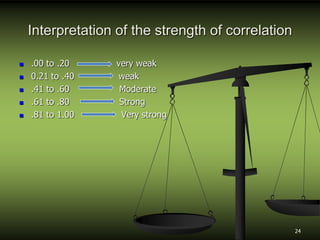
 .00 to .20 very weak
 0.21 to .40 weak
 .41 to .60 Moderate
 .61 to .80 Strong
 .81 to 1.00 Very strong
24
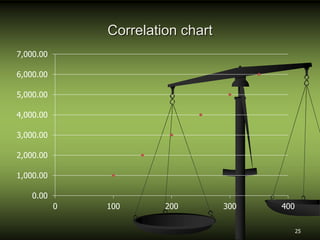
Correlation chart
0.00
1,000.00
2,000.00
3,000.00
4,000.00
5,000.00
6,000.00
7,000.00
0 100 200 300 400
25
How to calculate correlation
 Excel has a statistical function . It calculates pearson product
moment correlation.
 SPSS calculates correltion.
26
 ANY QUESTION PLEASE ?
27

Correlation research design presentation 2015

  • 3.
    Correlational Research Design Weighing OneVariable Against Another By Syed Imran Ali
  • 4.
    Topics to BeDiscussed  What is research design?  Design vs. method.  Correlation research  Types of correlation research.  Key characteristics of correlation research.  Steps or procedure of conducting correlation research  How to evaluate the correlation research. 4
  • 5.
    What is researchdesign? To under stand what is research design an analogue may help us.  When constructing a building there is no point ordering materials or setting critical dates for completion of project stages until we know what sort of building is being constructed.  whether we need a high rise of building, a factory for manufacturing Machinery, a school, a residential home or an apartment block.  Until this is done we cannot sketch a plan, obtain permits, and work out a work Schedule or order materials.  Similarly, social research needs a design or a structure before data Collection or analysis can commence. 5
  • 6.
    What is researchdesign?  The function of A research design is to ensure that the evidence obtained enables us to answer the Initial-How do we evaluate a Correlational Study all question as unambiguously as possible.  In other words, when designing research we need to ask: given this research question (or theory), what type of evidence is needed to answer the question (or test the theory) in a convincing way? Research design `deals with a logical problem and not a logistical problem' (Yin, 1989: 29). 6
  • 7.
    Design vs. method How the data are collected is irrelevant to the logic of the Research design is different from the method by which data are collected.  . There are many research methods that provide a loose framework or guidelines to conduct a research project. One has to choose a method that suits the requirements of the project and the researcher is comfortable with.  On the other hand, research design is the specific framework within which a project is pursued and completed. Many remain confused about the differences between research methods and research design.  Research design refers to the blue print that you prepare using the research method chosen and it delineates the steps that you need to take. 7
  • 8.
    Design vs. method Research design tells how the goals of a research project can be accomplished.  Key features of any research design are methodology, collection and assignment of samples, collection and analysis of data along with procedures and instruments to be used. 8
  • 9.
    Correlation research  Aprocedure in which subjects’ scores on two variables are simply measured, without manipulation of any variables, to determine whether there is a relationship  Correlational research examines the relationship between two or more non manipulated variables.  Involves collecting data or searching out records of a specified population and ascertaining the relationships among the variables of interest.  The correlational approach is sometimes referred to as the study of individual differences because emphasis is placed on differences among individuals. 9
  • 10.
    Correlation Research  Whatis the relationship between:  Height and weight?  Birth order and years of education?  Cigarettes smoked per day and health care costs?  How close to the front you sit in a classroom and your grade in a class?  Can high school grades be used to predict college grades.  Does physical exercise cause people to lose weight.  To examine the possible existence of causation. 10
  • 11.
    What can correlationalresearch tell us?  Imagine that researchers find an association between sitting in the front of the classroom and receiving good grades  You promptly move to the front of the classroom, and expect your grade will improve 11
  • 12.
    Correlation Research  OperationalDefinition:  A statistical analysis of covariant data to determine a pre-existing relationship. Researcher makes no attempt to manipulate an independent variable.  Purpose:  This research technique is used to relate two or more variables and allow predictions of outcomes based on causative relationships between the variables. 12
  • 13.
    Correlation Research Historical Perspective: Karl Pearson introduced modern correlation techniques in 1895 at a Royal Society meeting in London where he illustrated his statistical model using Darwin’s evolution and Galton’s heredity.  Improvements were slow coming until the arrival of microcomputers when complex regressional analysis of multiple variables was possible 13
  • 14.
    Correlation Research  ExampleSituation:  We, as teachers, practice correlation research often in the forms of pre-tests, quizzes, dip-sticking, etc., where we correlate (based on years of experience) the outcome of these assessments with anticipated final test results. We will often modify our teaching in response to the data to modify the outcome. 14
  • 15.
    Types of correlationaldesign  Explanatory Design:  Research looks for simple associations between variables and investigates the extent to which the variables are related  Prediction Design: Research designed to identify variables that will positively predict outcomes 15
  • 16.
    Types of correlationaldesign Key Characteristics of ERD  Correlation of two or more variables  Data collected at one time  Single group  At least two scores recorded  Correlation Statistical Test- Strength and Direction of correlation determined  Researcher draws conclusions from statistics alone 16
  • 17.
    Types of correlationaldesign Key Characteristics of PRD  Author states that prediction capability is the goal of the research  Use of predictor variable followed with a criterion variable  Author forecasts future performance 17
  • 18.
    Characteristics of Correlational Design As suggested by the explanatory & prediction design, Correlation research includes specific characteristics:  Displays of scores  Associations between scores (direction, form, & strength)  Multiple variable analysis (partial correlation & multiple regression) 18
  • 19.
    Primary Tools forCorrelation Designs  Mathematical Tools  Product-Moment correlation coefficient  Coefficient of determination  Spearman rho  Phi-coefficient  Point-by-serial correlation  Regression lines 19
  • 20.
    Primary Tools forCorrelation Designs Graphical Tools  Scatter plots  Correlation matrixes  Simple graphical regressions  Venn Diagram 20
  • 21.
    Procedure of correlationresearch  variable to be selected are identified  Question and /or hypothesis are stated .  A sample is selected ( a minimum of 30 is needed)  Data are collected  Correlations are calculated.  Results are reported.  For each individual in the research , there must be at least two measures , or it will be impossible to calculate a correlation.  A correlation is reported as “ r “ such as r =.36  The statistical probability is reported as “ p”. 21
  • 22.
    Procedure of correlation research Some researchers report the probability as of the correlation happening by chance was P .05 ( More than 5 out of 100) or P< .05 ( Less than 5 out of 100)  Other researcher report the actual probability ; P = .03  The first approach was used before the age of computers.  Either approach is acceptable.  Correlation can be range from = 1.00 to 1.00  A 1.00 is a perfect positive correlation . As one variable increases , so does the other. - 1.00 is a perfect negative correlation . - As one variable increases, the other variables decreases. 22
  • 23.
    Procedure of correlation research A -00 correlation indicates no correlation  Means there is no relationship between one variable and another. 23
  • 24.
    Interpretation of thestrength of correlation  .00 to .20 very weak  0.21 to .40 weak  .41 to .60 Moderate  .61 to .80 Strong  .81 to 1.00 Very strong 24
  • 25.
  • 26.
    How to calculatecorrelation  Excel has a statistical function . It calculates pearson product moment correlation.  SPSS calculates correltion. 26
  • 27.
     ANY QUESTIONPLEASE ? 27