Conditional Clauses
By Mª Mercedes Sánchez
Year 2012- 13
What is a conditional ?


A conditional sentence has two clauses:the
condition and the result or main clause.




EX. If you study hard, you will pass the exam.

The if-clause can come before or after the result
clause. If it comes before, it is separated by a
comma. If it comes after, no comma is needed.


EX. You will pass the exam if you study hard.
Present or zero conditional



If + simple present, simple present
It is used to describe real situations that
can happen at any time or an event that
always follows another. If can be replaced
by when.


EX. When/If you heat ice, it melts.
When/If I eat spicy food, I always get stomachache.
First Conditional (future or
real conditional)



If + present simple, will+ bare infinitive.
When you think something is likely to happen or you
want to talk about the results of a possible future
condition.






EX. If you study hard, you will pass the exam.

The If-clause refers to the future but using a present
tense.
You can also use the present continuous in the if-clause,
and a modal or an imperative in the main clause.



EX. If it’s raining tomorrow, they might not go for a picnic.
EX. If you arrive late, don’t call me.
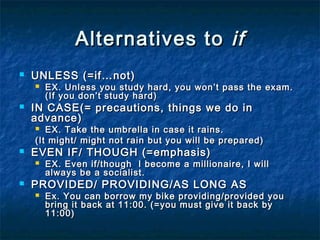
Alternatives to if


UNLESS (=if…not)




EX. Unless you study hard, you won’t pass the exam.
(If you don’t study hard)

IN CASE(= precautions, things we do in
advance)

EX. Take the umbrella in case it rains.
(It might/ might not rain but you will be prepared)




EVEN IF/ THOUGH (=emphasis)




EX. Even if/though I become a millionaire, I will
always be a socialist.

PROVIDED/ PROVIDING/AS LONG AS


Ex. You can borrow my bike providing/provided you
bring it back at 11:00. (=you must give it back by
11:00)
Second Conditional (Unreal,
hypothetical)
If +simple past, would+bare infinitive.
We use the second conditional for:
 Future situations that are possible but unlikely.






Also, for present situations that are unreal.




EX. If I won the lotto, I would buy a Ferrari.

EX. If we had the key, we would open the door.

And to give some advice, we use the expression:If I were you, …

Were is used with the first and the third person singular, although was is
also used in spoken English
 If I were you, I would go to the doctor



Could or might can be used in the main clause instead of would.


EX. If they were friends, they could go out together.
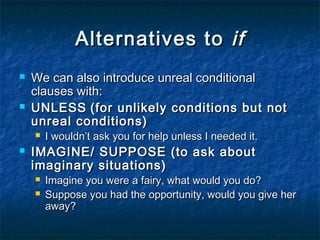
Alternatives to if




We can also introduce unreal conditional
clauses with:
UNLESS (for unlikely conditions but not
unreal conditions)




I wouldn’t ask you for help unless I needed it.

IMAGINE/ SUPPOSE (to ask about
imaginary situations)



Imagine you were a fairy, what would you do?
Suppose you had the opportunity, would you give her
away?
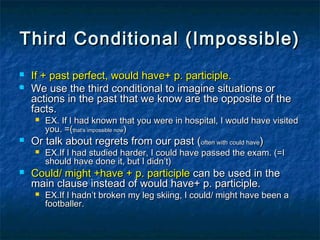
Third Conditional (Impossible)



If + past perfect, would have+ p. participle.
We use the third conditional to imagine situations or
actions in the past that we know are the opposite of the
facts.




Or talk about regrets from our past (often with could have)




EX. If I had known that you were in hospital, I would have visited
you. =(that’s impossible now)
EX.If I had studied harder, I could have passed the exam. (=I
should have done it, but I didn’t)

Could/ might +have + p. participle can be used in the
main clause instead of would have+ p. participle.


EX.If I hadn’t broken my leg skiing, I could/ might have been a
footballer.
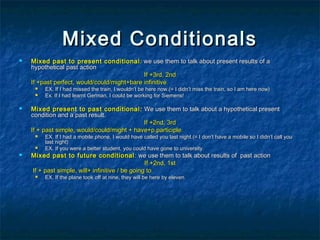
Mixed Conditionals


Mixed past to present conditional : we use them to talk about present results of a
hypothetical past action
If +3rd, 2nd
If +past perfect, would/could/might+bare infinitive .





Mixed present to past conditional : We use them to talk about a hypothetical present
condition and a past result.
If +2nd, 3rd
If + past simple, would/could/might + have+p.participle .





EX. If I had missed the train, I wouldn’t be here now.(= I didn’t miss the train, so I am here now)
Ex. If I had learnt German, I could be working for Siemens!

EX. If I had a mobile phone, I would have called you last night.(= I don’t have a mobile so I didn’t call you
last night)
EX. If you were a better student, you could have gone to university.

Mixed past to future conditional : we use them to talk about results of past action
If +2nd, 1st
If + past simple, will+ infinitive / be going to


EX. If the plane took off at nine, they will be here by eleven.
Conditionals

Conditionals

  • 1.
    Conditional Clauses By MªMercedes Sánchez Year 2012- 13
  • 2.
    What is aconditional ?  A conditional sentence has two clauses:the condition and the result or main clause.   EX. If you study hard, you will pass the exam. The if-clause can come before or after the result clause. If it comes before, it is separated by a comma. If it comes after, no comma is needed.  EX. You will pass the exam if you study hard.
  • 3.
    Present or zeroconditional   If + simple present, simple present It is used to describe real situations that can happen at any time or an event that always follows another. If can be replaced by when.  EX. When/If you heat ice, it melts. When/If I eat spicy food, I always get stomachache.
  • 4.
    First Conditional (futureor real conditional)   If + present simple, will+ bare infinitive. When you think something is likely to happen or you want to talk about the results of a possible future condition.    EX. If you study hard, you will pass the exam. The If-clause refers to the future but using a present tense. You can also use the present continuous in the if-clause, and a modal or an imperative in the main clause.   EX. If it’s raining tomorrow, they might not go for a picnic. EX. If you arrive late, don’t call me.
  • 5.
    Alternatives to if  UNLESS(=if…not)   EX. Unless you study hard, you won’t pass the exam. (If you don’t study hard) IN CASE(= precautions, things we do in advance) EX. Take the umbrella in case it rains. (It might/ might not rain but you will be prepared)   EVEN IF/ THOUGH (=emphasis)   EX. Even if/though I become a millionaire, I will always be a socialist. PROVIDED/ PROVIDING/AS LONG AS  Ex. You can borrow my bike providing/provided you bring it back at 11:00. (=you must give it back by 11:00)
  • 6.
    Second Conditional (Unreal, hypothetical) If+simple past, would+bare infinitive. We use the second conditional for:  Future situations that are possible but unlikely.    Also, for present situations that are unreal.   EX. If I won the lotto, I would buy a Ferrari. EX. If we had the key, we would open the door. And to give some advice, we use the expression:If I were you, … Were is used with the first and the third person singular, although was is also used in spoken English  If I were you, I would go to the doctor  Could or might can be used in the main clause instead of would.  EX. If they were friends, they could go out together.
  • 7.
    Alternatives to if   Wecan also introduce unreal conditional clauses with: UNLESS (for unlikely conditions but not unreal conditions)   I wouldn’t ask you for help unless I needed it. IMAGINE/ SUPPOSE (to ask about imaginary situations)   Imagine you were a fairy, what would you do? Suppose you had the opportunity, would you give her away?
  • 8.
    Third Conditional (Impossible)   If+ past perfect, would have+ p. participle. We use the third conditional to imagine situations or actions in the past that we know are the opposite of the facts.   Or talk about regrets from our past (often with could have)   EX. If I had known that you were in hospital, I would have visited you. =(that’s impossible now) EX.If I had studied harder, I could have passed the exam. (=I should have done it, but I didn’t) Could/ might +have + p. participle can be used in the main clause instead of would have+ p. participle.  EX.If I hadn’t broken my leg skiing, I could/ might have been a footballer.
  • 9.
    Mixed Conditionals  Mixed pastto present conditional : we use them to talk about present results of a hypothetical past action If +3rd, 2nd If +past perfect, would/could/might+bare infinitive .    Mixed present to past conditional : We use them to talk about a hypothetical present condition and a past result. If +2nd, 3rd If + past simple, would/could/might + have+p.participle .    EX. If I had missed the train, I wouldn’t be here now.(= I didn’t miss the train, so I am here now) Ex. If I had learnt German, I could be working for Siemens! EX. If I had a mobile phone, I would have called you last night.(= I don’t have a mobile so I didn’t call you last night) EX. If you were a better student, you could have gone to university. Mixed past to future conditional : we use them to talk about results of past action If +2nd, 1st If + past simple, will+ infinitive / be going to  EX. If the plane took off at nine, they will be here by eleven.