PRESENTED BY -
RATNAKAR UPADHYAY
INHERITANCE
 The acquisition of traits genetically transmitted from
parents to offspring.
 Transmission of nuclear genes.
 The genes located on the chromosomes of the nuclei show
mendelian inheritance.
 In mendelian inheritance:-
The contribution of both male and female is equal so, the
reciprocal crosses are identical.
The segregation produces 3:1 ratio in F1monohybrid and
9:3:3:1 in F2 dihybrid shows distinct segregation pattern.
Non mendelian inheritance:-
The reciprocal cross gives different results.
The trait only from the female parent is transmitted in
to next generation (Because the cytoplasm is usually
contributed entirely by one parent).
There is no segregation in F2 generation.
The genes governing the characters showing non
mendelian inheritance are located outside of nucleus
and found in cytoplasm, these genes are called as
plasma genes or cytoplasmic genes or cytogenes or
extranuclear genes or extrachromosomal genes.
 Inheritance of such extra nuclear genes is known as
cytoplasmic inheritance
The total gene present in the cytoplasm of a cell or an
individual is known as Plasmon, while all genes in
plastid called as plastome.
The genes present in the mitochondria called as
chondriome.
The mitochondrial genes are abbreviated as mt DNA
and
 the chloroplast genes are abbreviated as cp DNA
 Examples for cytoplasmic inheritance :-
1.Plastid inheritance in Mirabilis
2.Shell coiling in snail
3.Kappa particles in Paramoecium
4.Cytoplasmic male sterility in maize
CYTOPLASMIC INHERITANCE IN
Mirabilis jalapa
 The evidence of cytoplasmic inheritance is first
presented by Carl Erich Correns (1864-1933) a
German Botanist in Mirabilis jalapa.
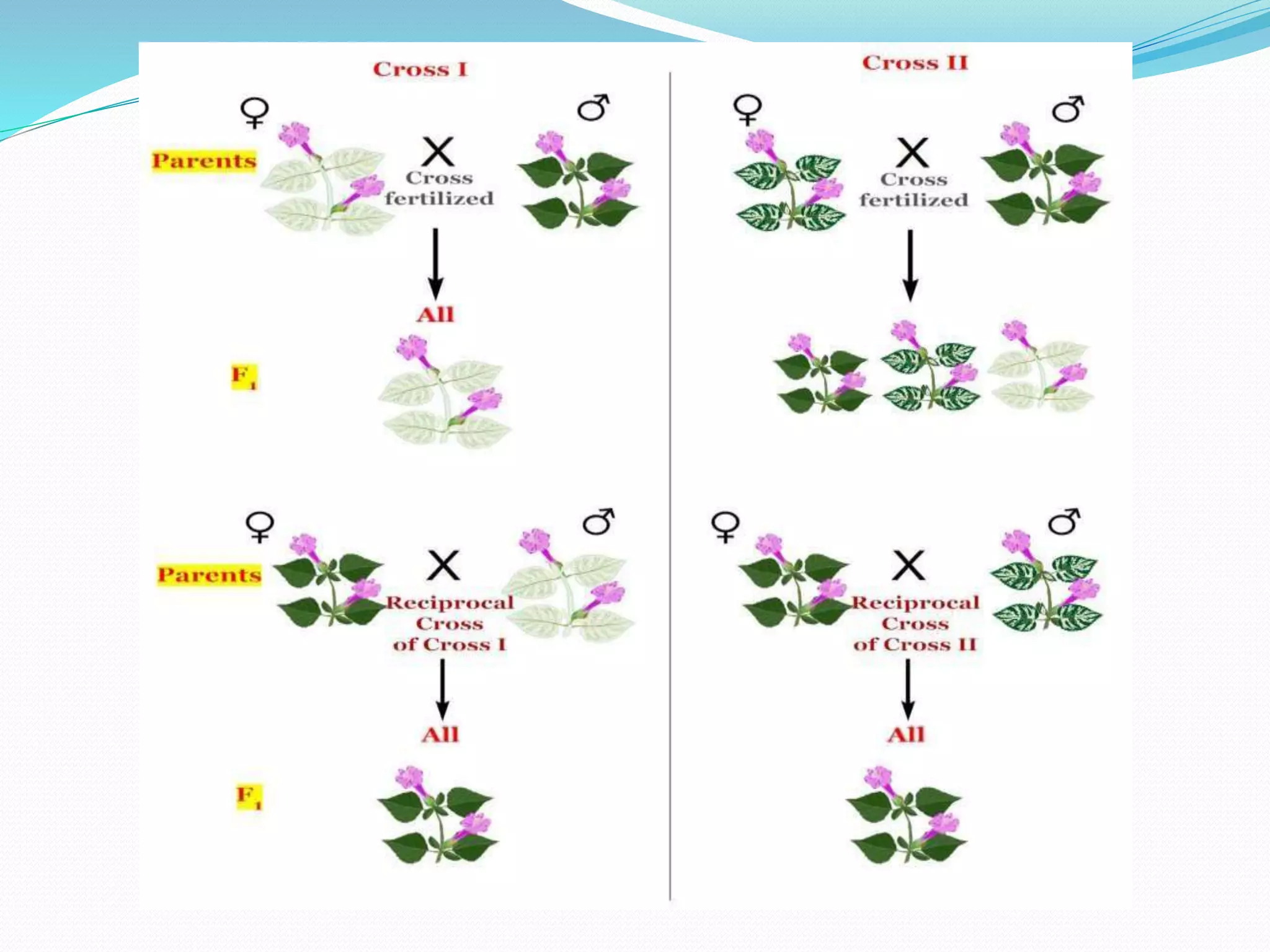
 In Mirabilis jalapa, there are three types of branches:-
 1. Green- having chloroplast.
 2. Pale green- having leucoplast.
 3. Variegated- having all the three plastids i.e.
chloroplast, leucoplast, chromoplast.
CROSS BETWEEN DIFFERENT PROGENIES
WITH RESPECT TO DIFFERENT MALE AND
FEMALE PARENT
INHERITANCE OF KAPPA
PARTICLES IN PARAMOECIUM
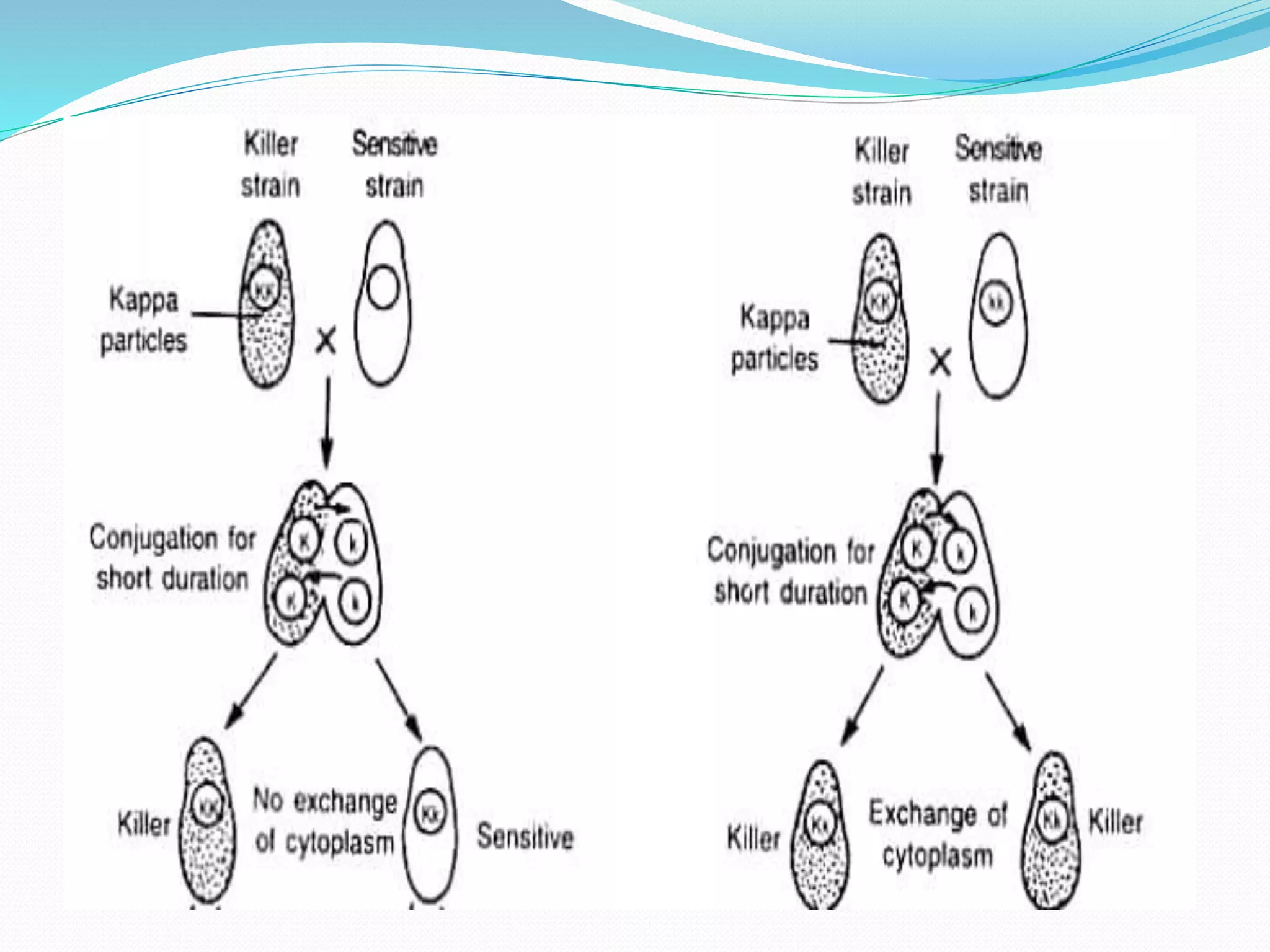
 There are two strains of Paramoecium aurelia :-
1.Killer strain- Dominant “K” gene + kappa particles
 2. Sensitive strain- either K gene or kappa particles are
present (Explained by T.M.SONNEBURN 1938)
 Kappa particles are the cytoplasmic particles which
duplicates on their own & it is present in the
cytoplasm of the Paramoecium.
 It is responsible for the production of toxic chemical
known as PARAMYCIN.
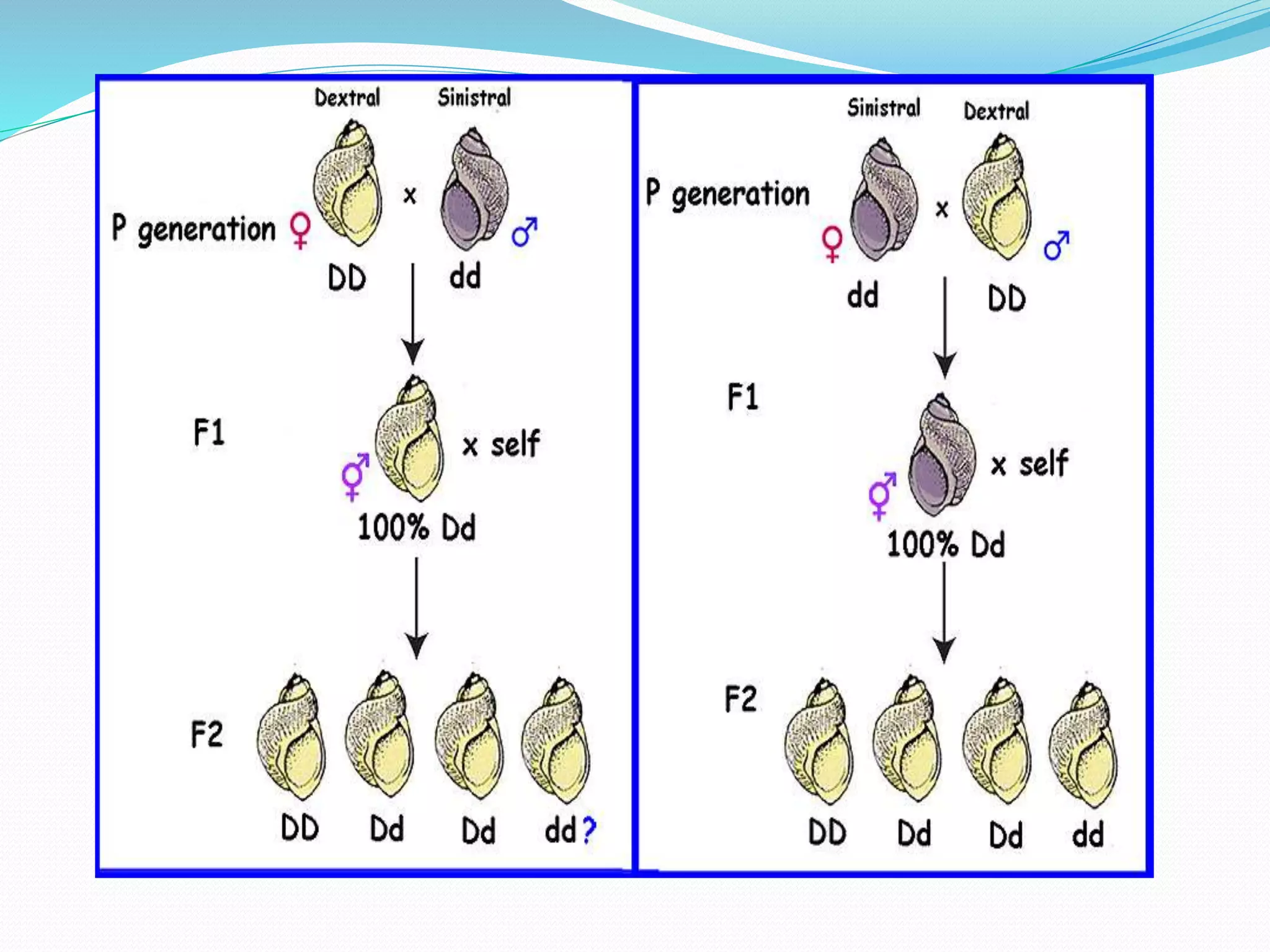
SHELL COILING IN SNAIL
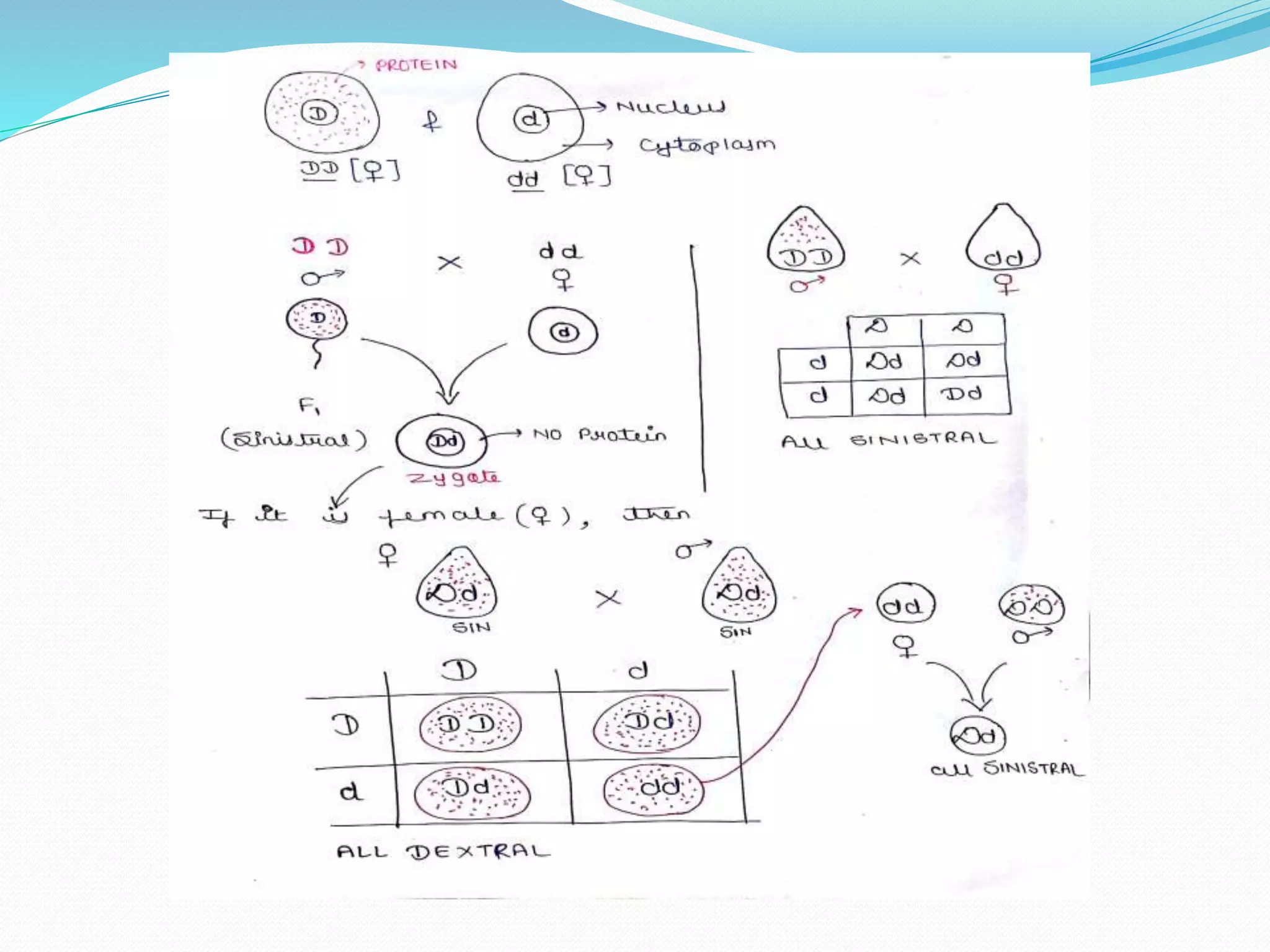
 LIMNAEA PEREGRA
 Coiling pattern:-
1. Dextral- right handed/ clockwise (DD/Dd)
2.Sinistral- left handed/anticlockwise (dd)
 Shell coiling is decided by a protein which is present in
the cytoplasm of the gamete.
 Only “D”(dominant) gene is responsible for the
production of that protein. “d”(recessive) gene can not
form such protein.
MALE STERILITY
 Male sterility is characterized by nonfunctional pollen
grains, while female gametes function normally.
 Inability to produce or to release viable or functional
pollen as a result of failure of formation or development
of functional stamens, microspores or gametes.
 Main reason is mutation.
CYTOPLASMIC MALE STERILTIY
 Determined by the cytoplasm (mitochondrial or
chloroplast genes).
 Result of mutation in mitochondrial genome (mt-DNA)-
Mitochondrial disfunction.
 Progenies would always be male sterile since the
cytoplasm comes
primarily from female gamete only.
 CMS is not influenced by environmental factors
(temperature) so is stable.
WHY MALE STERILITY ?
 Reduced the cost of hybrid seed production.
 Production of large scale of F1 seeds.
 Avoids enormous manual work of emasculation and
pollination.
 Speed up the hybridization programme.
Iojap Strain of Maize:
 The iojap strain of maize is characterised by green and white
stripes on the leaf. The name iojap originates from two parental
strains Iowa which is green and Japonica, a striped variety.
 In crosses between iojap and green varieties when iojap is used as
the male parent, the trait is inherited according to Mendelian
pattern with F1 progeny all green, and F2 segregating into 3/4 green
and 1/4 iojap. But in the reciprocal cross where iojap is used as the
female parent, the F1 plants showed all three phenotypes viz. green,
white and striped.
 It was found that the iojap gene in the homozygous recessive
condition causes some of the plastids to mutate giving rise to
colourless plastids. The mixture of green and colourless plastids
accounts for the origin of striped plants. Once created, further
transmission of the striped character takes place maternally
through the egg cytoplasm as evident from the phenotypes of the
F2 progeny of the cross above.
Cytoplasmic inheritance and male sterility

Cytoplasmic inheritance and male sterility

  • 1.
  • 2.
    INHERITANCE  The acquisitionof traits genetically transmitted from parents to offspring.  Transmission of nuclear genes.  The genes located on the chromosomes of the nuclei show mendelian inheritance.  In mendelian inheritance:- The contribution of both male and female is equal so, the reciprocal crosses are identical. The segregation produces 3:1 ratio in F1monohybrid and 9:3:3:1 in F2 dihybrid shows distinct segregation pattern.
  • 3.
    Non mendelian inheritance:- Thereciprocal cross gives different results. The trait only from the female parent is transmitted in to next generation (Because the cytoplasm is usually contributed entirely by one parent). There is no segregation in F2 generation. The genes governing the characters showing non mendelian inheritance are located outside of nucleus and found in cytoplasm, these genes are called as plasma genes or cytoplasmic genes or cytogenes or extranuclear genes or extrachromosomal genes.  Inheritance of such extra nuclear genes is known as cytoplasmic inheritance
  • 4.
    The total genepresent in the cytoplasm of a cell or an individual is known as Plasmon, while all genes in plastid called as plastome. The genes present in the mitochondria called as chondriome. The mitochondrial genes are abbreviated as mt DNA and  the chloroplast genes are abbreviated as cp DNA  Examples for cytoplasmic inheritance :- 1.Plastid inheritance in Mirabilis 2.Shell coiling in snail 3.Kappa particles in Paramoecium 4.Cytoplasmic male sterility in maize
  • 5.
    CYTOPLASMIC INHERITANCE IN Mirabilisjalapa  The evidence of cytoplasmic inheritance is first presented by Carl Erich Correns (1864-1933) a German Botanist in Mirabilis jalapa.  In Mirabilis jalapa, there are three types of branches:-  1. Green- having chloroplast.  2. Pale green- having leucoplast.  3. Variegated- having all the three plastids i.e. chloroplast, leucoplast, chromoplast.
  • 6.
    CROSS BETWEEN DIFFERENTPROGENIES WITH RESPECT TO DIFFERENT MALE AND FEMALE PARENT
  • 8.
    INHERITANCE OF KAPPA PARTICLESIN PARAMOECIUM  There are two strains of Paramoecium aurelia :- 1.Killer strain- Dominant “K” gene + kappa particles  2. Sensitive strain- either K gene or kappa particles are present (Explained by T.M.SONNEBURN 1938)  Kappa particles are the cytoplasmic particles which duplicates on their own & it is present in the cytoplasm of the Paramoecium.  It is responsible for the production of toxic chemical known as PARAMYCIN.
  • 10.
    SHELL COILING INSNAIL  LIMNAEA PEREGRA  Coiling pattern:- 1. Dextral- right handed/ clockwise (DD/Dd) 2.Sinistral- left handed/anticlockwise (dd)  Shell coiling is decided by a protein which is present in the cytoplasm of the gamete.  Only “D”(dominant) gene is responsible for the production of that protein. “d”(recessive) gene can not form such protein.
  • 13.
    MALE STERILITY  Malesterility is characterized by nonfunctional pollen grains, while female gametes function normally.  Inability to produce or to release viable or functional pollen as a result of failure of formation or development of functional stamens, microspores or gametes.  Main reason is mutation.
  • 14.
    CYTOPLASMIC MALE STERILTIY Determined by the cytoplasm (mitochondrial or chloroplast genes).  Result of mutation in mitochondrial genome (mt-DNA)- Mitochondrial disfunction.  Progenies would always be male sterile since the cytoplasm comes primarily from female gamete only.  CMS is not influenced by environmental factors (temperature) so is stable.
  • 15.
    WHY MALE STERILITY?  Reduced the cost of hybrid seed production.  Production of large scale of F1 seeds.  Avoids enormous manual work of emasculation and pollination.  Speed up the hybridization programme.
  • 16.
    Iojap Strain ofMaize:  The iojap strain of maize is characterised by green and white stripes on the leaf. The name iojap originates from two parental strains Iowa which is green and Japonica, a striped variety.  In crosses between iojap and green varieties when iojap is used as the male parent, the trait is inherited according to Mendelian pattern with F1 progeny all green, and F2 segregating into 3/4 green and 1/4 iojap. But in the reciprocal cross where iojap is used as the female parent, the F1 plants showed all three phenotypes viz. green, white and striped.  It was found that the iojap gene in the homozygous recessive condition causes some of the plastids to mutate giving rise to colourless plastids. The mixture of green and colourless plastids accounts for the origin of striped plants. Once created, further transmission of the striped character takes place maternally through the egg cytoplasm as evident from the phenotypes of the F2 progeny of the cross above.