Proofreading Mechanisms
And Mismatch Repair
Replication Errors
 Replication errors and DNA damage are actually happening in
the cells of our bodies all the time.
 In most cases, they don’t cause cancer, or even mutations.
 Mutations happen, and get passed on to daughter cells, only
when these mechanisms fail. Cancer, in turn, develops only
when multiple mutations in division-related genes
accumulate in the same cell.
Proofreading
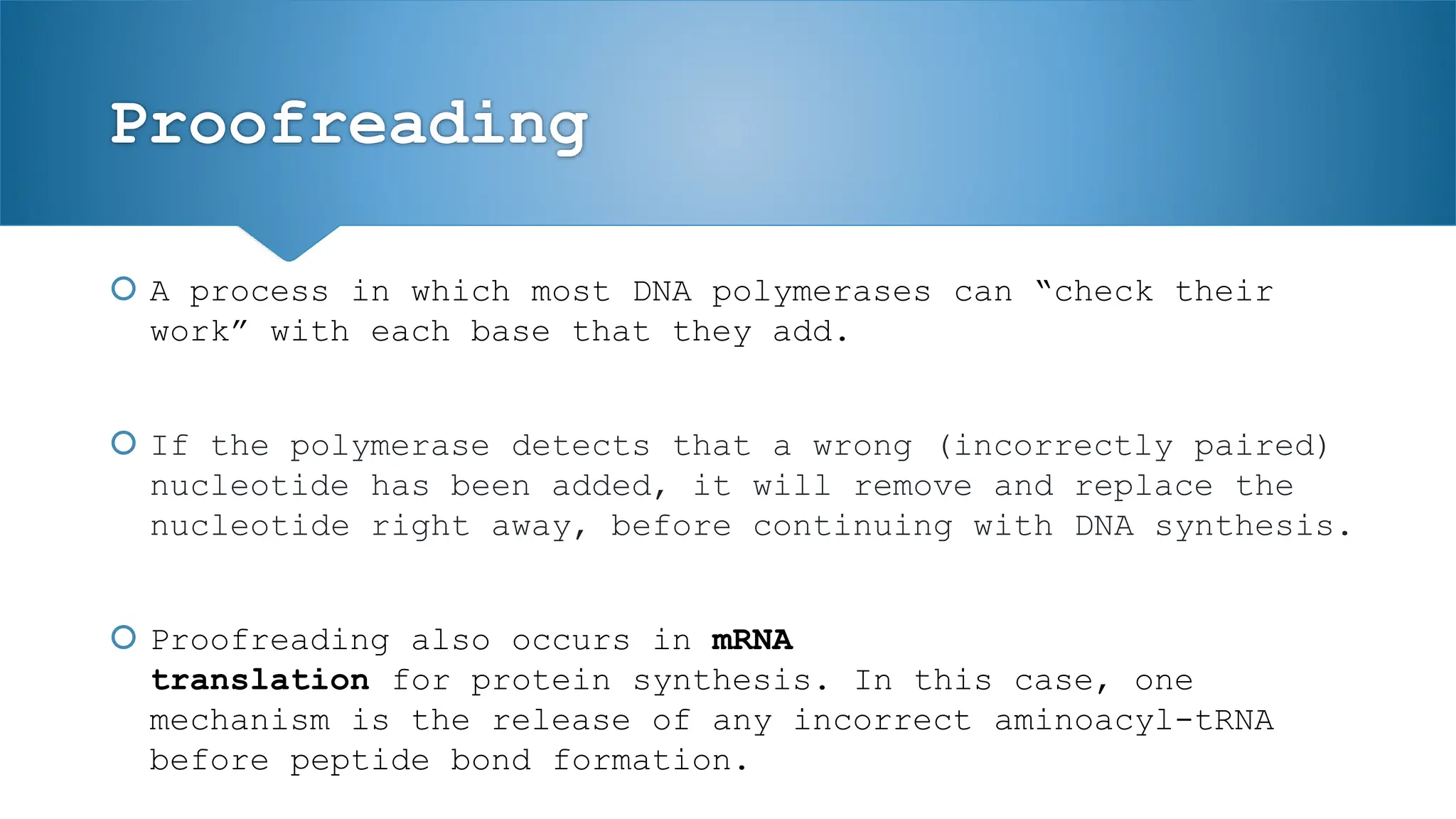
 A process in which most DNA polymerases can “check their
work” with each base that they add.
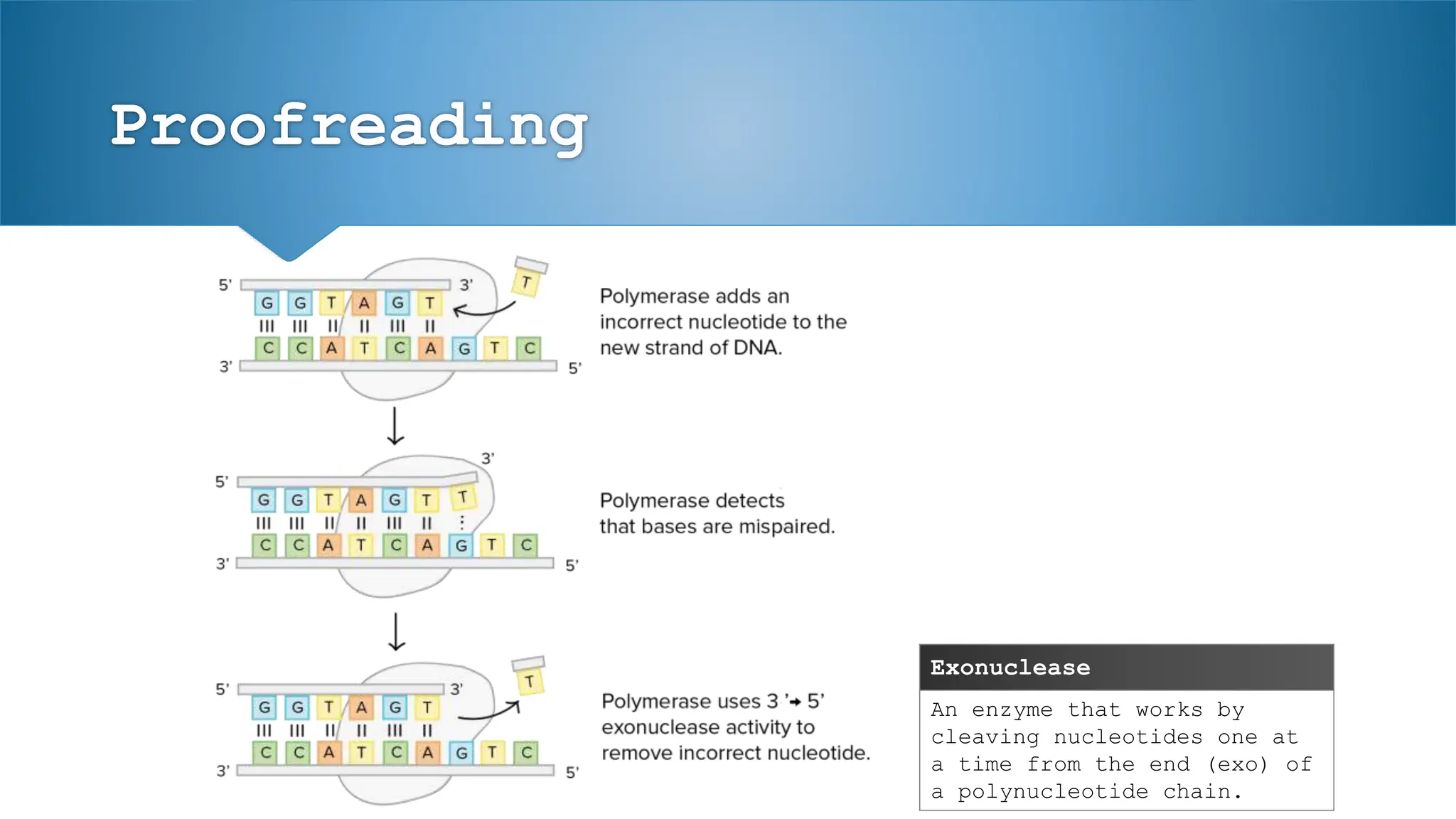
 If the polymerase detects that a wrong (incorrectly paired)
nucleotide has been added, it will remove and replace the
nucleotide right away, before continuing with DNA synthesis.
 Proofreading also occurs in mRNA
translation for protein synthesis. In this case, one
mechanism is the release of any incorrect aminoacyl-tRNA
before peptide bond formation.
Proofreading
Exonuclease
An enzyme that works by
cleaving nucleotides one at
a time from the end (exo) of
a polynucleotide chain.
Mismatch Repair (MMR)
 A system for recognizing and repairing erroneous insertion,
deletion, and mis-incorporation of bases that can arise
during DNA replication and recombination, as well as
repairing some forms of DNA damage.
 Mismatch repair is strand-specific. In order to begin
repair, the mismatch repair machinery distinguishes the
newly synthesized strand from the template.
 In gram-negative bacteria, transient hemimethylation
distinguishes the strands (the parental is methylated and
daughter is not).
Mismatch Repair (MMR)
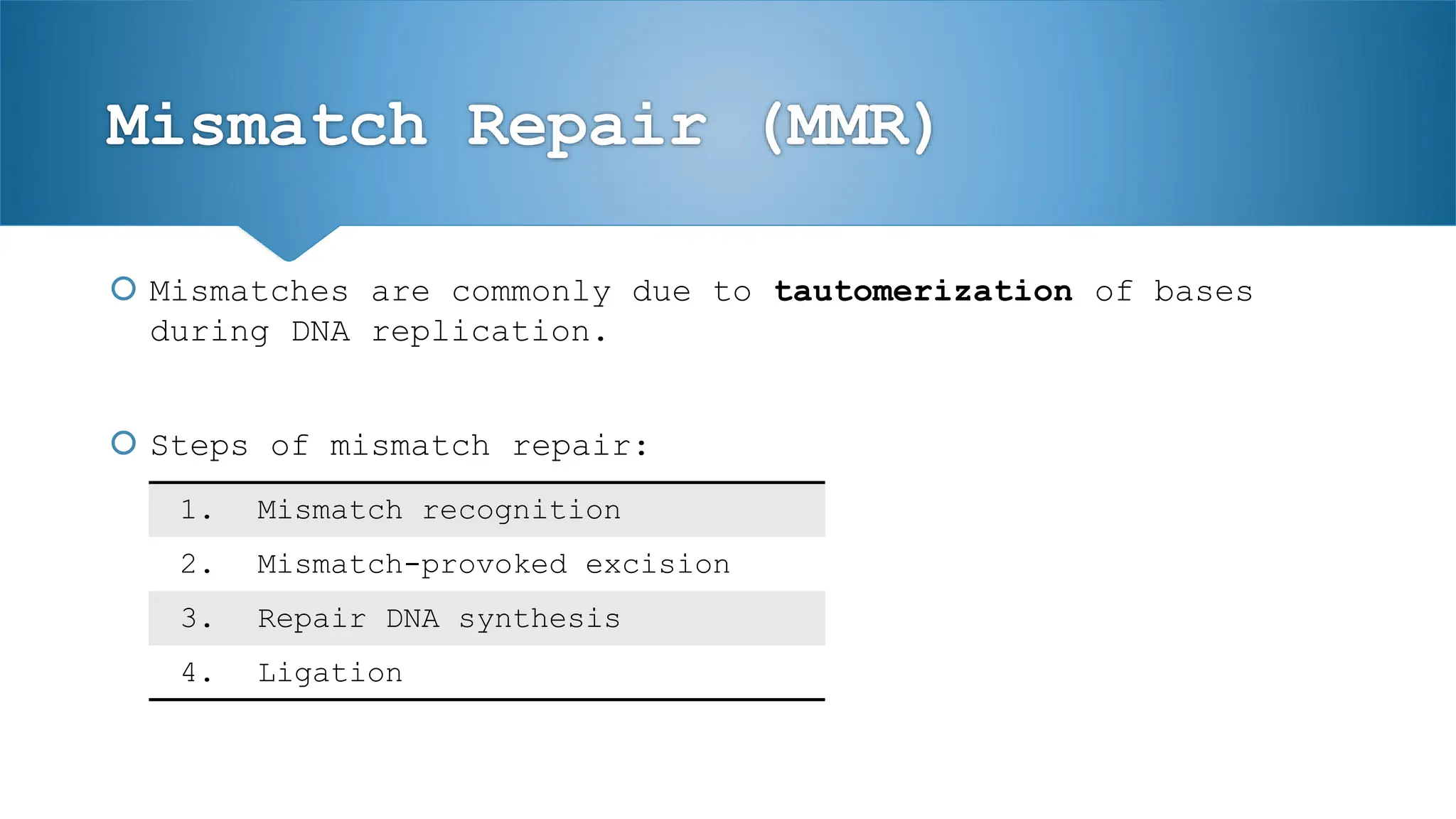
 Mismatches are commonly due to tautomerization of bases
during DNA replication.
 Steps of mismatch repair:
1. Mismatch recognition
2. Mismatch-provoked excision
3. Repair DNA synthesis
4. Ligation
Mismatch Repair in E. Coli
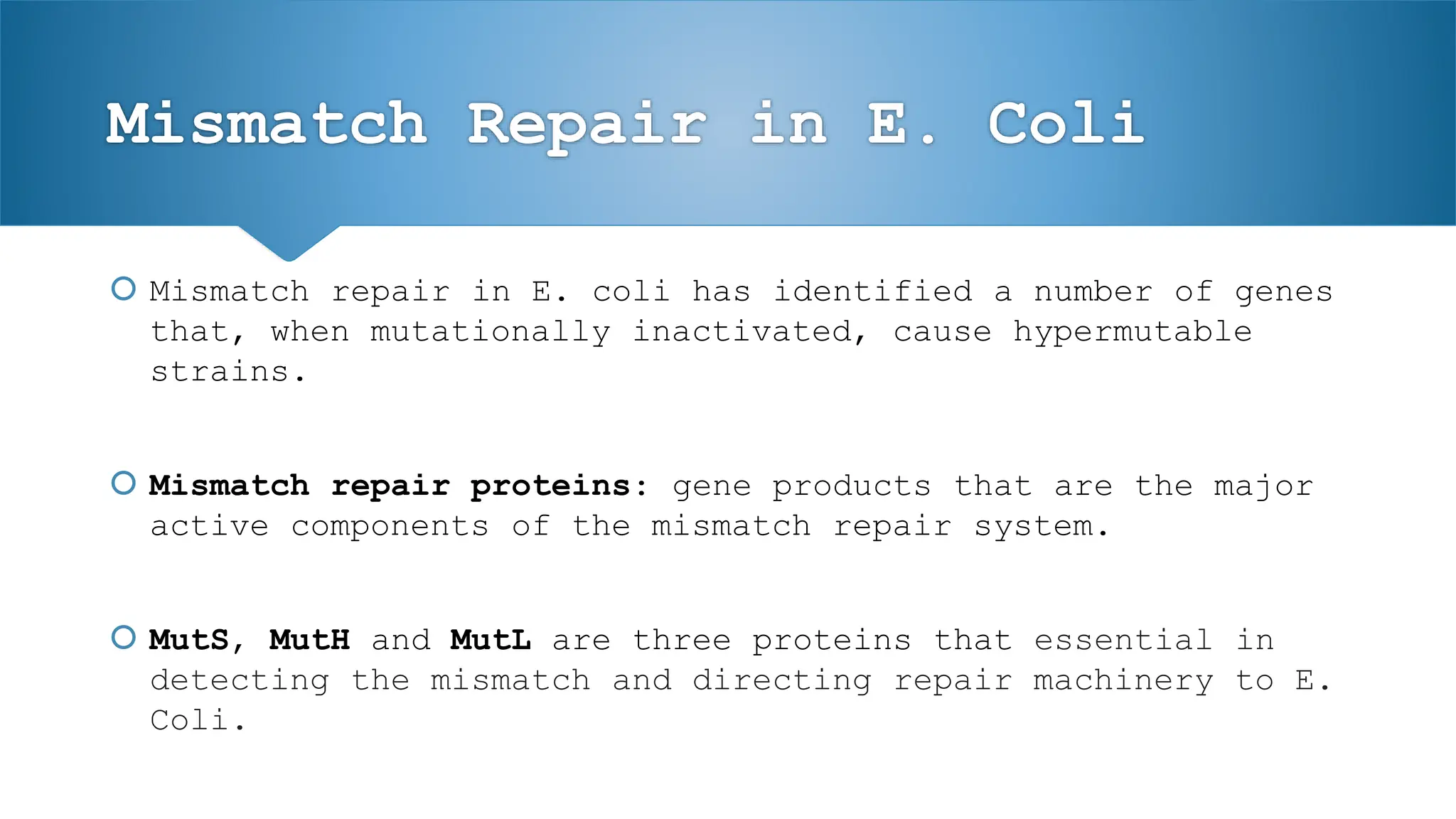
 Mismatch repair in E. coli has identified a number of genes
that, when mutationally inactivated, cause hypermutable
strains.
 Mismatch repair proteins: gene products that are the major
active components of the mismatch repair system.
 MutS, MutH and MutL are three proteins that essential in
detecting the mismatch and directing repair machinery to E.
Coli.
Mismatch Repair in E. Coli
 Other proteins involves in mismatch repair in E. Coli.
 The MMR process is more complicated in mammalian cells.
 In humans, seven DNA mismatch repair proteins
(MLH1, MLH3, MSH2, MSH3, MSH6, PMS1 and PMS2) work
coordinately in sequential steps to initiate repair of DNA
mismatches.
Helicase Recruited to remove base pairs which is
included in mismatch
Exonuclease
Ligase Sealing
DNA
Polymerase
Filling the gap
References
 https://en.wikipedia.org/wiki/Proofreading_(biology)
 https://www.khanacademy.org/science/biology/dna-as-the-
genetic-material/dna-replication/a/dna-proofreading-and-
repair
 https://en.wikipedia.org/wiki/Exonuclease
 https://en.wikipedia.org/wiki/DNA_mismatch_repair#Mismatch_
repair_proteins
Thank You For Your Attention!

Proofreading Mechanisms & Mismatch Repair.pptx

  • 1.
  • 2.
    Replication Errors  Replicationerrors and DNA damage are actually happening in the cells of our bodies all the time.  In most cases, they don’t cause cancer, or even mutations.  Mutations happen, and get passed on to daughter cells, only when these mechanisms fail. Cancer, in turn, develops only when multiple mutations in division-related genes accumulate in the same cell.
  • 3.
    Proofreading  A processin which most DNA polymerases can “check their work” with each base that they add.  If the polymerase detects that a wrong (incorrectly paired) nucleotide has been added, it will remove and replace the nucleotide right away, before continuing with DNA synthesis.  Proofreading also occurs in mRNA translation for protein synthesis. In this case, one mechanism is the release of any incorrect aminoacyl-tRNA before peptide bond formation.
  • 4.
    Proofreading Exonuclease An enzyme thatworks by cleaving nucleotides one at a time from the end (exo) of a polynucleotide chain.
  • 5.
    Mismatch Repair (MMR) A system for recognizing and repairing erroneous insertion, deletion, and mis-incorporation of bases that can arise during DNA replication and recombination, as well as repairing some forms of DNA damage.  Mismatch repair is strand-specific. In order to begin repair, the mismatch repair machinery distinguishes the newly synthesized strand from the template.  In gram-negative bacteria, transient hemimethylation distinguishes the strands (the parental is methylated and daughter is not).
  • 6.
    Mismatch Repair (MMR) Mismatches are commonly due to tautomerization of bases during DNA replication.  Steps of mismatch repair: 1. Mismatch recognition 2. Mismatch-provoked excision 3. Repair DNA synthesis 4. Ligation
  • 7.
    Mismatch Repair inE. Coli  Mismatch repair in E. coli has identified a number of genes that, when mutationally inactivated, cause hypermutable strains.  Mismatch repair proteins: gene products that are the major active components of the mismatch repair system.  MutS, MutH and MutL are three proteins that essential in detecting the mismatch and directing repair machinery to E. Coli.
  • 8.
    Mismatch Repair inE. Coli  Other proteins involves in mismatch repair in E. Coli.  The MMR process is more complicated in mammalian cells.  In humans, seven DNA mismatch repair proteins (MLH1, MLH3, MSH2, MSH3, MSH6, PMS1 and PMS2) work coordinately in sequential steps to initiate repair of DNA mismatches. Helicase Recruited to remove base pairs which is included in mismatch Exonuclease Ligase Sealing DNA Polymerase Filling the gap
  • 9.
  • 10.
    Thank You ForYour Attention!