Unit 3
Pharmaceutical Microbiology
Presented by Asst. Prof. Priya Talekar
Samarth College of Pharmacy
Table of contents
Morphology, cultivation
classification, replication
MOA, Factor affecting,
Evaluation
Evaluation As per IP, BP & USP
01
03
02
04
Study of Fungi
& Viruses
Bacteriostatic,
Bactericidal
Disinfectant &
Antiseptic
Sterility Test
Introduction
• Fungus is a member of a large group of non- motile,
eukaryotic organisms which is separate from plants,
animals, protozoa and bacteria
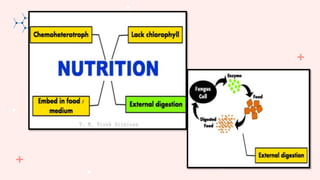
• Non-photosynthetic, they are Chemohetrotrophs,
requires organic compounds for energy and carbon
• The study of fungi is known as MYCOLOGY
• Disease caused by a fungal infection known as
MYCOSIS
• The body of fungus called as Thallus which
Posses differentiated nuclei with a nuclear
membrane
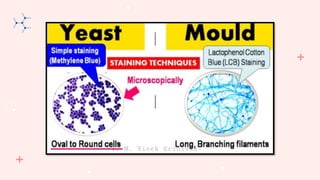
• Morphologically may be either simple oval cells
or long tubular with branching
• Fungal cell walls contain Chitin ie. Amino sugars
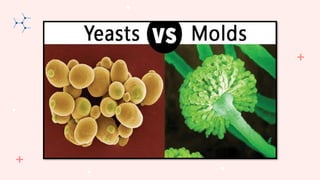
• They may be microscopic unicellular (Yeast) or
multicellular (Mold)
Morphology
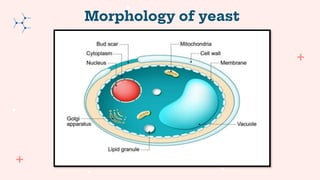
Morphology of yeast
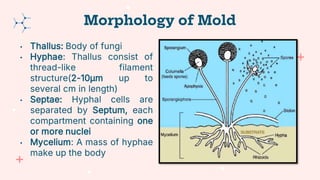
• Thallus: Body of fungi
• Hyphae: Thallus consist of
thread-like filament
structure(2-10µm up to
several cm in length)
• Septae: Hyphal cells are
separated by Septum, each
compartment containing one
or more nuclei
• Mycelium: A mass of hyphae
make up the body
Morphology of Mold
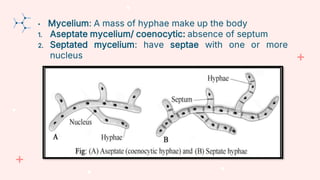
• Mycelium: A mass of hyphae make up the body
1. Aseptate mycelium/ coenocytic: absence of septum
2. Septated mycelium: have septae with one or more
nucleus
• Saprophytic fungi are living on dead organic
substances like Penicillium, Molds, mushrooms,
yeast, Mucor
• Parasitic fungi feed on living organisms ie.
Taphrina
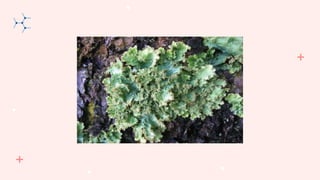
• Symbiotic fungi are interdependent relationship
associate with other species in which both are
mutually benefited like Lichens
Based on mode of nutrition
Classification of fungi
I. Yeasts
II. Yeast like fungi
III. Moulds
IV. Dimorphic fungi
I. Zygomycetes/ Phycomycetes
II. Ascomycetes
III. Basidiomycetes
IV. Dueteromycetes/ Hyphomycetes/ Fungi imperfecti
Depending on cell morphology
Depending on their spores formation
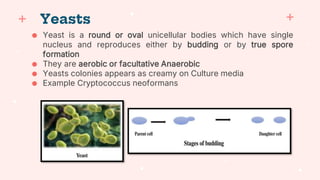
● Yeast is a round or oval unicellular bodies which have single
nucleus and reproduces either by budding or by true spore
formation
● They are aerobic or facultative Anaerobic
● Yeasts colonies appears as creamy on Culture media
● Example Cryptococcus neoformans
Yeasts
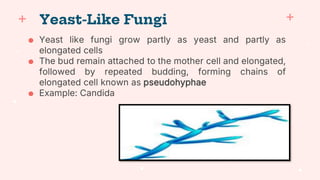
● Yeast like fungi grow partly as yeast and partly as
elongated cells
● The bud remain attached to the mother cell and elongated,
followed by repeated budding, forming chains of
elongated cell known as pseudohyphae
● Example: Candida
Yeast-Like Fungi
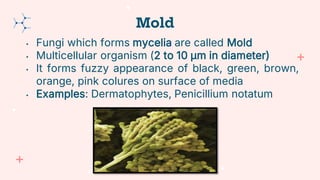
• Fungi which forms mycelia are called Mold
• Multicellular organism (2 to 10 µm in diameter)
• It forms fuzzy appearance of black, green, brown,
orange, pink colures on surface of media
• Examples: Dermatophytes, Penicillium notatum
Mold
● Some fungi, mainly pathogenic species exhibit
dimorphism i.e. two forms of growth. It can be
grow either as a mold or as a yeast
● Temperature and CO2 dependent, At 37°C, grow
like yeast & at 25°C it grow like mold
● Examples: Penicillium marneffei
Dimorphic Fungi
● They are formed by fusion of 2 different cells. Fungi have
hyphae without septa (lower fungi)
● Produce Asexual spores: Sporangiospore
● Sexual spores: oospores and zygospores
● Examples: Rhizopus, Mucor
Zygomycetes
Ascomycetes
● Also known as sac (Ascus) fungi. Can be decomposers
● Sexual spores: Ascospores
● Asexual spores: Conidiospores
● Example: Histoplasma, Candida
● Also known as Mushrooms live as parasites
● Sexual spores: Basidiospores
● Asexual spores: budding or fragmentation
● Examples: Cryptococcus neoformans
Basidiomycetes
Deuteromycetes
● Consists of group of fungi whose sexual phases are not
been identified and they form septate hyphae and asexual
conidia
● Example Trichophyton
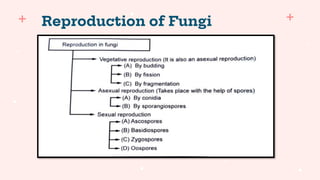
Reproduction of Fungi
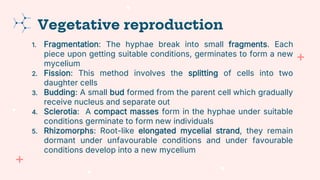
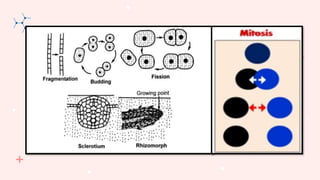
1. Fragmentation: The hyphae break into small fragments. Each
piece upon getting suitable conditions, germinates to form a new
mycelium
2. Fission: This method involves the splitting of cells into two
daughter cells
3. Budding: A small bud formed from the parent cell which gradually
receive nucleus and separate out
4. Sclerotia: A compact masses form in the hyphae under suitable
conditions germinate to form new individuals
5. Rhizomorphs: Root-like elongated mycelial strand, they remain
dormant under unfavourable conditions and under favourable
conditions develop into a new mycelium
Vegetative reproduction
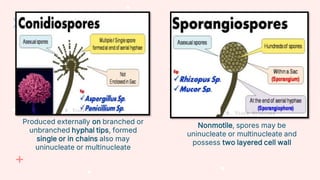
Produced externally on branched or
unbranched hyphal tips, formed
single or in chains also may
uninucleate or multinucleate
Nonmotile, spores may be
uninucleate or multinucleate and
possess two layered cell wall
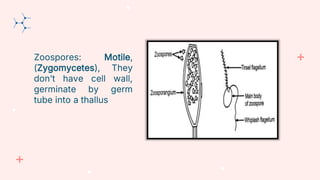
Zoospores: Motile,
(Zygomycetes), They
don’t have cell wall,
germinate by germ
tube into a thallus
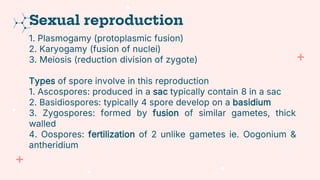
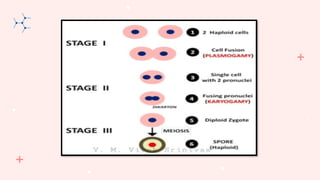
1. Plasmogamy (protoplasmic fusion)
2. Karyogamy (fusion of nuclei)
3. Meiosis (reduction division of zygote)
Types of spore involve in this reproduction
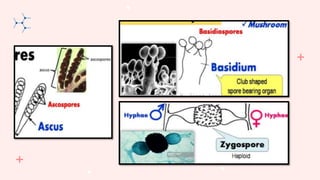
1. Ascospores: produced in a sac typically contain 8 in a sac
2. Basidiospores: typically 4 spore develop on a basidium
3. Zygospores: formed by fusion of similar gametes, thick
walled
4. Oospores: fertilization of 2 unlike gametes ie. Oogonium &
antheridium
Sexual reproduction
• Natural and synthetic type of fungal culture media are used
for growth and cultivation of fungi
• The std temp. for incubation of fungi is 30°C and incubated
in humidified environment for 21 days
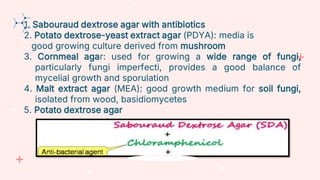
• Sabouraud dextrose agar media culture
CULTIVATION OF FUNGI
Ingredients Quantity Characteristics
Peptone 1 gm
Source of amino
grp
Dextrose 4 gm
Carbohydrate
source
Agar 2 gm Solidified agent
Distilled water 100 ml Vehicle
1. Sabouraud dextrose agar with antibiotics
2. Potato dextrose-yeast extract agar (PDYA): media is
good growing culture derived from mushroom
3. Cornmeal agar: used for growing a wide range of fungi,
particularly fungi imperfecti, provides a good balance of
mycelial growth and sporulation
4. Malt extract agar (MEA): good growth medium for soil fungi,
isolated from wood, basidiomycetes
5. Potato dextrose agar
End

Fungi Pharmaceutical Microbiology unit 3

  • 1.
    Unit 3 Pharmaceutical Microbiology Presentedby Asst. Prof. Priya Talekar Samarth College of Pharmacy
  • 2.
    Table of contents Morphology,cultivation classification, replication MOA, Factor affecting, Evaluation Evaluation As per IP, BP & USP 01 03 02 04 Study of Fungi & Viruses Bacteriostatic, Bactericidal Disinfectant & Antiseptic Sterility Test
  • 3.
    Introduction • Fungus isa member of a large group of non- motile, eukaryotic organisms which is separate from plants, animals, protozoa and bacteria • Non-photosynthetic, they are Chemohetrotrophs, requires organic compounds for energy and carbon • The study of fungi is known as MYCOLOGY • Disease caused by a fungal infection known as MYCOSIS
  • 5.
    • The bodyof fungus called as Thallus which Posses differentiated nuclei with a nuclear membrane • Morphologically may be either simple oval cells or long tubular with branching • Fungal cell walls contain Chitin ie. Amino sugars • They may be microscopic unicellular (Yeast) or multicellular (Mold) Morphology
  • 7.
  • 8.
    • Thallus: Bodyof fungi • Hyphae: Thallus consist of thread-like filament structure(2-10µm up to several cm in length) • Septae: Hyphal cells are separated by Septum, each compartment containing one or more nuclei • Mycelium: A mass of hyphae make up the body Morphology of Mold
  • 9.
    • Mycelium: Amass of hyphae make up the body 1. Aseptate mycelium/ coenocytic: absence of septum 2. Septated mycelium: have septae with one or more nucleus
  • 10.
    • Saprophytic fungiare living on dead organic substances like Penicillium, Molds, mushrooms, yeast, Mucor • Parasitic fungi feed on living organisms ie. Taphrina • Symbiotic fungi are interdependent relationship associate with other species in which both are mutually benefited like Lichens Based on mode of nutrition
  • 11.
    Classification of fungi I.Yeasts II. Yeast like fungi III. Moulds IV. Dimorphic fungi I. Zygomycetes/ Phycomycetes II. Ascomycetes III. Basidiomycetes IV. Dueteromycetes/ Hyphomycetes/ Fungi imperfecti Depending on cell morphology Depending on their spores formation
  • 12.
    ● Yeast isa round or oval unicellular bodies which have single nucleus and reproduces either by budding or by true spore formation ● They are aerobic or facultative Anaerobic ● Yeasts colonies appears as creamy on Culture media ● Example Cryptococcus neoformans Yeasts
  • 13.
    ● Yeast likefungi grow partly as yeast and partly as elongated cells ● The bud remain attached to the mother cell and elongated, followed by repeated budding, forming chains of elongated cell known as pseudohyphae ● Example: Candida Yeast-Like Fungi
  • 14.
    • Fungi whichforms mycelia are called Mold • Multicellular organism (2 to 10 µm in diameter) • It forms fuzzy appearance of black, green, brown, orange, pink colures on surface of media • Examples: Dermatophytes, Penicillium notatum Mold
  • 15.
    ● Some fungi,mainly pathogenic species exhibit dimorphism i.e. two forms of growth. It can be grow either as a mold or as a yeast ● Temperature and CO2 dependent, At 37°C, grow like yeast & at 25°C it grow like mold ● Examples: Penicillium marneffei Dimorphic Fungi
  • 16.
    ● They areformed by fusion of 2 different cells. Fungi have hyphae without septa (lower fungi) ● Produce Asexual spores: Sporangiospore ● Sexual spores: oospores and zygospores ● Examples: Rhizopus, Mucor Zygomycetes Ascomycetes ● Also known as sac (Ascus) fungi. Can be decomposers ● Sexual spores: Ascospores ● Asexual spores: Conidiospores ● Example: Histoplasma, Candida
  • 17.
    ● Also knownas Mushrooms live as parasites ● Sexual spores: Basidiospores ● Asexual spores: budding or fragmentation ● Examples: Cryptococcus neoformans Basidiomycetes Deuteromycetes ● Consists of group of fungi whose sexual phases are not been identified and they form septate hyphae and asexual conidia ● Example Trichophyton
  • 18.
  • 19.
    1. Fragmentation: Thehyphae break into small fragments. Each piece upon getting suitable conditions, germinates to form a new mycelium 2. Fission: This method involves the splitting of cells into two daughter cells 3. Budding: A small bud formed from the parent cell which gradually receive nucleus and separate out 4. Sclerotia: A compact masses form in the hyphae under suitable conditions germinate to form new individuals 5. Rhizomorphs: Root-like elongated mycelial strand, they remain dormant under unfavourable conditions and under favourable conditions develop into a new mycelium Vegetative reproduction
  • 21.
    Produced externally onbranched or unbranched hyphal tips, formed single or in chains also may uninucleate or multinucleate Nonmotile, spores may be uninucleate or multinucleate and possess two layered cell wall
  • 22.
    Zoospores: Motile, (Zygomycetes), They don’thave cell wall, germinate by germ tube into a thallus
  • 23.
    1. Plasmogamy (protoplasmicfusion) 2. Karyogamy (fusion of nuclei) 3. Meiosis (reduction division of zygote) Types of spore involve in this reproduction 1. Ascospores: produced in a sac typically contain 8 in a sac 2. Basidiospores: typically 4 spore develop on a basidium 3. Zygospores: formed by fusion of similar gametes, thick walled 4. Oospores: fertilization of 2 unlike gametes ie. Oogonium & antheridium Sexual reproduction
  • 27.
    • Natural andsynthetic type of fungal culture media are used for growth and cultivation of fungi • The std temp. for incubation of fungi is 30°C and incubated in humidified environment for 21 days • Sabouraud dextrose agar media culture CULTIVATION OF FUNGI Ingredients Quantity Characteristics Peptone 1 gm Source of amino grp Dextrose 4 gm Carbohydrate source Agar 2 gm Solidified agent Distilled water 100 ml Vehicle
  • 28.
    1. Sabouraud dextroseagar with antibiotics 2. Potato dextrose-yeast extract agar (PDYA): media is good growing culture derived from mushroom 3. Cornmeal agar: used for growing a wide range of fungi, particularly fungi imperfecti, provides a good balance of mycelial growth and sporulation 4. Malt extract agar (MEA): good growth medium for soil fungi, isolated from wood, basidiomycetes 5. Potato dextrose agar
  • 30.