A Reporting Tool
Executive Support
System[ESS]
Presented By:-
Sadhish.k.Jain
• Executive support systems are intended to be used
by the senior managers directly to provide support
to non-programmed decisions in strategic
management.
• These information are often external, unstructured
and even uncertain. Exact scope and context of such
information is often not known beforehand.
Introduction
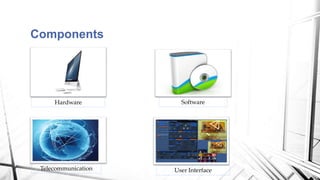
Components
Hardware Software
Telecommunication User Interface
• Market intelligence
• Investment intelligence
• Technology intelligence
This information is intelligence based:
• External databases
• Technology reports like patent records etc.
• Technical reports from consultants
• Market reports
• Confidential information about competitors
• Speculative information like market conditions
• Government policies
• Financial reports and information
Examples of Intelligent Information
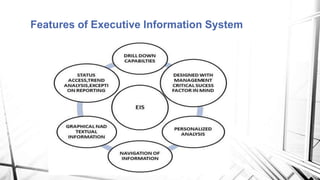
Features of Executive Information System
• Increased executive time horizons.
• Better reporting system
• Improved mental model of
business executive
• Help improve consensus building
and communication
• Improve office automation
• Reduce time for finding
information
• Early identification of company
performance
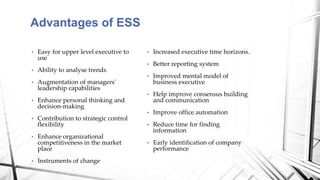
• Easy for upper level executive to
use
• Ability to analyse trends
• Augmentation of managers'
leadership capabilities
• Enhance personal thinking and
decision-making
• Contribution to strategic control
flexibility
• Enhance organizational
competitiveness in the market
place
• Instruments of change
Advantages of ESS
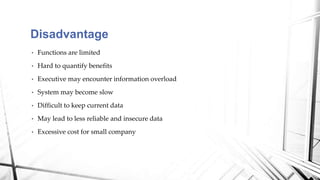
• Functions are limited
• Hard to quantify benefits
• Executive may encounter information overload
• System may become slow
• Difficult to keep current data
• May lead to less reliable and insecure data
• Excessive cost for small company
Disadvantage
• The Executive Support System for the
company’s evaluation based on the
statistical analysis of the balance sheet
records which the companies must send
to The Ministry of Finance.
Sitirating:-
• To the financial institutions (Stock Markets, Brokerage companies),
commercial and investment banks, investment funds. These institutions
can easily and rapidly obtain reports of estimated evaluation for the risks
their clients are exposed.
• To middle sized and large companies which can easily get:
• a rating and prognosis report of its own development.
• a rating report of the activity report they are part of.
• To the foreign investors that want to begin partnerships with Romanian
companies.
• To the investors or creditors wanting to transaction debts on a secondary
market of debts.
To whom is SITIRATING addressed?
• Calculation of the discount
coefficient for the debt on the
secondary debt market.
• Two companies’ simultaneous
simulation
• Rating reports simulation
• Prognosis simulation regarding the
business plan
• Written reports and graphs
resulted from the analysis of the
company’s financial records or the
studied activity sector.
•
• Evaluation of the company’s
development trend.
• Evaluation of the development
trend on activity sectors.
• Evaluation of the Financial
Capacity.
• Evaluation of the resources’
administration (financial, human).
• Risks evaluation (Operational,
Financial, of Credit).
What does the system provide?
• Loading data :
• Searching the company ;
• Loading data in order to identify the company ;
• Loading data- balance sheet of the company ;
• Viewing the loaded balance sheets ;
• Loading data on an external support ;
• Changing data :
• Searching the company ;
Functions:
As markets become highly competitive, the ability to
react quickly and decisively is more critical than ever.
Selecting, developing and implementing Decision
Support Systems, Executive Information System and
Executive Support System are complex and
challenging tasks. The presented SITIRATING
solutions ensure the availability of business-critical
information in real time.
Conclusion
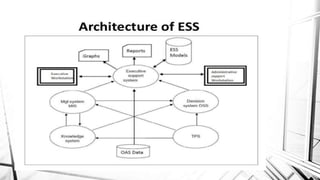
Executive Supportive System

Executive Supportive System

  • 1.
    A Reporting Tool ExecutiveSupport System[ESS] Presented By:- Sadhish.k.Jain
  • 2.
    • Executive supportsystems are intended to be used by the senior managers directly to provide support to non-programmed decisions in strategic management. • These information are often external, unstructured and even uncertain. Exact scope and context of such information is often not known beforehand. Introduction
  • 3.
  • 4.
    • Market intelligence •Investment intelligence • Technology intelligence This information is intelligence based:
  • 5.
    • External databases •Technology reports like patent records etc. • Technical reports from consultants • Market reports • Confidential information about competitors • Speculative information like market conditions • Government policies • Financial reports and information Examples of Intelligent Information
  • 7.
    Features of ExecutiveInformation System
  • 8.
    • Increased executivetime horizons. • Better reporting system • Improved mental model of business executive • Help improve consensus building and communication • Improve office automation • Reduce time for finding information • Early identification of company performance • Easy for upper level executive to use • Ability to analyse trends • Augmentation of managers' leadership capabilities • Enhance personal thinking and decision-making • Contribution to strategic control flexibility • Enhance organizational competitiveness in the market place • Instruments of change Advantages of ESS
  • 9.
    • Functions arelimited • Hard to quantify benefits • Executive may encounter information overload • System may become slow • Difficult to keep current data • May lead to less reliable and insecure data • Excessive cost for small company Disadvantage
  • 10.
    • The ExecutiveSupport System for the company’s evaluation based on the statistical analysis of the balance sheet records which the companies must send to The Ministry of Finance. Sitirating:-
  • 11.
    • To thefinancial institutions (Stock Markets, Brokerage companies), commercial and investment banks, investment funds. These institutions can easily and rapidly obtain reports of estimated evaluation for the risks their clients are exposed. • To middle sized and large companies which can easily get: • a rating and prognosis report of its own development. • a rating report of the activity report they are part of. • To the foreign investors that want to begin partnerships with Romanian companies. • To the investors or creditors wanting to transaction debts on a secondary market of debts. To whom is SITIRATING addressed?
  • 12.
    • Calculation ofthe discount coefficient for the debt on the secondary debt market. • Two companies’ simultaneous simulation • Rating reports simulation • Prognosis simulation regarding the business plan • Written reports and graphs resulted from the analysis of the company’s financial records or the studied activity sector. • • Evaluation of the company’s development trend. • Evaluation of the development trend on activity sectors. • Evaluation of the Financial Capacity. • Evaluation of the resources’ administration (financial, human). • Risks evaluation (Operational, Financial, of Credit). What does the system provide?
  • 13.
    • Loading data: • Searching the company ; • Loading data in order to identify the company ; • Loading data- balance sheet of the company ; • Viewing the loaded balance sheets ; • Loading data on an external support ; • Changing data : • Searching the company ; Functions:
  • 14.
    As markets becomehighly competitive, the ability to react quickly and decisively is more critical than ever. Selecting, developing and implementing Decision Support Systems, Executive Information System and Executive Support System are complex and challenging tasks. The presented SITIRATING solutions ensure the availability of business-critical information in real time. Conclusion