Introduction and overview IST 603 Information Processing  Fall 2006 Denise A. Garofalo
Overview Class meetings Prerequisites Course objectives and competencies, text Performance evaluation, policies, grades Outline Basic info processing & bib control info Online at  http://tinyurl.com/rrtfr   (http://www.geocities.com/dgarony/IST603/main2006.html)
Class meetings The course will meet 13 times, Wednesdays from 4:30PM-7:15PM, September 6 through December 13 in the Community Room of the Marlboro Free Library (1251 Route 9W, corner of Route 9W and Bloom streets).  Because of holidays, etc. class is suspended October 11, November 1, and November 22.
Prerequisites Prerequisite: IIST 602 A presumption of basic word processing skills and use of e-mail is held.
Course objectives  By completing this course students should acquire a basic understanding of information processing. Specifically, students should: gain an understanding of the concepts of bibliographic control; develop a practical understanding of the principles of bibliographic description and of the MARC  (machine-readable cataloging) standard;
More course objectives learn the techniques, advantages and disadvantages of utilizing standard subject heading lists such as Sears and LCSH (Library of Congress Subject Headings)  to define the content of bibliographic material; develop a practical understanding of the structure and applications of major classification codes, including LC and Dewey;
Course objectives, continued become familiar with the principles of authority control and other methods of maintaining consistency and clarity in bibliographic databases; and, gain an understanding of bibliographic networks and utilities, workflow design and new approaches to cataloging in the changing information environment.
Competencies At the completion of the course students will be able to: understand the functions of library catalogs in both a manual and an automated environment prepare basic catalog records for monographic materials which comply with bibliographic standards (ISBD, AACR2 and MARC) and understand the principles for applying these standards in real-world situations and with materials released in formats other than monographic.
More competencies assign subject headings to records using Sears and LCSH systems and understand the theoretical, practical and political implications of utilizing these and other standard thesauri for subject analysis assign basic call numbers using Dewey and LC classification systems and various Cutter  tables understand the functions of authority records and data understand online bibliographic data such as OCLC records
Competencies, continued evaluate the effectiveness of library catalogs and cataloging practices in meeting user information needs understand the relationship between bibliographic control and library automation, reference work and collection development
Questions?
Text Required text: Taylor, Arlene G.  Wynar's Introduction to Cataloging and Classification,  revised 9th ed. Libraries Unlimited, c2004.  ISBN 1-59158-213-X (pbk).
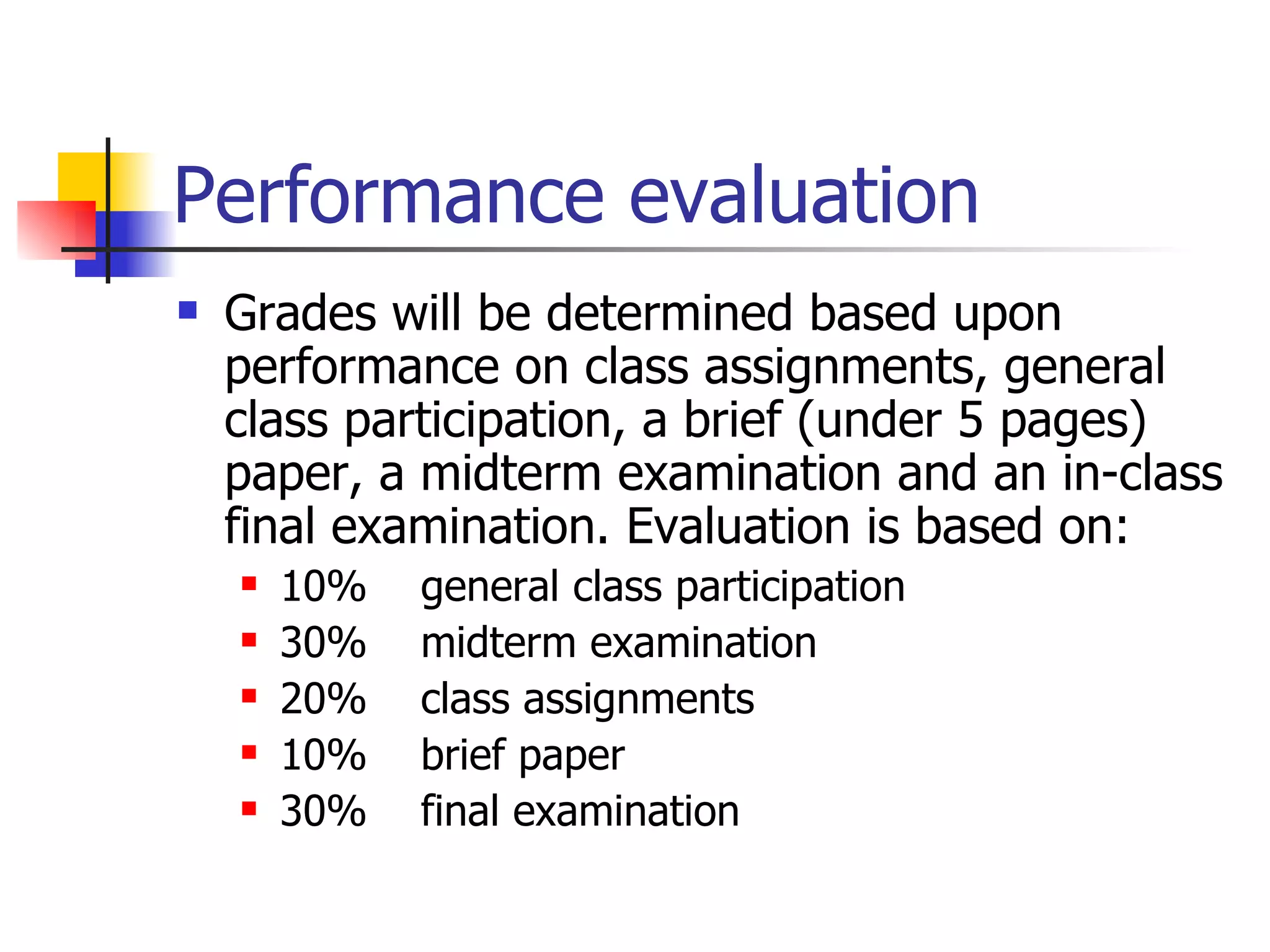
Performance evaluation Grades will be determined based upon performance on class assignments, general class participation, a brief (under 5 pages) paper, a midterm examination and an in-class final examination. Evaluation is based on: 10%  general class participation 30%  midterm examination 20%  class assignments 10%  brief paper 30%  final examination
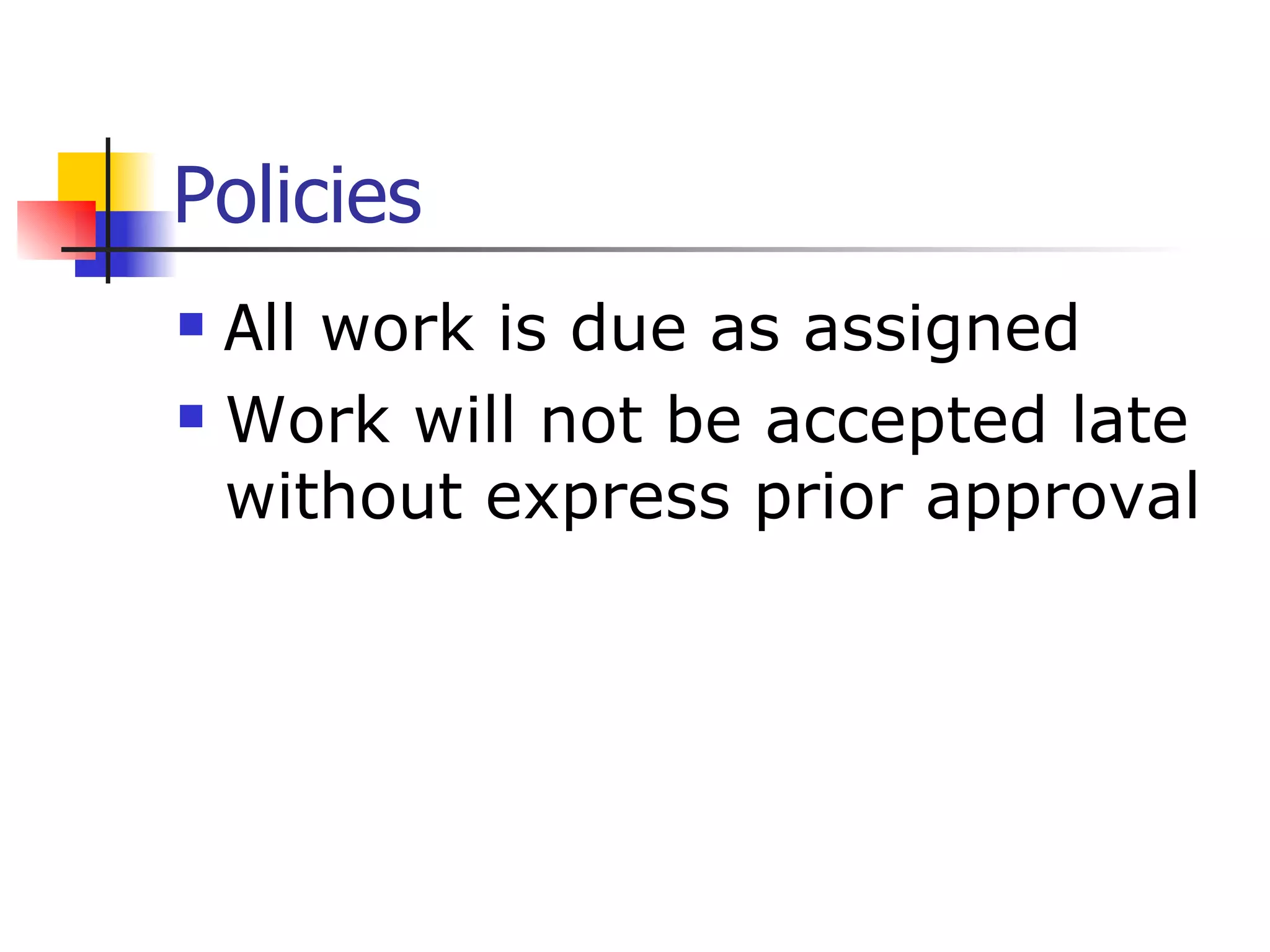
Policies A ll work is due as assigned  Work will not be accepted late without express prior approval
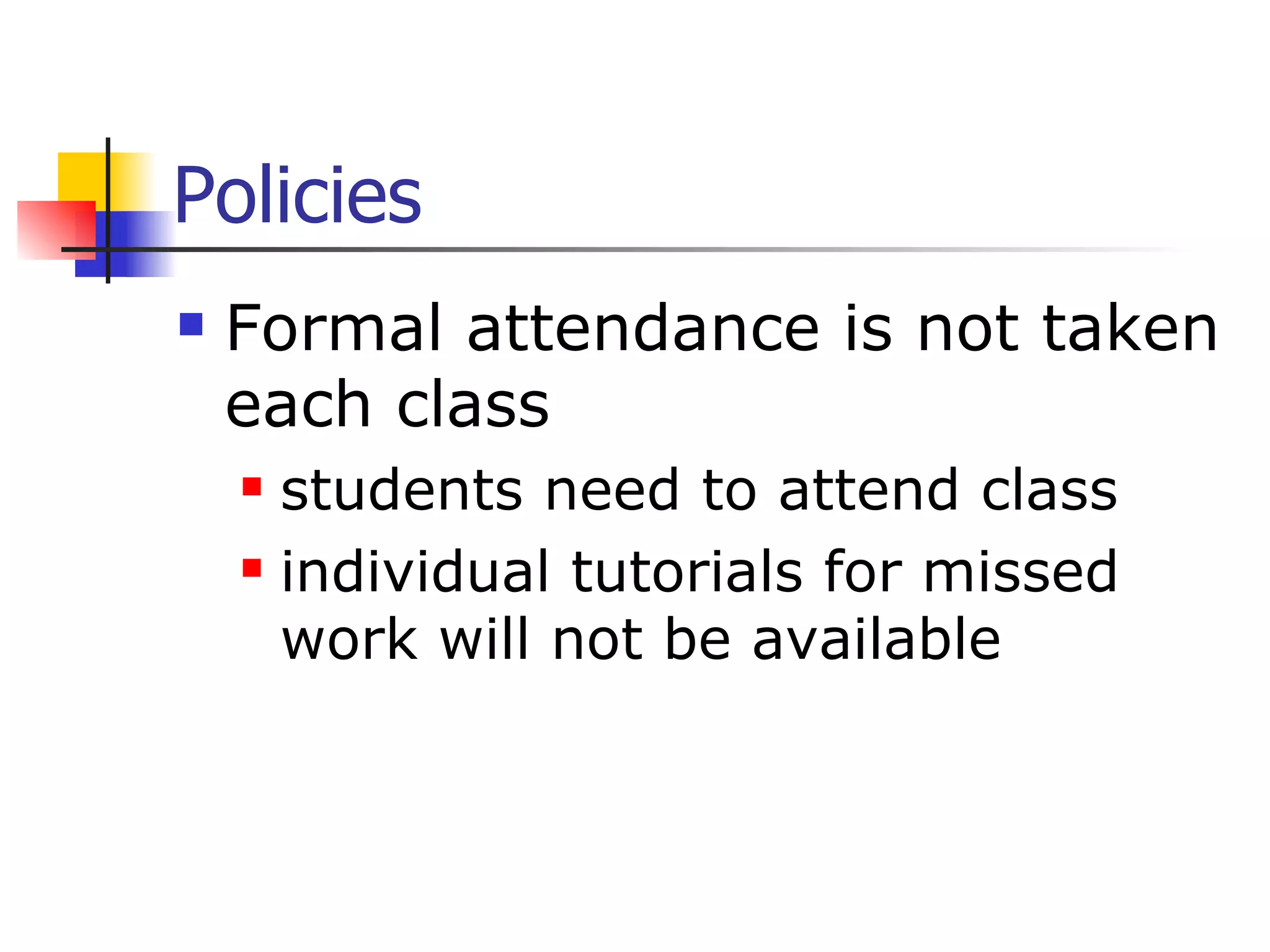
Policies Formal attendance is not taken each class students need to attend class individual tutorials for missed work will not be available
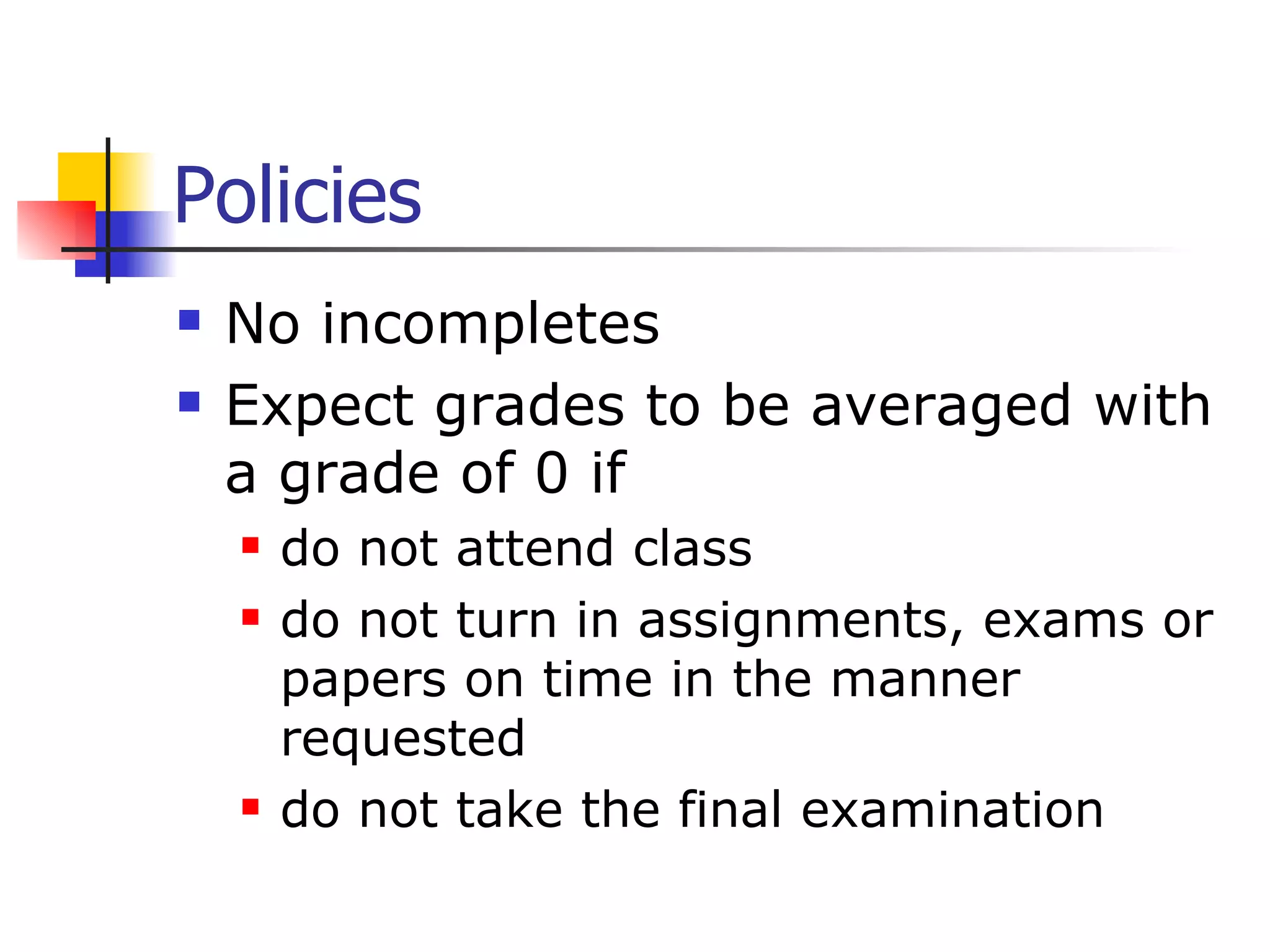
Policies No incompletes  Expect grades to be averaged with a grade of 0 if  do not attend class do not turn in assignments, exams or papers on time in the manner requested  do not take the final examination
Policies syllabus and assignments may be subject to change be prepared to handle any changes in assignments and other syllabus content
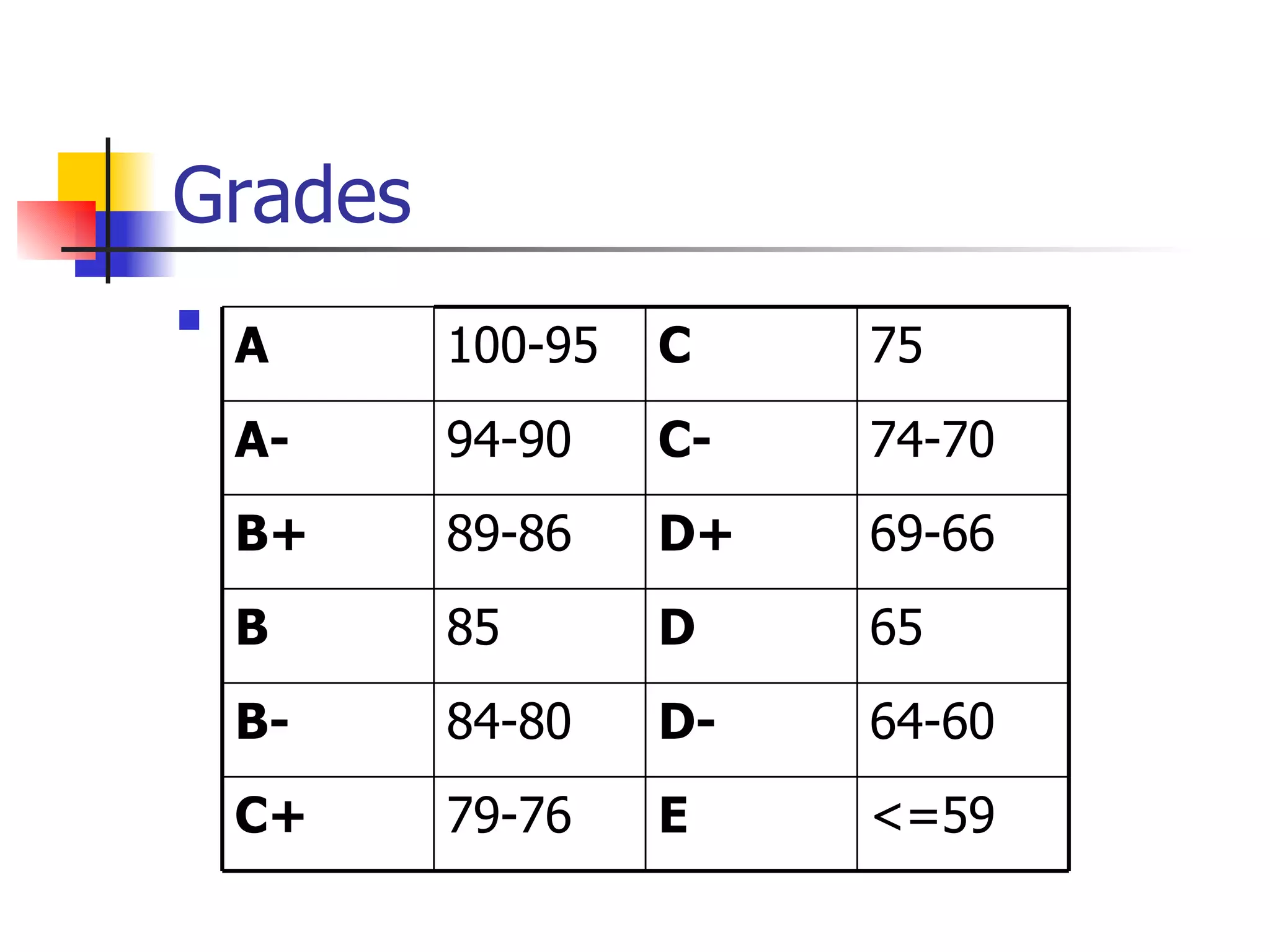
Grades <=59 E 79-76 C+ 64-60 D- 84-80 B- 65 D 85 B 69-66 D+ 89-86 B+ 74-70 C- 94-90 A- 75 C 100-95 A
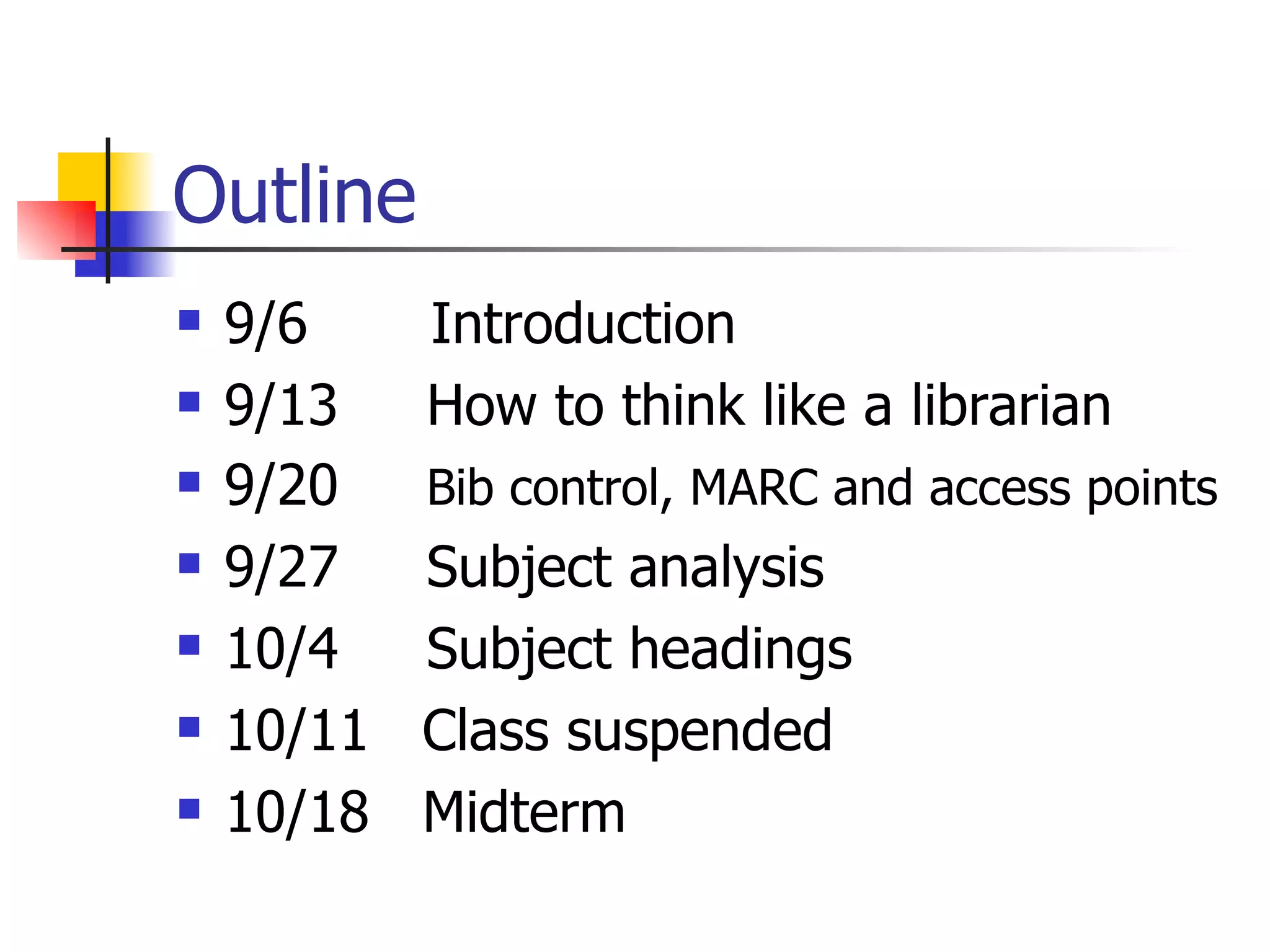
Outline 9/6  Introduction 9/13  How to think like a librarian 9/20  Bib control, MARC and access points 9/27  Subject analysis 10/4  Subject headings 10/11  Class suspended 10/18  Midterm
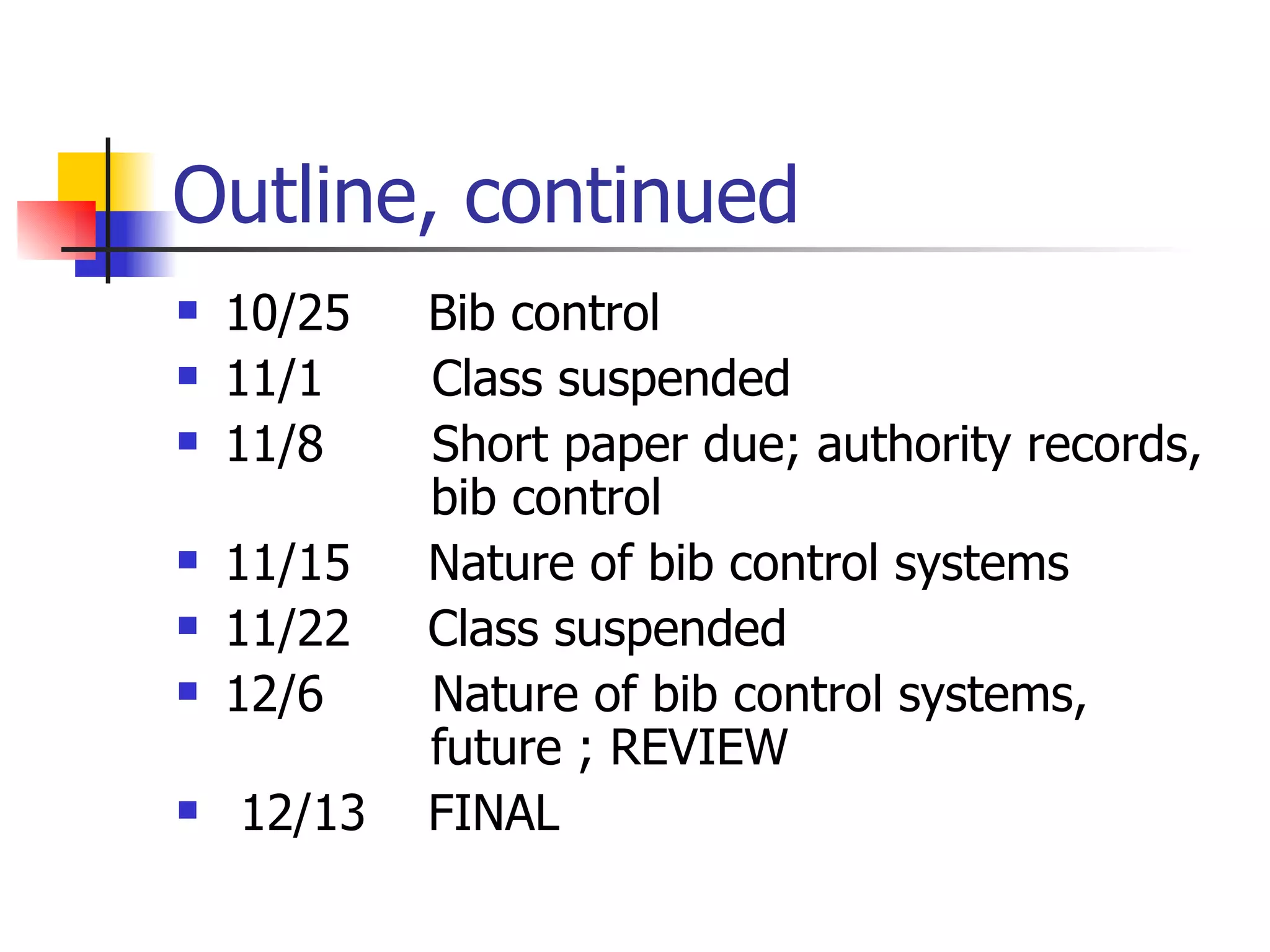
Outline, continued 10/25  Bib control 11/1  Class suspended 11/8  Short paper due; authority records,  bib control 11/15  Nature of bib control systems 11/22  Class suspended 12/6  Nature of bib control systems,  future ; REVIEW 12/13  FINAL
Questions?
Short break
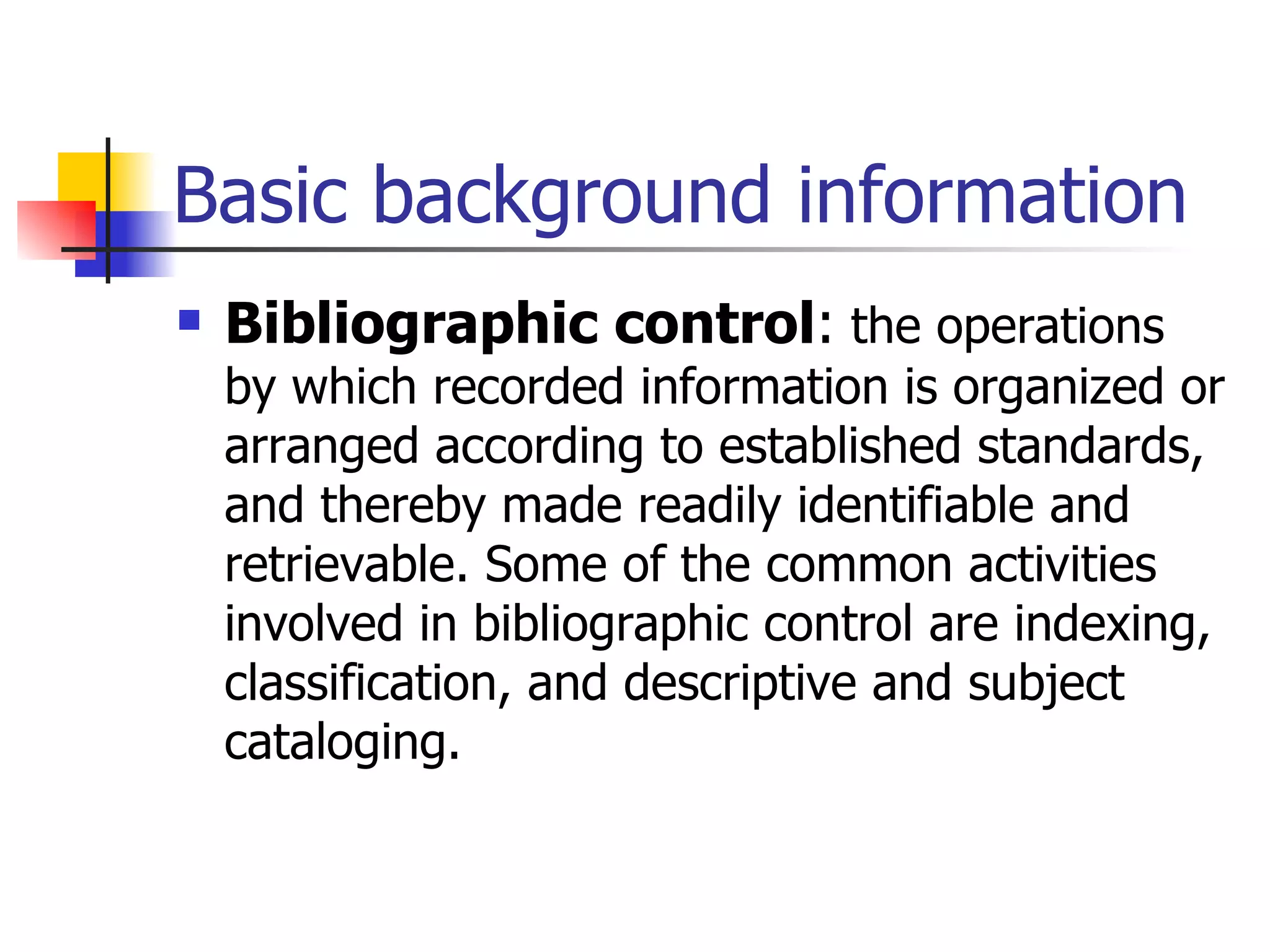
Basic background information Bibliographic control :  the operations by which recorded information is organized or arranged according to established standards, and thereby made readily identifiable and retrievable. Some of the common activities involved in bibliographic control are indexing, classification, and descriptive and subject cataloging.
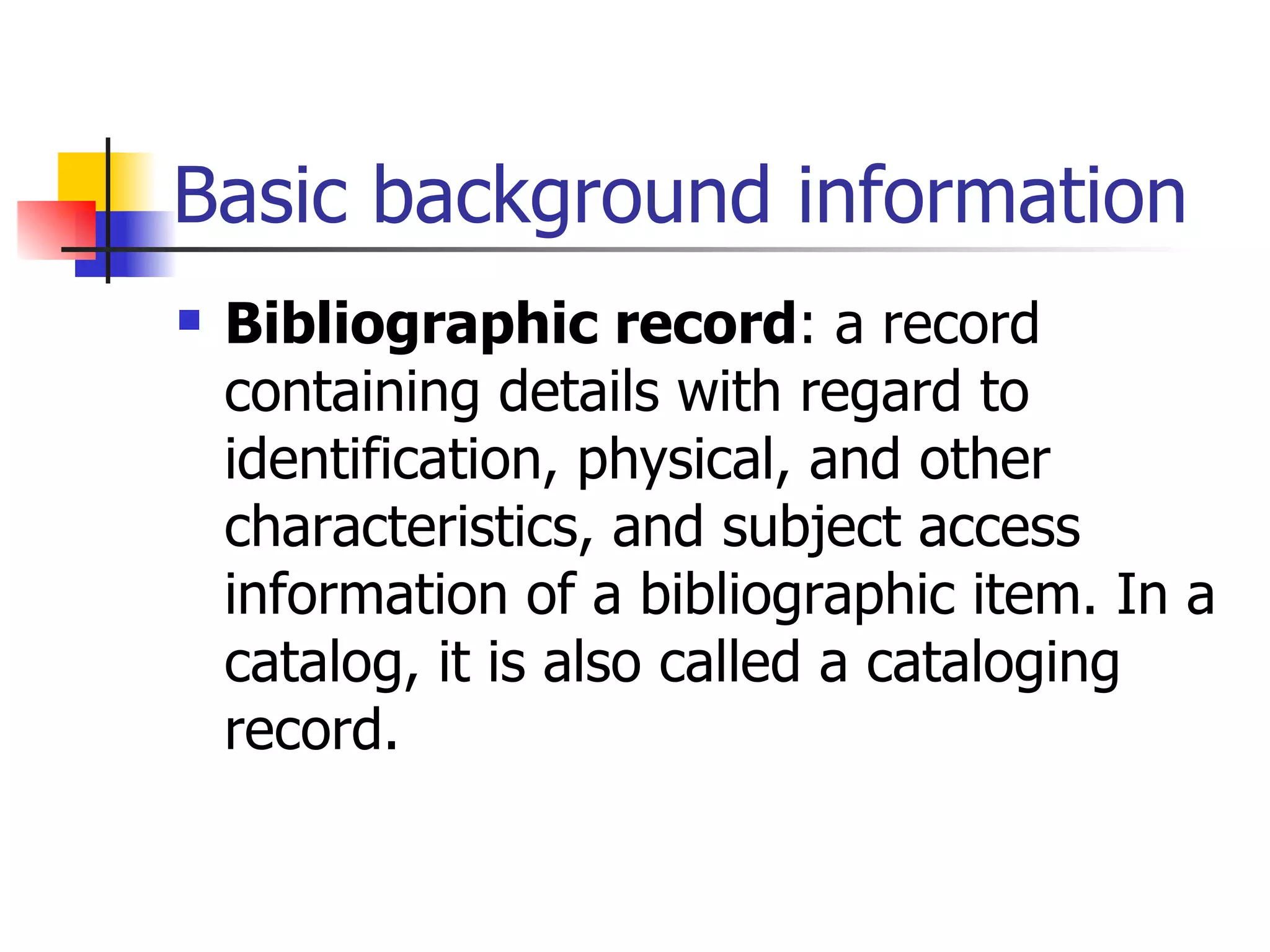
Basic background information Bibliographic record : a record containing details with regard to identification, physical, and other characteristics, and subject access information of a bibliographic item. In a catalog, it is also called a cataloging record.
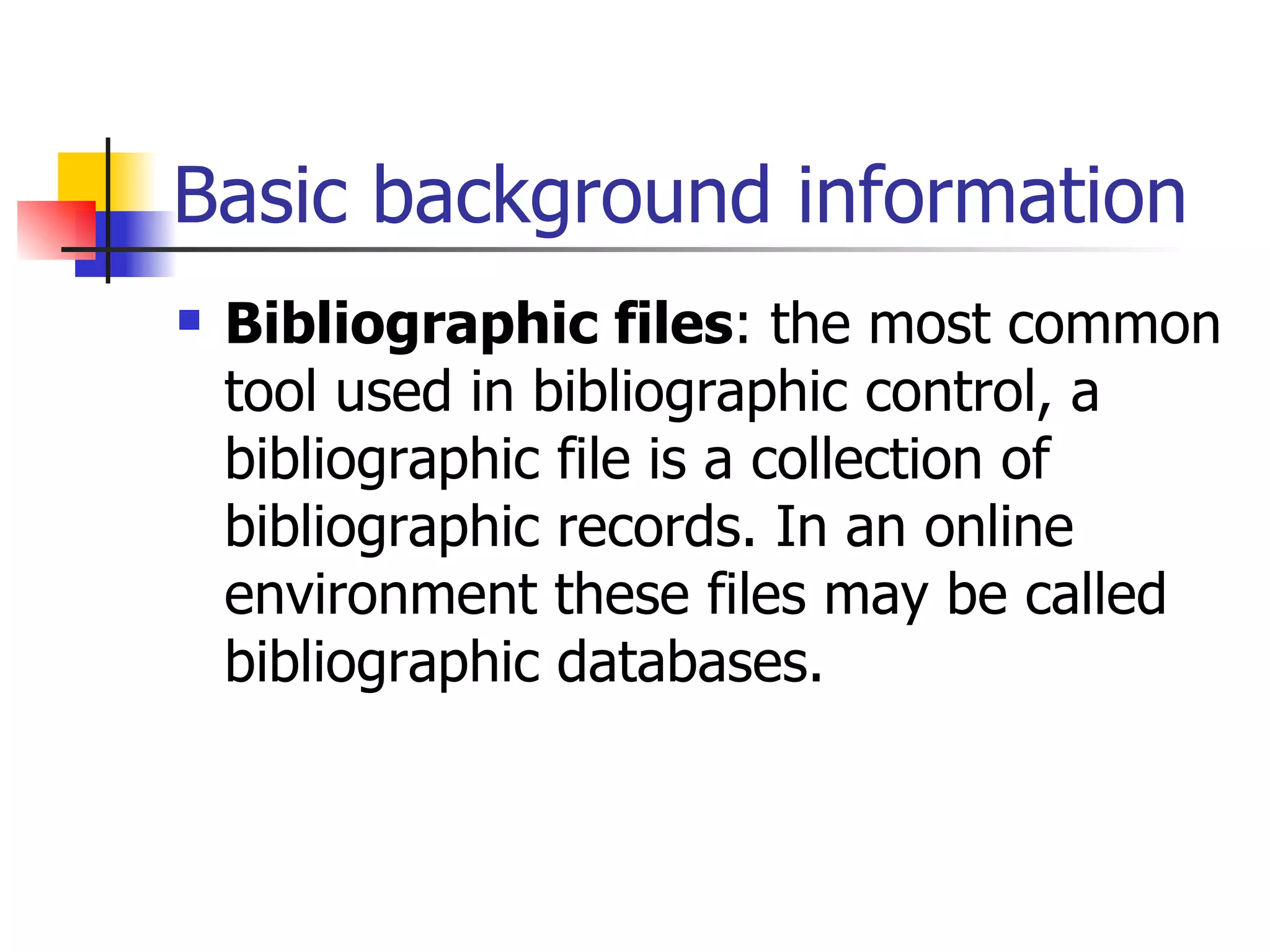
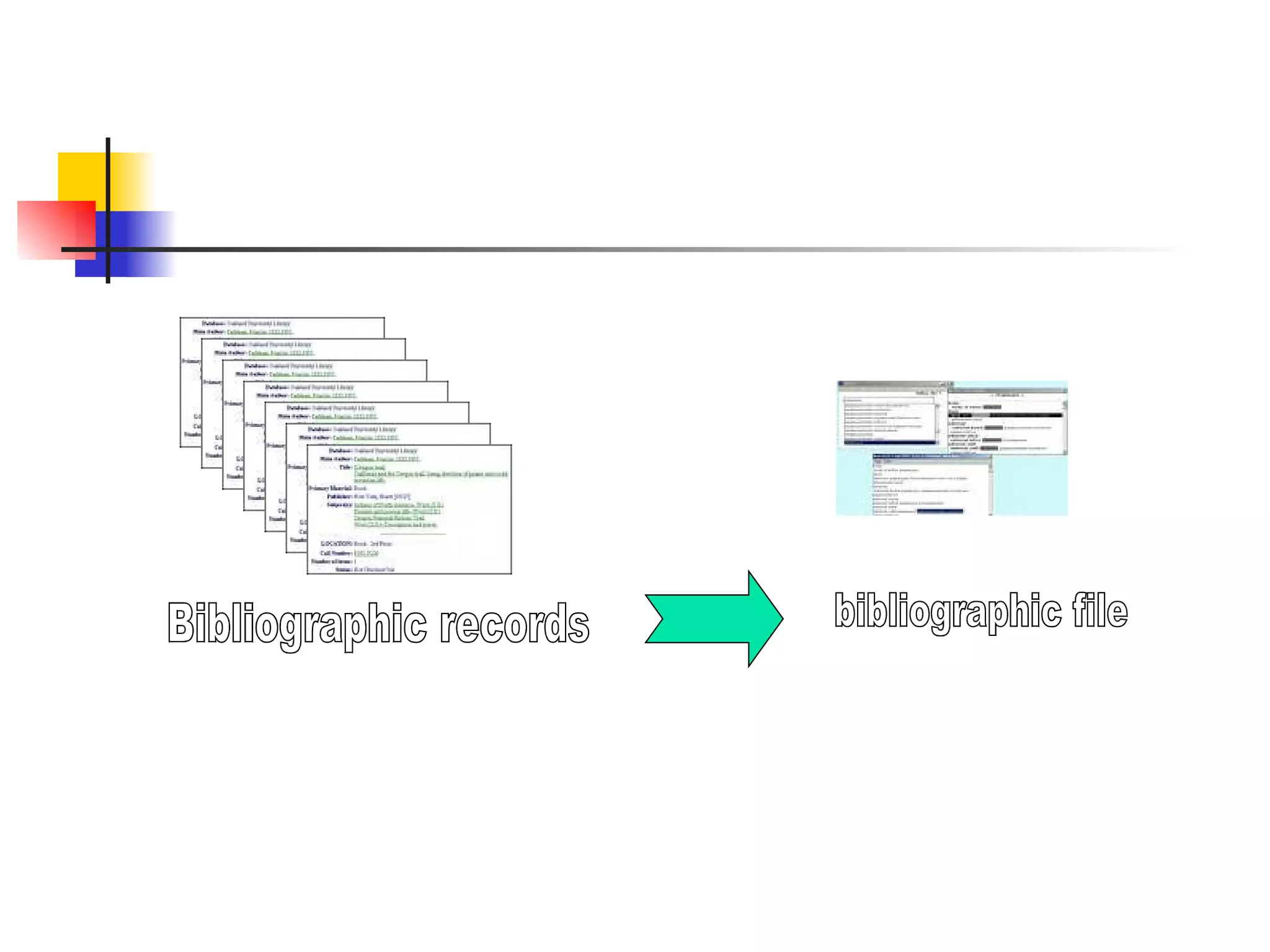
Basic background information Bibliographic files : the most common tool used in bibliographic control, a bibliographic file is a collection of bibliographic records. In an online environment these files may be called bibliographic databases.
Bibliographic records bibliographic file
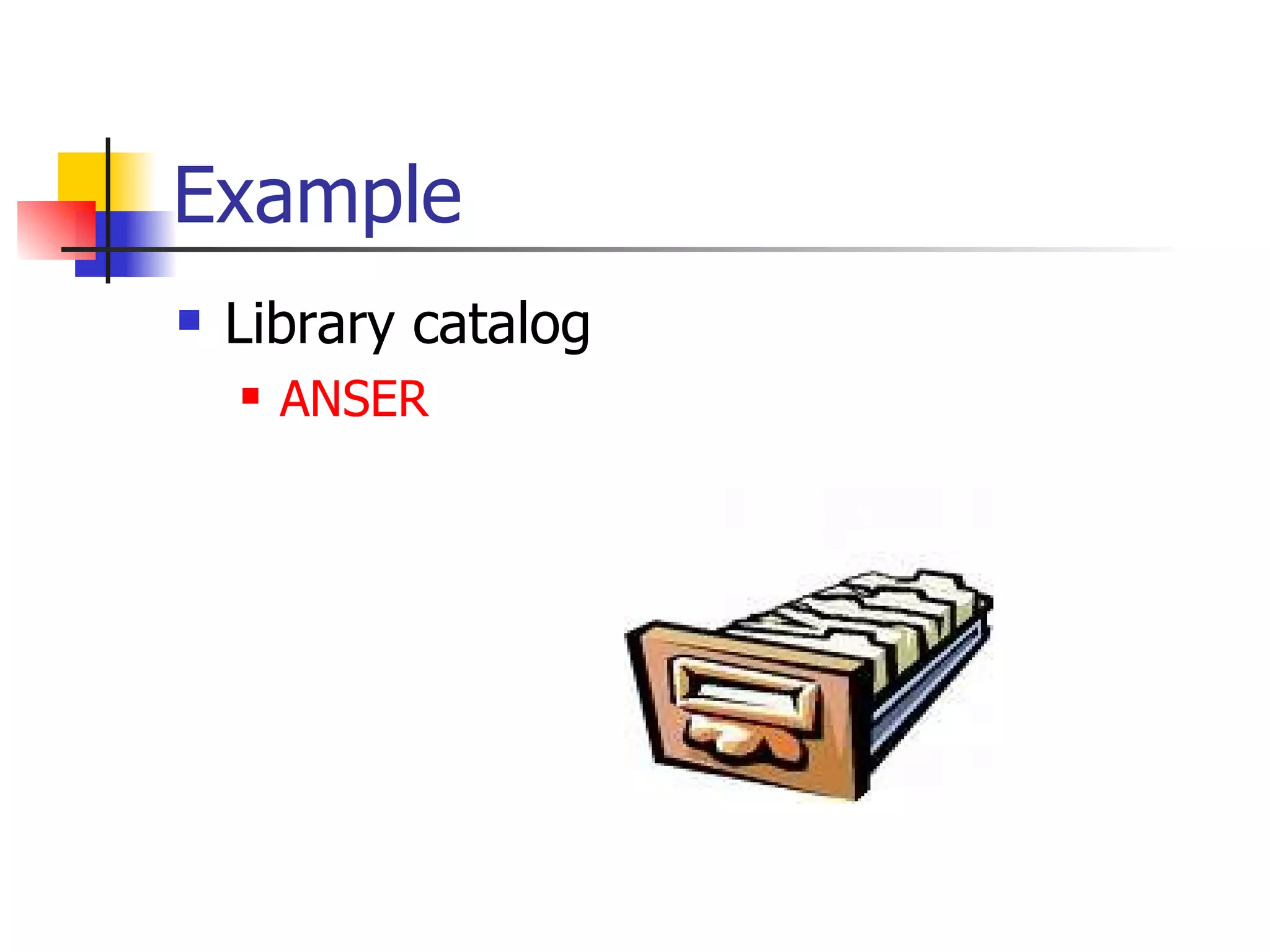
Basic background information Library catalog : a type of bibliographic file, but all its records pertain to items in one or more libraries and carry information on where the items can be found. Considered multiple access files in that they offer many ways to retrieve a particular record---by author, by title, by subject, and by other characteristics.
Example Library catalog ANSER
Basic background information Union catalog :  library catalogs that show the holdings of several libraries or collections.
Basic bib information Authority control :  A companion in the bibliographic control effort, it is the state where uniform terms are used for names and topics as access points, so that records pertaining to the same entity or concept are not dispersed among synonyms or variant name forms. Authority control resolves homonyms by distinguishing terms that are spelled the same but have different meanings.

Examples Union Catalog WorldCat MHLS catalog Authority Control Library of Congress authorities
Foundation Bibliographic records are the building blocks of a bibliographic file.
Bibliographic (bib) records Each bib record pertains to an item in the collection represented in the file, and contains two primary kinds of information: Enough data for the item to be identifiable in the context of the file At least one access point or label by which the record can be retrieved, or under which it is filed.
Other terms The bibliographic file represents the library’s holdings--it is what is commonly called the  catalog .  A  shelflist  is a copy of a subset of the bibliographic file it consists of an array of duplicates of main entries arranged in shelf order  it may contain information beyond basic bibliographic content, such as acquisition notes and number of copies owned.
Basic bib record info The bib record is the basic cataloging data, including: Classification data, or Class number Descriptive data Bibliographic description (title, statement of responsibility, edition, publication, physical description, series, notes, standard numbers,) Bibliographic access points (main entry, title, series, added entries) Subject cataloging data, or subject headings
Basic authority record info The authority record contains: The established heading for a person or a corporate body, the uniform title of a work, or a subject Cross-references from other names, titles, or terms not used for the heading and to and from related headings The source used in establishing the heading
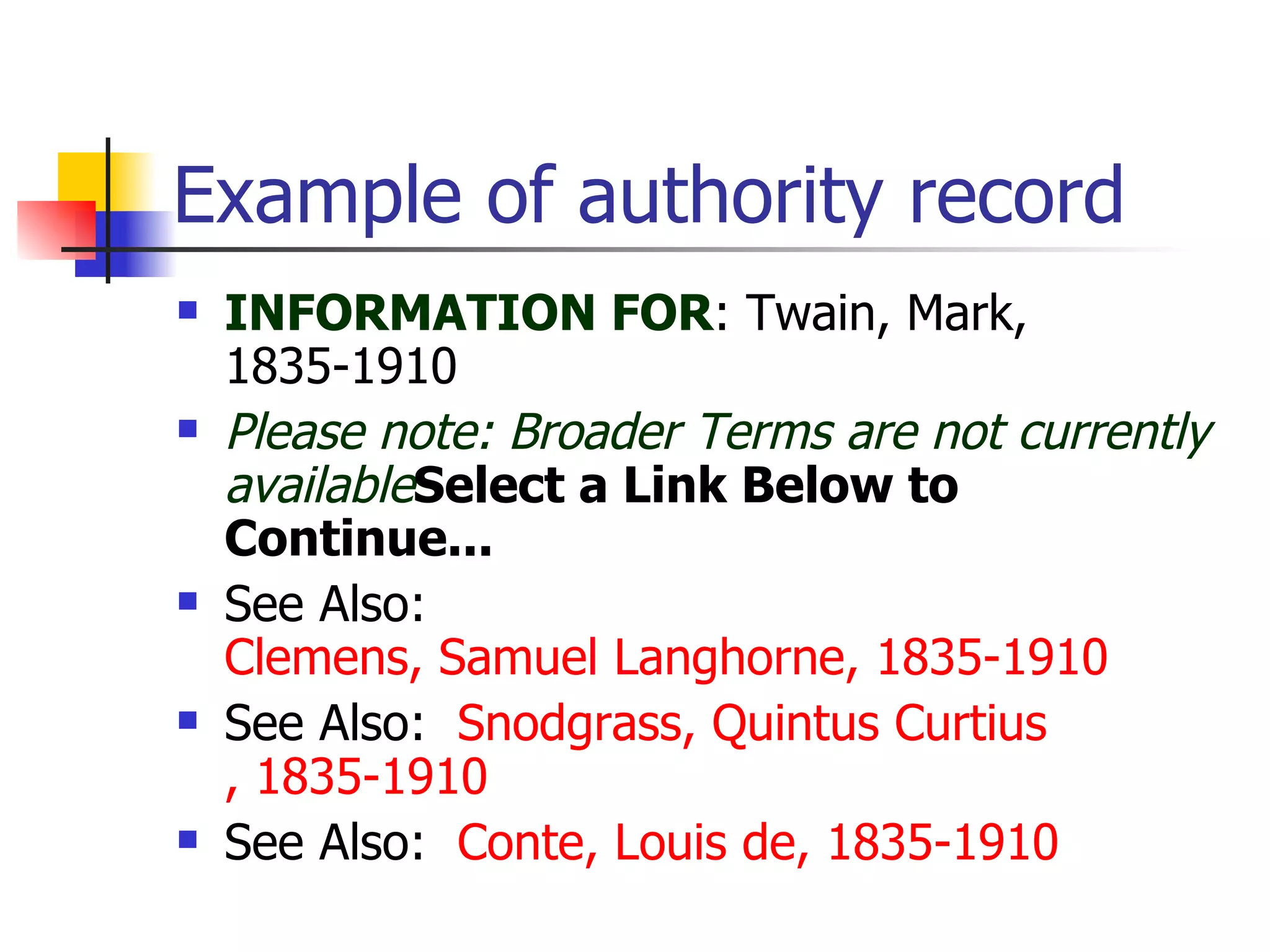
Example of authority record INFORMATION FOR : Twain, Mark, 1835-1910  Please note: Broader Terms are not currently available Select a Link Below to Continue... See Also:   Clemens, Samuel Langhorne, 1835-1910   See Also:   Snodgrass, Quintus  Curtius , 1835-1910   See Also:   Conte, Louis de, 1835-1910
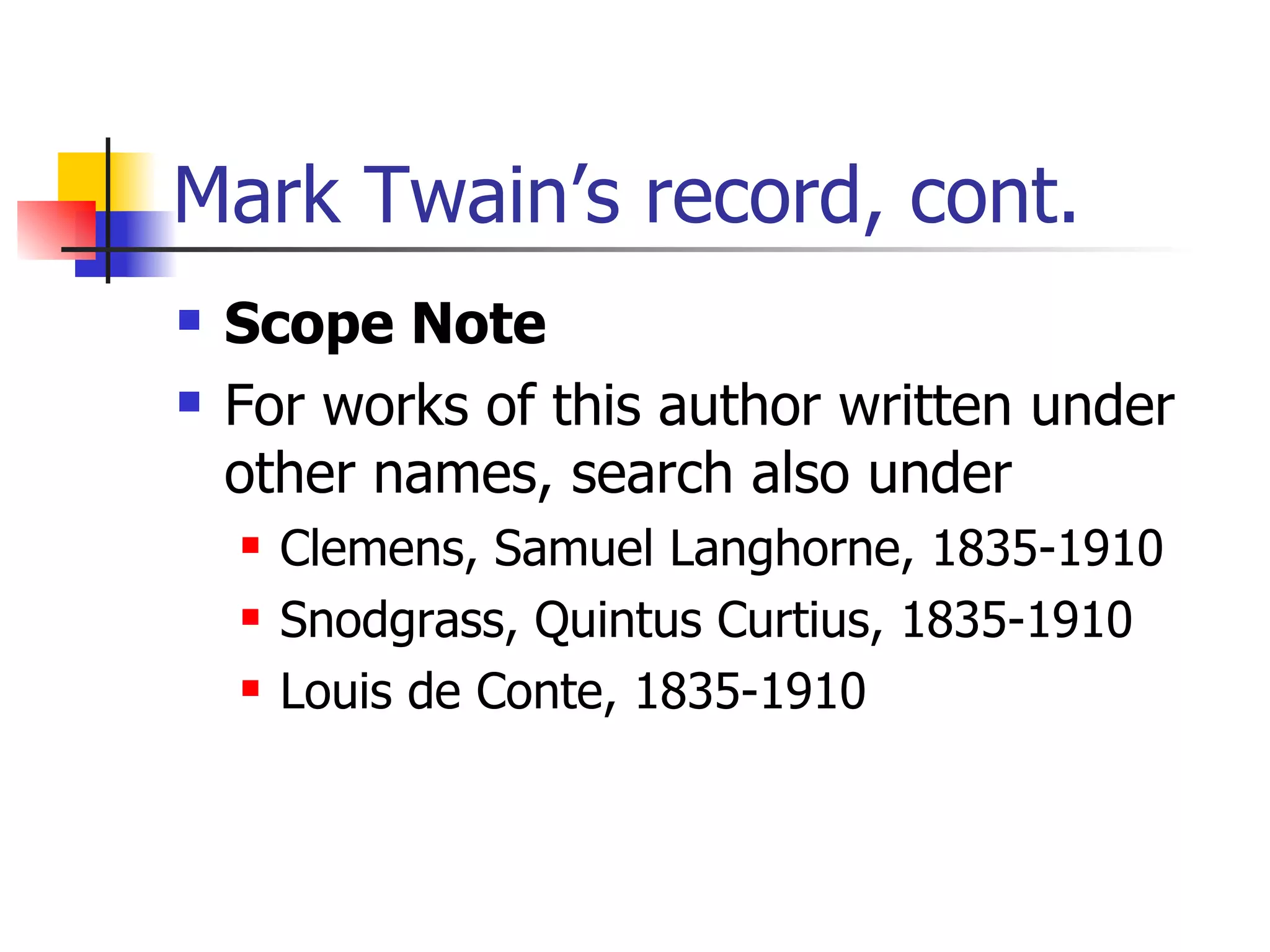
Mark Twain’s record, cont. Scope Note For works of this author written under other names, search also under  Clemens, Samuel Langhorne, 1835-1910 Snodgrass, Quintus Curtius, 1835-1910  Louis de Conte, 1835-1910
Questions?
For next class Chapter 2 in Wynar Review list of paper topics Choose a paper topic by next class Complete assignment sheets

Introduction to Information Processing

  • 1.
    Introduction and overviewIST 603 Information Processing Fall 2006 Denise A. Garofalo
  • 2.
    Overview Class meetingsPrerequisites Course objectives and competencies, text Performance evaluation, policies, grades Outline Basic info processing & bib control info Online at http://tinyurl.com/rrtfr (http://www.geocities.com/dgarony/IST603/main2006.html)
  • 3.
    Class meetings Thecourse will meet 13 times, Wednesdays from 4:30PM-7:15PM, September 6 through December 13 in the Community Room of the Marlboro Free Library (1251 Route 9W, corner of Route 9W and Bloom streets). Because of holidays, etc. class is suspended October 11, November 1, and November 22.
  • 4.
    Prerequisites Prerequisite: IIST602 A presumption of basic word processing skills and use of e-mail is held.
  • 5.
    Course objectives By completing this course students should acquire a basic understanding of information processing. Specifically, students should: gain an understanding of the concepts of bibliographic control; develop a practical understanding of the principles of bibliographic description and of the MARC (machine-readable cataloging) standard;
  • 6.
    More course objectiveslearn the techniques, advantages and disadvantages of utilizing standard subject heading lists such as Sears and LCSH (Library of Congress Subject Headings) to define the content of bibliographic material; develop a practical understanding of the structure and applications of major classification codes, including LC and Dewey;
  • 7.
    Course objectives, continuedbecome familiar with the principles of authority control and other methods of maintaining consistency and clarity in bibliographic databases; and, gain an understanding of bibliographic networks and utilities, workflow design and new approaches to cataloging in the changing information environment.
  • 8.
    Competencies At thecompletion of the course students will be able to: understand the functions of library catalogs in both a manual and an automated environment prepare basic catalog records for monographic materials which comply with bibliographic standards (ISBD, AACR2 and MARC) and understand the principles for applying these standards in real-world situations and with materials released in formats other than monographic.
  • 9.
    More competencies assignsubject headings to records using Sears and LCSH systems and understand the theoretical, practical and political implications of utilizing these and other standard thesauri for subject analysis assign basic call numbers using Dewey and LC classification systems and various Cutter tables understand the functions of authority records and data understand online bibliographic data such as OCLC records
  • 10.
    Competencies, continued evaluatethe effectiveness of library catalogs and cataloging practices in meeting user information needs understand the relationship between bibliographic control and library automation, reference work and collection development
  • 11.
  • 12.
    Text Required text:Taylor, Arlene G. Wynar's Introduction to Cataloging and Classification, revised 9th ed. Libraries Unlimited, c2004. ISBN 1-59158-213-X (pbk).
  • 13.
    Performance evaluation Gradeswill be determined based upon performance on class assignments, general class participation, a brief (under 5 pages) paper, a midterm examination and an in-class final examination. Evaluation is based on: 10% general class participation 30% midterm examination 20% class assignments 10% brief paper 30% final examination
  • 14.
    Policies A llwork is due as assigned Work will not be accepted late without express prior approval
  • 15.
    Policies Formal attendanceis not taken each class students need to attend class individual tutorials for missed work will not be available
  • 16.
    Policies No incompletes Expect grades to be averaged with a grade of 0 if do not attend class do not turn in assignments, exams or papers on time in the manner requested do not take the final examination
  • 17.
    Policies syllabus andassignments may be subject to change be prepared to handle any changes in assignments and other syllabus content
  • 18.
    Grades <=59 E79-76 C+ 64-60 D- 84-80 B- 65 D 85 B 69-66 D+ 89-86 B+ 74-70 C- 94-90 A- 75 C 100-95 A
  • 19.
    Outline 9/6 Introduction 9/13 How to think like a librarian 9/20 Bib control, MARC and access points 9/27 Subject analysis 10/4 Subject headings 10/11 Class suspended 10/18 Midterm
  • 20.
    Outline, continued 10/25 Bib control 11/1 Class suspended 11/8 Short paper due; authority records, bib control 11/15 Nature of bib control systems 11/22 Class suspended 12/6 Nature of bib control systems, future ; REVIEW 12/13 FINAL
  • 21.
  • 22.
  • 23.
    Basic background informationBibliographic control : the operations by which recorded information is organized or arranged according to established standards, and thereby made readily identifiable and retrievable. Some of the common activities involved in bibliographic control are indexing, classification, and descriptive and subject cataloging.
  • 24.
    Basic background informationBibliographic record : a record containing details with regard to identification, physical, and other characteristics, and subject access information of a bibliographic item. In a catalog, it is also called a cataloging record.
  • 25.
    Basic background informationBibliographic files : the most common tool used in bibliographic control, a bibliographic file is a collection of bibliographic records. In an online environment these files may be called bibliographic databases.
  • 26.
  • 27.
    Basic background informationLibrary catalog : a type of bibliographic file, but all its records pertain to items in one or more libraries and carry information on where the items can be found. Considered multiple access files in that they offer many ways to retrieve a particular record---by author, by title, by subject, and by other characteristics.
  • 28.
  • 29.
    Basic background informationUnion catalog : library catalogs that show the holdings of several libraries or collections.
  • 30.
    Basic bib informationAuthority control : A companion in the bibliographic control effort, it is the state where uniform terms are used for names and topics as access points, so that records pertaining to the same entity or concept are not dispersed among synonyms or variant name forms. Authority control resolves homonyms by distinguishing terms that are spelled the same but have different meanings.
  • 31.
    Examples Union CatalogWorldCat MHLS catalog Authority Control Library of Congress authorities
  • 32.
    Foundation Bibliographic recordsare the building blocks of a bibliographic file.
  • 33.
    Bibliographic (bib) recordsEach bib record pertains to an item in the collection represented in the file, and contains two primary kinds of information: Enough data for the item to be identifiable in the context of the file At least one access point or label by which the record can be retrieved, or under which it is filed.
  • 34.
    Other terms Thebibliographic file represents the library’s holdings--it is what is commonly called the catalog . A shelflist is a copy of a subset of the bibliographic file it consists of an array of duplicates of main entries arranged in shelf order it may contain information beyond basic bibliographic content, such as acquisition notes and number of copies owned.
  • 35.
    Basic bib recordinfo The bib record is the basic cataloging data, including: Classification data, or Class number Descriptive data Bibliographic description (title, statement of responsibility, edition, publication, physical description, series, notes, standard numbers,) Bibliographic access points (main entry, title, series, added entries) Subject cataloging data, or subject headings
  • 36.
    Basic authority recordinfo The authority record contains: The established heading for a person or a corporate body, the uniform title of a work, or a subject Cross-references from other names, titles, or terms not used for the heading and to and from related headings The source used in establishing the heading
  • 37.
    Example of authorityrecord INFORMATION FOR : Twain, Mark, 1835-1910 Please note: Broader Terms are not currently available Select a Link Below to Continue... See Also:   Clemens, Samuel Langhorne, 1835-1910 See Also:   Snodgrass, Quintus Curtius , 1835-1910 See Also:   Conte, Louis de, 1835-1910
  • 38.
    Mark Twain’s record,cont. Scope Note For works of this author written under other names, search also under Clemens, Samuel Langhorne, 1835-1910 Snodgrass, Quintus Curtius, 1835-1910 Louis de Conte, 1835-1910
  • 39.
  • 40.
    For next classChapter 2 in Wynar Review list of paper topics Choose a paper topic by next class Complete assignment sheets