MODULE -2 KINDS  OF  INFORMATION  SYSTEM
Information system Information systems are implemented within an organization for the purpose of improving the effectiveness and efficiency of that organization.
Kinds/ Types of IS Transaction Processing system Office Automation System Management Information System Decision Support System Group Decision Support System Expert System Executive Support System
Transaction Processing system A TPS is a information system that records company transaction…. A transaction is defined as a exchange  or cross-functional information system between two or more business entities….. Events that occur as part of doing business like sales, purchases, refunds and payments.. Eg: Ticket reservation
Characteristics of TPS It records Internal and external transaction for a company. It performs routine, repetitive task. Transaction can be recorded in online
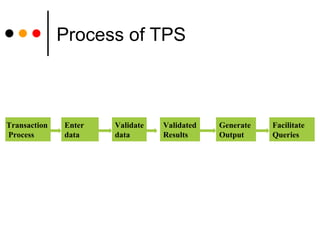
Process of TPS Transaction  Process Enter data Validate data Validated Results  Generate  Output Facilitate Queries
Process of TPS There are six steps in processing a transaction ……….. Data entry Data capture Data validation Processing and revalidation Storage Output generation Query support
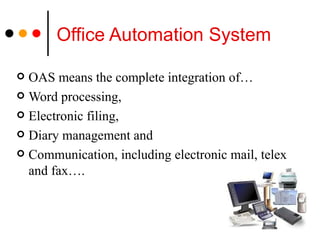
Office Automation System OAS means the complete integration of…  Word processing,  Electronic filing,  Diary management and  Communication, including electronic mail, telex and fax….
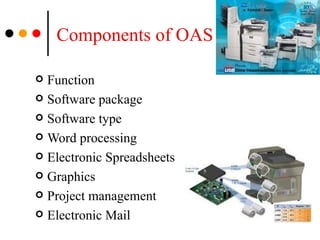
Components of OAS Function Software package Software type Word processing Electronic Spreadsheets Graphics Project management Electronic Mail
Advantages of OAS Increased productivity  Improved quality of work Improved organizational effectiveness Better service Better management control Disadvantages: Office staff became dependent on computers OAS is expensive than manual system Health problem to employees
Managemen t  Information  System According to G.B. Davis ,  “ MIS is an integrated man/machine system for providing information to support the operations, management  and decision making function in an organization” MIS is a system that aid management in making , carrying out and controlling decision.
Characteristics   of   MIS MIS is an integrative system MIS is coordinated system MIS is flexible MIS enhance productivity MIS is a feedback system MIS transform the data into information
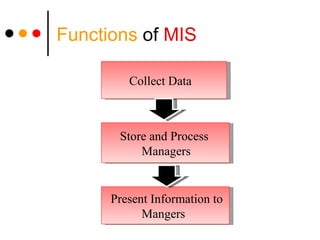
Functions  of  MIS Collect Data Store and Process Managers Present Information to Mangers
Application of MIS Strategy support Computers can assist management to understand the effects of their strategies and help enable effective decision making……… Data processing MIS system allow for the collation of vast amounts of business data, but they also provide a valuable time saving benefit to the workforce……………….
Decision Support System DSS is an outcome of MIS providing support for management at operational control, management control and strategic planning…. In DSS currently receiving much publicity is computer graphics….. The term decision support system refers to a system which support process of making decisions…..
Cont………. Definition….A set of well-integrated, user-friendly, computer-based tools that combine data with various decision making models- quantitative and qualitative to solve semi-structured and unstructured problems According to Scott Morton,  “ DSS as interactive computer based systems, which help decision-makers to utilize data and model to solve unstructured problems”
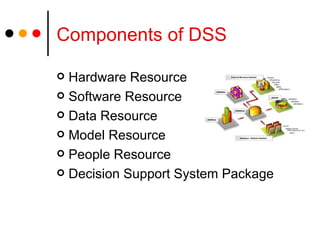
Components of DSS Hardware Resource Software Resource Data Resource  Model Resource People Resource Decision Support System Package
Application of DSS Independent problem Interrelated problem Organizational problem
Group Decision Support System Meaning of GDSS……….  GDSS is an interactive, computer based system that facilities solution of unstructured problem by set of decision makers working together as a group…..
Chacterstics of GDSS that Enhance Decision Making Special design Ease of use Flexibility Decision- Making Support Reduction of Negative group behavior Parallel communication
  Expert System An experts system is software that contains a knowledge base of facts and relationships and has ability to make inferences based on that knowledge base According to REBOH and REITER….. “ Expert systems are interactive computer programs incorporating judgment, rules of thumb, intuition and other expertise to provide knowledgeable advice about a variety of tasks”
Components of ES Knowledge acquisition subsystem Knowledge base Inference engine. User interface.
Business Application of Expert System Manufacturing Marketing Accounting and Finance Personnel General Business
Executive Support System EIS or ESS are information system that combine many of the features of management information system and decision support system …….
Components of EIS Hardware Software Interface Telecommunication
Applications of EIS Manufacturing Marketing Financial

Mis 2

  • 1.
    MODULE -2 KINDS OF INFORMATION SYSTEM
  • 2.
    Information system Informationsystems are implemented within an organization for the purpose of improving the effectiveness and efficiency of that organization.
  • 3.
    Kinds/ Types ofIS Transaction Processing system Office Automation System Management Information System Decision Support System Group Decision Support System Expert System Executive Support System
  • 4.
    Transaction Processing systemA TPS is a information system that records company transaction…. A transaction is defined as a exchange or cross-functional information system between two or more business entities….. Events that occur as part of doing business like sales, purchases, refunds and payments.. Eg: Ticket reservation
  • 5.
    Characteristics of TPSIt records Internal and external transaction for a company. It performs routine, repetitive task. Transaction can be recorded in online
  • 6.
    Process of TPSTransaction Process Enter data Validate data Validated Results Generate Output Facilitate Queries
  • 7.
    Process of TPSThere are six steps in processing a transaction ……….. Data entry Data capture Data validation Processing and revalidation Storage Output generation Query support
  • 8.
    Office Automation SystemOAS means the complete integration of… Word processing, Electronic filing, Diary management and Communication, including electronic mail, telex and fax….
  • 9.
    Components of OASFunction Software package Software type Word processing Electronic Spreadsheets Graphics Project management Electronic Mail
  • 10.
    Advantages of OASIncreased productivity Improved quality of work Improved organizational effectiveness Better service Better management control Disadvantages: Office staff became dependent on computers OAS is expensive than manual system Health problem to employees
  • 11.
    Managemen t Information System According to G.B. Davis , “ MIS is an integrated man/machine system for providing information to support the operations, management and decision making function in an organization” MIS is a system that aid management in making , carrying out and controlling decision.
  • 12.
    Characteristics of MIS MIS is an integrative system MIS is coordinated system MIS is flexible MIS enhance productivity MIS is a feedback system MIS transform the data into information
  • 13.
    Functions of MIS Collect Data Store and Process Managers Present Information to Mangers
  • 14.
    Application of MISStrategy support Computers can assist management to understand the effects of their strategies and help enable effective decision making……… Data processing MIS system allow for the collation of vast amounts of business data, but they also provide a valuable time saving benefit to the workforce……………….
  • 15.
    Decision Support SystemDSS is an outcome of MIS providing support for management at operational control, management control and strategic planning…. In DSS currently receiving much publicity is computer graphics….. The term decision support system refers to a system which support process of making decisions…..
  • 16.
    Cont………. Definition….A setof well-integrated, user-friendly, computer-based tools that combine data with various decision making models- quantitative and qualitative to solve semi-structured and unstructured problems According to Scott Morton, “ DSS as interactive computer based systems, which help decision-makers to utilize data and model to solve unstructured problems”
  • 17.
    Components of DSSHardware Resource Software Resource Data Resource Model Resource People Resource Decision Support System Package
  • 18.
    Application of DSSIndependent problem Interrelated problem Organizational problem
  • 19.
    Group Decision SupportSystem Meaning of GDSS………. GDSS is an interactive, computer based system that facilities solution of unstructured problem by set of decision makers working together as a group…..
  • 20.
    Chacterstics of GDSSthat Enhance Decision Making Special design Ease of use Flexibility Decision- Making Support Reduction of Negative group behavior Parallel communication
  • 21.
    ExpertSystem An experts system is software that contains a knowledge base of facts and relationships and has ability to make inferences based on that knowledge base According to REBOH and REITER….. “ Expert systems are interactive computer programs incorporating judgment, rules of thumb, intuition and other expertise to provide knowledgeable advice about a variety of tasks”
  • 22.
    Components of ESKnowledge acquisition subsystem Knowledge base Inference engine. User interface.
  • 23.
    Business Application ofExpert System Manufacturing Marketing Accounting and Finance Personnel General Business
  • 24.
    Executive Support SystemEIS or ESS are information system that combine many of the features of management information system and decision support system …….
  • 25.
    Components of EISHardware Software Interface Telecommunication
  • 26.
    Applications of EISManufacturing Marketing Financial