The Gift of the Nile Ancient Egypt
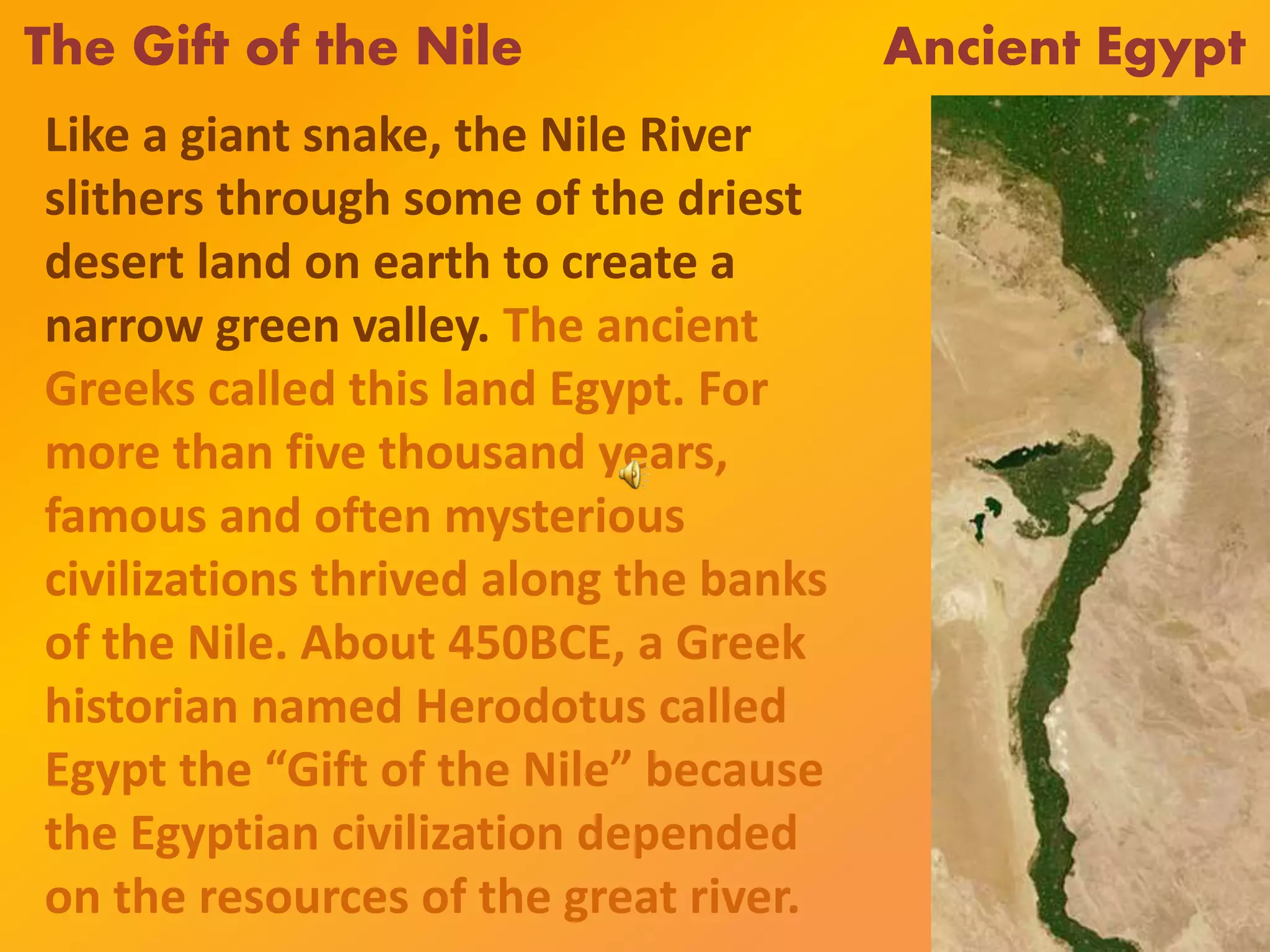
Like a giant snake, the Nile River
slithers through some of the driest
desert land on earth to create a
narrow green valley. The ancient
Greeks called this land Egypt. For
more than five thousand years,
famous and often mysterious
civilizations thrived along the banks
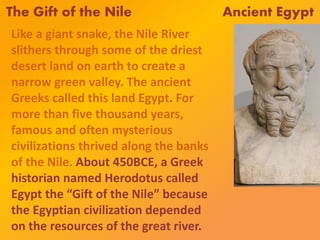
of the Nile. About 450BCE, a Greek
historian named Herodotus called
Egypt the “Gift of the Nile” because
the Egyptian civilization depended
on the resources of the great river.
The Gift of the Nile Ancient Egypt
Like a giant snake, the Nile River
slithers through some of the driest
desert land on earth to create a
narrow green valley. The ancient
Greeks called this land Egypt. For
more than five thousand years,
famous and often mysterious
civilizations thrived along the banks
of the Nile. About 450BCE, a Greek
historian named Herodotus called
Egypt the “Gift of the Nile” because
the Egyptian civilization depended
on the resources of the great river.
The Gift of the Nile Ancient Egypt
Like a giant snake, the Nile River
slithers through some of the driest
desert land on earth to create a
narrow green valley. The ancient
Greeks called this land Egypt. For
more than five thousand years,
famous and often mysterious
civilizations thrived along the banks
of the Nile. About 450BCE, a Greek
historian named Herodotus called
Egypt the “Gift of the Nile” because
the Egyptian civilization depended
on the resources of the great river.
The Gift of the Nile Ancient Egypt
Like a giant snake, the Nile River
slithers through some of the driest
desert land on earth to create a
narrow green valley. The ancient
Greeks called this land Egypt. For
more than five thousand years,
famous and often mysterious
civilizations thrived along the banks
of the Nile. About 450BCE, a Greek
historian named Herodotus called
Egypt the “Gift of the Nile” because
the Egyptian civilization depended
on the resources of the great river.
The Gift of the Nile Ancient Egypt
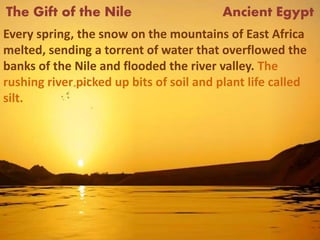
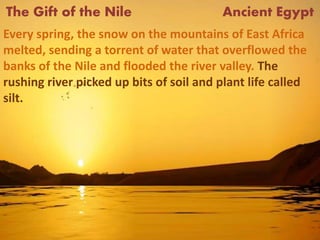
Every spring, the snow on the mountains of East Africa
melted, sending a torrent of water that overflowed the
banks of the Nile and flooded the river valley. The
rushing river picked up bits of soil and plant life called
silt.
The Gift of the Nile Ancient Egypt
Every spring, the snow on the mountains of East Africa
melted, sending a torrent of water that overflowed the
banks of the Nile and flooded the river valley. The
rushing river picked up bits of soil and plant life called
silt.
The Gift of the Nile Ancient Egypt
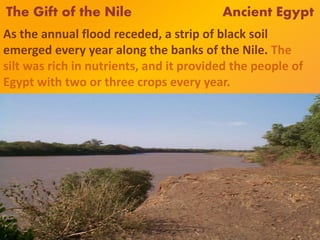
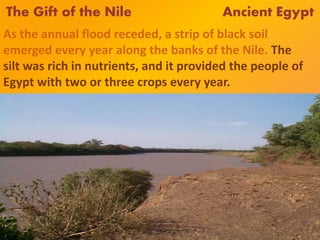
As the annual flood receded, a strip of black soil
emerged every year along the banks of the Nile. The
silt was rich in nutrients, and it provided the people of
Egypt with two or three crops every year.
The Gift of the Nile Ancient Egypt
As the annual flood receded, a strip of black soil
emerged every year along the banks of the Nile. The
silt was rich in nutrients, and it provided the people of
Egypt with two or three crops every year.
The Gift of the Nile Ancient Egypt
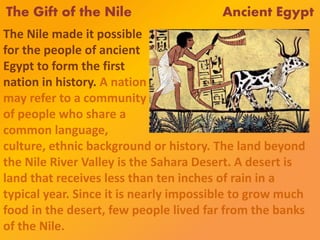
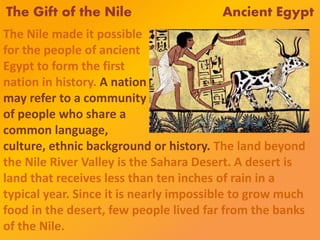
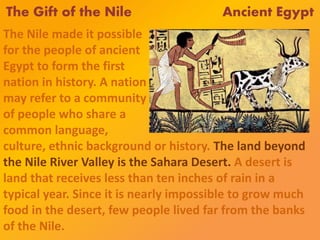
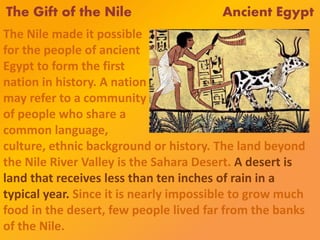
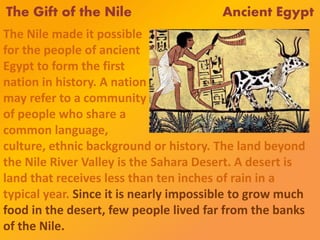
The Nile made it possible
for the people of ancient
Egypt to form the first
nation in history. A nation
may refer to a community
of people who share a
common language,
culture, ethnic background or history. The land beyond
the Nile River Valley is the Sahara Desert. A desert is
land that receives less than ten inches of rain in a
typical year. Since it is nearly impossible to grow much
food in the desert, few people lived far from the banks
of the Nile.
The Gift of the Nile Ancient Egypt
The Nile made it possible
for the people of ancient
Egypt to form the first
nation in history. A nation
may refer to a community
of people who share a
common language,
culture, ethnic background or history. The land beyond
the Nile River Valley is the Sahara Desert. A desert is
land that receives less than ten inches of rain in a
typical year. Since it is nearly impossible to grow much
food in the desert, few people lived far from the banks
of the Nile.
The Gift of the Nile Ancient Egypt
The Nile made it possible
for the people of ancient
Egypt to form the first
nation in history. A nation
may refer to a community
of people who share a
common language,
culture, ethnic background or history. The land beyond
the Nile River Valley is the Sahara Desert. A desert is
land that receives less than ten inches of rain in a
typical year. Since it is nearly impossible to grow much
food in the desert, few people lived far from the banks
of the Nile.
The Gift of the Nile Ancient Egypt
The Nile made it possible
for the people of ancient
Egypt to form the first
nation in history. A nation
may refer to a community
of people who share a
common language,
culture, ethnic background or history. The land beyond
the Nile River Valley is the Sahara Desert. A desert is
land that receives less than ten inches of rain in a
typical year. Since it is nearly impossible to grow much
food in the desert, few people lived far from the banks
of the Nile.
The Gift of the Nile Ancient Egypt
The Nile made it possible
for the people of ancient
Egypt to form the first
nation in history. A nation
may refer to a community
of people who share a
common language,
culture, ethnic background or history. The land beyond
the Nile River Valley is the Sahara Desert. A desert is
land that receives less than ten inches of rain in a
typical year. Since it is nearly impossible to grow much
food in the desert, few people lived far from the banks
of the Nile.
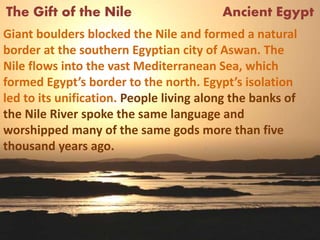
The Gift of the Nile Ancient Egypt
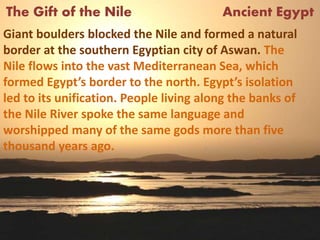
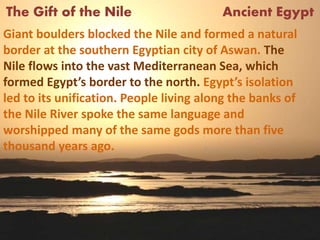
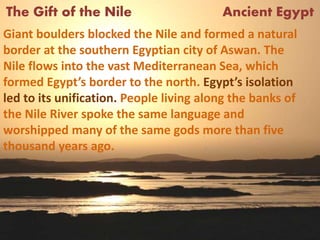
Giant boulders blocked the Nile and formed a natural
border at the southern Egyptian city of Aswan. The
Nile flows into the vast Mediterranean Sea, which
formed Egypt’s border to the north. Egypt’s isolation
led to its unification. People living along the banks of
the Nile River spoke the same language and
worshipped many of the same gods more than five
thousand years ago.
The Gift of the Nile Ancient Egypt
Giant boulders blocked the Nile and formed a natural
border at the southern Egyptian city of Aswan. The
Nile flows into the vast Mediterranean Sea, which
formed Egypt’s border to the north. Egypt’s isolation
led to its unification. People living along the banks of
the Nile River spoke the same language and
worshipped many of the same gods more than five
thousand years ago.
The Gift of the Nile Ancient Egypt
Giant boulders blocked the Nile and formed a natural
border at the southern Egyptian city of Aswan. The
Nile flows into the vast Mediterranean Sea, which
formed Egypt’s border to the north. Egypt’s isolation
led to its unification. People living along the banks of
the Nile River spoke the same language and
worshipped many of the same gods more than five
thousand years ago.
The Gift of the Nile Ancient Egypt
Giant boulders blocked the Nile and formed a natural
border at the southern Egyptian city of Aswan. The
Nile flows into the vast Mediterranean Sea, which
formed Egypt’s border to the north. Egypt’s isolation
led to its unification. People living along the banks of
the Nile River spoke the same language and
worshipped many of the same gods more than five
thousand years ago.
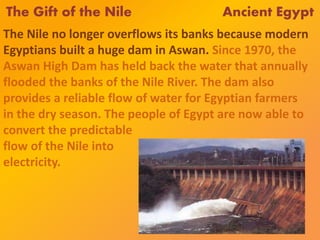
The Gift of the Nile Ancient Egypt
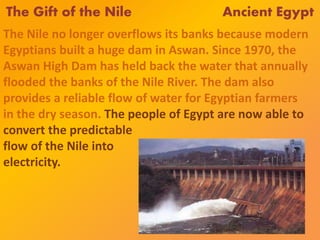
The Nile no longer overflows its banks because modern
Egyptians built a huge dam in Aswan. Since 1970, the
Aswan High Dam has held back the water that annually
flooded the banks of the Nile River. The dam also
provides a reliable flow of water for Egyptian farmers
in the dry season. The people of Egypt are now able to
convert the predictable
flow of the Nile into
electricity.
The Gift of the Nile Ancient Egypt
The Nile no longer overflows its banks because modern
Egyptians built a huge dam in Aswan. Since 1970, the
Aswan High Dam has held back the water that annually
flooded the banks of the Nile River. The dam also
provides a reliable flow of water for Egyptian farmers
in the dry season. The people of Egypt are now able to
convert the predictable
flow of the Nile into
electricity.
The Gift of the Nile Ancient Egypt
The Nile no longer overflows its banks because modern
Egyptians built a huge dam in Aswan. Since 1970, the
Aswan High Dam has held back the water that annually
flooded the banks of the Nile River. The dam also
provides a reliable flow of water for Egyptian farmers
in the dry season. The people of Egypt are now able to
convert the predictable
flow of the Nile into
electricity.
The Gift of the Nile Ancient Egypt
The Nile no longer overflows its banks because modern
Egyptians built a huge dam in Aswan. Since 1970, the
Aswan High Dam has held back the water that annually
flooded the banks of the Nile River. The dam also
provides a reliable flow of water for Egyptian farmers
in the dry season. The people of Egypt are now able to
convert the predictable
flow of the Nile into
electricity.
The Gift of the Nile Ancient Egypt
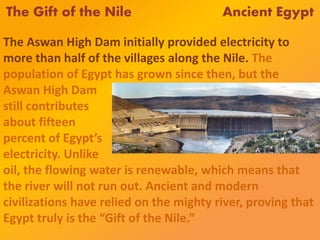
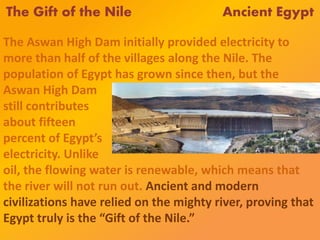
The Aswan High Dam initially provided electricity to
more than half of the villages along the Nile. The
population of Egypt has grown since then, but the
Aswan High Dam
still contributes
about fifteen
percent of Egypt’s
electricity. Unlike
oil, the flowing water is renewable, which means that
the river will not run out. Ancient and modern
civilizations have relied on the mighty river, proving that
Egypt truly is the “Gift of the Nile.”
The Gift of the Nile Ancient Egypt
The Aswan High Dam initially provided electricity to
more than half of the villages along the Nile. The
population of Egypt has grown since then, but the
Aswan High Dam
still contributes
about fifteen
percent of Egypt’s
electricity. Unlike
oil, the flowing water is renewable, which means that
the river will not run out. Ancient and modern
civilizations have relied on the mighty river, proving that
Egypt truly is the “Gift of the Nile.”
The Gift of the Nile Ancient Egypt
The Aswan High Dam initially provided electricity to
more than half of the villages along the Nile. The
population of Egypt has grown since then, but the
Aswan High Dam
still contributes
about fifteen
percent of Egypt’s
electricity. Unlike
oil, the flowing water is renewable, which means that
the river will not run out. Ancient and modern
civilizations have relied on the mighty river, proving that
Egypt truly is the “Gift of the Nile.”
The Gift of the Nile Ancient Egypt
The Aswan High Dam initially provided electricity to
more than half of the villages along the Nile. The
population of Egypt has grown since then, but the
Aswan High Dam
still contributes
about fifteen
percent of Egypt’s
electricity. Unlike
oil, the flowing water is renewable, which means that
the river will not run out. Ancient and modern
civilizations have relied on the mighty river, proving that
Egypt truly is the “Gift of the Nile.”
The Gift of the Nile Ancient Egypt
Learn more about history at
www.mrdowling.com
Music courtesy of Kevin MacLeod
http://incompetech.com/music/royalty-free/

604 egypt

  • 1.
    The Gift ofthe Nile Ancient Egypt Like a giant snake, the Nile River slithers through some of the driest desert land on earth to create a narrow green valley. The ancient Greeks called this land Egypt. For more than five thousand years, famous and often mysterious civilizations thrived along the banks of the Nile. About 450BCE, a Greek historian named Herodotus called Egypt the “Gift of the Nile” because the Egyptian civilization depended on the resources of the great river.
  • 2.
    The Gift ofthe Nile Ancient Egypt Like a giant snake, the Nile River slithers through some of the driest desert land on earth to create a narrow green valley. The ancient Greeks called this land Egypt. For more than five thousand years, famous and often mysterious civilizations thrived along the banks of the Nile. About 450BCE, a Greek historian named Herodotus called Egypt the “Gift of the Nile” because the Egyptian civilization depended on the resources of the great river.
  • 3.
    The Gift ofthe Nile Ancient Egypt Like a giant snake, the Nile River slithers through some of the driest desert land on earth to create a narrow green valley. The ancient Greeks called this land Egypt. For more than five thousand years, famous and often mysterious civilizations thrived along the banks of the Nile. About 450BCE, a Greek historian named Herodotus called Egypt the “Gift of the Nile” because the Egyptian civilization depended on the resources of the great river.
  • 4.
    The Gift ofthe Nile Ancient Egypt Like a giant snake, the Nile River slithers through some of the driest desert land on earth to create a narrow green valley. The ancient Greeks called this land Egypt. For more than five thousand years, famous and often mysterious civilizations thrived along the banks of the Nile. About 450BCE, a Greek historian named Herodotus called Egypt the “Gift of the Nile” because the Egyptian civilization depended on the resources of the great river.
  • 5.
    The Gift ofthe Nile Ancient Egypt Every spring, the snow on the mountains of East Africa melted, sending a torrent of water that overflowed the banks of the Nile and flooded the river valley. The rushing river picked up bits of soil and plant life called silt.
  • 6.
    The Gift ofthe Nile Ancient Egypt Every spring, the snow on the mountains of East Africa melted, sending a torrent of water that overflowed the banks of the Nile and flooded the river valley. The rushing river picked up bits of soil and plant life called silt.
  • 7.
    The Gift ofthe Nile Ancient Egypt As the annual flood receded, a strip of black soil emerged every year along the banks of the Nile. The silt was rich in nutrients, and it provided the people of Egypt with two or three crops every year.
  • 8.
    The Gift ofthe Nile Ancient Egypt As the annual flood receded, a strip of black soil emerged every year along the banks of the Nile. The silt was rich in nutrients, and it provided the people of Egypt with two or three crops every year.
  • 9.
    The Gift ofthe Nile Ancient Egypt The Nile made it possible for the people of ancient Egypt to form the first nation in history. A nation may refer to a community of people who share a common language, culture, ethnic background or history. The land beyond the Nile River Valley is the Sahara Desert. A desert is land that receives less than ten inches of rain in a typical year. Since it is nearly impossible to grow much food in the desert, few people lived far from the banks of the Nile.
  • 10.
    The Gift ofthe Nile Ancient Egypt The Nile made it possible for the people of ancient Egypt to form the first nation in history. A nation may refer to a community of people who share a common language, culture, ethnic background or history. The land beyond the Nile River Valley is the Sahara Desert. A desert is land that receives less than ten inches of rain in a typical year. Since it is nearly impossible to grow much food in the desert, few people lived far from the banks of the Nile.
  • 11.
    The Gift ofthe Nile Ancient Egypt The Nile made it possible for the people of ancient Egypt to form the first nation in history. A nation may refer to a community of people who share a common language, culture, ethnic background or history. The land beyond the Nile River Valley is the Sahara Desert. A desert is land that receives less than ten inches of rain in a typical year. Since it is nearly impossible to grow much food in the desert, few people lived far from the banks of the Nile.
  • 12.
    The Gift ofthe Nile Ancient Egypt The Nile made it possible for the people of ancient Egypt to form the first nation in history. A nation may refer to a community of people who share a common language, culture, ethnic background or history. The land beyond the Nile River Valley is the Sahara Desert. A desert is land that receives less than ten inches of rain in a typical year. Since it is nearly impossible to grow much food in the desert, few people lived far from the banks of the Nile.
  • 13.
    The Gift ofthe Nile Ancient Egypt The Nile made it possible for the people of ancient Egypt to form the first nation in history. A nation may refer to a community of people who share a common language, culture, ethnic background or history. The land beyond the Nile River Valley is the Sahara Desert. A desert is land that receives less than ten inches of rain in a typical year. Since it is nearly impossible to grow much food in the desert, few people lived far from the banks of the Nile.
  • 14.
    The Gift ofthe Nile Ancient Egypt Giant boulders blocked the Nile and formed a natural border at the southern Egyptian city of Aswan. The Nile flows into the vast Mediterranean Sea, which formed Egypt’s border to the north. Egypt’s isolation led to its unification. People living along the banks of the Nile River spoke the same language and worshipped many of the same gods more than five thousand years ago.
  • 15.
    The Gift ofthe Nile Ancient Egypt Giant boulders blocked the Nile and formed a natural border at the southern Egyptian city of Aswan. The Nile flows into the vast Mediterranean Sea, which formed Egypt’s border to the north. Egypt’s isolation led to its unification. People living along the banks of the Nile River spoke the same language and worshipped many of the same gods more than five thousand years ago.
  • 16.
    The Gift ofthe Nile Ancient Egypt Giant boulders blocked the Nile and formed a natural border at the southern Egyptian city of Aswan. The Nile flows into the vast Mediterranean Sea, which formed Egypt’s border to the north. Egypt’s isolation led to its unification. People living along the banks of the Nile River spoke the same language and worshipped many of the same gods more than five thousand years ago.
  • 17.
    The Gift ofthe Nile Ancient Egypt Giant boulders blocked the Nile and formed a natural border at the southern Egyptian city of Aswan. The Nile flows into the vast Mediterranean Sea, which formed Egypt’s border to the north. Egypt’s isolation led to its unification. People living along the banks of the Nile River spoke the same language and worshipped many of the same gods more than five thousand years ago.
  • 18.
    The Gift ofthe Nile Ancient Egypt The Nile no longer overflows its banks because modern Egyptians built a huge dam in Aswan. Since 1970, the Aswan High Dam has held back the water that annually flooded the banks of the Nile River. The dam also provides a reliable flow of water for Egyptian farmers in the dry season. The people of Egypt are now able to convert the predictable flow of the Nile into electricity.
  • 19.
    The Gift ofthe Nile Ancient Egypt The Nile no longer overflows its banks because modern Egyptians built a huge dam in Aswan. Since 1970, the Aswan High Dam has held back the water that annually flooded the banks of the Nile River. The dam also provides a reliable flow of water for Egyptian farmers in the dry season. The people of Egypt are now able to convert the predictable flow of the Nile into electricity.
  • 20.
    The Gift ofthe Nile Ancient Egypt The Nile no longer overflows its banks because modern Egyptians built a huge dam in Aswan. Since 1970, the Aswan High Dam has held back the water that annually flooded the banks of the Nile River. The dam also provides a reliable flow of water for Egyptian farmers in the dry season. The people of Egypt are now able to convert the predictable flow of the Nile into electricity.
  • 21.
    The Gift ofthe Nile Ancient Egypt The Nile no longer overflows its banks because modern Egyptians built a huge dam in Aswan. Since 1970, the Aswan High Dam has held back the water that annually flooded the banks of the Nile River. The dam also provides a reliable flow of water for Egyptian farmers in the dry season. The people of Egypt are now able to convert the predictable flow of the Nile into electricity.
  • 22.
    The Gift ofthe Nile Ancient Egypt The Aswan High Dam initially provided electricity to more than half of the villages along the Nile. The population of Egypt has grown since then, but the Aswan High Dam still contributes about fifteen percent of Egypt’s electricity. Unlike oil, the flowing water is renewable, which means that the river will not run out. Ancient and modern civilizations have relied on the mighty river, proving that Egypt truly is the “Gift of the Nile.”
  • 23.
    The Gift ofthe Nile Ancient Egypt The Aswan High Dam initially provided electricity to more than half of the villages along the Nile. The population of Egypt has grown since then, but the Aswan High Dam still contributes about fifteen percent of Egypt’s electricity. Unlike oil, the flowing water is renewable, which means that the river will not run out. Ancient and modern civilizations have relied on the mighty river, proving that Egypt truly is the “Gift of the Nile.”
  • 24.
    The Gift ofthe Nile Ancient Egypt The Aswan High Dam initially provided electricity to more than half of the villages along the Nile. The population of Egypt has grown since then, but the Aswan High Dam still contributes about fifteen percent of Egypt’s electricity. Unlike oil, the flowing water is renewable, which means that the river will not run out. Ancient and modern civilizations have relied on the mighty river, proving that Egypt truly is the “Gift of the Nile.”
  • 25.
    The Gift ofthe Nile Ancient Egypt The Aswan High Dam initially provided electricity to more than half of the villages along the Nile. The population of Egypt has grown since then, but the Aswan High Dam still contributes about fifteen percent of Egypt’s electricity. Unlike oil, the flowing water is renewable, which means that the river will not run out. Ancient and modern civilizations have relied on the mighty river, proving that Egypt truly is the “Gift of the Nile.”
  • 26.
    The Gift ofthe Nile Ancient Egypt Learn more about history at www.mrdowling.com Music courtesy of Kevin MacLeod http://incompetech.com/music/royalty-free/