TOPICS
MIS (Management information system)
DSS(Decision support system)MANAGEMENT INFORMATION SYSTEM
Data vs. InformationDataA “given,” or fact; a number, a statement, or a pictureRepresents something in the real worldThe raw materials in the production of information.InformationData that have meaning within a contextData in meaningful formData after manipulation.Data, Information, and Systems
What Is a System?System: A set of components that work together to achieve a common goalSubsystem: Asystem that is part of some larger systemData, Information, and Systems
. Why Do People Need Information?Individuals - Entertainment and enlightenmentBusinesses - Decision making, problem solving and control. Information Systems
An organized combination of people, hardware, software, communication networks, and data resources .To collect, transform, and disseminates information in an organization.Information system
Manual systemComputer based information systemInformation system types
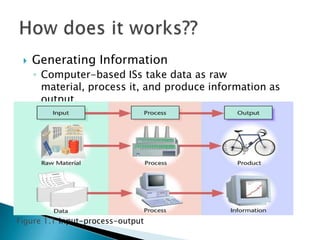
Generating InformationComputer-based ISs take data as raw material, process it, and produce information as output.How does it works??Figure 1.1 Input-process-output
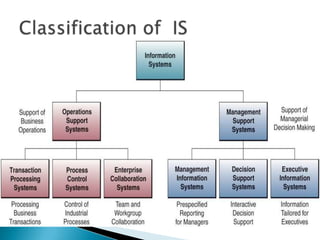
Classification of  IS
M =Management= Practical Use of Power of Decision Making
I =Information= Useful Data
S =System= Technique of Use of Data for BusinessNow, we are able to introduce Management Information System. MIS STANDS FOR…..
A management information system (MIS) is a system that provides information needed to manage organizations effectively.MIS Provide information in the form of reports and displays to managers to support business decision making. It is a sub part of information system.What is “MIS”??
An MIS provides managers with information and support for effective decision making.
provides feedback on daily operations
Output(reports), are usually generated through accumulation of transaction processing data
Each MIS is an integrated collection of subsystems, which are typically organized along functional lines within an organization.Management information system (MIS)
Transaction processing systems, (routine transactions)like payroll, shipping, or sales orders.Office automation systems, like word processing, electronic mail, and digital filing.Examples of MIS
Routine information for routine decisions.
Operational efficiency.
Use transaction data as main input.
Databases put together MIS in different functional areas.MIS Helpful for..
To design and implement man-machine procedures, processes, and routines that provide suitably detailed reports in an accurate, consistent, and timely manner.objective
Scheduled reportsProduced periodically, or on a schedule (daily, weekly, monthly)Key-indicator reportSummarizes the previous day’s critical activitiesTypically available at the beginning of each dayDemand reportGives certain information at a manager’s requestException reportAutomatically produced when a situation is unusual or requires management actionOutputs of MIS
Characteristics of a MISProvides reports with fixed and standard formats
Hard-copy and soft-copy reports
Uses internal data stored in the computer system
MIS eliminates redundant data
End users can develop custom reports
Requires formal requests from users
It promotes security system by providing only access to authorized users.Provides support to managers as they work to achieve corporate goals.Enables managers to compare results to established company goals and identify problem areas and opportunities for improvement.Management Information Systems for Competitive Advantage
Applications of MIS.
*Strategy SupportProvide financial statements and performance reports to assist in the planning, monitoring and implementation of strategy. MIS systems can also use these raw data to run hypothetical scenarios like ‘what if’ questions.
For instance, MIS systems can provide predictions about the effect on sales that an alteration in price would have on a product.  MIS provide a valuable time saving benefit to the workforce.In past business information had to be manually processed for filing and analysisNow it can be entered quickly and easily onto a computer by a data processor, allowing for faster decision making and quicker reflexes for the enterprise as a whole.* Data Processing
Management by ObjectivesMIS also be of use as a Management by Objectives (MBO) tool.MBO is a management process by which managers and subordinates agree upon a series of objectives for the subordinate to attempt to achieve within a set time frame. Objectives are set using the SMART ratio: that is, objectives should be Specific, Measurable, Agreed, Realistic and Time-Specific.
a) Quicker information availabilityb) Anytime anywhere access to informationc) Promotes non redundancyd) Quick decision-makinge) Fast actions undertakenf) Effective productivityg) Reduced transaction rateImpact of MIS on business
It Facilitates planning.
It Minimizes information overload.
MIS Encourages Decentralization.
It brings Co ordination(connects all decision centers in the organization).
It makes control easier.
Reduce paper work.
 MIS assembles, process , stores , Retrieves , evaluates and Disseminates the information .Benefits of MIS
Allocation of budgets for MIS upgrades.Highly sensitive requires constant monitoringQuality of outputs governed by quality of inputsEffectiveness decreases due to frequent changes in top managementlack of flexibility to update itself.UnemploymentDrawbacks of MIS
Workforce downsizingInformation overloadEmployee mistrustDifficult to builtSecurity breachesChallenges
Enhanced global competitivenessCapture market opportunitiesSupport corporate strategyEnhance worker productivityImprove quality of goods and servicesOpportunities

MIS presentation

  • 1.
  • 2.
  • 3.
  • 4.
    Data vs. InformationDataA“given,” or fact; a number, a statement, or a pictureRepresents something in the real worldThe raw materials in the production of information.InformationData that have meaning within a contextData in meaningful formData after manipulation.Data, Information, and Systems
  • 5.
    What Is aSystem?System: A set of components that work together to achieve a common goalSubsystem: Asystem that is part of some larger systemData, Information, and Systems
  • 6.
    . Why DoPeople Need Information?Individuals - Entertainment and enlightenmentBusinesses - Decision making, problem solving and control. Information Systems
  • 7.
    An organized combinationof people, hardware, software, communication networks, and data resources .To collect, transform, and disseminates information in an organization.Information system
  • 8.
    Manual systemComputer basedinformation systemInformation system types
  • 9.
    Generating InformationComputer-based ISstake data as raw material, process it, and produce information as output.How does it works??Figure 1.1 Input-process-output
  • 10.
  • 11.
    M =Management= PracticalUse of Power of Decision Making
  • 12.
  • 13.
    S =System= Techniqueof Use of Data for BusinessNow, we are able to introduce Management Information System. MIS STANDS FOR…..
  • 14.
    A management informationsystem (MIS) is a system that provides information needed to manage organizations effectively.MIS Provide information in the form of reports and displays to managers to support business decision making. It is a sub part of information system.What is “MIS”??
  • 15.
    An MIS providesmanagers with information and support for effective decision making.
  • 16.
    provides feedback ondaily operations
  • 17.
    Output(reports), are usuallygenerated through accumulation of transaction processing data
  • 18.
    Each MIS isan integrated collection of subsystems, which are typically organized along functional lines within an organization.Management information system (MIS)
  • 19.
    Transaction processing systems,(routine transactions)like payroll, shipping, or sales orders.Office automation systems, like word processing, electronic mail, and digital filing.Examples of MIS
  • 20.
    Routine information forroutine decisions.
  • 21.
  • 22.
    Use transaction dataas main input.
  • 23.
    Databases put togetherMIS in different functional areas.MIS Helpful for..
  • 24.
    To design andimplement man-machine procedures, processes, and routines that provide suitably detailed reports in an accurate, consistent, and timely manner.objective
  • 25.
    Scheduled reportsProduced periodically,or on a schedule (daily, weekly, monthly)Key-indicator reportSummarizes the previous day’s critical activitiesTypically available at the beginning of each dayDemand reportGives certain information at a manager’s requestException reportAutomatically produced when a situation is unusual or requires management actionOutputs of MIS
  • 26.
    Characteristics of aMISProvides reports with fixed and standard formats
  • 27.
  • 28.
    Uses internal datastored in the computer system
  • 29.
  • 30.
    End users candevelop custom reports
  • 31.
  • 32.
    It promotes securitysystem by providing only access to authorized users.Provides support to managers as they work to achieve corporate goals.Enables managers to compare results to established company goals and identify problem areas and opportunities for improvement.Management Information Systems for Competitive Advantage
  • 33.
  • 34.
    *Strategy SupportProvide financialstatements and performance reports to assist in the planning, monitoring and implementation of strategy. MIS systems can also use these raw data to run hypothetical scenarios like ‘what if’ questions.
  • 35.
    For instance, MISsystems can provide predictions about the effect on sales that an alteration in price would have on a product.  MIS provide a valuable time saving benefit to the workforce.In past business information had to be manually processed for filing and analysisNow it can be entered quickly and easily onto a computer by a data processor, allowing for faster decision making and quicker reflexes for the enterprise as a whole.* Data Processing
  • 36.
    Management by ObjectivesMISalso be of use as a Management by Objectives (MBO) tool.MBO is a management process by which managers and subordinates agree upon a series of objectives for the subordinate to attempt to achieve within a set time frame. Objectives are set using the SMART ratio: that is, objectives should be Specific, Measurable, Agreed, Realistic and Time-Specific.
  • 37.
    a) Quicker informationavailabilityb) Anytime anywhere access to informationc) Promotes non redundancyd) Quick decision-makinge) Fast actions undertakenf) Effective productivityg) Reduced transaction rateImpact of MIS on business
  • 38.
  • 39.
  • 40.
  • 41.
    It brings Coordination(connects all decision centers in the organization).
  • 42.
  • 43.
  • 44.
    MIS assembles,process , stores , Retrieves , evaluates and Disseminates the information .Benefits of MIS
  • 45.
    Allocation of budgetsfor MIS upgrades.Highly sensitive requires constant monitoringQuality of outputs governed by quality of inputsEffectiveness decreases due to frequent changes in top managementlack of flexibility to update itself.UnemploymentDrawbacks of MIS
  • 46.
    Workforce downsizingInformation overloadEmployeemistrustDifficult to builtSecurity breachesChallenges
  • 47.
    Enhanced global competitivenessCapturemarket opportunitiesSupport corporate strategyEnhance worker productivityImprove quality of goods and servicesOpportunities