TOOLS FOR MORE EQUITABLE WATER
     DISTRIBUTION IN EGYPT


         Abdel Rahman shafey
    Assem Ahmed Alsawy Abdel Hak
PROBLEM STATEMENT

   Irrigation distribution in Egypt nowadays is facing a
    challenge, upstream water users tend to have more than
    their adequate share at the expense of those downstream.
OBJECTIVE

   Build a tool that enable the tracking of water abstraction
    by individual mesqas, which could help resolve this
    problem and support a more equitable water distribution
    system, consequently helping to increase irrigation
    efficiencies.
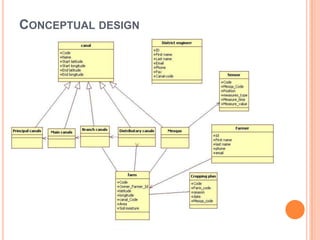
CONCEPTUAL DESIGN
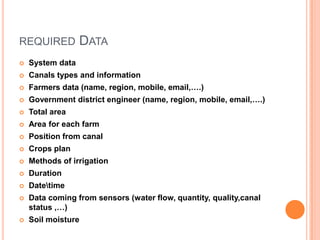
REQUIRED          DATA
   System data
   Canals types and information
   Farmers data (name, region, mobile, email,….)
   Government district engineer (name, region, mobile, email,….)
   Total area
   Area for each farm
   Position from canal
   Crops plan
   Methods of irrigation
   Duration
   Datetime
   Data coming from sensors (water flow, quantity, quality,canal
    status ,…)
   Soil moisture
REQUIREMENT SPECIFICATIONS

 Actors
 System data

 Technologies
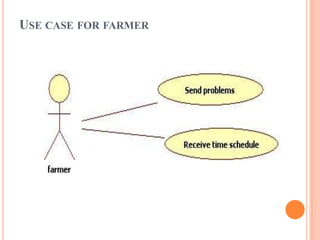
USE CASE FOR FARMER
USE CASE FOR DISTRICT UTILITY ENGINEER
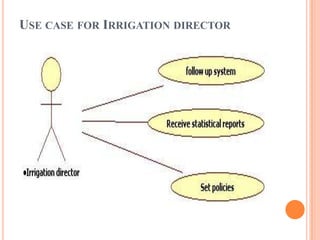
USE CASE FOR IRRIGATION DIRECTOR
TECHNOLOGIES

 Statistical analysis tools :To draw charts
 GIS : to draw maps, set layers

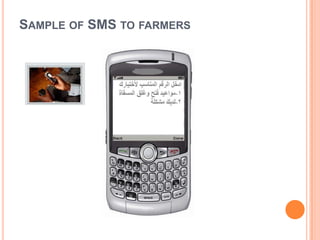
 SMS mobile system

 Sensors

 Data warehouse

 Data mining
SEQUENCE DIAGRAM FOR SMS
SAMPLE OF SMS TO FARMERS
DETERMIE PERIORITY
    Using fuzzy numbers
SAMPLE OF STATISTICAL DATA
60


50


40


                                               Emergency Need water
30                                             Satisfied farm
                                               On safe mode
                                               Mixed
20


10


 0
     up stream   down stream   middle stream
SAMPLES OF MAPS
TYPES OF PROBLEMS MAPS
Thank you

Water distribution

  • 1.
    TOOLS FOR MOREEQUITABLE WATER DISTRIBUTION IN EGYPT Abdel Rahman shafey Assem Ahmed Alsawy Abdel Hak
  • 2.
    PROBLEM STATEMENT  Irrigation distribution in Egypt nowadays is facing a challenge, upstream water users tend to have more than their adequate share at the expense of those downstream.
  • 3.
    OBJECTIVE  Build a tool that enable the tracking of water abstraction by individual mesqas, which could help resolve this problem and support a more equitable water distribution system, consequently helping to increase irrigation efficiencies.
  • 4.
  • 5.
    REQUIRED DATA  System data  Canals types and information  Farmers data (name, region, mobile, email,….)  Government district engineer (name, region, mobile, email,….)  Total area  Area for each farm  Position from canal  Crops plan  Methods of irrigation  Duration  Datetime  Data coming from sensors (water flow, quantity, quality,canal status ,…)  Soil moisture
  • 6.
    REQUIREMENT SPECIFICATIONS  Actors System data  Technologies
  • 7.
  • 8.
    USE CASE FORDISTRICT UTILITY ENGINEER
  • 9.
    USE CASE FORIRRIGATION DIRECTOR
  • 10.
    TECHNOLOGIES  Statistical analysistools :To draw charts  GIS : to draw maps, set layers  SMS mobile system  Sensors  Data warehouse  Data mining
  • 11.
  • 12.
    SAMPLE OF SMSTO FARMERS
  • 13.
    SAMPLE OF SMSTO FARMERS
  • 14.
    DETERMIE PERIORITY  Using fuzzy numbers
  • 15.
    SAMPLE OF STATISTICALDATA 60 50 40 Emergency Need water 30 Satisfied farm On safe mode Mixed 20 10 0 up stream down stream middle stream
  • 16.
  • 17.
  • 18.