INFORMATION
SYSTEMS IN
ORGANISATIONS
BY
D.ROHIT
121813701019
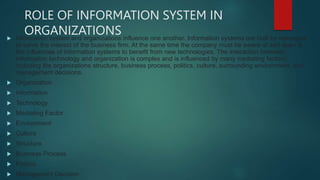
ROLE OF INFORMATION SYSTEM IN
ORGANIZATIONS
 Information system and organizations influence one another. Information systems are built by managers
to serve the interest of the business firm. At the same time the company must be aware of and open to
the influences of information systems to benefit from new technologies. The interaction between
information technology and organization is complex and is influenced by many mediating factors,
including the organizations structure, business process, politics, culture, surrounding environment, and
management decisions.
 Organization
 Information
 Technology
 Mediating Factor
 Environment
 Culture
 Structure
 Business Process
 Politics
 Management Decision
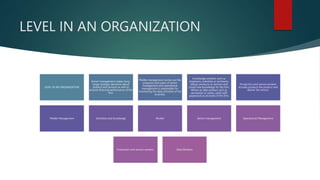
LEVEL IN AN ORGANIZATION
Senior management makes long-
range strategic decisions about
product and services as well as
ensures financial performance of the
firm.
Middle management carries out the
programs and plans of senior
management and operational
management is responsible for
monitoring the daily activities of the
business.
Knowledge workers, such as
engineers, scientists or architects,
design products or services and
create new knowledge for the firm.
Where as data workers such as
secretaries or clerks, assist with
paperwork at all levels of the firm.
Production and service workers
actually produce the product and
deliver the service.
Middle Management Scientists and knowledge Worker Senior management Operational Management
Production and service workers, Data Workers
SYSTEM TYPES AND CHARACTERISTICS:-
 Organizational information systems can be conveniently be placed into the following
categories:-
 Transaction Processing System (TPS) or Data Processing System
 Management Information System (MIS)
 Executive Information System (EIS)
 Decision Support System (DSS)
TRANSACTION PROCESSING SYSTEM(TPS):
In the beginning, computers were all rather limited, highly specialized machines which required
a dedicated environment and specialist personnel to make them function correctly. Such
machines were called ‘mainframes’ and the organization needed a computer department to
provide the necessary data processing service to produce reports some examples of tps system
in typical organizations
Are payroll system,stock control system and an order entry system
MIS
MANAGEMENT INFORMATION SYSTEM(MIS):
 If the first phase of business computing was to automate the manual
and clerical processes of business with the aim of increasing
efficiency, the second phase was to emphasize the role of
information.
 Early management information systems sought to use the output
from existing data processing system (and the data processing
department) in some form which made it more suitable for middle
management to understand.
EXECUTIVE INFORMATION SYSTEM(EIS):
In spite of the success of MISs at the tactical level of management, it
became apparent that IT had not produced any significant benefits for
top-level executives. The strategic decision-making processes (e.g. new
product development, changes in market position, growth by
acquisition) were often noticeably ill informed. Many chief executives in
the late 1980s had not used any form pf computer system at all. Because
of this, it was apparent that new developments such as windowsâ„¢ and
recent developments in human computer interaction (HCI) such as
buttons and touch sensitive screen would form the basis of EISs.
DECISION
SUPPORT
SYSTEM
DECISION SUPPORT SYSTEM(DSS):
Decision support systems were developing to overcome the rigidity of MIS-type reporting
structures and the limitations of spreadsheets. In addition there were advances in corporate
database technology and EIS-type interfaces on which to draw. DSS support nonroutine
decision making for middle management. They focus on problems that are unique and
rapidly changing, for which the procedure for arriving at a solution may not be fully
predefined in advanced.
BRIGHT ASPECTS OF INFORMATION SYSTEM:
 MIS facilitates planning: – MIS improves the quality of plants by providing relevant
information for sound decision-making. Due to increase in the size and complexity of
organization, managers have lost personal contact with the sense of operation.
 It minimizes information overload: – MIS change the larger amount of data into
summarized form and there by avoids the confusion which may arise when managers
are flooded with detailed facts.
 It encourages decentralization: – Decentralization of authority is possibly when there is
a system for monitoring operation at lower levels. MIS is successfully used for
measuring performance and making necessary change in the organizational plans and
procedures.
 It brings co-ordination:- MIS facilities integration of specialized activities by keeping
each department aware of the problem and requirements of other department. It
connects all decision centers in the organization.
DARK ASPECTS
OF
INFORMATION
SYSTEM
DARK ASPECTS OF INFORMATION SYSTEM:
Hacker activities have broadened beyond mere system intrusion to include theft of goods and
information, as well as system damage and cyber vandalism, the intentional disruption, defacement, or
even destruction of a web-site or corporate information system.
No one knows the magnitude of the computer crime problem- how many systems are invaded, how
many people engage in the practice, or the total economic damage. According to the 2007 CSI,
Computer Crime and Security Survey of nearly 500 companies, participant’s average annual loss from
computer crime and security attacks was $350,420 (Richardson, 2007)..
System malfunction if computer hardware breaks down, is not configured properly, or is damaged by
improper use or criminal acts. Error in programming, improper installation, or unauthorized changes
cause computer software to fail. Power failure, floods, fires, or other natural disaster can also disrupt
computer system.
Vulnerability has also increased from wide spread use of e-mail, instant messaging (IM), and peer-to-
peer file sharing programs. E-mail may contain attachments that serve as springboards for malicious
software or unauthorized access to internal corporate systems.
THANK
YOU

New Microsoft PowerPoint Presentation (2).pptx

  • 1.
  • 2.
    ROLE OF INFORMATIONSYSTEM IN ORGANIZATIONS  Information system and organizations influence one another. Information systems are built by managers to serve the interest of the business firm. At the same time the company must be aware of and open to the influences of information systems to benefit from new technologies. The interaction between information technology and organization is complex and is influenced by many mediating factors, including the organizations structure, business process, politics, culture, surrounding environment, and management decisions.  Organization  Information  Technology  Mediating Factor  Environment  Culture  Structure  Business Process  Politics  Management Decision
  • 3.
    LEVEL IN ANORGANIZATION LEVEL IN AN ORGANIZATION Senior management makes long- range strategic decisions about product and services as well as ensures financial performance of the firm. Middle management carries out the programs and plans of senior management and operational management is responsible for monitoring the daily activities of the business. Knowledge workers, such as engineers, scientists or architects, design products or services and create new knowledge for the firm. Where as data workers such as secretaries or clerks, assist with paperwork at all levels of the firm. Production and service workers actually produce the product and deliver the service. Middle Management Scientists and knowledge Worker Senior management Operational Management Production and service workers, Data Workers
  • 4.
    SYSTEM TYPES ANDCHARACTERISTICS:-  Organizational information systems can be conveniently be placed into the following categories:-  Transaction Processing System (TPS) or Data Processing System  Management Information System (MIS)  Executive Information System (EIS)  Decision Support System (DSS) TRANSACTION PROCESSING SYSTEM(TPS): In the beginning, computers were all rather limited, highly specialized machines which required a dedicated environment and specialist personnel to make them function correctly. Such machines were called ‘mainframes’ and the organization needed a computer department to provide the necessary data processing service to produce reports some examples of tps system in typical organizations Are payroll system,stock control system and an order entry system
  • 5.
    MIS MANAGEMENT INFORMATION SYSTEM(MIS): If the first phase of business computing was to automate the manual and clerical processes of business with the aim of increasing efficiency, the second phase was to emphasize the role of information.  Early management information systems sought to use the output from existing data processing system (and the data processing department) in some form which made it more suitable for middle management to understand. EXECUTIVE INFORMATION SYSTEM(EIS): In spite of the success of MISs at the tactical level of management, it became apparent that IT had not produced any significant benefits for top-level executives. The strategic decision-making processes (e.g. new product development, changes in market position, growth by acquisition) were often noticeably ill informed. Many chief executives in the late 1980s had not used any form pf computer system at all. Because of this, it was apparent that new developments such as windowsâ„¢ and recent developments in human computer interaction (HCI) such as buttons and touch sensitive screen would form the basis of EISs.
  • 6.
    DECISION SUPPORT SYSTEM DECISION SUPPORT SYSTEM(DSS): Decisionsupport systems were developing to overcome the rigidity of MIS-type reporting structures and the limitations of spreadsheets. In addition there were advances in corporate database technology and EIS-type interfaces on which to draw. DSS support nonroutine decision making for middle management. They focus on problems that are unique and rapidly changing, for which the procedure for arriving at a solution may not be fully predefined in advanced. BRIGHT ASPECTS OF INFORMATION SYSTEM:  MIS facilitates planning: – MIS improves the quality of plants by providing relevant information for sound decision-making. Due to increase in the size and complexity of organization, managers have lost personal contact with the sense of operation.  It minimizes information overload: – MIS change the larger amount of data into summarized form and there by avoids the confusion which may arise when managers are flooded with detailed facts.  It encourages decentralization: – Decentralization of authority is possibly when there is a system for monitoring operation at lower levels. MIS is successfully used for measuring performance and making necessary change in the organizational plans and procedures.  It brings co-ordination:- MIS facilities integration of specialized activities by keeping each department aware of the problem and requirements of other department. It connects all decision centers in the organization.
  • 7.
    DARK ASPECTS OF INFORMATION SYSTEM DARK ASPECTSOF INFORMATION SYSTEM: Hacker activities have broadened beyond mere system intrusion to include theft of goods and information, as well as system damage and cyber vandalism, the intentional disruption, defacement, or even destruction of a web-site or corporate information system. No one knows the magnitude of the computer crime problem- how many systems are invaded, how many people engage in the practice, or the total economic damage. According to the 2007 CSI, Computer Crime and Security Survey of nearly 500 companies, participant’s average annual loss from computer crime and security attacks was $350,420 (Richardson, 2007).. System malfunction if computer hardware breaks down, is not configured properly, or is damaged by improper use or criminal acts. Error in programming, improper installation, or unauthorized changes cause computer software to fail. Power failure, floods, fires, or other natural disaster can also disrupt computer system. Vulnerability has also increased from wide spread use of e-mail, instant messaging (IM), and peer-to- peer file sharing programs. E-mail may contain attachments that serve as springboards for malicious software or unauthorized access to internal corporate systems.
  • 8.