MANAGEMENT
INFORMATION SYSTEM
1
“To err is human, but to really foul things up
requires a computer”
Content
 An introduction to Information System
 Meaning of Management Information System
 Characteristic of MIS
 Components of MIS
 The aim of MIS
 Outputs of MIS
 Benefits of MIS
2
3
What is MIS?
 Identifying the information that is needed
for effective decision making in
organizations
 Developing information systems to
satisfy those needs
4
What is MIS?
In other words…..
“ MIS is using technology to
create business value.”
5
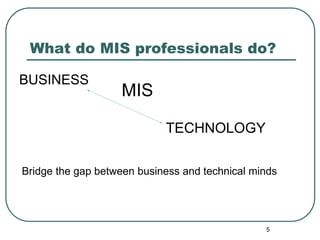
What do MIS professionals do?
BUSINESS
TECHNOLOGY
MIS
Bridge the gap between business and technical minds
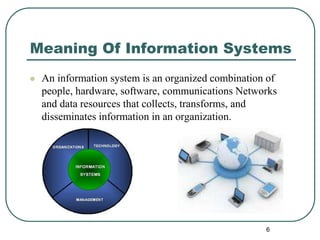
Meaning Of Information Systems
 An information system is an organized combination of
people, hardware, software, communications Networks
and data resources that collects, transforms, and
disseminates information in an organization.
6
 The MIS is defined as a system based on the database of
the evolved for the purpose of providing information to
the people in the organization.
MANAGEMENT INFORMATION SYSTEM(MIS)
7
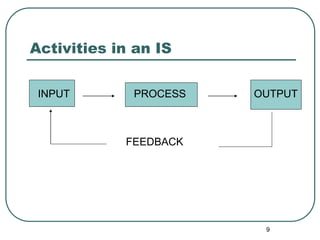
 Management information systems are distinct from regular
information systems in that they are used to analyze other
information systems applied in operational activities in the
organization. MIS involve three primary resources:
technology, information, and people.
 Management information systems are regarded to be a
subset of the overall internal controls procedures in a
business, which cover the application of people,
documents, technologies, and procedures used by
management accountants to solve business problems such
as costing a product, service or a business-wide strategy.
8
9
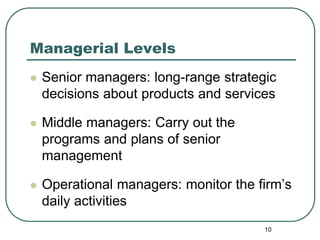
Activities in an IS
INPUT PROCESS OUTPUT
FEEDBACK
10
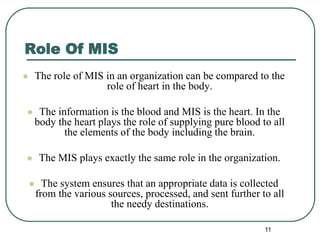
Managerial Levels
 Senior managers: long-range strategic
decisions about products and services
 Middle managers: Carry out the
programs and plans of senior
management
 Operational managers: monitor the firm’s
daily activities
Role Of MIS
 The role of MIS in an organization can be compared to the
role of heart in the body.
 The information is the blood and MIS is the heart. In the
body the heart plays the role of supplying pure blood to all
the elements of the body including the brain.
 The MIS plays exactly the same role in the organization.
 The system ensures that an appropriate data is collected
from the various sources, processed, and sent further to all
the needy destinations.
11
 The system is expected to fulfill the information needs of
an individual, a group of individuals, the management
functionaries: the managers and the top management.
 The MIS satisfies the diverse needs through a variety of
systems such as Query Systems, Analysis Systems,
Modeling Systems and Decision Support Systems.
 The MIS helps in Strategic Planning, Management
Control, Operational Control and Transaction Processing.
12
Characteristics of MIS
 Management-oriented: The basic objective of MIS is to
provide information support to the management in the
organization for decision making.
 Management directed: When MIS is management-
oriented, it should be directed by the management because
it is the management who tells their needs and
requirements more effectively than anybody else.
 Integrated: It means a comprehensive or complete view
of all the subsystems in the organization of a company.
13
 Common data flows: The integration of different
subsystems will lead to a common data flow which will
further help in avoiding duplicacy and redundancy in data
collection, storage and processing.
 Heavy planning-element: The preparation of MIS is not
a one or two day exercise. It usually takes 3 to 5 years and
sometimes a much longer period.
 Subsystem concept: When a problem is seen in 2 sub
parts, then the better solution to the problem is possible.
14
Features of MIS
 Timeliness
 Accuracy
 Consistency
 Completeness
 Relevance
15
Aim of Management Information
System
 The main aim of MIS is to inform management and help
them make informed decisions about management and the
way the business is run.
16
Types Of MIS
 Transaction processing systems: These systems process
a large volume of routine, recurring transactions.
 Operations information systems: These systems gather
comprehensive data, organize it and summarize it in a
form that is useful for managers.
 Decision support systems: These systems help mangers
with the necessary information to make intelligent
decisions.
 Expert systems: They are meant to mimic humans in
making decisions in a specific field.
17
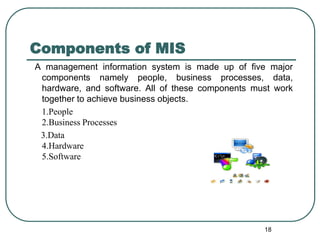
Components of MIS
A management information system is made up of five major
components namely people, business processes, data,
hardware, and software. All of these components must work
together to achieve business objects.
1.People
2.Business Processes
3.Data
4.Hardware
5.Software
18
 People – these are the users who use the information system
to record the day to day business transactions. The users are
usually qualified professionals such as accountants, human
resource managers, etc. The ICT department usually has the
support staff who ensure that the system is running properly.
 Business Procedures – these are agreed upon best practices
that guide the users and all other components on how to work
efficiently. Business procedures are developed by the people
i.e. users, consultants, etc.
 Data – the recorded day to day business transactions. For a
bank, data is collected from activities such as deposits,
withdrawals, etc.
19
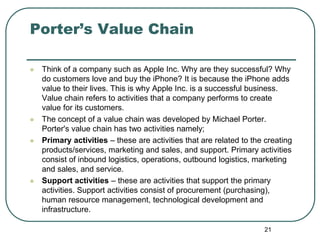
 Hardware – hardware is made up of the computers, printers,
networking devices, etc. The hardware provides the computing
power for processing data. It also provides networking and
printing capabilities. The hardware speeds up the processing of
data into information.
 Software – these are programs that run on the hardware. The
software is broken down into two major categories namely
system software and applications software. System software
refers to the operating system i.e. Windows, Mac OS, and
Ubuntu, etc. Applications software refers to specialized
software for accomplishing business tasks such as a
payroll program, banking system, point of sale system, etc.
20
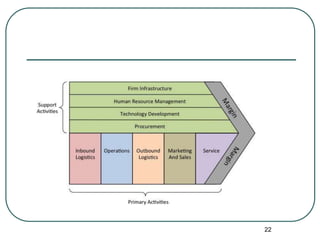
Porter’s Value Chain
 Think of a company such as Apple Inc. Why are they successful? Why
do customers love and buy the iPhone? It is because the iPhone adds
value to their lives. This is why Apple Inc. is a successful business.
Value chain refers to activities that a company performs to create
value for its customers.
 The concept of a value chain was developed by Michael Porter.
Porter's value chain has two activities namely;
 Primary activities – these are activities that are related to the creating
products/services, marketing and sales, and support. Primary activities
consist of inbound logistics, operations, outbound logistics, marketing
and sales, and service.
 Support activities – these are activities that support the primary
activities. Support activities consist of procurement (purchasing),
human resource management, technological development and
infrastructure.
21
22
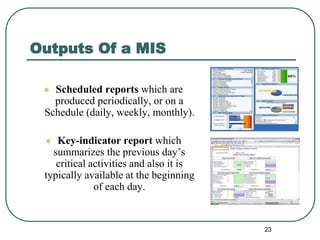
Outputs Of a MIS
 Scheduled reports which are
produced periodically, or on a
Schedule (daily, weekly, monthly).
 Key-indicator report which
summarizes the previous day’s
critical activities and also it is
typically available at the beginning
of each day.
23
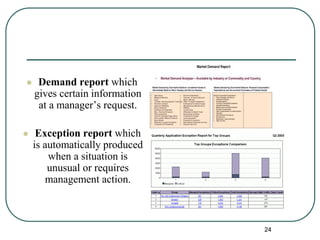
 Demand report which
gives certain information
at a manager’s request.
 Exception report which
is automatically produced
when a situation is
unusual or requires
management action.
24
Benefits of MIS
 It improves personal efficiency.
 It expedites problem solving(speed up
the progress of problems solving in an
organization).
 It facilitates interpersonal
communication
 It promotes learning or training.
 It increases organizational control.
25
 It generates new evidence in support
of a decision.
 It creates a competitive advantage
over competition.
 It encourages exploration and
discovery on the part of the decision
maker.
 It reveals new approaches to
thinking about the problem space.
 It helps automate the Managerial
processes.
26
27
Information Systems in
Business
 Functional Areas of Business
•Sales and Marketing
•Manufacturing / Service
•Finance / Accounting
•Human Resource
 Cross Functional
28
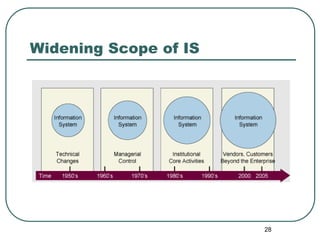
Widening Scope of IS
29
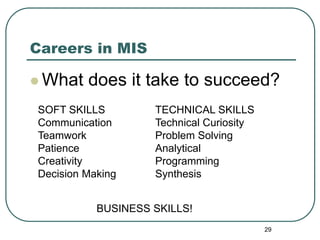
Careers in MIS
 What does it take to succeed?
SOFT SKILLS
Communication
Teamwork
Patience
Creativity
Decision Making
TECHNICAL SKILLS
Technical Curiosity
Problem Solving
Analytical
Programming
Synthesis
BUSINESS SKILLS!
30
Careers in MIS
 Project Managers / CIO
 System Design
 Software Design
 Internet
 Database
 Network / Telecommunications
 System Analyst
31
MIS Career Outlook – GREAT!
Pays well too!
Network systems & data communications
analysts
- Computer software engineers,
applications
- Personal financial advisors
- Financial analysts
- Substance abuse and behavioral
counselors
32
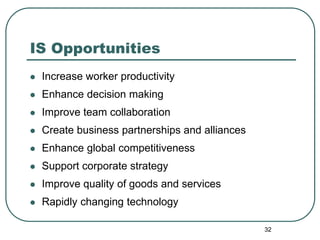
IS Opportunities
 Increase worker productivity
 Enhance decision making
 Improve team collaboration
 Create business partnerships and alliances
 Enhance global competitiveness
 Support corporate strategy
 Improve quality of goods and services
 Rapidly changing technology
33
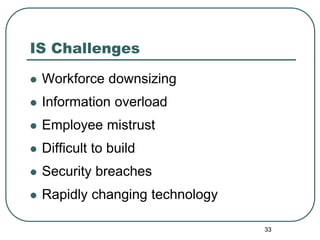
IS Challenges
 Workforce downsizing
 Information overload
 Employee mistrust
 Difficult to build
 Security breaches
 Rapidly changing technology

1-Intro_MIS.ppt

  • 1.
    MANAGEMENT INFORMATION SYSTEM 1 “To erris human, but to really foul things up requires a computer”
  • 2.
    Content  An introductionto Information System  Meaning of Management Information System  Characteristic of MIS  Components of MIS  The aim of MIS  Outputs of MIS  Benefits of MIS 2
  • 3.
    3 What is MIS? Identifying the information that is needed for effective decision making in organizations  Developing information systems to satisfy those needs
  • 4.
    4 What is MIS? Inother words….. “ MIS is using technology to create business value.”
  • 5.
    5 What do MISprofessionals do? BUSINESS TECHNOLOGY MIS Bridge the gap between business and technical minds
  • 6.
    Meaning Of InformationSystems  An information system is an organized combination of people, hardware, software, communications Networks and data resources that collects, transforms, and disseminates information in an organization. 6
  • 7.
     The MISis defined as a system based on the database of the evolved for the purpose of providing information to the people in the organization. MANAGEMENT INFORMATION SYSTEM(MIS) 7
  • 8.
     Management informationsystems are distinct from regular information systems in that they are used to analyze other information systems applied in operational activities in the organization. MIS involve three primary resources: technology, information, and people.  Management information systems are regarded to be a subset of the overall internal controls procedures in a business, which cover the application of people, documents, technologies, and procedures used by management accountants to solve business problems such as costing a product, service or a business-wide strategy. 8
  • 9.
    9 Activities in anIS INPUT PROCESS OUTPUT FEEDBACK
  • 10.
    10 Managerial Levels  Seniormanagers: long-range strategic decisions about products and services  Middle managers: Carry out the programs and plans of senior management  Operational managers: monitor the firm’s daily activities
  • 11.
    Role Of MIS The role of MIS in an organization can be compared to the role of heart in the body.  The information is the blood and MIS is the heart. In the body the heart plays the role of supplying pure blood to all the elements of the body including the brain.  The MIS plays exactly the same role in the organization.  The system ensures that an appropriate data is collected from the various sources, processed, and sent further to all the needy destinations. 11
  • 12.
     The systemis expected to fulfill the information needs of an individual, a group of individuals, the management functionaries: the managers and the top management.  The MIS satisfies the diverse needs through a variety of systems such as Query Systems, Analysis Systems, Modeling Systems and Decision Support Systems.  The MIS helps in Strategic Planning, Management Control, Operational Control and Transaction Processing. 12
  • 13.
    Characteristics of MIS Management-oriented: The basic objective of MIS is to provide information support to the management in the organization for decision making.  Management directed: When MIS is management- oriented, it should be directed by the management because it is the management who tells their needs and requirements more effectively than anybody else.  Integrated: It means a comprehensive or complete view of all the subsystems in the organization of a company. 13
  • 14.
     Common dataflows: The integration of different subsystems will lead to a common data flow which will further help in avoiding duplicacy and redundancy in data collection, storage and processing.  Heavy planning-element: The preparation of MIS is not a one or two day exercise. It usually takes 3 to 5 years and sometimes a much longer period.  Subsystem concept: When a problem is seen in 2 sub parts, then the better solution to the problem is possible. 14
  • 15.
    Features of MIS Timeliness  Accuracy  Consistency  Completeness  Relevance 15
  • 16.
    Aim of ManagementInformation System  The main aim of MIS is to inform management and help them make informed decisions about management and the way the business is run. 16
  • 17.
    Types Of MIS Transaction processing systems: These systems process a large volume of routine, recurring transactions.  Operations information systems: These systems gather comprehensive data, organize it and summarize it in a form that is useful for managers.  Decision support systems: These systems help mangers with the necessary information to make intelligent decisions.  Expert systems: They are meant to mimic humans in making decisions in a specific field. 17
  • 18.
    Components of MIS Amanagement information system is made up of five major components namely people, business processes, data, hardware, and software. All of these components must work together to achieve business objects. 1.People 2.Business Processes 3.Data 4.Hardware 5.Software 18
  • 19.
     People –these are the users who use the information system to record the day to day business transactions. The users are usually qualified professionals such as accountants, human resource managers, etc. The ICT department usually has the support staff who ensure that the system is running properly.  Business Procedures – these are agreed upon best practices that guide the users and all other components on how to work efficiently. Business procedures are developed by the people i.e. users, consultants, etc.  Data – the recorded day to day business transactions. For a bank, data is collected from activities such as deposits, withdrawals, etc. 19
  • 20.
     Hardware –hardware is made up of the computers, printers, networking devices, etc. The hardware provides the computing power for processing data. It also provides networking and printing capabilities. The hardware speeds up the processing of data into information.  Software – these are programs that run on the hardware. The software is broken down into two major categories namely system software and applications software. System software refers to the operating system i.e. Windows, Mac OS, and Ubuntu, etc. Applications software refers to specialized software for accomplishing business tasks such as a payroll program, banking system, point of sale system, etc. 20
  • 21.
    Porter’s Value Chain Think of a company such as Apple Inc. Why are they successful? Why do customers love and buy the iPhone? It is because the iPhone adds value to their lives. This is why Apple Inc. is a successful business. Value chain refers to activities that a company performs to create value for its customers.  The concept of a value chain was developed by Michael Porter. Porter's value chain has two activities namely;  Primary activities – these are activities that are related to the creating products/services, marketing and sales, and support. Primary activities consist of inbound logistics, operations, outbound logistics, marketing and sales, and service.  Support activities – these are activities that support the primary activities. Support activities consist of procurement (purchasing), human resource management, technological development and infrastructure. 21
  • 22.
  • 23.
    Outputs Of aMIS  Scheduled reports which are produced periodically, or on a Schedule (daily, weekly, monthly).  Key-indicator report which summarizes the previous day’s critical activities and also it is typically available at the beginning of each day. 23
  • 24.
     Demand reportwhich gives certain information at a manager’s request.  Exception report which is automatically produced when a situation is unusual or requires management action. 24
  • 25.
    Benefits of MIS It improves personal efficiency.  It expedites problem solving(speed up the progress of problems solving in an organization).  It facilitates interpersonal communication  It promotes learning or training.  It increases organizational control. 25
  • 26.
     It generatesnew evidence in support of a decision.  It creates a competitive advantage over competition.  It encourages exploration and discovery on the part of the decision maker.  It reveals new approaches to thinking about the problem space.  It helps automate the Managerial processes. 26
  • 27.
    27 Information Systems in Business Functional Areas of Business •Sales and Marketing •Manufacturing / Service •Finance / Accounting •Human Resource  Cross Functional
  • 28.
  • 29.
    29 Careers in MIS What does it take to succeed? SOFT SKILLS Communication Teamwork Patience Creativity Decision Making TECHNICAL SKILLS Technical Curiosity Problem Solving Analytical Programming Synthesis BUSINESS SKILLS!
  • 30.
    30 Careers in MIS Project Managers / CIO  System Design  Software Design  Internet  Database  Network / Telecommunications  System Analyst
  • 31.
    31 MIS Career Outlook– GREAT! Pays well too! Network systems & data communications analysts - Computer software engineers, applications - Personal financial advisors - Financial analysts - Substance abuse and behavioral counselors
  • 32.
    32 IS Opportunities  Increaseworker productivity  Enhance decision making  Improve team collaboration  Create business partnerships and alliances  Enhance global competitiveness  Support corporate strategy  Improve quality of goods and services  Rapidly changing technology
  • 33.
    33 IS Challenges  Workforcedownsizing  Information overload  Employee mistrust  Difficult to build  Security breaches  Rapidly changing technology