Management of waste by products in 
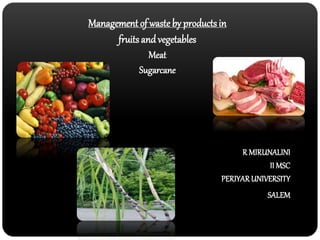
fruits and vegetables 
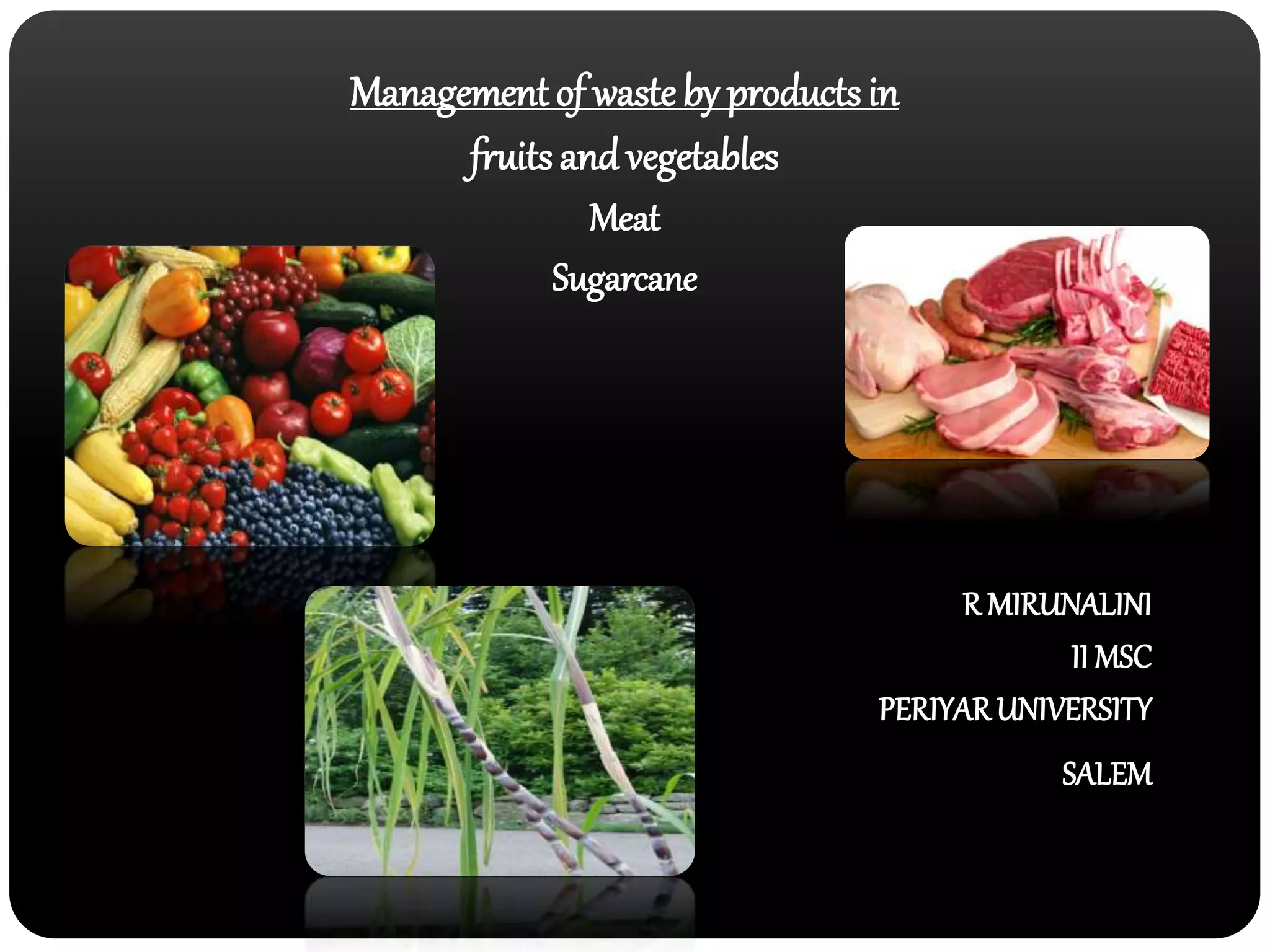
Meat 
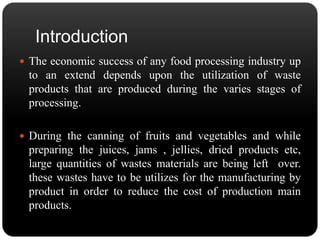
Sugarcane 
R MIRUNALINI 
II MSC 
PERIYAR UNIVERSITY 
SALEM
Introduction 
 The economic success of any food processing industry up 
to an extend depends upon the utilization of waste 
products that are produced during the varies stages of 
processing. 
 During the canning of fruits and vegetables and while 
preparing the juices, jams , jellies, dried products etc, 
large quantities of wastes materials are being left over. 
these wastes have to be utilizes for the manufacturing by 
product in order to reduce the cost of production main 
products.
 From 10% - 75% of the fruit and 
vegetables that are processed in contribute 
to an estimated two lack tons of an 
underutilized energy resource in the world. 
Some of this waste ends up as animal feed 
and some is returned to the land as a 
nutrient. It is an important fact, that waste 
of fruit and vegetable is a potential energy 
source, methane. 
 Up to 50% of fruit and vegetable waste 
could be potentially converted to this fuel. 
The anaerobic digestion of vegetable by 
products has the potential to produce both 
energy (methane) and heat.
 Most agricultural anaerobic digestion systems will 
use manure as a primary component and add 
materials such as vegetable waste. 
 Commonly used methods of managing fruit 
and vegetable waste are: 
 Return fruit and vegetable waste to the field on 
which it was grown 
 Store the culled fruit and vegetables in a pile or 
burned area for a limited time 
 Feed fruit and vegetable waste to livestock 
 Process fruit and vegetable waste to separate 
juice from pulp 
 Dispose of fruit and vegetable waste in landfill 
areas.
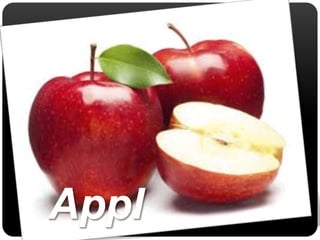
 APPLE 
 Apple pomace left over after the processing of 
juice can be dried for cattle feed. 
The pomace can also be used for the produce 
pectin. 
 The pomace is heated at a ph of 3.0 for 1 and 
half hours at about 190˚ F or 30-40 minutes at 
212˚F. 
 Addition of 0.2 percent citric tartarise or lactic acid 
gives better results. 
 After boiling the pomace is pressed and the 
solution is clarified by setting or by centrifugal 
treatment. 
 The starch and protein present is removed by 
adding enzymes.
 The liquid is further heated to kill the enzymes 
and decolorizes with activated carbon. 
 After that it is filtered using filter paper . 
 The pectin content in the filtrate will be around 
0.7 – 1 %. 
 It is then concentrated under reduced pressure to 
4.5 % pectin , the product can be standardized 
using jelly tests. 
 Apple pomace being a rich source of pectin and 
fairly good sources of sugars can be utilized for 
the preparation of jellies, jams etc.,
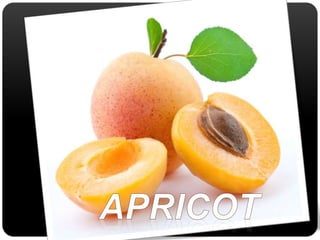
APRICOT 
 Kernels (The inner and usually edible 
part of a seed or grain or nut or fruit 
stone) 
 They can also be used in confectionery. 
 Edible oil can be extracted, The kernels 
contain 49% oil which was extracted 
using n-hexane. The oil was rich in oleic 
acid 
 The kernels can be utilized in cosmetic 
and pharmaceutical preparations. 
 The kernels are some times used for 
making paste which are usually made 
from almonds.
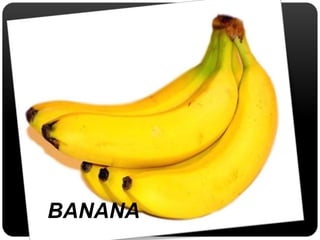
BANANA
 BANANA 
 Banana pseudo stem products 
 Tender banana stem is generally used as a 
vegetable and has high medicinal values. Sweet 
candy is prepared from tender banana pseudo stem 
 apart from this the wastage obtained from this is 
used for paper industries for One of the materials 
found to be promising was banana stem waste, 
which is a very good source of cellulose. 
Various uses include: Acoustic panels, Partition 
walls and other utilities, Packing material, Files 
and cover paper, Expansion joint pads, etc,.
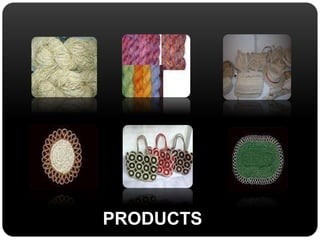
BANANA FIBER EXTRACTION: 
Banana Fiber is extracted from Banana tree bark. 
This fiber is then used for making various 
products in attractive designs of various sizes. 
• Coasters 
• Table Mats 
• Bags 
• Floor Mats 
• Home Furnishings
PRODUCTS
AGROWASTE UTILIZATION IN BANANA PEEL 
 Banana peels and waste are readily available 
agricultural waste, yet they seem to be under utilized as 
potential growth medium for local yeast strain, despite their 
rich carbohydrate content and other basic nutrients that can 
support yeast growth. 
 It is mostly used in preparation of media.
Use of Banana leaves 
The large leaves of bananas and plantains are put to a 
diversity of uses. They make ideal green umbrellas and 
are frequently used as disposable plates. 
The use of banana leaves as a “biological plate” for 
serving food has gained such popularity in Southern 
India that bananas cultivated exclusively for their 
leaves are now being grown commercially. 
In many countries, banana leaves are also used for 
thatching and for wrapping food for cooking.
MEDICINAL 
Because they contain vitamin A, bananas and plantains 
act as an aid to digestion, and it is reported that boiled, 
mashed ripe fruit can be good for constipation, 
especially when mixed with other recommended 
plants. 
The juice from the male bud provides an apparent 
remedy for stomach problems in people of all ages, 
while there are reports of the ripe fruit being used in 
the treatment of asthma and bronchitis.
Finally, some other minor, but extremely varied, 
uses of the plant include the use of banana seeds 
for making necklaces and other ornaments, the use 
of banana sap as a dye, the use of the fruit as a 
meat tenderizer and the use of banana ash in soap. 
 In Indonesia, the production of floor wax and 
shoe polish from banana peels is also being 
explored
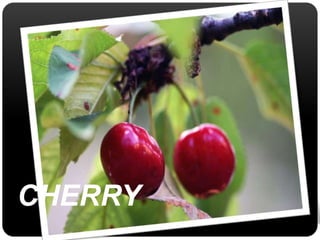
CHERRY
Cheery 
 Fruit kernels of cherry can be used 
for edible oil extraction. 
 Cherry kernels yield 30% of edible 
oil on dry basis.
CITRUS FRUITS
 Citrus fruits 
 Oranges and lime are usually known as citrus 
fruits. 
 Seeds and sludge's obtained from lime this can 
be used for the production of essential oil which 
finds a ready market in confectionery and 
perfumery trades. 
 Citric acid can be also prepared from lime and 
orange waste. 
 Orange residues can be fermented to vinegar. 
 Pectin can be also prepared from juice residues 
of lime and orange. 
 Fresh orange peels yield 0.54 % of citrus oil 
this can be extracted in several ways example 
like cold press method.
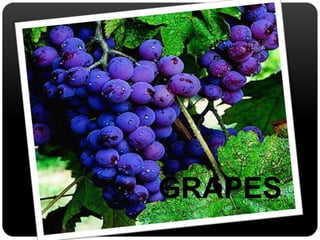
GRAPES
Grapes 
 Grape seed Oil for Cooking 
 Improves Cardiovascular Health 
 High in omega-6 fatty acids in the form of linoleic 
acid 
 Rich in polyunsaturated fats, which are better 
than fats from butter and margarine. 
 Skincare Products 
 Anti-bacterial, anti-viral and anti-inflammatory. 
 Good for sensitive skin 
 Fine Liquor: Grappa 
 New Development! Biodegradable Containers 
 Cattle feed
GUAVA
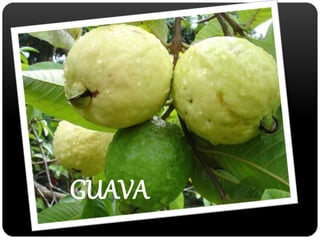
Guava 
 Peelings seeds and cores are the 
waste obtained from guava 
possessing each of these can used 
for the production of the guava 
cheese. 
 Peels can be used for the cattle 
feed.
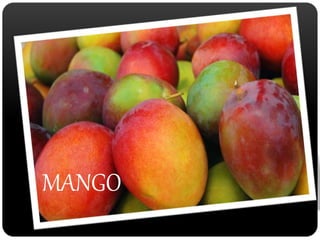
MANGO
By Products of Mango. 
 Juice from pomace 
 Kernel flour 
 Starch / fat from kernel 
 Pectin from peel 
 Biogas production from peel 
 Pickles 
 Mango peel used for preparation 
of vinegar and pectin
 Uses of Mango Kernel Flour 
 Human food: 
 It can replace wheat flour to an extent 
of about 5-10% in preparation of various 
food products like chapatti. 
 Animal feed: Can be used as feed and manure 
 Starch manufacturing: Used in sizing operations 
in textile and clothing industries, for washing 
clothes, in adhesives, paper and fermentation 
 Oil and fat extraction: This oil has a medicinal 
value, used in unani and ayurveda medicines. 
The fat can be used as an edible oil purpose 
being slightly modified and also in soap industries
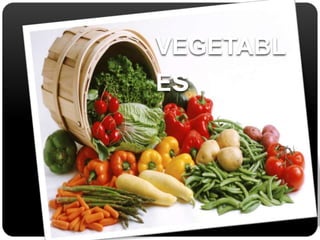
VEGETABL 
Es 
VEGETABLES
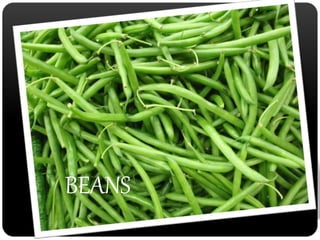
BEANS
Beans 
 The waste are pods and crop tops 
which occur at the harvesting end. 
These can be used in fresh 
condition to feed cattle or ploughed 
into the field to serve as manure. 
 Green crop parts can be utilized to 
get chlorophyll it can also be 
converted into silage.
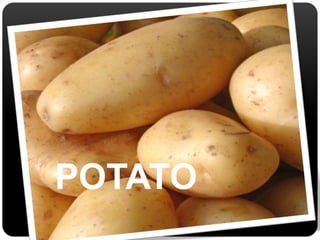
POTATO
 Potato waste is an excellent source of energy 
for feeding cattle. It has energy values similar 
to corn and barley while being low in calcium 
and protein. 
 The starch product, obtained by drying the 
debris recovered from peeling potatoes, is 
recommended for use in drilling muds 
 Medical and biological sciences are 
researching uses of solanine, chaconine, and 
leptine extracted from potato wastes. 
 Chlorogenic acid (CGA), a naturally occurring 
phenolic compound found in fruits and 
vegetables, is readily extractable from potato 
peels.
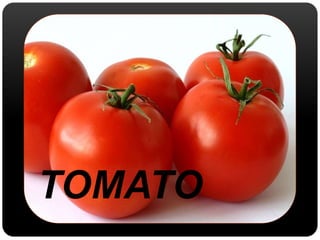
TOMATO
• Processing of tomato results in generation of 
large amounts of wastes or by-products i.e. 
seeds, skins and pulp. 
• These by-products are good sources of many 
important bioactive substances like lycopene, β 
catotene, polyphenols, sterols, terpenes, 
tocopherols etc.. 
• These bioactive compounds can be utilized as 
functional ingredients or additives in preparation 
of functional foods. 
• Caroteniods may be extracted by using hexane 
and ethyl acetate as solvents 
• The recovery caroteniods is about 37 mg /kg 
waste 
• Lycopene, beta carotene and lutein have role in 
prevention and reduction of incidence of various 
diseases i.e. heart diseases, hardening of arteries
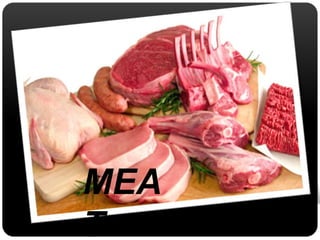
MEAT 
MEA 
T
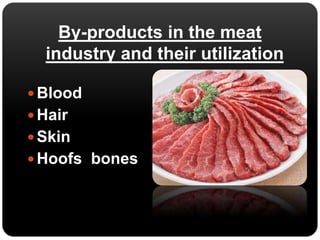
By-products in the meat 
industry and their utilization 
Blood 
 Hair 
Skin 
Hoofs bones
 Blood 
 Blood is the main waste product of meat industry 
this waste can be recovered to produce some 
useful products like fertilizers feedstuffs binders 
and other items. 
 Blood is used in food as an emulsifier, a stabilizer, 
a clarifier, a colour additive, and as a nutritional 
component. 
 Most blood is used in livestock feed in the form of 
blood meal. 
 Plasma is the best water and fat binder of the 
blood fraction. 
 Blood plasma also has an excellent foaming 
capacity and can be used to replace egg whites 
in the baking industry.
Skin 
• Animal hides have been used for 
shelters, clothing and as containers by 
human beings since prehistoric times. 
• Hides and skins are generally one of 
the most valuable by-products from 
animals. Examples of finished products 
from the hides of cattle and pigs, and 
from sheep pelts, are leather shoes and 
bags, athletic equipment, reformed 
sausage casing and cosmetic products, 
sausage skins, edible gelatine and glue
Hairs 
 Used for producing winter cloths 
like hot tops caps, coat and hand 
gloves. 
Some times it is used to prepare 
fine fibers 
 And also hairs are cleaned and 
washed with lime an water to 
produce a good quality resin. 
 These resin are found to be high 
strength
BONES 
• The marrow inside some of the bones can also 
be used as food. 
• Bones can be used as fertilizers like calcium 
ammonium nitrate, Calcium superphosphates 
• These are mainly used for preparing the 
gelatin/glue.
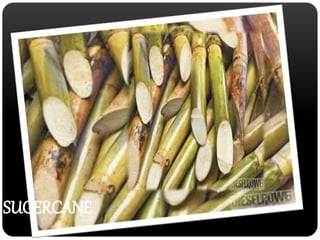
SUGERCANE
 Sugarcane produces mainly two types of 
biomass, Cane Trash and Bagasse. 
 Cane Trash is the field residue remaining after 
harvesting the Cane stalk and Bagasse is the 
milling by-product which remains after extracting 
sugar from the stalk. 
 Bagasse is commonly used as a substitute for 
wood in many tropical and subtropical countries 
for the production paper and board. 
 On the other hand, Bagasse has been 
traditionally used as a fuel in the Sugar mill
Mirunalini

Mirunalini

  • 1.
    Management of wasteby products in fruits and vegetables Meat Sugarcane R MIRUNALINI II MSC PERIYAR UNIVERSITY SALEM
  • 2.
    Introduction  Theeconomic success of any food processing industry up to an extend depends upon the utilization of waste products that are produced during the varies stages of processing.  During the canning of fruits and vegetables and while preparing the juices, jams , jellies, dried products etc, large quantities of wastes materials are being left over. these wastes have to be utilizes for the manufacturing by product in order to reduce the cost of production main products.
  • 3.
     From 10%- 75% of the fruit and vegetables that are processed in contribute to an estimated two lack tons of an underutilized energy resource in the world. Some of this waste ends up as animal feed and some is returned to the land as a nutrient. It is an important fact, that waste of fruit and vegetable is a potential energy source, methane.  Up to 50% of fruit and vegetable waste could be potentially converted to this fuel. The anaerobic digestion of vegetable by products has the potential to produce both energy (methane) and heat.
  • 4.
     Most agriculturalanaerobic digestion systems will use manure as a primary component and add materials such as vegetable waste.  Commonly used methods of managing fruit and vegetable waste are:  Return fruit and vegetable waste to the field on which it was grown  Store the culled fruit and vegetables in a pile or burned area for a limited time  Feed fruit and vegetable waste to livestock  Process fruit and vegetable waste to separate juice from pulp  Dispose of fruit and vegetable waste in landfill areas.
  • 6.
     APPLE Apple pomace left over after the processing of juice can be dried for cattle feed. The pomace can also be used for the produce pectin.  The pomace is heated at a ph of 3.0 for 1 and half hours at about 190˚ F or 30-40 minutes at 212˚F.  Addition of 0.2 percent citric tartarise or lactic acid gives better results.  After boiling the pomace is pressed and the solution is clarified by setting or by centrifugal treatment.  The starch and protein present is removed by adding enzymes.
  • 7.
     The liquidis further heated to kill the enzymes and decolorizes with activated carbon.  After that it is filtered using filter paper .  The pectin content in the filtrate will be around 0.7 – 1 %.  It is then concentrated under reduced pressure to 4.5 % pectin , the product can be standardized using jelly tests.  Apple pomace being a rich source of pectin and fairly good sources of sugars can be utilized for the preparation of jellies, jams etc.,
  • 13.
    APRICOT  Kernels(The inner and usually edible part of a seed or grain or nut or fruit stone)  They can also be used in confectionery.  Edible oil can be extracted, The kernels contain 49% oil which was extracted using n-hexane. The oil was rich in oleic acid  The kernels can be utilized in cosmetic and pharmaceutical preparations.  The kernels are some times used for making paste which are usually made from almonds.
  • 14.
  • 15.
     BANANA Banana pseudo stem products  Tender banana stem is generally used as a vegetable and has high medicinal values. Sweet candy is prepared from tender banana pseudo stem  apart from this the wastage obtained from this is used for paper industries for One of the materials found to be promising was banana stem waste, which is a very good source of cellulose. Various uses include: Acoustic panels, Partition walls and other utilities, Packing material, Files and cover paper, Expansion joint pads, etc,.
  • 16.
    BANANA FIBER EXTRACTION: Banana Fiber is extracted from Banana tree bark. This fiber is then used for making various products in attractive designs of various sizes. • Coasters • Table Mats • Bags • Floor Mats • Home Furnishings
  • 17.
  • 18.
    AGROWASTE UTILIZATION INBANANA PEEL  Banana peels and waste are readily available agricultural waste, yet they seem to be under utilized as potential growth medium for local yeast strain, despite their rich carbohydrate content and other basic nutrients that can support yeast growth.  It is mostly used in preparation of media.
  • 19.
    Use of Bananaleaves The large leaves of bananas and plantains are put to a diversity of uses. They make ideal green umbrellas and are frequently used as disposable plates. The use of banana leaves as a “biological plate” for serving food has gained such popularity in Southern India that bananas cultivated exclusively for their leaves are now being grown commercially. In many countries, banana leaves are also used for thatching and for wrapping food for cooking.
  • 20.
    MEDICINAL Because theycontain vitamin A, bananas and plantains act as an aid to digestion, and it is reported that boiled, mashed ripe fruit can be good for constipation, especially when mixed with other recommended plants. The juice from the male bud provides an apparent remedy for stomach problems in people of all ages, while there are reports of the ripe fruit being used in the treatment of asthma and bronchitis.
  • 21.
    Finally, some otherminor, but extremely varied, uses of the plant include the use of banana seeds for making necklaces and other ornaments, the use of banana sap as a dye, the use of the fruit as a meat tenderizer and the use of banana ash in soap.  In Indonesia, the production of floor wax and shoe polish from banana peels is also being explored
  • 22.
  • 23.
    Cheery  Fruitkernels of cherry can be used for edible oil extraction.  Cherry kernels yield 30% of edible oil on dry basis.
  • 24.
  • 25.
     Citrus fruits  Oranges and lime are usually known as citrus fruits.  Seeds and sludge's obtained from lime this can be used for the production of essential oil which finds a ready market in confectionery and perfumery trades.  Citric acid can be also prepared from lime and orange waste.  Orange residues can be fermented to vinegar.  Pectin can be also prepared from juice residues of lime and orange.  Fresh orange peels yield 0.54 % of citrus oil this can be extracted in several ways example like cold press method.
  • 26.
  • 27.
    Grapes  Grapeseed Oil for Cooking  Improves Cardiovascular Health  High in omega-6 fatty acids in the form of linoleic acid  Rich in polyunsaturated fats, which are better than fats from butter and margarine.  Skincare Products  Anti-bacterial, anti-viral and anti-inflammatory.  Good for sensitive skin  Fine Liquor: Grappa  New Development! Biodegradable Containers  Cattle feed
  • 28.
  • 29.
    Guava  Peelingsseeds and cores are the waste obtained from guava possessing each of these can used for the production of the guava cheese.  Peels can be used for the cattle feed.
  • 30.
  • 31.
    By Products ofMango.  Juice from pomace  Kernel flour  Starch / fat from kernel  Pectin from peel  Biogas production from peel  Pickles  Mango peel used for preparation of vinegar and pectin
  • 32.
     Uses ofMango Kernel Flour  Human food:  It can replace wheat flour to an extent of about 5-10% in preparation of various food products like chapatti.  Animal feed: Can be used as feed and manure  Starch manufacturing: Used in sizing operations in textile and clothing industries, for washing clothes, in adhesives, paper and fermentation  Oil and fat extraction: This oil has a medicinal value, used in unani and ayurveda medicines. The fat can be used as an edible oil purpose being slightly modified and also in soap industries
  • 33.
  • 34.
  • 35.
    Beans  Thewaste are pods and crop tops which occur at the harvesting end. These can be used in fresh condition to feed cattle or ploughed into the field to serve as manure.  Green crop parts can be utilized to get chlorophyll it can also be converted into silage.
  • 36.
  • 37.
     Potato wasteis an excellent source of energy for feeding cattle. It has energy values similar to corn and barley while being low in calcium and protein.  The starch product, obtained by drying the debris recovered from peeling potatoes, is recommended for use in drilling muds  Medical and biological sciences are researching uses of solanine, chaconine, and leptine extracted from potato wastes.  Chlorogenic acid (CGA), a naturally occurring phenolic compound found in fruits and vegetables, is readily extractable from potato peels.
  • 38.
  • 39.
    • Processing oftomato results in generation of large amounts of wastes or by-products i.e. seeds, skins and pulp. • These by-products are good sources of many important bioactive substances like lycopene, β catotene, polyphenols, sterols, terpenes, tocopherols etc.. • These bioactive compounds can be utilized as functional ingredients or additives in preparation of functional foods. • Caroteniods may be extracted by using hexane and ethyl acetate as solvents • The recovery caroteniods is about 37 mg /kg waste • Lycopene, beta carotene and lutein have role in prevention and reduction of incidence of various diseases i.e. heart diseases, hardening of arteries
  • 40.
  • 41.
    By-products in themeat industry and their utilization Blood  Hair Skin Hoofs bones
  • 42.
     Blood Blood is the main waste product of meat industry this waste can be recovered to produce some useful products like fertilizers feedstuffs binders and other items.  Blood is used in food as an emulsifier, a stabilizer, a clarifier, a colour additive, and as a nutritional component.  Most blood is used in livestock feed in the form of blood meal.  Plasma is the best water and fat binder of the blood fraction.  Blood plasma also has an excellent foaming capacity and can be used to replace egg whites in the baking industry.
  • 43.
    Skin • Animalhides have been used for shelters, clothing and as containers by human beings since prehistoric times. • Hides and skins are generally one of the most valuable by-products from animals. Examples of finished products from the hides of cattle and pigs, and from sheep pelts, are leather shoes and bags, athletic equipment, reformed sausage casing and cosmetic products, sausage skins, edible gelatine and glue
  • 44.
    Hairs  Usedfor producing winter cloths like hot tops caps, coat and hand gloves. Some times it is used to prepare fine fibers  And also hairs are cleaned and washed with lime an water to produce a good quality resin.  These resin are found to be high strength
  • 45.
    BONES • Themarrow inside some of the bones can also be used as food. • Bones can be used as fertilizers like calcium ammonium nitrate, Calcium superphosphates • These are mainly used for preparing the gelatin/glue.
  • 46.
  • 47.
     Sugarcane producesmainly two types of biomass, Cane Trash and Bagasse.  Cane Trash is the field residue remaining after harvesting the Cane stalk and Bagasse is the milling by-product which remains after extracting sugar from the stalk.  Bagasse is commonly used as a substitute for wood in many tropical and subtropical countries for the production paper and board.  On the other hand, Bagasse has been traditionally used as a fuel in the Sugar mill