Verification of
Mobile SOC
Design (UFS)
Mohamed Samy
Mentor Graphics
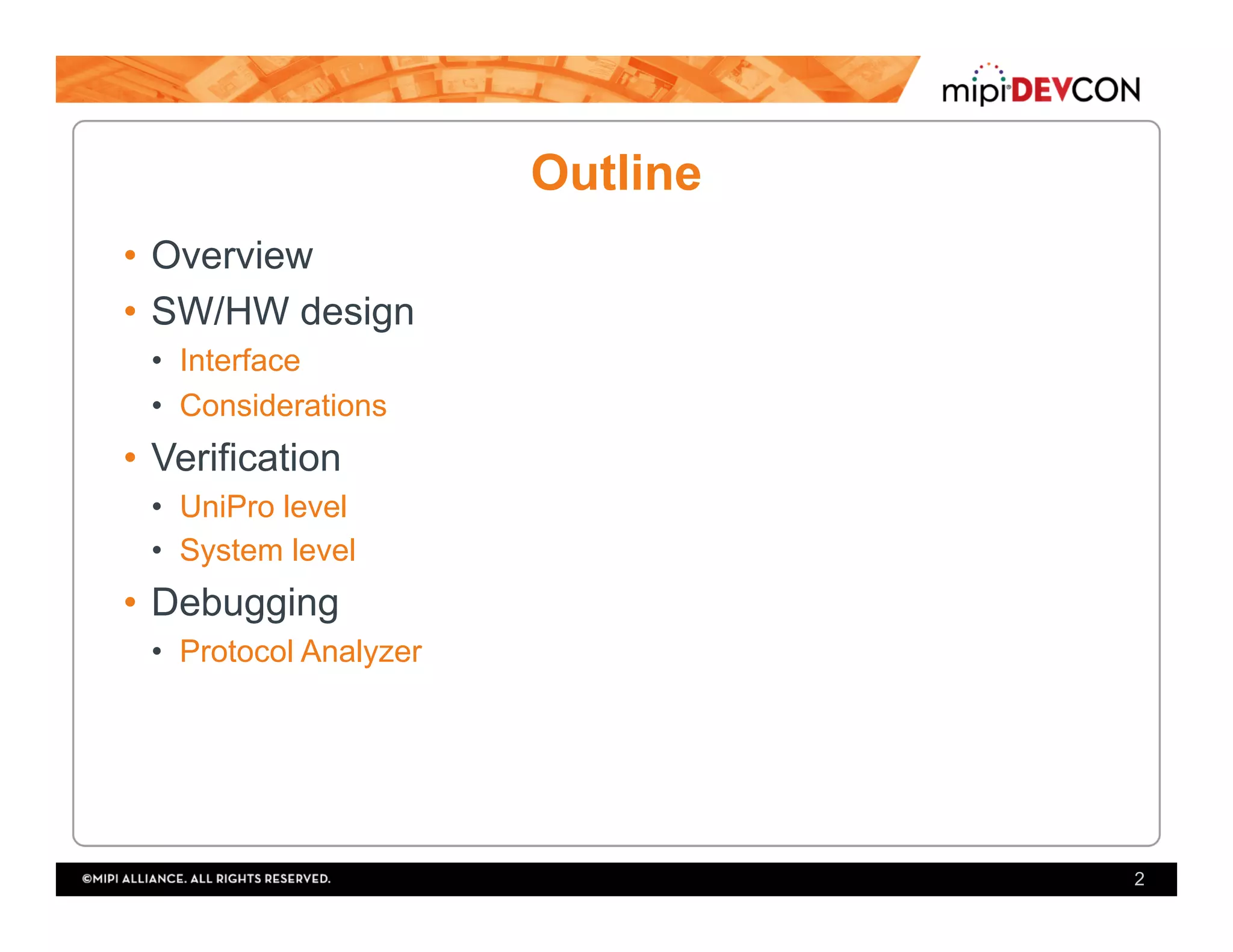
Outline
•  Overview
•  SW/HW design
•  Interface
•  Considerations
•  Verification
•  UniPro level
•  System level
•  Debugging
•  Protocol Analyzer
2
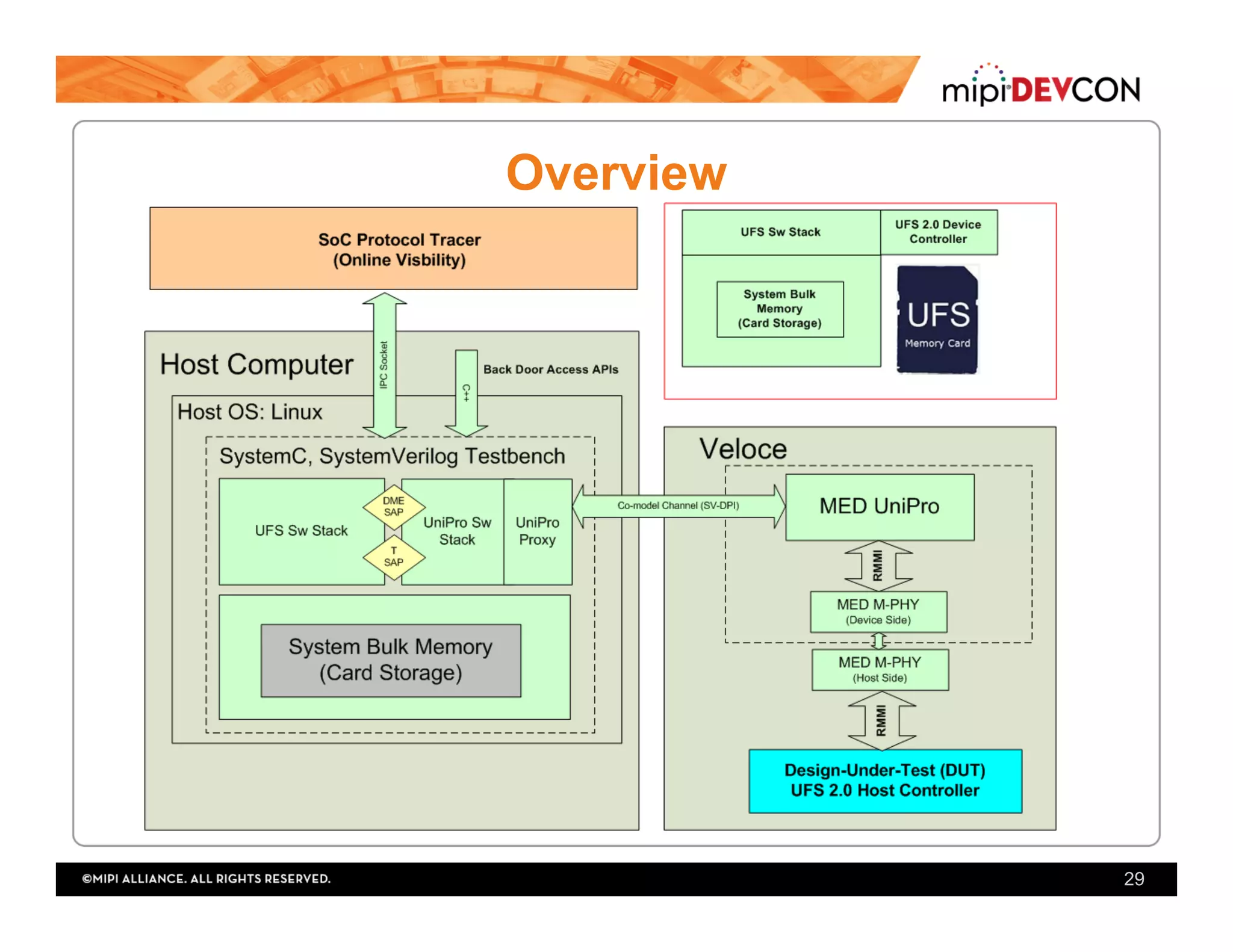
Overview
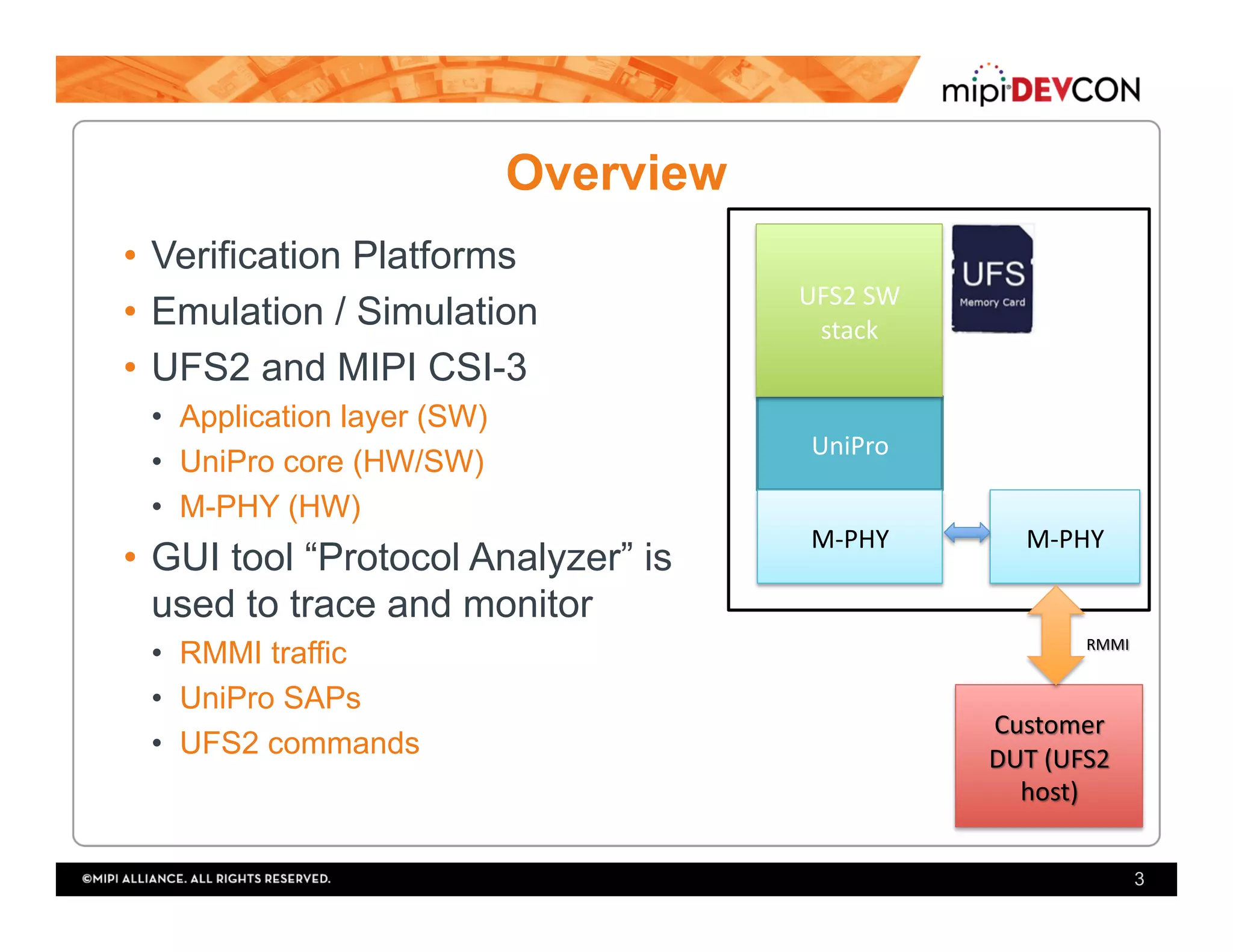
•  Verification Platforms
•  Emulation / Simulation
•  UFS2 and MIPI CSI-3
•  Application layer (SW)
•  UniPro core (HW/SW)
•  M-PHY (HW)
•  GUI tool “Protocol Analyzer” is
used to trace and monitor
•  RMMI traffic
•  UniPro SAPs
•  UFS2 commands
3
UniPro	
UFS2	SW	
stack	
M-PHY	 M-PHY
Overview
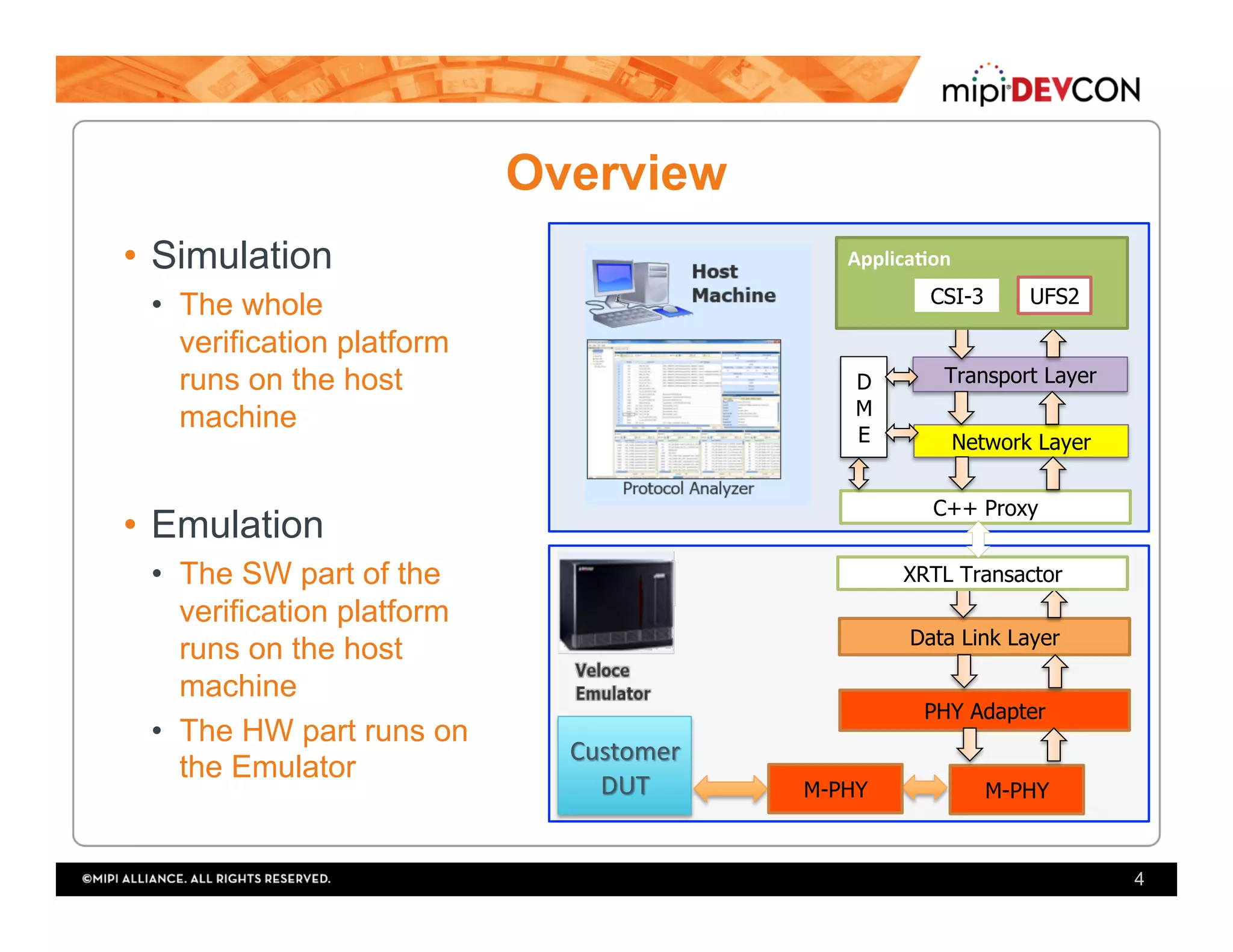
•  Simulation
•  The whole
verification platform
runs on the host
machine
•  Emulation
•  The SW part of the
verification platform
runs on the host
machine
•  The HW part runs on
the Emulator
4
Transport Layer
Network Layer
Data Link Layer
PHY Adapter
D
M
E
Applica'on	
C++ Proxy
XRTL Transactor
CSI-3 UFS2
M-PHYM-PHY
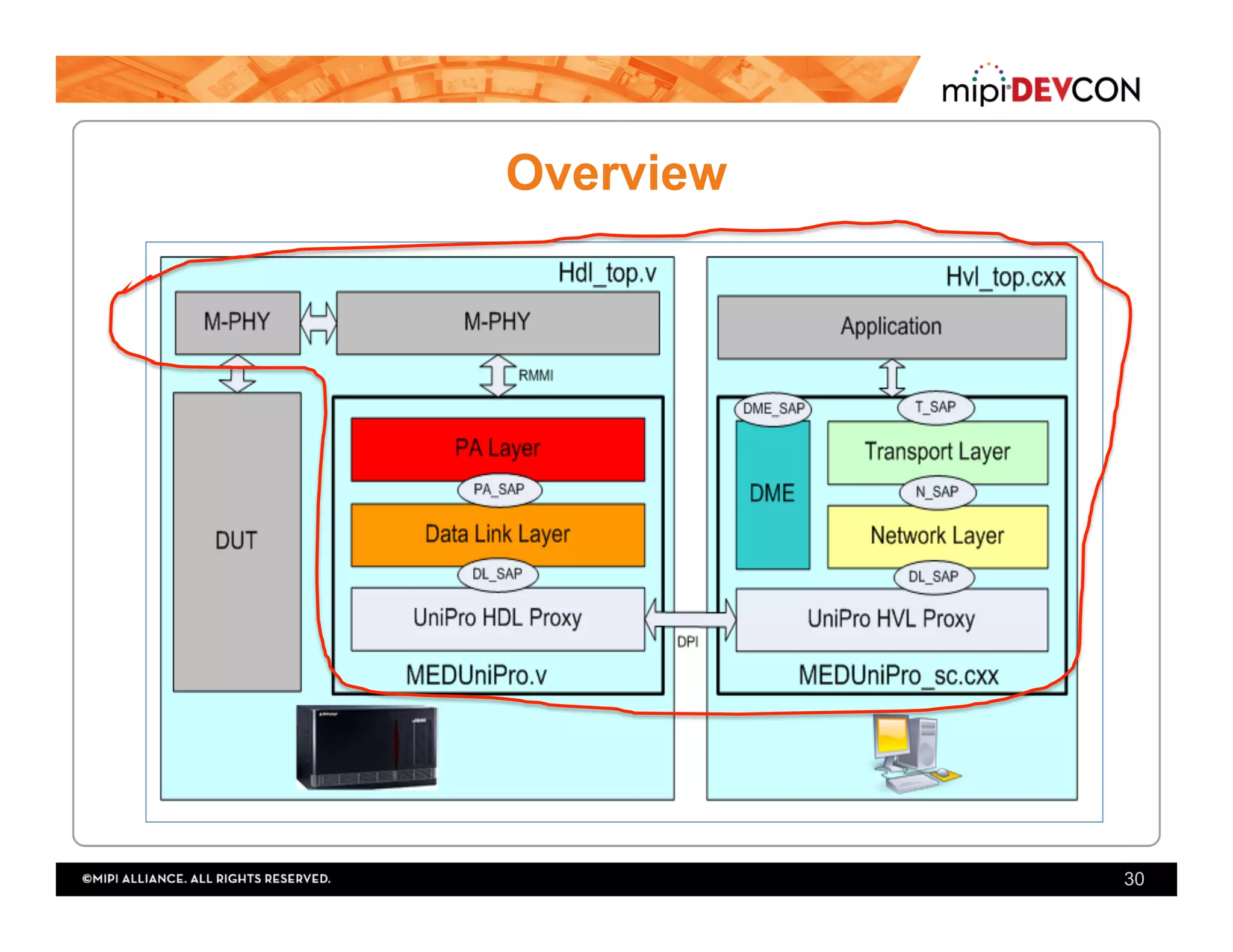
Co-Design
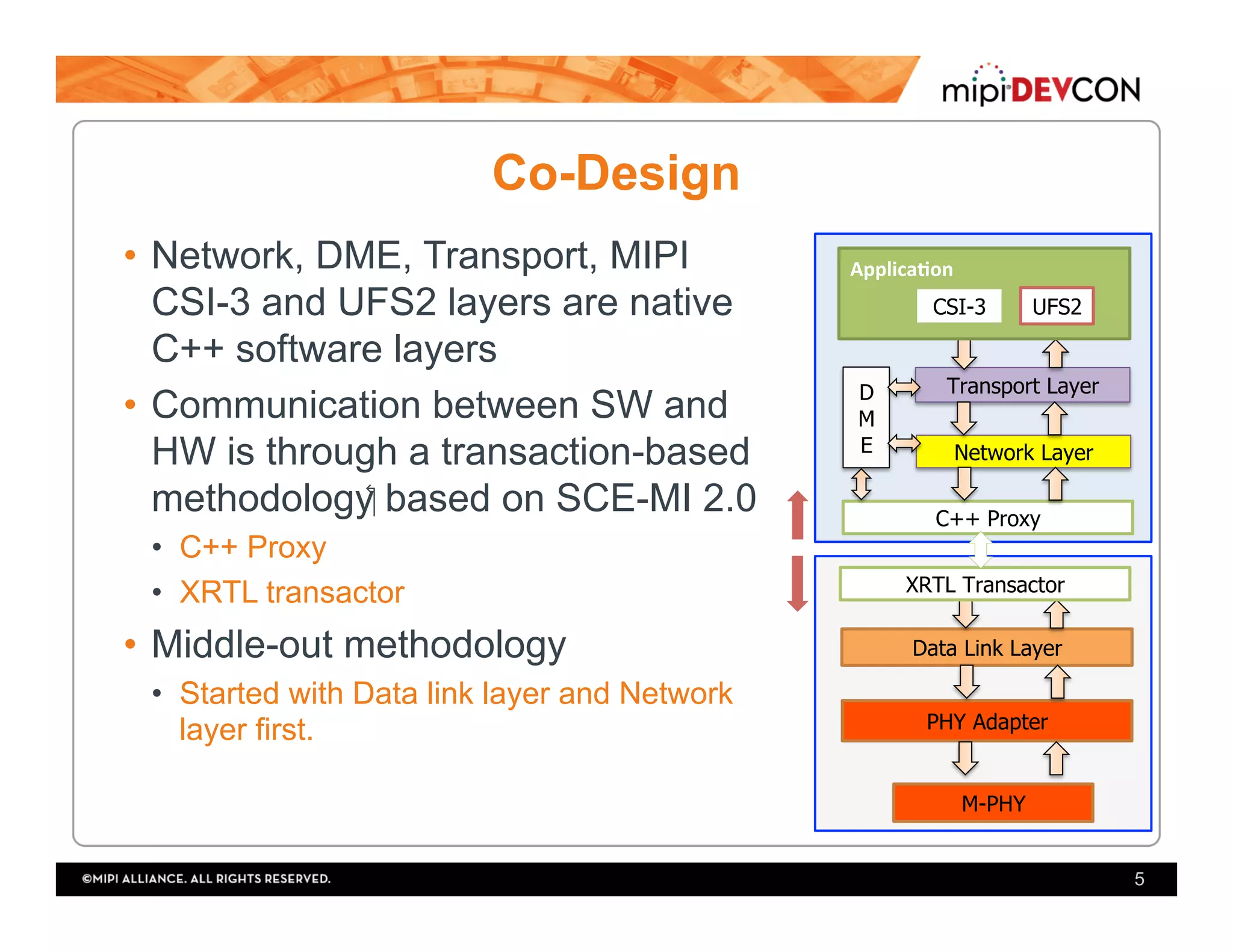
•  Network, DME, Transport, MIPI
CSI-3 and UFS2 layers are native
C++ software layers
•  Communication between SW and
HW is through a transaction-based
methodology‫‏‬ based on SCE-MI 2.0
•  C++ Proxy
•  XRTL transactor
•  Middle-out methodology
•  Started with Data link layer and Network
layer first.
5
Transport Layer
Network Layer
Data Link Layer
PHY Adapter
D
M
E
Applica'on	
C++ Proxy
XRTL Transactor
CSI-3 UFS2
M-PHY
Co-Design
int UniProMemoryXactor_sc::WriteTransaction(u_int8_t *pBuf,
u_int16_t wBytesCount,
bool IsBlocking)
{
…
UniProMemoryWrite((svBitVecVal *)pTxBuf,(int)wBytesCount, (IsBlocking)?1:0);
if (IsBlocking) {
wait(Done);
};
…
}
6
function void UniProMemoryWrite(input bit [COMODEL_BUF_SIZE-1:0] Buf,
int BytesCount,
int IsBlocking);
WrIsBlock = IsBlocking;
WrDataWordsCounts = ((BytesCount/(DATA_WIDTH/8)) + ((BytesCount%(DATA_WIDTH/8))?1:0));
WrBytesOfLastWord = BytesCount - (WrDataWordsCounts-1)*(DATA_WIDTH/8);
WrLastBe = (WrBytesOfLastWord == 8 ) ? 8'hFF:
(WrBytesOfLastWord == 7 ) ? 8'h7F:
(WrBytesOfLastWord == 6 ) ? 8'h3F:
(WrBytesOfLastWord == 5 ) ? 8'h1F:
(WrBytesOfLastWord == 4 ) ? 8'h0F:
(WrBytesOfLastWord == 3 ) ? 8'h07:
(WrBytesOfLastWord == 2 ) ? 8'h03:
(WrBytesOfLastWord == 1 ) ? 8'h01:
8'hFF;
for(int i =0 ; i< WrDataWordsCounts; i = i + 1 ) begin
WrBuf[i] = Buf[(DATA_WIDTH)*i +: DATA_WIDTH];
end
->e_StartWr;
endfunction;
C++	proxy	
un;med	so?ware	model		
XRTL	counterpart
SW/HW Interface
7
•  DME <-> DLL
•  DME <-> PAL
•  NL <-> DLL
NL		
DME	
DLL	
PAL
SW/HW Interface (DME/NL SAPs)
8
Data	Symbol	# Bit	fields	
0
[15:0]	 DME_SAP	opcode
[31:16] GenSelectorIndex	or	SelectorIndex
[47:32] MIBaUribute	or	GenMIBaUribute
[55:48] ResultCode:	used	for	GenericErrorCode,	ConfigResultCode	and	PowerChangeResultCode,	
DLErrorCode
[56] AUrSetType
[57] ResetLevel
[58] PAResult
[59] PHYDirec;on
1 [31:0] MIBvalue
2,3,4 PAPowerModeUserData
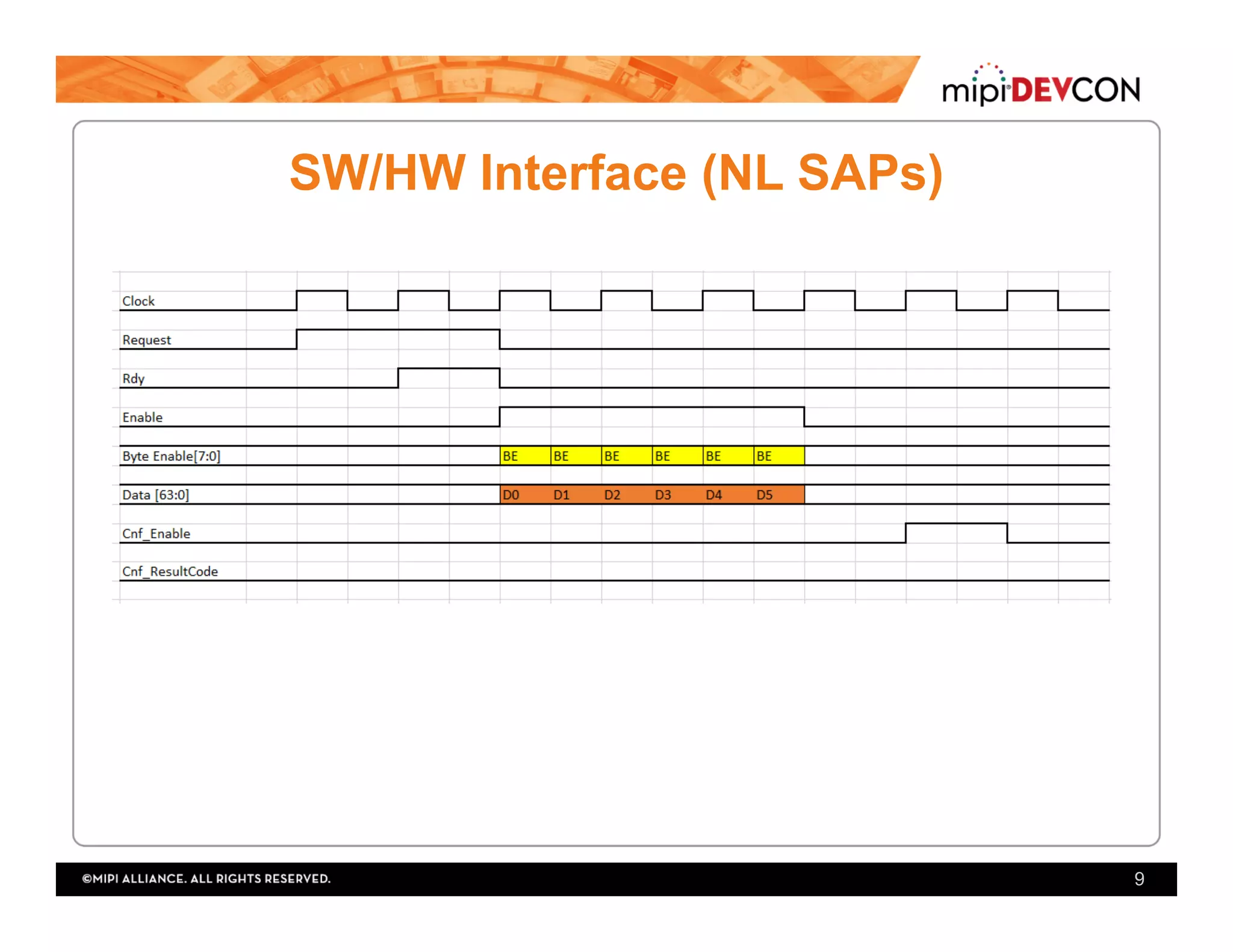
SW/HW Interface (NL SAPs)
9
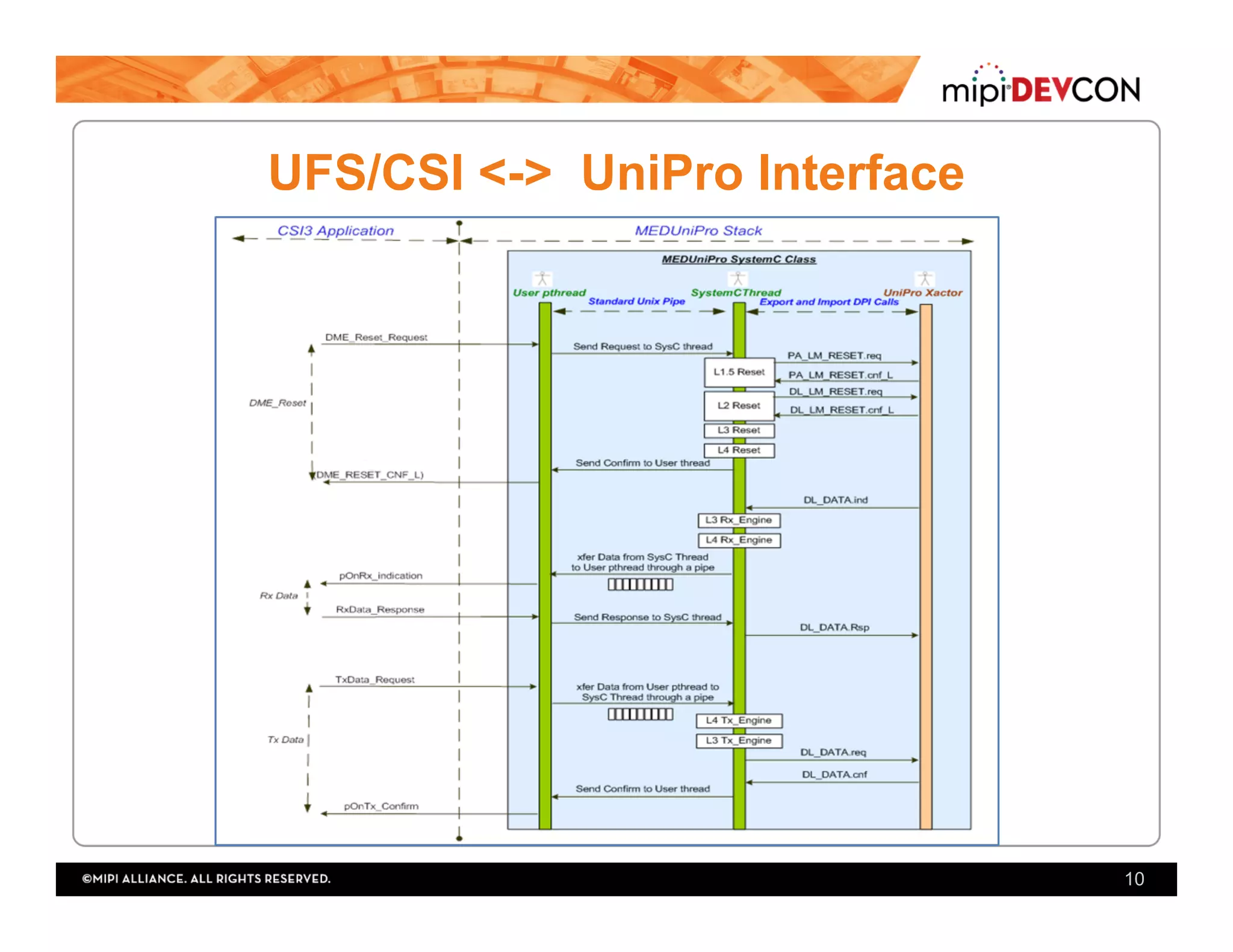
UFS/CSI <-> UniPro Interface
10
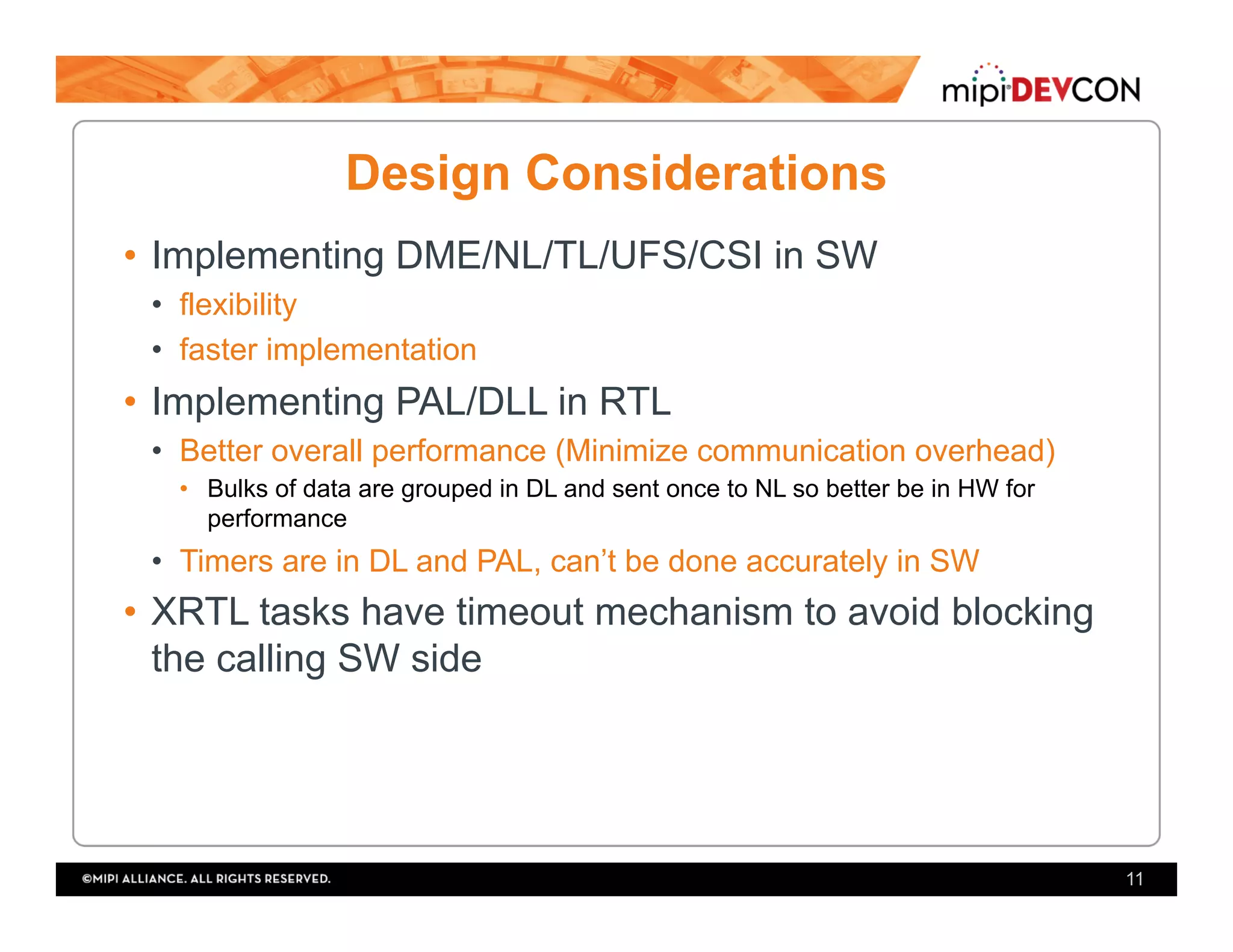
Design Considerations
•  Implementing DME/NL/TL/UFS/CSI in SW
•  flexibility
•  faster implementation
•  Implementing PAL/DLL in RTL
•  Better overall performance (Minimize communication overhead)
•  Bulks of data are grouped in DL and sent once to NL so better be in HW for
performance
•  Timers are in DL and PAL, can’t be done accurately in SW
•  XRTL tasks have timeout mechanism to avoid blocking
the calling SW side
11
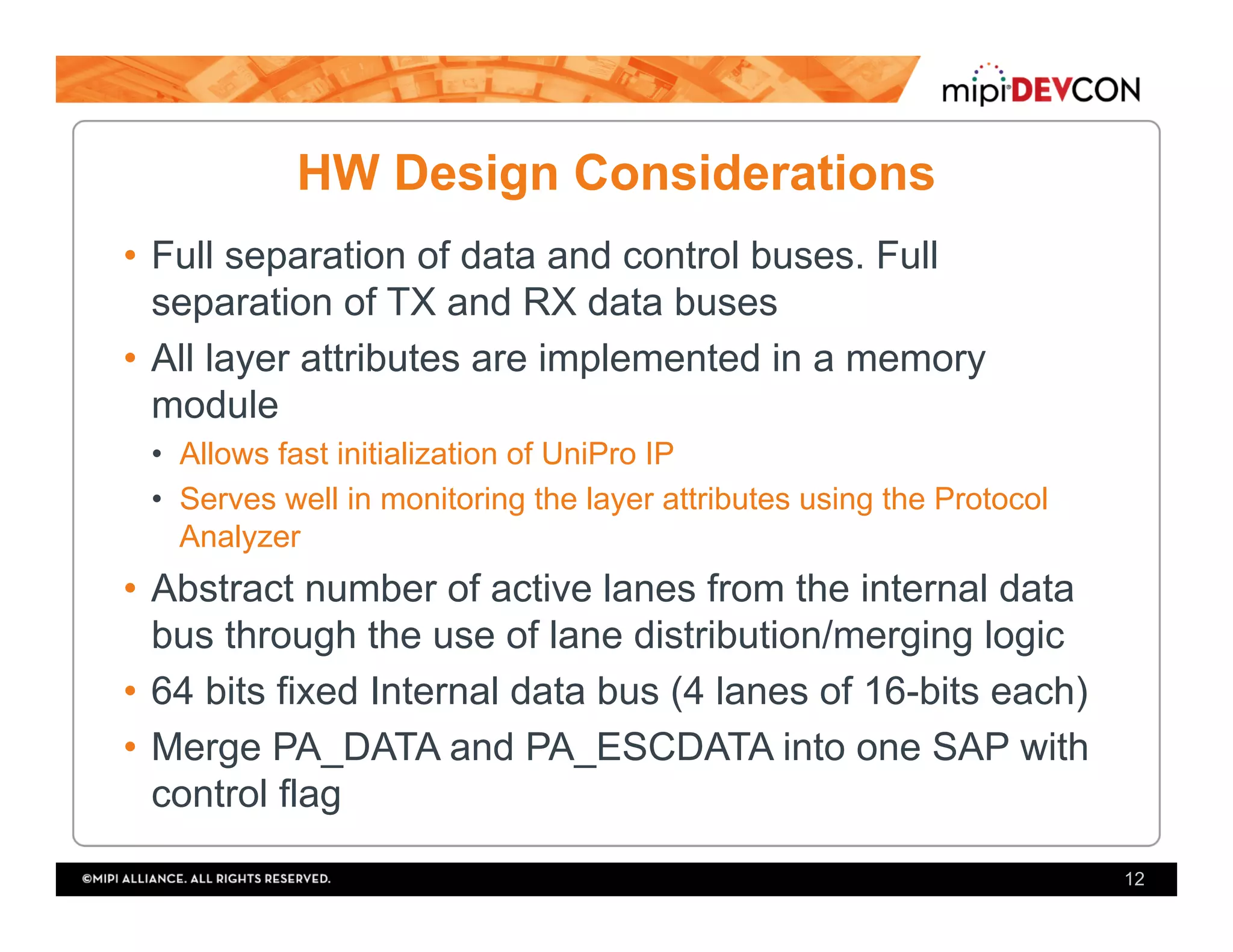
HW Design Considerations
•  Full separation of data and control buses. Full
separation of TX and RX data buses
•  All layer attributes are implemented in a memory
module
•  Allows fast initialization of UniPro IP
•  Serves well in monitoring the layer attributes using the Protocol
Analyzer
•  Abstract number of active lanes from the internal data
bus through the use of lane distribution/merging logic
•  64 bits fixed Internal data bus (4 lanes of 16-bits each)
•  Merge PA_DATA and PA_ESCDATA into one SAP with
control flag
12
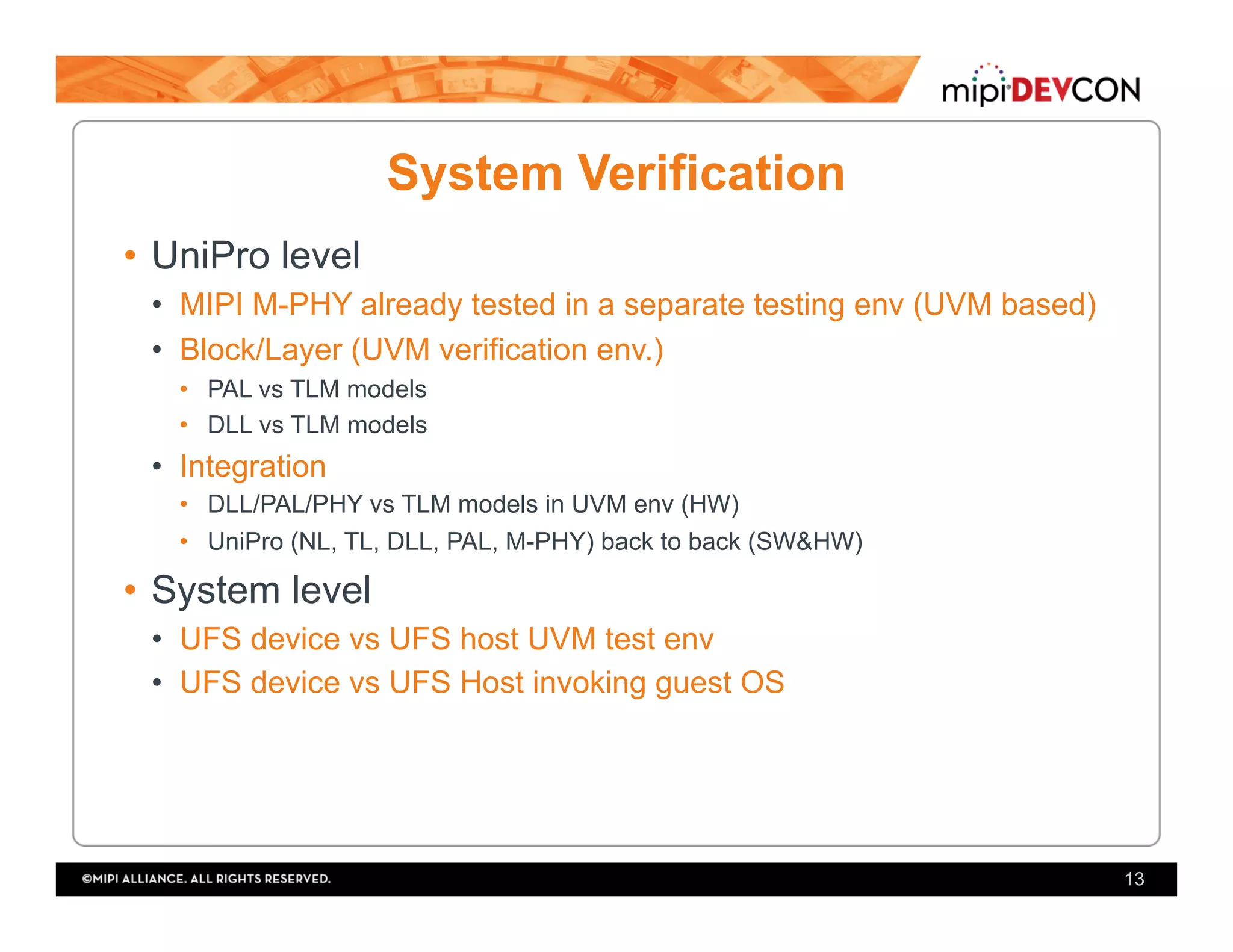
System Verification
•  UniPro level
•  MIPI M-PHY already tested in a separate testing env (UVM based)
•  Block/Layer (UVM verification env.)
•  PAL vs TLM models
•  DLL vs TLM models
•  Integration
•  DLL/PAL/PHY vs TLM models in UVM env (HW)
•  UniPro (NL, TL, DLL, PAL, M-PHY) back to back (SW&HW)
•  System level
•  UFS device vs UFS host UVM test env
•  UFS device vs UFS Host invoking guest OS
13
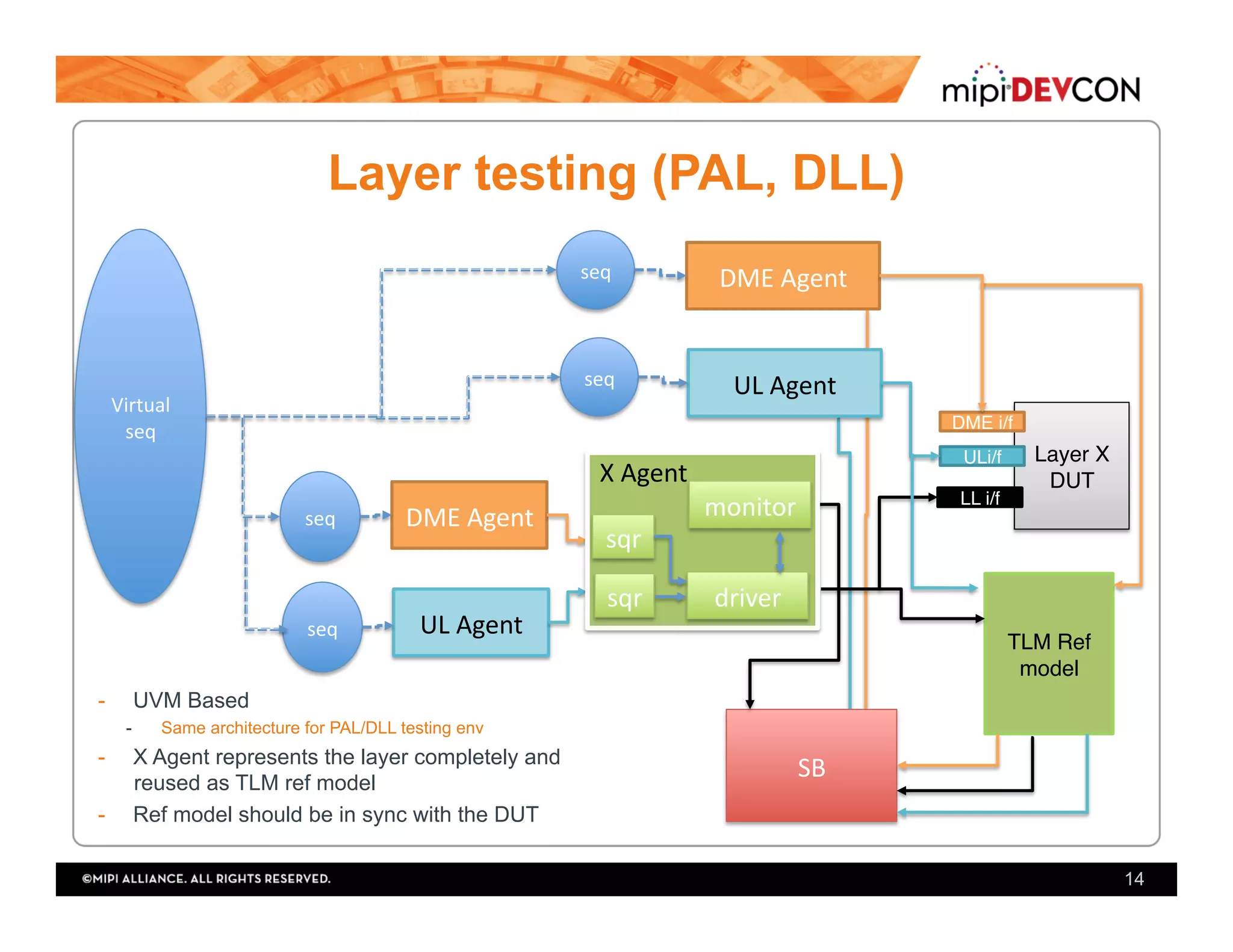
Layer testing (PAL, DLL)
14
DME	Agent	
UL	Agent	
Layer X
DUT
DME i/f
ULi/f
LL i/f
DME	Agent	
UL	Agent	
TLM Ref
model
SB	
seq	
seq	
seq	
seq	
Virtual	
seq	
-  UVM Based
-  Same architecture for PAL/DLL testing env
-  X Agent represents the layer completely and
reused as TLM ref model
-  Ref model should be in sync with the DUT
monitor	
driver	sqr	
sqr	
X	Agent
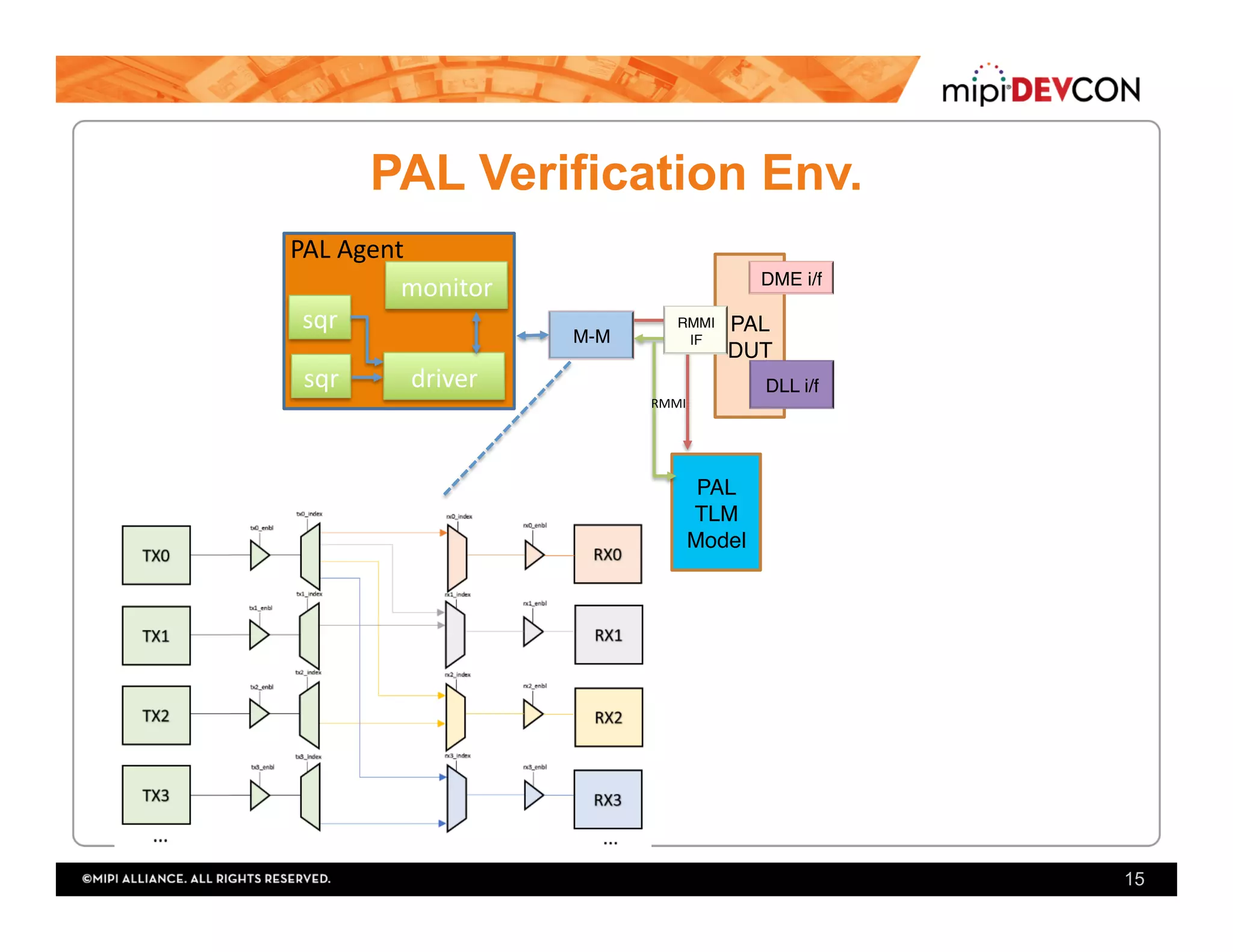
PAL Verification Env.
15
PAL
DUT
DME i/f
DLL i/f
M-M
PAL
TLM
Model
monitor	
driver	sqr	
sqr	
RMMI	
RMMI
IF
PAL	Agent
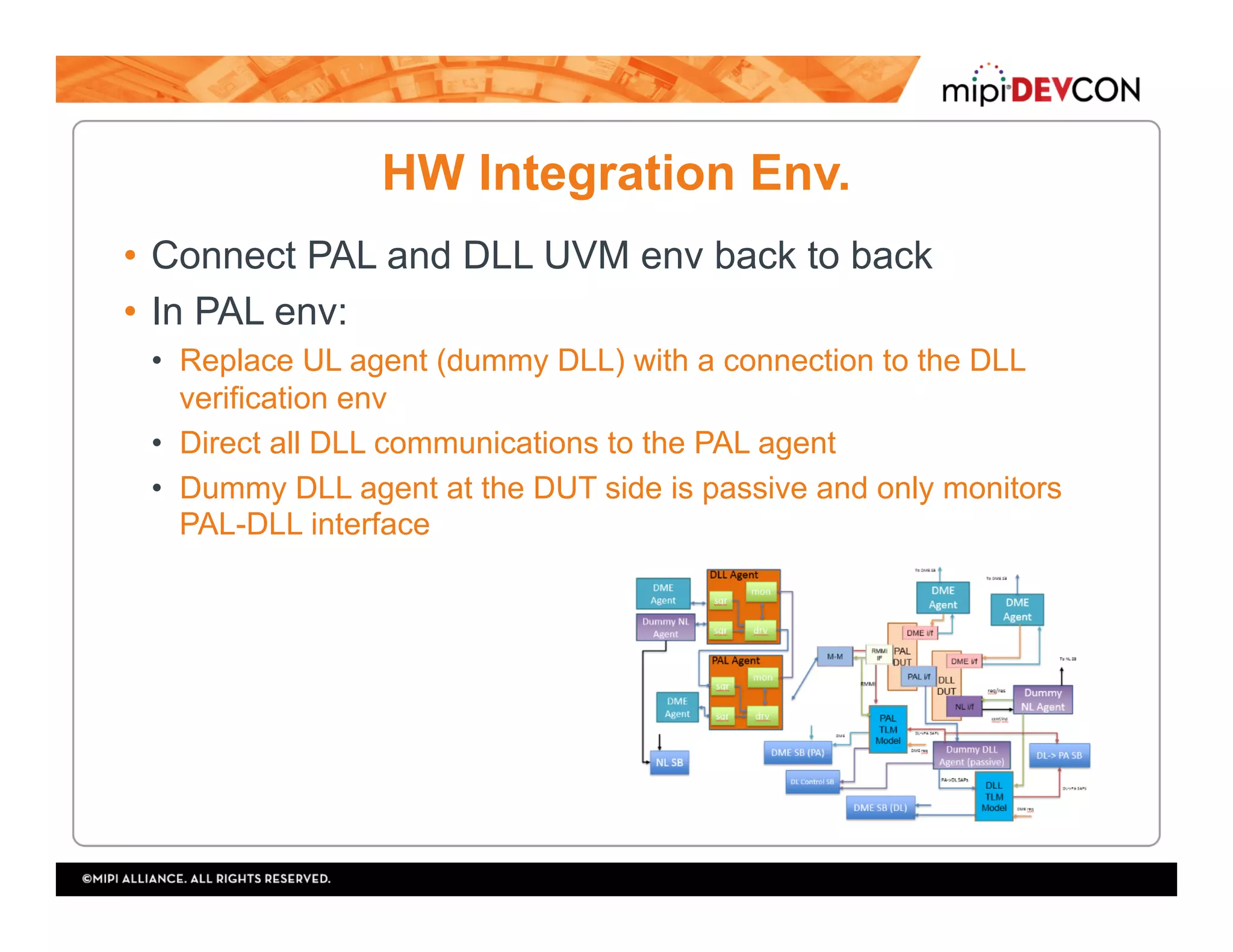
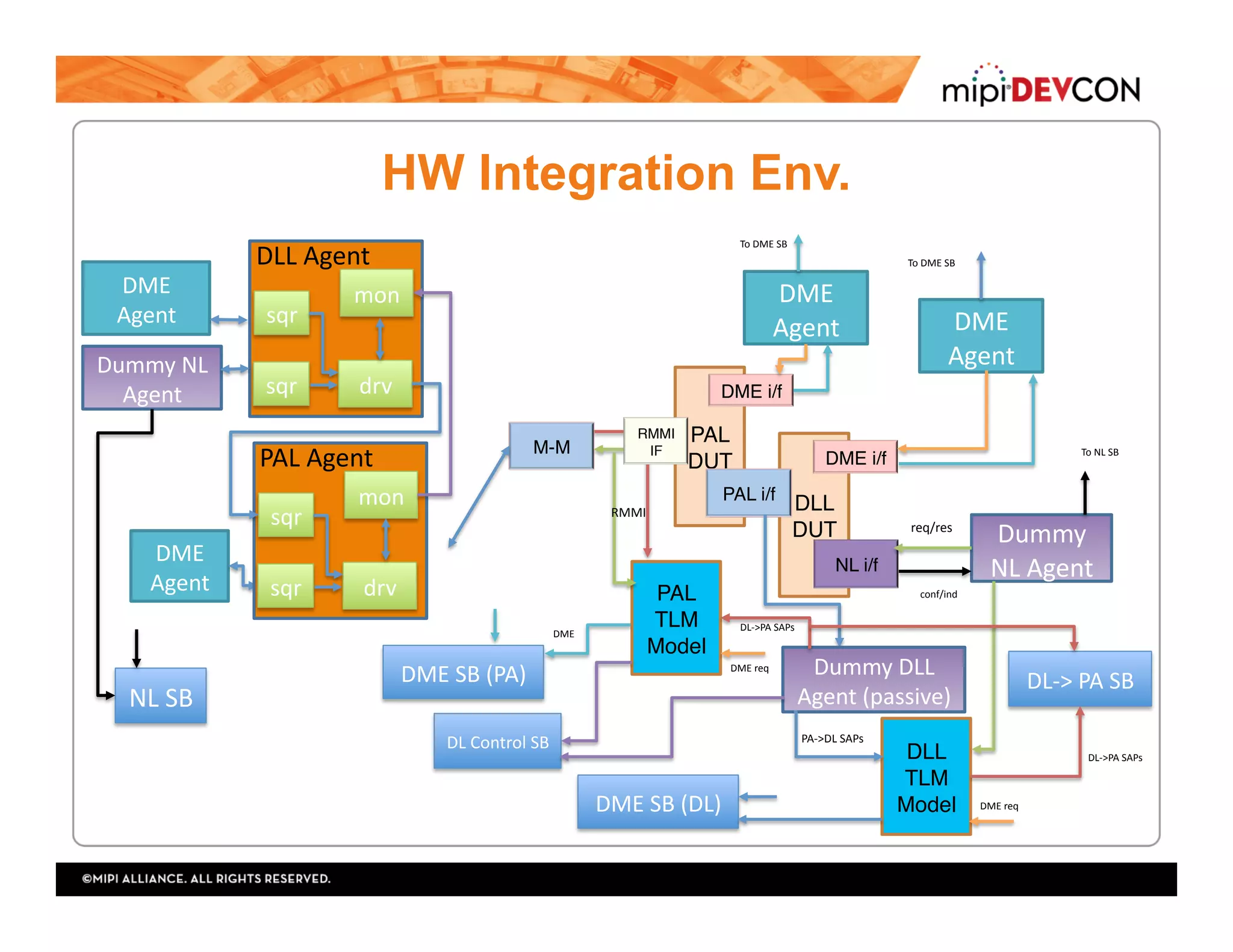
HW Integration Env.
•  Connect PAL and DLL UVM env back to back
•  In PAL env:
•  Replace UL agent (dummy DLL) with a connection to the DLL
verification env
•  Direct all DLL communications to the PAL agent
•  Dummy DLL agent at the DUT side is passive and only monitors
PAL-DLL interface
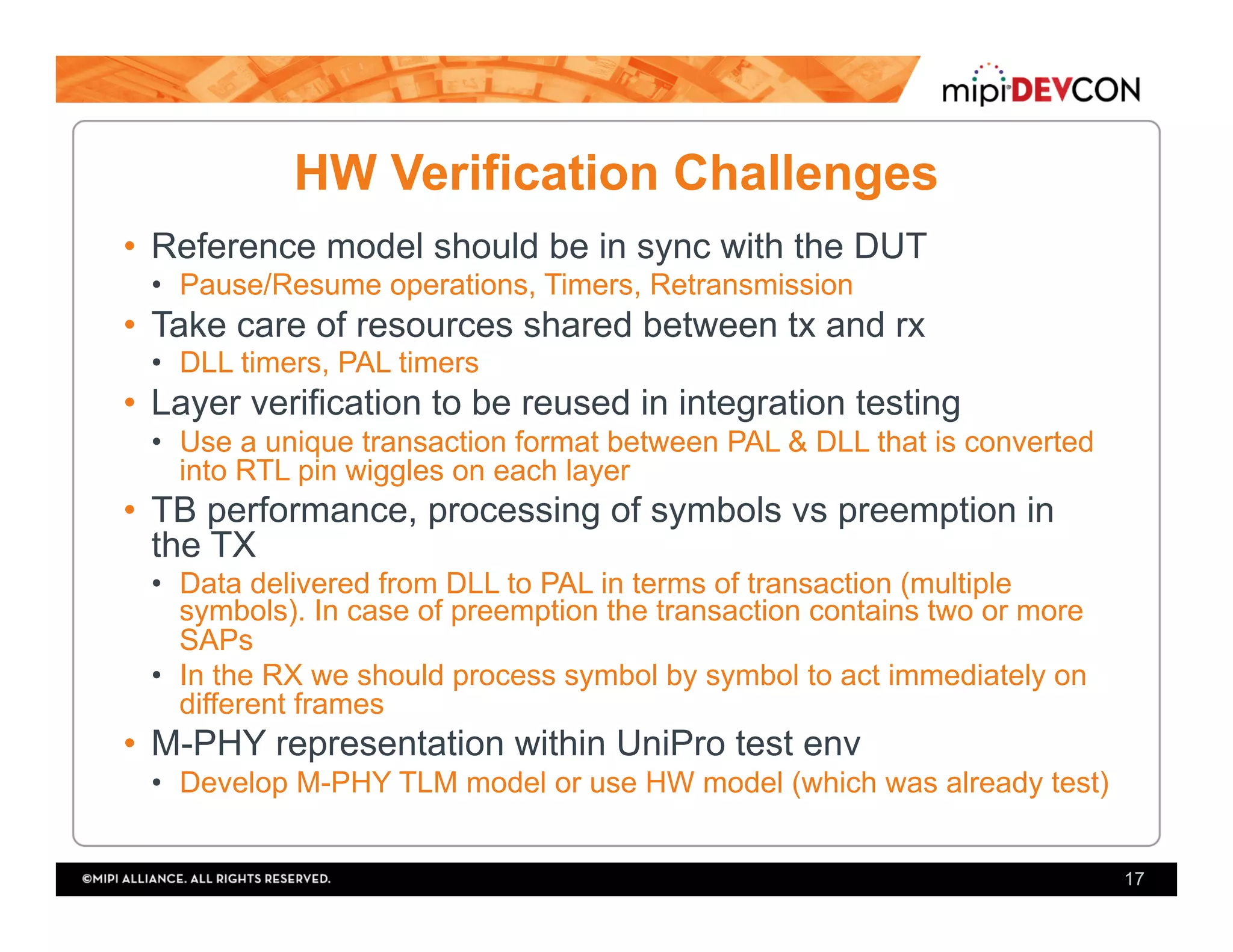
HW Verification Challenges
•  Reference model should be in sync with the DUT
•  Pause/Resume operations, Timers, Retransmission
•  Take care of resources shared between tx and rx
•  DLL timers, PAL timers
•  Layer verification to be reused in integration testing
•  Use a unique transaction format between PAL & DLL that is converted
into RTL pin wiggles on each layer
•  TB performance, processing of symbols vs preemption in
the TX
•  Data delivered from DLL to PAL in terms of transaction (multiple
symbols). In case of preemption the transaction contains two or more
SAPs
•  In the RX we should process symbol by symbol to act immediately on
different frames
•  M-PHY representation within UniPro test env
•  Develop M-PHY TLM model or use HW model (which was already test)
17
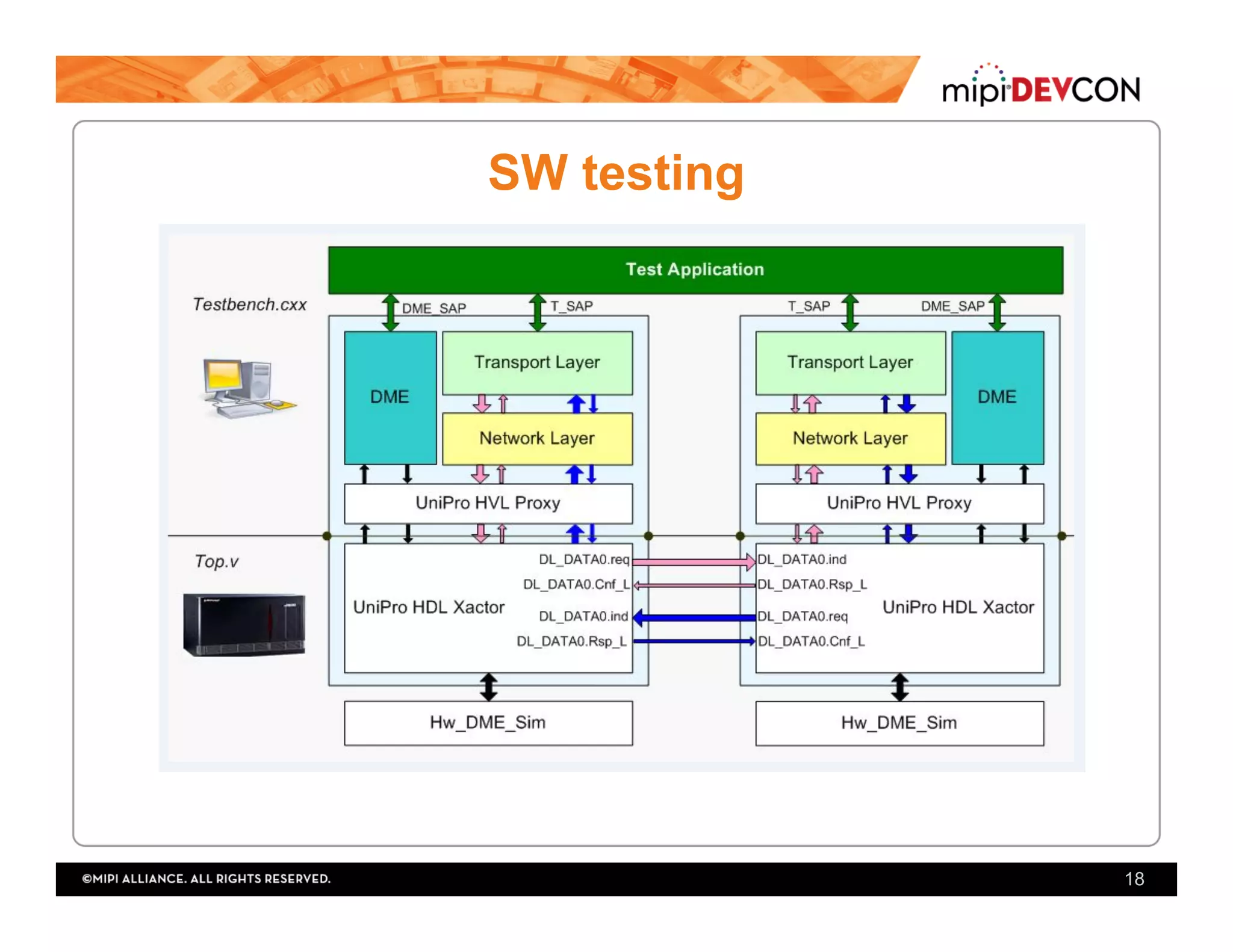
SW testing
18
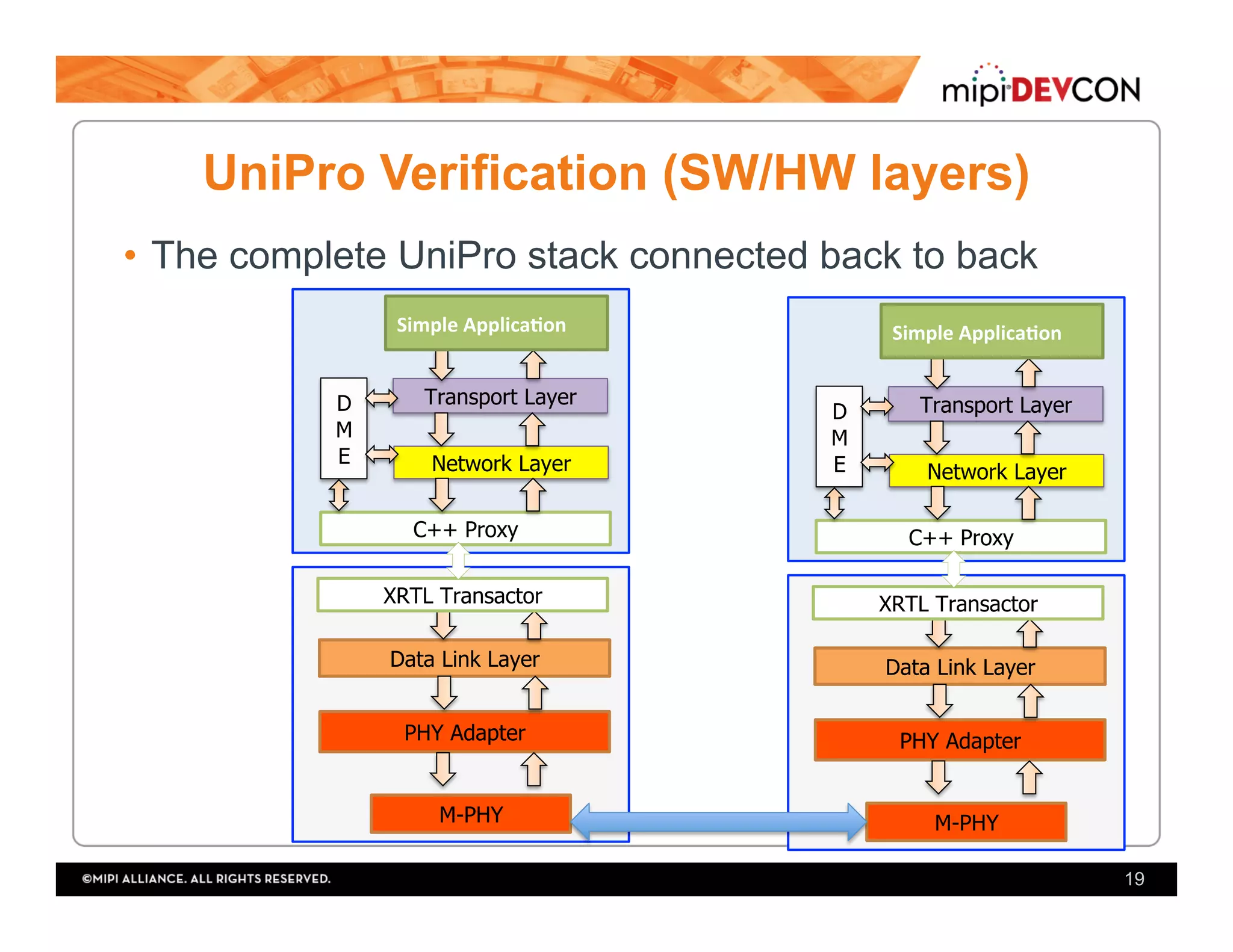
UniPro Verification (SW/HW layers)
•  The complete UniPro stack connected back to back
19
Transport Layer
Network Layer
Data Link Layer
PHY Adapter
D
M
E
Simple	Applica'on
C++ Proxy
XRTL Transactor
M-PHY
Transport Layer
Network Layer
Data Link Layer
PHY Adapter
D
M
E
Simple	Applica'on
C++ Proxy
XRTL Transactor
M-PHY
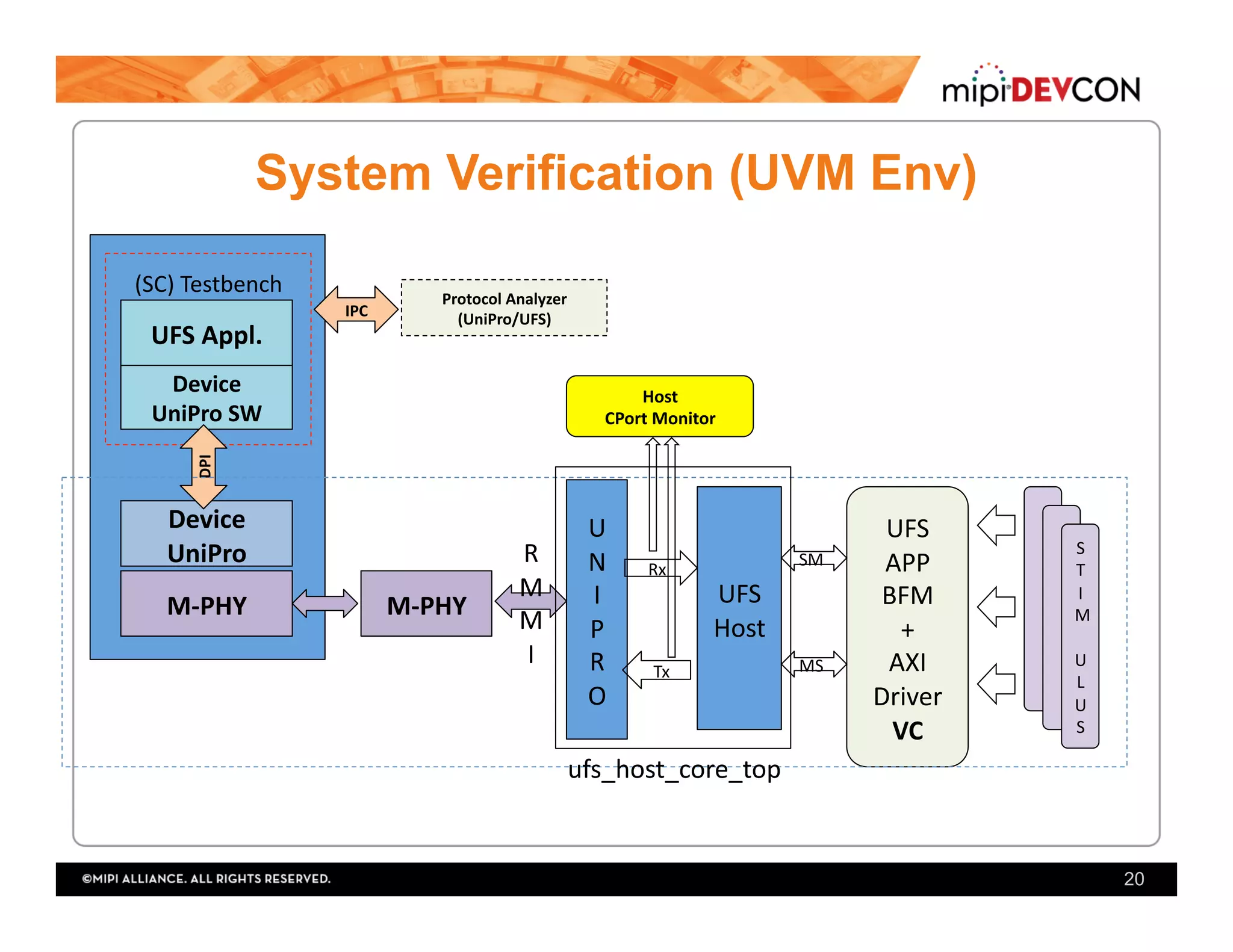
System Verification (UVM Env)
20
UFS	
APP		
BFM	
+	
AXI	
Driver	
VC	
S	
T	
I	
M
U	
L	
U	
S	
UFS	
Host		
M-PHY	
Device	
UniPro	
M-PHY	
R
M
M	
I	
Device	
UniPro	SW	
UFS	Appl.	
(SC)	Testbench	
IPC	
DPI	
U	
N	
I	
P	
R	
O	
Host	
CPort	Monitor	
MS	
SM	
Rx	
Tx	
ufs_host_core_top	
Protocol	Analyzer	
(UniPro/UFS)
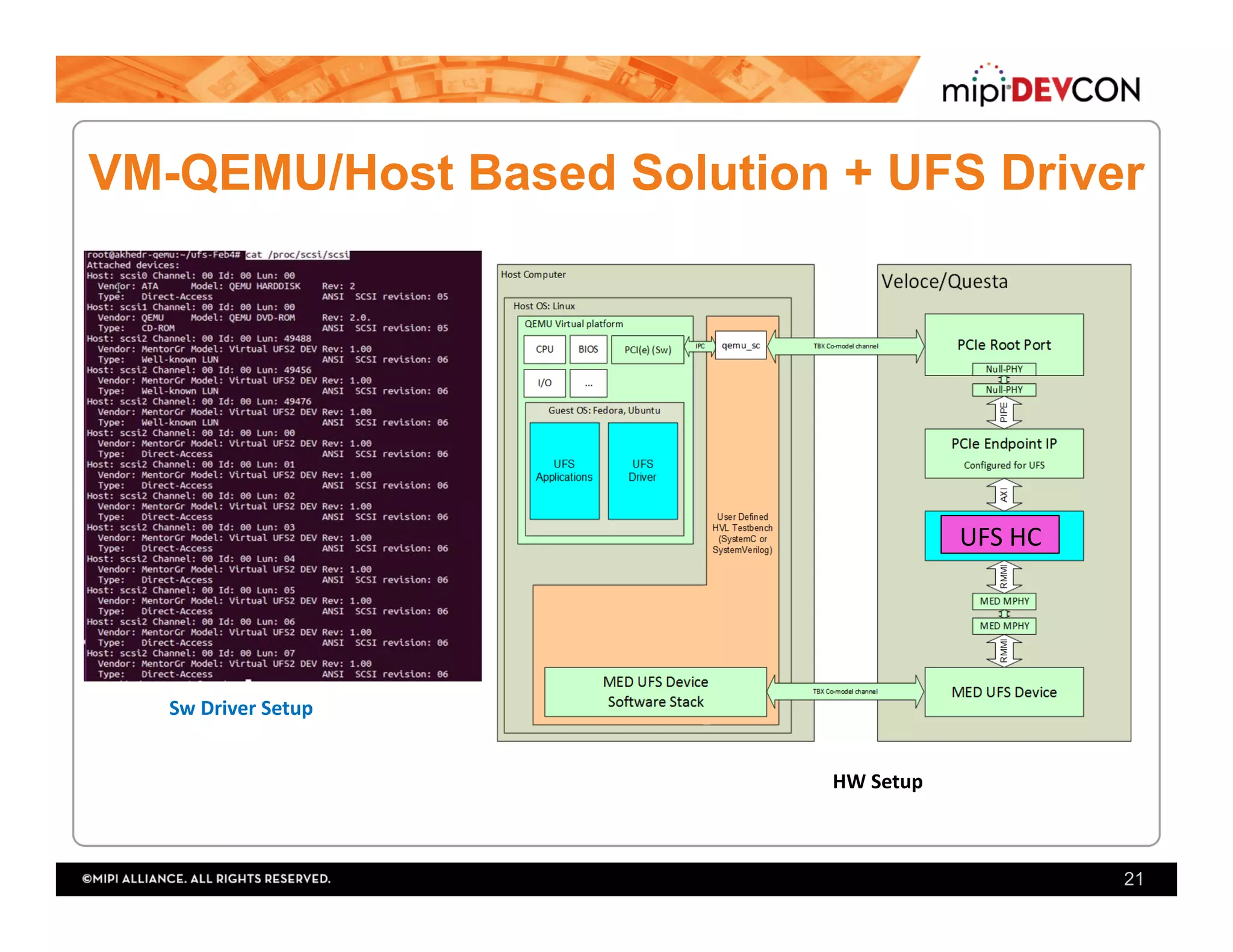
VM-QEMU/Host Based Solution + UFS Driver
21
Sw	Driver	Setup	
HW	Setup	
UFS	HC
DEBUGGING
Protocol Analyzer
22
Debugging
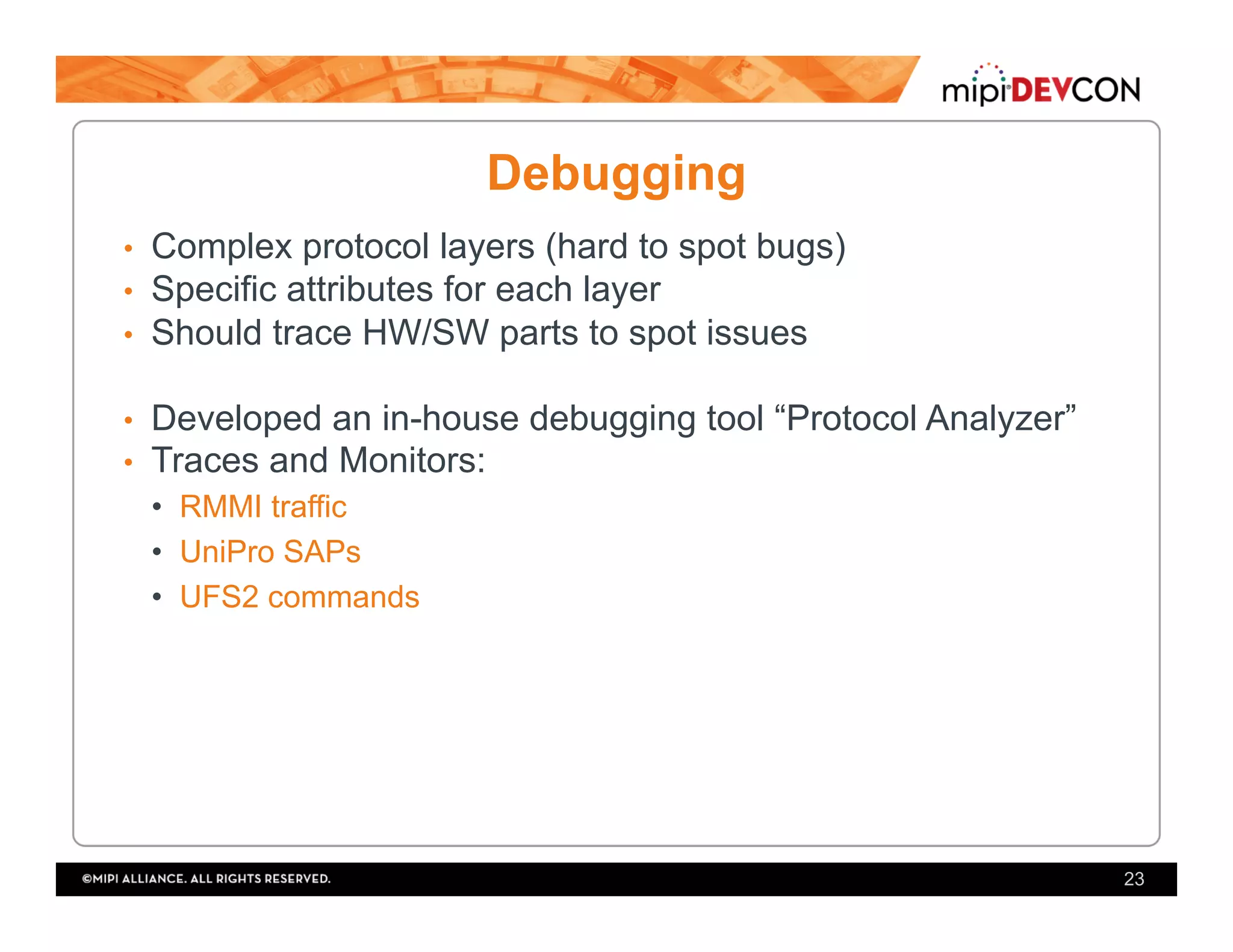
•  Complex protocol layers (hard to spot bugs)
•  Specific attributes for each layer
•  Should trace HW/SW parts to spot issues
•  Developed an in-house debugging tool “Protocol Analyzer”
•  Traces and Monitors:
•  RMMI traffic
•  UniPro SAPs
•  UFS2 commands
23
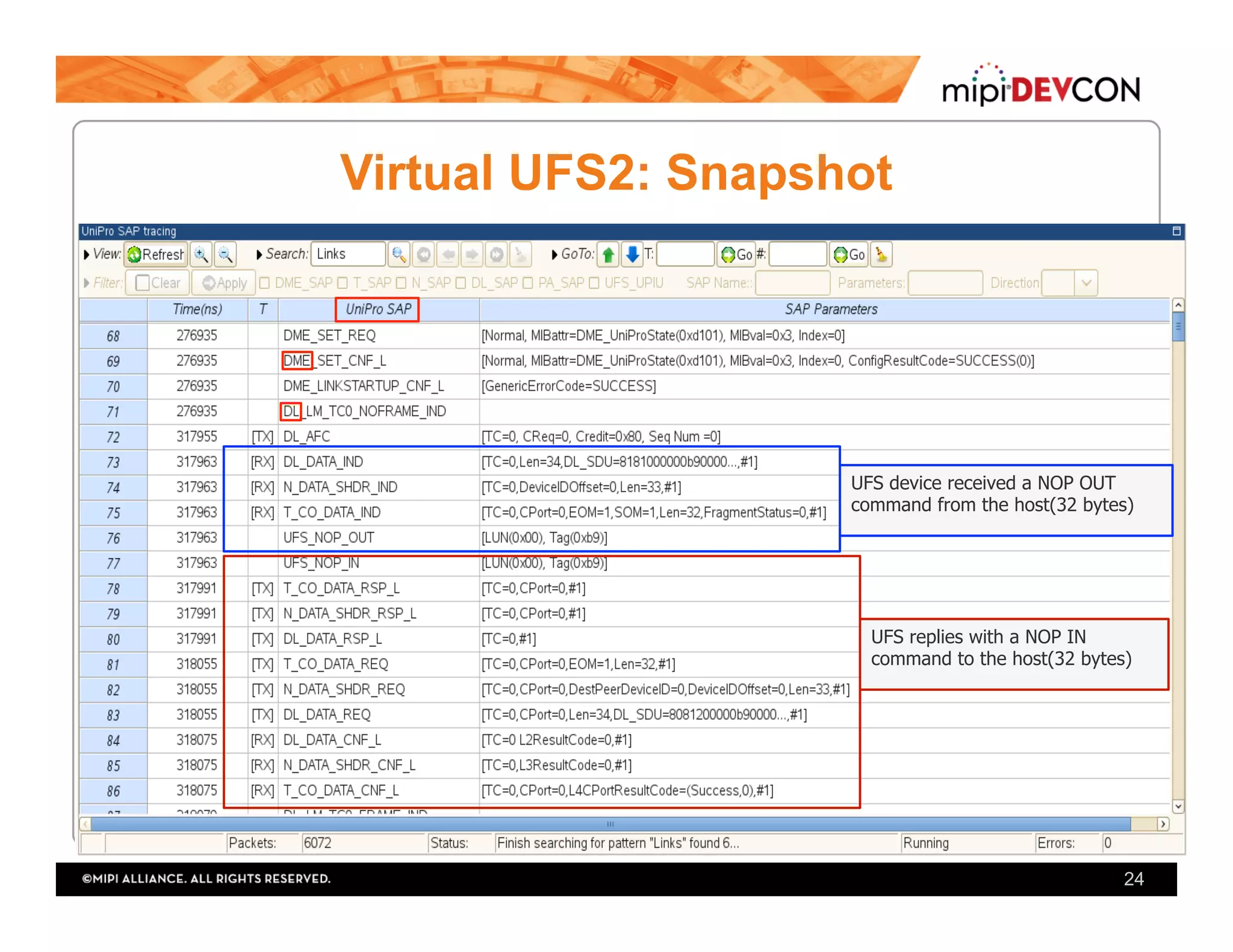
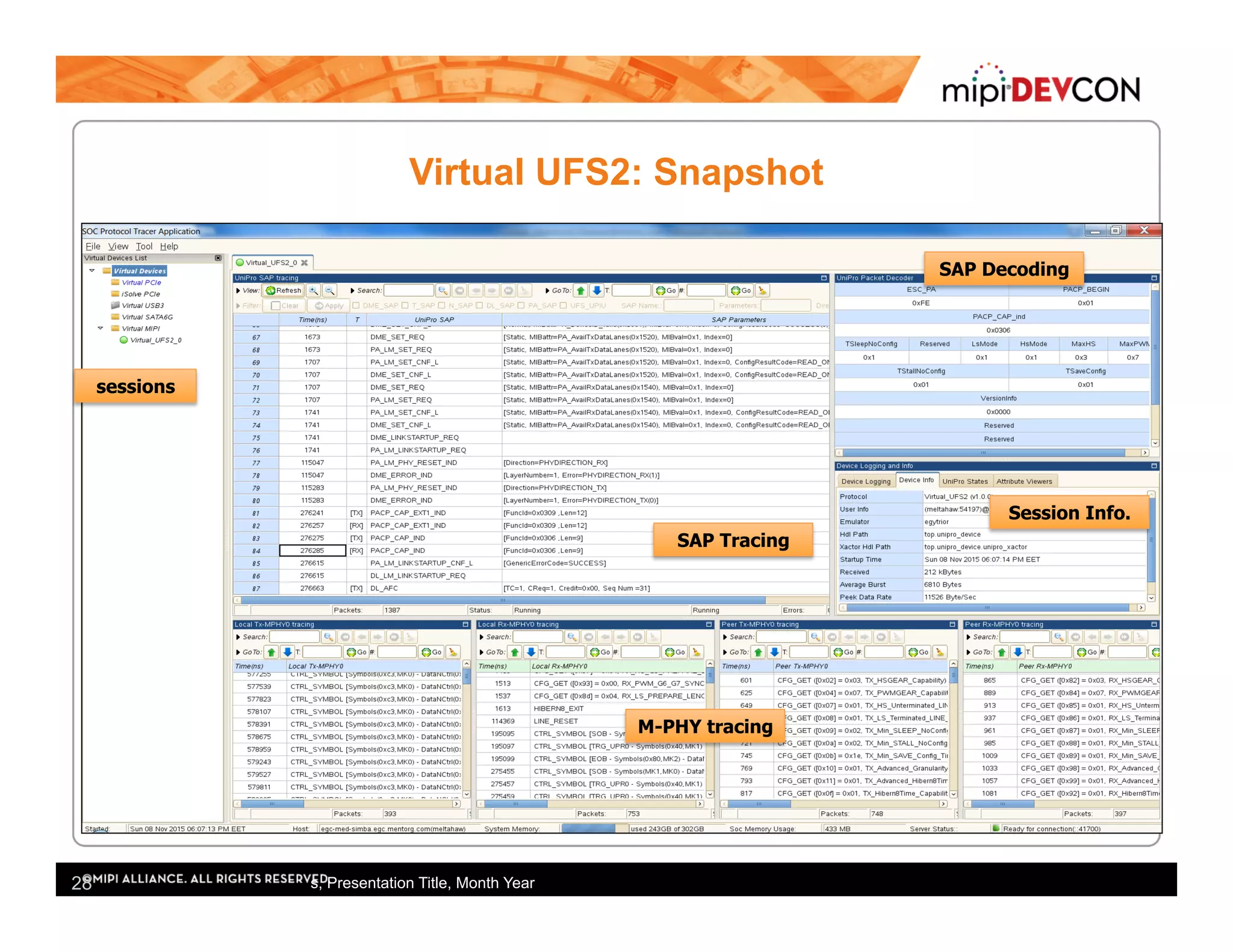
Virtual UFS2: Snapshot
24
UFS device received a NOP OUT
command from the host(32 bytes)
UFS replies with a NOP IN
command to the host(32 bytes)
Virtual UFS2: SAP Tracing
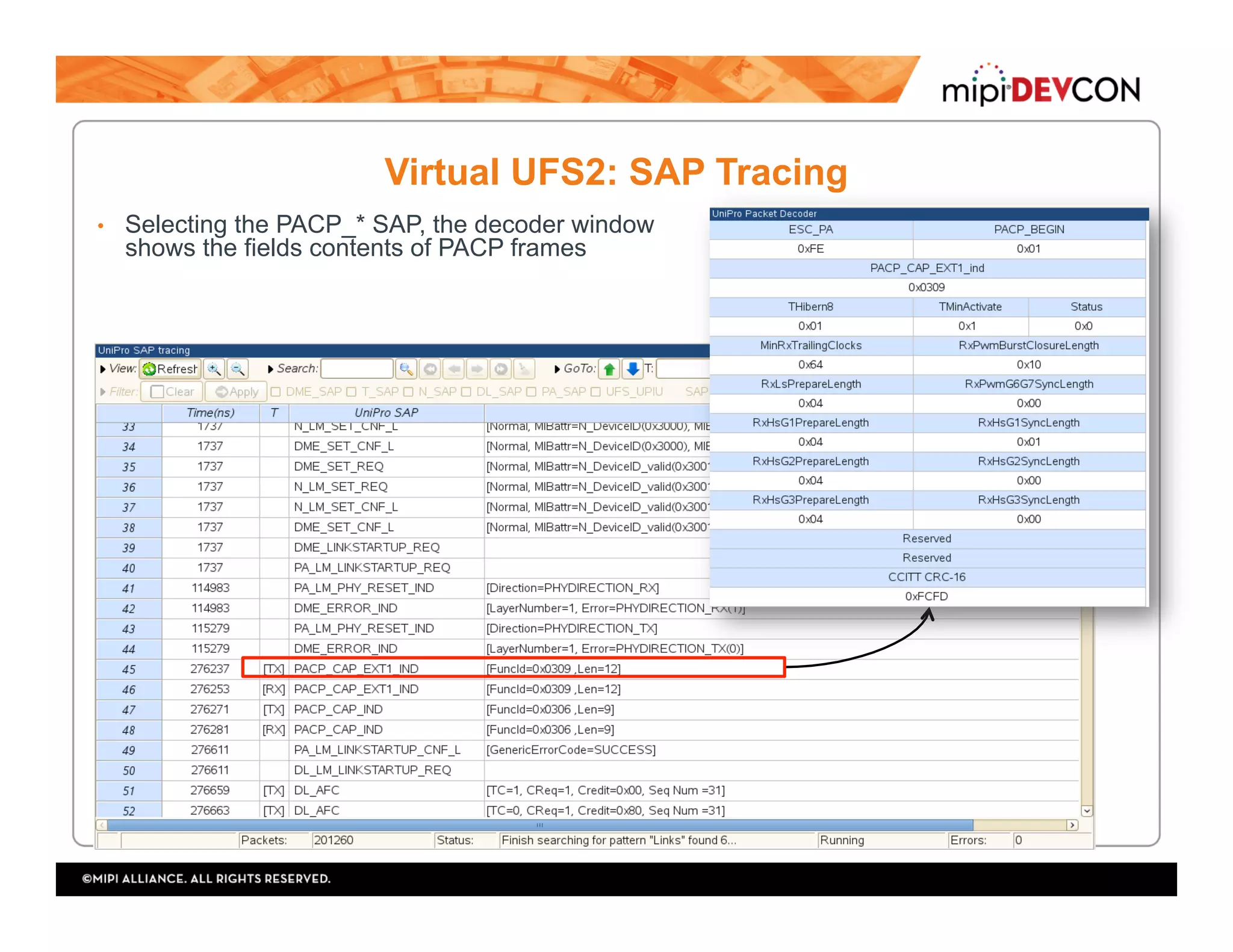
•  Selecting the PACP_* SAP, the decoder window
shows the fields contents of PACP frames
Virtual UFS2: SAP Tracing
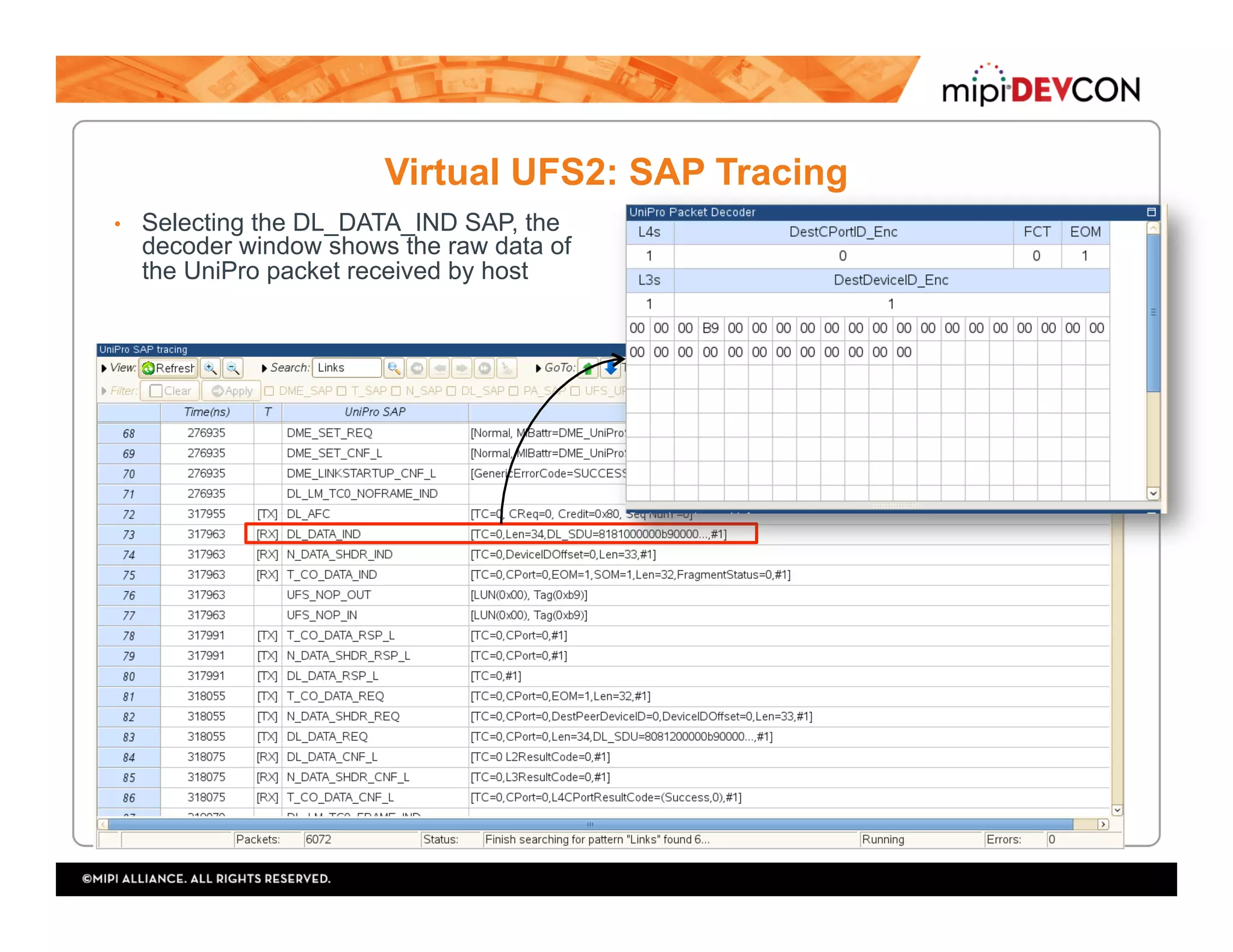
•  Selecting the DL_DATA_IND SAP, the
decoder window shows the raw data of
the UniPro packet received by host
Virtual UFS2: SAP Tracing
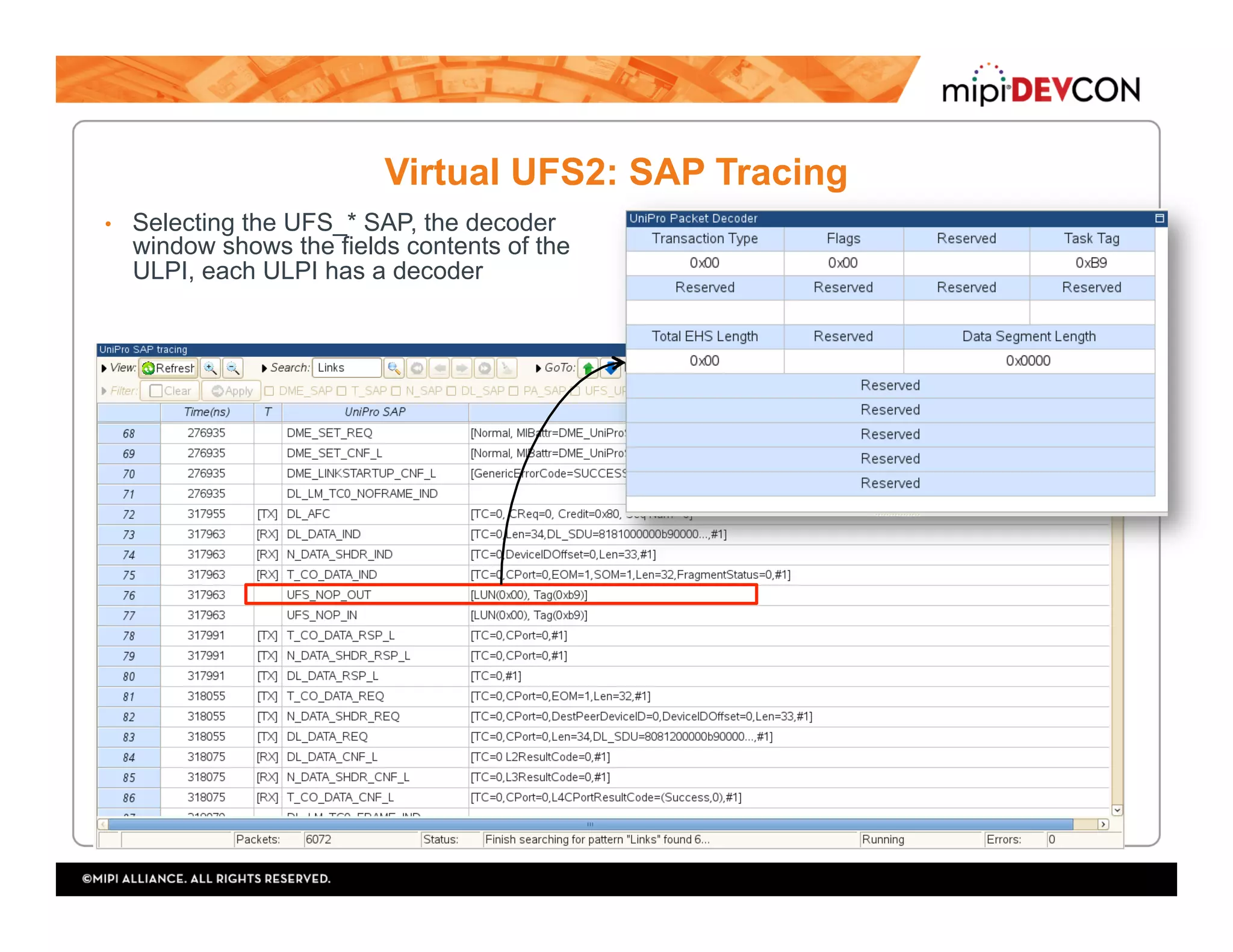
•  Selecting the UFS_* SAP, the decoder
window shows the fields contents of the
ULPI, each ULPI has a decoder
Virtual UFS2: Snapshot
s, Presentation Title, Month Year28
SAP Tracing
M-PHY tracing
SAP Decoding
sessions
Session Info.
Overview
29
Overview
30
HW Integration Env.
PAL
DUT
DME i/f
DLL i/f
M-M
PAL
TLM
Model
RMMI
IF
RMMI	 DLL
DUT
DME i/f
NL i/f
PAL i/f
DME	
Agent	 DME	
Agent	
To	DME	SB	
To	DME	SB	
DME	req	
DLL
TLM
Model DME	req	
Dummy	
NL	Agent	
req/res	
conf/ind	
Dummy	DLL	
Agent	(passive)	
DLL	Agent	
Dummy	NL	
Agent	
DME	
Agent	
mon	
drv	sqr	
sqr	
DME	
Agent	
PAL	Agent	
mon	
drv	sqr	
sqr	
PA->DL	SAPs	
DL->	PA	SB	
DL->PA	SAPs	
DL->PA	SAPs	
DME	SB	(PA)	
DME	
DME	SB	(DL)	
NL	SB	
To	NL	SB	
DL	Control	SB
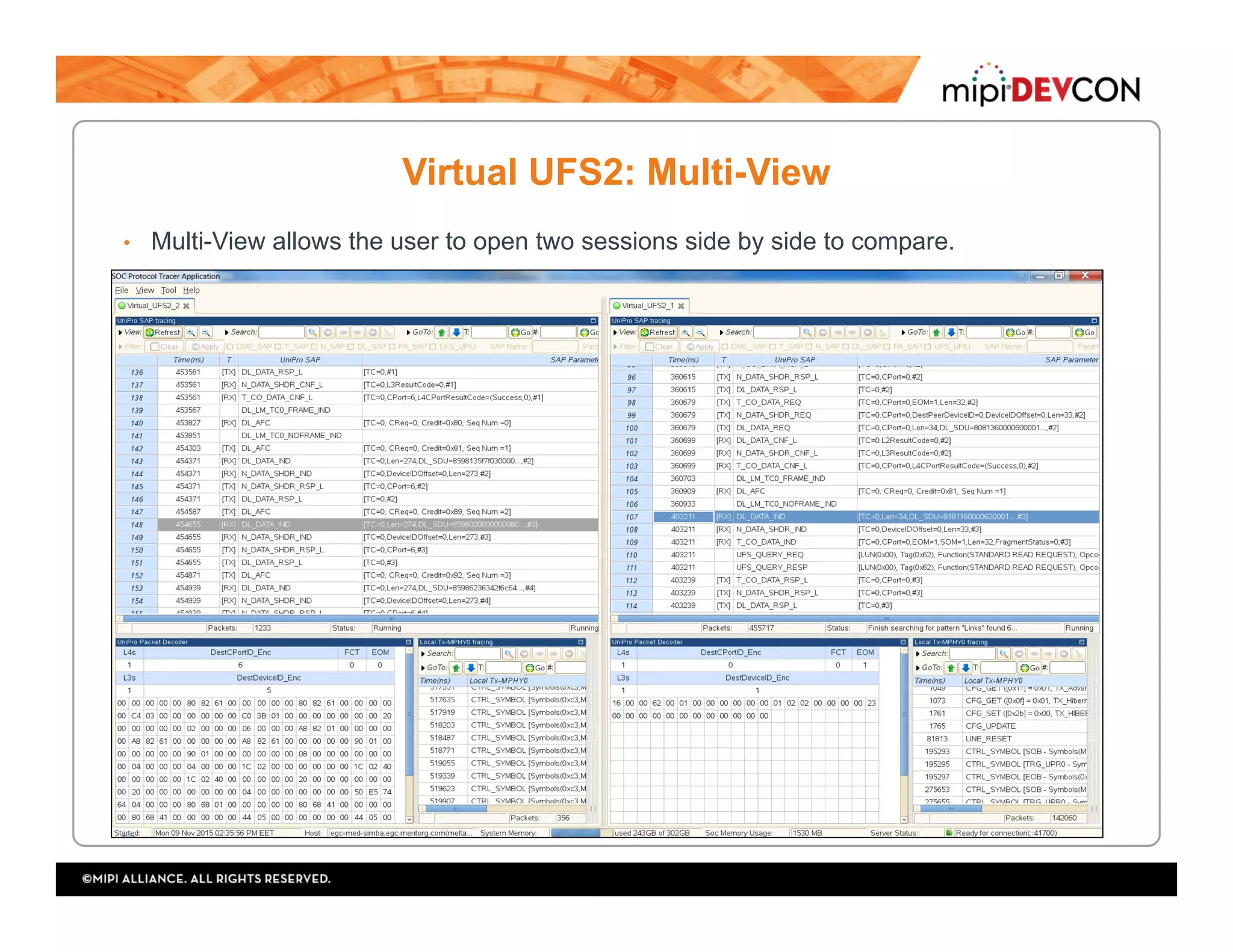
Virtual UFS2: Multi-View
•  Multi-View allows the user to open two sessions side by side to compare.
Virtual UFS2: SAP Tracing
Peer	
M-PHY	
Rx	
Peer
M-PHY
Tx
Local
M-PHY
Tx
Local
M-PHY
Rx
Mentor UFS
Device
DUT
(UFS Host)
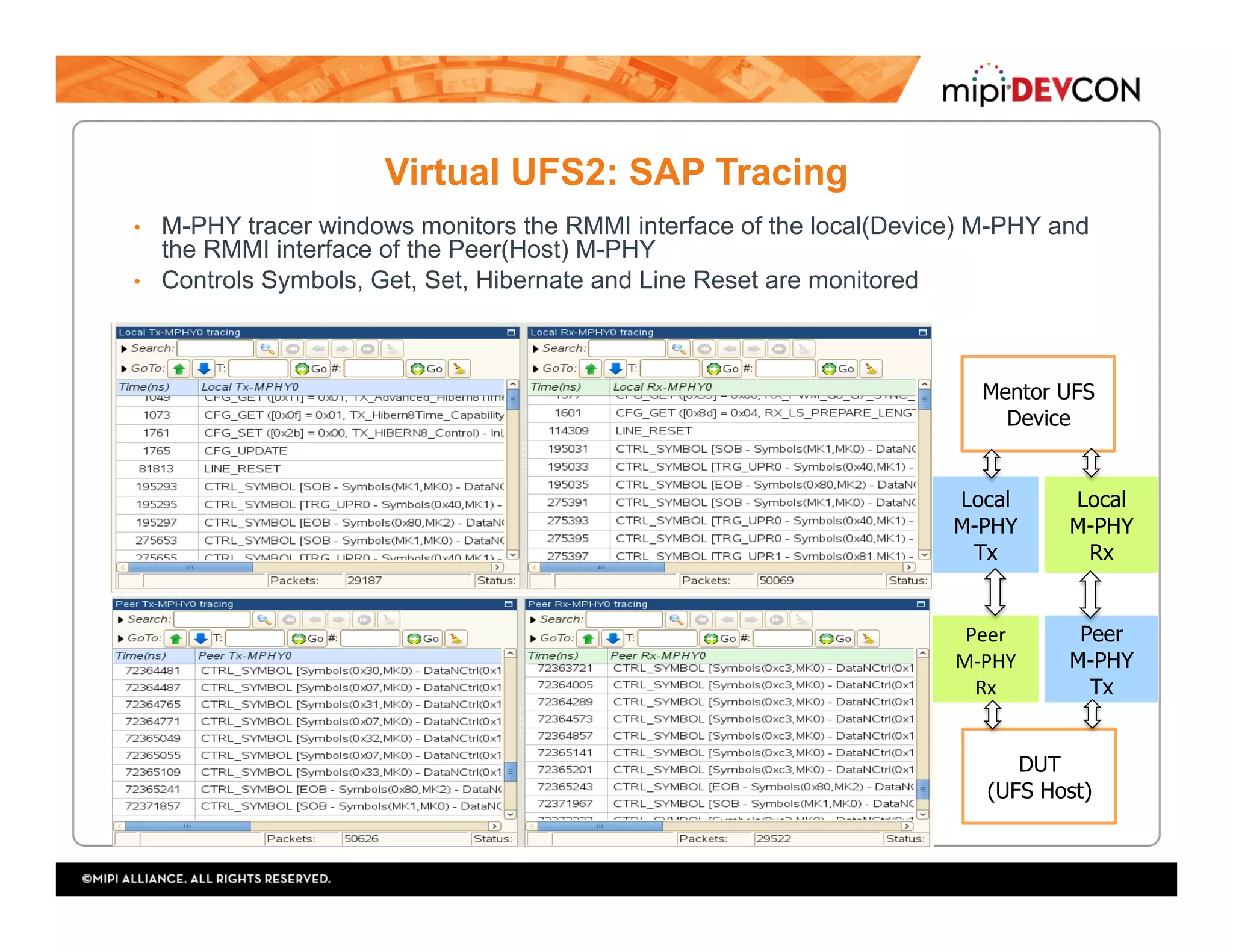
•  M-PHY tracer windows monitors the RMMI interface of the local(Device) M-PHY and
the RMMI interface of the Peer(Host) M-PHY
•  Controls Symbols, Get, Set, Hibernate and Line Reset are monitored
Virtual UFS2: Session Configurations
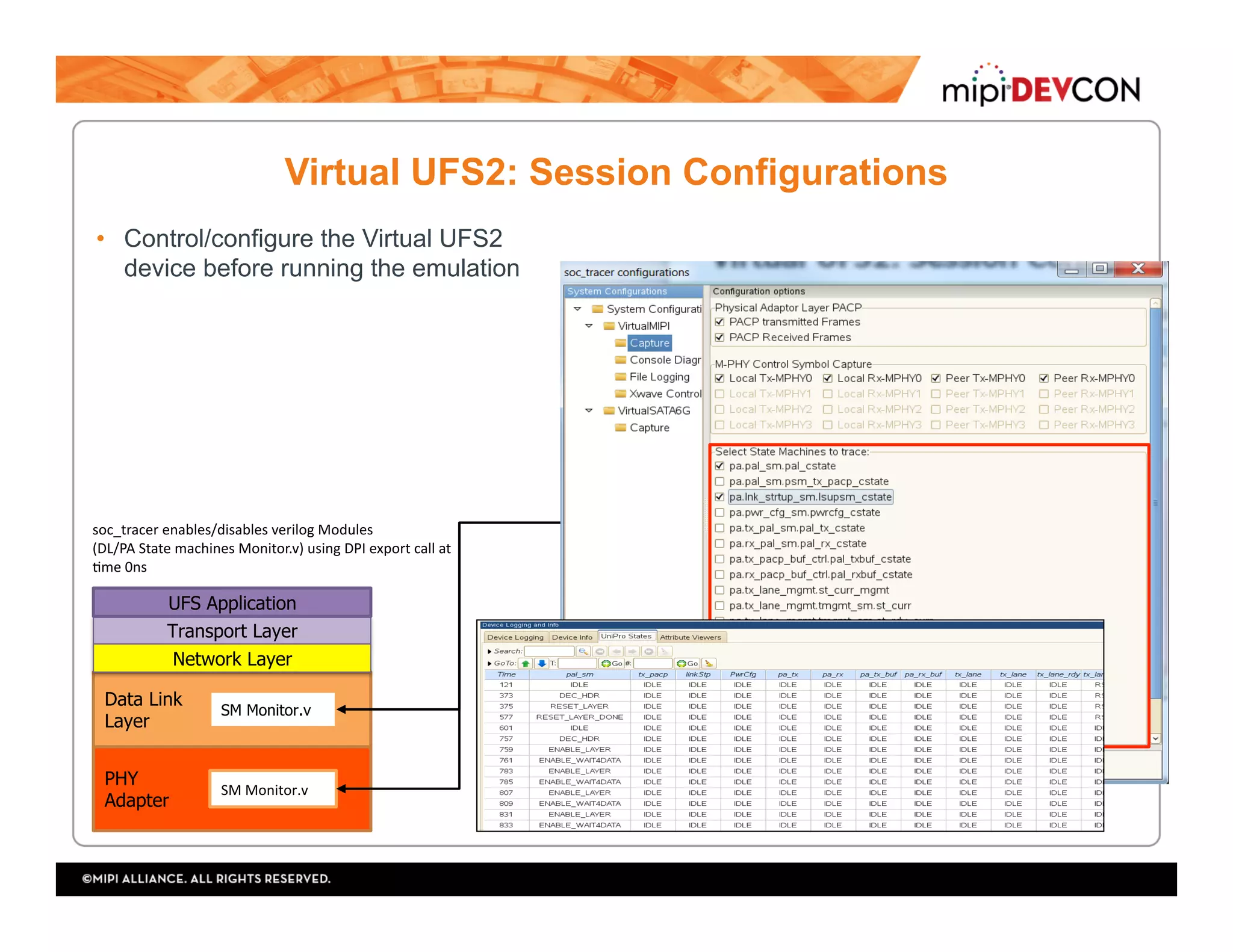
•  Control/configure the Virtual UFS2
device before running the emulation
Data Link
Layer
PHY
Adapter
Transport Layer
Network Layer
UFS Application
soc_tracer	enables/disables	verilog	Modules	
(DL/PA	State	machines	Monitor.v)	using	DPI	export	call	at	
;me	0ns	
SM Monitor.v
SM	Monitor.v

MIPI DevCon 2016: Verification of Mobile SOC Design (UFS)

  • 1.
    Verification of Mobile SOC Design(UFS) Mohamed Samy Mentor Graphics
  • 2.
    Outline •  Overview •  SW/HWdesign •  Interface •  Considerations •  Verification •  UniPro level •  System level •  Debugging •  Protocol Analyzer 2
  • 3.
    Overview •  Verification Platforms • Emulation / Simulation •  UFS2 and MIPI CSI-3 •  Application layer (SW) •  UniPro core (HW/SW) •  M-PHY (HW) •  GUI tool “Protocol Analyzer” is used to trace and monitor •  RMMI traffic •  UniPro SAPs •  UFS2 commands 3 UniPro UFS2 SW stack M-PHY M-PHY
  • 4.
    Overview •  Simulation •  Thewhole verification platform runs on the host machine •  Emulation •  The SW part of the verification platform runs on the host machine •  The HW part runs on the Emulator 4 Transport Layer Network Layer Data Link Layer PHY Adapter D M E Applica'on C++ Proxy XRTL Transactor CSI-3 UFS2 M-PHYM-PHY
  • 5.
    Co-Design •  Network, DME,Transport, MIPI CSI-3 and UFS2 layers are native C++ software layers •  Communication between SW and HW is through a transaction-based methodology‫‏‬ based on SCE-MI 2.0 •  C++ Proxy •  XRTL transactor •  Middle-out methodology •  Started with Data link layer and Network layer first. 5 Transport Layer Network Layer Data Link Layer PHY Adapter D M E Applica'on C++ Proxy XRTL Transactor CSI-3 UFS2 M-PHY
  • 6.
    Co-Design int UniProMemoryXactor_sc::WriteTransaction(u_int8_t *pBuf, u_int16_twBytesCount, bool IsBlocking) { … UniProMemoryWrite((svBitVecVal *)pTxBuf,(int)wBytesCount, (IsBlocking)?1:0); if (IsBlocking) { wait(Done); }; … } 6 function void UniProMemoryWrite(input bit [COMODEL_BUF_SIZE-1:0] Buf, int BytesCount, int IsBlocking); WrIsBlock = IsBlocking; WrDataWordsCounts = ((BytesCount/(DATA_WIDTH/8)) + ((BytesCount%(DATA_WIDTH/8))?1:0)); WrBytesOfLastWord = BytesCount - (WrDataWordsCounts-1)*(DATA_WIDTH/8); WrLastBe = (WrBytesOfLastWord == 8 ) ? 8'hFF: (WrBytesOfLastWord == 7 ) ? 8'h7F: (WrBytesOfLastWord == 6 ) ? 8'h3F: (WrBytesOfLastWord == 5 ) ? 8'h1F: (WrBytesOfLastWord == 4 ) ? 8'h0F: (WrBytesOfLastWord == 3 ) ? 8'h07: (WrBytesOfLastWord == 2 ) ? 8'h03: (WrBytesOfLastWord == 1 ) ? 8'h01: 8'hFF; for(int i =0 ; i< WrDataWordsCounts; i = i + 1 ) begin WrBuf[i] = Buf[(DATA_WIDTH)*i +: DATA_WIDTH]; end ->e_StartWr; endfunction; C++ proxy un;med so?ware model XRTL counterpart
  • 7.
    SW/HW Interface 7 •  DME<-> DLL •  DME <-> PAL •  NL <-> DLL NL DME DLL PAL
  • 8.
    SW/HW Interface (DME/NLSAPs) 8 Data Symbol # Bit fields 0 [15:0] DME_SAP opcode [31:16] GenSelectorIndex or SelectorIndex [47:32] MIBaUribute or GenMIBaUribute [55:48] ResultCode: used for GenericErrorCode, ConfigResultCode and PowerChangeResultCode, DLErrorCode [56] AUrSetType [57] ResetLevel [58] PAResult [59] PHYDirec;on 1 [31:0] MIBvalue 2,3,4 PAPowerModeUserData
  • 9.
  • 10.
    UFS/CSI <-> UniProInterface 10
  • 11.
    Design Considerations •  ImplementingDME/NL/TL/UFS/CSI in SW •  flexibility •  faster implementation •  Implementing PAL/DLL in RTL •  Better overall performance (Minimize communication overhead) •  Bulks of data are grouped in DL and sent once to NL so better be in HW for performance •  Timers are in DL and PAL, can’t be done accurately in SW •  XRTL tasks have timeout mechanism to avoid blocking the calling SW side 11
  • 12.
    HW Design Considerations • Full separation of data and control buses. Full separation of TX and RX data buses •  All layer attributes are implemented in a memory module •  Allows fast initialization of UniPro IP •  Serves well in monitoring the layer attributes using the Protocol Analyzer •  Abstract number of active lanes from the internal data bus through the use of lane distribution/merging logic •  64 bits fixed Internal data bus (4 lanes of 16-bits each) •  Merge PA_DATA and PA_ESCDATA into one SAP with control flag 12
  • 13.
    System Verification •  UniProlevel •  MIPI M-PHY already tested in a separate testing env (UVM based) •  Block/Layer (UVM verification env.) •  PAL vs TLM models •  DLL vs TLM models •  Integration •  DLL/PAL/PHY vs TLM models in UVM env (HW) •  UniPro (NL, TL, DLL, PAL, M-PHY) back to back (SW&HW) •  System level •  UFS device vs UFS host UVM test env •  UFS device vs UFS Host invoking guest OS 13
  • 14.
    Layer testing (PAL,DLL) 14 DME Agent UL Agent Layer X DUT DME i/f ULi/f LL i/f DME Agent UL Agent TLM Ref model SB seq seq seq seq Virtual seq -  UVM Based -  Same architecture for PAL/DLL testing env -  X Agent represents the layer completely and reused as TLM ref model -  Ref model should be in sync with the DUT monitor driver sqr sqr X Agent
  • 15.
    PAL Verification Env. 15 PAL DUT DMEi/f DLL i/f M-M PAL TLM Model monitor driver sqr sqr RMMI RMMI IF PAL Agent
  • 16.
    HW Integration Env. • Connect PAL and DLL UVM env back to back •  In PAL env: •  Replace UL agent (dummy DLL) with a connection to the DLL verification env •  Direct all DLL communications to the PAL agent •  Dummy DLL agent at the DUT side is passive and only monitors PAL-DLL interface
  • 17.
    HW Verification Challenges • Reference model should be in sync with the DUT •  Pause/Resume operations, Timers, Retransmission •  Take care of resources shared between tx and rx •  DLL timers, PAL timers •  Layer verification to be reused in integration testing •  Use a unique transaction format between PAL & DLL that is converted into RTL pin wiggles on each layer •  TB performance, processing of symbols vs preemption in the TX •  Data delivered from DLL to PAL in terms of transaction (multiple symbols). In case of preemption the transaction contains two or more SAPs •  In the RX we should process symbol by symbol to act immediately on different frames •  M-PHY representation within UniPro test env •  Develop M-PHY TLM model or use HW model (which was already test) 17
  • 18.
  • 19.
    UniPro Verification (SW/HWlayers) •  The complete UniPro stack connected back to back 19 Transport Layer Network Layer Data Link Layer PHY Adapter D M E Simple Applica'on C++ Proxy XRTL Transactor M-PHY Transport Layer Network Layer Data Link Layer PHY Adapter D M E Simple Applica'on C++ Proxy XRTL Transactor M-PHY
  • 20.
    System Verification (UVMEnv) 20 UFS APP BFM + AXI Driver VC S T I M U L U S UFS Host M-PHY Device UniPro M-PHY R M M I Device UniPro SW UFS Appl. (SC) Testbench IPC DPI U N I P R O Host CPort Monitor MS SM Rx Tx ufs_host_core_top Protocol Analyzer (UniPro/UFS)
  • 21.
    VM-QEMU/Host Based Solution+ UFS Driver 21 Sw Driver Setup HW Setup UFS HC
  • 22.
  • 23.
    Debugging •  Complex protocollayers (hard to spot bugs) •  Specific attributes for each layer •  Should trace HW/SW parts to spot issues •  Developed an in-house debugging tool “Protocol Analyzer” •  Traces and Monitors: •  RMMI traffic •  UniPro SAPs •  UFS2 commands 23
  • 24.
    Virtual UFS2: Snapshot 24 UFSdevice received a NOP OUT command from the host(32 bytes) UFS replies with a NOP IN command to the host(32 bytes)
  • 25.
    Virtual UFS2: SAPTracing •  Selecting the PACP_* SAP, the decoder window shows the fields contents of PACP frames
  • 26.
    Virtual UFS2: SAPTracing •  Selecting the DL_DATA_IND SAP, the decoder window shows the raw data of the UniPro packet received by host
  • 27.
    Virtual UFS2: SAPTracing •  Selecting the UFS_* SAP, the decoder window shows the fields contents of the ULPI, each ULPI has a decoder
  • 28.
    Virtual UFS2: Snapshot s,Presentation Title, Month Year28 SAP Tracing M-PHY tracing SAP Decoding sessions Session Info.
  • 29.
  • 30.
  • 31.
    HW Integration Env. PAL DUT DMEi/f DLL i/f M-M PAL TLM Model RMMI IF RMMI DLL DUT DME i/f NL i/f PAL i/f DME Agent DME Agent To DME SB To DME SB DME req DLL TLM Model DME req Dummy NL Agent req/res conf/ind Dummy DLL Agent (passive) DLL Agent Dummy NL Agent DME Agent mon drv sqr sqr DME Agent PAL Agent mon drv sqr sqr PA->DL SAPs DL-> PA SB DL->PA SAPs DL->PA SAPs DME SB (PA) DME DME SB (DL) NL SB To NL SB DL Control SB
  • 32.
    Virtual UFS2: Multi-View • Multi-View allows the user to open two sessions side by side to compare.
  • 33.
    Virtual UFS2: SAPTracing Peer M-PHY Rx Peer M-PHY Tx Local M-PHY Tx Local M-PHY Rx Mentor UFS Device DUT (UFS Host) •  M-PHY tracer windows monitors the RMMI interface of the local(Device) M-PHY and the RMMI interface of the Peer(Host) M-PHY •  Controls Symbols, Get, Set, Hibernate and Line Reset are monitored
  • 34.
    Virtual UFS2: SessionConfigurations •  Control/configure the Virtual UFS2 device before running the emulation Data Link Layer PHY Adapter Transport Layer Network Layer UFS Application soc_tracer enables/disables verilog Modules (DL/PA State machines Monitor.v) using DPI export call at ;me 0ns SM Monitor.v SM Monitor.v