Ross Nelson, Protocol Insight
MIPI JEDEC & UFSA Liaisons
Test & UniPro Working Groups
Robust Debug and
Conformance Verification
Ensures Interoperability
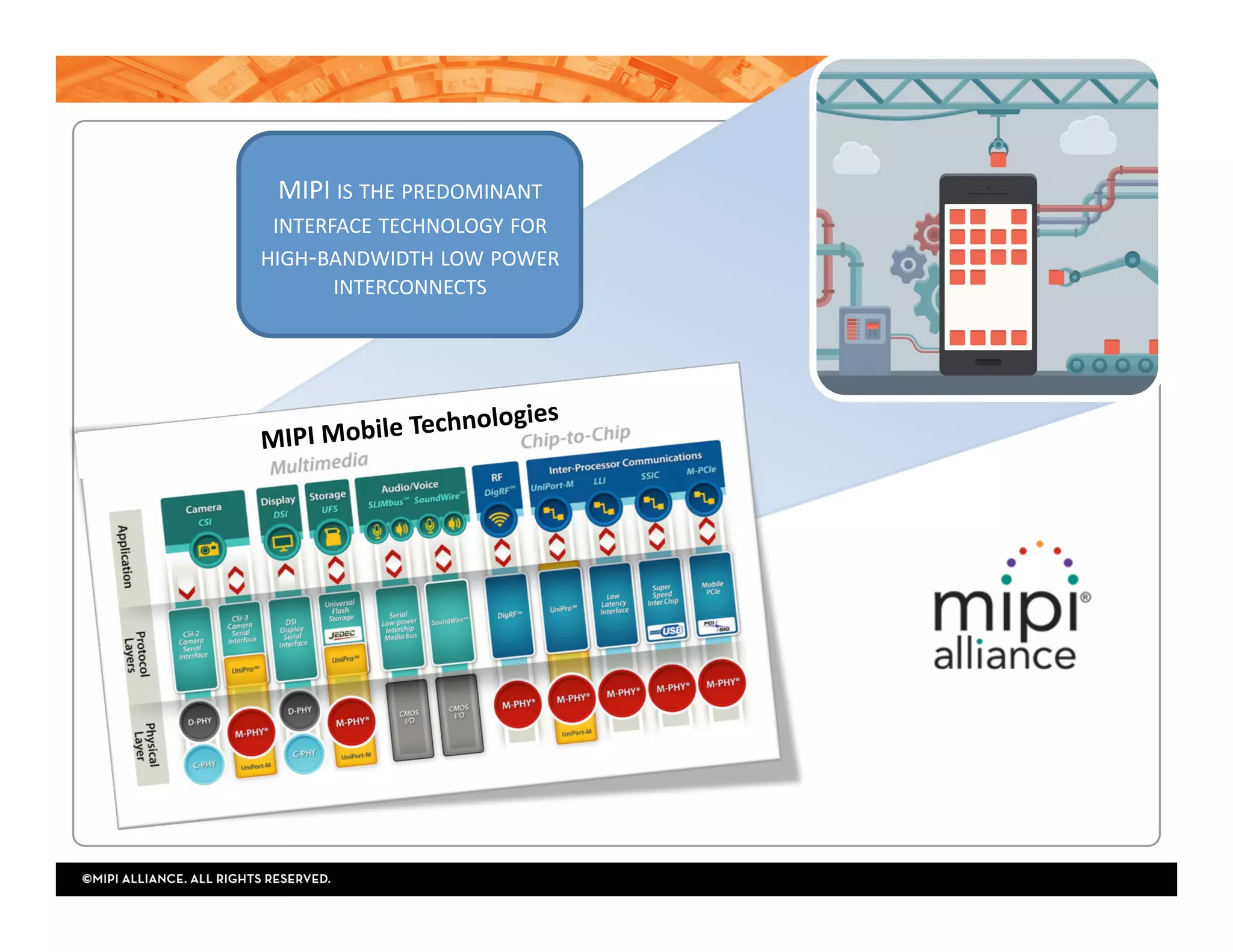
MIPI	Mobile	Technologies	
MIPI	IS	THE	PREDOMINANT	
INTERFACE	TECHNOLOGY	FOR	
HIGH-BANDWIDTH	LOW	POWER	
INTERCONNECTS
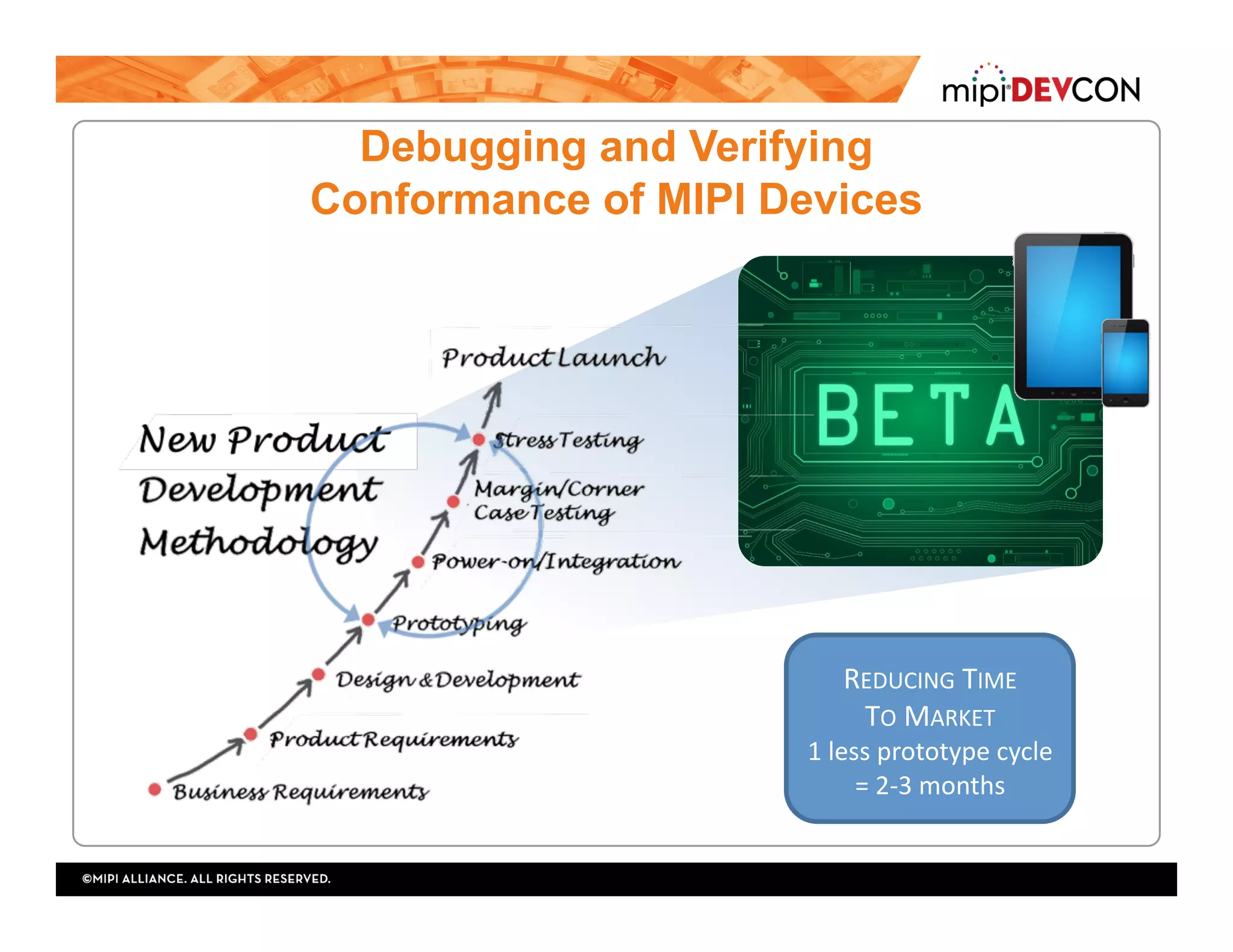
Debugging and Verifying
Conformance of MIPI Devices
REDUCING	TIME		
TO	MARKET	
1	less	prototype	cycle	
=	2-3	months
New Product
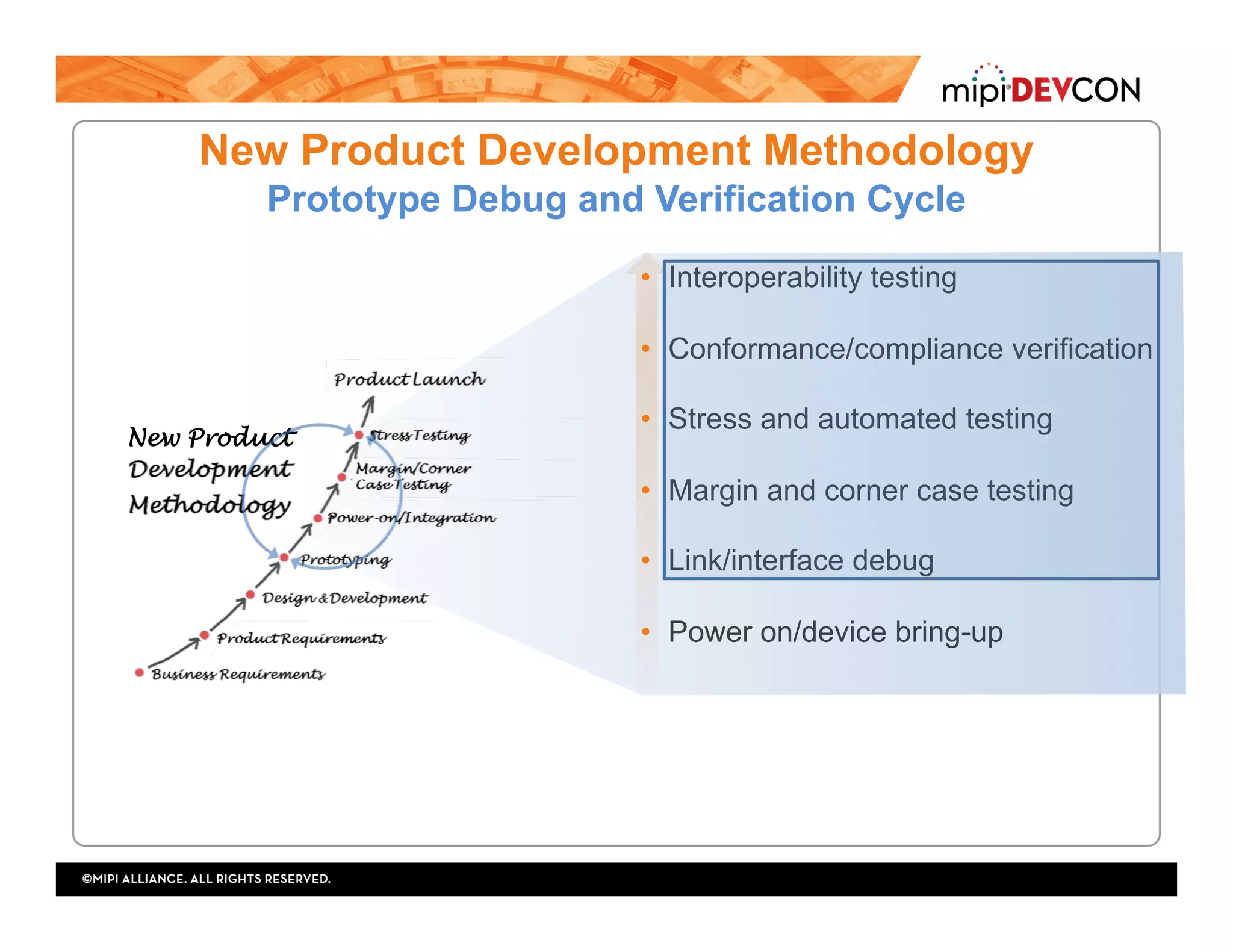
New Product Development Methodology
Prototype Debug and Verification Cycle
•  Interoperability testing
•  Conformance/compliance verification
•  Stress and automated testing
•  Margin and corner case testing
•  Link/interface debug
•  Power on/device bring-up
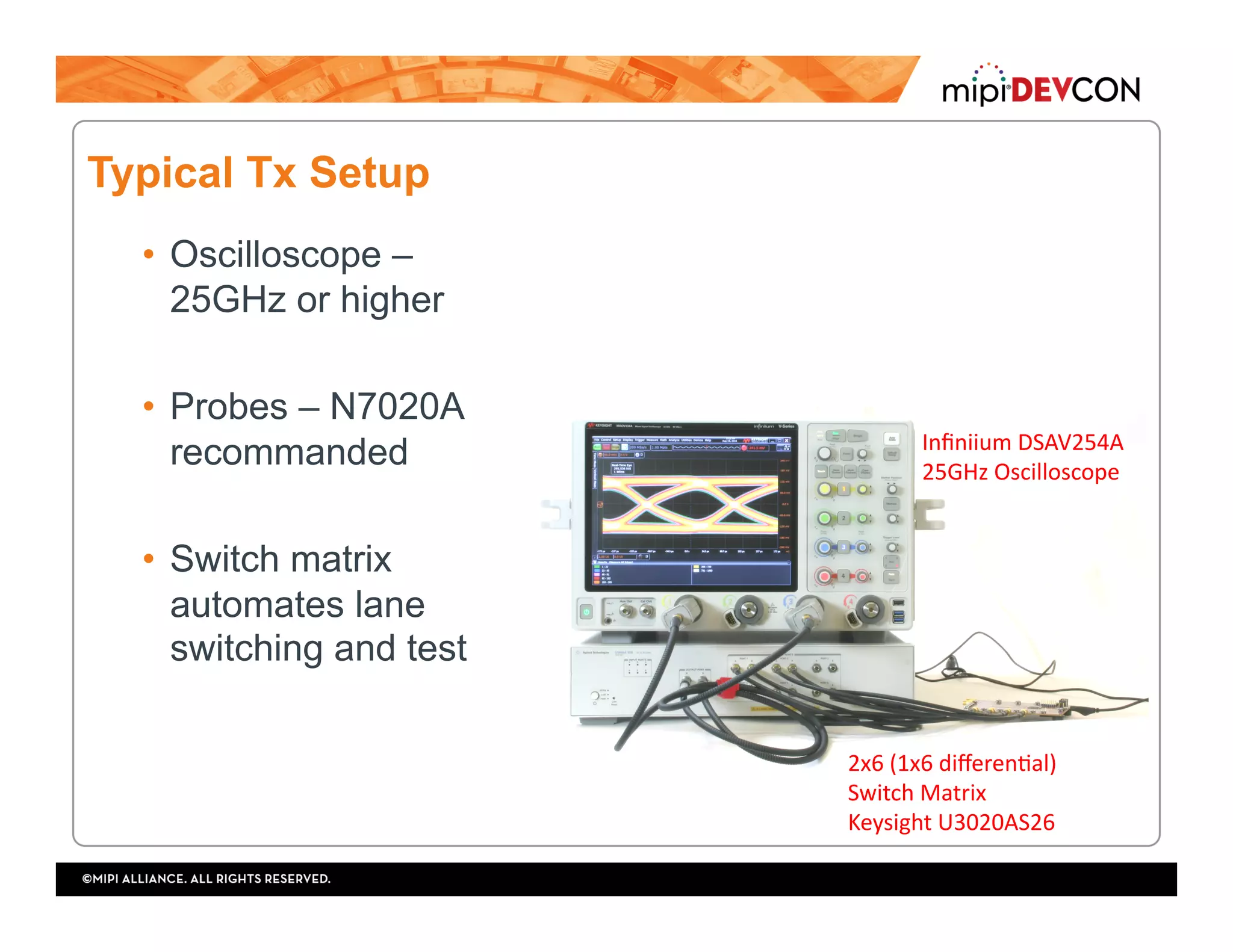
Typical Tx Setup
•  Oscilloscope –
25GHz or higher
•  Probes – N7020A
recommanded
•  Switch matrix
automates lane
switching and test
Infiniium	DSAV254A	
25GHz	Oscilloscope	
2x6	(1x6	differenTal)	
Switch	Matrix	
Keysight	U3020AS26
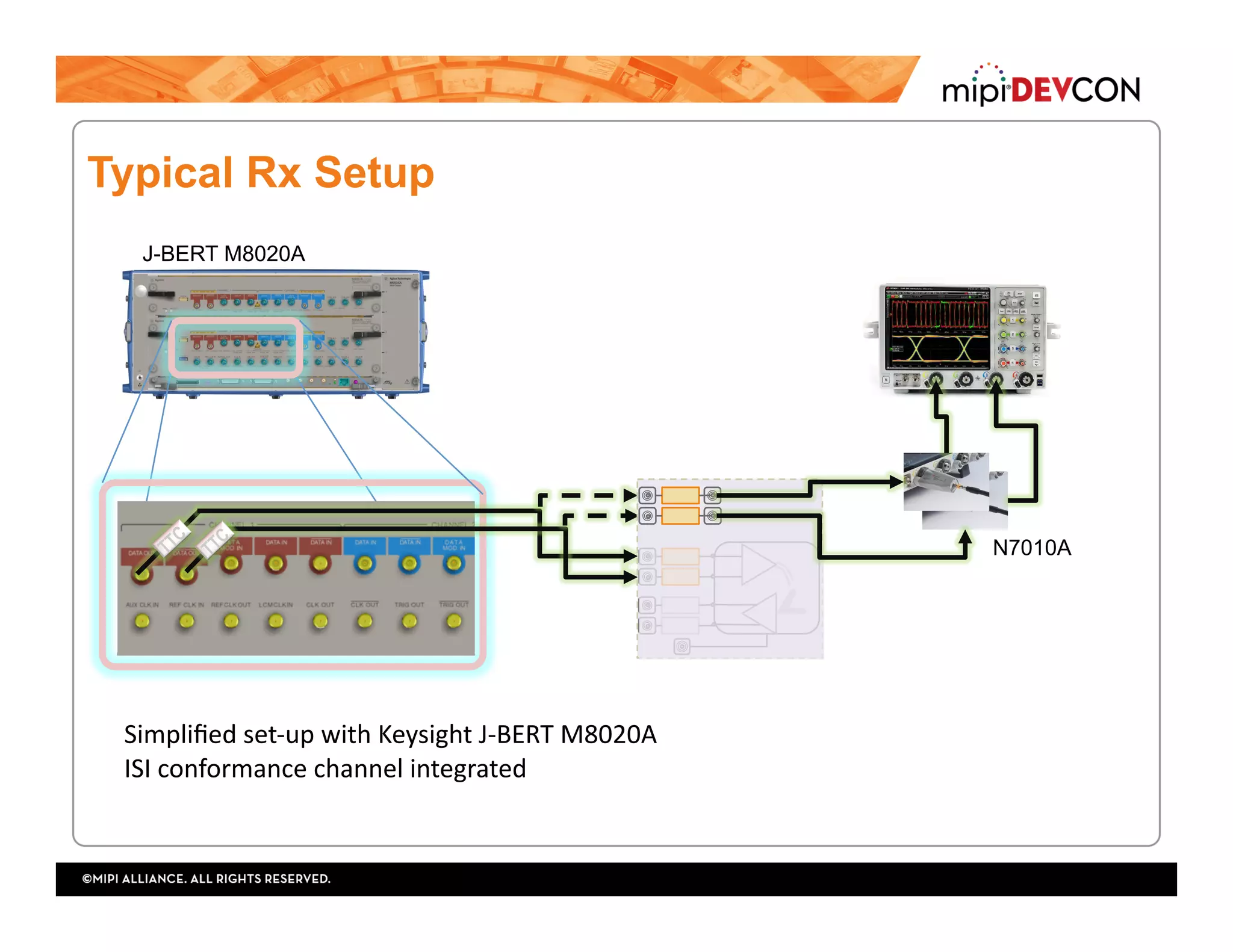
Typical Rx Setup
Simplified	set-up	with	Keysight	J-BERT	M8020A		
ISI	conformance	channel	integrated		
J-BERT M8020A
N7010A
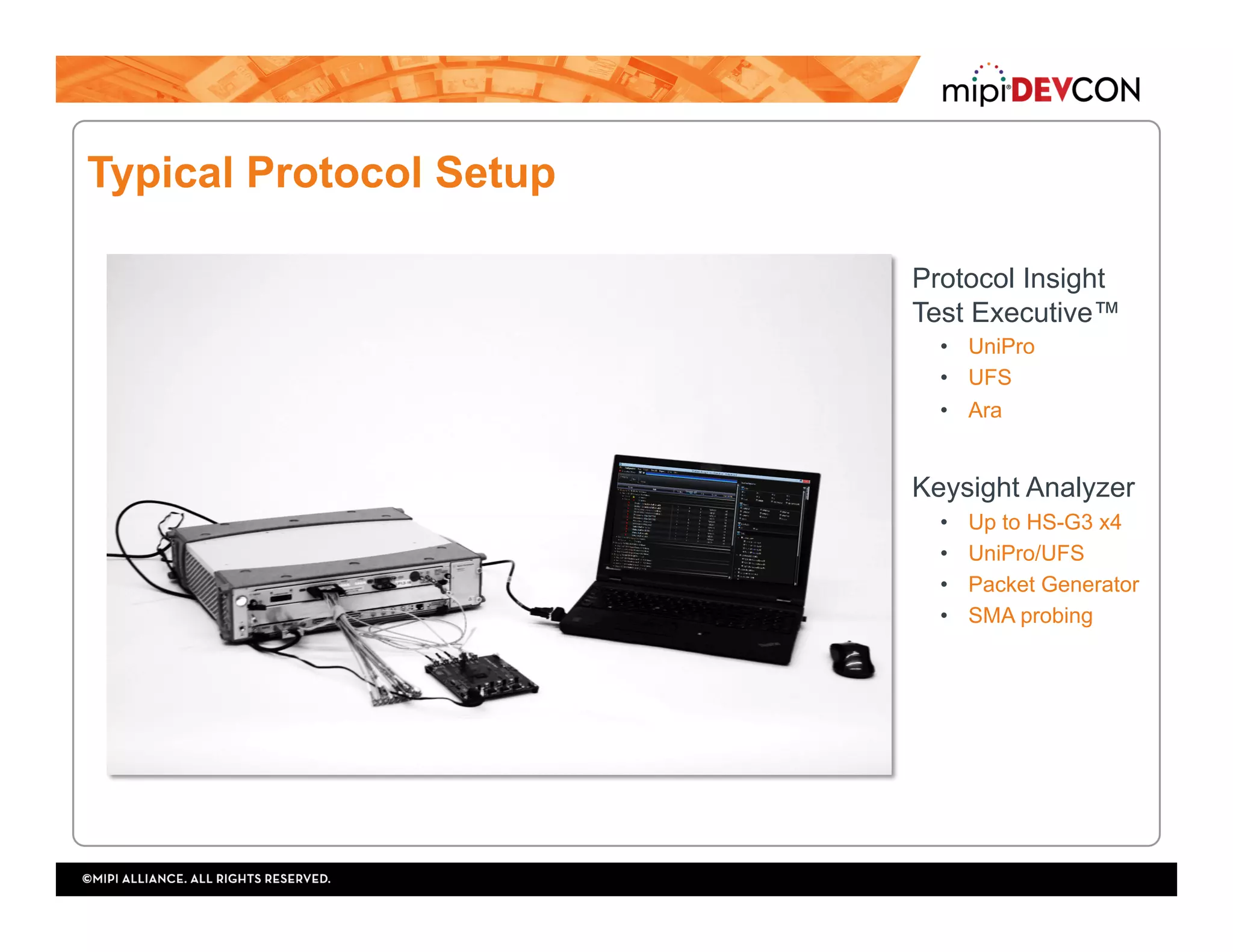
Typical Protocol Setup
Protocol Insight
Test Executive™
•  UniPro
•  UFS
•  Ara
Keysight Analyzer
•  Up to HS-G3 x4
•  UniPro/UFS
•  Packet Generator
•  SMA probing
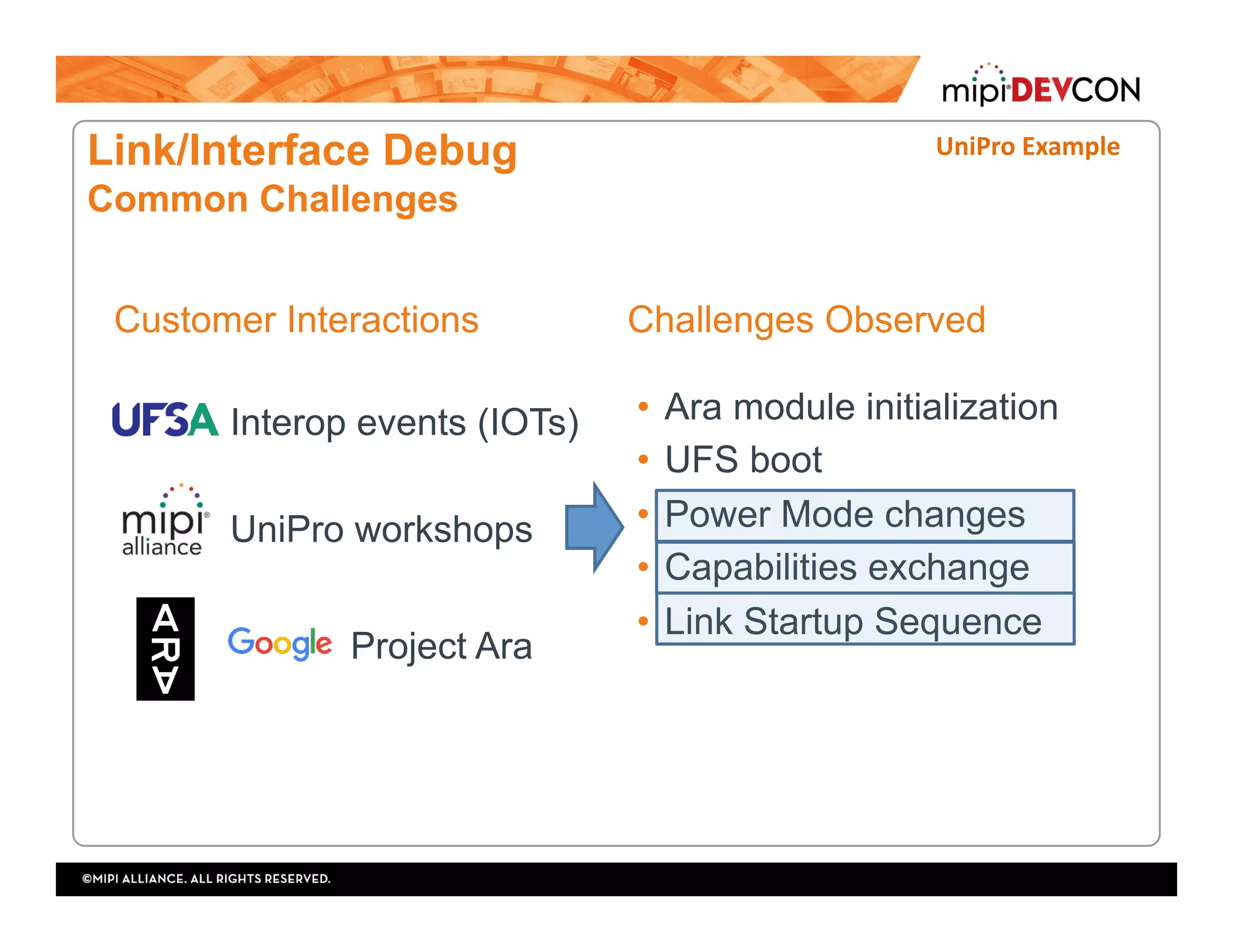
Link/Interface Debug
Common Challenges
Customer Interactions Challenges Observed
Interop events (IOTs)
UniPro workshops
GoogleProject Ara
•  Ara module initialization
•  UFS boot
•  Power Mode changes
•  Capabilities exchange
•  Link Startup Sequence
UniPro	Example
UniPro Common Challenges
•  Link Startup Sequence Phase 0 thru 4
•  Invalid Packet Order or Sequence
•  Timing violations
•  LSS Capabilities Exchange
•  Invalid Packet Order or Sequence
•  Non-PACP_CAP packets on link
•  Power Mode Change
•  Invalid Packet Order or Sequence
•  Device cannot change power modes reliably
•  After multiple Power Mode changes device does not respond
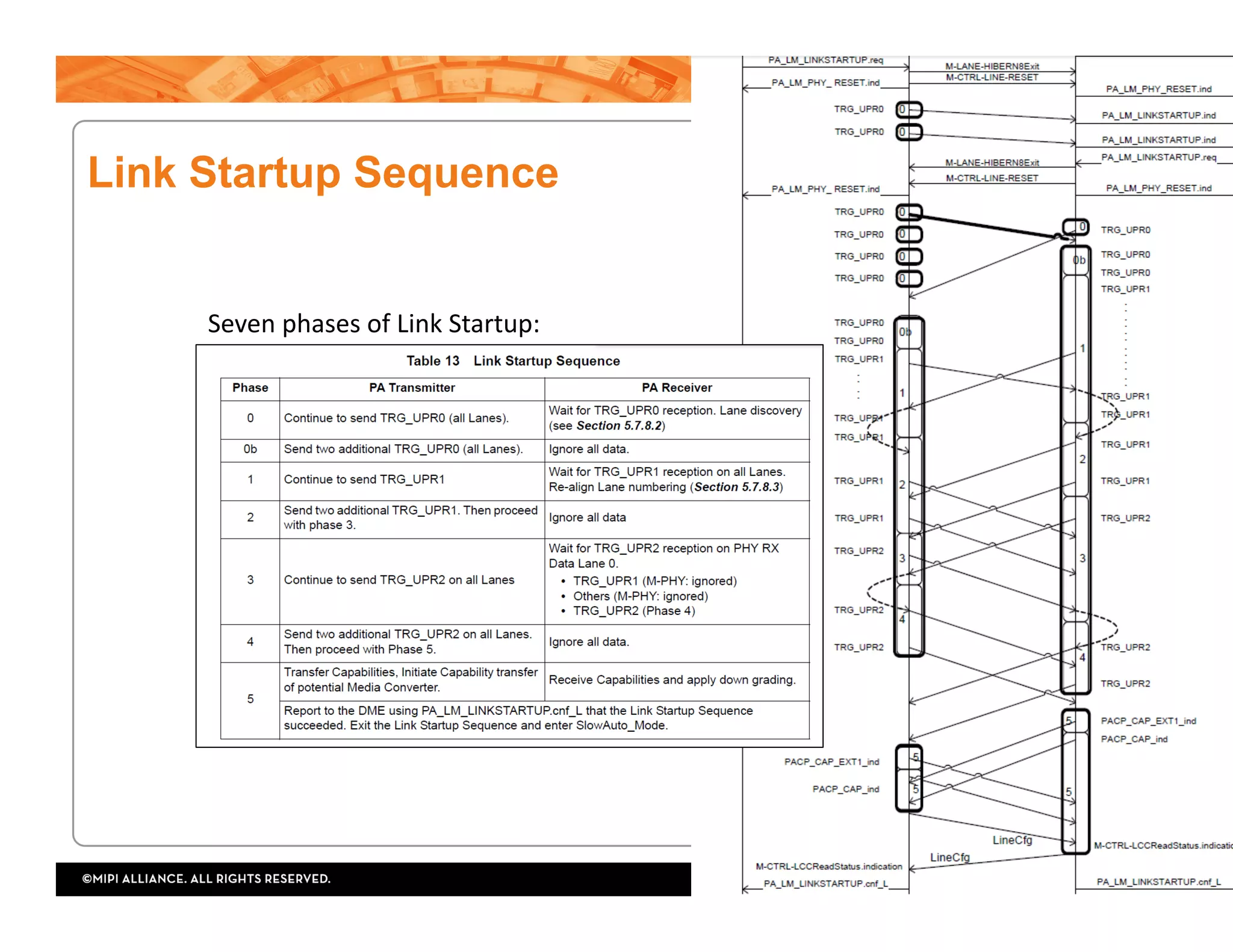
Link Startup Sequence
Seven	phases	of	Link	Startup:
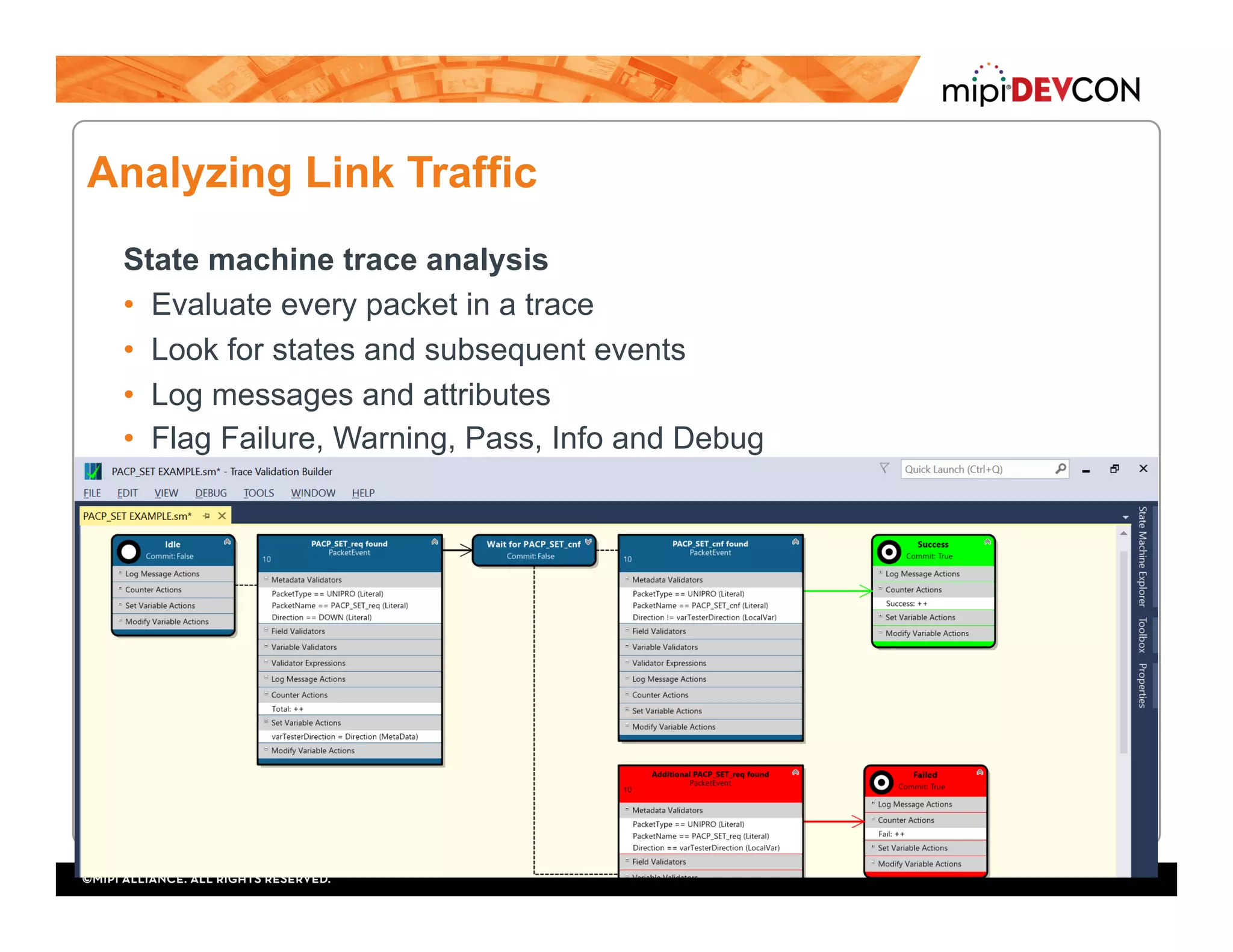
Analyzing Link Traffic
State machine trace analysis
•  Evaluate every packet in a trace
•  Look for states and subsequent events
•  Log messages and attributes
•  Flag Failure, Warning, Pass, Info and Debug
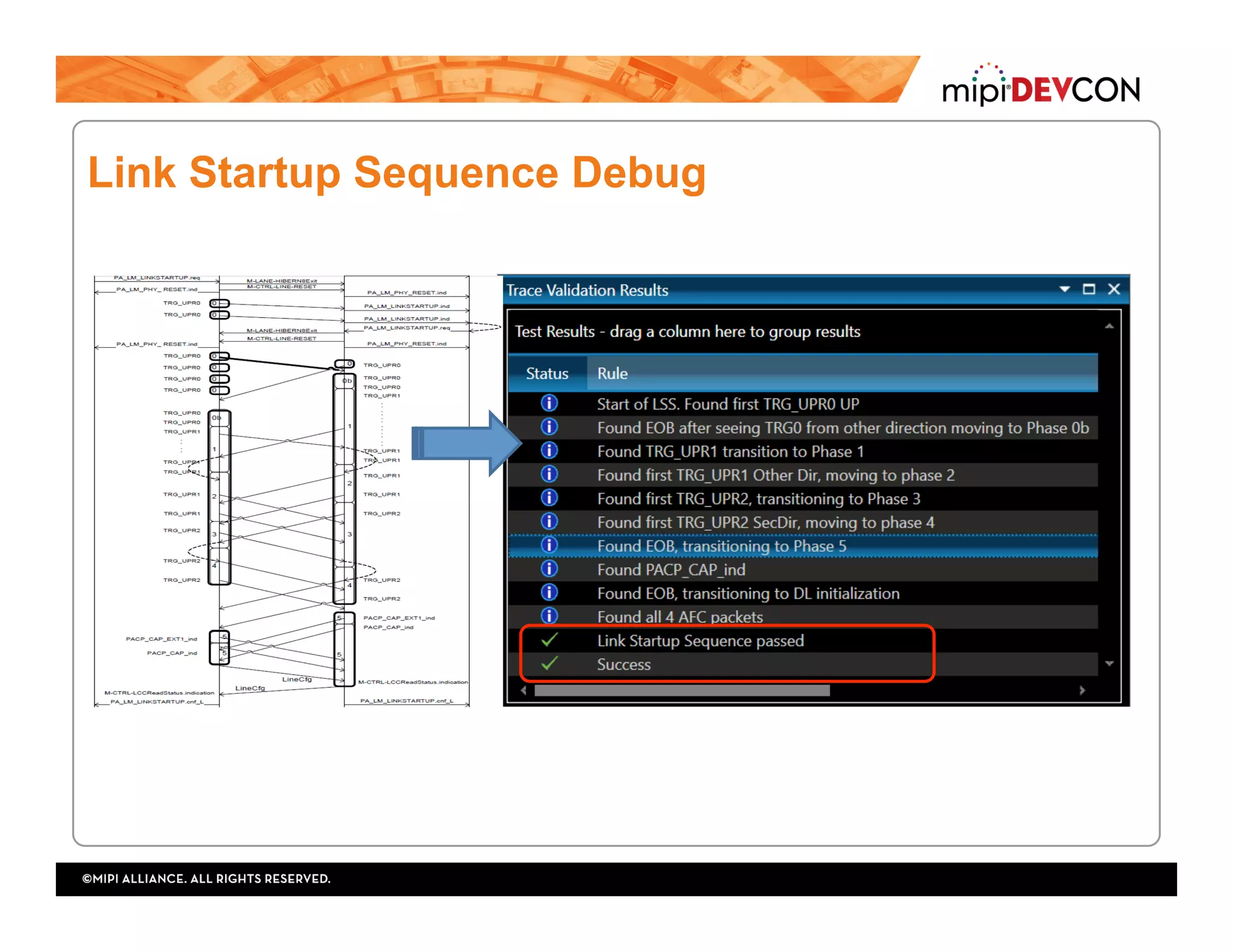
Link Startup Sequence Debug
Common LSS Phase 0 thru 4 Failures
•  Invalid Packet Order or Sequence
•  Timing violations
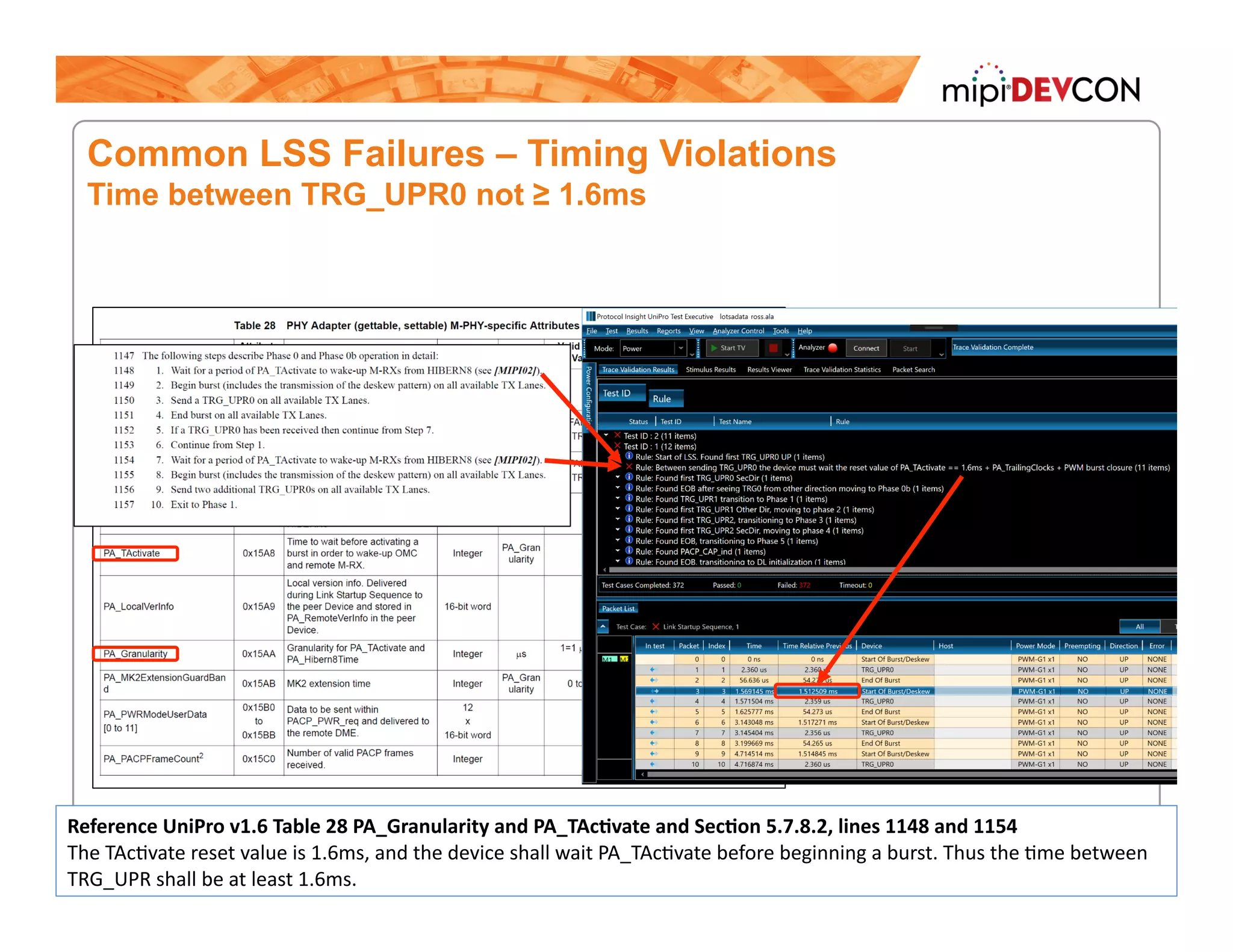
Common LSS Failures – Timing Violations
Time between TRG_UPR0 not ≥ 1.6ms
Reference	UniPro	v1.6	Table	28	PA_Granularity	and	PA_TAcFvate	and	SecFon	5.7.8.2,	lines	1148	and	1154	
The	TAcTvate	reset	value	is	1.6ms,	and	the	device	shall	wait	PA_TAcTvate	before	beginning	a	burst.	Thus	the	Tme	between	
TRG_UPR	shall	be	at	least	1.6ms.
Common LSS Capabilities Exchange Failures
•  Invalid Packet Order or Sequence
•  Non-PACP_CAP packets on link
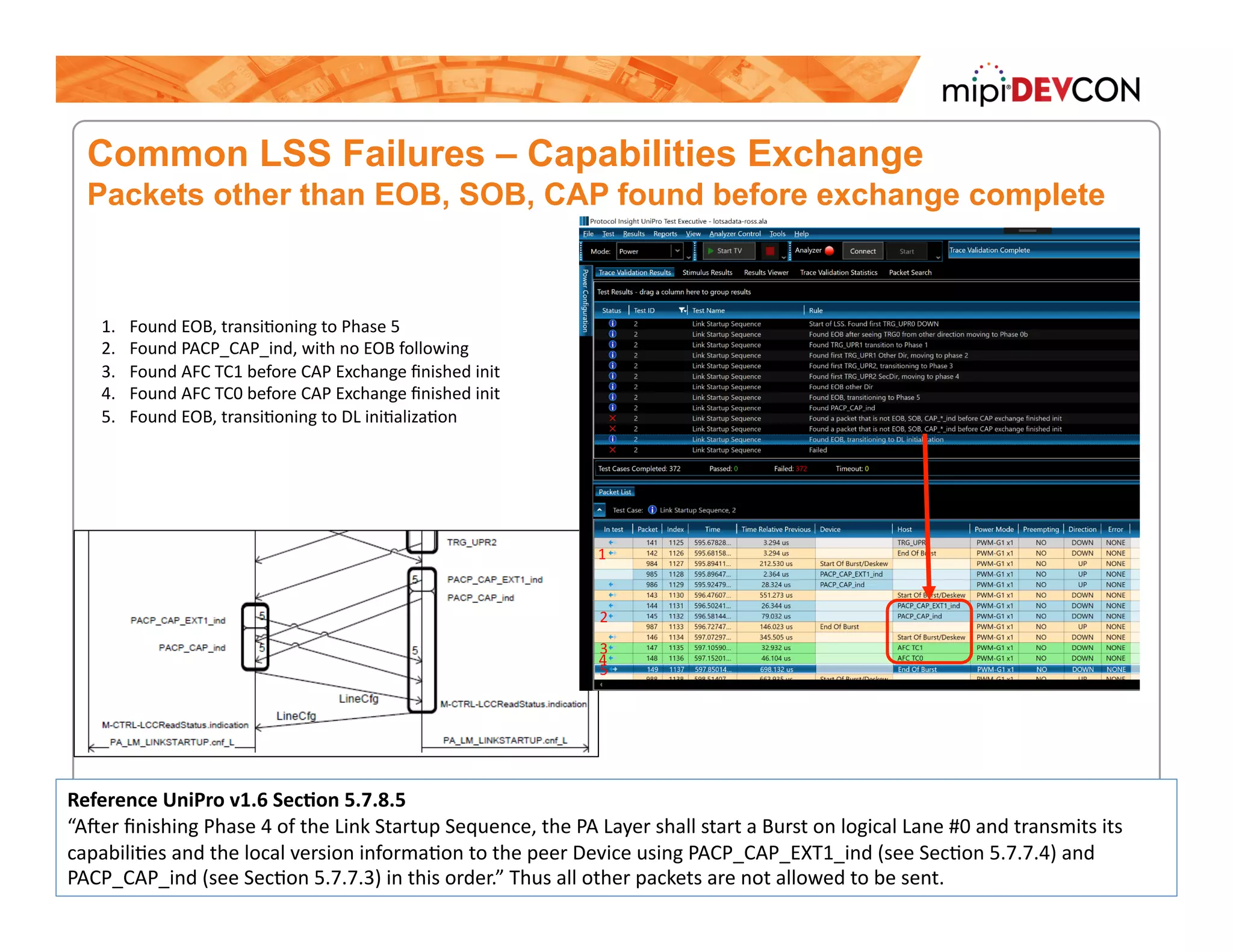
Common LSS Failures – Capabilities Exchange
Packets other than EOB, SOB, CAP found before exchange complete
Reference	UniPro	v1.6	SecFon	5.7.8.5	
“Aeer	finishing	Phase	4	of	the	Link	Startup	Sequence,	the	PA	Layer	shall	start	a	Burst	on	logical	Lane	#0	and	transmits	its	
capabiliTes	and	the	local	version	informaTon	to	the	peer	Device	using	PACP_CAP_EXT1_ind	(see	SecTon	5.7.7.4)	and	
PACP_CAP_ind	(see	SecTon	5.7.7.3)	in	this	order.”	Thus	all	other	packets	are	not	allowed	to	be	sent.	
1.  Found	EOB,	transiToning	to	Phase	5	
2.  Found	PACP_CAP_ind,	with	no	EOB	following	
3.  Found	AFC	TC1	before	CAP	Exchange	finished	init	
4.  Found	AFC	TC0	before	CAP	Exchange	finished	init	
5.  Found	EOB,	transiToning	to	DL	iniTalizaTon	
1	
2	
3	4	5
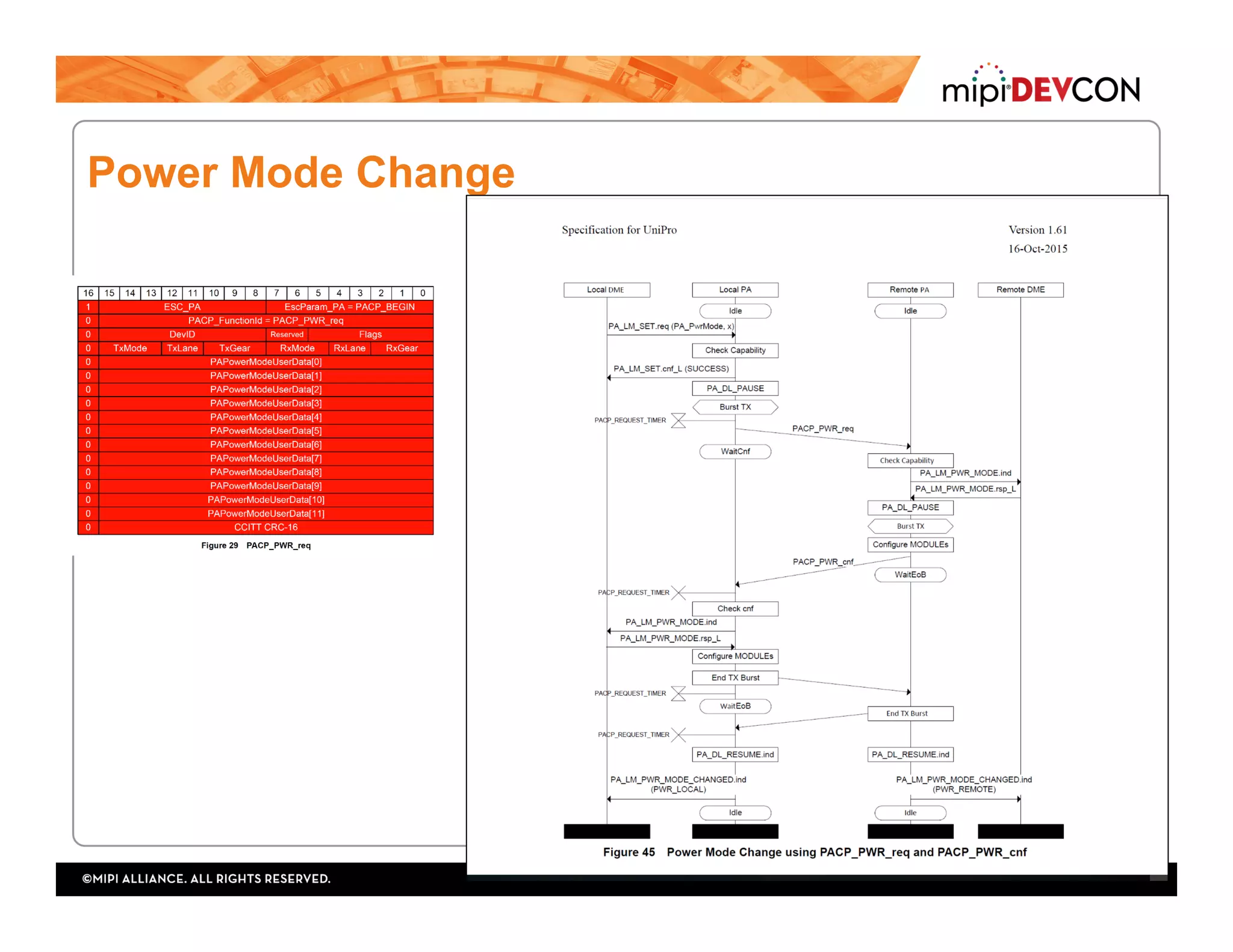
Power Mode Change
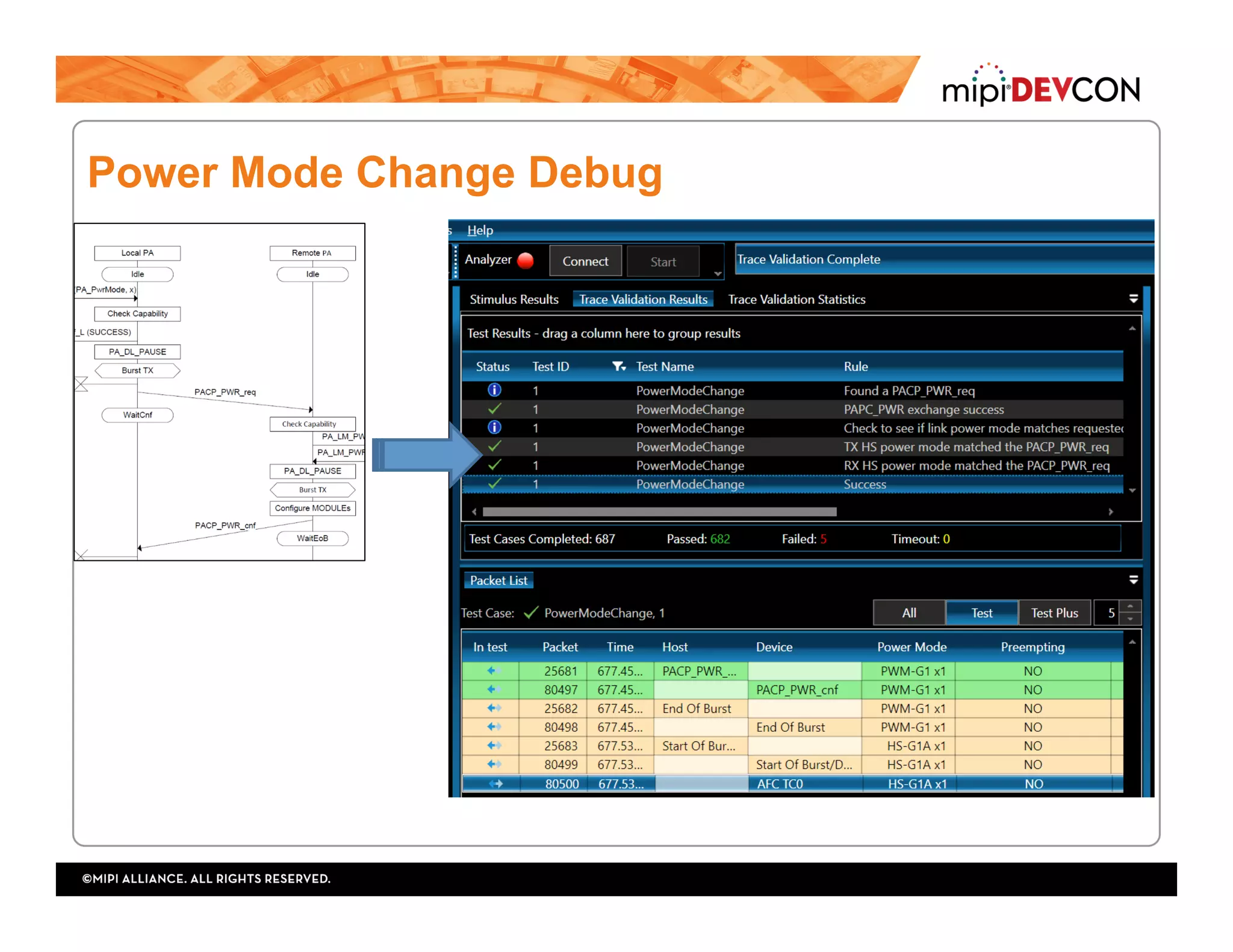
Power Mode Change Debug
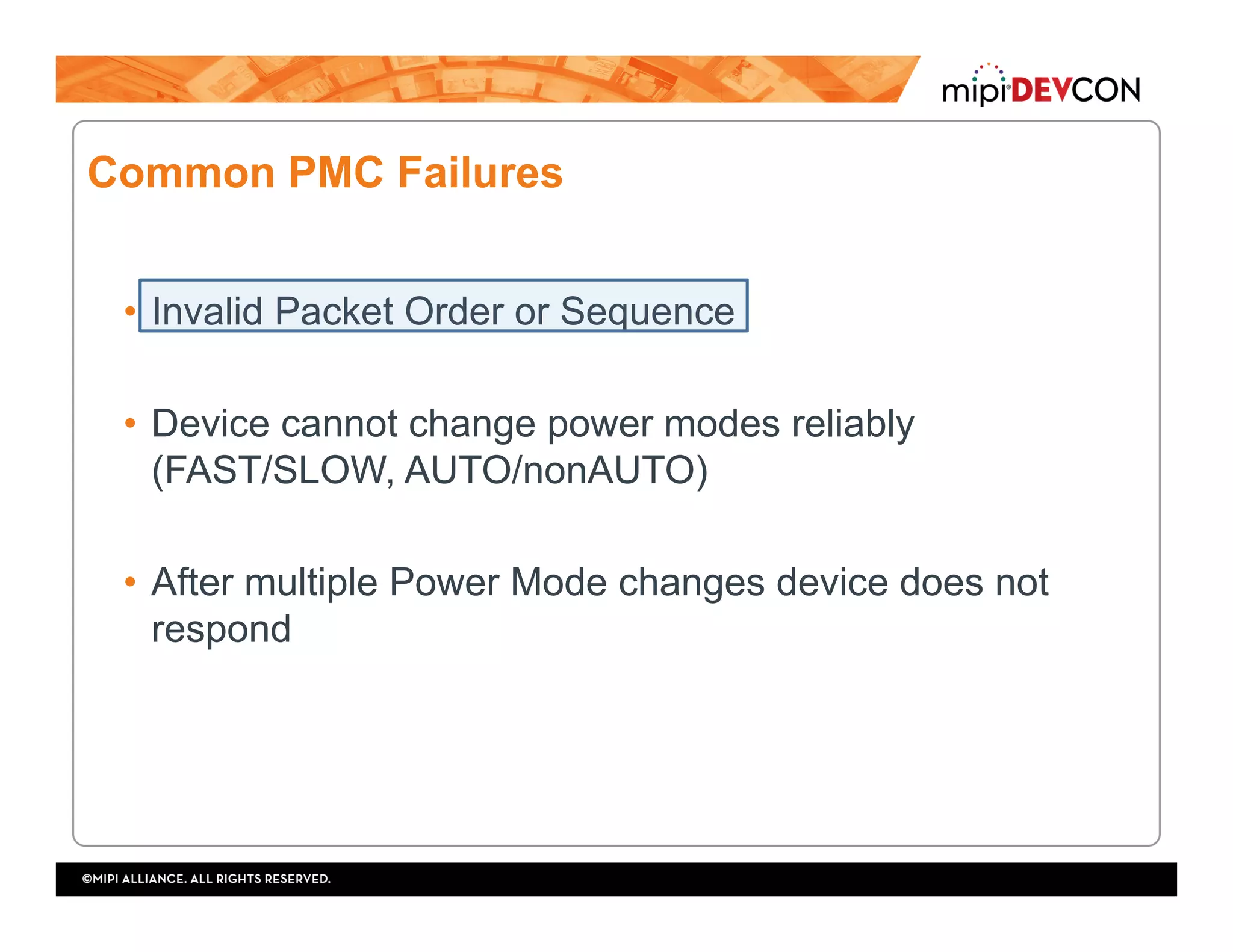
Common PMC Failures
•  Invalid Packet Order or Sequence
•  Device cannot change power modes reliably
(FAST/SLOW, AUTO/nonAUTO)
•  After multiple Power Mode changes device does not
respond
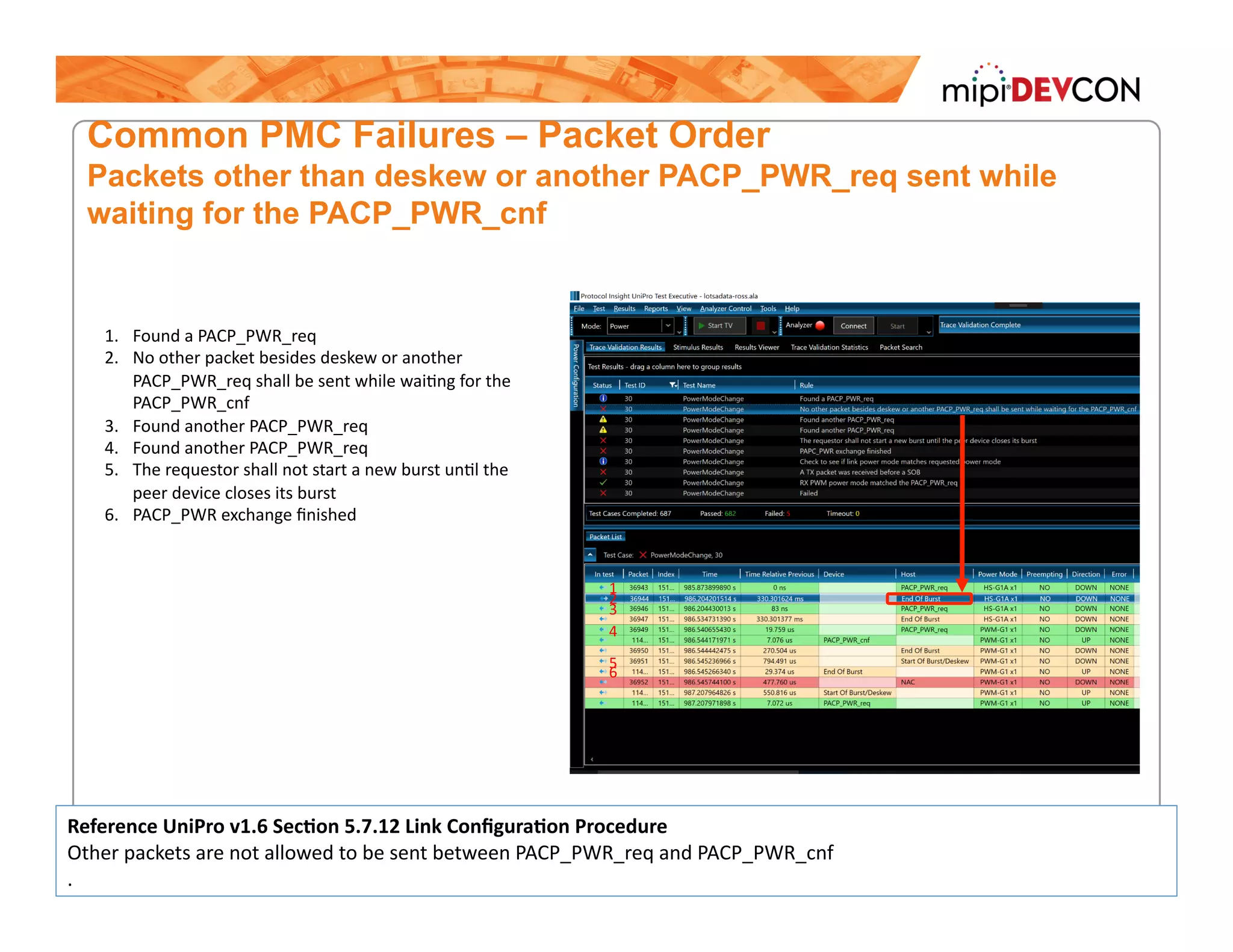
Common PMC Failures – Packet Order
Packets other than deskew or another PACP_PWR_req sent while
waiting for the PACP_PWR_cnf
Reference	UniPro	v1.6	SecFon	5.7.12	Link	ConfiguraFon	Procedure	
Other	packets	are	not	allowed	to	be	sent	between	PACP_PWR_req	and	PACP_PWR_cnf	
.	
1	2	3	
4	
5	
1.  Found	a	PACP_PWR_req	
2.  No	other	packet	besides	deskew	or	another	
PACP_PWR_req	shall	be	sent	while	waiTng	for	the	
PACP_PWR_cnf		
3.  Found	another	PACP_PWR_req	
4.  Found	another	PACP_PWR_req	
5.  The	requestor	shall	not	start	a	new	burst	unTl	the	
peer	device	closes	its	burst	
6.  PACP_PWR	exchange	finished	
6
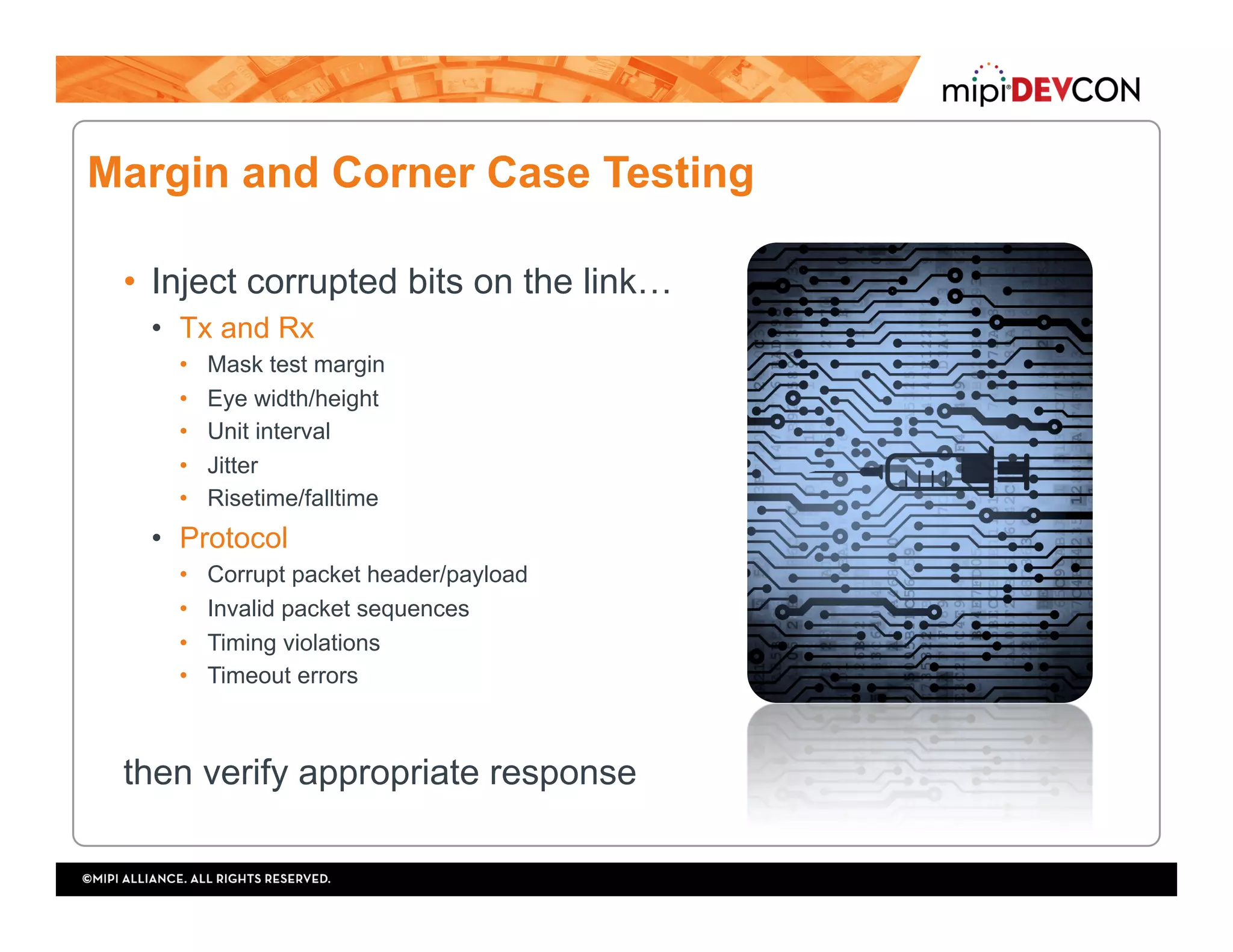
Margin and Corner Case Testing
•  Inject corrupted bits on the link…
•  Tx and Rx
•  Mask test margin
•  Eye width/height
•  Unit interval
•  Jitter
•  Risetime/falltime
•  Protocol
•  Corrupt packet header/payload
•  Invalid packet sequences
•  Timing violations
•  Timeout errors
then verify appropriate response
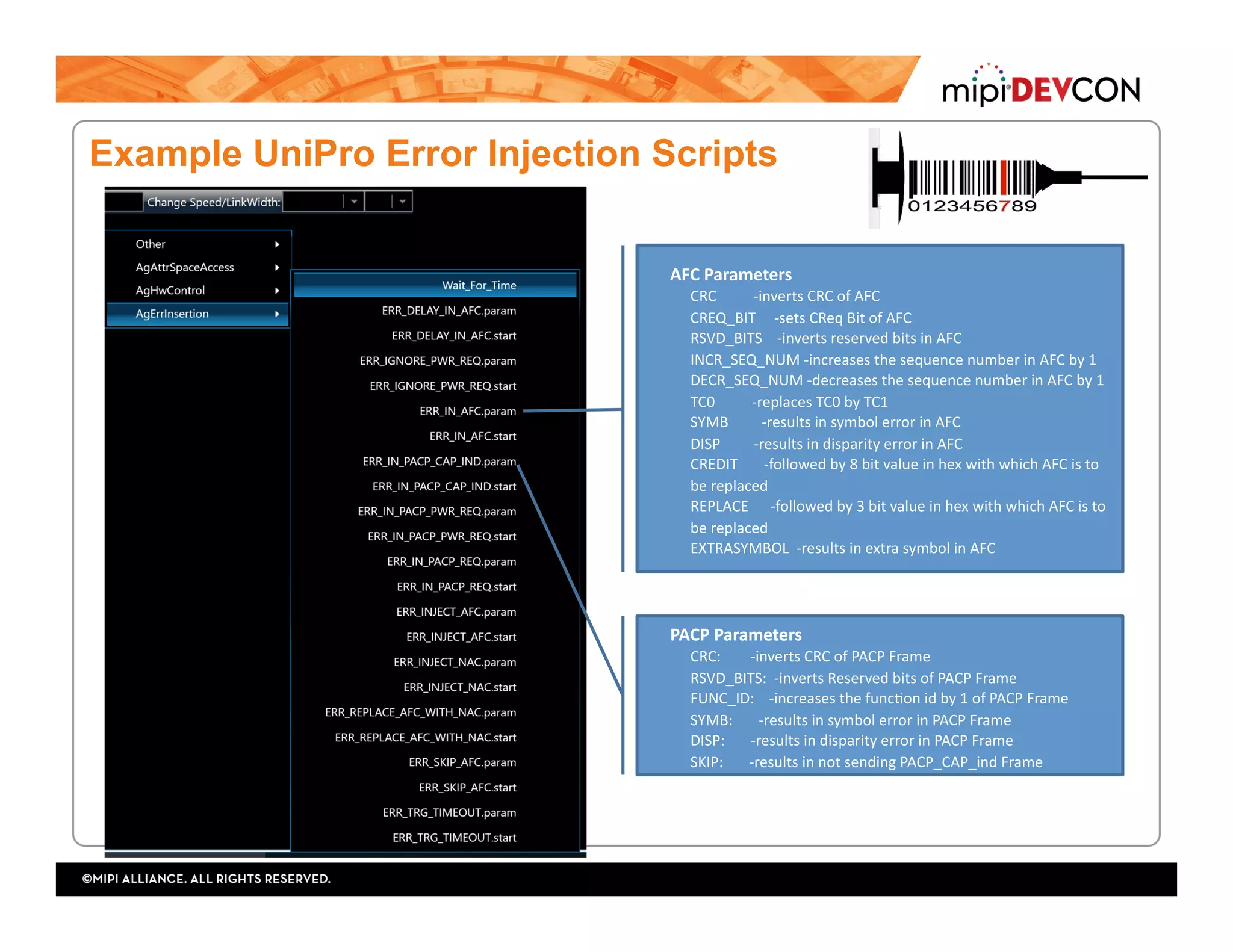
Example UniPro Error Injection Scripts
AFC	Parameters	
CRC										-inverts	CRC	of	AFC	
CREQ_BIT					-sets	CReq	Bit	of	AFC	
RSVD_BITS				-inverts	reserved	bits	in	AFC	
INCR_SEQ_NUM	-increases	the	sequence	number	in	AFC	by	1	
DECR_SEQ_NUM	-decreases	the	sequence	number	in	AFC	by	1	
TC0										-replaces	TC0	by	TC1	
SYMB									-results	in	symbol	error	in	AFC	
DISP									-results	in	disparity	error	in	AFC	
CREDIT							-followed	by	8	bit	value	in	hex	with	which	AFC	is	to	
be	replaced	
REPLACE						-followed	by	3	bit	value	in	hex	with	which	AFC	is	to	
be	replaced	
EXTRASYMBOL		-results	in	extra	symbol	in	AFC	
PACP	Parameters	
CRC:								-inverts	CRC	of	PACP	Frame	
RSVD_BITS:		-inverts	Reserved	bits	of	PACP	Frame	
FUNC_ID:				-increases	the	funcTon	id	by	1	of	PACP	Frame	
SYMB:							-results	in	symbol	error	in	PACP	Frame	
DISP:							-results	in	disparity	error	in	PACP	Frame	
SKIP:							-results	in	not	sending	PACP_CAP_ind	Frame
Stress and Automated Testing
•  Corner case and margin testing
•  Conformance and compliance
testing
•  Random order sequencing,
traceable deterministic results
•  Test loop management
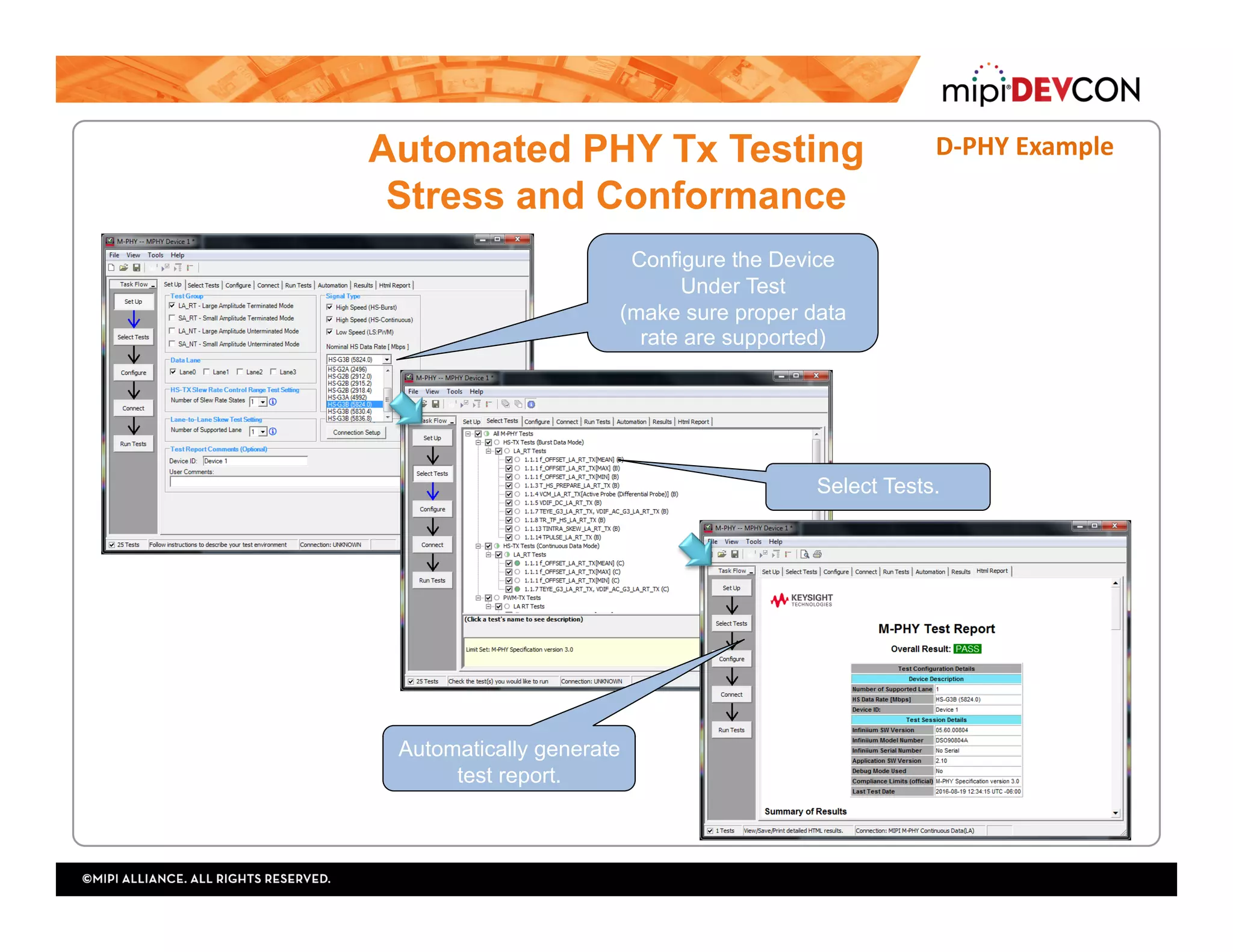
Automated PHY Tx Testing
Stress and Conformance
Configure the Device
Under Test
(make sure proper data
rate are supported)
Select Tests.
Automatically generate
test report.
D-PHY	Example
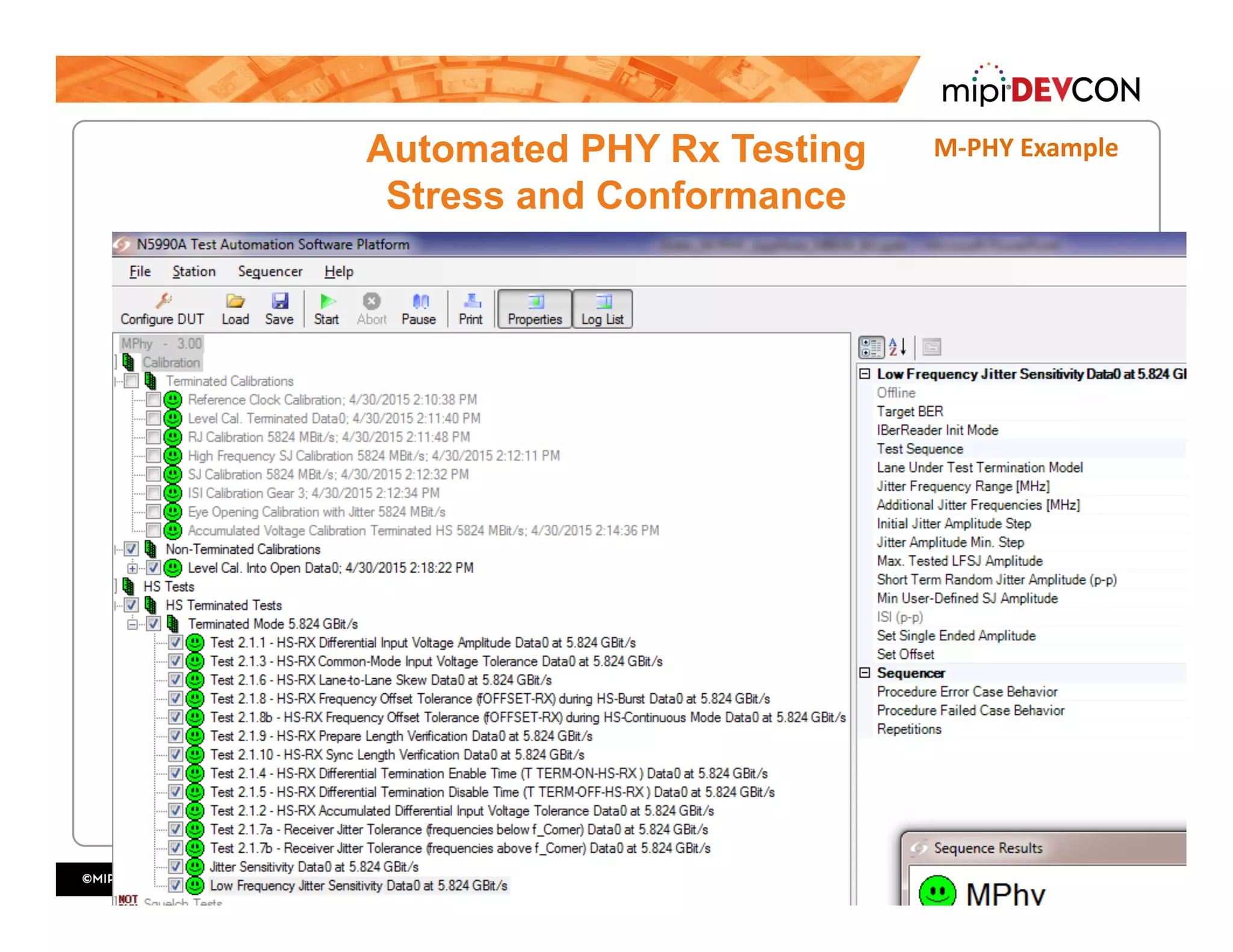
Automated PHY Rx Testing
Stress and Conformance
M-PHY	Example
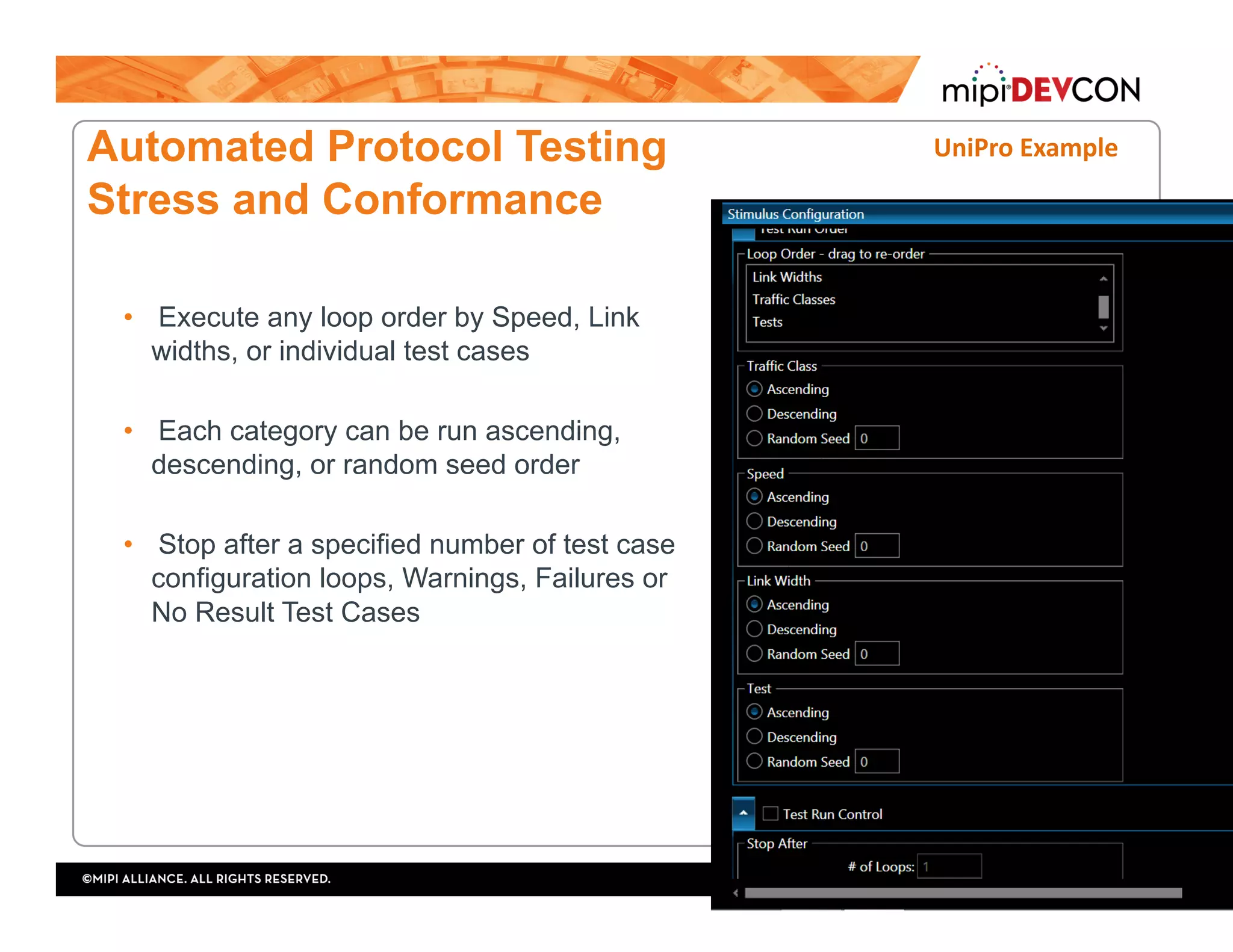
Automated Protocol Testing
Stress and Conformance
•  Execute any loop order by Speed, Link
widths, or individual test cases
•  Each category can be run ascending,
descending, or random seed order
•  Stop after a specified number of test case
configuration loops, Warnings, Failures or
No Result Test Cases
UniPro	Example
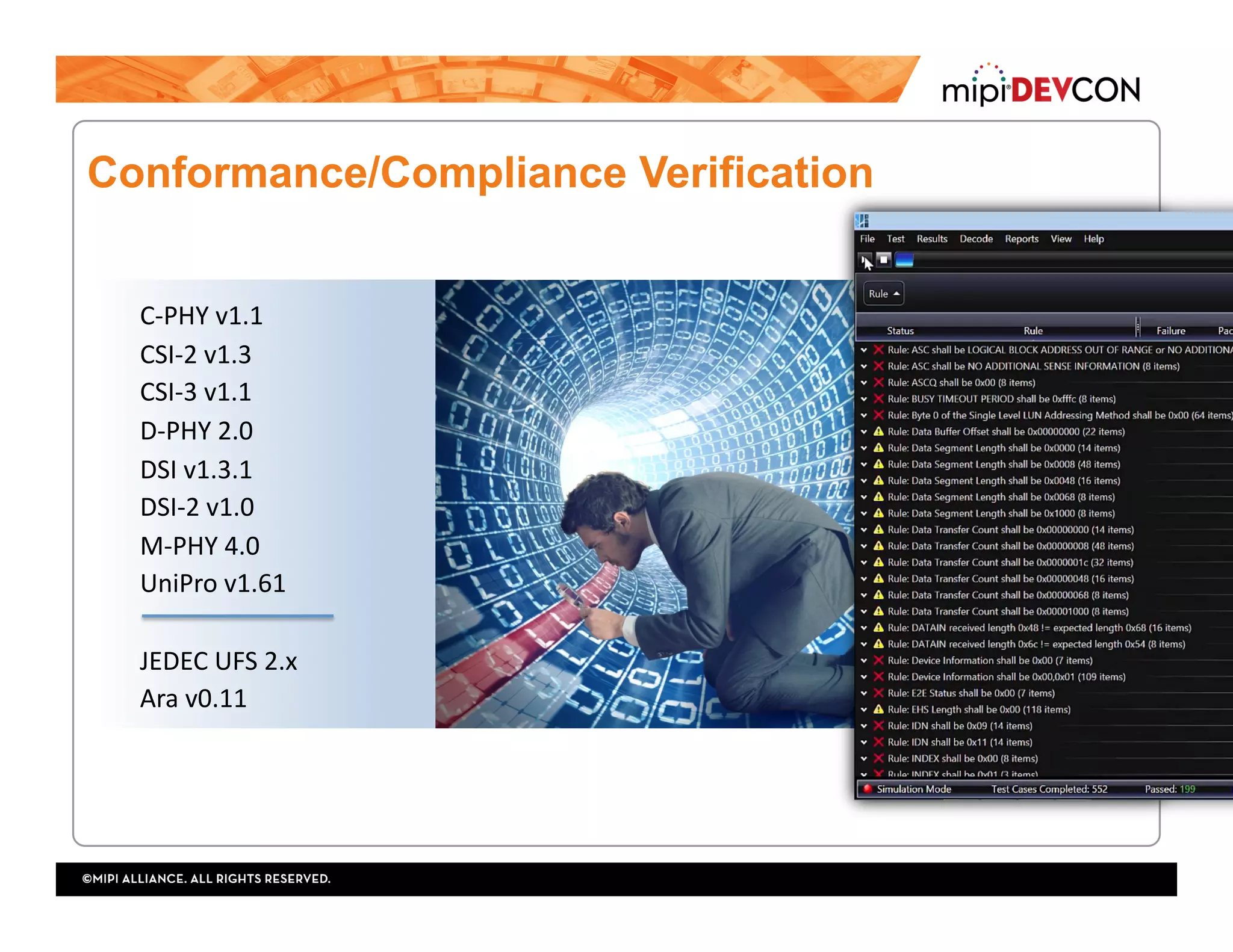
C-PHY	v1.1	
CSI-2	v1.3	
CSI-3	v1.1	
D-PHY	2.0	
DSI	v1.3.1	
DSI-2	v1.0	
M-PHY	4.0	
UniPro	v1.61	
JEDEC	UFS	2.x	
Ara	v0.11	
Conformance/Compliance Verification
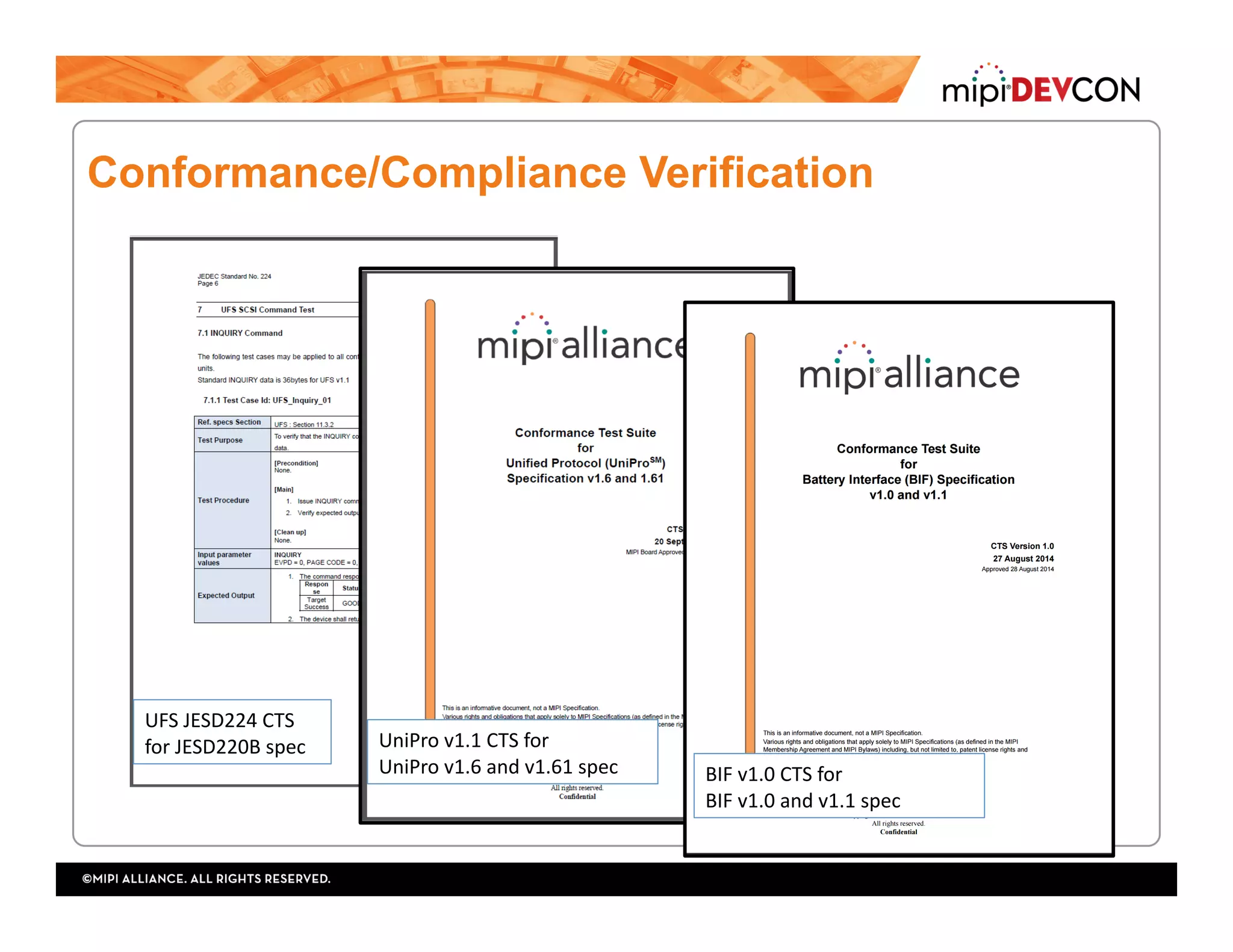
UFS	JESD224	CTS	
for	JESD220B	spec	 UniPro	v1.1	CTS	for		
UniPro	v1.6	and	v1.61	spec	 BIF	v1.0	CTS	for		
BIF	v1.0	and	v1.1	spec
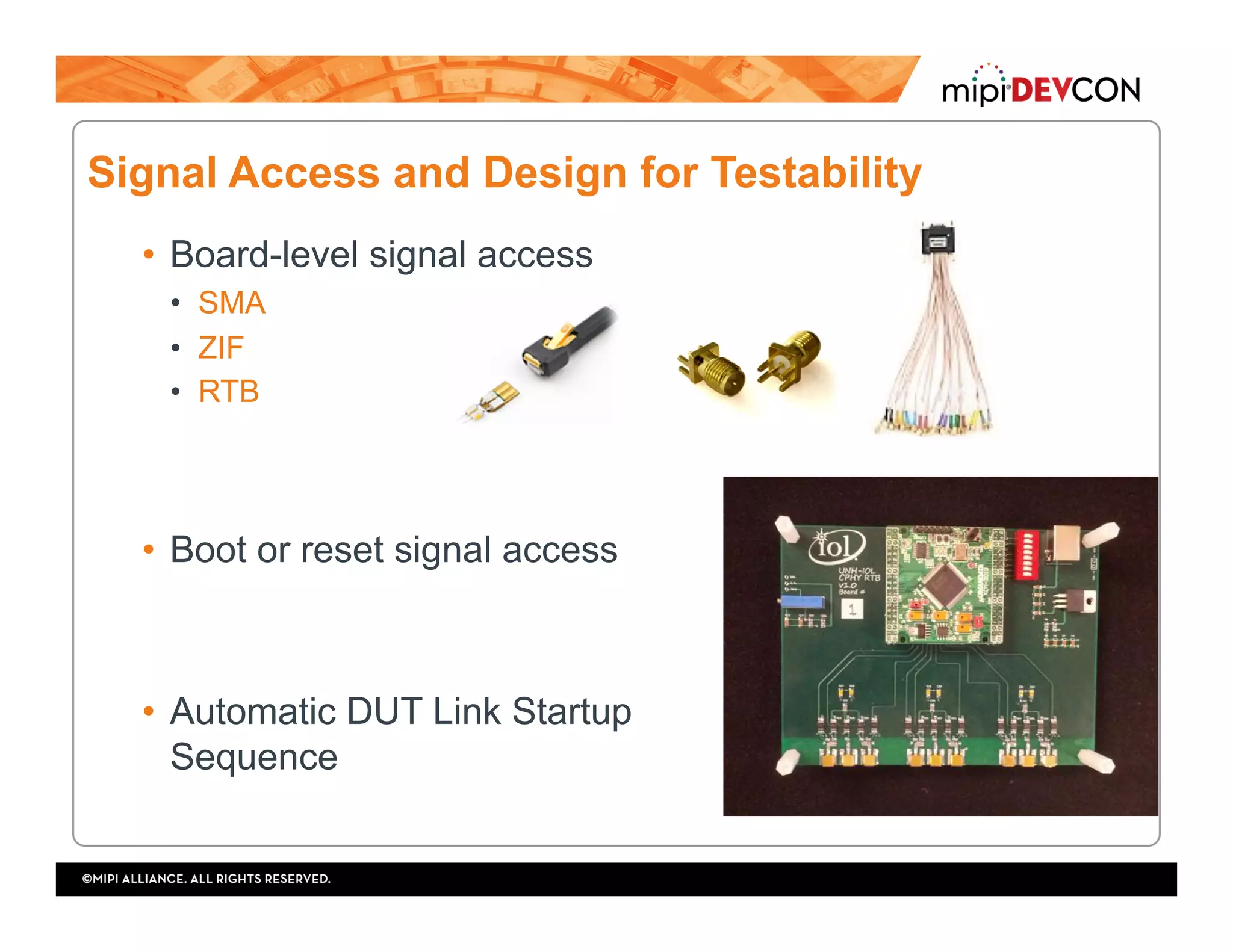
Signal Access and Design for Testability
•  Board-level signal access
•  SMA
•  ZIF
•  RTB
•  Boot or reset signal access
•  Automatic DUT Link Startup
Sequence
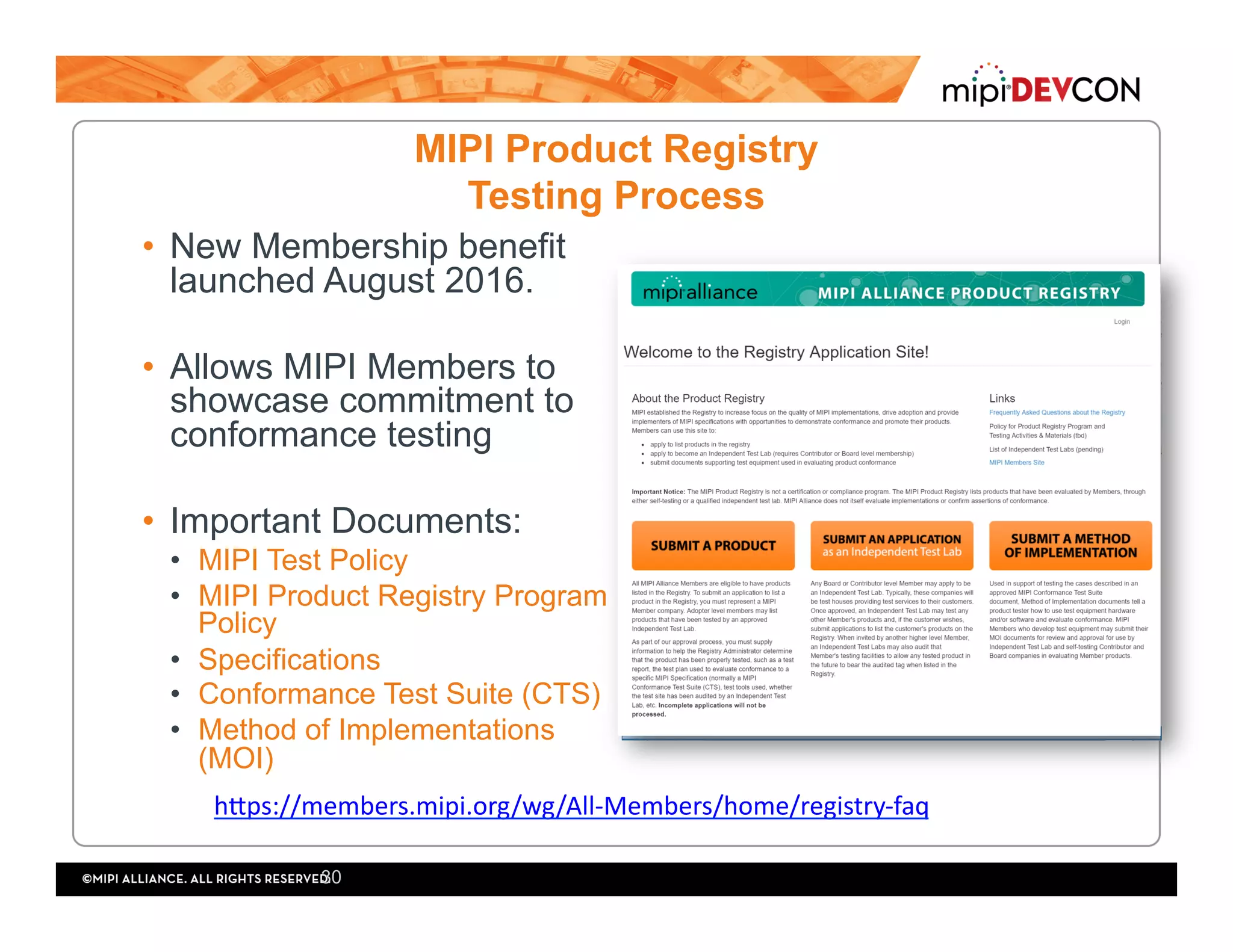
MIPI Product Registry
Testing Process
•  New Membership benefit
launched August 2016.
•  Allows MIPI Members to
showcase commitment to
conformance testing
•  Important Documents:
•  MIPI Test Policy
•  MIPI Product Registry Program
Policy
•  Specifications
•  Conformance Test Suite (CTS)
•  Method of Implementations
(MOI)
30
hlps://members.mipi.org/wg/All-Members/home/registry-faq
Conformance vs. Compliance
•  MIPI differentiates between conformance and compliance
•  Conformance means:
•  An implementation on Product Registry, confirming it meets the normative
requirements of the relevant Specification
or
•  a Member-company verified implementation adheres to a Specification’s
requirements
•  Compliance implies that a formal evaluation has been made, e.g. as
part of a certification program, which serves as a guarantee of a
company’s right to enjoy applicable licenses.
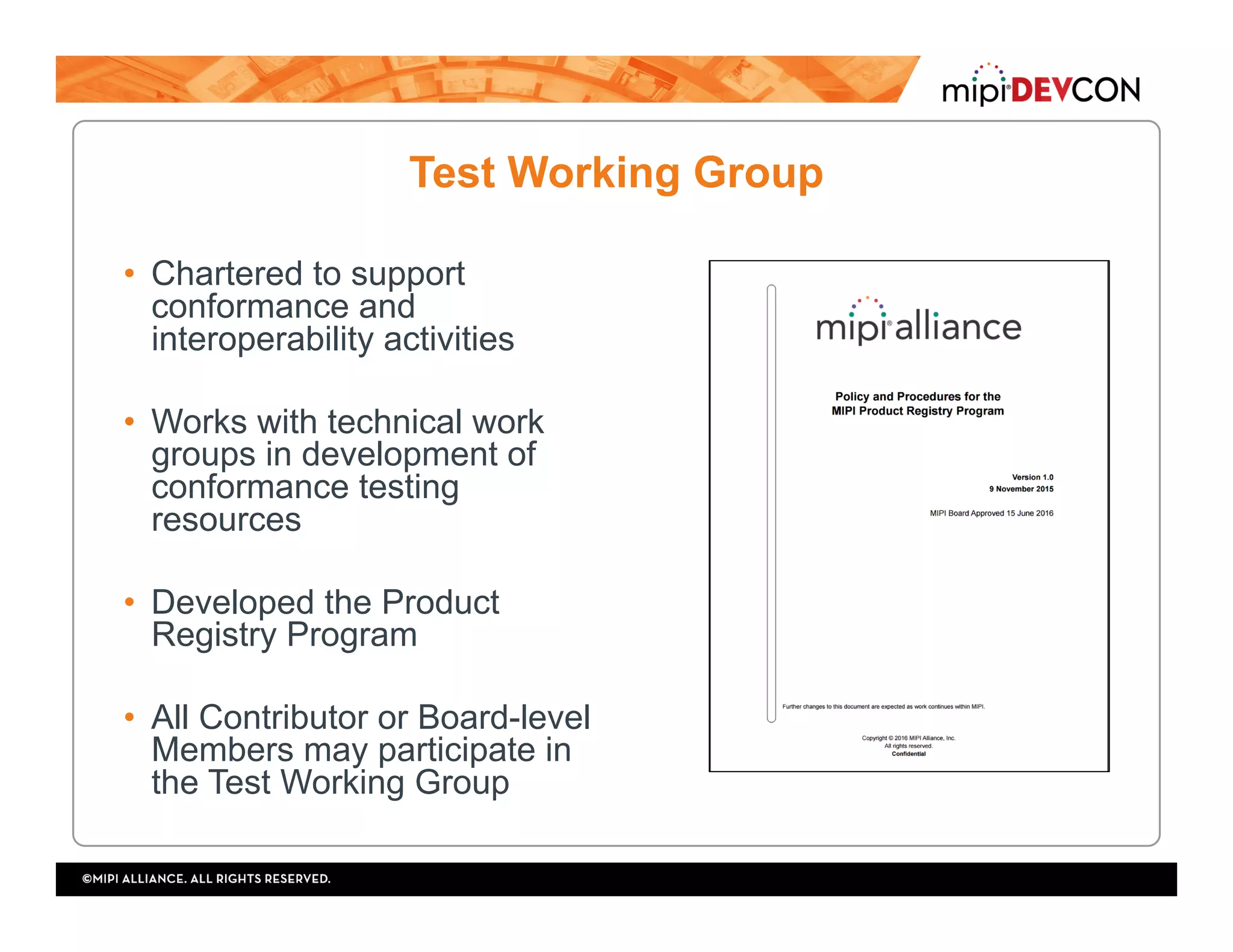
Test Working Group
•  Chartered to support
conformance and
interoperability activities
•  Works with technical work
groups in development of
conformance testing
resources
•  Developed the Product
Registry Program
•  All Contributor or Board-level
Members may participate in
the Test Working Group
MIPI Product Registry
Testing Process
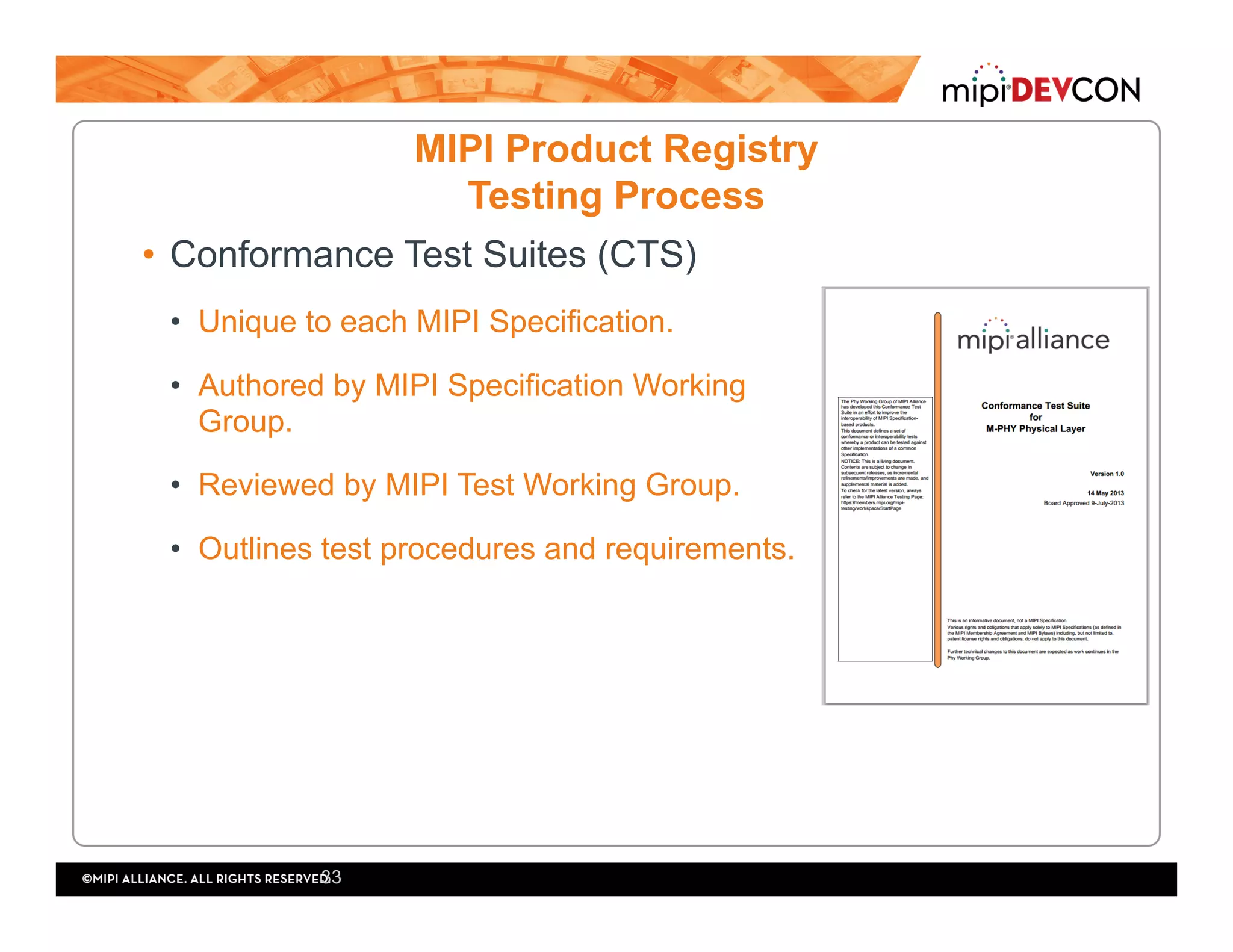
•  Conformance Test Suites (CTS)
•  Unique to each MIPI Specification.
•  Authored by MIPI Specification Working
Group.
•  Reviewed by MIPI Test Working Group.
•  Outlines test procedures and requirements.
33
MIPI Product Registry
Testing Process
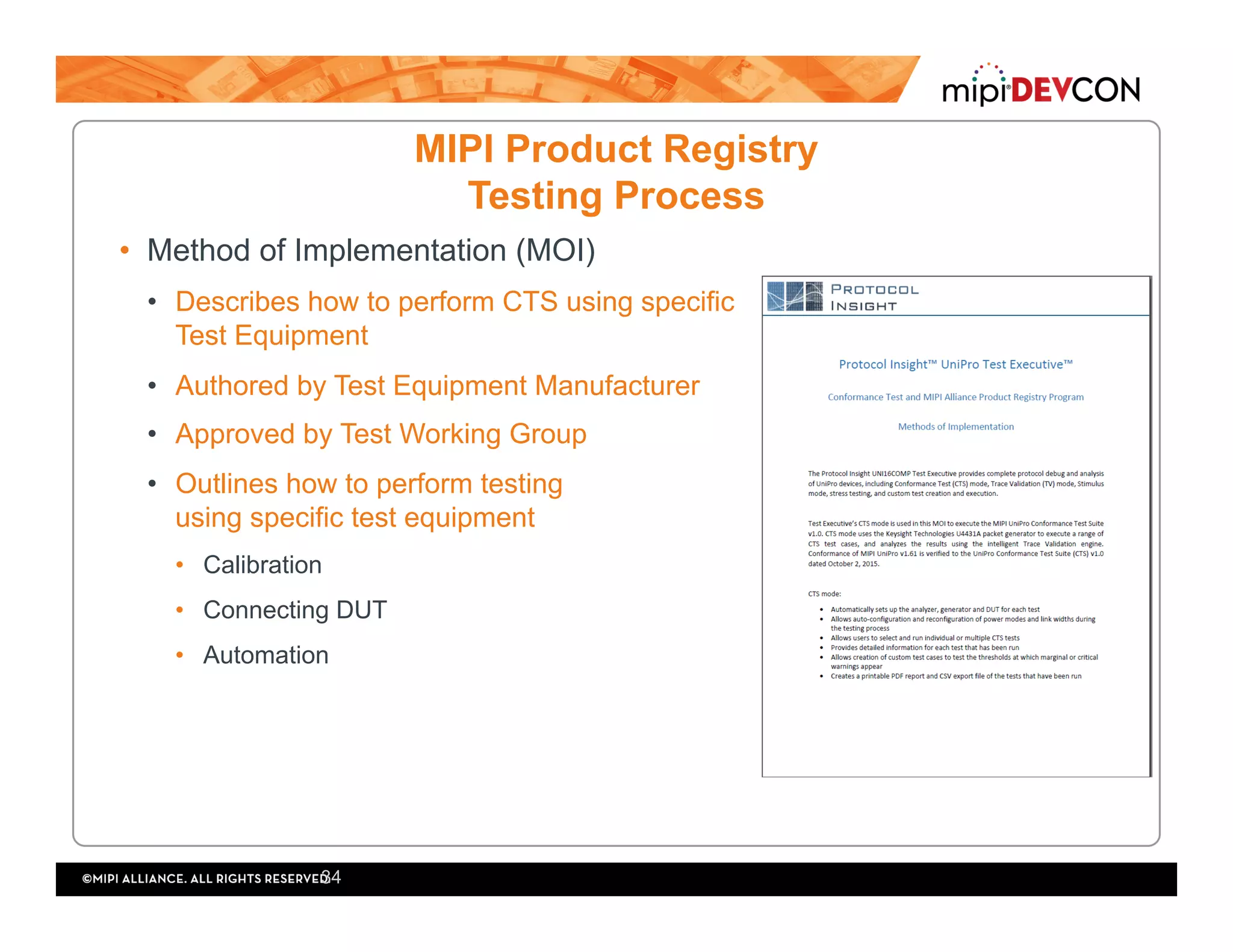
•  Method of Implementation (MOI)
•  Describes how to perform CTS using specific
Test Equipment
•  Authored by Test Equipment Manufacturer
•  Approved by Test Working Group
•  Outlines how to perform testing
using specific test equipment
•  Calibration
•  Connecting DUT
•  Automation
34
MIPI Product Registry
Testing Process
•  Contributor Members may perform self testing or use a
MIPI approved test lab
•  All products noted as self-tested or independently tested
•  Adopter members must use a MIPI approved test lab
•  Member provides results summary to MIPI Product
Registry Administrator
35
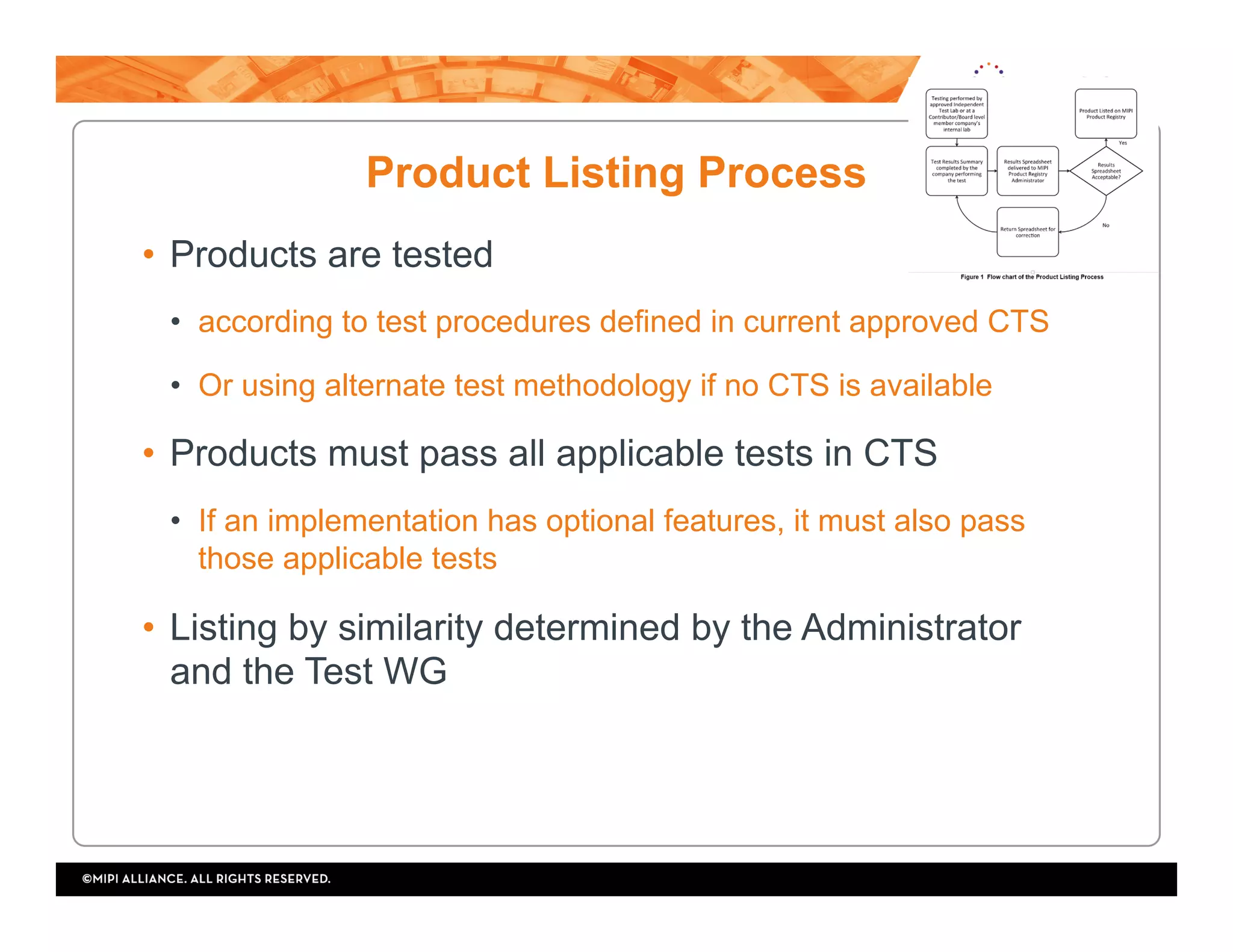
•  Products are tested
•  according to test procedures defined in current approved CTS
•  Or using alternate test methodology if no CTS is available
•  Products must pass all applicable tests in CTS
•  If an implementation has optional features, it must also pass
those applicable tests
•  Listing by similarity determined by the Administrator
and the Test WG
Product Listing Process
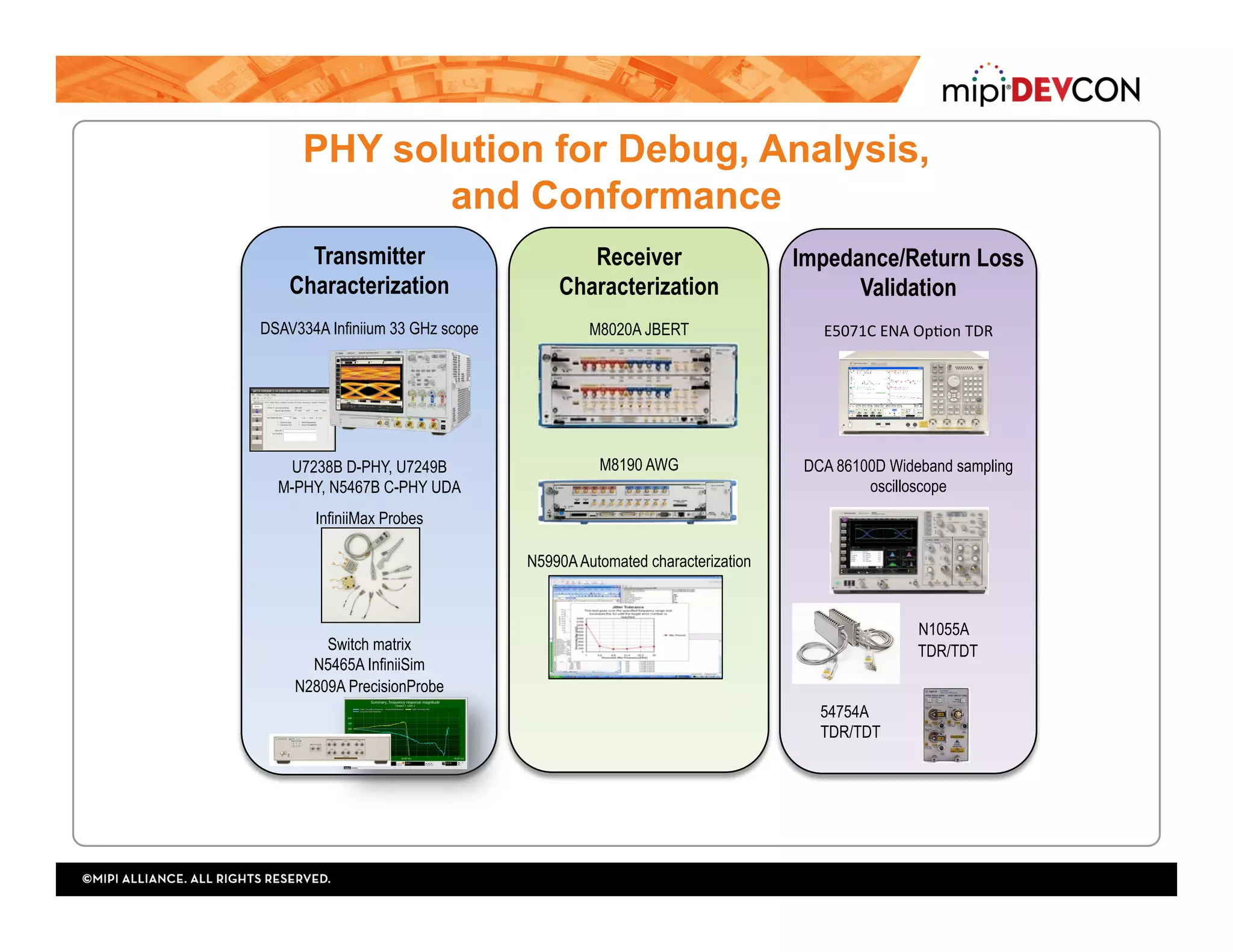
PHY solution for Debug, Analysis,
and Conformance
Transmitter
Characterization
DSAV334A Infiniium 33 GHz scope
U7238B D-PHY, U7249B
M-PHY, N5467B C-PHY UDA
InfiniiMax Probes
Switch matrix
N5465A InfiniiSim
N2809A PrecisionProbe
Receiver
Characterization
M8020A JBERT
M8190 AWG
N5990AAutomated characterization
Impedance/Return Loss
Validation
E5071C	ENA	OpTon	TDR	
DCA 86100D Wideband sampling
oscilloscope
N1055A
TDR/TDT
54754A
TDR/TDT
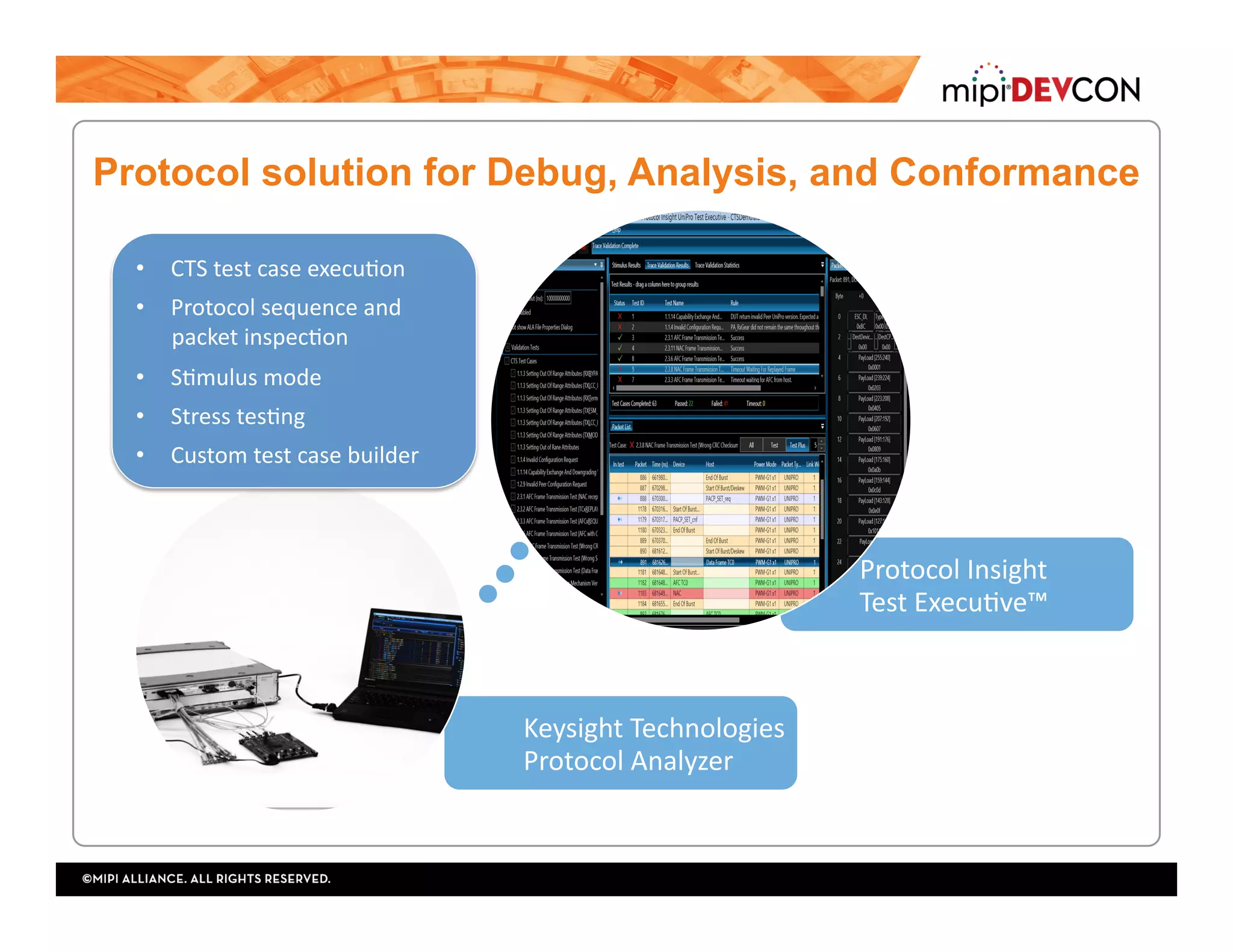
Keysight	Technologies	
Protocol	Analyzer	
Protocol	Insight		
Test	ExecuTve™	
•  CTS	test	case	execuTon	
•  Protocol	sequence	and		
packet	inspecTon	
•  STmulus	mode	
•  Stress	tesTng	
•  Custom	test	case	builder	
Protocol solution for Debug, Analysis, and Conformance
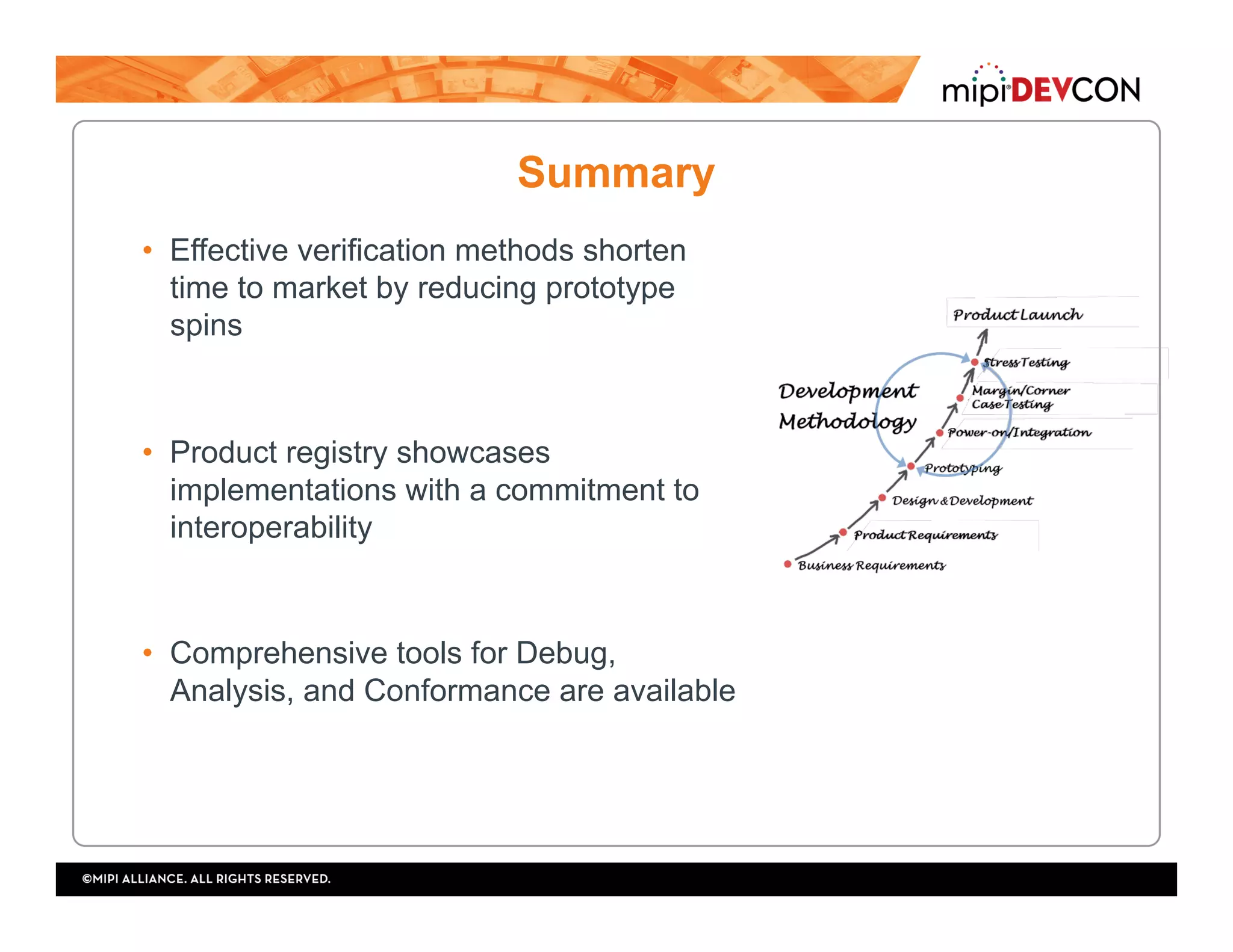
Summary
•  Effective verification methods shorten
time to market by reducing prototype
spins
•  Product registry showcases
implementations with a commitment to
interoperability
•  Comprehensive tools for Debug,
Analysis, and Conformance are available
MIPI DevCon 2016: Robust Debug and Conformance Verification Ensures Interoperability

MIPI DevCon 2016: Robust Debug and Conformance Verification Ensures Interoperability

  • 1.
    Ross Nelson, ProtocolInsight MIPI JEDEC & UFSA Liaisons Test & UniPro Working Groups Robust Debug and Conformance Verification Ensures Interoperability
  • 2.
  • 3.
    Debugging and Verifying Conformanceof MIPI Devices REDUCING TIME TO MARKET 1 less prototype cycle = 2-3 months
  • 4.
    New Product New ProductDevelopment Methodology Prototype Debug and Verification Cycle •  Interoperability testing •  Conformance/compliance verification •  Stress and automated testing •  Margin and corner case testing •  Link/interface debug •  Power on/device bring-up
  • 5.
    Typical Tx Setup • Oscilloscope – 25GHz or higher •  Probes – N7020A recommanded •  Switch matrix automates lane switching and test Infiniium DSAV254A 25GHz Oscilloscope 2x6 (1x6 differenTal) Switch Matrix Keysight U3020AS26
  • 6.
  • 7.
    Typical Protocol Setup ProtocolInsight Test Executive™ •  UniPro •  UFS •  Ara Keysight Analyzer •  Up to HS-G3 x4 •  UniPro/UFS •  Packet Generator •  SMA probing
  • 8.
    Link/Interface Debug Common Challenges CustomerInteractions Challenges Observed Interop events (IOTs) UniPro workshops GoogleProject Ara •  Ara module initialization •  UFS boot •  Power Mode changes •  Capabilities exchange •  Link Startup Sequence UniPro Example
  • 9.
    UniPro Common Challenges • Link Startup Sequence Phase 0 thru 4 •  Invalid Packet Order or Sequence •  Timing violations •  LSS Capabilities Exchange •  Invalid Packet Order or Sequence •  Non-PACP_CAP packets on link •  Power Mode Change •  Invalid Packet Order or Sequence •  Device cannot change power modes reliably •  After multiple Power Mode changes device does not respond
  • 10.
  • 11.
    Analyzing Link Traffic Statemachine trace analysis •  Evaluate every packet in a trace •  Look for states and subsequent events •  Log messages and attributes •  Flag Failure, Warning, Pass, Info and Debug
  • 12.
  • 13.
    Common LSS Phase0 thru 4 Failures •  Invalid Packet Order or Sequence •  Timing violations
  • 14.
    Common LSS Failures– Timing Violations Time between TRG_UPR0 not ≥ 1.6ms Reference UniPro v1.6 Table 28 PA_Granularity and PA_TAcFvate and SecFon 5.7.8.2, lines 1148 and 1154 The TAcTvate reset value is 1.6ms, and the device shall wait PA_TAcTvate before beginning a burst. Thus the Tme between TRG_UPR shall be at least 1.6ms.
  • 15.
    Common LSS CapabilitiesExchange Failures •  Invalid Packet Order or Sequence •  Non-PACP_CAP packets on link
  • 16.
    Common LSS Failures– Capabilities Exchange Packets other than EOB, SOB, CAP found before exchange complete Reference UniPro v1.6 SecFon 5.7.8.5 “Aeer finishing Phase 4 of the Link Startup Sequence, the PA Layer shall start a Burst on logical Lane #0 and transmits its capabiliTes and the local version informaTon to the peer Device using PACP_CAP_EXT1_ind (see SecTon 5.7.7.4) and PACP_CAP_ind (see SecTon 5.7.7.3) in this order.” Thus all other packets are not allowed to be sent. 1.  Found EOB, transiToning to Phase 5 2.  Found PACP_CAP_ind, with no EOB following 3.  Found AFC TC1 before CAP Exchange finished init 4.  Found AFC TC0 before CAP Exchange finished init 5.  Found EOB, transiToning to DL iniTalizaTon 1 2 3 4 5
  • 17.
  • 18.
  • 19.
    Common PMC Failures • Invalid Packet Order or Sequence •  Device cannot change power modes reliably (FAST/SLOW, AUTO/nonAUTO) •  After multiple Power Mode changes device does not respond
  • 20.
    Common PMC Failures– Packet Order Packets other than deskew or another PACP_PWR_req sent while waiting for the PACP_PWR_cnf Reference UniPro v1.6 SecFon 5.7.12 Link ConfiguraFon Procedure Other packets are not allowed to be sent between PACP_PWR_req and PACP_PWR_cnf . 1 2 3 4 5 1.  Found a PACP_PWR_req 2.  No other packet besides deskew or another PACP_PWR_req shall be sent while waiTng for the PACP_PWR_cnf 3.  Found another PACP_PWR_req 4.  Found another PACP_PWR_req 5.  The requestor shall not start a new burst unTl the peer device closes its burst 6.  PACP_PWR exchange finished 6
  • 21.
    Margin and CornerCase Testing •  Inject corrupted bits on the link… •  Tx and Rx •  Mask test margin •  Eye width/height •  Unit interval •  Jitter •  Risetime/falltime •  Protocol •  Corrupt packet header/payload •  Invalid packet sequences •  Timing violations •  Timeout errors then verify appropriate response
  • 22.
    Example UniPro ErrorInjection Scripts AFC Parameters CRC -inverts CRC of AFC CREQ_BIT -sets CReq Bit of AFC RSVD_BITS -inverts reserved bits in AFC INCR_SEQ_NUM -increases the sequence number in AFC by 1 DECR_SEQ_NUM -decreases the sequence number in AFC by 1 TC0 -replaces TC0 by TC1 SYMB -results in symbol error in AFC DISP -results in disparity error in AFC CREDIT -followed by 8 bit value in hex with which AFC is to be replaced REPLACE -followed by 3 bit value in hex with which AFC is to be replaced EXTRASYMBOL -results in extra symbol in AFC PACP Parameters CRC: -inverts CRC of PACP Frame RSVD_BITS: -inverts Reserved bits of PACP Frame FUNC_ID: -increases the funcTon id by 1 of PACP Frame SYMB: -results in symbol error in PACP Frame DISP: -results in disparity error in PACP Frame SKIP: -results in not sending PACP_CAP_ind Frame
  • 23.
    Stress and AutomatedTesting •  Corner case and margin testing •  Conformance and compliance testing •  Random order sequencing, traceable deterministic results •  Test loop management
  • 24.
    Automated PHY TxTesting Stress and Conformance Configure the Device Under Test (make sure proper data rate are supported) Select Tests. Automatically generate test report. D-PHY Example
  • 25.
    Automated PHY RxTesting Stress and Conformance M-PHY Example
  • 26.
    Automated Protocol Testing Stressand Conformance •  Execute any loop order by Speed, Link widths, or individual test cases •  Each category can be run ascending, descending, or random seed order •  Stop after a specified number of test case configuration loops, Warnings, Failures or No Result Test Cases UniPro Example
  • 27.
  • 28.
  • 29.
    Signal Access andDesign for Testability •  Board-level signal access •  SMA •  ZIF •  RTB •  Boot or reset signal access •  Automatic DUT Link Startup Sequence
  • 30.
    MIPI Product Registry TestingProcess •  New Membership benefit launched August 2016. •  Allows MIPI Members to showcase commitment to conformance testing •  Important Documents: •  MIPI Test Policy •  MIPI Product Registry Program Policy •  Specifications •  Conformance Test Suite (CTS) •  Method of Implementations (MOI) 30 hlps://members.mipi.org/wg/All-Members/home/registry-faq
  • 31.
    Conformance vs. Compliance • MIPI differentiates between conformance and compliance •  Conformance means: •  An implementation on Product Registry, confirming it meets the normative requirements of the relevant Specification or •  a Member-company verified implementation adheres to a Specification’s requirements •  Compliance implies that a formal evaluation has been made, e.g. as part of a certification program, which serves as a guarantee of a company’s right to enjoy applicable licenses.
  • 32.
    Test Working Group • Chartered to support conformance and interoperability activities •  Works with technical work groups in development of conformance testing resources •  Developed the Product Registry Program •  All Contributor or Board-level Members may participate in the Test Working Group
  • 33.
    MIPI Product Registry TestingProcess •  Conformance Test Suites (CTS) •  Unique to each MIPI Specification. •  Authored by MIPI Specification Working Group. •  Reviewed by MIPI Test Working Group. •  Outlines test procedures and requirements. 33
  • 34.
    MIPI Product Registry TestingProcess •  Method of Implementation (MOI) •  Describes how to perform CTS using specific Test Equipment •  Authored by Test Equipment Manufacturer •  Approved by Test Working Group •  Outlines how to perform testing using specific test equipment •  Calibration •  Connecting DUT •  Automation 34
  • 35.
    MIPI Product Registry TestingProcess •  Contributor Members may perform self testing or use a MIPI approved test lab •  All products noted as self-tested or independently tested •  Adopter members must use a MIPI approved test lab •  Member provides results summary to MIPI Product Registry Administrator 35
  • 36.
    •  Products aretested •  according to test procedures defined in current approved CTS •  Or using alternate test methodology if no CTS is available •  Products must pass all applicable tests in CTS •  If an implementation has optional features, it must also pass those applicable tests •  Listing by similarity determined by the Administrator and the Test WG Product Listing Process
  • 37.
    PHY solution forDebug, Analysis, and Conformance Transmitter Characterization DSAV334A Infiniium 33 GHz scope U7238B D-PHY, U7249B M-PHY, N5467B C-PHY UDA InfiniiMax Probes Switch matrix N5465A InfiniiSim N2809A PrecisionProbe Receiver Characterization M8020A JBERT M8190 AWG N5990AAutomated characterization Impedance/Return Loss Validation E5071C ENA OpTon TDR DCA 86100D Wideband sampling oscilloscope N1055A TDR/TDT 54754A TDR/TDT
  • 38.
    Keysight Technologies Protocol Analyzer Protocol Insight Test ExecuTve™ •  CTS test case execuTon •  Protocol sequence and packet inspecTon • STmulus mode •  Stress tesTng •  Custom test case builder Protocol solution for Debug, Analysis, and Conformance
  • 39.
    Summary •  Effective verificationmethods shorten time to market by reducing prototype spins •  Product registry showcases implementations with a commitment to interoperability •  Comprehensive tools for Debug, Analysis, and Conformance are available