© Tata Consultancy Services ltd. May 17, 2015 1
Challenges in Embedded Systems
Development – Wireless Radio
Perspective
Arpan Pal
Convergence Practice,
Tata Consultancy Services,
Kolkata, India
email : arpan.pal@tcs.com
2
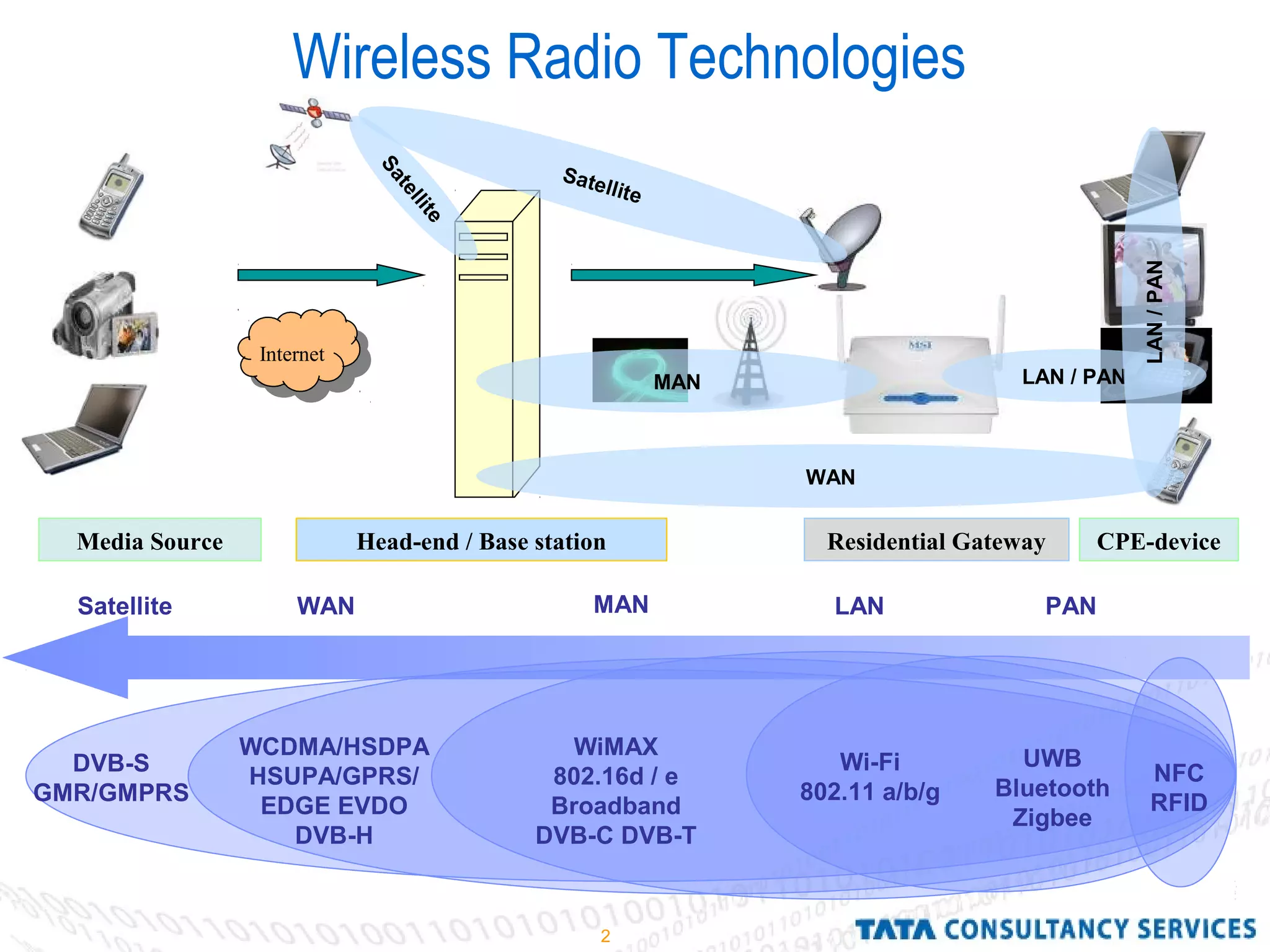
Wireless Radio Technologies
Media Source Head-end / Base station CPE-device
Internet
LAN / PANSatellite
Satellite
Residential Gateway
LAN/PAN
WAN
MAN
UWB
Bluetooth
Zigbee
PAN
WiMAX
802.16d / e
Broadband
DVB-C DVB-T
Wi-Fi
802.11 a/b/g
NFC
RFID
LANMAN
WCDMA/HSDPA
HSUPA/GPRS/
EDGE EVDO
DVB-H
DVB-S
GMR/GMPRS
WANSatellite
3
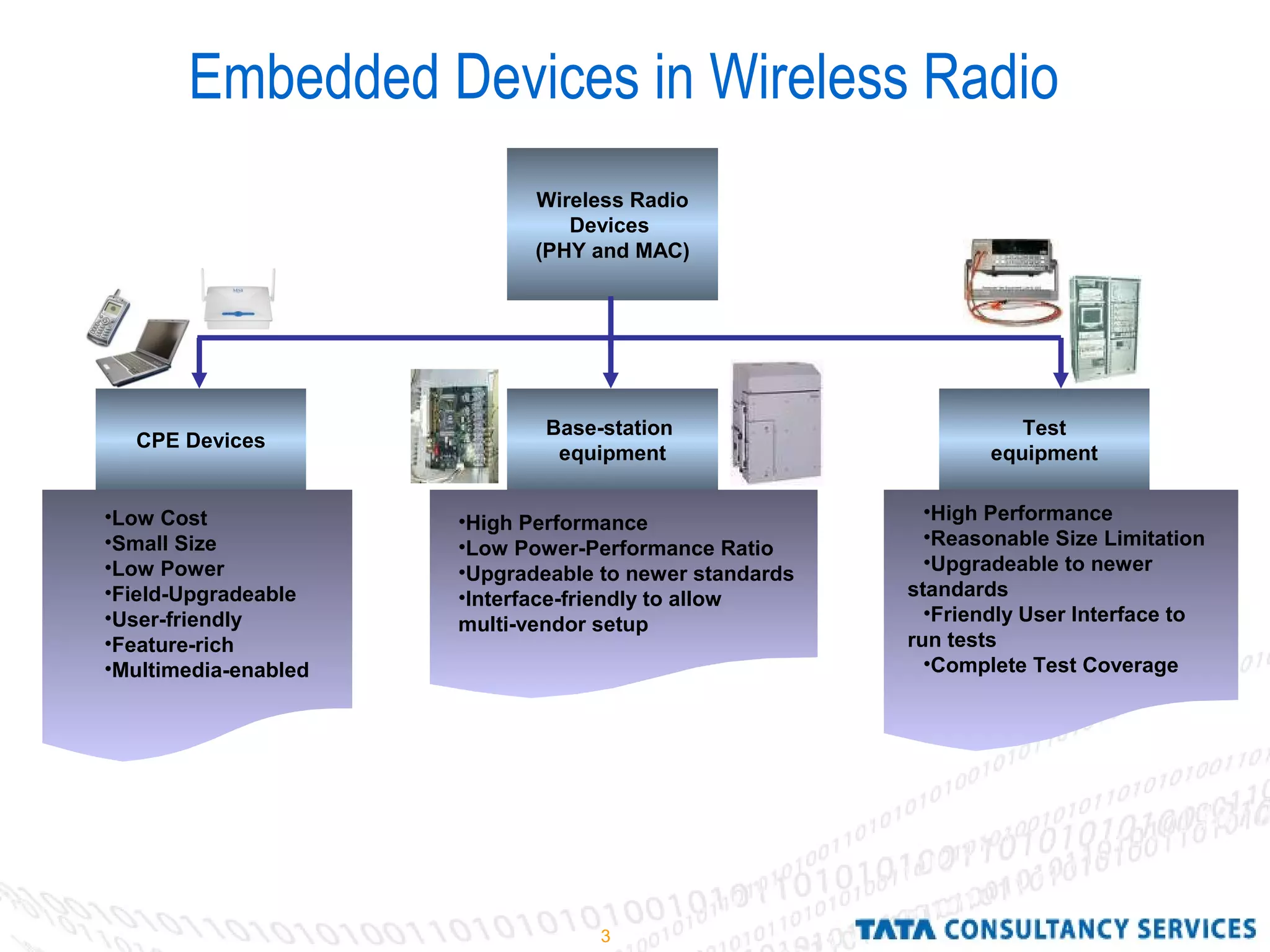
Embedded Devices in Wireless Radio
CPE Devices
Base-station
equipment
Test
equipment
•Low Cost
•Small Size
•Low Power
•Field-Upgradeable
•User-friendly
•Feature-rich
•Multimedia-enabled
•High Performance
•Low Power-Performance Ratio
•Upgradeable to newer standards
•Interface-friendly to allow
multi-vendor setup
•High Performance
•Reasonable Size Limitation
•Upgradeable to newer
standards
•Friendly User Interface to
run tests
•Complete Test Coverage
Wireless Radio
Devices
(PHY and MAC)
4
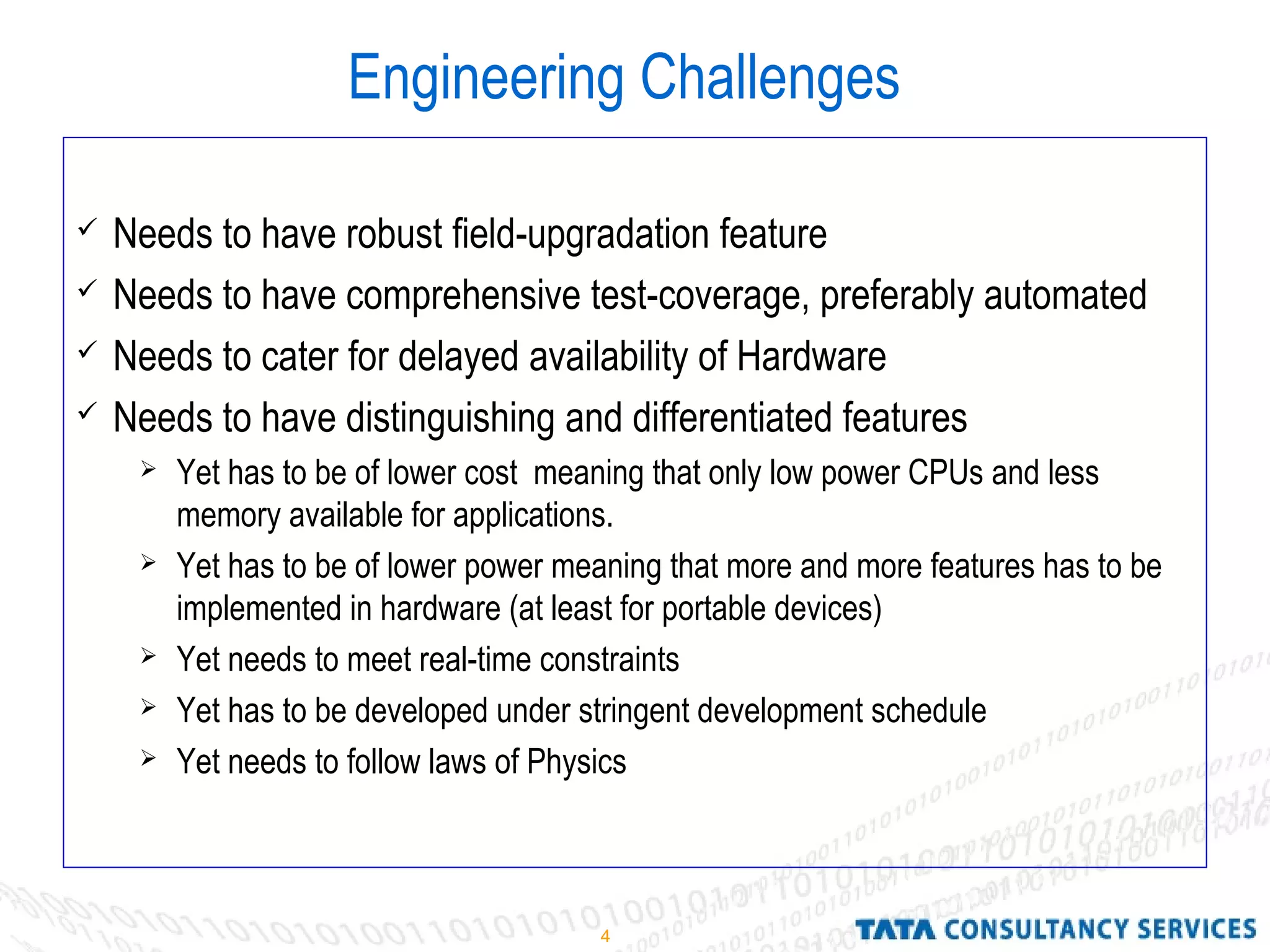
Engineering Challenges
 Needs to have robust field-upgradation feature
 Needs to have comprehensive test-coverage, preferably automated
 Needs to cater for delayed availability of Hardware
 Needs to have distinguishing and differentiated features
 Yet has to be of lower cost meaning that only low power CPUs and less
memory available for applications.
 Yet has to be of lower power meaning that more and more features has to be
implemented in hardware (at least for portable devices)
 Yet needs to meet real-time constraints
 Yet has to be developed under stringent development schedule
 Yet needs to follow laws of Physics
5
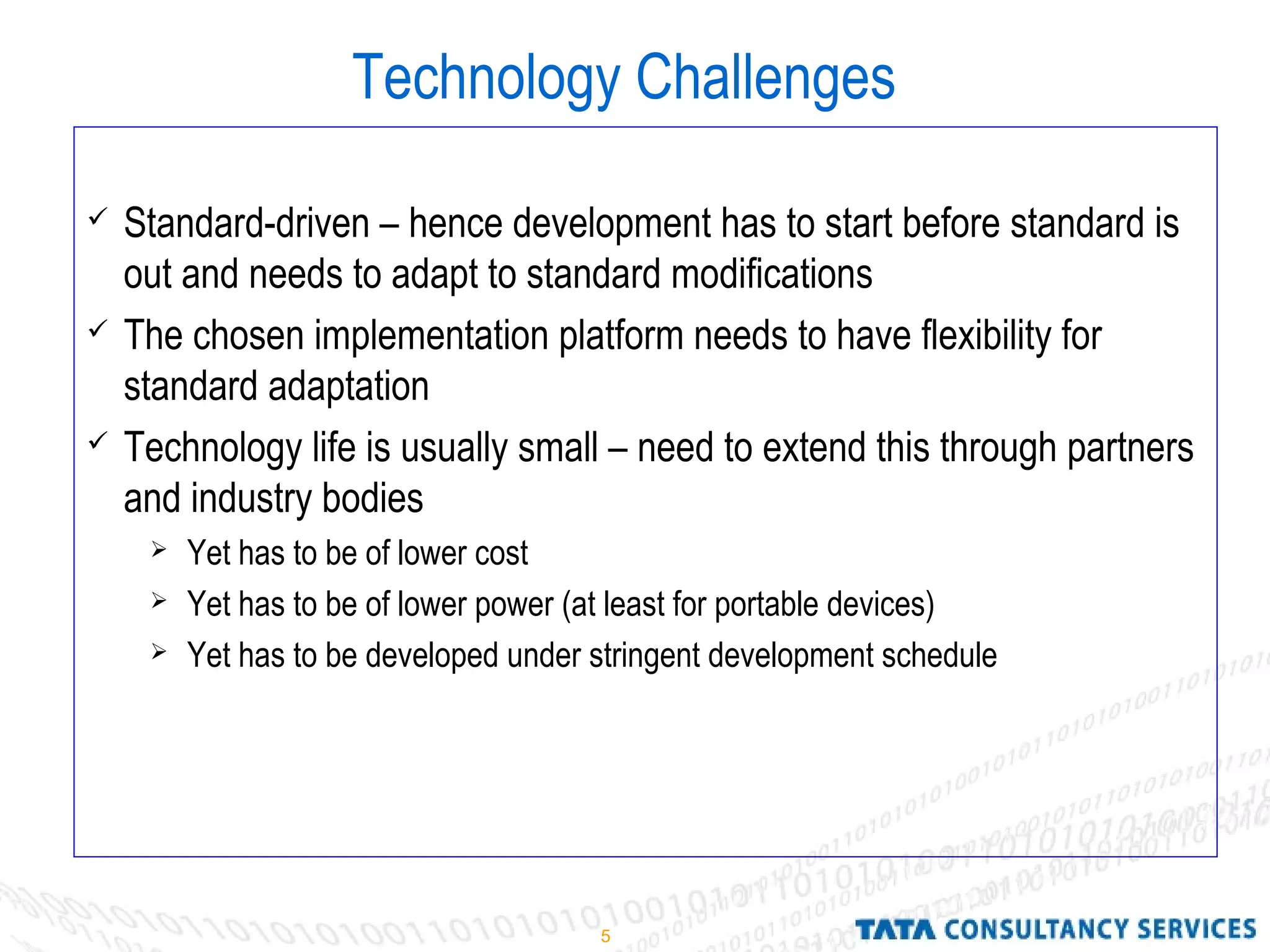
Technology Challenges
 Standard-driven – hence development has to start before standard is
out and needs to adapt to standard modifications
 The chosen implementation platform needs to have flexibility for
standard adaptation
 Technology life is usually small – need to extend this through partners
and industry bodies
 Yet has to be of lower cost
 Yet has to be of lower power (at least for portable devices)
 Yet has to be developed under stringent development schedule
6
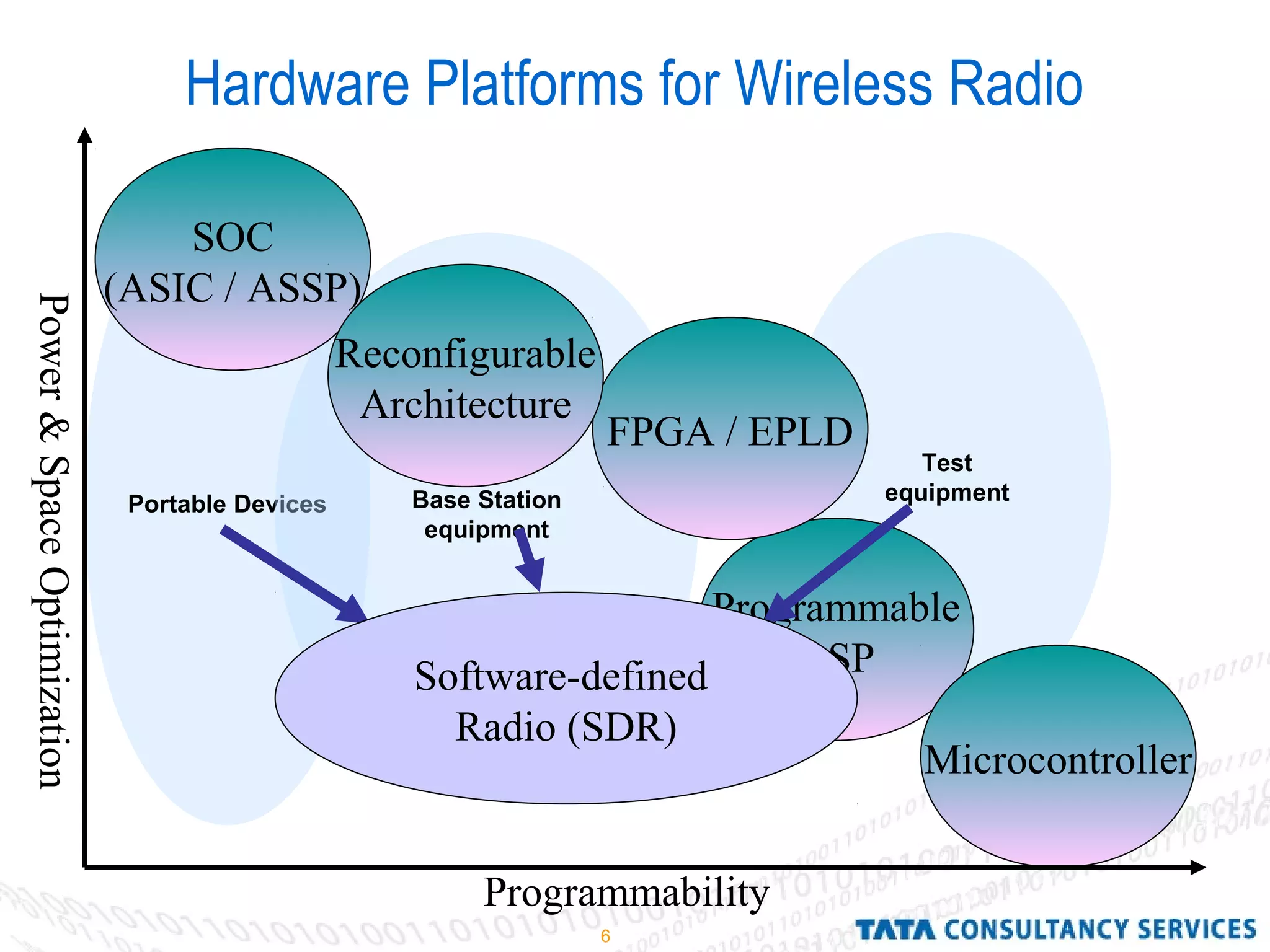
Portable Devices Base Station
equipment
Test
equipment
SOC
(ASIC / ASSP)
Programmable
DSP
Microcontroller
FPGA / EPLD
Reconfigurable
Architecture
Programmability
Power&SpaceOptimization
Hardware Platforms for Wireless Radio
Software-defined
Radio (SDR)
7
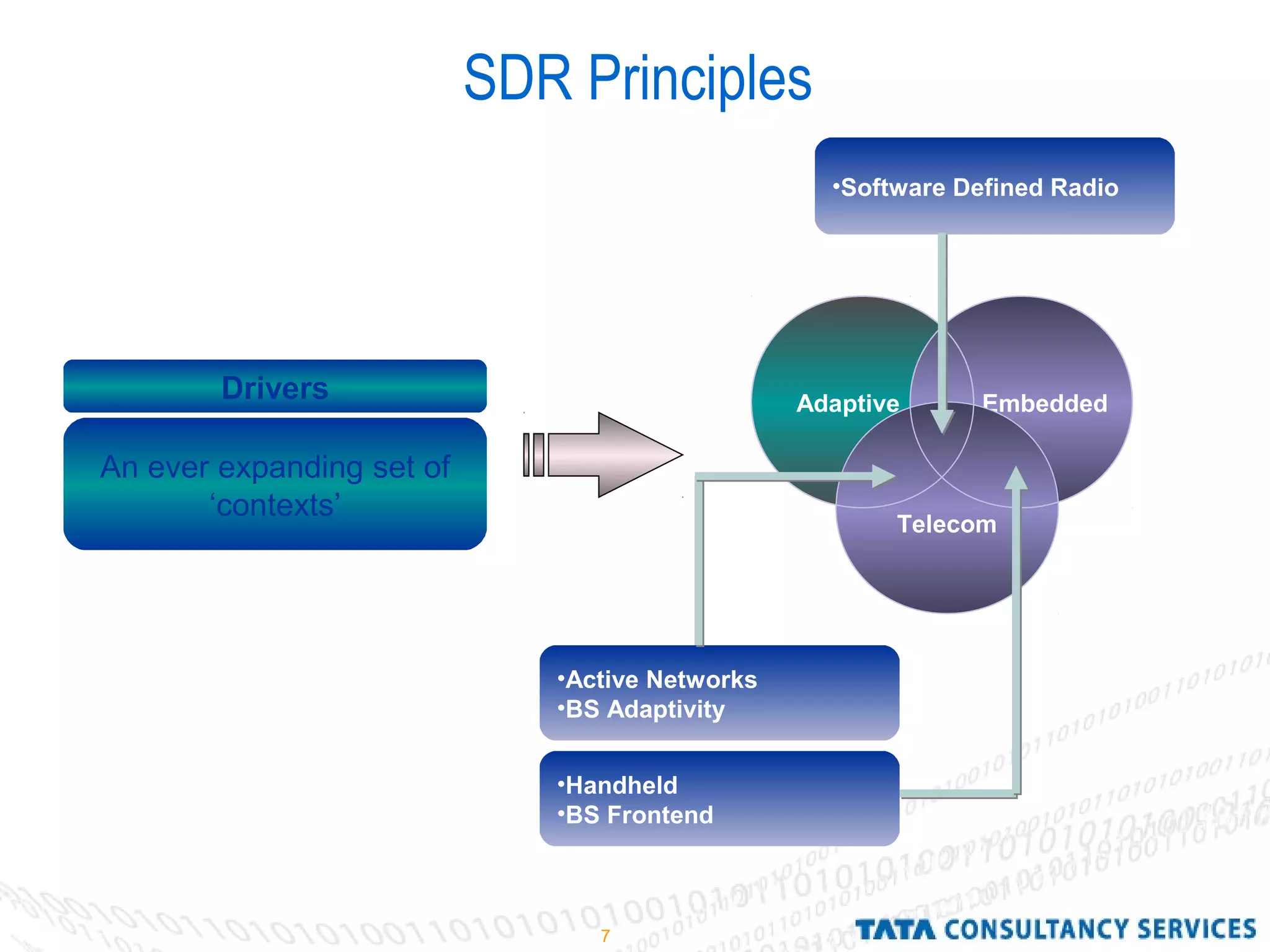
SDR Principles
Drivers
An ever expanding set of
‘contexts’
Adaptive Embedded
Telecom
•Active Networks
•BS Adaptivity
•Handheld
•BS Frontend
•Software Defined Radio
8
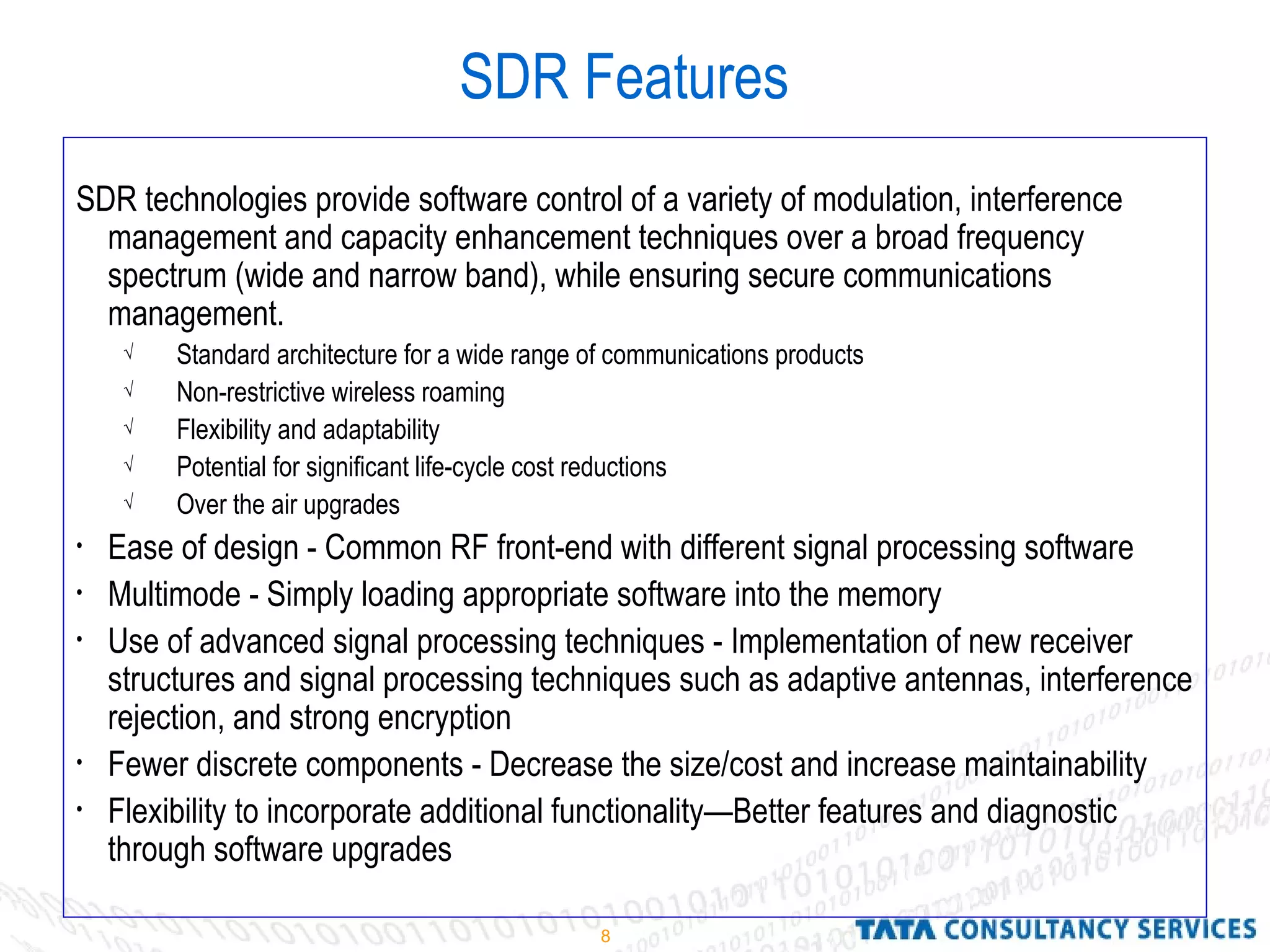
SDR Features
SDR technologies provide software control of a variety of modulation, interference
management and capacity enhancement techniques over a broad frequency
spectrum (wide and narrow band), while ensuring secure communications
management.
√ Standard architecture for a wide range of communications products
√ Non-restrictive wireless roaming
√ Flexibility and adaptability
√ Potential for significant life-cycle cost reductions
√ Over the air upgrades
• Ease of design - Common RF front-end with different signal processing software
• Multimode - Simply loading appropriate software into the memory
• Use of advanced signal processing techniques - Implementation of new receiver
structures and signal processing techniques such as adaptive antennas, interference
rejection, and strong encryption
• Fewer discrete components - Decrease the size/cost and increase maintainability
• Flexibility to incorporate additional functionality—Better features and diagnostic
through software upgrades
9
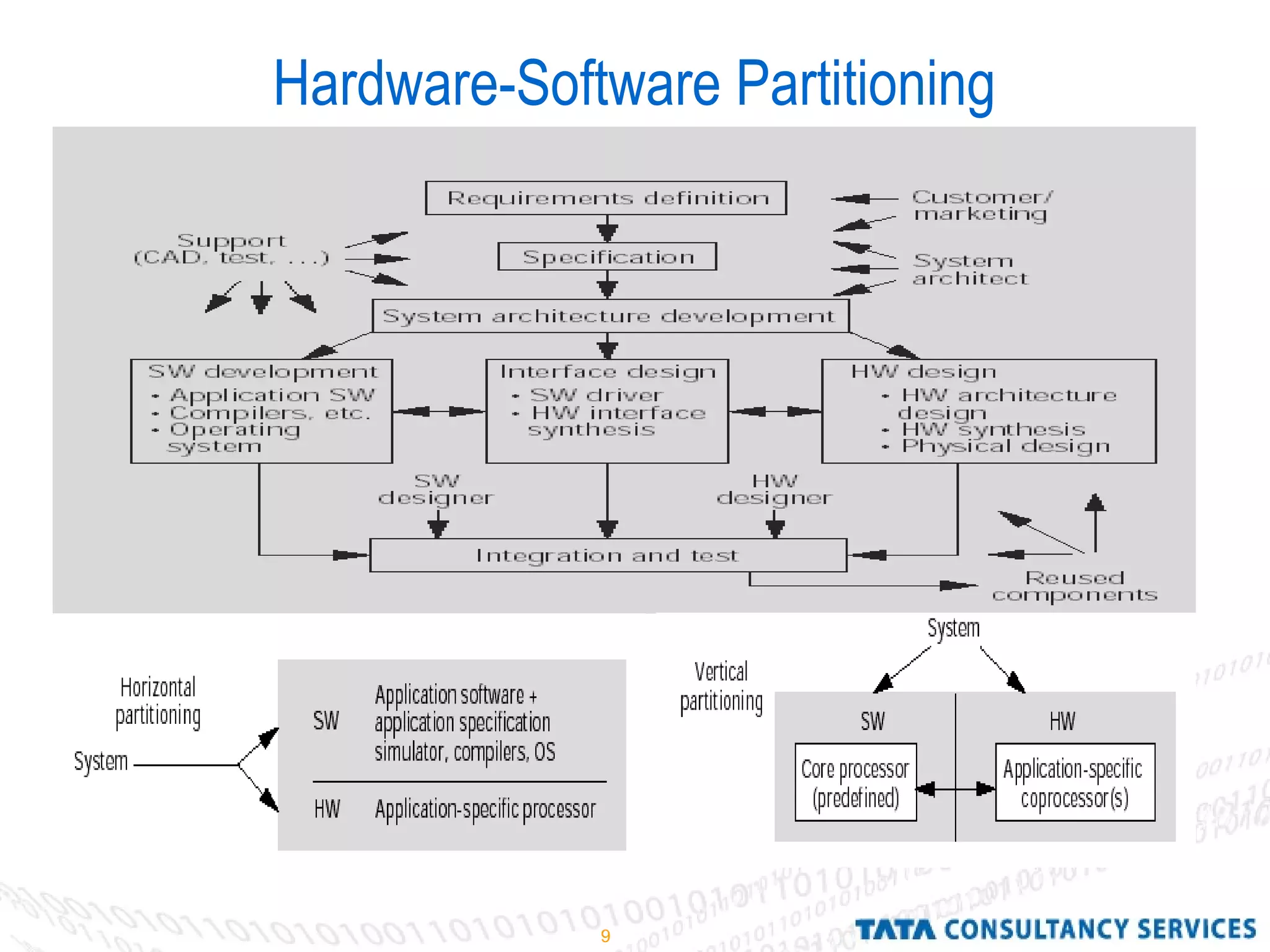
Hardware-Software Partitioning
10
Example Case Studies
- Challenges and Solutions
11
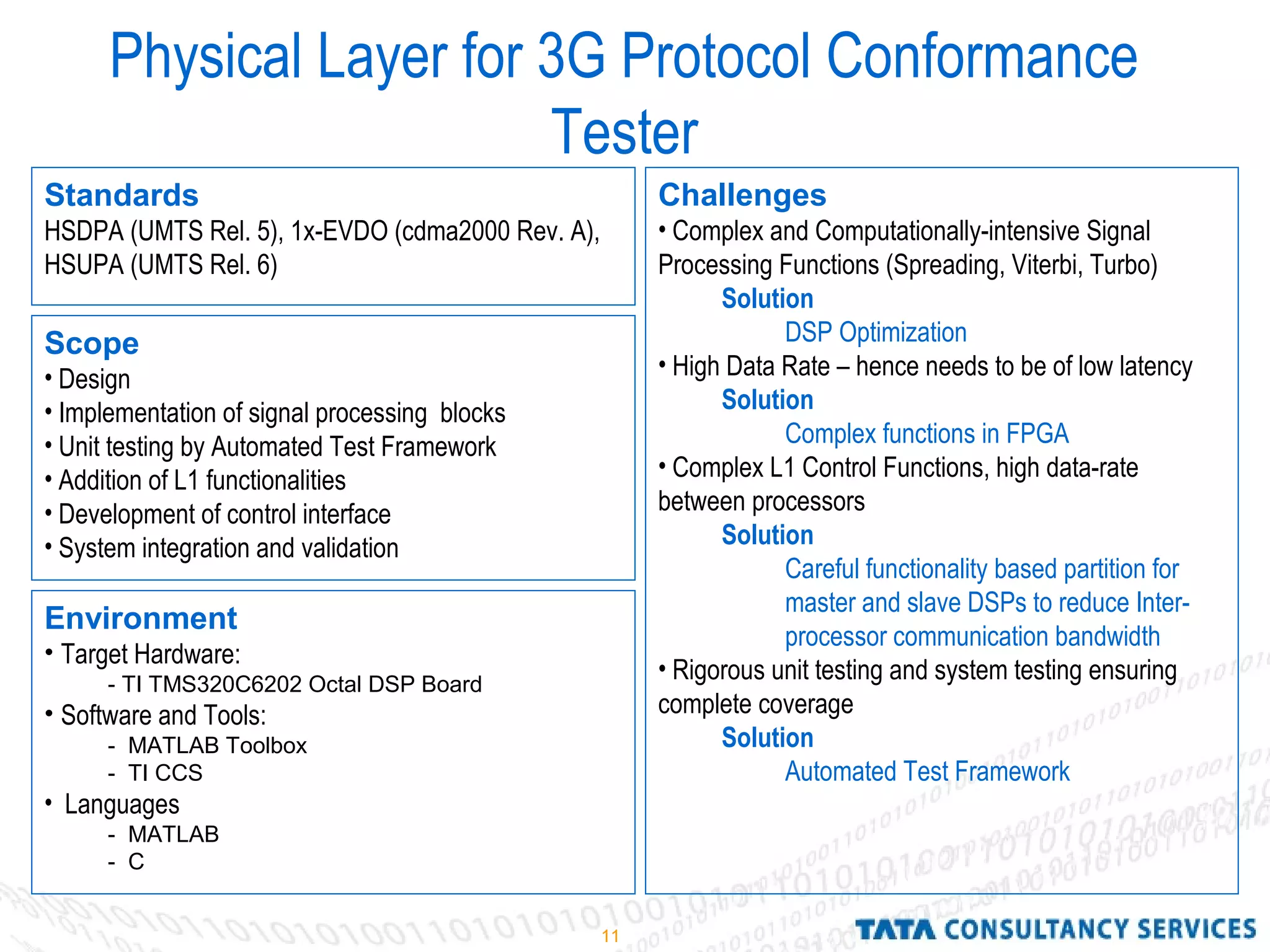
Physical Layer for 3G Protocol Conformance
Tester
Scope
• Design
• Implementation of signal processing blocks
• Unit testing by Automated Test Framework
• Addition of L1 functionalities
• Development of control interface
• System integration and validation
Environment
• Target Hardware:
- TI TMS320C6202 Octal DSP Board
• Software and Tools:
- MATLAB Toolbox
- TI CCS
• Languages
- MATLAB
- C
Challenges
• Complex and Computationally-intensive Signal
Processing Functions (Spreading, Viterbi, Turbo)
Solution
DSP Optimization
• High Data Rate – hence needs to be of low latency
Solution
Complex functions in FPGA
• Complex L1 Control Functions, high data-rate
between processors
Solution
Careful functionality based partition for
master and slave DSPs to reduce Inter-
processor communication bandwidth
• Rigorous unit testing and system testing ensuring
complete coverage
Solution
Automated Test Framework
Standards
HSDPA (UMTS Rel. 5), 1x-EVDO (cdma2000 Rev. A),
HSUPA (UMTS Rel. 6)
12
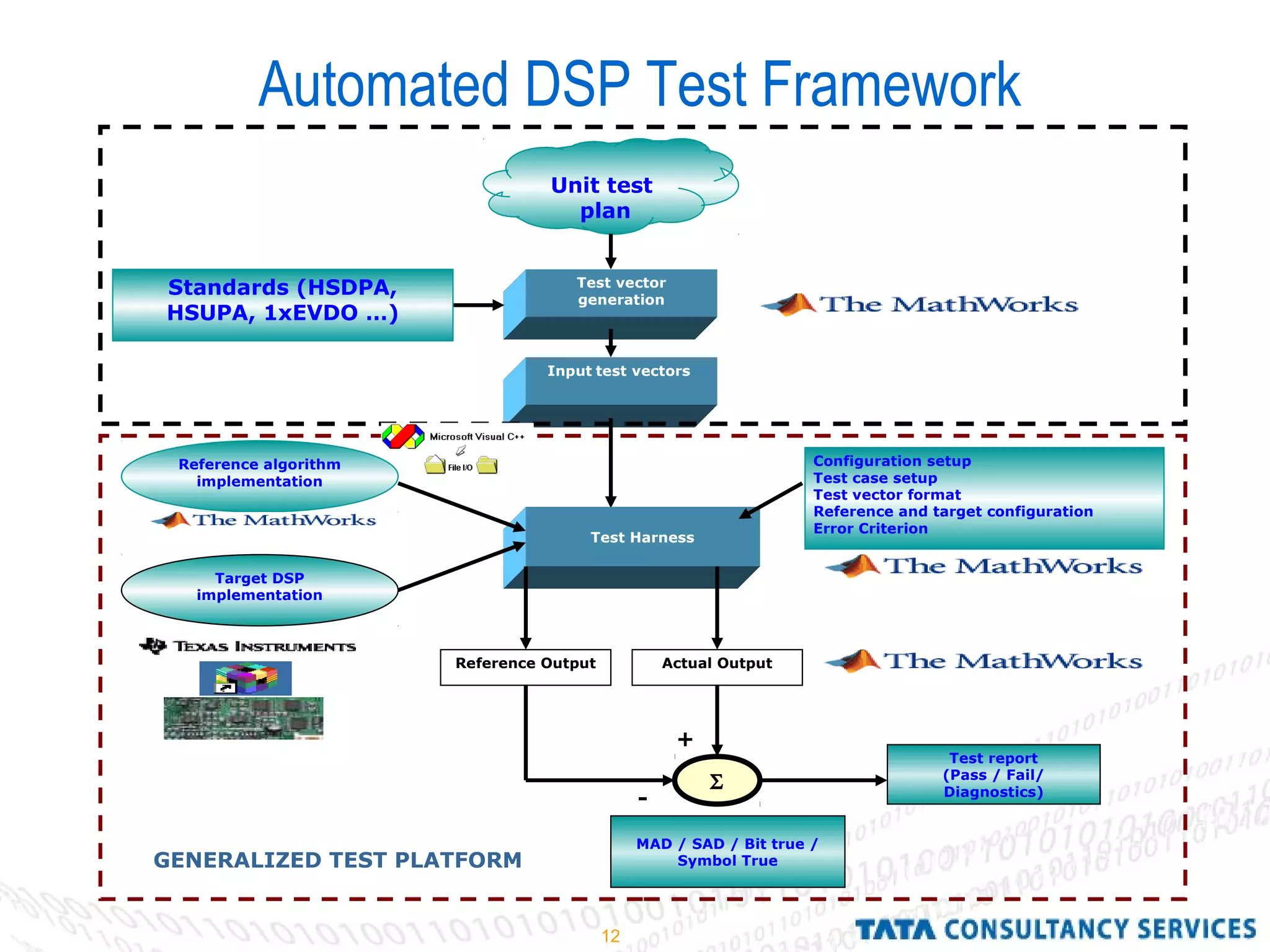
Test vector
generation
Standards (HSDPA,
HSUPA, 1xEVDO …)
Unit test
plan
Input test vectors
Test Harness
Reference algorithm
implementation
Target DSP
implementation
Reference Output Actual Output
Σ
+
-
Test report
(Pass / Fail/
Diagnostics)
Configuration setup
Test case setup
Test vector format
Reference and target configuration
Error Criterion
MAD / SAD / Bit true /
Symbol TrueGENERALIZED TEST PLATFORM
Automated DSP Test Framework
13
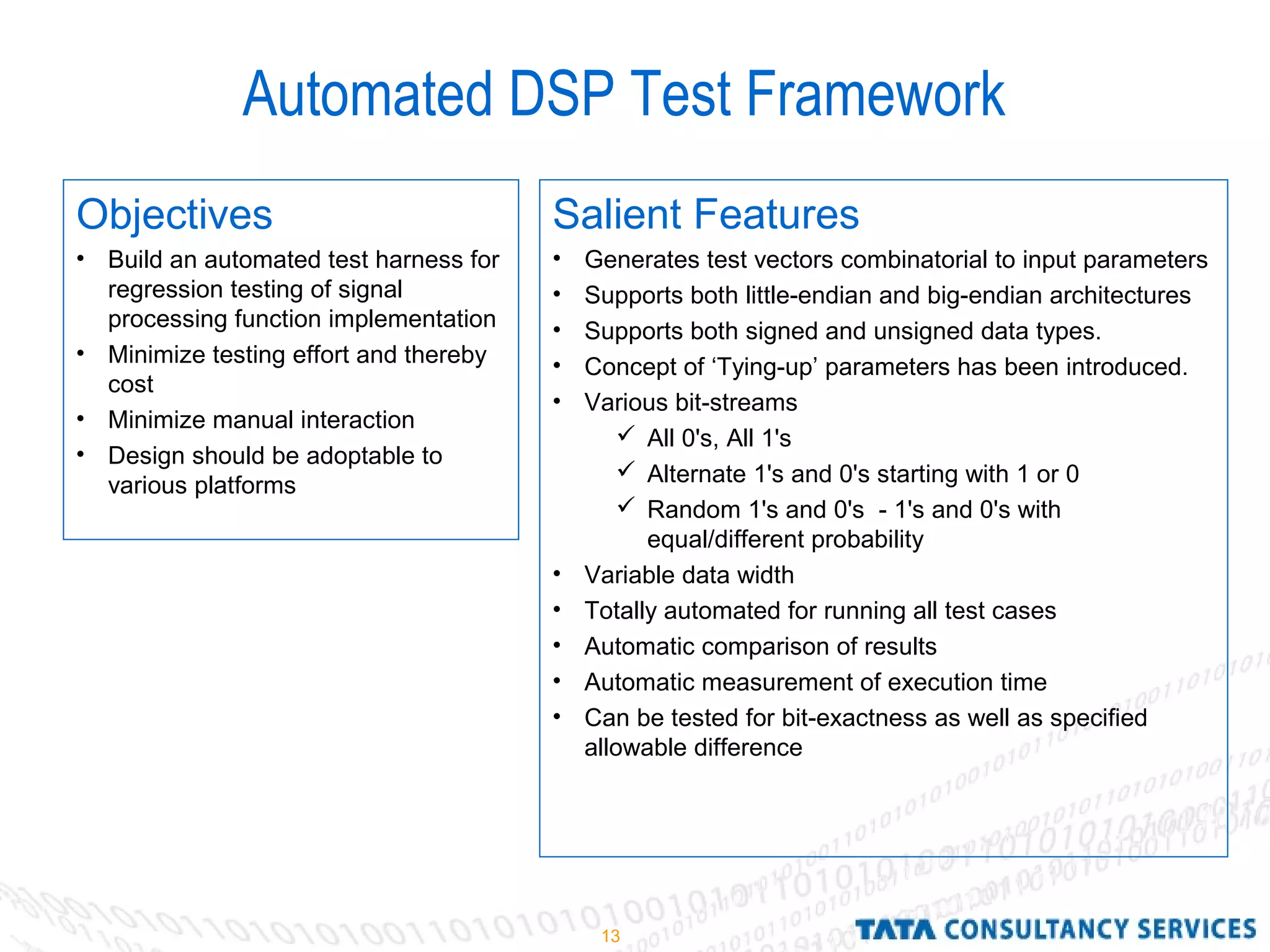
Automated DSP Test Framework
Salient Features
• Generates test vectors combinatorial to input parameters
• Supports both little-endian and big-endian architectures
• Supports both signed and unsigned data types.
• Concept of ‘Tying-up’ parameters has been introduced.
• Various bit-streams
 All 0's, All 1's
 Alternate 1's and 0's starting with 1 or 0
 Random 1's and 0's - 1's and 0's with
equal/different probability
• Variable data width
• Totally automated for running all test cases
• Automatic comparison of results
• Automatic measurement of execution time
• Can be tested for bit-exactness as well as specified
allowable difference
Objectives
• Build an automated test harness for
regression testing of signal
processing function implementation
• Minimize testing effort and thereby
cost
• Minimize manual interaction
• Design should be adoptable to
various platforms
14
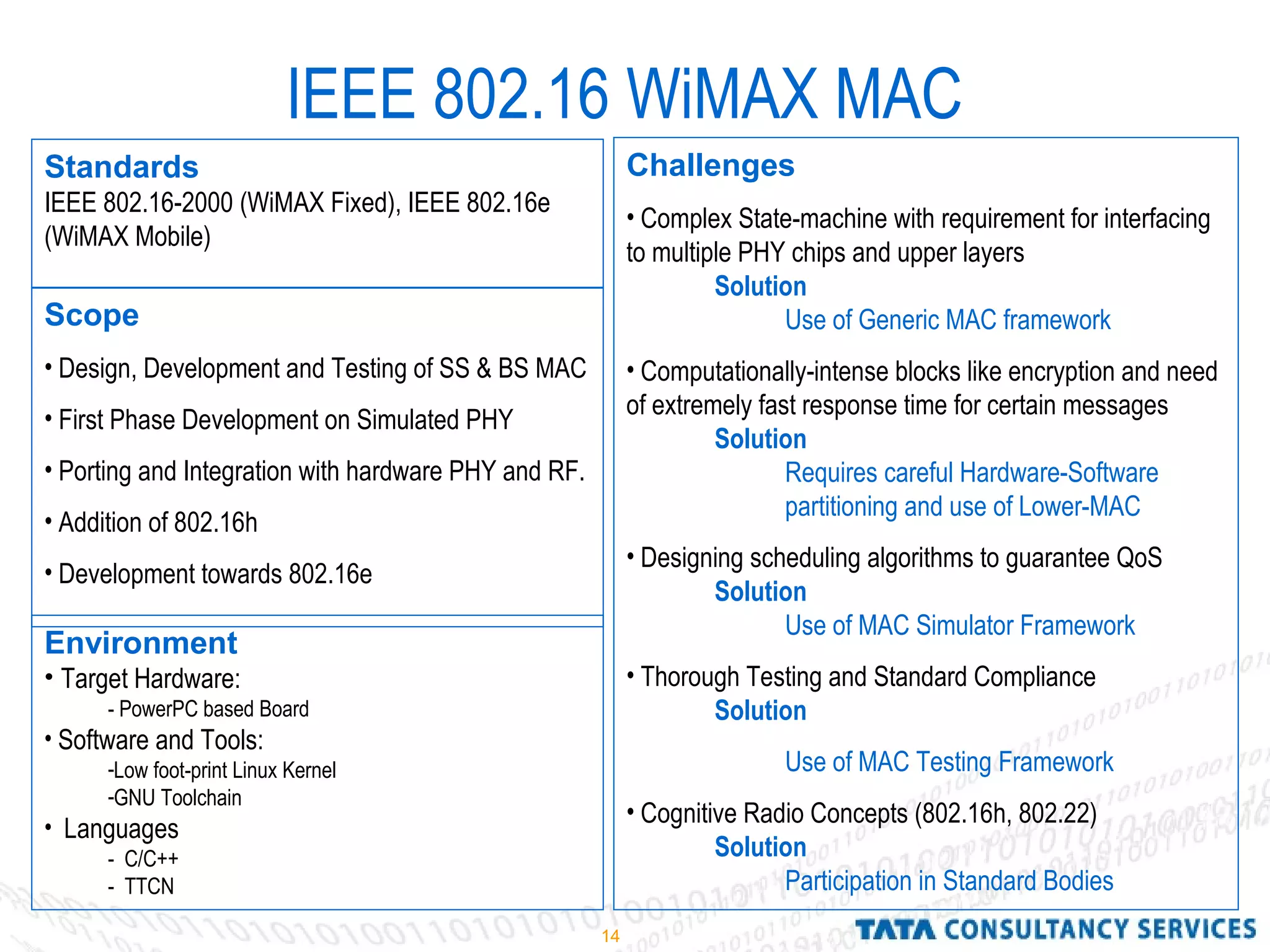
IEEE 802.16 WiMAX MAC
Scope
• Design, Development and Testing of SS & BS MAC
• First Phase Development on Simulated PHY
• Porting and Integration with hardware PHY and RF.
• Addition of 802.16h
• Development towards 802.16e
Environment
• Target Hardware:
- PowerPC based Board
• Software and Tools:
-Low foot-print Linux Kernel
-GNU Toolchain
• Languages
- C/C++
- TTCN
Challenges
• Complex State-machine with requirement for interfacing
to multiple PHY chips and upper layers
Solution
Use of Generic MAC framework
• Computationally-intense blocks like encryption and need
of extremely fast response time for certain messages
Solution
Requires careful Hardware-Software
partitioning and use of Lower-MAC
• Designing scheduling algorithms to guarantee QoS
Solution
Use of MAC Simulator Framework
• Thorough Testing and Standard Compliance
Solution
Use of MAC Testing Framework
• Cognitive Radio Concepts (802.16h, 802.22)
Solution
Participation in Standard Bodies
Standards
IEEE 802.16-2000 (WiMAX Fixed), IEEE 802.16e
(WiMAX Mobile)
15
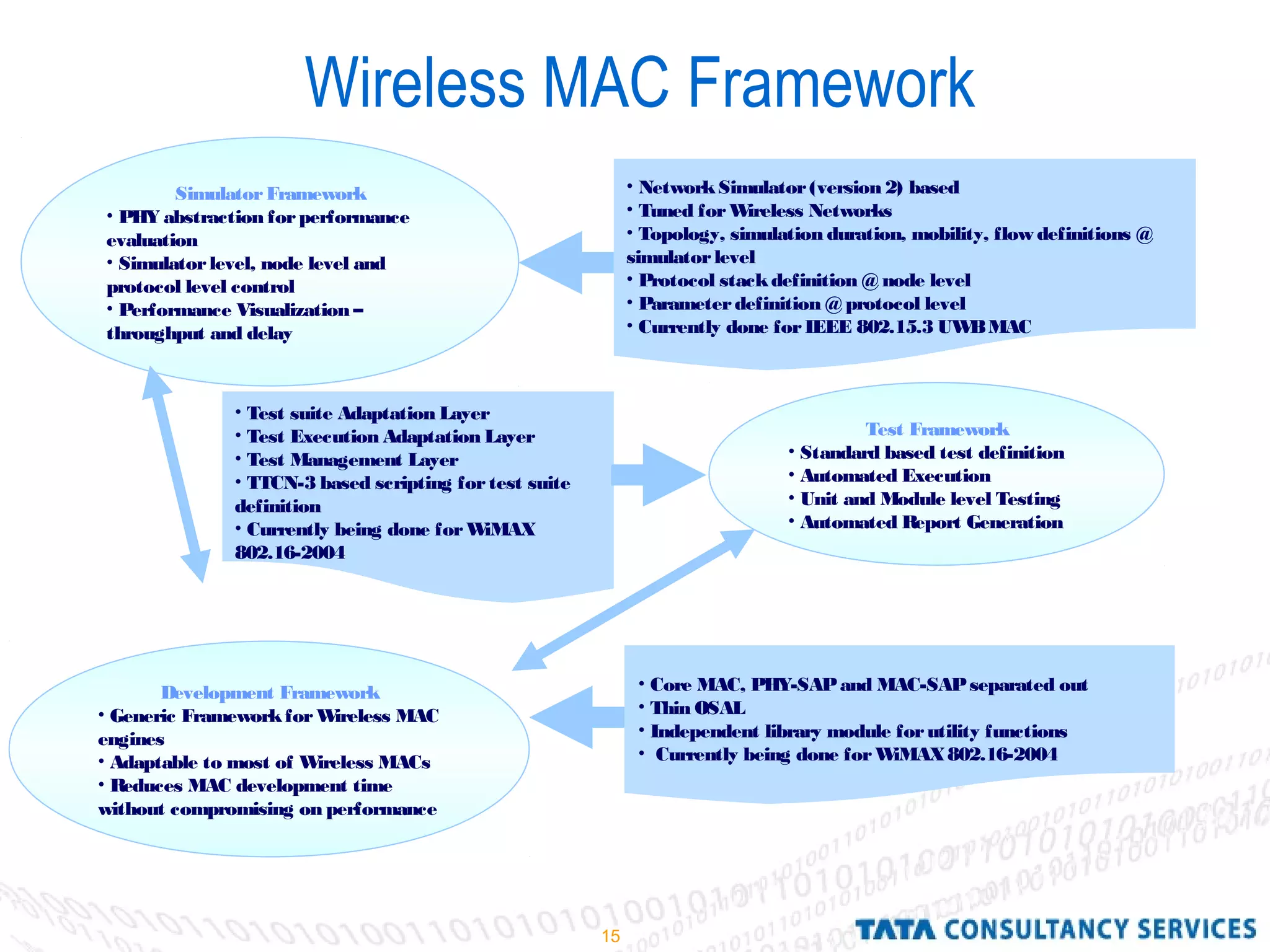
Wireless MAC Framework
Simulator Framework
• PHY abstraction forperformance
evaluation
• Simulatorlevel, node level and
protocol level control
• Performance Visualization –
throughput and delay
Development Framework
• Generic Frameworkfor Wireless MAC
engines
• Adaptable to most of Wireless MACs
• Reduces MAC development time
without compromising on performance
Test Framework
• Standard based test definition
• Automated Execution
• Unit and Module level Testing
• Automated Report Generation
• NetworkSimulator(version 2) based
• Tuned forWireless Networks
• Topology, simulation duration, mobility, flow definitions @
simulatorlevel
• Protocol stackdefinition @ node level
• Parameterdefinition @protocol level
• Currently done forIEEE 802.15.3 UWBMAC
• Core MAC, PHY-SAPand MAC-SAPseparated out
• Thin OSAL
• Independent library module forutility functions
• Currently being done forWiMAX802.16-2004
• Test suite Adaptation Layer
• Test Execution Adaptation Layer
• Test Management Layer
• TTCN-3 based scripting for test suite
definition
• Currently being done forWiMAX
802.16-2004
16
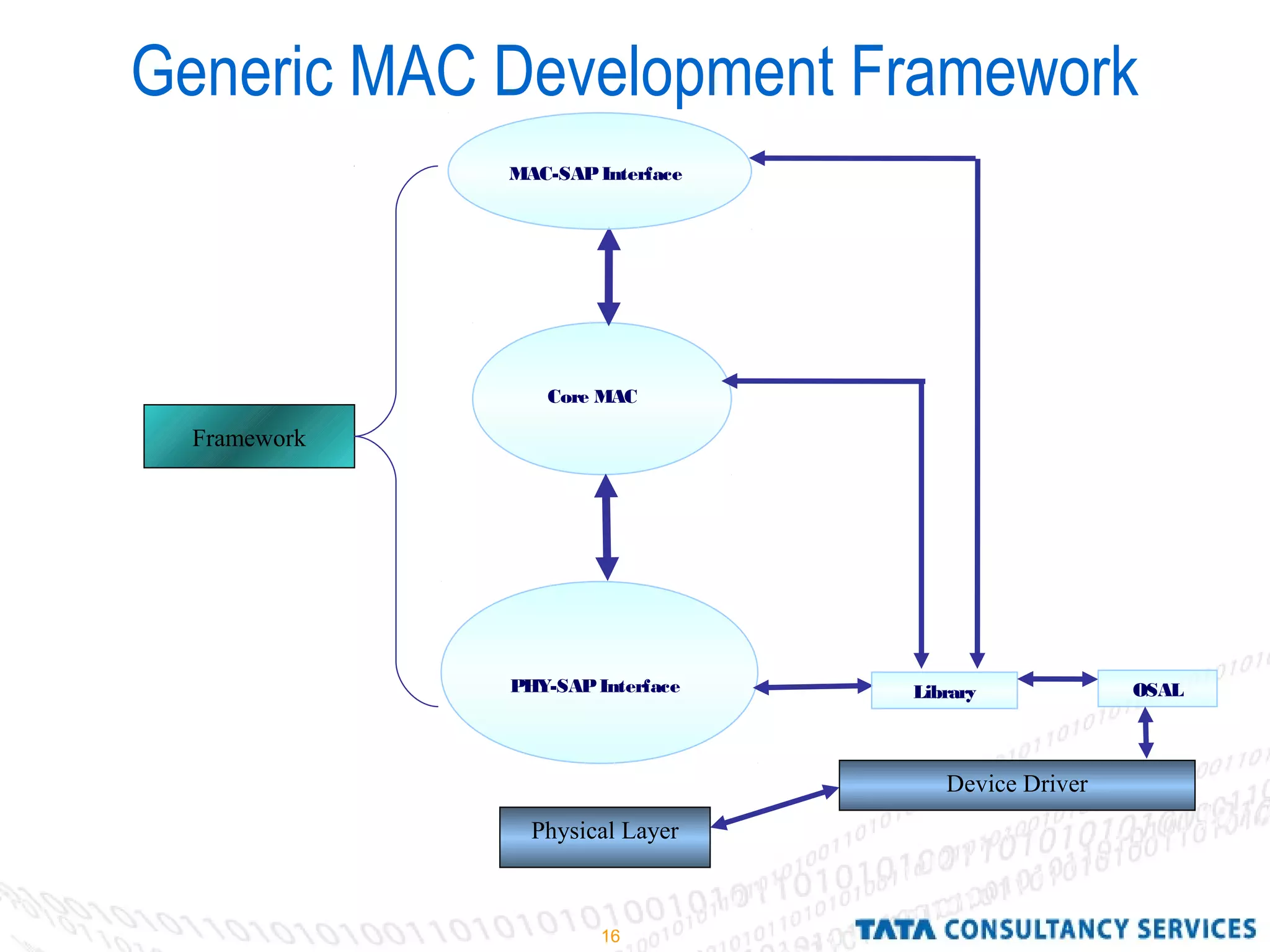
Generic MAC Development Framework
Physical Layer
Core MAC
PHY-SAPInterface
Framework
Library OSAL
Device Driver
MAC-SAPInterface
18
Thank You

Euro india2006 wirelessradioembeddedchallenges

  • 1.
    © Tata ConsultancyServices ltd. May 17, 2015 1 Challenges in Embedded Systems Development – Wireless Radio Perspective Arpan Pal Convergence Practice, Tata Consultancy Services, Kolkata, India email : arpan.pal@tcs.com
  • 2.
    2 Wireless Radio Technologies MediaSource Head-end / Base station CPE-device Internet LAN / PANSatellite Satellite Residential Gateway LAN/PAN WAN MAN UWB Bluetooth Zigbee PAN WiMAX 802.16d / e Broadband DVB-C DVB-T Wi-Fi 802.11 a/b/g NFC RFID LANMAN WCDMA/HSDPA HSUPA/GPRS/ EDGE EVDO DVB-H DVB-S GMR/GMPRS WANSatellite
  • 3.
    3 Embedded Devices inWireless Radio CPE Devices Base-station equipment Test equipment •Low Cost •Small Size •Low Power •Field-Upgradeable •User-friendly •Feature-rich •Multimedia-enabled •High Performance •Low Power-Performance Ratio •Upgradeable to newer standards •Interface-friendly to allow multi-vendor setup •High Performance •Reasonable Size Limitation •Upgradeable to newer standards •Friendly User Interface to run tests •Complete Test Coverage Wireless Radio Devices (PHY and MAC)
  • 4.
    4 Engineering Challenges  Needsto have robust field-upgradation feature  Needs to have comprehensive test-coverage, preferably automated  Needs to cater for delayed availability of Hardware  Needs to have distinguishing and differentiated features  Yet has to be of lower cost meaning that only low power CPUs and less memory available for applications.  Yet has to be of lower power meaning that more and more features has to be implemented in hardware (at least for portable devices)  Yet needs to meet real-time constraints  Yet has to be developed under stringent development schedule  Yet needs to follow laws of Physics
  • 5.
    5 Technology Challenges  Standard-driven– hence development has to start before standard is out and needs to adapt to standard modifications  The chosen implementation platform needs to have flexibility for standard adaptation  Technology life is usually small – need to extend this through partners and industry bodies  Yet has to be of lower cost  Yet has to be of lower power (at least for portable devices)  Yet has to be developed under stringent development schedule
  • 6.
    6 Portable Devices BaseStation equipment Test equipment SOC (ASIC / ASSP) Programmable DSP Microcontroller FPGA / EPLD Reconfigurable Architecture Programmability Power&SpaceOptimization Hardware Platforms for Wireless Radio Software-defined Radio (SDR)
  • 7.
    7 SDR Principles Drivers An everexpanding set of ‘contexts’ Adaptive Embedded Telecom •Active Networks •BS Adaptivity •Handheld •BS Frontend •Software Defined Radio
  • 8.
    8 SDR Features SDR technologiesprovide software control of a variety of modulation, interference management and capacity enhancement techniques over a broad frequency spectrum (wide and narrow band), while ensuring secure communications management. √ Standard architecture for a wide range of communications products √ Non-restrictive wireless roaming √ Flexibility and adaptability √ Potential for significant life-cycle cost reductions √ Over the air upgrades • Ease of design - Common RF front-end with different signal processing software • Multimode - Simply loading appropriate software into the memory • Use of advanced signal processing techniques - Implementation of new receiver structures and signal processing techniques such as adaptive antennas, interference rejection, and strong encryption • Fewer discrete components - Decrease the size/cost and increase maintainability • Flexibility to incorporate additional functionality—Better features and diagnostic through software upgrades
  • 9.
  • 10.
    10 Example Case Studies -Challenges and Solutions
  • 11.
    11 Physical Layer for3G Protocol Conformance Tester Scope • Design • Implementation of signal processing blocks • Unit testing by Automated Test Framework • Addition of L1 functionalities • Development of control interface • System integration and validation Environment • Target Hardware: - TI TMS320C6202 Octal DSP Board • Software and Tools: - MATLAB Toolbox - TI CCS • Languages - MATLAB - C Challenges • Complex and Computationally-intensive Signal Processing Functions (Spreading, Viterbi, Turbo) Solution DSP Optimization • High Data Rate – hence needs to be of low latency Solution Complex functions in FPGA • Complex L1 Control Functions, high data-rate between processors Solution Careful functionality based partition for master and slave DSPs to reduce Inter- processor communication bandwidth • Rigorous unit testing and system testing ensuring complete coverage Solution Automated Test Framework Standards HSDPA (UMTS Rel. 5), 1x-EVDO (cdma2000 Rev. A), HSUPA (UMTS Rel. 6)
  • 12.
    12 Test vector generation Standards (HSDPA, HSUPA,1xEVDO …) Unit test plan Input test vectors Test Harness Reference algorithm implementation Target DSP implementation Reference Output Actual Output Σ + - Test report (Pass / Fail/ Diagnostics) Configuration setup Test case setup Test vector format Reference and target configuration Error Criterion MAD / SAD / Bit true / Symbol TrueGENERALIZED TEST PLATFORM Automated DSP Test Framework
  • 13.
    13 Automated DSP TestFramework Salient Features • Generates test vectors combinatorial to input parameters • Supports both little-endian and big-endian architectures • Supports both signed and unsigned data types. • Concept of ‘Tying-up’ parameters has been introduced. • Various bit-streams  All 0's, All 1's  Alternate 1's and 0's starting with 1 or 0  Random 1's and 0's - 1's and 0's with equal/different probability • Variable data width • Totally automated for running all test cases • Automatic comparison of results • Automatic measurement of execution time • Can be tested for bit-exactness as well as specified allowable difference Objectives • Build an automated test harness for regression testing of signal processing function implementation • Minimize testing effort and thereby cost • Minimize manual interaction • Design should be adoptable to various platforms
  • 14.
    14 IEEE 802.16 WiMAXMAC Scope • Design, Development and Testing of SS & BS MAC • First Phase Development on Simulated PHY • Porting and Integration with hardware PHY and RF. • Addition of 802.16h • Development towards 802.16e Environment • Target Hardware: - PowerPC based Board • Software and Tools: -Low foot-print Linux Kernel -GNU Toolchain • Languages - C/C++ - TTCN Challenges • Complex State-machine with requirement for interfacing to multiple PHY chips and upper layers Solution Use of Generic MAC framework • Computationally-intense blocks like encryption and need of extremely fast response time for certain messages Solution Requires careful Hardware-Software partitioning and use of Lower-MAC • Designing scheduling algorithms to guarantee QoS Solution Use of MAC Simulator Framework • Thorough Testing and Standard Compliance Solution Use of MAC Testing Framework • Cognitive Radio Concepts (802.16h, 802.22) Solution Participation in Standard Bodies Standards IEEE 802.16-2000 (WiMAX Fixed), IEEE 802.16e (WiMAX Mobile)
  • 15.
    15 Wireless MAC Framework SimulatorFramework • PHY abstraction forperformance evaluation • Simulatorlevel, node level and protocol level control • Performance Visualization – throughput and delay Development Framework • Generic Frameworkfor Wireless MAC engines • Adaptable to most of Wireless MACs • Reduces MAC development time without compromising on performance Test Framework • Standard based test definition • Automated Execution • Unit and Module level Testing • Automated Report Generation • NetworkSimulator(version 2) based • Tuned forWireless Networks • Topology, simulation duration, mobility, flow definitions @ simulatorlevel • Protocol stackdefinition @ node level • Parameterdefinition @protocol level • Currently done forIEEE 802.15.3 UWBMAC • Core MAC, PHY-SAPand MAC-SAPseparated out • Thin OSAL • Independent library module forutility functions • Currently being done forWiMAX802.16-2004 • Test suite Adaptation Layer • Test Execution Adaptation Layer • Test Management Layer • TTCN-3 based scripting for test suite definition • Currently being done forWiMAX 802.16-2004
  • 16.
    16 Generic MAC DevelopmentFramework Physical Layer Core MAC PHY-SAPInterface Framework Library OSAL Device Driver MAC-SAPInterface
  • 17.

Editor's Notes

  • #3 <number>