March 2008 Booth 717 Carrier Ethernet  Service Assurance: Test. Measure. Guarantee.
Agenda What is Carrier Ethernet? Typical deployments and the importance of SLAs SLA measurement methodologies and standards Things to look for as you choose a Carrier Ethernet service assurance solution
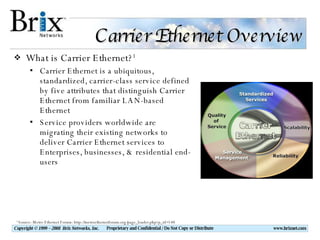
Carrier Ethernet Overview What is Carrier Ethernet? 1 Carrier Ethernet is a ubiquitous, standardized, carrier-class service defined by five attributes that distinguish Carrier Ethernet from familiar LAN-based Ethernet Service providers worldwide are migrating their existing networks to deliver Carrier Ethernet services to Enterprises, businesses, & residential end-users 1  Source: Metro Ethernet Forum: http://metroethernetforum.org/page_loader.php?p_id=140
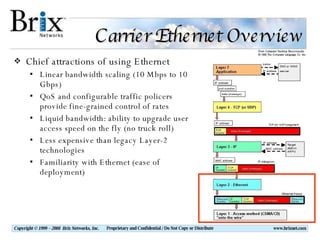
Carrier Ethernet Overview Chief attractions of using Ethernet Linear bandwidth scaling (10 Mbps to 10 Gbps) QoS and configurable traffic policers provide fine-grained control of rates Liquid bandwidth: ability to upgrade user access speed on the fly (no truck roll) Less expensive than legacy Layer-2 technologies Familiarity with Ethernet (ease of deployment)
Agenda What is Carrier Ethernet? Typical deployments and the importance of SLAs SLA measurement methodologies and standards Things to look for as you choose a Carrier Ethernet service assurance solution
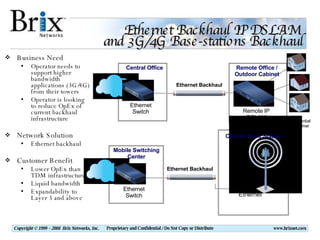
Ethernet Backhaul IP DSLAM  and 3G/4G Base-stations Backhaul Business Need Operator needs to support higher bandwidth applications (3G/4G) from their towers Operator is looking to reduce OpEx of current backhaul infrastructure Network Solution Ethernet backhaul Customer Benefit Lower OpEx than TDM infrastructure Liquid bandwidth Expandability to Layer 3 and above Central Office Ethernet Switch Mobile Switching Center Ethernet Switch Remote Office / Outdoor Cabinet Residential Customer Remote IP DSLAM Ethernet Ethernet Backhaul Ethernet Backhaul Cellular Base Station
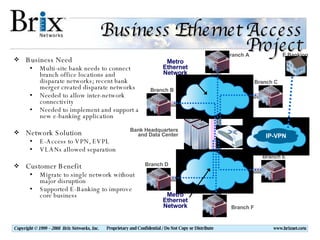
Business Ethernet Access Project Business Need Multi-site bank needs to connect branch office locations and disparate networks; recent bank merger created disparate networks Needed to allow inter-network connectivity Needed to implement and support a new e-banking application Network Solution E-Access to VPN, EVPL VLANs allowed separation  Customer Benefit Migrate to single network without major disruption Supported E-Banking to improve core business 10M 100M 100M Branch A Branch B Branch C Branch D Branch E Branch F Bank Headquarters and Data Center E Banking Metro Ethernet Network Metro Ethernet Network IP-VPN
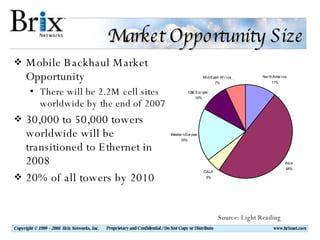
Market Opportunity Size Mobile Backhaul Market Opportunity  There will be 2.2M cell sites worldwide by the end of 2007 30,000 to 50,000 towers worldwide will be transitioned to Ethernet in 2008 20% of all towers by 2010 Source: Light Reading
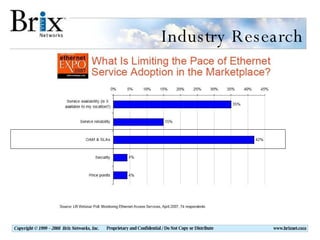
Industry Research
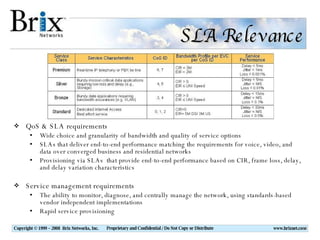
SLA Relevance QoS & SLA requirements Wide choice and granularity of bandwidth and quality of service options SLAs that deliver end-to-end performance matching the requirements for voice, video, and data over converged business and residential networks Provisioning via SLAs  that provide end-to-end performance based on CIR, frame loss, delay, and delay variation characteristics Service management requirements The ability to monitor, diagnose, and centrally manage the network, using standards-based vendor independent implementations Rapid service provisioning
Agenda What is Carrier Ethernet? Typical deployments and the importance of SLAs SLA measurement methodologies and standards Things to look for as you choose a Carrier Ethernet service assurance solution
High-Quality Carrier Ethernet Solutions Turnkey Carrier Ethernet service assurance solution Validate Ethernet install meets contract Monitor the service Troubleshoot when a problem is identified Addressing QoS, SLAs, and service management requirements Turn-up & 24x7 service monitoring On-demand and ongoing tests for validation and troubleshooting of new services Proactive monitoring through ongoing, periodic, and randomly scheduled tests Real-time reports for turn-up, diagnostics, and performance baselines Historical reports for operational monitoring, SLAs, marketing, and executives
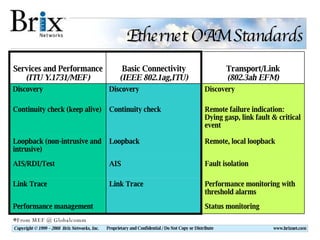
Ethernet OAM Standards From MEF @ Globalcomm Status monitoring Performance management  Performance monitoring with threshold alarms  Link Trace  Link Trace  Fault isolation AIS AIS/RDI/Test Remote, local loopback  Loopback Loopback (non-intrusive and intrusive)  Remote failure indication: Dying gasp, link fault & critical event Continuity check Continuity check (keep alive)  Discovery  Discovery Discovery  Transport/Link (802.3ah EFM) Basic Connectivity (IEEE 802.1ag,ITU) Services and Performance (ITU Y.1731/MEF)
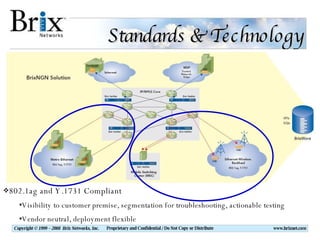
Standards & Technology 802.1ag and Y.1731 Compliant Visibility to customer premise, segmentation for troubleshooting, actionable testing Vendor neutral, deployment flexible
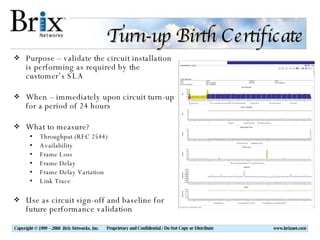
Turn-up Birth Certificate Purpose – validate the circuit installation is performing as required by the customer’s SLA When – immediately upon circuit turn-up for a period of 24 hours What to measure? Throughput (RFC 2544) Availability Frame Loss Frame Delay Frame Delay Variation Link Trace Use as circuit sign-off and baseline for future performance validation
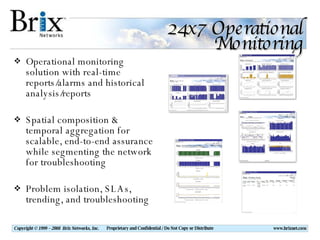
24x7 Operational Monitoring Operational monitoring solution with real-time reports/alarms and historical analysis/reports Spatial composition & temporal aggregation for scalable, end-to-end assurance while segmenting the network for troubleshooting Problem isolation, SLAs, trending, and troubleshooting
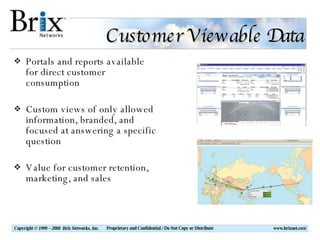
Customer Viewable Data Portals and reports available for direct customer consumption Custom views of only allowed information, branded, and focused at answering a specific question Value for customer retention, marketing, and sales
Agenda What is Carrier Ethernet? Typical deployments and the importance of SLAs SLA measurement methodologies and standards Things to look for as you choose a Carrier Ethernet service assurance solution
Things to Look For Multi-vendor Flexibility Ability to test to any NID in the network with the same ease Requirements for homogeneous solutions or proprietary protocols for results reporting Remember your own “worst case scenario” in deployments An Operational Tool Lights-out management, large scale deployments, solid references Extensibility Ability to leverage the system in other parts of the network for consistent performance results Configuration Ease-of-setup and modification of test parameters, thresholds, configurations, and devices
Things to Look For #2 Analysis, Visualization, OSS Integration Seamless integration into business processes – security, flow-through provisioning, fault management Tailored analysis and aggregation - for different audiences and applications through integration with existing OSS/BSS/MoM systems Custom presentation of data - adaptable to different services based on providers’ business needs Scale Ability to handle requirements to test to tens of thousands of network elements Quickly add new sites Generate on-demand tests to each customer on any VLAN Precision Validate network elements with a neutral third party
Conclusion Layer 2 deployments are picking up steam SLAs are critical to meeting your customer’s QoE expectations Network elements are incorporating the standards necessary to support mission-critical SLAs Systems are ready to manage those SLAs from a turn-up/validation, 24x7 monitoring, and troubleshooting perspective
Brix Networks 285 Mill Road Chelmsford, MA  01824 www.brixnet.com www.TestYourVoIP.com www.TestYourIPVideo.com www.ServiceAssuranceBlog.com

Baker Charlie

  • 1.
    March 2008 Booth717 Carrier Ethernet Service Assurance: Test. Measure. Guarantee.
  • 2.
    Agenda What isCarrier Ethernet? Typical deployments and the importance of SLAs SLA measurement methodologies and standards Things to look for as you choose a Carrier Ethernet service assurance solution
  • 3.
    Carrier Ethernet OverviewWhat is Carrier Ethernet? 1 Carrier Ethernet is a ubiquitous, standardized, carrier-class service defined by five attributes that distinguish Carrier Ethernet from familiar LAN-based Ethernet Service providers worldwide are migrating their existing networks to deliver Carrier Ethernet services to Enterprises, businesses, & residential end-users 1 Source: Metro Ethernet Forum: http://metroethernetforum.org/page_loader.php?p_id=140
  • 4.
    Carrier Ethernet OverviewChief attractions of using Ethernet Linear bandwidth scaling (10 Mbps to 10 Gbps) QoS and configurable traffic policers provide fine-grained control of rates Liquid bandwidth: ability to upgrade user access speed on the fly (no truck roll) Less expensive than legacy Layer-2 technologies Familiarity with Ethernet (ease of deployment)
  • 5.
    Agenda What isCarrier Ethernet? Typical deployments and the importance of SLAs SLA measurement methodologies and standards Things to look for as you choose a Carrier Ethernet service assurance solution
  • 6.
    Ethernet Backhaul IPDSLAM and 3G/4G Base-stations Backhaul Business Need Operator needs to support higher bandwidth applications (3G/4G) from their towers Operator is looking to reduce OpEx of current backhaul infrastructure Network Solution Ethernet backhaul Customer Benefit Lower OpEx than TDM infrastructure Liquid bandwidth Expandability to Layer 3 and above Central Office Ethernet Switch Mobile Switching Center Ethernet Switch Remote Office / Outdoor Cabinet Residential Customer Remote IP DSLAM Ethernet Ethernet Backhaul Ethernet Backhaul Cellular Base Station
  • 7.
    Business Ethernet AccessProject Business Need Multi-site bank needs to connect branch office locations and disparate networks; recent bank merger created disparate networks Needed to allow inter-network connectivity Needed to implement and support a new e-banking application Network Solution E-Access to VPN, EVPL VLANs allowed separation Customer Benefit Migrate to single network without major disruption Supported E-Banking to improve core business 10M 100M 100M Branch A Branch B Branch C Branch D Branch E Branch F Bank Headquarters and Data Center E Banking Metro Ethernet Network Metro Ethernet Network IP-VPN
  • 8.
    Market Opportunity SizeMobile Backhaul Market Opportunity There will be 2.2M cell sites worldwide by the end of 2007 30,000 to 50,000 towers worldwide will be transitioned to Ethernet in 2008 20% of all towers by 2010 Source: Light Reading
  • 9.
  • 10.
    SLA Relevance QoS& SLA requirements Wide choice and granularity of bandwidth and quality of service options SLAs that deliver end-to-end performance matching the requirements for voice, video, and data over converged business and residential networks Provisioning via SLAs that provide end-to-end performance based on CIR, frame loss, delay, and delay variation characteristics Service management requirements The ability to monitor, diagnose, and centrally manage the network, using standards-based vendor independent implementations Rapid service provisioning
  • 11.
    Agenda What isCarrier Ethernet? Typical deployments and the importance of SLAs SLA measurement methodologies and standards Things to look for as you choose a Carrier Ethernet service assurance solution
  • 12.
    High-Quality Carrier EthernetSolutions Turnkey Carrier Ethernet service assurance solution Validate Ethernet install meets contract Monitor the service Troubleshoot when a problem is identified Addressing QoS, SLAs, and service management requirements Turn-up & 24x7 service monitoring On-demand and ongoing tests for validation and troubleshooting of new services Proactive monitoring through ongoing, periodic, and randomly scheduled tests Real-time reports for turn-up, diagnostics, and performance baselines Historical reports for operational monitoring, SLAs, marketing, and executives
  • 13.
    Ethernet OAM StandardsFrom MEF @ Globalcomm Status monitoring Performance management Performance monitoring with threshold alarms Link Trace Link Trace Fault isolation AIS AIS/RDI/Test Remote, local loopback Loopback Loopback (non-intrusive and intrusive) Remote failure indication: Dying gasp, link fault & critical event Continuity check Continuity check (keep alive) Discovery Discovery Discovery Transport/Link (802.3ah EFM) Basic Connectivity (IEEE 802.1ag,ITU) Services and Performance (ITU Y.1731/MEF)
  • 14.
    Standards & Technology802.1ag and Y.1731 Compliant Visibility to customer premise, segmentation for troubleshooting, actionable testing Vendor neutral, deployment flexible
  • 15.
    Turn-up Birth CertificatePurpose – validate the circuit installation is performing as required by the customer’s SLA When – immediately upon circuit turn-up for a period of 24 hours What to measure? Throughput (RFC 2544) Availability Frame Loss Frame Delay Frame Delay Variation Link Trace Use as circuit sign-off and baseline for future performance validation
  • 16.
    24x7 Operational MonitoringOperational monitoring solution with real-time reports/alarms and historical analysis/reports Spatial composition & temporal aggregation for scalable, end-to-end assurance while segmenting the network for troubleshooting Problem isolation, SLAs, trending, and troubleshooting
  • 17.
    Customer Viewable DataPortals and reports available for direct customer consumption Custom views of only allowed information, branded, and focused at answering a specific question Value for customer retention, marketing, and sales
  • 18.
    Agenda What isCarrier Ethernet? Typical deployments and the importance of SLAs SLA measurement methodologies and standards Things to look for as you choose a Carrier Ethernet service assurance solution
  • 19.
    Things to LookFor Multi-vendor Flexibility Ability to test to any NID in the network with the same ease Requirements for homogeneous solutions or proprietary protocols for results reporting Remember your own “worst case scenario” in deployments An Operational Tool Lights-out management, large scale deployments, solid references Extensibility Ability to leverage the system in other parts of the network for consistent performance results Configuration Ease-of-setup and modification of test parameters, thresholds, configurations, and devices
  • 20.
    Things to LookFor #2 Analysis, Visualization, OSS Integration Seamless integration into business processes – security, flow-through provisioning, fault management Tailored analysis and aggregation - for different audiences and applications through integration with existing OSS/BSS/MoM systems Custom presentation of data - adaptable to different services based on providers’ business needs Scale Ability to handle requirements to test to tens of thousands of network elements Quickly add new sites Generate on-demand tests to each customer on any VLAN Precision Validate network elements with a neutral third party
  • 21.
    Conclusion Layer 2deployments are picking up steam SLAs are critical to meeting your customer’s QoE expectations Network elements are incorporating the standards necessary to support mission-critical SLAs Systems are ready to manage those SLAs from a turn-up/validation, 24x7 monitoring, and troubleshooting perspective
  • 22.
    Brix Networks 285Mill Road Chelmsford, MA 01824 www.brixnet.com www.TestYourVoIP.com www.TestYourIPVideo.com www.ServiceAssuranceBlog.com