MIPI in
Automotive
Mixel, Inc., Ashraf Takla, CEO
NXP, Thomas Wilson, Automotive Radar
Product Marketing Manager
NXP, Christian Tuschen, Automotive
Systems Engineering
Outline
•  Why MIPI in automotive
•  What is similar
•  What is different
•  Overview of information flow in auto and where MIPI is used
•  Telematics and In-Vehicle Infotainment (IVI)
•  Advanced Driver Assist Systems (ADAS)
•  Intelligent Transportation Systems (ITS)
•  Autonomous Driving Systems (ADS)
•  Safety and Reliability
•  RX+: Optimized MIPI configuration
•  Use case: NXP ADAS processor
•  Future trends
•  Q&A
2
Why MIPI in Automotive
•  What’s similar
•  Need to use high bandwidth sensors (e.g. high resolution image sensors)
•  Traditionally are closed (vendor controlled) system interfaces
•  Historically use many non-standardized specifications, both benefiting from
standards that create open competitive landscape
•  Low cost
•  High Volume
•  The “nervous system” is being connected both wired and wirelessly
•  Same capabilities are required: collection, transmission, and processing of a wide
variety of information at a wide range of speeds
•  Low power exceptionally important for mobile, and very important for automotive
•  What’s different
•  Reliability and safety are paramount for many automotive applications
•  1ppm vs. 100ppm field failure
•  Functional safety (ISO 26262)
•  Product life-cycle: tens of years, vs. a couple of years
3
Electronics in automotive
•  Vehicle Telematics
•  In-Vehicle Infotainment (IVI)
•  Advanced Driver Assist Systems (ADAS)
•  Intelligent Transportation Systems (ITS)
•  Autonomous Driving Systems (ADS)
4
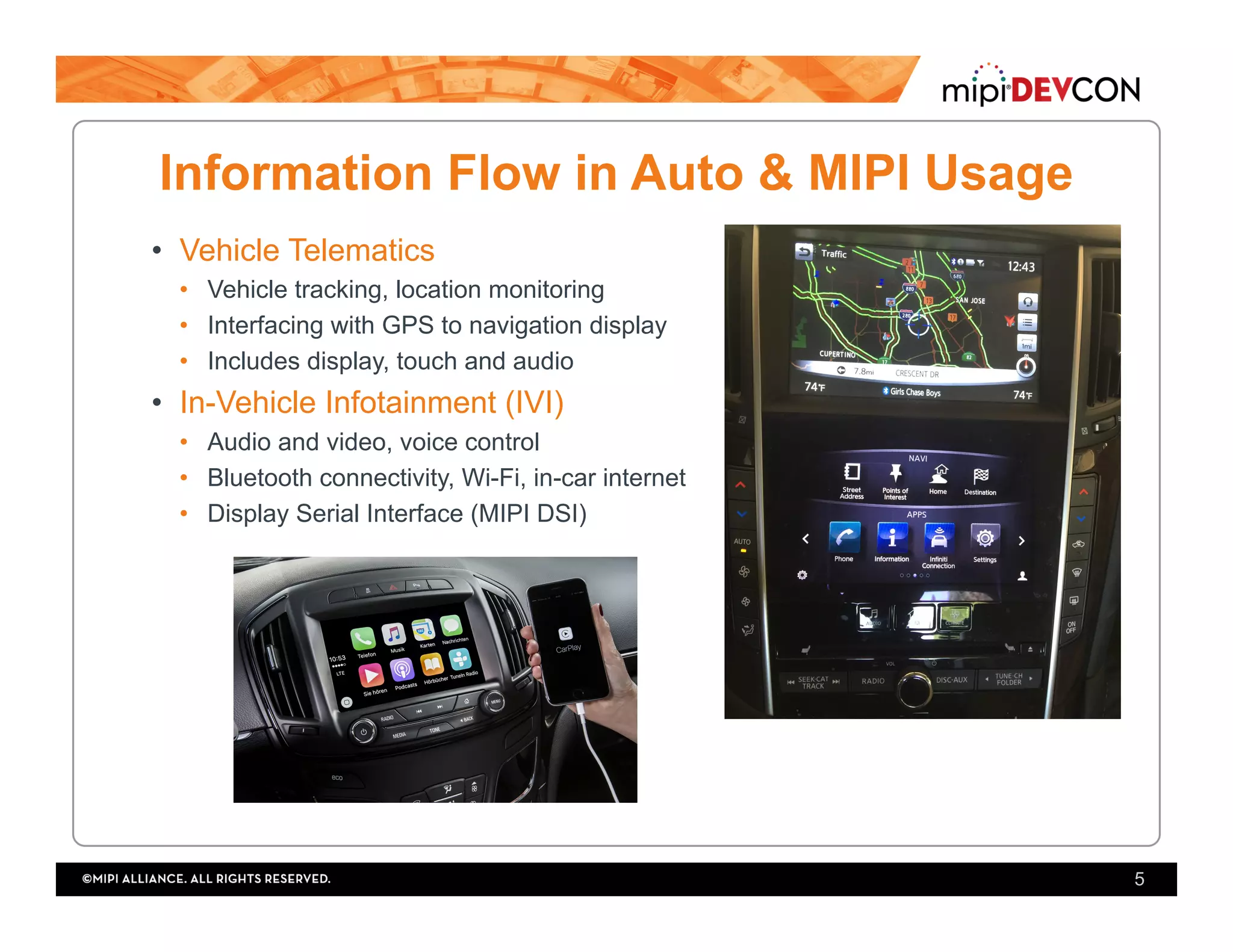
Information Flow in Auto & MIPI Usage
•  Vehicle Telematics
•  Vehicle tracking, location monitoring
•  Interfacing with GPS to navigation display
•  Includes display, touch and audio
•  In-Vehicle Infotainment (IVI)
•  Audio and video, voice control
•  Bluetooth connectivity, Wi-Fi, in-car internet
•  Display Serial Interface (MIPI DSI)
5
Information Flow in Auto & MIPI Usage
•  Advanced Driver Assistance Systems (ADAS)
•  Features
•  Collision Avoidance
•  Adaptive cruise control
•  Automatic breaking
•  Lane detection
•  Proximity detection
•  Electronics
•  Vision interfaces
•  Radar
•  Ultrasound
•  Lidar (Light Detection and Ranging)
•  Image/signal processing
•  MIPI Usage
•  Camera Serial Interface (MIPI CSI), most prevalent MIPI usage in automotive
•  MIPI DSI’s adoption is accelerating
6
Information Flow in Auto & MIPI Usage
•  Intelligent Transportation Systems (ITS)
•  Vehicle-to-everything (V2X) connections:
•  Vehicle-to-infrastructure (V2I)
•  Vehicle-to-vehicle (V2V)
•  Vehicle-to-pedestrian (V2P)
•  Vehicle-to-device (V2D)
•  Vehicle-to-Grid (V2G)
•  Connections, bridging to RF modems that support a number of different
wireless (802.11p, ac, ah, Bluetooth) and cellular (LTE, GSM) standards
•  Autonomous Driving Systems (ADS)
•  The ultimate goal
•  Happening faster than anticipated
•  The race is on
7
ADAS and the Sensor Shield
8
Surround View
Blind Spot
Detection
ParkAssist
Rear
Collision
Warning
Park Assistance/
Surround View
Surround
View
ParkAssist
Cross
Traffic
Alert
Traffic Sign
Recognition
Lane Departure
Warning
Emergency Braking
Pedestrian Detection
Collision Avoidance
Adaptive
Cruise Control
Courtesy	of	NXP
MIPI Use in Automotive
9
Courtesy	of	MIPI	Alliance
Camera-to-Processor Connection
10
Image
Sensor
MIPI
CSI-2 TX
MIPI
D-PHY
TX
Lens
MIPI
D-PHY
RX+
MIPI
CSI-2 RX
Image
Signal
Processing
Other Functional Blocks
Camera Subsystem
System-level SoC
Safety and Reliability
•  Operational reliability and robustness are of paramount importance
•  1ppm in field failure over tens of years
•  Wider range of temperature (-40C to 125C)
•  Wider range of process variation tolerance (5+ sigma)
•  Rigorous and demanding reliability standards: AEC-Q100,
IEC61508, and ISO26262 (Road Vehicles - Functional Safety)
•  AEC-Q100: different temperature Grades (Grade 1: -40 C to 125 C,
though Grade 4: 0 C to 70 C)
•  Testability & diagnostics are key to ensure continued safe operation
•  Full speed production testing
•  In-system test capability
•  RX+ configuration was developed to optimally address this challenge
11
Traditional Solution: Universal Lane
12
MIPI D-PHY LP/HS operation
13
MIPI D-PHY LP/HS operation
14
MIPI D-PHY Optimized for Automotive
•  Receiver usage is widely adopted on the chips
receiving camera data stream
•  RX+ is a D-PHY configuration that enables
•  Full-speed, full function, comprehensive
•  Production test
•  In-system test
•  Independent of external load (patent pending)
•  Supports higher data rates at lower BER
•  Lower serial interface capacitive loading
•  Small footprint
•  Eliminate multiple high-speed transmitters, area reduction: ~35 %
•  Lower inactive power
•  Leakage Power reduction: ~50 %
15
RX+: Optimized for Automotive
16
RX+ in NXP S32V234 ADAS Processor
17
NXP S32V234 features
•  High performance automotive processor
•  Supports safe computation-intensive vision and sensor
fusion applications
•  Target applications:
•  Front Camera: pedestrian detection, object detection, lane
departure warning, smart head beam control and traffic sign
recognition
•  Surround view applications where the image data can be received
in raw formats via the MIPI CSI-2
•  Smart rear view camera applications
•  Sensor fusion computing in communication with a radar MCU
•  Satisfies ISO 26262 ASIL B functional safety
requirements
18
NXP S32V234 MIPI features
•  It integrates Mixel’s RX+ D-PHY
•  Four data lanes, configurable to operate as 1, 2, 4
lanes
•  Aggregate data rate of up to 6 Gbps
•  Supports CSI-2
•  Supports full speed testing at wafer level
•  Eliminates the need for high speed ATE
19
Radar Transceiver to Radar Processor
20
Courtesy	MIPI	Alliance	
Radar	Module	
4x	Rx	
3x	Tx	
Antenna	
CSI-2 TX D-PHY
TX
D-PHY
RX+
CSI-2 RX
System Memory
and Interconnect
Radar	Processor	SOC	
Radar	Transceiver		
Analog
FE with
ADCS
NXP
Radar
Processing
Future Trends
•  Suppliers are moving to extend ADAS into ADS
•  MIPI is evolving to support automotive requirements
•  Considering longer reach channels
•  Combination of different sensor types is required for
ADS
•  Accelerating Radar use with MIPI as high-bandwidth
transceiver interconnect with Radar Signal Processor
•  Key in Autonomous Driving Systems
•  New players jumping into deployment
•  Traditional players are accelerating their adoption
•  Exciting future lies ahead for consumers as well as
many opportunities for early adopters
21
Conclusion
•  The electronic content in automotive is increasing
substantially
•  Automotive electronics providers are increasingly
adopting MIPI standards
•  The MIPI Alliance and its members are collaborating
and coordinating to maximize MIPI adoption in
Automotive
•  The transition from Advanced Driver Assistance to
Autonomous Driving is accelerating and happening
faster than expected
•  The race is on, and MIPI is in!
22
Contact
97 East Brokaw Road, Suite 250
San Jose, CA 95112
P: (408) 436-8500
F: (408) 436-8400
marketing@mixel.com
www.mixel.com
24

MIPI DevCon 2016: MIPI in Automotive

  • 1.
    MIPI in Automotive Mixel, Inc.,Ashraf Takla, CEO NXP, Thomas Wilson, Automotive Radar Product Marketing Manager NXP, Christian Tuschen, Automotive Systems Engineering
  • 2.
    Outline •  Why MIPIin automotive •  What is similar •  What is different •  Overview of information flow in auto and where MIPI is used •  Telematics and In-Vehicle Infotainment (IVI) •  Advanced Driver Assist Systems (ADAS) •  Intelligent Transportation Systems (ITS) •  Autonomous Driving Systems (ADS) •  Safety and Reliability •  RX+: Optimized MIPI configuration •  Use case: NXP ADAS processor •  Future trends •  Q&A 2
  • 3.
    Why MIPI inAutomotive •  What’s similar •  Need to use high bandwidth sensors (e.g. high resolution image sensors) •  Traditionally are closed (vendor controlled) system interfaces •  Historically use many non-standardized specifications, both benefiting from standards that create open competitive landscape •  Low cost •  High Volume •  The “nervous system” is being connected both wired and wirelessly •  Same capabilities are required: collection, transmission, and processing of a wide variety of information at a wide range of speeds •  Low power exceptionally important for mobile, and very important for automotive •  What’s different •  Reliability and safety are paramount for many automotive applications •  1ppm vs. 100ppm field failure •  Functional safety (ISO 26262) •  Product life-cycle: tens of years, vs. a couple of years 3
  • 4.
    Electronics in automotive • Vehicle Telematics •  In-Vehicle Infotainment (IVI) •  Advanced Driver Assist Systems (ADAS) •  Intelligent Transportation Systems (ITS) •  Autonomous Driving Systems (ADS) 4
  • 5.
    Information Flow inAuto & MIPI Usage •  Vehicle Telematics •  Vehicle tracking, location monitoring •  Interfacing with GPS to navigation display •  Includes display, touch and audio •  In-Vehicle Infotainment (IVI) •  Audio and video, voice control •  Bluetooth connectivity, Wi-Fi, in-car internet •  Display Serial Interface (MIPI DSI) 5
  • 6.
    Information Flow inAuto & MIPI Usage •  Advanced Driver Assistance Systems (ADAS) •  Features •  Collision Avoidance •  Adaptive cruise control •  Automatic breaking •  Lane detection •  Proximity detection •  Electronics •  Vision interfaces •  Radar •  Ultrasound •  Lidar (Light Detection and Ranging) •  Image/signal processing •  MIPI Usage •  Camera Serial Interface (MIPI CSI), most prevalent MIPI usage in automotive •  MIPI DSI’s adoption is accelerating 6
  • 7.
    Information Flow inAuto & MIPI Usage •  Intelligent Transportation Systems (ITS) •  Vehicle-to-everything (V2X) connections: •  Vehicle-to-infrastructure (V2I) •  Vehicle-to-vehicle (V2V) •  Vehicle-to-pedestrian (V2P) •  Vehicle-to-device (V2D) •  Vehicle-to-Grid (V2G) •  Connections, bridging to RF modems that support a number of different wireless (802.11p, ac, ah, Bluetooth) and cellular (LTE, GSM) standards •  Autonomous Driving Systems (ADS) •  The ultimate goal •  Happening faster than anticipated •  The race is on 7
  • 8.
    ADAS and theSensor Shield 8 Surround View Blind Spot Detection ParkAssist Rear Collision Warning Park Assistance/ Surround View Surround View ParkAssist Cross Traffic Alert Traffic Sign Recognition Lane Departure Warning Emergency Braking Pedestrian Detection Collision Avoidance Adaptive Cruise Control Courtesy of NXP
  • 9.
    MIPI Use inAutomotive 9 Courtesy of MIPI Alliance
  • 10.
    Camera-to-Processor Connection 10 Image Sensor MIPI CSI-2 TX MIPI D-PHY TX Lens MIPI D-PHY RX+ MIPI CSI-2RX Image Signal Processing Other Functional Blocks Camera Subsystem System-level SoC
  • 11.
    Safety and Reliability • Operational reliability and robustness are of paramount importance •  1ppm in field failure over tens of years •  Wider range of temperature (-40C to 125C) •  Wider range of process variation tolerance (5+ sigma) •  Rigorous and demanding reliability standards: AEC-Q100, IEC61508, and ISO26262 (Road Vehicles - Functional Safety) •  AEC-Q100: different temperature Grades (Grade 1: -40 C to 125 C, though Grade 4: 0 C to 70 C) •  Testability & diagnostics are key to ensure continued safe operation •  Full speed production testing •  In-system test capability •  RX+ configuration was developed to optimally address this challenge 11
  • 12.
  • 13.
    MIPI D-PHY LP/HSoperation 13
  • 14.
    MIPI D-PHY LP/HSoperation 14
  • 15.
    MIPI D-PHY Optimizedfor Automotive •  Receiver usage is widely adopted on the chips receiving camera data stream •  RX+ is a D-PHY configuration that enables •  Full-speed, full function, comprehensive •  Production test •  In-system test •  Independent of external load (patent pending) •  Supports higher data rates at lower BER •  Lower serial interface capacitive loading •  Small footprint •  Eliminate multiple high-speed transmitters, area reduction: ~35 % •  Lower inactive power •  Leakage Power reduction: ~50 % 15
  • 16.
    RX+: Optimized forAutomotive 16
  • 17.
    RX+ in NXPS32V234 ADAS Processor 17
  • 18.
    NXP S32V234 features • High performance automotive processor •  Supports safe computation-intensive vision and sensor fusion applications •  Target applications: •  Front Camera: pedestrian detection, object detection, lane departure warning, smart head beam control and traffic sign recognition •  Surround view applications where the image data can be received in raw formats via the MIPI CSI-2 •  Smart rear view camera applications •  Sensor fusion computing in communication with a radar MCU •  Satisfies ISO 26262 ASIL B functional safety requirements 18
  • 19.
    NXP S32V234 MIPIfeatures •  It integrates Mixel’s RX+ D-PHY •  Four data lanes, configurable to operate as 1, 2, 4 lanes •  Aggregate data rate of up to 6 Gbps •  Supports CSI-2 •  Supports full speed testing at wafer level •  Eliminates the need for high speed ATE 19
  • 20.
    Radar Transceiver toRadar Processor 20 Courtesy MIPI Alliance Radar Module 4x Rx 3x Tx Antenna CSI-2 TX D-PHY TX D-PHY RX+ CSI-2 RX System Memory and Interconnect Radar Processor SOC Radar Transceiver Analog FE with ADCS NXP Radar Processing
  • 21.
    Future Trends •  Suppliersare moving to extend ADAS into ADS •  MIPI is evolving to support automotive requirements •  Considering longer reach channels •  Combination of different sensor types is required for ADS •  Accelerating Radar use with MIPI as high-bandwidth transceiver interconnect with Radar Signal Processor •  Key in Autonomous Driving Systems •  New players jumping into deployment •  Traditional players are accelerating their adoption •  Exciting future lies ahead for consumers as well as many opportunities for early adopters 21
  • 22.
    Conclusion •  The electroniccontent in automotive is increasing substantially •  Automotive electronics providers are increasingly adopting MIPI standards •  The MIPI Alliance and its members are collaborating and coordinating to maximize MIPI adoption in Automotive •  The transition from Advanced Driver Assistance to Autonomous Driving is accelerating and happening faster than expected •  The race is on, and MIPI is in! 22
  • 23.
    Contact 97 East BrokawRoad, Suite 250 San Jose, CA 95112 P: (408) 436-8500 F: (408) 436-8400 marketing@mixel.com www.mixel.com 24