Minimum
Spanning Tree
Using
Kruskal’s Algorithm
Name: Mrunal Patil
Year: First Year MCA
Design & Analysis
of Algorithm
Greedy Technique
Algorithm Design
Technique :
Problem : Kruskal’s Algorithm
 Greedy Method
• It is very straight forward algorithm design technique.
• A problem have ‘n’ inputs and we have to obtain subset of inputs that satisfies
some constraint.
• We need to find the feasible solution that either maximizes or minimizes
given objective function.
• A feasible solution, that optimize the solution is called optimal solution.
 Spanning Tree
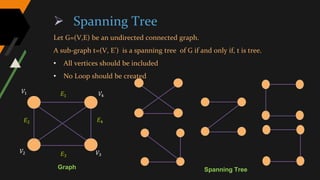
Let G=(V,E) be an undirected connected graph.
A sub-graph t=(V, E’) is a spanning tree of G if and only if, t is tree.
• All vertices should be included
• No Loop should be created
𝑉1
𝑉2 𝑉3
𝑉4
𝐸1
𝐸2 𝐸4
𝐸3
Spanning Tree
Graph
 Minimum Cost Spanning Tree
• A minimum cost spanning tree is special kind of tree that minimizes
length of the tree.
• The cost of the spanning tree is the sum of the weights of all
the edges in the tree.
• Minimum spanning tree is the spanning tree where the cost is
minimum among all the spanning trees.
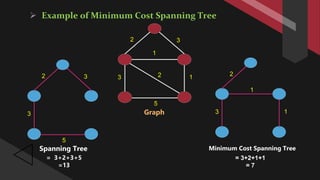
2 3
3
5
2 3
3 1
2
1
5
2
3 1
1
Graph
Minimum Cost Spanning Tree
Spanning Tree
 Example of Minimum Cost Spanning Tree
= 3+2+3+5
=13
= 3+2+1+1
= 7
Kruskal’s Algorithms
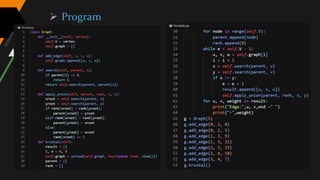
Kruskal's algorithm is used to find the minimum spanning tree for a
connected weighted graph.
Kruskal's algorithm follows greedy approach which finds an optimum solution at
every stage instead of focusing on a global optimum.
 Algorithm
 Program
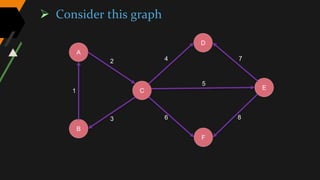
A
B
E
F
D
C
1
3
2
5
4
6
7
8
 Consider this graph
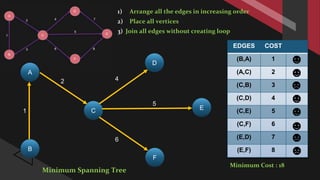
3) Join all edges without creating loop
A
B
E
F
D
C
1
2
5
4
6
EDGES COST
(B,A) 1
(A,C) 2
(C,B) 3
(C,D) 4
(C,E) 5
(C,F) 6
(E,D) 7
(E,F) 8
1) Arrange all the edges in increasing order
2) Place all vertices
Minimum Spanning Tree
Minimum Cost : 18
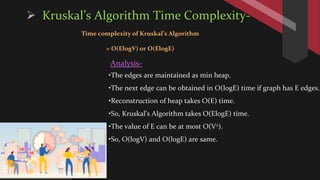
Time complexity of Kruskal’s Algorithm
= O(ElogV) or O(ElogE)
Analysis-
•The edges are maintained as min heap.
•The next edge can be obtained in O(logE) time if graph has E edges.
•Reconstruction of heap takes O(E) time.
•So, Kruskal’s Algorithm takes O(ElogE) time.
•The value of E can be at most O(V2).
•So, O(logV) and O(logE) are same.
 Kruskal’s Algorithm Time Complexity-
Thank You

Minimum Spanning Tree using Kruskal's Algorithm

  • 1.
  • 2.
    Name: Mrunal Patil Year:First Year MCA Design & Analysis of Algorithm Greedy Technique Algorithm Design Technique : Problem : Kruskal’s Algorithm
  • 3.
     Greedy Method •It is very straight forward algorithm design technique. • A problem have ‘n’ inputs and we have to obtain subset of inputs that satisfies some constraint. • We need to find the feasible solution that either maximizes or minimizes given objective function. • A feasible solution, that optimize the solution is called optimal solution.
  • 4.
     Spanning Tree LetG=(V,E) be an undirected connected graph. A sub-graph t=(V, E’) is a spanning tree of G if and only if, t is tree. • All vertices should be included • No Loop should be created 𝑉1 𝑉2 𝑉3 𝑉4 𝐸1 𝐸2 𝐸4 𝐸3 Spanning Tree Graph
  • 5.
     Minimum CostSpanning Tree • A minimum cost spanning tree is special kind of tree that minimizes length of the tree. • The cost of the spanning tree is the sum of the weights of all the edges in the tree. • Minimum spanning tree is the spanning tree where the cost is minimum among all the spanning trees.
  • 6.
    2 3 3 5 2 3 31 2 1 5 2 3 1 1 Graph Minimum Cost Spanning Tree Spanning Tree  Example of Minimum Cost Spanning Tree = 3+2+3+5 =13 = 3+2+1+1 = 7
  • 7.
    Kruskal’s Algorithms Kruskal's algorithmis used to find the minimum spanning tree for a connected weighted graph. Kruskal's algorithm follows greedy approach which finds an optimum solution at every stage instead of focusing on a global optimum.
  • 8.
  • 9.
  • 10.
  • 11.
    3) Join alledges without creating loop A B E F D C 1 2 5 4 6 EDGES COST (B,A) 1 (A,C) 2 (C,B) 3 (C,D) 4 (C,E) 5 (C,F) 6 (E,D) 7 (E,F) 8 1) Arrange all the edges in increasing order 2) Place all vertices Minimum Spanning Tree Minimum Cost : 18
  • 12.
    Time complexity ofKruskal’s Algorithm = O(ElogV) or O(ElogE) Analysis- •The edges are maintained as min heap. •The next edge can be obtained in O(logE) time if graph has E edges. •Reconstruction of heap takes O(E) time. •So, Kruskal’s Algorithm takes O(ElogE) time. •The value of E can be at most O(V2). •So, O(logV) and O(logE) are same.  Kruskal’s Algorithm Time Complexity-
  • 13.