Graphs
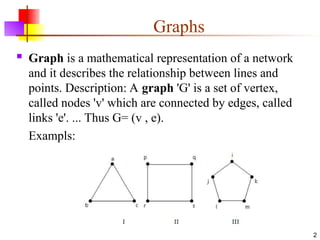
Graph isa mathematical representation of a network
and it describes the relationship between lines and
points. Description: A graph 'G' is a set of vertex,
called nodes 'v' which are connected by edges, called
links 'e'. ... Thus G= (v , e).
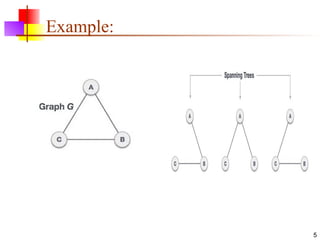
Exampls:
2
Spanning Tree
Supposeyou have a connected undirected graph
Connected: Every note is reachable from every other node.
Undirected: Edges do not have an associated direction
A spanning tree is a subset of Graph G, which
has all the vertices covered with minimum possible number of
edges. Hence, a spanning tree does not have cycles and it
cannot be disconnected.. By this definition, we can draw a
conclusion that every connected and undirected Graph G has
at least one spanning tree.
4
General Properties ofSpanning Tree
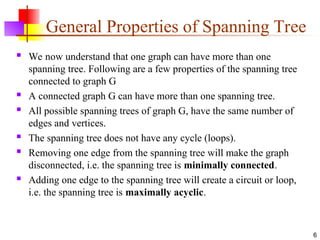
We now understand that one graph can have more than one
spanning tree. Following are a few properties of the spanning tree
connected to graph G
A connected graph G can have more than one spanning tree.
All possible spanning trees of graph G, have the same number of
edges and vertices.
The spanning tree does not have any cycle (loops).
Removing one edge from the spanning tree will make the graph
disconnected, i.e. the spanning tree is minimally connected.
Adding one edge to the spanning tree will create a circuit or loop,
i.e. the spanning tree is maximally acyclic.
6
7.
Mathematical Properties ofSpanning Tree
Spanning tree has n-1 edges, where n is the number of
nodes (vertices).
From a complete graph, by removing maximum
e - n + 1 edges, we can construct a spanning tree.
A complete graph can have maximum nn-2
number of
spanning trees.
Thus, we can conclude that spanning trees are a subset
of connected Graph G and disconnected graphs do not
have spanning tree.
7
8.
Finding Spanning Trees
There are two basic algorithms for finding minimum-
cost spanning trees, and both are greedy algorithms
Kruskal’s Algorithm
Created in 1957 by Joseph Kruskal
Prim's Algorithm
Created by Robert C. Prim
8
9.
Minimum Spanning Tree(MST)
In a weighted graph, a minimum spanning tree is a
spanning tree that has minimum weight than all other
spanning trees of the same graph. In real-world situations,
this weight can be measured as distance, congestion,
traffic load or any arbitrary value denoted to the edges.
Minimum Spanning-Tree Algorithm
We shall learn about two most important spanning
tree algorithms here
Kruskal's Algorithm
Prim's Algorithm
9
10.
Kruskal's Spanning TreeAlgorithm
Kruskal's algorithm to find the minimum cost spanning
tree uses the greedy approach. This algorithm treats the
graph as a forest and every node it has as an individual
tree. A tree connects to another only and only if, it has
the least cost among all available options and does not
violate MST properties.
10
11.
Example
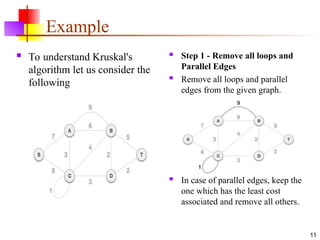
To understandKruskal's
algorithm let us consider the
following
Step 1 - Remove all loops and
Parallel Edges
Remove all loops and parallel
edges from the given graph.
In case of parallel edges, keep the
one which has the least cost
associated and remove all others.
11
12.
.
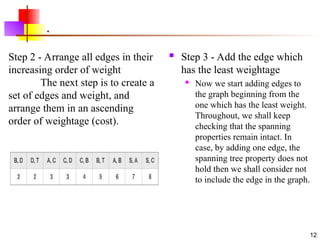
Step 3- Add the edge which
has the least weightage
Now we start adding edges to
the graph beginning from the
one which has the least weight.
Throughout, we shall keep
checking that the spanning
properties remain intact. In
case, by adding one edge, the
spanning tree property does not
hold then we shall consider not
to include the edge in the graph.
12
Step 2 - Arrange all edges in their
increasing order of weight
The next step is to create a
set of edges and weight, and
arrange them in an ascending
order of weightage (cost).
13.
.
13
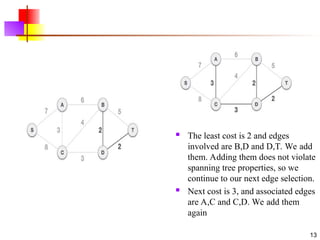
The leastcost is 2 and edges
involved are B,D and D,T. We add
them. Adding them does not violate
spanning tree properties, so we
continue to our next edge selection.
Next cost is 3, and associated edges
are A,C and C,D. We add them
again
14.
.
14
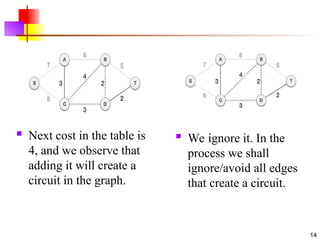
Next costin the table is
4, and we observe that
adding it will create a
circuit in the graph.
We ignore it. In the
process we shall
ignore/avoid all edges
that create a circuit.
15.
.
15
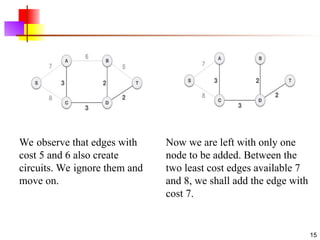
We observe thatedges with
cost 5 and 6 also create
circuits. We ignore them and
move on.
Now we are left with only one
node to be added. Between the
two least cost edges available 7
and 8, we shall add the edge with
cost 7.
16.
.
16
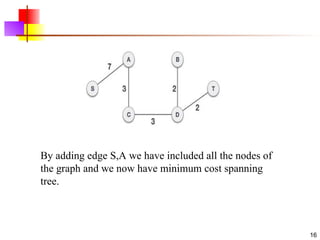
By adding edgeS,A we have included all the nodes of
the graph and we now have minimum cost spanning
tree.
17.
Prim's Spanning TreeAlgorithm
Prim's algorithm to find minimum cost spanning tree (as
Kruskal's algorithm) uses the greedy approach. Prim's
algorithm shares a similarity with the shortest path
first algorithms.
Prim's algorithm, in contrast with Kruskal's algorithm,
treats the nodes as a single tree and keeps on adding
new nodes to the spanning tree from the given graph.
17
18.
18
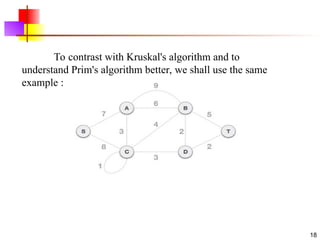
To contrast withKruskal's algorithm and to
understand Prim's algorithm better, we shall use the same
example :
19.
.
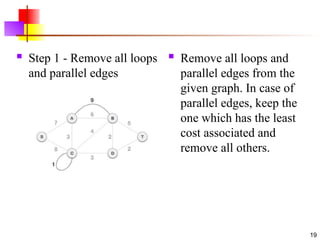
Step 1- Remove all loops
and parallel edges
19
Remove all loops and
parallel edges from the
given graph. In case of
parallel edges, keep the
one which has the least
cost associated and
remove all others.
20.
.
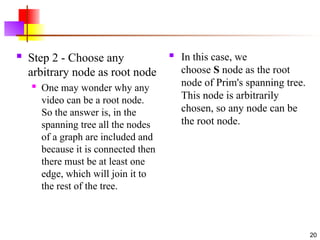
Step 2- Choose any
arbitrary node as root node
One may wonder why any
video can be a root node.
So the answer is, in the
spanning tree all the nodes
of a graph are included and
because it is connected then
there must be at least one
edge, which will join it to
the rest of the tree.
In this case, we
choose S node as the root
node of Prim's spanning tree.
This node is arbitrarily
chosen, so any node can be
the root node.
20
21.
.
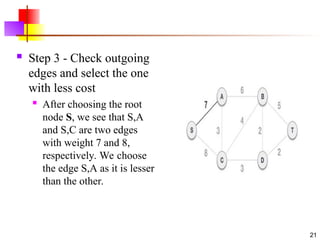
Step 3- Check outgoing
edges and select the one
with less cost
After choosing the root
node S, we see that S,A
and S,C are two edges
with weight 7 and 8,
respectively. We choose
the edge S,A as it is lesser
than the other.
.
21
22.
.
22
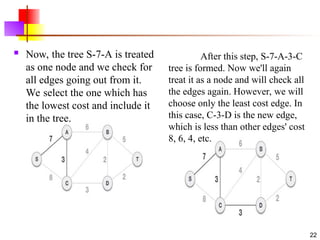
Now, thetree S-7-A is treated
as one node and we check for
all edges going out from it.
We select the one which has
the lowest cost and include it
in the tree.
After this step, S-7-A-3-C
tree is formed. Now we'll again
treat it as a node and will check all
the edges again. However, we will
choose only the least cost edge. In
this case, C-3-D is the new edge,
which is less than other edges' cost
8, 6, 4, etc.
23.
.
23
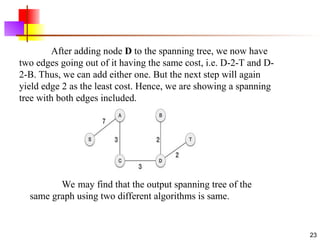
After adding nodeD to the spanning tree, we now have
two edges going out of it having the same cost, i.e. D-2-T and D-
2-B. Thus, we can add either one. But the next step will again
yield edge 2 as the least cost. Hence, we are showing a spanning
tree with both edges included.
We may find that the output spanning tree of the
same graph using two different algorithms is same.
24.
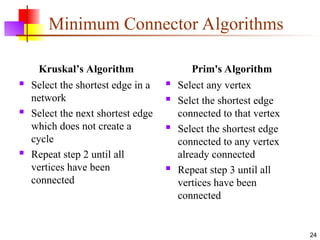
Minimum Connector Algorithms
Kruskal’sAlgorithm
Select the shortest edge in a
network
Select the next shortest edge
which does not create a
cycle
Repeat step 2 until all
vertices have been
connected
Prim's Algorithm
Select any vertex
Selct the shortest edge
connected to that vertex
Select the shortest edge
connected to any vertex
already connected
Repeat step 3 until all
vertices have been
connected
24