MINIMAL INVASIVE SURGERY
Prepared by: Suprvisor:
Dareevan Mahdi Dr. Sardar Hasan
University of Duhok
College of Medicine
OBJECTIVES
• Definition.
• Principle of laparoscopic surgery.
• Types of minimal invasive surgery.
• Advantages and disadvantages.
• Preoperative evaluation.
• Contraindications.
• Operative problems.
• Post operative care.
• Surgical principles.
• Robotic surgery.
DEFENITION:
• Minimal access surgery is a product of modern
technology and surgical innovation that aims to
accomplish surgical therapeutic goals with minimal
somatic and psychological trauma.
• This type of surgery has reduced wound access
trauma, as well as being less disfiguring than
conventional techniques.
• It can offer cost-effectiveness to both health services
and employers by shortening operating times,
shortening hospital stays, improving operative
precision compared to open surgery in some (but not
all) cases and allowing faster recuperation.
PRINCIPLES OF MINIMAL ACCESS
SURGERY
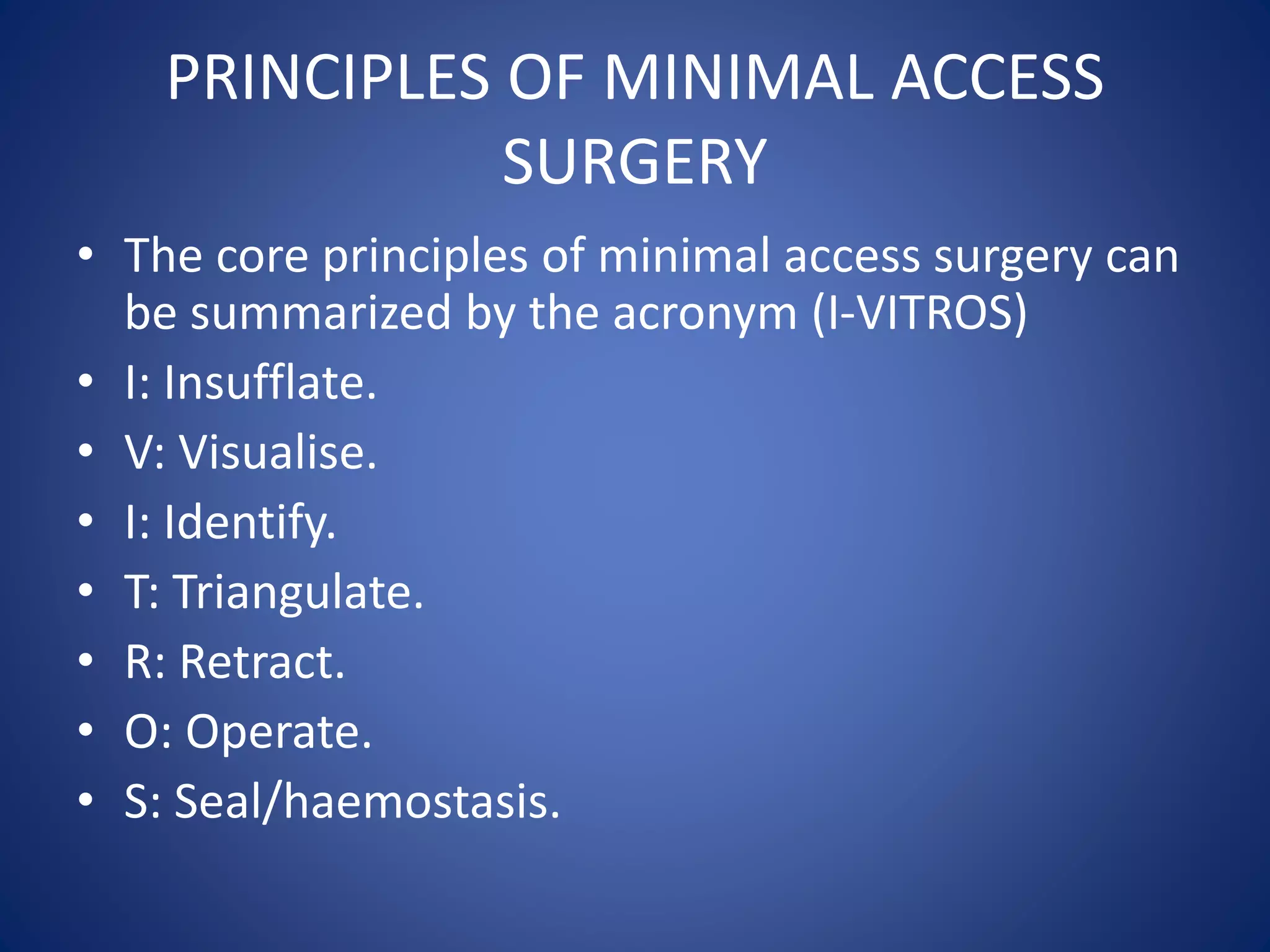
• The core principles of minimal access surgery can
be summarized by the acronym (I-VITROS)
• I: Insufflate.
• V: Visualise.
• I: Identify.
• T: Triangulate.
• R: Retract.
• O: Operate.
• S: Seal/haemostasis.
Types of Minimal
Invasive Surgery
• Minimal access techniques can be categorised as
follows:
• Laparoscopy.
• Thoracoscopy.
• Endoluminal endoscopy.
• Perivisceral endoscopy.
• Arthroscopy.
• Combined approach.
• NOTES.
Advantages of minimal access surgery
• Decrease in wound size.
• Reduction in wound infection , dehiscence ,
bleeding, herniation and nerve entrapment.
• Decrease in wound pain.
• Improved mobility.
• Decreased wound trauma.
• Decreased heat loss.
• Improved visualization.
Disadvantages of minimal access
surgery
• Reliance on remote vision and operating.
• Loss of tactile feedback.
• Dependence on hand eye coordination.
• Difficulty with haemostasis.
• Reliance on new techniques.
• Extraction of large specimens.
Preoperative Evaluation
• Preparation of the patient and careful
preoperative management is essential to
minimize the morbidity.
• History.
• Examination.
• Prophylaxis against thromboembolism.
• Urinary catheter and nasogastric tube.
• Informed consent.
Contraindications-relative
• Previous abdominal surgeries.
• Morbid Obesity.
• Peritonitis.
• Bleeding disorders.
• Compromised cardiac status.
• 3rd trimester pregnancy.
• Portal hypertention.
Operative Problems
• Intraoperative perforation of a viscus.
• Bleeding:
• 1-bleeding from a major vesssel.
• 2-bleeding from organs encountred during
surgery.
• 3-bleeding from trocar site.
• Blood clots.
• Septecemia and infection.
Post Operative Complications
• Dull upper abdominal pain.
• Nausea.
• Shoulder tip pain.
Post Operative Care
• Analgesia.
• Oral fluids.
• Oral feeding.
• Urinary catheter.
• Drains.
Discharge From The Hospital
• patient discharge is based on clinical indicators .
• One of the core drivers for the application of minimally
invasive surgery is an earlier recovery and therefore
discharge from hospital. For the common laparoscopic
procedure , most surgeons discharge a significant
proportion of their laparoscopic patients on the day of
surgery, but some are kept in overnight and discharged the
following morning.
• Patients should not be discharged until they are seen to be
comfortable, have passed urine and are eating and drinking
satisfactorily.
• They should be told that if they develop abdominal pain or
other severe symptoms they should return to the hospital.
• Patient can get out of bed as soon as they
have recovered from the anaesthetic and they
should be encouraged to do so.
• Such movements are remarkably pain free
when compared with the mobility achieved
after an open operation.
• Similarly, patients can cough actively and clear
bronchial secretions, and this helps to
diminish the incidence of chest infections.
Surgical Principles
• Meticulous care in the creation of a
pneumoperitoneum.
• Controlled dissection of adhesions.
• Adequate exposure of operative field.
• Avoidance and control of bleeding.
• Avoidance of organ injury.
• Avoidance of diathermy damage.
• Vigilance in the postoperative period.
Basic Laparoscopic Instruments
• Laparoscope.
• Light source and fiberoptics.
• Trocars.
• Devices for dissection and grasping.
• Devices for haemostasis.
• Surgical staplers.
• Tissue removal devices.
Creating A Pneumoperitoneum
• There are two method for creation of
pneumopertoneum:
• 1-closed method.
• 2-open method ( modifeid Hasson approach).
• In some cases combination approach maybe
employed.
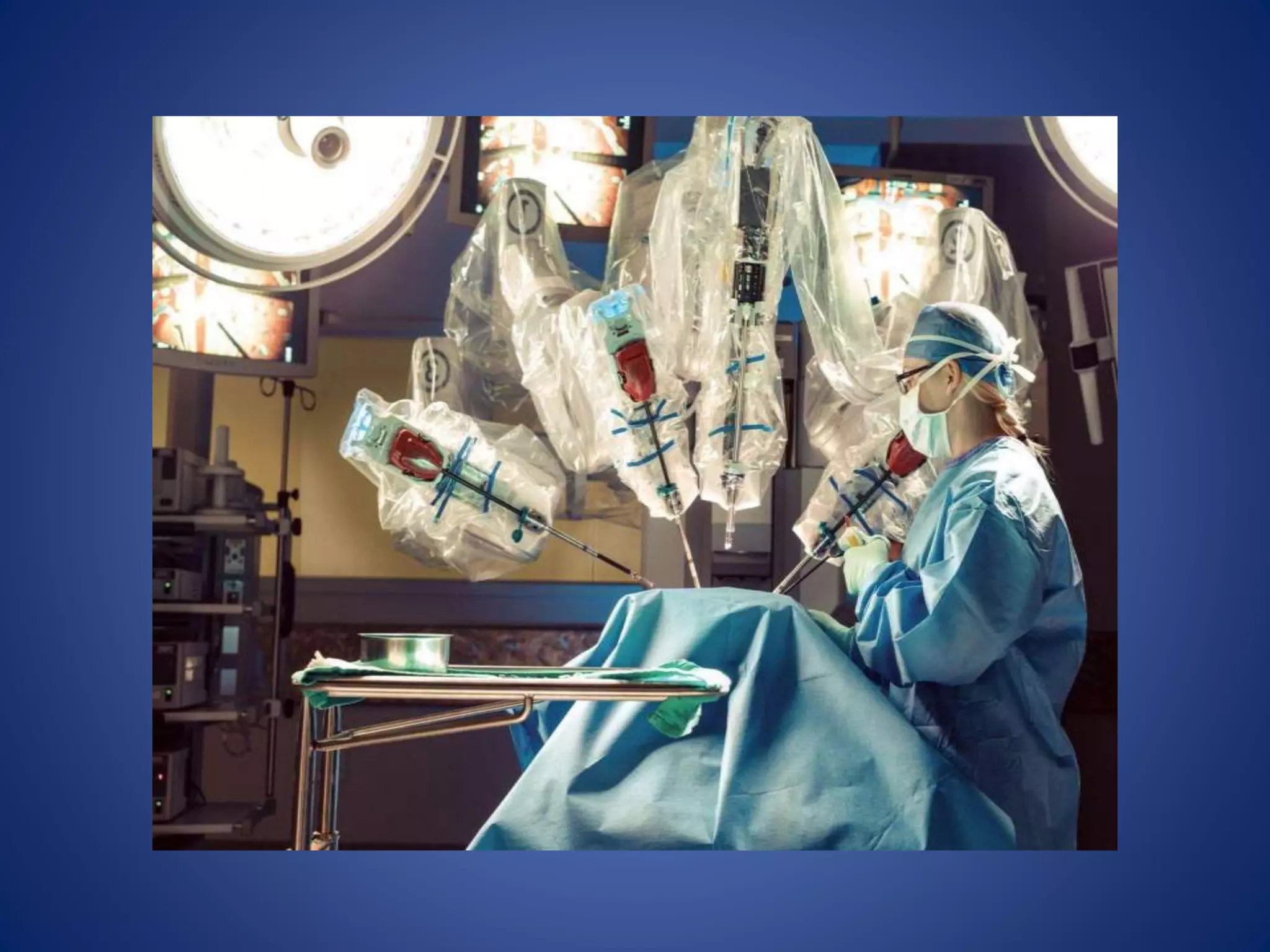
Robotic surgery
• Computer enhanced surgical devices.
• Steadier image.
• Fewer members.
• Teleoperated system.
• Image guided system.
References
Schwartz Principles of surgery. 10th ed.
Bailey and loves. Short practice of surgery. 27th
ed.
SRBS manual of surgery. 4th ed.
• Thank you

Minimal invasive surgery

  • 1.
    MINIMAL INVASIVE SURGERY Preparedby: Suprvisor: Dareevan Mahdi Dr. Sardar Hasan University of Duhok College of Medicine
  • 2.
    OBJECTIVES • Definition. • Principleof laparoscopic surgery. • Types of minimal invasive surgery. • Advantages and disadvantages. • Preoperative evaluation. • Contraindications. • Operative problems. • Post operative care. • Surgical principles. • Robotic surgery.
  • 3.
    DEFENITION: • Minimal accesssurgery is a product of modern technology and surgical innovation that aims to accomplish surgical therapeutic goals with minimal somatic and psychological trauma. • This type of surgery has reduced wound access trauma, as well as being less disfiguring than conventional techniques. • It can offer cost-effectiveness to both health services and employers by shortening operating times, shortening hospital stays, improving operative precision compared to open surgery in some (but not all) cases and allowing faster recuperation.
  • 4.
    PRINCIPLES OF MINIMALACCESS SURGERY • The core principles of minimal access surgery can be summarized by the acronym (I-VITROS) • I: Insufflate. • V: Visualise. • I: Identify. • T: Triangulate. • R: Retract. • O: Operate. • S: Seal/haemostasis.
  • 6.
    Types of Minimal InvasiveSurgery • Minimal access techniques can be categorised as follows: • Laparoscopy. • Thoracoscopy. • Endoluminal endoscopy. • Perivisceral endoscopy. • Arthroscopy. • Combined approach. • NOTES.
  • 7.
    Advantages of minimalaccess surgery • Decrease in wound size. • Reduction in wound infection , dehiscence , bleeding, herniation and nerve entrapment. • Decrease in wound pain. • Improved mobility. • Decreased wound trauma. • Decreased heat loss. • Improved visualization.
  • 8.
    Disadvantages of minimalaccess surgery • Reliance on remote vision and operating. • Loss of tactile feedback. • Dependence on hand eye coordination. • Difficulty with haemostasis. • Reliance on new techniques. • Extraction of large specimens.
  • 9.
    Preoperative Evaluation • Preparationof the patient and careful preoperative management is essential to minimize the morbidity. • History. • Examination. • Prophylaxis against thromboembolism. • Urinary catheter and nasogastric tube. • Informed consent.
  • 12.
    Contraindications-relative • Previous abdominalsurgeries. • Morbid Obesity. • Peritonitis. • Bleeding disorders. • Compromised cardiac status. • 3rd trimester pregnancy. • Portal hypertention.
  • 13.
    Operative Problems • Intraoperativeperforation of a viscus. • Bleeding: • 1-bleeding from a major vesssel. • 2-bleeding from organs encountred during surgery. • 3-bleeding from trocar site. • Blood clots. • Septecemia and infection.
  • 14.
    Post Operative Complications •Dull upper abdominal pain. • Nausea. • Shoulder tip pain.
  • 15.
    Post Operative Care •Analgesia. • Oral fluids. • Oral feeding. • Urinary catheter. • Drains.
  • 16.
    Discharge From TheHospital • patient discharge is based on clinical indicators . • One of the core drivers for the application of minimally invasive surgery is an earlier recovery and therefore discharge from hospital. For the common laparoscopic procedure , most surgeons discharge a significant proportion of their laparoscopic patients on the day of surgery, but some are kept in overnight and discharged the following morning. • Patients should not be discharged until they are seen to be comfortable, have passed urine and are eating and drinking satisfactorily. • They should be told that if they develop abdominal pain or other severe symptoms they should return to the hospital.
  • 17.
    • Patient canget out of bed as soon as they have recovered from the anaesthetic and they should be encouraged to do so. • Such movements are remarkably pain free when compared with the mobility achieved after an open operation. • Similarly, patients can cough actively and clear bronchial secretions, and this helps to diminish the incidence of chest infections.
  • 18.
    Surgical Principles • Meticulouscare in the creation of a pneumoperitoneum. • Controlled dissection of adhesions. • Adequate exposure of operative field. • Avoidance and control of bleeding. • Avoidance of organ injury. • Avoidance of diathermy damage. • Vigilance in the postoperative period.
  • 19.
    Basic Laparoscopic Instruments •Laparoscope. • Light source and fiberoptics. • Trocars. • Devices for dissection and grasping. • Devices for haemostasis. • Surgical staplers. • Tissue removal devices.
  • 27.
    Creating A Pneumoperitoneum •There are two method for creation of pneumopertoneum: • 1-closed method. • 2-open method ( modifeid Hasson approach). • In some cases combination approach maybe employed.
  • 30.
    Robotic surgery • Computerenhanced surgical devices. • Steadier image. • Fewer members. • Teleoperated system. • Image guided system.
  • 34.
    References Schwartz Principles ofsurgery. 10th ed. Bailey and loves. Short practice of surgery. 27th ed. SRBS manual of surgery. 4th ed.
  • 35.