SURGICAL DRESSINGS
Part- I
13/08/2021
Dr. Ankita Singh
Assistant Professor
ACMS, Delhi Cantt
Learning Objective
What is surgical dressing?
History
Ideal wound dressing
How to select appropriate surgical dressing?
Types/classification
Commonly used dressings
Modern/miscellaneous dressings
What is surgical dressing?
Surgical dressing:
sterile pad or compress applied to a
wound to promote healing and prevent further
harm
Bandage:
piece of material used either to support a
medical device such as a dressing or splint
History
Material like fabric, leaves, cobweb, dung etc.
Ancient Eqyptians (1500BC)- honey
Hippocrates (460BC)- vinegar & fig leaves
Roman physicians (100)- spices like saffron,
thyme, mint; silver & lead (antiseptic) but
were lost to Dark Ages
History..
Joseph Lister (1860s)-
Introduced antiseptic dressings (carbolic acid)
Decreased mortality
History..
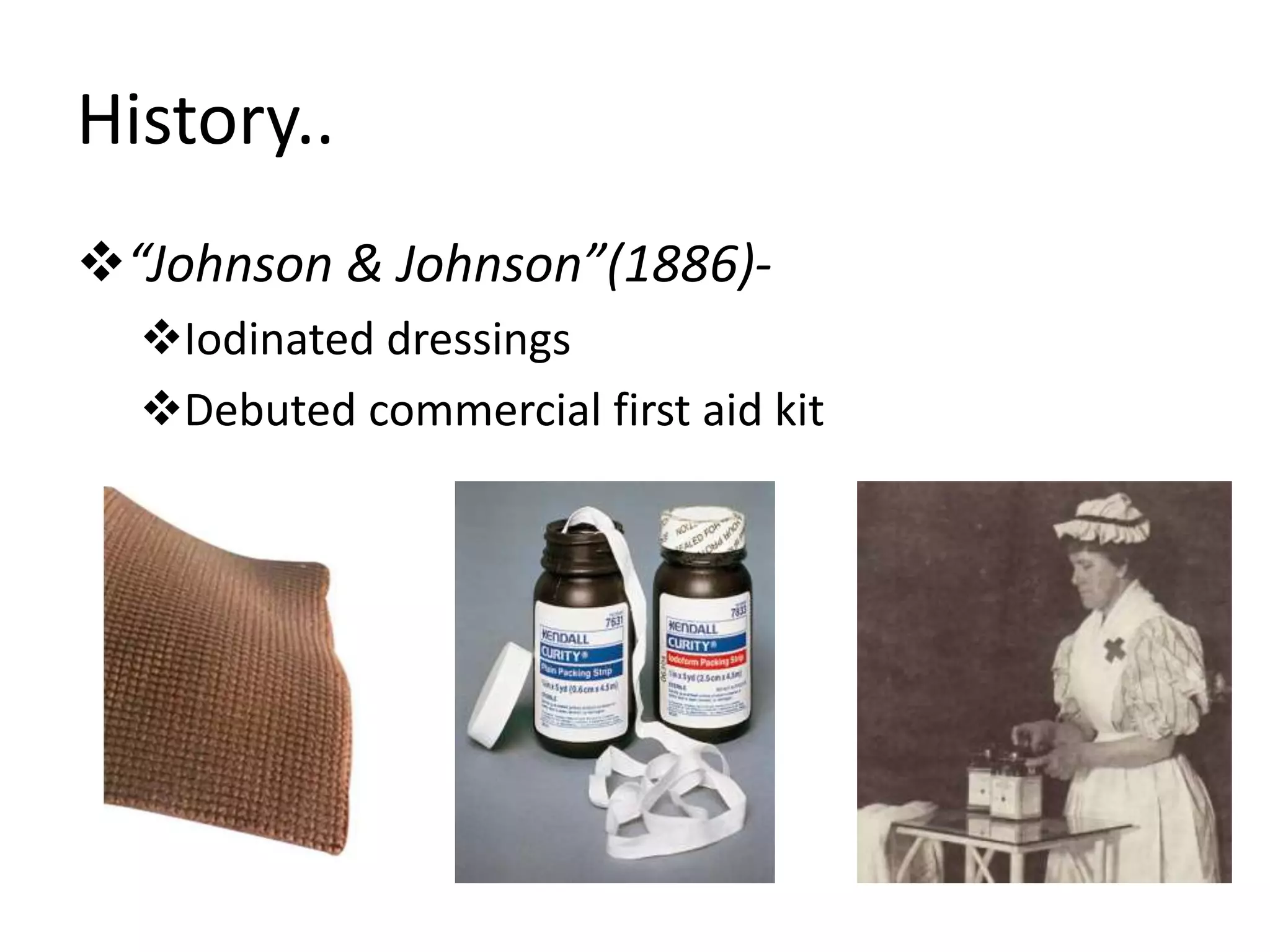
“Johnson & Johnson”(1886)-
Iodinated dressings
Debuted commercial first aid kit
History..
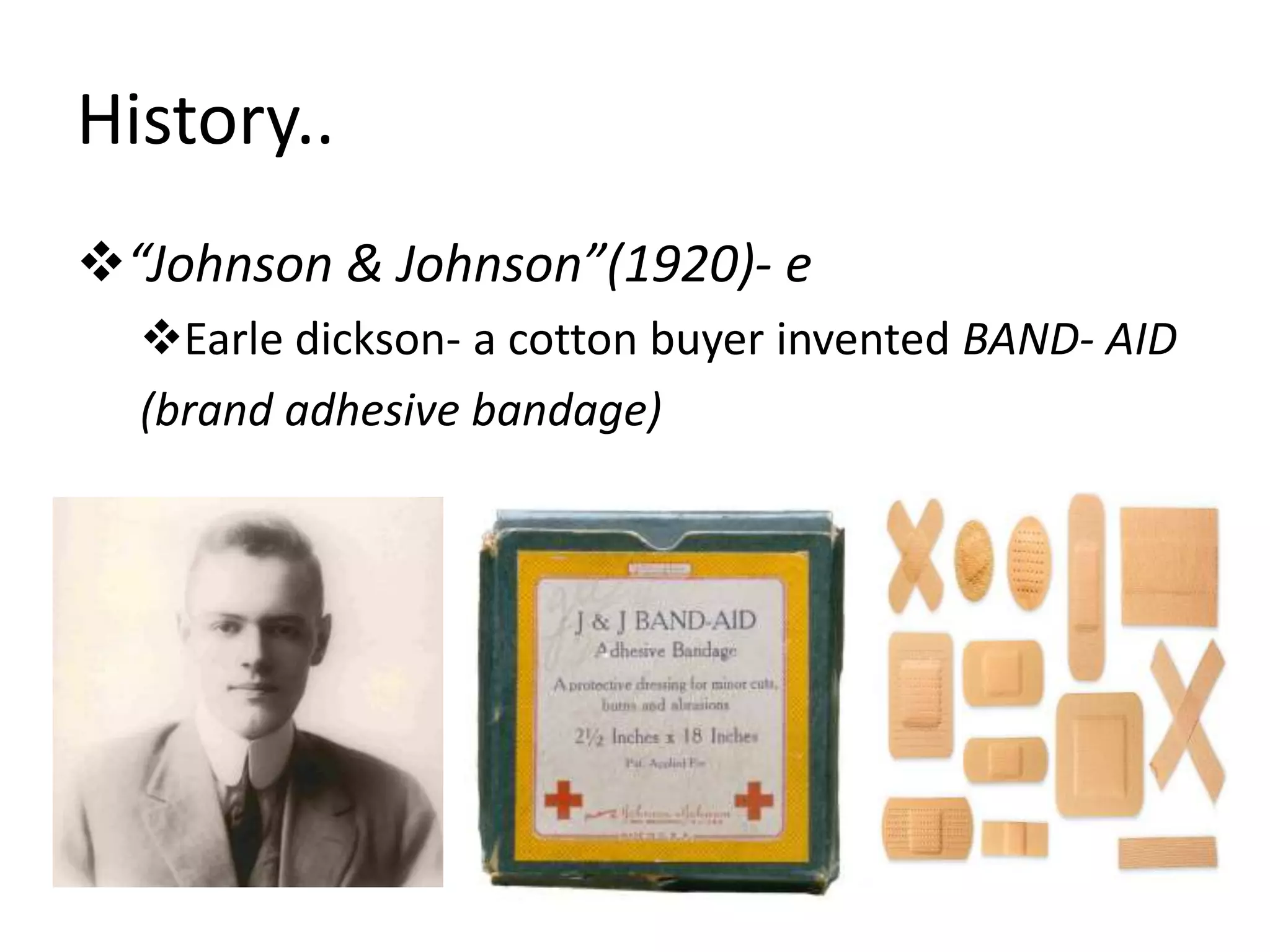
“Johnson & Johnson”(1920)- e
Earle dickson- a cotton buyer invented BAND- AID
(brand adhesive bandage)
History..
George Winter (1962)-
Pioneered concept of moist healing & occlusive
dressings
History to modern dressings..
1990 onwards-
Hydrogels
Hydrocolloids
Alginates
Synthetic foam
dressings
Vapor permeable
adhesive films
Anti adhesives:
silicon meshes
Tissue adhesives
Barrier films
Silver/collagen
dressings
Miscellaneous:
Combination products
Engineered skin
substitutes
Ideal wound dressing
Creates moist
environment
Removes excess exudate
Prevents desiccation
Allows for gaseous
exchange
Impermeable to
microorganisms
Thermally insulated
Ideal wound dressing..
Prevents particulate
contamination
odorless
Non toxic to benefit host
cells
Provides mechanical
protection
Non traumatic
Easy to use
Cost effective
How to select appropriate surgical
dressing?
Concept of occlusion & absorption
Occlusive dressing-
Principle of moist healing
faster wound healing by reducing pH and
oxygen tension
Stimulating fibroblast proliferation
Harmful in infected wounds
Absorptive dressing-
Preferred in wounds with high bacterial counts
& ↑ exudate
Types of dressings
Simple vs. Composite dressings
Simple-
Saline gauze dressings
Film dressings
Parrafin gauze dressings
Composite-
Multilayered dressing – outer, middle & inner layer
Types of dressings..
Nonadherent fabrics
Absorptive dressings
Occlusive dressings
Creams, ointments, and solutions
Types of dressings..
1. Non adherent fabrics
Fine mesh gauze supplemented with
substance to augment occlusive property/
antibacterial properties
E.g. Paraffin gauze, Scarlet Red, Xeroform
Types of dressings..
1. Non adherent fabrics
E.g. Paraffin gauze
Types of dressings..
1. Non adherent fabrics
E.g. Xeroform
Types of dressings..
2. Absorptive dressings
Wounds with significant amount of exudate
E.g. Wide mesh gauze, Foams
Types of dressings..
2. Absorptive dressings
E.g. Wide mesh gauze- not effective when
saturated, Foams
Types of dressings..
2. Absorptive dressings
E.g. Foams-
Types of dressings..
2. Absorptive dressings
E.g. Foams-
Types of dressings..
2. Occlusive dressings
Two types-
Non biological-e.g. Films, Hydrocolloids, Alginates,
Hydrogels
Biologic-e.g. Homograft, Xenograft, Amnion, Skin
substitutes
Types of dressings..
2. Occlusive dressings
Non biological- Films
Types of dressings..
2. Occlusive dressings
Non biological- Hydrocolloid matrix
 gelatin, pectin, carboxymethylcellulose
Types of dressings..
2. Occlusive dressings
Non biological- Hydrogels
Polyethylene oxide or carboxymethylcellulose polymer
and water (80%)
Rehydrating agents for dry wounds ;little water
absorption
Types of dressings..
2. Occlusive dressings
Non biological- Alginates
derived from brown algae
contain long chains of polysaccharides (mannuronic
and glucuronic acid)
Processed as the calcium form, alginates turn into
soluble sodium alginate
Types of dressings..
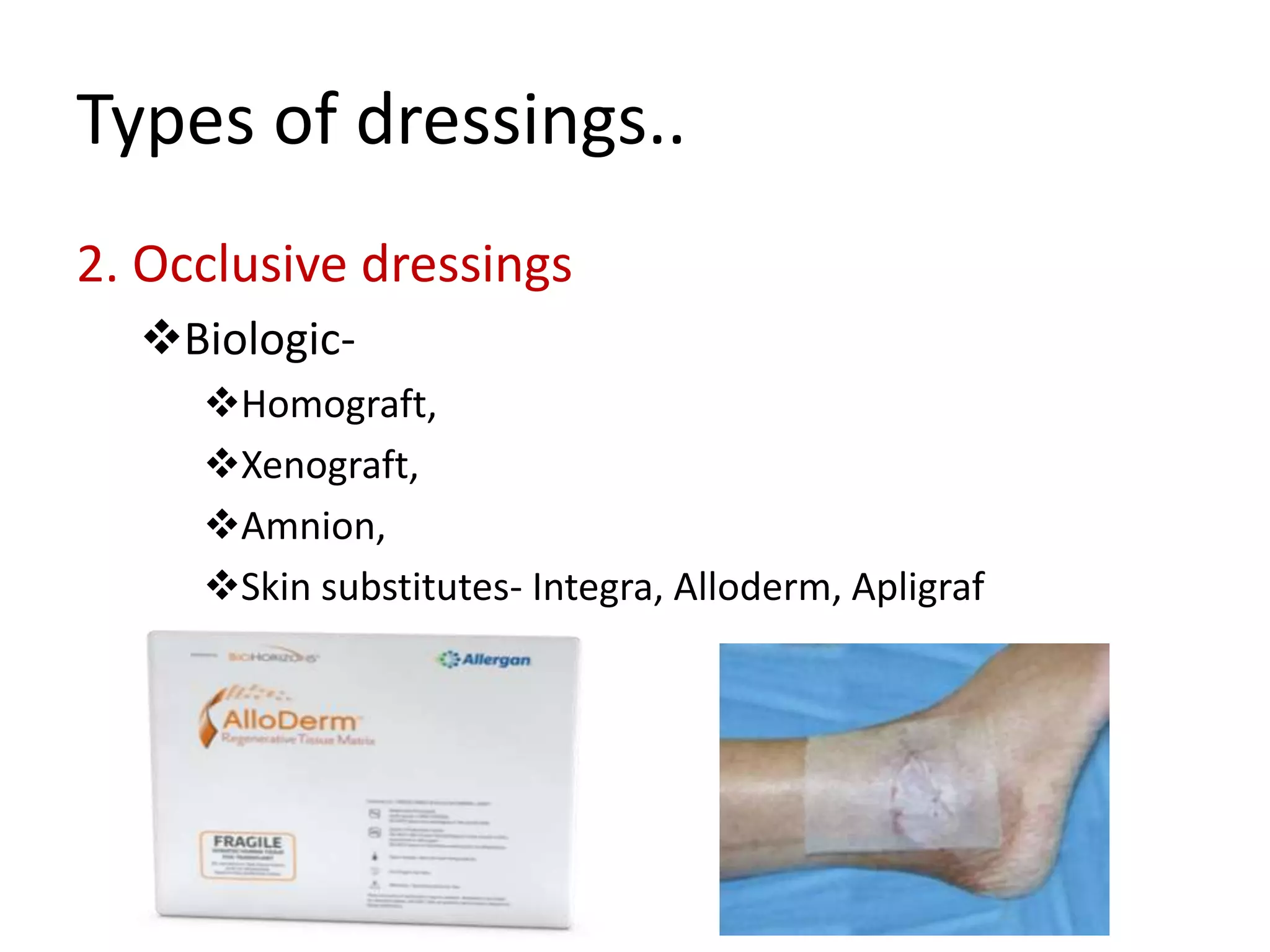
2. Occlusive dressings
Biologic-
Homograft,
Xenograft,
Amnion,
Skin substitutes- Integra, Alloderm, Apligraf
Types of dressings..
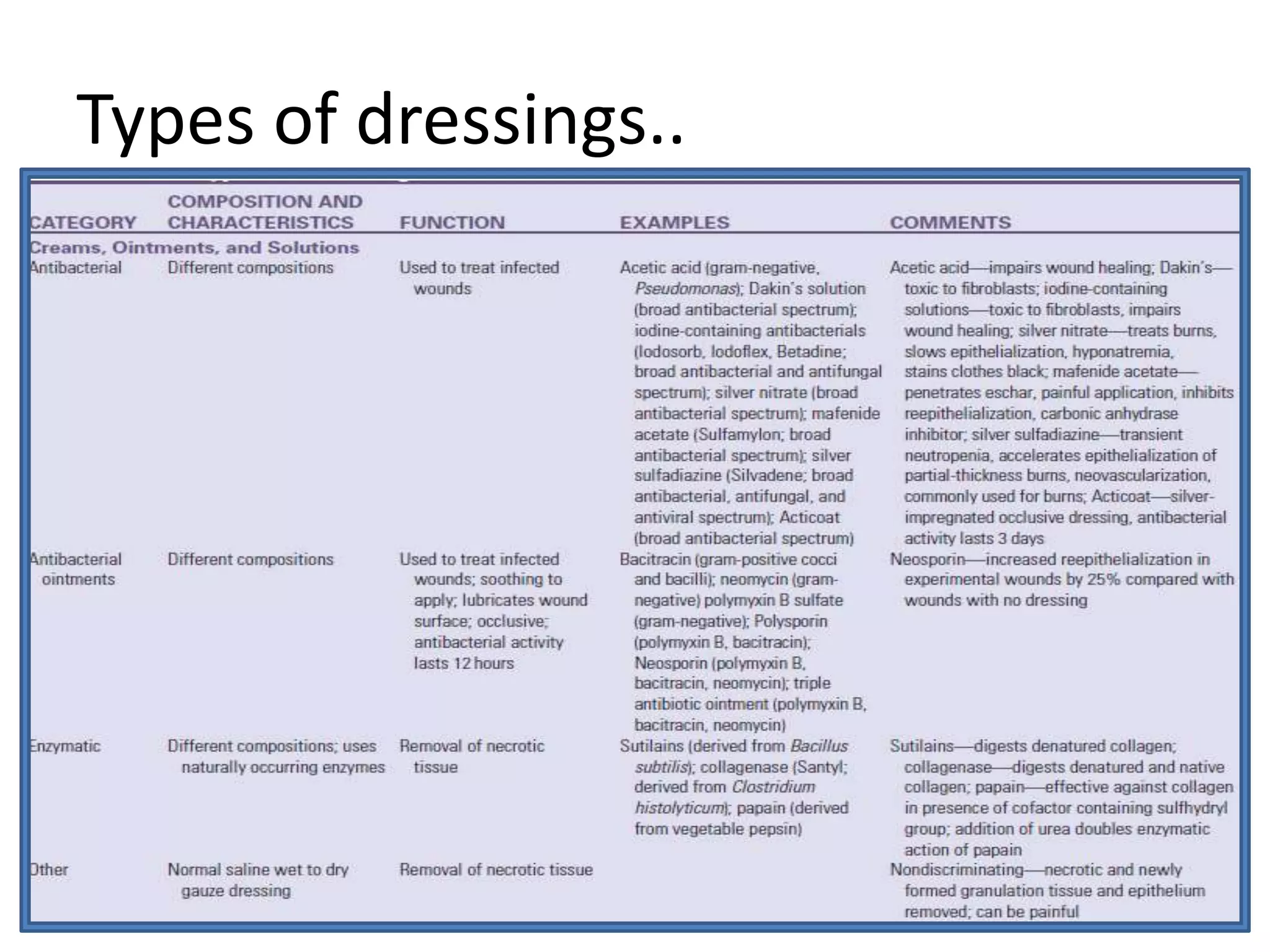
2. Creams, Ointments & Solutions
 Traditional materials- zinc oxide paste
Antibacterial creams and ointments
Acetic acid, Silver nitrate, Silver sulfadiazine,
iodine containing ointments(iodosorbs), bacitracin
Enzymes
Growth factors
Indicated in infected wounds
Types of dressings..
2. Creams, Ointments & Solutions
Zinc oxide paste
Antibacterial creams and ointments
Acetic acid, Silver nitrate, Silver sulfadiazine,
iodine containing ointments(iodosorbs), bacitracin
Types of dressings..
2. Creams, Ointments & Solutions
Nano silver
Betadine
What did we learn?
What is surgical dressing?
History
Ideal wound dressing
How to select appropriate surgical dressing?
Types/classification
Commonly used dressings
Modern/miscellaneous dressings
Bibliography
Sabiston 21st ed., Chap. 6, Wound Healing,
wound dressings
SRB 5th ed., Chap 36-G, Dressings and
Bandages
Additional reading-
Science of wound healing and dressing material-
Vibhakar & Payal
Surgical wound healing and management- Mark &
Luc
Next reading
Pye’s Surgical Handicraft, 22nd ed.- Chap.6,
Application of bandages
Attendance!!
&
?
Thank you

Surgical dressings i

  • 1.
    SURGICAL DRESSINGS Part- I 13/08/2021 Dr.Ankita Singh Assistant Professor ACMS, Delhi Cantt
  • 2.
    Learning Objective What issurgical dressing? History Ideal wound dressing How to select appropriate surgical dressing? Types/classification Commonly used dressings Modern/miscellaneous dressings
  • 3.
    What is surgicaldressing? Surgical dressing: sterile pad or compress applied to a wound to promote healing and prevent further harm Bandage: piece of material used either to support a medical device such as a dressing or splint
  • 4.
    History Material like fabric,leaves, cobweb, dung etc. Ancient Eqyptians (1500BC)- honey Hippocrates (460BC)- vinegar & fig leaves Roman physicians (100)- spices like saffron, thyme, mint; silver & lead (antiseptic) but were lost to Dark Ages
  • 5.
    History.. Joseph Lister (1860s)- Introducedantiseptic dressings (carbolic acid) Decreased mortality
  • 6.
    History.. “Johnson & Johnson”(1886)- Iodinateddressings Debuted commercial first aid kit
  • 7.
    History.. “Johnson & Johnson”(1920)-e Earle dickson- a cotton buyer invented BAND- AID (brand adhesive bandage)
  • 8.
    History.. George Winter (1962)- Pioneeredconcept of moist healing & occlusive dressings
  • 9.
    History to moderndressings.. 1990 onwards- Hydrogels Hydrocolloids Alginates Synthetic foam dressings Vapor permeable adhesive films Anti adhesives: silicon meshes Tissue adhesives Barrier films Silver/collagen dressings Miscellaneous: Combination products Engineered skin substitutes
  • 10.
    Ideal wound dressing Createsmoist environment Removes excess exudate Prevents desiccation Allows for gaseous exchange Impermeable to microorganisms Thermally insulated
  • 11.
    Ideal wound dressing.. Preventsparticulate contamination odorless Non toxic to benefit host cells Provides mechanical protection Non traumatic Easy to use Cost effective
  • 12.
    How to selectappropriate surgical dressing? Concept of occlusion & absorption Occlusive dressing- Principle of moist healing faster wound healing by reducing pH and oxygen tension Stimulating fibroblast proliferation Harmful in infected wounds Absorptive dressing- Preferred in wounds with high bacterial counts & ↑ exudate
  • 13.
    Types of dressings Simplevs. Composite dressings Simple- Saline gauze dressings Film dressings Parrafin gauze dressings Composite- Multilayered dressing – outer, middle & inner layer
  • 14.
    Types of dressings.. Nonadherentfabrics Absorptive dressings Occlusive dressings Creams, ointments, and solutions
  • 15.
  • 16.
    Types of dressings.. 1.Non adherent fabrics Fine mesh gauze supplemented with substance to augment occlusive property/ antibacterial properties E.g. Paraffin gauze, Scarlet Red, Xeroform
  • 17.
    Types of dressings.. 1.Non adherent fabrics E.g. Paraffin gauze
  • 18.
    Types of dressings.. 1.Non adherent fabrics E.g. Xeroform
  • 19.
  • 20.
    Types of dressings.. 2.Absorptive dressings Wounds with significant amount of exudate E.g. Wide mesh gauze, Foams
  • 21.
    Types of dressings.. 2.Absorptive dressings E.g. Wide mesh gauze- not effective when saturated, Foams
  • 22.
    Types of dressings.. 2.Absorptive dressings E.g. Foams-
  • 23.
    Types of dressings.. 2.Absorptive dressings E.g. Foams-
  • 24.
  • 25.
    Types of dressings.. 2.Occlusive dressings Two types- Non biological-e.g. Films, Hydrocolloids, Alginates, Hydrogels Biologic-e.g. Homograft, Xenograft, Amnion, Skin substitutes
  • 26.
    Types of dressings.. 2.Occlusive dressings Non biological- Films
  • 27.
    Types of dressings.. 2.Occlusive dressings Non biological- Hydrocolloid matrix  gelatin, pectin, carboxymethylcellulose
  • 28.
    Types of dressings.. 2.Occlusive dressings Non biological- Hydrogels Polyethylene oxide or carboxymethylcellulose polymer and water (80%) Rehydrating agents for dry wounds ;little water absorption
  • 29.
    Types of dressings.. 2.Occlusive dressings Non biological- Alginates derived from brown algae contain long chains of polysaccharides (mannuronic and glucuronic acid) Processed as the calcium form, alginates turn into soluble sodium alginate
  • 30.
    Types of dressings.. 2.Occlusive dressings Biologic- Homograft, Xenograft, Amnion, Skin substitutes- Integra, Alloderm, Apligraf
  • 31.
  • 32.
    Types of dressings.. 2.Creams, Ointments & Solutions  Traditional materials- zinc oxide paste Antibacterial creams and ointments Acetic acid, Silver nitrate, Silver sulfadiazine, iodine containing ointments(iodosorbs), bacitracin Enzymes Growth factors Indicated in infected wounds
  • 33.
    Types of dressings.. 2.Creams, Ointments & Solutions Zinc oxide paste Antibacterial creams and ointments Acetic acid, Silver nitrate, Silver sulfadiazine, iodine containing ointments(iodosorbs), bacitracin
  • 34.
    Types of dressings.. 2.Creams, Ointments & Solutions Nano silver Betadine
  • 35.
    What did welearn? What is surgical dressing? History Ideal wound dressing How to select appropriate surgical dressing? Types/classification Commonly used dressings Modern/miscellaneous dressings
  • 36.
    Bibliography Sabiston 21st ed.,Chap. 6, Wound Healing, wound dressings SRB 5th ed., Chap 36-G, Dressings and Bandages Additional reading- Science of wound healing and dressing material- Vibhakar & Payal Surgical wound healing and management- Mark & Luc
  • 37.
    Next reading Pye’s SurgicalHandicraft, 22nd ed.- Chap.6, Application of bandages
  • 38.
  • 39.