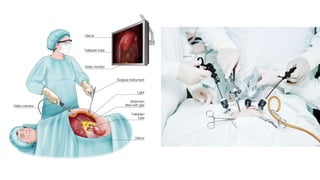
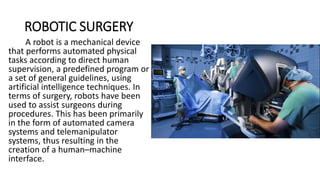
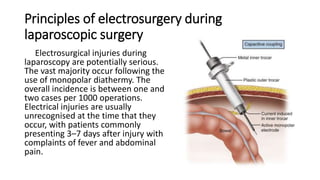
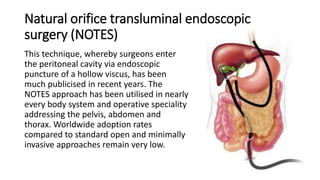
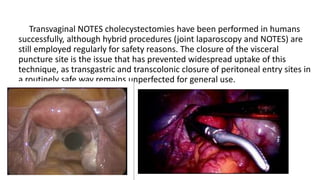
Georg Kelling first introduced experimental laparoscopic procedures in 1901, though it took several decades for laparoscopy to become widely adopted. Laparoscopic surgery has significant short-term benefits over open surgery such as less postoperative pain, shorter hospital stays, and faster return to normal activities. However, long-term outcomes like cancer survival rates have not been conclusively shown to be equivalent. Robotic surgery systems were later developed to address some limitations of laparoscopy like loss of tactile feedback and ergonomic challenges, providing benefits such as 3D visualization, tremor filtering, and improved instrument maneuverability. Both laparoscopic and robotic procedures require special considerations regarding patient selection, trocar placement, hemostasis, and potential