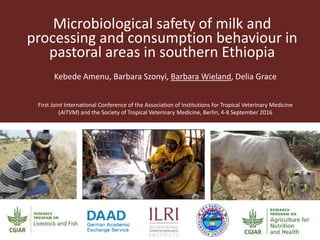
Microbiological safety of milk and
processing and consumption behaviour in
pastoral areas in southern Ethiopia
Kebede Amenu, Barbara Szonyi, Barbara Wieland, Delia Grace
First Joint International Conference of the Association of Institutions for Tropical Veterinary Medicine
(AITVM) and the Society of Tropical Veterinary Medicine, Berlin, 4-8 September 2016
Introduction
• Milk is prone to microbial contamination and
subsequently loses its quality and safety
• The microbiological quality and safety of milk is
affected by different factors:
• health status of the animal
• hygienic practices in the dairy premises
• post-milking handling
• processing practices
Milk production in Borana
Importance of milk in
the diet pastoral
communities
Risk of milk and milk
products to
contamination
Low education level of
communities in safe
milk handling practices
Research towards improving milk
handling practices and locally
adapted strategies to mitigate
associated health risks
Livestock keepers and
consumers at risk of
infection with milk-
borne pathogens
Objectives
• To assess dairy production and consumption
behaviour of pastoralists
• To assess microbiological quality and safety of
milk and traditional dairy products
Materials and methods
Qualitative research
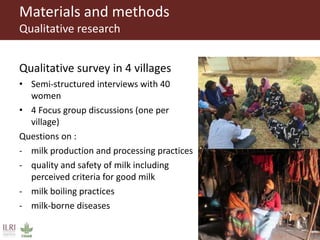
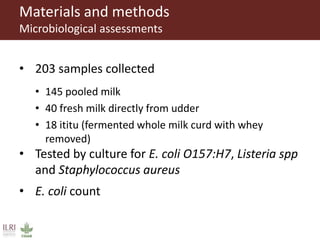
Qualitative survey in 4 villages
• Semi-structured interviews with 40
women
• 4 Focus group discussions (one per
village)
Questions on :
- milk production and processing practices
- quality and safety of milk including
perceived criteria for good milk
- milk boiling practices
- milk-borne diseases
Materials and methods
Microbiological assessments
• 203 samples collected
• 145 pooled milk
• 40 fresh milk directly from udder
• 18 ititu (fermented whole milk curd with whey
removed)
• Tested by culture for E. coli O157:H7, Listeria spp
and Staphylococcus aureus
• E. coli count
Results
Dairy production
• Cattle, camels and goats kept for
milk production
• Cattle most important
• processing of cow milk into
different dairy products
• use of butter for hair dressing and
cosmetics
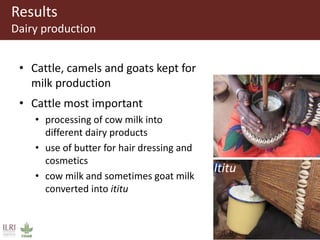
• cow milk and sometimes goat milk
converted into ititu
Ititu
Results
Dairy consumption
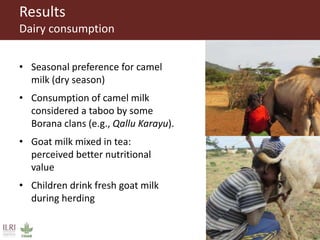
• Seasonal preference for camel
milk (dry season)
• Consumption of camel milk
considered a taboo by some
Borana clans (e.g., Qallu Karayu).
• Goat milk mixed in tea:
perceived better nutritional
value
• Children drink fresh goat milk
during herding
Results
Perception on quality and safety
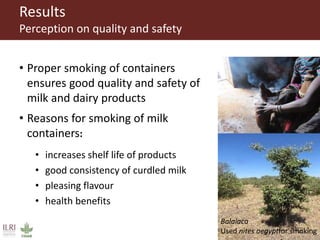
• Proper smoking of containers
ensures good quality and safety of
milk and dairy products
• Reasons for smoking of milk
containers:
• increases shelf life of products
• good consistency of curdled milk
• pleasing flavour
• health benefits
Balaiaca
Used nites aegyptfor smoking
Results
Perception on milk boiling
• Boiling of fresh milk not common practice
• “long time tradition of Borana people for not doing so”
• the perception that “boiling of milk destroys vitamins”
• “boiled milk is considered dead”
• boiling of milk reduces the nutritional quality of milk
• However milk is boiled for children: to prevent
qullichoo (cream, risk when vomiting)
Results
Milk-borne diseases
Women highlighted health benefits of milk, poor awareness of
disease risks:
• “People drinking milk don't have problem. Rather, people
who don't drink milk get sick”.
• “We haven't seen milk related sickness. We haven't had any
problem because of the milk from our animals. We use it to
raise our children. We are not aware that one can get
disease from milk” (IDI 11)
• “…The milk itself is medicine. Fresh milk can be
recommended for TB patients” (IDI 8).
Results
Microbiological results
• E. coli: 51.7%
• mean count 5x10⁵ CFU/ml.
• E. coli O157:H7: 2.5%,
• Staphylococcus aureus: 10.8%
• Listeria spp: 1.5%
Conclusion
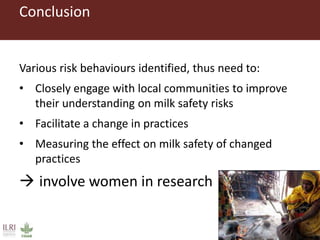
Various risk behaviours identified, thus need to:
• Closely engage with local communities to improve
their understanding on milk safety risks
• Facilitate a change in practices
• Measuring the effect on milk safety of changed
practices
 involve women in research
The presentation has a Creative Commons license. You are free to re-use or distribute this work, provided credit is given to ILRI.
better lives through livestock
ilri.org

Microbiological safety of milk and processing and consumption behaviour in pastoral areas in southern Ethiopia

  • 1.
    Microbiological safety ofmilk and processing and consumption behaviour in pastoral areas in southern Ethiopia Kebede Amenu, Barbara Szonyi, Barbara Wieland, Delia Grace First Joint International Conference of the Association of Institutions for Tropical Veterinary Medicine (AITVM) and the Society of Tropical Veterinary Medicine, Berlin, 4-8 September 2016
  • 2.
    Introduction • Milk isprone to microbial contamination and subsequently loses its quality and safety • The microbiological quality and safety of milk is affected by different factors: • health status of the animal • hygienic practices in the dairy premises • post-milking handling • processing practices
  • 3.
    Milk production inBorana Importance of milk in the diet pastoral communities Risk of milk and milk products to contamination Low education level of communities in safe milk handling practices Research towards improving milk handling practices and locally adapted strategies to mitigate associated health risks Livestock keepers and consumers at risk of infection with milk- borne pathogens
  • 4.
    Objectives • To assessdairy production and consumption behaviour of pastoralists • To assess microbiological quality and safety of milk and traditional dairy products
  • 5.
    Materials and methods Qualitativeresearch Qualitative survey in 4 villages • Semi-structured interviews with 40 women • 4 Focus group discussions (one per village) Questions on : - milk production and processing practices - quality and safety of milk including perceived criteria for good milk - milk boiling practices - milk-borne diseases
  • 6.
    Materials and methods Microbiologicalassessments • 203 samples collected • 145 pooled milk • 40 fresh milk directly from udder • 18 ititu (fermented whole milk curd with whey removed) • Tested by culture for E. coli O157:H7, Listeria spp and Staphylococcus aureus • E. coli count
  • 7.
    Results Dairy production • Cattle,camels and goats kept for milk production • Cattle most important • processing of cow milk into different dairy products • use of butter for hair dressing and cosmetics • cow milk and sometimes goat milk converted into ititu Ititu
  • 8.
    Results Dairy consumption • Seasonalpreference for camel milk (dry season) • Consumption of camel milk considered a taboo by some Borana clans (e.g., Qallu Karayu). • Goat milk mixed in tea: perceived better nutritional value • Children drink fresh goat milk during herding
  • 9.
    Results Perception on qualityand safety • Proper smoking of containers ensures good quality and safety of milk and dairy products • Reasons for smoking of milk containers: • increases shelf life of products • good consistency of curdled milk • pleasing flavour • health benefits Balaiaca Used nites aegyptfor smoking
  • 10.
    Results Perception on milkboiling • Boiling of fresh milk not common practice • “long time tradition of Borana people for not doing so” • the perception that “boiling of milk destroys vitamins” • “boiled milk is considered dead” • boiling of milk reduces the nutritional quality of milk • However milk is boiled for children: to prevent qullichoo (cream, risk when vomiting)
  • 11.
    Results Milk-borne diseases Women highlightedhealth benefits of milk, poor awareness of disease risks: • “People drinking milk don't have problem. Rather, people who don't drink milk get sick”. • “We haven't seen milk related sickness. We haven't had any problem because of the milk from our animals. We use it to raise our children. We are not aware that one can get disease from milk” (IDI 11) • “…The milk itself is medicine. Fresh milk can be recommended for TB patients” (IDI 8).
  • 12.
    Results Microbiological results • E.coli: 51.7% • mean count 5x10⁵ CFU/ml. • E. coli O157:H7: 2.5%, • Staphylococcus aureus: 10.8% • Listeria spp: 1.5%
  • 13.
    Conclusion Various risk behavioursidentified, thus need to: • Closely engage with local communities to improve their understanding on milk safety risks • Facilitate a change in practices • Measuring the effect on milk safety of changed practices  involve women in research
  • 14.
    The presentation hasa Creative Commons license. You are free to re-use or distribute this work, provided credit is given to ILRI. better lives through livestock ilri.org

Editor's Notes

  • #2 There MUST be a CGIAR logo or a CRP logo. You can copy and paste the logo you need from the final slide of this presentation. Then you can delete that final slide   To replace a photo above, copy and paste this link in your browser: http://www.flickr.com/photos/ilri/sets/72157632057087650/detail/   Find a photo you like and the right size, copy and paste it in the block above.
  • #11 “We don't boil. In other place boiled for children. If boiled, vitamin is destroyed. Milk has cream (qarruu). If ititu is prepared, when churned what becomes butter is the cream. When boiled the vitamin is destroyed, said by Borana. Smoking alone makes milk good. Milk in which cream has been removed is not good…” (IDI 36). “We boil milk only for small children. Adults don't boil. We want that raw milk. Boiled milk is dead. Raw milk is good. Only educated people boil milk” (IDI 28). Milk for children, reason for boiling was not to prevent milk-borne diseases: “The reason boiled for children is qullichoo, formed when vomiting. If boiled, no qullichoo. Cream (qarruu) is removed and the milk given to children. Qullichoo can suffocate children when vomiting. Adults able to remove [the milk curdle]. In adults, no problem! The stomach is accustomed with raw [milk] “(FGD 4).