BY: KUNCHAM NAGENDRABABU
GITAM UNIVERSITY
BIO TECHNOLOGY
• Milk constitutes an excellent medium for the
growth of micro-organisms.
• Freshly drawn milk from healthy animals
contains a small number of harmless micro-
organisms, however, during milking process and
storage the contamination takes place, the extent
of which depends upon the hygienic measures
taken before, during and after milking process
and storage conditions observed thereafter.
 Nearly all the changes that take place in the flavor
and appearance of the milk after it is drawn form
the cow, are the result of the activities of
microorganisms ,therefore, it is very essential to
control these microorganisms.
Significance of
Microorganisms in Milk
 Microbial content serves as an indicator of
production conditions and sanitary quality of milk.
 Prevention of spoilage.
 Prevention of milk borne illnesses.
 Production of dairy products with desired
characteristics imparted via m.o. introduction
 The types of microorganisms found in milk vary
considerably
 Bacteria, yeasts, moulds and bacteriophages are
commonly encountered.
 Viruses and protozoa are seldom observed in milk, except
as occasional contaminants.
*Bacteria
Most common and most numerous of microorganisms
found in milk and milk products .
 They belong to four main groups:
1. Gram +ive cocci
2. Gram +ive non-spore forming rods
3. Gram +ive spore-forming rods
4. Gram -ive non-spore forming rods.
Normally present in milk and they are also used as
starter culture for the production of cultured dairy
products. They ferment lactose and yield lactic acid.
 Brucella species
 Campylobactere jejuni
 Coxiella bruneti
 Escherichia coli
 Listeria monocytogenes
 Mycobacterium bovis
 Mycobacterium paratuberculosis
 Salmonella species
 E.coli
Coliforms
• Facultative anaerobes
• Optimum growth @ 370c
• Indicator organism and are closely associated the
presence of pathogens but not necessary pathogens
themselves.
• They ferment lactose with production of acid and gas
• cause rapid spoilage of milk
• they are killed by pasteurization
• Their presence is an indication of PP contamination
of milk.
Yeast
 Most frequently encountered in raw cream during hot
weather produce acid and co2. They are potential
contaminants throughout the year.
Moulds
 Their growth is visible as a fuzzy or fluffy growth on the
surface of milk and milk products.
 They may be black, green, grey, blue or white.
 They discolor the product and often produce repulsive
undesirable off odors
 Essential in production of certain varieties of cheese.
1. Food supply(H2o,energy,C,N Vit.
&Mineral source)
2. Moisture
3. Oxygen supply (Obligate aerobes
,facultative ,micoaerophillic ,
Aerotolerant anaerobes,obligate
anaerobes)
4. Acidity and pH (Acidophilic)
5. Preservatives
6. Light ( phototrophic)
7. Concentration (osmophillic yeasts)
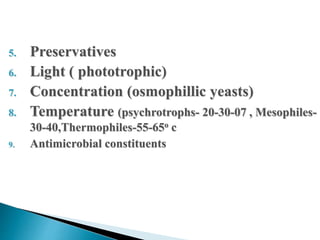
8. Temperature (psychrotrophs- 20-30-07 , Mesophiles-
30-40,Thermophiles-55-65o c
9. Antimicrobial constituents
Result of microbial growth in milk (Spoilage)
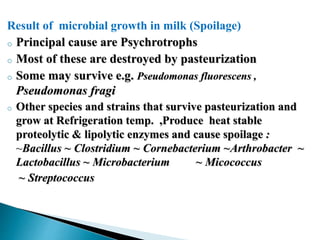
o Principal cause are Psychrotrophs
o Most of these are destroyed by pasteurization
o Some may survive e.g. Pseudomonas fluorescens ,
Pseudomonas fragi
o Other species and strains that survive pasteurization and
grow at Refrigeration temp. ,Produce heat stable
proteolytic & lipolytic enzymes and cause spoilage :
~Bacillus ~ Clostridium ~ Cornebacterium ~Arthrobacter ~
Lactobacillus ~ Microbacterium ~ Micococcus
~ Streptococcus
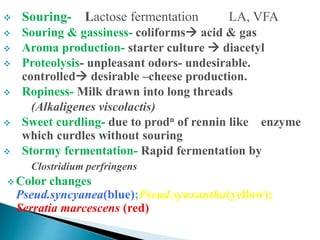
 Souring- Lactose fermentation LA, VFA
 Souring & gassiness- coliforms acid & gas
 Aroma production- starter culture  diacetyl
 Proteolysis- unpleasant odors- undesirable.
controlled desirable –cheese production.
 Ropiness- Milk drawn into long threads
(Alkaligenes viscolactis)
 Sweet curdling- due to prodn of rennin like enzyme
which curdles without souring
 Stormy fermentation- Rapid fermentation by
Clostridium perfringens
 Color changes
Pseud.syncyanea(blue);Pseud.synxantha(yellow);
Serratia marcescens (red)
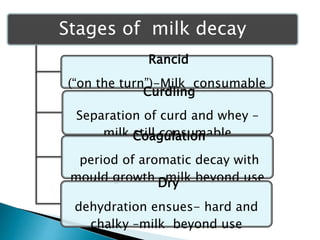
Stages of milk decay
Rancid
(“on the turn”)-Milk consumable
Curdling
Separation of curd and whey –
milk still consumableCoagulation
period of aromatic decay with
mould growth –milk beyond useDry
dehydration ensues- hard and
chalky –milk beyond use
Control and Practical Application
1. Heat - pasteurization , sterilization etc.
2. Ionizing Radiations- UV., gamma rays
3. High frequency sound waves- super &
ultrasonic
4. Electricity - by the heat generated.
5. Pressure - 600 x > atmospheric pressure
6. Chemicals Acids ,alkalis, halogens H2 02 etc.

Microbiology of milk

  • 1.
    BY: KUNCHAM NAGENDRABABU GITAMUNIVERSITY BIO TECHNOLOGY
  • 3.
    • Milk constitutesan excellent medium for the growth of micro-organisms. • Freshly drawn milk from healthy animals contains a small number of harmless micro- organisms, however, during milking process and storage the contamination takes place, the extent of which depends upon the hygienic measures taken before, during and after milking process and storage conditions observed thereafter.
  • 4.
     Nearly allthe changes that take place in the flavor and appearance of the milk after it is drawn form the cow, are the result of the activities of microorganisms ,therefore, it is very essential to control these microorganisms.
  • 5.
  • 6.
     Microbial contentserves as an indicator of production conditions and sanitary quality of milk.  Prevention of spoilage.  Prevention of milk borne illnesses.  Production of dairy products with desired characteristics imparted via m.o. introduction
  • 8.
     The typesof microorganisms found in milk vary considerably  Bacteria, yeasts, moulds and bacteriophages are commonly encountered.  Viruses and protozoa are seldom observed in milk, except as occasional contaminants. *Bacteria Most common and most numerous of microorganisms found in milk and milk products .
  • 9.
     They belongto four main groups: 1. Gram +ive cocci 2. Gram +ive non-spore forming rods 3. Gram +ive spore-forming rods 4. Gram -ive non-spore forming rods. Normally present in milk and they are also used as starter culture for the production of cultured dairy products. They ferment lactose and yield lactic acid.
  • 10.
     Brucella species Campylobactere jejuni  Coxiella bruneti  Escherichia coli  Listeria monocytogenes  Mycobacterium bovis  Mycobacterium paratuberculosis  Salmonella species  E.coli
  • 11.
    Coliforms • Facultative anaerobes •Optimum growth @ 370c • Indicator organism and are closely associated the presence of pathogens but not necessary pathogens themselves. • They ferment lactose with production of acid and gas • cause rapid spoilage of milk • they are killed by pasteurization • Their presence is an indication of PP contamination of milk.
  • 12.
    Yeast  Most frequentlyencountered in raw cream during hot weather produce acid and co2. They are potential contaminants throughout the year. Moulds  Their growth is visible as a fuzzy or fluffy growth on the surface of milk and milk products.  They may be black, green, grey, blue or white.  They discolor the product and often produce repulsive undesirable off odors  Essential in production of certain varieties of cheese.
  • 13.
    1. Food supply(H2o,energy,C,NVit. &Mineral source) 2. Moisture 3. Oxygen supply (Obligate aerobes ,facultative ,micoaerophillic , Aerotolerant anaerobes,obligate anaerobes) 4. Acidity and pH (Acidophilic)
  • 14.
    5. Preservatives 6. Light( phototrophic) 7. Concentration (osmophillic yeasts) 8. Temperature (psychrotrophs- 20-30-07 , Mesophiles- 30-40,Thermophiles-55-65o c 9. Antimicrobial constituents
  • 15.
    Result of microbialgrowth in milk (Spoilage) o Principal cause are Psychrotrophs o Most of these are destroyed by pasteurization o Some may survive e.g. Pseudomonas fluorescens , Pseudomonas fragi o Other species and strains that survive pasteurization and grow at Refrigeration temp. ,Produce heat stable proteolytic & lipolytic enzymes and cause spoilage : ~Bacillus ~ Clostridium ~ Cornebacterium ~Arthrobacter ~ Lactobacillus ~ Microbacterium ~ Micococcus ~ Streptococcus
  • 17.
     Souring- Lactosefermentation LA, VFA  Souring & gassiness- coliforms acid & gas  Aroma production- starter culture  diacetyl  Proteolysis- unpleasant odors- undesirable. controlled desirable –cheese production.  Ropiness- Milk drawn into long threads (Alkaligenes viscolactis)  Sweet curdling- due to prodn of rennin like enzyme which curdles without souring  Stormy fermentation- Rapid fermentation by Clostridium perfringens  Color changes Pseud.syncyanea(blue);Pseud.synxantha(yellow); Serratia marcescens (red)
  • 18.
    Stages of milkdecay Rancid (“on the turn”)-Milk consumable Curdling Separation of curd and whey – milk still consumableCoagulation period of aromatic decay with mould growth –milk beyond useDry dehydration ensues- hard and chalky –milk beyond use
  • 19.
    Control and PracticalApplication 1. Heat - pasteurization , sterilization etc. 2. Ionizing Radiations- UV., gamma rays 3. High frequency sound waves- super & ultrasonic 4. Electricity - by the heat generated. 5. Pressure - 600 x > atmospheric pressure 6. Chemicals Acids ,alkalis, halogens H2 02 etc.