Migration Terminologies 
Centre for Migration Studies, UG. Ghana 
Presented at 
MEDIA TRAINING WORKSHOP, 
YURI LODGE, UNIVERSITY OF GHANA 
2ND – 4TH SEPTEMBER, 2014 
By 
Dr. Joseph K. Teye
Specific Objectives of the Workshop 
Specifically, the workshop shall seek to: 
• Increase the coverage of migration in West African Media 
platforms and also improve upon the quality of migration stories. 
• Broaden and deepen journalist understanding in the area of 
migration to enable them appreciate the positive aspects of 
migration, including migration’s potential for economic 
development and poverty reduction. 
• Train journalists to conduct comprehensive investigations into 
migration-related stories and to consider various perspectives in 
their coverage to avoid bias. 
15/09/2014 2
Objectives Cont. 
• Provide a platform for disseminating Ghana RPC 
research findings. 
• Facilitate the strengthening of the West Africa 
Network of Journalists on Migration (WANJOM) 
leading to a more sustainable journalist’s network. 
• Strengthen the relationship between the media and 
the RPC to enhance their engagement and 
effectiveness in disseminating RPC-related research 
across the West African sub-region 
15/09/2014 3
MIGRATION TERMINOLOGIES 
Objectives of this session: 
By the end of this session participants should be 
able to: 
-explain the concept of migration 
-identify the causes and effects of migration 
-outline some theories of migration 
-explain some basic migration terminologies 
15/09/2014 4
Definition and measurement of 
Migration 
• Hauser and Duncan (1971), define migration as “movement 
across space between one geographical unit and another 
involving a permanent or semi-permanent change in 
residence”. 
• Migration must involved movement across a geographical 
boundary (e.g. district boundary, regional boundary, 
national boundary) (Carr, 1990). Yet, what constitutes a 
geographical boundary is sometimes contested as such 
boundaries may be ‘artificially’ created. Awumbila, 2014). 
• Distinction between internal migration and international 
migration. 
15/09/2014 5
Definitions 
• The duration of stay at the destination is a key factor in determining whether a 
movement can be considered migration. 
• In many West African countries, a migrant is defined as a person who has moved 
and stayed at his current place of residence for at least a year. This definition has 
been contested on the grounds that it does not cover seasonal migrants who 
migrate periodically for a few months. 
• Distinction between long term migrants and short -term migrants. 
• Mobility is broader term and includes a whole range of population movements 
from one place to another and varying in scale and varying in time. 
• Contested migration Status: There are many people who are considered migrants 
in the countries where they were born because of national laws that equate 
migration status with nationality (e.g. so called ‘second generation migrants’ ). 
• Journalists sometimes use certain terms to capture migration status, even when 
this is not needed: E.G.“ An American by name Asafo , whose parents originally 
came from Pakistan, was arrested with bombs in London’ 
15/09/2014 6
MIGRATION STATISTICAL DATA COLLECTION SYSTEMS 
IN WEST AFRICA 
• Population and Housing Census data (Ghana Statistical 
Service). 
• National immigration departments (e.g. Ghana 
Immigration Services). Completion of questionnaire at 
point of entry or exit. 
• Surveys (e.g. Global Quantitative survey) 
• International agencies . E.G. The United Nations High 
Commission on Refugees (UNHCR); The UN DESA 
Population Division; World Bank 
15/09/2014 7
Causes of Migration 
• Economic Factors: Movements in search of for job opportunities; job transfers; 
exploitation of natural resources (e.g. gold, diamond etc). 
• Social Factors: Movements for better education; medical services; marriage; to join 
spouses and families; move away from some traditional practices; etc 
• Political Factors: Migration to avoid political or religious persecution; movements 
during wars (political refugees) 
• Environmental Factors: Migration as a strategy to deal with environmental hazards (e.g. 
drought, famine, volcanic eruptions, earthquakes) and poverty (Tacoli, 2009; Black, 
Bennett, Thomas, & Beddington 2011). 
• Several factors interact to drive people away from their usual places of residence. While 
some movements are voluntary, others are forced. Faced with the same 
economic/environmental problems, some people may choose to migrate while others 
may still remain at the origin because of lack of resources to migrate or unwillingness to 
do so. The term ‘trapped migration’ is used for situations whereby people facing 
serious environmental and economic challenges want to migrate, but they are unable to 
do so. 
15/09/2014 8
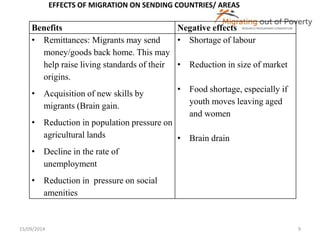
EFFECTS OF MIGRATION ON SENDING COUNTRIES/ AREAS 
Benefits Negative effects 
• Remittances: Migrants may send 
money/goods back home. This may 
help raise living standards of their 
origins. 
• Acquisition of new skills by 
migrants (Brain gain. 
• Reduction in population pressure on 
agricultural lands 
• Decline in the rate of 
unemployment 
• Reduction in pressure on social 
amenities 
• Shortage of labour 
• Reduction in size of market 
• Food shortage, especially if 
youth moves leaving aged 
and women 
• Brain drain 
15/09/2014 9
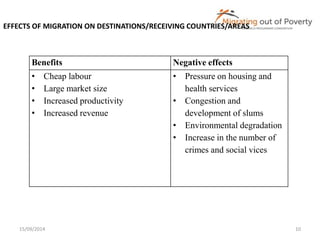
EFFECTS OF MIGRATION ON DESTINATIONS/RECEIVING COUNTRIES/AREAS 
Benefits Negative effects 
• Cheap labour 
• Large market size 
• Increased productivity 
• Increased revenue 
• Pressure on housing and 
health services 
• Congestion and 
development of slums 
• Environmental degradation 
• Increase in the number of 
crimes and social vices 
15/09/2014 10
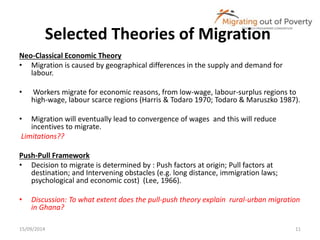
Selected Theories of Migration 
Neo-Classical Economic Theory 
• Migration is caused by geographical differences in the supply and demand for 
labour. 
• Workers migrate for economic reasons, from low-wage, labour-surplus regions to 
high-wage, labour scarce regions (Harris & Todaro 1970; Todaro & Maruszko 1987). 
• Migration will eventually lead to convergence of wages and this will reduce 
incentives to migrate. 
Limitations?? 
Push-Pull Framework 
• Decision to migrate is determined by : Push factors at origin; Pull factors at 
destination; and Intervening obstacles (e.g. long distance, immigration laws; 
psychological and economic cost) (Lee, 1966). 
• Discussion: To what extent does the pull-push theory explain rural-urban migration 
in Ghana? 
15/09/2014 11
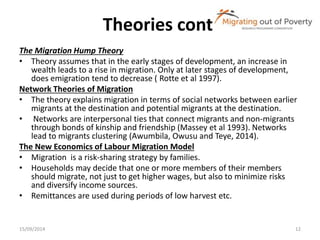
Theories cont 
The Migration Hump Theory 
• Theory assumes that in the early stages of development, an increase in 
wealth leads to a rise in migration. Only at later stages of development, 
does emigration tend to decrease ( Rotte et al 1997). 
Network Theories of Migration 
• The theory explains migration in terms of social networks between earlier 
migrants at the destination and potential migrants at the destination. 
• Networks are interpersonal ties that connect migrants and non-migrants 
through bonds of kinship and friendship (Massey et al 1993). Networks 
lead to migrants clustering (Awumbila, Owusu and Teye, 2014). 
The New Economics of Labour Migration Model 
• Migration is a risk-sharing strategy by families. 
• Households may decide that one or more members of their members 
should migrate, not just to get higher wages, but also to minimize risks 
and diversify income sources. 
• Remittances are used during periods of low harvest etc. 
15/09/2014 12
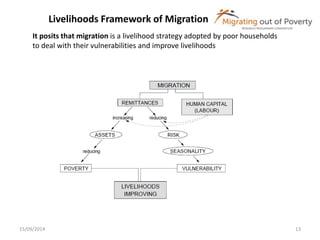
Livelihoods Framework of Migration 
It posits that migration is a livelihood strategy adopted by poor households 
to deal with their vulnerabilities and improve livelihoods 
15/09/2014 13
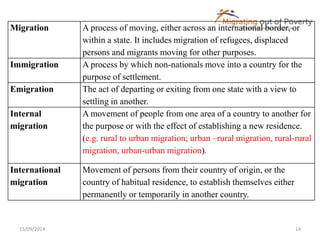
Migration A process of moving, either across an international border, or 
within a state. It includes migration of refugees, displaced 
persons and migrants moving for other purposes. 
Immigration A process by which non-nationals move into a country for the 
purpose of settlement. 
Emigration The act of departing or exiting from one state with a view to 
settling in another. 
Internal 
migration 
A movement of people from one area of a country to another for 
the purpose or with the effect of establishing a new residence. 
(e.g. rural to urban migration; urban –rural migration, rural-rural 
migration, urban-urban migration). 
International 
migration 
Movement of persons from their country of origin, or the 
country of habitual residence, to establish themselves either 
permanently or temporarily in another country. 
15/09/2014 14
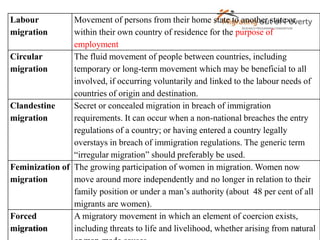
Labour 
migration 
Movement of persons from their home state to another state or 
within their own country of residence for the purpose of 
employment 
Circular 
migration 
The fluid movement of people between countries, including 
temporary or long-term movement which may be beneficial to all 
involved, if occurring voluntarily and linked to the labour needs of 
countries of origin and destination. 
Clandestine 
migration 
Secret or concealed migration in breach of immigration 
requirements. It can occur when a non-national breaches the entry 
regulations of a country; or having entered a country legally 
overstays in breach of immigration regulations. The generic term 
“irregular migration” should preferably be used. 
Feminization of 
migration 
The growing participation of women in migration. Women now 
move around more independently and no longer in relation to their 
family position or under a man’s authority (about 48 per cent of all 
migrants are women). 
Forced 
migration 
A migratory movement in which an element of coercion exists, 
including threats to life and livelihood, whether arising from natural 
or man-made causes 
15/09/2014 15
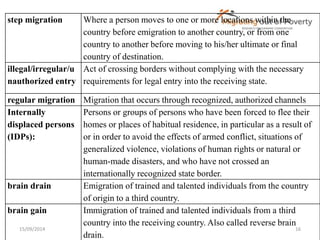
step migration Where a person moves to one or more locations within the 
country before emigration to another country, or from one 
country to another before moving to his/her ultimate or final 
country of destination. 
illegal/irregular/u 
nauthorized entry 
Act of crossing borders without complying with the necessary 
requirements for legal entry into the receiving state. 
regular migration Migration that occurs through recognized, authorized channels 
Internally 
displaced persons 
(IDPs): 
Persons or groups of persons who have been forced to flee their 
homes or places of habitual residence, in particular as a result of 
or in order to avoid the effects of armed conflict, situations of 
generalized violence, violations of human rights or natural or 
human-made disasters, and who have not crossed an 
internationally recognized state border. 
brain drain Emigration of trained and talented individuals from the country 
of origin to a third country. 
brain gain Immigration of trained and talented individuals from a third 
country into the receiving country. Also called reverse brain 
drain. 
15/09/2014 16
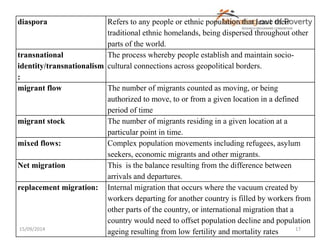
diaspora Refers to any people or ethnic population that leave their 
traditional ethnic homelands, being dispersed throughout other 
parts of the world. 
transnational 
identity/transnationalism 
: 
The process whereby people establish and maintain socio-cultural 
connections across geopolitical borders. 
migrant flow The number of migrants counted as moving, or being 
authorized to move, to or from a given location in a defined 
period of time 
migrant stock The number of migrants residing in a given location at a 
particular point in time. 
mixed flows: Complex population movements including refugees, asylum 
seekers, economic migrants and other migrants. 
Net migration This is the balance resulting from the difference between 
arrivals and departures. 
replacement migration: Internal migration that occurs where the vacuum created by 
workers departing for another country is filled by workers from 
other parts of the country, or international migration that a 
country would need to offset population decline and population 
ageing resulting from low fertility and mortality rates 
15/09/2014 17
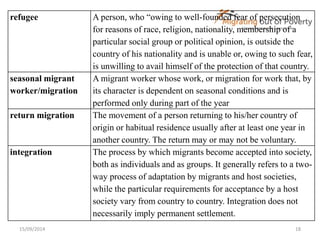
refugee A person, who “owing to well-founded fear of persecution 
for reasons of race, religion, nationality, membership of a 
particular social group or political opinion, is outside the 
country of his nationality and is unable or, owing to such fear, 
is unwilling to avail himself of the protection of that country. 
seasonal migrant 
worker/migration 
A migrant worker whose work, or migration for work that, by 
its character is dependent on seasonal conditions and is 
performed only during part of the year 
return migration The movement of a person returning to his/her country of 
origin or habitual residence usually after at least one year in 
another country. The return may or may not be voluntary. 
integration The process by which migrants become accepted into society, 
both as individuals and as groups. It generally refers to a two-way 
process of adaptation by migrants and host societies, 
while the particular requirements for acceptance by a host 
society vary from country to country. Integration does not 
necessarily imply permanent settlement. 
15/09/2014 18
Migrant smuggling: The procurement, in order to obtain, directly or indirectly, a 
financial or other material benefit, of the illegal [or 
unauthorized] entry of a person into a state party of which 
the person is not a national or a permanent resident 
smuggler (of migrants): An intermediary who is moving people by agreement with 
them, in order to transport them in an unauthorized manner 
across an internationally recognized state border. 
trafficking in persons: The recruitment, transportation, transfer, harbouring or 
receipt of persons, by means of the threat or use of force or 
other forms of coercion, of abduction, of fraud, of 
deception, of the abuse of power or of a position of 
vulnerability or of the giving or receiving of payments or 
benefits to achieve the consent of a person having control 
over another person, for the purpose of exploitation. 
forced/compulsory 
labour: 
All work or service which is exacted from any person under 
the menace of any penalty and for which the said person 
has not offered himself/herself voluntarily. 
15/09/2014 19
Group Work 
• Report back in 10 minutes 
15/09/2014 20

Migration terminologies - Migrating out of Poverty media training, Ghana

  • 1.
    Migration Terminologies Centrefor Migration Studies, UG. Ghana Presented at MEDIA TRAINING WORKSHOP, YURI LODGE, UNIVERSITY OF GHANA 2ND – 4TH SEPTEMBER, 2014 By Dr. Joseph K. Teye
  • 2.
    Specific Objectives ofthe Workshop Specifically, the workshop shall seek to: • Increase the coverage of migration in West African Media platforms and also improve upon the quality of migration stories. • Broaden and deepen journalist understanding in the area of migration to enable them appreciate the positive aspects of migration, including migration’s potential for economic development and poverty reduction. • Train journalists to conduct comprehensive investigations into migration-related stories and to consider various perspectives in their coverage to avoid bias. 15/09/2014 2
  • 3.
    Objectives Cont. •Provide a platform for disseminating Ghana RPC research findings. • Facilitate the strengthening of the West Africa Network of Journalists on Migration (WANJOM) leading to a more sustainable journalist’s network. • Strengthen the relationship between the media and the RPC to enhance their engagement and effectiveness in disseminating RPC-related research across the West African sub-region 15/09/2014 3
  • 4.
    MIGRATION TERMINOLOGIES Objectivesof this session: By the end of this session participants should be able to: -explain the concept of migration -identify the causes and effects of migration -outline some theories of migration -explain some basic migration terminologies 15/09/2014 4
  • 5.
    Definition and measurementof Migration • Hauser and Duncan (1971), define migration as “movement across space between one geographical unit and another involving a permanent or semi-permanent change in residence”. • Migration must involved movement across a geographical boundary (e.g. district boundary, regional boundary, national boundary) (Carr, 1990). Yet, what constitutes a geographical boundary is sometimes contested as such boundaries may be ‘artificially’ created. Awumbila, 2014). • Distinction between internal migration and international migration. 15/09/2014 5
  • 6.
    Definitions • Theduration of stay at the destination is a key factor in determining whether a movement can be considered migration. • In many West African countries, a migrant is defined as a person who has moved and stayed at his current place of residence for at least a year. This definition has been contested on the grounds that it does not cover seasonal migrants who migrate periodically for a few months. • Distinction between long term migrants and short -term migrants. • Mobility is broader term and includes a whole range of population movements from one place to another and varying in scale and varying in time. • Contested migration Status: There are many people who are considered migrants in the countries where they were born because of national laws that equate migration status with nationality (e.g. so called ‘second generation migrants’ ). • Journalists sometimes use certain terms to capture migration status, even when this is not needed: E.G.“ An American by name Asafo , whose parents originally came from Pakistan, was arrested with bombs in London’ 15/09/2014 6
  • 7.
    MIGRATION STATISTICAL DATACOLLECTION SYSTEMS IN WEST AFRICA • Population and Housing Census data (Ghana Statistical Service). • National immigration departments (e.g. Ghana Immigration Services). Completion of questionnaire at point of entry or exit. • Surveys (e.g. Global Quantitative survey) • International agencies . E.G. The United Nations High Commission on Refugees (UNHCR); The UN DESA Population Division; World Bank 15/09/2014 7
  • 8.
    Causes of Migration • Economic Factors: Movements in search of for job opportunities; job transfers; exploitation of natural resources (e.g. gold, diamond etc). • Social Factors: Movements for better education; medical services; marriage; to join spouses and families; move away from some traditional practices; etc • Political Factors: Migration to avoid political or religious persecution; movements during wars (political refugees) • Environmental Factors: Migration as a strategy to deal with environmental hazards (e.g. drought, famine, volcanic eruptions, earthquakes) and poverty (Tacoli, 2009; Black, Bennett, Thomas, & Beddington 2011). • Several factors interact to drive people away from their usual places of residence. While some movements are voluntary, others are forced. Faced with the same economic/environmental problems, some people may choose to migrate while others may still remain at the origin because of lack of resources to migrate or unwillingness to do so. The term ‘trapped migration’ is used for situations whereby people facing serious environmental and economic challenges want to migrate, but they are unable to do so. 15/09/2014 8
  • 9.
    EFFECTS OF MIGRATIONON SENDING COUNTRIES/ AREAS Benefits Negative effects • Remittances: Migrants may send money/goods back home. This may help raise living standards of their origins. • Acquisition of new skills by migrants (Brain gain. • Reduction in population pressure on agricultural lands • Decline in the rate of unemployment • Reduction in pressure on social amenities • Shortage of labour • Reduction in size of market • Food shortage, especially if youth moves leaving aged and women • Brain drain 15/09/2014 9
  • 10.
    EFFECTS OF MIGRATIONON DESTINATIONS/RECEIVING COUNTRIES/AREAS Benefits Negative effects • Cheap labour • Large market size • Increased productivity • Increased revenue • Pressure on housing and health services • Congestion and development of slums • Environmental degradation • Increase in the number of crimes and social vices 15/09/2014 10
  • 11.
    Selected Theories ofMigration Neo-Classical Economic Theory • Migration is caused by geographical differences in the supply and demand for labour. • Workers migrate for economic reasons, from low-wage, labour-surplus regions to high-wage, labour scarce regions (Harris & Todaro 1970; Todaro & Maruszko 1987). • Migration will eventually lead to convergence of wages and this will reduce incentives to migrate. Limitations?? Push-Pull Framework • Decision to migrate is determined by : Push factors at origin; Pull factors at destination; and Intervening obstacles (e.g. long distance, immigration laws; psychological and economic cost) (Lee, 1966). • Discussion: To what extent does the pull-push theory explain rural-urban migration in Ghana? 15/09/2014 11
  • 12.
    Theories cont TheMigration Hump Theory • Theory assumes that in the early stages of development, an increase in wealth leads to a rise in migration. Only at later stages of development, does emigration tend to decrease ( Rotte et al 1997). Network Theories of Migration • The theory explains migration in terms of social networks between earlier migrants at the destination and potential migrants at the destination. • Networks are interpersonal ties that connect migrants and non-migrants through bonds of kinship and friendship (Massey et al 1993). Networks lead to migrants clustering (Awumbila, Owusu and Teye, 2014). The New Economics of Labour Migration Model • Migration is a risk-sharing strategy by families. • Households may decide that one or more members of their members should migrate, not just to get higher wages, but also to minimize risks and diversify income sources. • Remittances are used during periods of low harvest etc. 15/09/2014 12
  • 13.
    Livelihoods Framework ofMigration It posits that migration is a livelihood strategy adopted by poor households to deal with their vulnerabilities and improve livelihoods 15/09/2014 13
  • 14.
    Migration A processof moving, either across an international border, or within a state. It includes migration of refugees, displaced persons and migrants moving for other purposes. Immigration A process by which non-nationals move into a country for the purpose of settlement. Emigration The act of departing or exiting from one state with a view to settling in another. Internal migration A movement of people from one area of a country to another for the purpose or with the effect of establishing a new residence. (e.g. rural to urban migration; urban –rural migration, rural-rural migration, urban-urban migration). International migration Movement of persons from their country of origin, or the country of habitual residence, to establish themselves either permanently or temporarily in another country. 15/09/2014 14
  • 15.
    Labour migration Movementof persons from their home state to another state or within their own country of residence for the purpose of employment Circular migration The fluid movement of people between countries, including temporary or long-term movement which may be beneficial to all involved, if occurring voluntarily and linked to the labour needs of countries of origin and destination. Clandestine migration Secret or concealed migration in breach of immigration requirements. It can occur when a non-national breaches the entry regulations of a country; or having entered a country legally overstays in breach of immigration regulations. The generic term “irregular migration” should preferably be used. Feminization of migration The growing participation of women in migration. Women now move around more independently and no longer in relation to their family position or under a man’s authority (about 48 per cent of all migrants are women). Forced migration A migratory movement in which an element of coercion exists, including threats to life and livelihood, whether arising from natural or man-made causes 15/09/2014 15
  • 16.
    step migration Wherea person moves to one or more locations within the country before emigration to another country, or from one country to another before moving to his/her ultimate or final country of destination. illegal/irregular/u nauthorized entry Act of crossing borders without complying with the necessary requirements for legal entry into the receiving state. regular migration Migration that occurs through recognized, authorized channels Internally displaced persons (IDPs): Persons or groups of persons who have been forced to flee their homes or places of habitual residence, in particular as a result of or in order to avoid the effects of armed conflict, situations of generalized violence, violations of human rights or natural or human-made disasters, and who have not crossed an internationally recognized state border. brain drain Emigration of trained and talented individuals from the country of origin to a third country. brain gain Immigration of trained and talented individuals from a third country into the receiving country. Also called reverse brain drain. 15/09/2014 16
  • 17.
    diaspora Refers toany people or ethnic population that leave their traditional ethnic homelands, being dispersed throughout other parts of the world. transnational identity/transnationalism : The process whereby people establish and maintain socio-cultural connections across geopolitical borders. migrant flow The number of migrants counted as moving, or being authorized to move, to or from a given location in a defined period of time migrant stock The number of migrants residing in a given location at a particular point in time. mixed flows: Complex population movements including refugees, asylum seekers, economic migrants and other migrants. Net migration This is the balance resulting from the difference between arrivals and departures. replacement migration: Internal migration that occurs where the vacuum created by workers departing for another country is filled by workers from other parts of the country, or international migration that a country would need to offset population decline and population ageing resulting from low fertility and mortality rates 15/09/2014 17
  • 18.
    refugee A person,who “owing to well-founded fear of persecution for reasons of race, religion, nationality, membership of a particular social group or political opinion, is outside the country of his nationality and is unable or, owing to such fear, is unwilling to avail himself of the protection of that country. seasonal migrant worker/migration A migrant worker whose work, or migration for work that, by its character is dependent on seasonal conditions and is performed only during part of the year return migration The movement of a person returning to his/her country of origin or habitual residence usually after at least one year in another country. The return may or may not be voluntary. integration The process by which migrants become accepted into society, both as individuals and as groups. It generally refers to a two-way process of adaptation by migrants and host societies, while the particular requirements for acceptance by a host society vary from country to country. Integration does not necessarily imply permanent settlement. 15/09/2014 18
  • 19.
    Migrant smuggling: Theprocurement, in order to obtain, directly or indirectly, a financial or other material benefit, of the illegal [or unauthorized] entry of a person into a state party of which the person is not a national or a permanent resident smuggler (of migrants): An intermediary who is moving people by agreement with them, in order to transport them in an unauthorized manner across an internationally recognized state border. trafficking in persons: The recruitment, transportation, transfer, harbouring or receipt of persons, by means of the threat or use of force or other forms of coercion, of abduction, of fraud, of deception, of the abuse of power or of a position of vulnerability or of the giving or receiving of payments or benefits to achieve the consent of a person having control over another person, for the purpose of exploitation. forced/compulsory labour: All work or service which is exacted from any person under the menace of any penalty and for which the said person has not offered himself/herself voluntarily. 15/09/2014 19
  • 20.
    Group Work •Report back in 10 minutes 15/09/2014 20