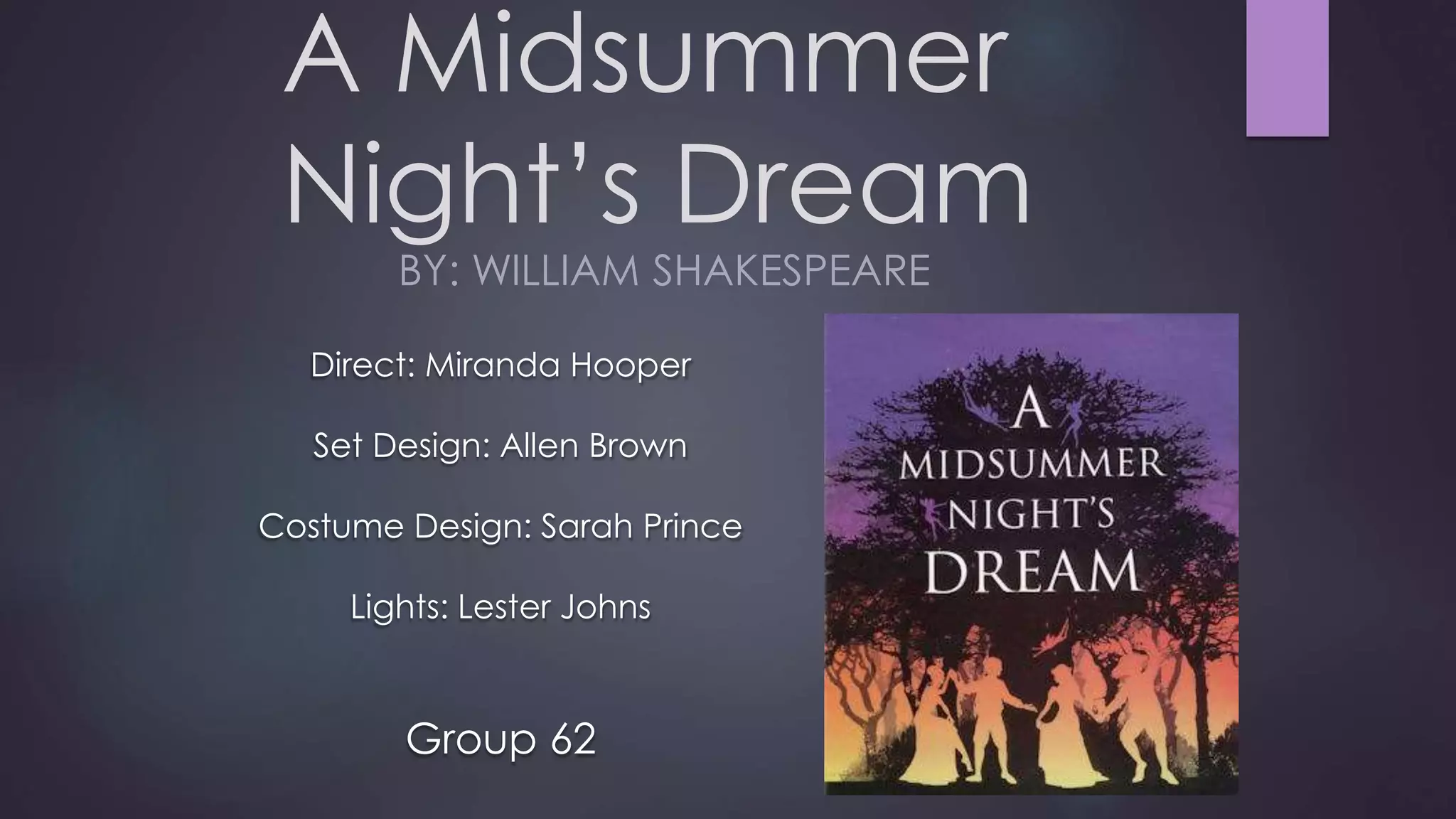
A Midsummer 
Night’s Dream 
BY: WILLIAM SHAKESPEARE 
Direct: Miranda Hooper 
Set Design: Allen Brown 
Costume Design: Sarah Prince 
Lights: Lester Johns 
Group 62
Miranda Hooper
Choosing a script 
 When choosing the script, 
my team and I considered 
all choices and the possible 
ideas we could do to 
produce the play. 
 We chose the script that 
stood out the most to us 
and that seemed to have 
the most interesting 
storyline as well as the most 
audience interest.
Choice of Style 
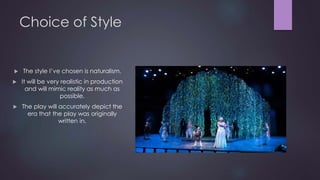
 The style I’ve chosen is naturalism. 
 It will be very realistic in production 
and will mimic reality as much as 
possible. 
 The play will accurately depict the 
era that the play was originally 
written in.
Casting 
 Casting is a very important aspect of a play’s production. 
You have to find someone who will fit the persona and 
actions of the characters in the play. 
 The actors being chosen must be similar in character to be 
able to accurately portray the characters’ motives. 
 This creates a better, more realistic production that has 
more audience appeal and creates a more believable 
scene. Audiences can become more connected to the 
play when the actions and emotions coming from the 
actors are real.
Casting 
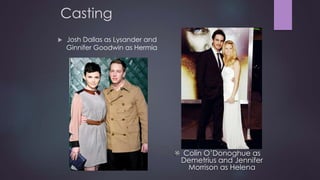
 Josh Dallas as Lysander and 
Ginnifer Goodwin as Hermia 
Colin O’Donoghue as 
Demetrius and Jennifer 
Morrison as Helena
Casting 
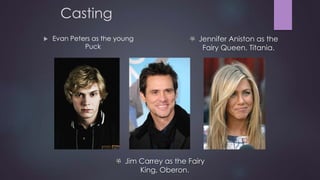
 Evan Peters as the young 
Puck 
Jennifer Aniston as the 
Fairy Queen, Titania. 
Jim Carrey as the Fairy 
King, Oberon.
Casting 
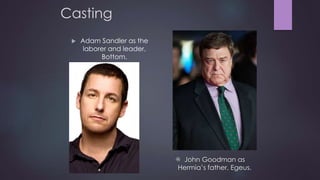
 Adam Sandler as the 
laborer and leader, 
Bottom. 
John Goodman as 
Hermia’s father, Egeus.
Casting 
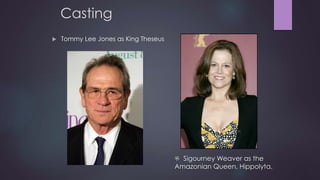
 Tommy Lee Jones as King Theseus 
Sigourney Weaver as the 
Amazonian Queen, Hippolyta.
The “Spine” of the Script 
 The “spine” of a script is the 
overall theme or main 
concept of a play. 
 Though there were many 
aspects of the play that 
provoked insightful ideas, 
the main theme, that I 
believe is the “spine” of the 
play, is that love is a 
complicated endeavor.
Set Design 
ALLEN BROWN
Environment 
 The way that I will set the environment: 
 Since the play starts off in a palace and later switches 
to a forest and then back to the palace I will make 
the walls of the set two sided. 
 On one side will be the wall of the palace. 
 On the other will be made to look like a forest 
 This way both of the scenes can be designed into the 
plays set.
Mood and Style 
 Naturalism 
 This means that the scene that is set in the 
palace will literally be the interior of a palace. 
 Same goes for the forest scene the walls will turn 
and will make the persona of a forest.
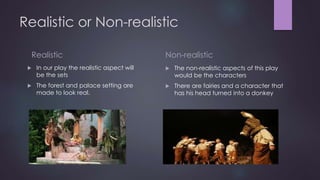
Realistic or Non-realistic 
Realistic 
 In our play the realistic aspect will 
be the sets 
 The forest and palace setting are 
made to look real. 
Non-realistic 
 The non-realistic aspects of this play 
would be the characters 
 There are fairies and a character that 
has his head turned into a donkey
Locale and Period 
 Play takes place in a palace and a forest 
 You can tell from what is said that the play is set in the past because 
of how they speak and what they will be wearing. 
 The setting will also have things that will help the audience in 
placing a date on the play. 
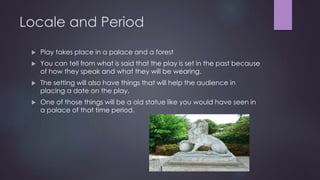
 One of those things will be a old statue like you would have seen in 
a palace of that time period.
Design Concept 
 In A Midsummer night’s dream the set changes 
from the palace to a forest and back to a 
palace. 
 This was a key focus of the plays design concept 
Had to make sure that the focus of the play 
would be able to notice a specific transition 
between scenes when they switched
Central image/ visual metaphor 
 This can be an object that has a thematic 
representation 
 In A midsummer nights dream rather an object 
it’s two characters that server as a visual 
metaphor 
Theseus and Hippolyta represent order and 
structure when things go wrong.
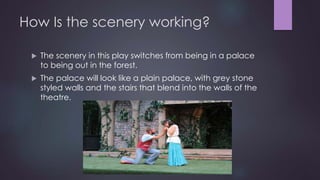
How Is the scenery working? 
 The scenery in this play switches from being in a palace 
to being out in the forest. 
 The palace will look like a plain palace, with grey stone 
styled walls and the stairs that blend into the walls of the 
theatre.
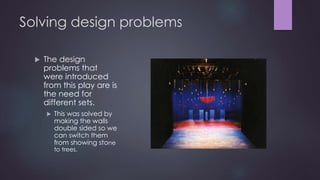
Solving design problems 
 The design 
problems that 
were introduced 
from this play are is 
the need for 
different sets. 
 This was solved by 
making the walls 
double sided so we 
can switch them 
from showing stone 
to trees.
Lights 
LESTER JOHNS
Lights 
Act. I 
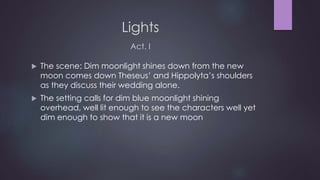
 The scene: Dim moonlight shines down from the new 
moon comes down Theseus’ and Hippolyta’s shoulders 
as they discuss their wedding alone. 
 The setting calls for dim blue moonlight shining 
overhead, well lit enough to see the characters well yet 
dim enough to show that it is a new moon
Act I 
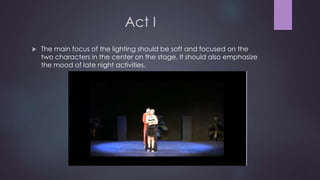
 The main focus of the lighting should be soft and focused on the 
two characters in the center on the stage. It should also emphasize 
the mood of late night activities.
Act II 
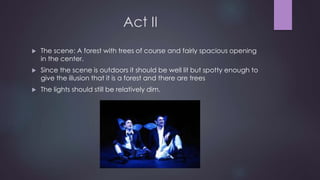
 The scene: A forest with trees of course and fairly spacious opening 
in the center. 
 Since the scene is outdoors it should be well lit but spotty enough to 
give the illusion that it is a forest and there are trees 
 The lights should still be relatively dim.
Act II 
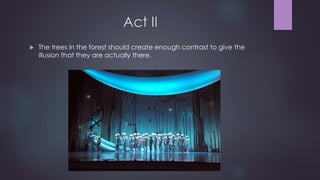
 The trees in the forest should create enough contrast to give the 
illusion that they are actually there.
Act III 
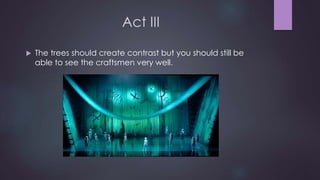
 The scene: The woods where the craftsmen will rehearse 
their play. 
 Everything should be pretty well lit but bluish for them all 
to rehearse and see each other it is morning. 
 The contract from the trees should still be there but more 
because of the sunlight 
 This is the longest act so the lights should end up getting 
dimmer by the end of the scene
Act III 
 The trees should create contrast but you should still be 
able to see the craftsmen very well.
Act IV 
 The scene: The Athenians lie asleep in the grove 
the light should be dimmed but not in excess the 
scene needs to still be visible 
 This is the shortest act in the play and serves as 
an transition so the lighting is the same 
throughout
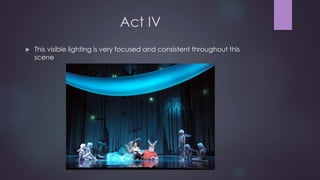
Act IV 
 This visible lighting is very focused and consistent throughout this 
scene
Act V 
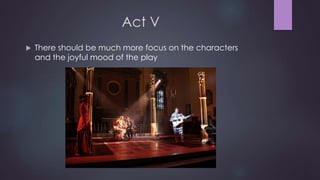
 The scene: Inside of Theseus’ palace, the lighting should 
reflect that of royalty with a more yellowish tone. 
 this scene has a mix of emotions but excitement is 
among the most dominant, all of the characters reflect 
this emotion 
 This is the final act of the play and is being set for the 
final scene 
 The lighting should be easygoing and gentle to match 
the mood of a happy ending
Act V 
 There should be much more focus on the characters 
and the joyful mood of the play
Costume Design 
SARAH PRINCE
Style 
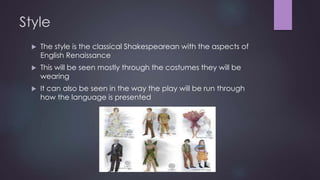
 The style is the classical Shakespearean with the aspects of 
English Renaissance 
 This will be seen mostly through the costumes they will be 
wearing 
 It can also be seen in the way the play will be run through 
how the language is presented
Historical Period 
 London 1594 to 1595 
 Athens forest outside the walls 
 English Renaissance 
 Costumes will be Shakespearean with a 
heighten since of English clothes
Relationships 
Major Characters 
• Puck (Robin Goodfellow) 
• Nick Bottom 
• Helena 
• Lysander 
• Demetrius 
• Hermia 
Minor Characters 
• Oberon 
• Titania 
• Laborers 
• Theseus 
• Egeus
Contrasting Characters 
 Main characters: 
 Clothing will pop out having brighter clothing 
 Will be nicer and fancy English clothing 
 Minor characters: 
 Lighter coloring clothes 
 Will not stand out as much as main characters 
 Fairies 
 Following cloths 
 White to use the lighting on stage as an accent 
 Laborers 
 Clothing will be ragged 
 Makes it seem that they do much work and are not as wealthy as the others
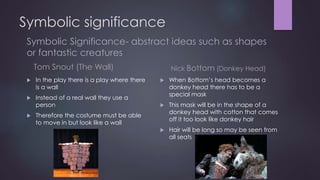
Symbolic significance 
Symbolic Significance- abstract ideas such as shapes 
or fantastic creatures 
Tom Snout (The Wall) 
 In the play there is a play where there 
is a wall 
 Instead of a real wall they use a 
person 
 Therefore the costume must be able 
to move in but look like a wall 
Nick Bottom (Donkey Head) 
 When Bottom’s head becomes a 
donkey head there has to be a 
special mask 
 This mask will be in the shape of a 
donkey head with cotton that comes 
off it too look like donkey hair 
 Hair will be long so may be seen from 
all seats
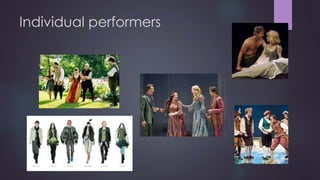
Individual performers
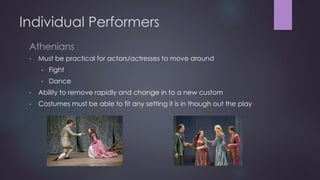
Individual Performers 
Athenians 
• Must be practical for actors/actresses to move around 
• Fight 
• Dance 
• Ability to remove rapidly and change in to a new custom 
• Costumes must be able to fit any setting it is in though out the play
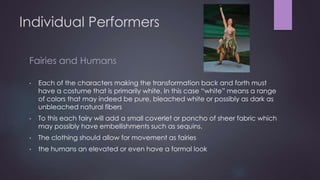
Individual Performers 
Fairies and Humans 
• Each of the characters making the transformation back and forth must 
have a costume that is primarily white. In this case “white” means a range 
of colors that may indeed be pure, bleached white or possibly as dark as 
unbleached natural fibers 
• To this each fairy will add a small coverlet or poncho of sheer fabric which 
may possibly have embellishments such as sequins. 
• The clothing should allow for movement as fairies 
• the humans an elevated or even have a formal look

Midsummer Nights Dream Egging Grroup 62

  • 1.
    A Midsummer Night’sDream BY: WILLIAM SHAKESPEARE Direct: Miranda Hooper Set Design: Allen Brown Costume Design: Sarah Prince Lights: Lester Johns Group 62
  • 2.
  • 3.
    Choosing a script  When choosing the script, my team and I considered all choices and the possible ideas we could do to produce the play.  We chose the script that stood out the most to us and that seemed to have the most interesting storyline as well as the most audience interest.
  • 4.
    Choice of Style  The style I’ve chosen is naturalism.  It will be very realistic in production and will mimic reality as much as possible.  The play will accurately depict the era that the play was originally written in.
  • 5.
    Casting  Castingis a very important aspect of a play’s production. You have to find someone who will fit the persona and actions of the characters in the play.  The actors being chosen must be similar in character to be able to accurately portray the characters’ motives.  This creates a better, more realistic production that has more audience appeal and creates a more believable scene. Audiences can become more connected to the play when the actions and emotions coming from the actors are real.
  • 6.
    Casting  JoshDallas as Lysander and Ginnifer Goodwin as Hermia Colin O’Donoghue as Demetrius and Jennifer Morrison as Helena
  • 7.
    Casting  EvanPeters as the young Puck Jennifer Aniston as the Fairy Queen, Titania. Jim Carrey as the Fairy King, Oberon.
  • 8.
    Casting  AdamSandler as the laborer and leader, Bottom. John Goodman as Hermia’s father, Egeus.
  • 9.
    Casting  TommyLee Jones as King Theseus Sigourney Weaver as the Amazonian Queen, Hippolyta.
  • 10.
    The “Spine” ofthe Script  The “spine” of a script is the overall theme or main concept of a play.  Though there were many aspects of the play that provoked insightful ideas, the main theme, that I believe is the “spine” of the play, is that love is a complicated endeavor.
  • 11.
  • 12.
    Environment  Theway that I will set the environment:  Since the play starts off in a palace and later switches to a forest and then back to the palace I will make the walls of the set two sided.  On one side will be the wall of the palace.  On the other will be made to look like a forest  This way both of the scenes can be designed into the plays set.
  • 13.
    Mood and Style  Naturalism  This means that the scene that is set in the palace will literally be the interior of a palace.  Same goes for the forest scene the walls will turn and will make the persona of a forest.
  • 14.
    Realistic or Non-realistic Realistic  In our play the realistic aspect will be the sets  The forest and palace setting are made to look real. Non-realistic  The non-realistic aspects of this play would be the characters  There are fairies and a character that has his head turned into a donkey
  • 15.
    Locale and Period  Play takes place in a palace and a forest  You can tell from what is said that the play is set in the past because of how they speak and what they will be wearing.  The setting will also have things that will help the audience in placing a date on the play.  One of those things will be a old statue like you would have seen in a palace of that time period.
  • 16.
    Design Concept In A Midsummer night’s dream the set changes from the palace to a forest and back to a palace.  This was a key focus of the plays design concept Had to make sure that the focus of the play would be able to notice a specific transition between scenes when they switched
  • 17.
    Central image/ visualmetaphor  This can be an object that has a thematic representation  In A midsummer nights dream rather an object it’s two characters that server as a visual metaphor Theseus and Hippolyta represent order and structure when things go wrong.
  • 18.
    How Is thescenery working?  The scenery in this play switches from being in a palace to being out in the forest.  The palace will look like a plain palace, with grey stone styled walls and the stairs that blend into the walls of the theatre.
  • 19.
    Solving design problems  The design problems that were introduced from this play are is the need for different sets.  This was solved by making the walls double sided so we can switch them from showing stone to trees.
  • 20.
  • 21.
    Lights Act. I  The scene: Dim moonlight shines down from the new moon comes down Theseus’ and Hippolyta’s shoulders as they discuss their wedding alone.  The setting calls for dim blue moonlight shining overhead, well lit enough to see the characters well yet dim enough to show that it is a new moon
  • 22.
    Act I The main focus of the lighting should be soft and focused on the two characters in the center on the stage. It should also emphasize the mood of late night activities.
  • 23.
    Act II The scene: A forest with trees of course and fairly spacious opening in the center.  Since the scene is outdoors it should be well lit but spotty enough to give the illusion that it is a forest and there are trees  The lights should still be relatively dim.
  • 24.
    Act II The trees in the forest should create enough contrast to give the illusion that they are actually there.
  • 25.
    Act III The scene: The woods where the craftsmen will rehearse their play.  Everything should be pretty well lit but bluish for them all to rehearse and see each other it is morning.  The contract from the trees should still be there but more because of the sunlight  This is the longest act so the lights should end up getting dimmer by the end of the scene
  • 26.
    Act III The trees should create contrast but you should still be able to see the craftsmen very well.
  • 27.
    Act IV The scene: The Athenians lie asleep in the grove the light should be dimmed but not in excess the scene needs to still be visible  This is the shortest act in the play and serves as an transition so the lighting is the same throughout
  • 28.
    Act IV This visible lighting is very focused and consistent throughout this scene
  • 29.
    Act V The scene: Inside of Theseus’ palace, the lighting should reflect that of royalty with a more yellowish tone.  this scene has a mix of emotions but excitement is among the most dominant, all of the characters reflect this emotion  This is the final act of the play and is being set for the final scene  The lighting should be easygoing and gentle to match the mood of a happy ending
  • 30.
    Act V There should be much more focus on the characters and the joyful mood of the play
  • 31.
  • 32.
    Style  Thestyle is the classical Shakespearean with the aspects of English Renaissance  This will be seen mostly through the costumes they will be wearing  It can also be seen in the way the play will be run through how the language is presented
  • 33.
    Historical Period London 1594 to 1595  Athens forest outside the walls  English Renaissance  Costumes will be Shakespearean with a heighten since of English clothes
  • 34.
    Relationships Major Characters • Puck (Robin Goodfellow) • Nick Bottom • Helena • Lysander • Demetrius • Hermia Minor Characters • Oberon • Titania • Laborers • Theseus • Egeus
  • 35.
    Contrasting Characters Main characters:  Clothing will pop out having brighter clothing  Will be nicer and fancy English clothing  Minor characters:  Lighter coloring clothes  Will not stand out as much as main characters  Fairies  Following cloths  White to use the lighting on stage as an accent  Laborers  Clothing will be ragged  Makes it seem that they do much work and are not as wealthy as the others
  • 36.
    Symbolic significance SymbolicSignificance- abstract ideas such as shapes or fantastic creatures Tom Snout (The Wall)  In the play there is a play where there is a wall  Instead of a real wall they use a person  Therefore the costume must be able to move in but look like a wall Nick Bottom (Donkey Head)  When Bottom’s head becomes a donkey head there has to be a special mask  This mask will be in the shape of a donkey head with cotton that comes off it too look like donkey hair  Hair will be long so may be seen from all seats
  • 37.
  • 38.
    Individual Performers Athenians • Must be practical for actors/actresses to move around • Fight • Dance • Ability to remove rapidly and change in to a new custom • Costumes must be able to fit any setting it is in though out the play
  • 39.
    Individual Performers Fairiesand Humans • Each of the characters making the transformation back and forth must have a costume that is primarily white. In this case “white” means a range of colors that may indeed be pure, bleached white or possibly as dark as unbleached natural fibers • To this each fairy will add a small coverlet or poncho of sheer fabric which may possibly have embellishments such as sequins. • The clothing should allow for movement as fairies • the humans an elevated or even have a formal look

Editor's Notes

  • #16 Need to find out if the PowerPoint needs to be over things from the play or if it needs to be over the types of things.