A Midsummer Night's Dream
DAY 1 - https://youtu.be/M1wMfOwlAZ8
A Midsummer Night’s Dream - Genre
A Midsummer Night’s Dream, comedy (romcom) in five acts by William
Shakespeare, written about 1595–96 and published in 1600 in a quarto edition from
the author’s manuscript, in which there are some minor inconsistencies. The earliest
texts of William Shakespeare's works were published during the 16th and 17th
centuries in quarto or folio format. Folios are large, tall volumes; quartos are smaller,
roughly half the size. The publications of the latter are usually abbreviated to Q1, Q2,
etc., where the letter stands for "quarto" and the number for the first, second, or third
edition published.
The version published in the First Folio of 1623 was taken from a second quarto
edition, with some reference to a promptbook. One of the “great” or “middle”
comedies, A Midsummer Night’s Dream, with its multilayered examination of love
and its vagaries, has long been one of the most popular of Shakespeare’s plays.
Quarto refers to the format
(and implicitly, the size) of
a book that results from
printing four pages on
each side of a sheet of
paper, front and back,
and folding the sheet
twice, each time folding
against the long side.
Eight pages are thus
printed on one sheet of
paper.
Ancient Greek
comedy was divided
into three periods:
Old Comedy, Middle
Comedy, and New
Comedy.
First Folio, first published
edition (1623) of the collected
works of
William Shakespeare,
originally published as Mr.
William Shakespeares
Comedies, Histories &
Tragedies. It is the major
source for contemporary
texts of his plays.
Midsummer Madness
People in Northern Europe and Great Britain enjoy Midsummer and celebrate Midsummer
Day. It's an ancient day that many people still enjoy because summer in that cold part of the
world, calls for celebration! Celebrated in n mid-June, it seems nature has burst into life and like
the Sun never sets. In fact, in the north of Sweden, it doesn’t, and in the south, only for an hour
or two. Historically, this day marks the midpoint of the growing season, halfway between planting
and harvest.
The night before Midsummer Day is called Midsummer Eve (June 23) which is on or near the
shortest night of the year! Celebrations for Midsummer typically begin on Midsummer's Eve.
Dancing, feasting, bonfires, and general merrymaking are hallmarks of the night!
Astronomically speaking, summer begins on the solstice. In 2021, the ‘solstice’ arrived
Saturday, June 20. At this moment, the Sun reached its highest and northernmost points in the
sky and Earth’s North Pole tilts directly toward the Sun.
Midsummer Madness is a temporary lapse into foolishness, senseless behavior, folly, etc.,
especially during the summer. The play is centred around this “madness” features ample
wordplay, underscoring the nonsensical mischief of the plot.
SETTING
A Midsummer Night’s Dream takes place partly in the city of Athens, and partly in
the forest that lies beyond the city’s walls. This split between city and forest is
thematically significant. The city of Athens is depicted as a place of civilization, law,
and order, while the forest is a place of wildness, anarchy, and chaos. As if to
underline the idea of Athens as a place of law and order, the play opens with Egeus
bringing a legal dispute before Theseus.
As duke of Athens, Theseus stands as the city’s chief legal authority. His primary
responsibility is to uphold the law, which he attempts to do when he rules that
Hermia must obey her father and marry Demetrius instead of Lysander. In contrast
to this display of Athenian rule of law, the forest appears decidedly unruly—which is
to say, ruled by fairy mischief. The forest is a place where social norms break down,
as exemplified in the increasing chaos and confusion that afflicts the Athenian lovers
as well as Titania and Nick Bottom.
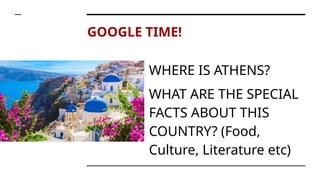
GOOGLE TIME!
WHERE IS ATHENS?
WHAT ARE THE SPECIAL
FACTS ABOUT THIS
COUNTRY? (Food,
Culture, Literature etc)
MAGIC IN SHAKESPEARE’S TIMES
Have you ever wondered why Shakespeare used witchcraft and the supernatural in many of
his works?
Even in Shakespeare’s day people were extremely superstitious. During the Elizabethan era people
blamed unexplainable events such as the Bubonic Plague, unexplained deaths or unpleasant
illnesses - as the work of witches. Some of Shakespeare’s most well-known plays such as Macbeth,
Hamlet, The Tempest and Julius Caesar were very much influenced by witchcraft and the
supernatural.He often used ghosts, witches, floating daggers and prophetic apparitions throughout his
plays. In Macbeth he used characters such as the witches to bring dark magic and suspense. In
Shakespeare's day those accused of witchcraft, or being a witch, were generally old, poor and single
women, widows or 'wise women'.
In 1542 Parliament passed the Witchcraft Act which defined witchcraft as a crime punishable by
death. It was repealed five years later, but restored by a new Act in 1562.A further law was passed in
1604 during the reign of James I who took a keen interest in demonology and even published a book
on it. The 1562 and 1604 Acts transferred the trial of witches from the Church to the ordinary
courts.As well as the charge of ‘mischief following anger’, there were other ways witches were
identified at trial. One was the presence of ‘witch marks’, a mark supposed to have been put on a
woman’s body by the Devil.Water was another commonly used means of determining whether women
were witches: water was seen as inherently pure, so a suspected witch would be tied up and thrown
in a pond or lake.If the suspect sank, the water ‘accepted’ her and therefore she was not a witch, but
if she floated, the water ‘rejected’ her, and she was presumed a witch.
READING TIME!
READ THE COMIC STRIP
VERSION IN THE TEXTBOOK TO
ENJOY THIS MAD MAD STORY!
DAY 2 - The Plot and the
Themes
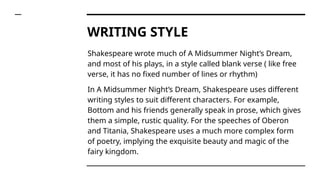
WRITING STYLE
Shakespeare wrote much of A Midsummer Night’s Dream,
and most of his plays, in a style called blank verse ( like free
verse, it has no fixed number of lines or rhythm)
In A Midsummer Night’s Dream, Shakespeare uses different
writing styles to suit different characters. For example,
Bottom and his friends generally speak in prose, which gives
them a simple, rustic quality. For the speeches of Oberon
and Titania, Shakespeare uses a much more complex form
of poetry, implying the exquisite beauty and magic of the
fairy kingdom.
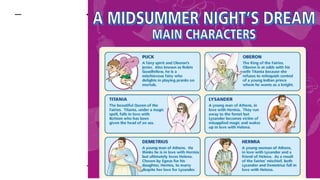
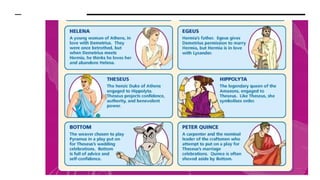
CHARACTERS
A SHORT SUMMARY OF THE PLOT
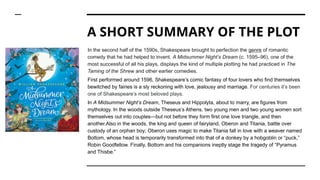
In the second half of the 1590s, Shakespeare brought to perfection the genre of romantic
comedy that he had helped to invent. A Midsummer Night’s Dream (c. 1595–96), one of the
most successful of all his plays, displays the kind of multiple plotting he had practiced in The
Taming of the Shrew and other earlier comedies.
First performed around 1596, Shakespeare’s comic fantasy of four lovers who find themselves
bewitched by fairies is a sly reckoning with love, jealousy and marriage. For centuries it’s been
one of Shakespeare’s most beloved plays.
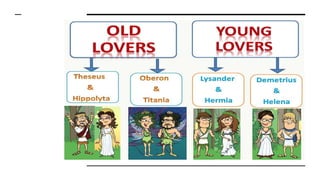
In A Midsummer Night’s Dream, Theseus and Hippolyta, about to marry, are figures from
mythology. In the woods outside Theseus’s Athens, two young men and two young women sort
themselves out into couples—but not before they form first one love triangle, and then
another.Also in the woods, the king and queen of fairyland, Oberon and Titania, battle over
custody of an orphan boy; Oberon uses magic to make Titania fall in love with a weaver named
Bottom, whose head is temporarily transformed into that of a donkey by a hobgoblin or “puck,”
Robin Goodfellow. Finally, Bottom and his companions ineptly stage the tragedy of “Pyramus
and Thisbe.”
As we follow the events of the opening scene, you should make a note of characters
in your books, like a cast list in a theatre programme.
Each time you encounter a new character, you should record:
•their name;
•their relationship to other characters;
•personality traits;
•any other key details.
Please Make a Note
MidSummer Night's Dream Presentation Grade VI

MidSummer Night's Dream Presentation Grade VI

  • 1.
  • 2.
    DAY 1 -https://youtu.be/M1wMfOwlAZ8
  • 3.
    A Midsummer Night’sDream - Genre A Midsummer Night’s Dream, comedy (romcom) in five acts by William Shakespeare, written about 1595–96 and published in 1600 in a quarto edition from the author’s manuscript, in which there are some minor inconsistencies. The earliest texts of William Shakespeare's works were published during the 16th and 17th centuries in quarto or folio format. Folios are large, tall volumes; quartos are smaller, roughly half the size. The publications of the latter are usually abbreviated to Q1, Q2, etc., where the letter stands for "quarto" and the number for the first, second, or third edition published. The version published in the First Folio of 1623 was taken from a second quarto edition, with some reference to a promptbook. One of the “great” or “middle” comedies, A Midsummer Night’s Dream, with its multilayered examination of love and its vagaries, has long been one of the most popular of Shakespeare’s plays. Quarto refers to the format (and implicitly, the size) of a book that results from printing four pages on each side of a sheet of paper, front and back, and folding the sheet twice, each time folding against the long side. Eight pages are thus printed on one sheet of paper. Ancient Greek comedy was divided into three periods: Old Comedy, Middle Comedy, and New Comedy. First Folio, first published edition (1623) of the collected works of William Shakespeare, originally published as Mr. William Shakespeares Comedies, Histories & Tragedies. It is the major source for contemporary texts of his plays.
  • 4.
    Midsummer Madness People inNorthern Europe and Great Britain enjoy Midsummer and celebrate Midsummer Day. It's an ancient day that many people still enjoy because summer in that cold part of the world, calls for celebration! Celebrated in n mid-June, it seems nature has burst into life and like the Sun never sets. In fact, in the north of Sweden, it doesn’t, and in the south, only for an hour or two. Historically, this day marks the midpoint of the growing season, halfway between planting and harvest. The night before Midsummer Day is called Midsummer Eve (June 23) which is on or near the shortest night of the year! Celebrations for Midsummer typically begin on Midsummer's Eve. Dancing, feasting, bonfires, and general merrymaking are hallmarks of the night! Astronomically speaking, summer begins on the solstice. In 2021, the ‘solstice’ arrived Saturday, June 20. At this moment, the Sun reached its highest and northernmost points in the sky and Earth’s North Pole tilts directly toward the Sun. Midsummer Madness is a temporary lapse into foolishness, senseless behavior, folly, etc., especially during the summer. The play is centred around this “madness” features ample wordplay, underscoring the nonsensical mischief of the plot.
  • 5.
    SETTING A Midsummer Night’sDream takes place partly in the city of Athens, and partly in the forest that lies beyond the city’s walls. This split between city and forest is thematically significant. The city of Athens is depicted as a place of civilization, law, and order, while the forest is a place of wildness, anarchy, and chaos. As if to underline the idea of Athens as a place of law and order, the play opens with Egeus bringing a legal dispute before Theseus. As duke of Athens, Theseus stands as the city’s chief legal authority. His primary responsibility is to uphold the law, which he attempts to do when he rules that Hermia must obey her father and marry Demetrius instead of Lysander. In contrast to this display of Athenian rule of law, the forest appears decidedly unruly—which is to say, ruled by fairy mischief. The forest is a place where social norms break down, as exemplified in the increasing chaos and confusion that afflicts the Athenian lovers as well as Titania and Nick Bottom.
  • 6.
    GOOGLE TIME! WHERE ISATHENS? WHAT ARE THE SPECIAL FACTS ABOUT THIS COUNTRY? (Food, Culture, Literature etc)
  • 7.
    MAGIC IN SHAKESPEARE’STIMES Have you ever wondered why Shakespeare used witchcraft and the supernatural in many of his works? Even in Shakespeare’s day people were extremely superstitious. During the Elizabethan era people blamed unexplainable events such as the Bubonic Plague, unexplained deaths or unpleasant illnesses - as the work of witches. Some of Shakespeare’s most well-known plays such as Macbeth, Hamlet, The Tempest and Julius Caesar were very much influenced by witchcraft and the supernatural.He often used ghosts, witches, floating daggers and prophetic apparitions throughout his plays. In Macbeth he used characters such as the witches to bring dark magic and suspense. In Shakespeare's day those accused of witchcraft, or being a witch, were generally old, poor and single women, widows or 'wise women'. In 1542 Parliament passed the Witchcraft Act which defined witchcraft as a crime punishable by death. It was repealed five years later, but restored by a new Act in 1562.A further law was passed in 1604 during the reign of James I who took a keen interest in demonology and even published a book on it. The 1562 and 1604 Acts transferred the trial of witches from the Church to the ordinary courts.As well as the charge of ‘mischief following anger’, there were other ways witches were identified at trial. One was the presence of ‘witch marks’, a mark supposed to have been put on a woman’s body by the Devil.Water was another commonly used means of determining whether women were witches: water was seen as inherently pure, so a suspected witch would be tied up and thrown in a pond or lake.If the suspect sank, the water ‘accepted’ her and therefore she was not a witch, but if she floated, the water ‘rejected’ her, and she was presumed a witch.
  • 8.
    READING TIME! READ THECOMIC STRIP VERSION IN THE TEXTBOOK TO ENJOY THIS MAD MAD STORY!
  • 9.
    DAY 2 -The Plot and the Themes
  • 10.
    WRITING STYLE Shakespeare wrotemuch of A Midsummer Night’s Dream, and most of his plays, in a style called blank verse ( like free verse, it has no fixed number of lines or rhythm) In A Midsummer Night’s Dream, Shakespeare uses different writing styles to suit different characters. For example, Bottom and his friends generally speak in prose, which gives them a simple, rustic quality. For the speeches of Oberon and Titania, Shakespeare uses a much more complex form of poetry, implying the exquisite beauty and magic of the fairy kingdom.
  • 11.
  • 13.
    A SHORT SUMMARYOF THE PLOT In the second half of the 1590s, Shakespeare brought to perfection the genre of romantic comedy that he had helped to invent. A Midsummer Night’s Dream (c. 1595–96), one of the most successful of all his plays, displays the kind of multiple plotting he had practiced in The Taming of the Shrew and other earlier comedies. First performed around 1596, Shakespeare’s comic fantasy of four lovers who find themselves bewitched by fairies is a sly reckoning with love, jealousy and marriage. For centuries it’s been one of Shakespeare’s most beloved plays. In A Midsummer Night’s Dream, Theseus and Hippolyta, about to marry, are figures from mythology. In the woods outside Theseus’s Athens, two young men and two young women sort themselves out into couples—but not before they form first one love triangle, and then another.Also in the woods, the king and queen of fairyland, Oberon and Titania, battle over custody of an orphan boy; Oberon uses magic to make Titania fall in love with a weaver named Bottom, whose head is temporarily transformed into that of a donkey by a hobgoblin or “puck,” Robin Goodfellow. Finally, Bottom and his companions ineptly stage the tragedy of “Pyramus and Thisbe.”
  • 14.
    As we followthe events of the opening scene, you should make a note of characters in your books, like a cast list in a theatre programme. Each time you encounter a new character, you should record: •their name; •their relationship to other characters; •personality traits; •any other key details. Please Make a Note