Mid-Sized Enterprise Resource Planning
  Systems


                             Jeremy Watkins
                                       IT323
                              Laura Welmers
                           November 1, 2011

11/17/2011                                     1
Topic
                                    Discussions

 What is an Enterprise
  Resource Planning (ERP)
  System?
 How does an ERP System
  benefit a Mid-Sized
  Enterprise?
 Discuss the functional areas in
  a Mid-Sized Enterprise.
 How do the functional areas
  interact with one another when
  using an ERP System?


11/17/2011                                        2
What is an Enterprise Resource Planning (ERP) System?


 Enterprise resource planning (ERP)
  systems integrate the planning,
  management, and use of all of an
  organization’s resources.
 An enterprise resource planning
  systems is one the main software
  that major companies rely on to
  manage data on a daily basis.
 Enterprise resource planning
  systems make up of various
  business processes which are a
  number of inputted processes.
 These input processes are retrieved
  through various queries and
  outputted in the form of sales
  reports, forecast, and spreadsheet
  (Monk and Wagner).


11/17/2011                                                           3
How does an ERP System benefit a Mid-Sized Enterprise?

                          •   The main objectives of Enterprise
                              resource planning (ERP) systems are
                              closely inter-related with other
                              functional areas of the mid-sized
                              organization and to enable information
                              to travel throughout the other functional
                              areas.
                          •    Integration means that changes in one
                              functional area will be replicated to the
                              other functional areas (Rainer and
                              Turban).


11/17/2011                                                                4
What are the functional areas in a Mid-Sized Enterprise?


11/17/2011                                                 5
Accounting and Finance Department


 In the accounting and finance
  department, understanding
  enterprise resource planning
  (ERP) systems is very important.
 They perform financial
  accounting to provide summaries
  of operational data in managerial
  reports, controlling accounts,
  planning and budgeting, and
  cash-flow management.


11/17/2011                                        6
Accounting and Finance Department (cont’d)


                                It is also necessary to be aware of the
                                 transactions of all functional areas in
                                 a mid-sized business and how all
                                 systems are interconnected.
                                Financial accounting systems are one
                                 of the key components in an
                                 enterprise resource planning package.
                                Mid-sized companies consult with
                                 their clients through an enterprise
                                 resource planning system.
                                A number of conflicts in the supply
                                 chain, ranging from inventory to risk
                                 analysis, all apply to the accounting
                                 and finance department (Rainer and
                                 Turban).


11/17/2011                                                                 7
The Marketing and Sales Department


   Set the prices for products, promote product
    thought advertising and marketing, takes
    customer orders, support customers, and
    create sales forecasts.
   Expenses are usually the primary targets in
    reducing cost. Cost reductions not only
    improves the employee’s productivity but
    also increases customer service.
   Understanding how downstream segments
    work is important to the marketing and
    sales analyst. Downstream segments are
    used by the marketing and sales department
    to distribute channels and conduct customer
    service.
   Not utilizing downstream segments creates
    problems along the supply chain, reduces
    customer satisfaction, and deters marketing
    efforts. (Rainer and Turban).


11/17/2011                                                     8
The Marketing and Sales Department (cont’d)


11/17/2011                                           9
Supply Chain Management Department


                              •   Assist the manufacturing department
                                  when managing production tasks,
                                  handling of material, and inventories.
                                  The system also helps to reduce
                                  reoccurring costs with vendors and
                                  increase competitiveness.
                              •   Supply chain management
                                  departments produce the plan and
                                  orders of raw materials which are
                                  shipped by its suppliers.
                              •   They usher in the raw material into a
                                  business and ship the finish product
                                  to their valued customers (Monk and
                                  Wagner).


11/17/2011                                                                 10
Supply Chain Management Department (cont’d)


11/17/2011                                    11
Supply Chain Management Department (cont’d)


11/17/2011                                                 12
Supply Chain Management Flow Chart


11/17/2011                                        13
The Human Resources Department


•   The human resource department is
    responsible for hiring new
    employees.
•   They ensure that each employee is in
    compliance with various business
    functions by administering training.
    Human resources also evaluate
    employees to determine if they
    eligible for certain benefits.
•   Human resource employees need to
    understand the way data travels from
    their department to other functional
    areas within the network
    infrastructure(Monk and Wagner).


11/17/2011                                          14
The Human Resources Department (cont’d)


11/17/2011                                      15
The Human Resources Department (cont’d)


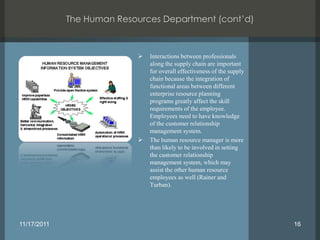
                              Interactions between professionals
                               along the supply chain are important
                               for overall effectiveness of the supply
                               chain because the integration of
                               functional areas between different
                               enterprise resource planning
                               programs greatly affect the skill
                               requirements of the employee.
                               Employees need to have knowledge
                               of the customer relationship
                               management system.
                              The human resource manager is more
                               than likely to be involved in setting
                               the customer relationship
                               management system, which may
                               assist the other human resource
                               employees as well (Rainer and
                               Turban).


11/17/2011                                                               16
Topic Recap

 What is an Enterprise Resource
  Planning (ERP) System?
 How does an ERP System benefit a
  Mid-Sized Enterprise?
 Discuss the functional areas in a
  Mid-Sized Enterprise.
 How do the functional areas
  interact with one another when
  using an ERP System?


11/17/2011                                     17
?Any Questions?


11/17/2011                     18
Works Cited
• Monk, Ellen F., and Bret J. Wagner. Concepts in
  Enterprise Resource Planning. Australia: Course
  Technology Cengage Learning, 2009. Print.
• Rainer, R. Kelly. Introduction to Information
  Systems: Supporting and Transforming Business.
  Hoboken, NJ: Wiley, 2008. Print.


11/17/2011                                          19

Mid Sized Enterprise Resource Planning Systems

  • 1.
    Mid-Sized Enterprise ResourcePlanning Systems Jeremy Watkins IT323 Laura Welmers November 1, 2011 11/17/2011 1
  • 2.
    Topic Discussions  What is an Enterprise Resource Planning (ERP) System?  How does an ERP System benefit a Mid-Sized Enterprise?  Discuss the functional areas in a Mid-Sized Enterprise.  How do the functional areas interact with one another when using an ERP System? 11/17/2011 2
  • 3.
    What is anEnterprise Resource Planning (ERP) System?  Enterprise resource planning (ERP) systems integrate the planning, management, and use of all of an organization’s resources.  An enterprise resource planning systems is one the main software that major companies rely on to manage data on a daily basis.  Enterprise resource planning systems make up of various business processes which are a number of inputted processes.  These input processes are retrieved through various queries and outputted in the form of sales reports, forecast, and spreadsheet (Monk and Wagner). 11/17/2011 3
  • 4.
    How does anERP System benefit a Mid-Sized Enterprise? • The main objectives of Enterprise resource planning (ERP) systems are closely inter-related with other functional areas of the mid-sized organization and to enable information to travel throughout the other functional areas. • Integration means that changes in one functional area will be replicated to the other functional areas (Rainer and Turban). 11/17/2011 4
  • 5.
    What are thefunctional areas in a Mid-Sized Enterprise? 11/17/2011 5
  • 6.
    Accounting and FinanceDepartment  In the accounting and finance department, understanding enterprise resource planning (ERP) systems is very important.  They perform financial accounting to provide summaries of operational data in managerial reports, controlling accounts, planning and budgeting, and cash-flow management. 11/17/2011 6
  • 7.
    Accounting and FinanceDepartment (cont’d)  It is also necessary to be aware of the transactions of all functional areas in a mid-sized business and how all systems are interconnected.  Financial accounting systems are one of the key components in an enterprise resource planning package.  Mid-sized companies consult with their clients through an enterprise resource planning system.  A number of conflicts in the supply chain, ranging from inventory to risk analysis, all apply to the accounting and finance department (Rainer and Turban). 11/17/2011 7
  • 8.
    The Marketing andSales Department  Set the prices for products, promote product thought advertising and marketing, takes customer orders, support customers, and create sales forecasts.  Expenses are usually the primary targets in reducing cost. Cost reductions not only improves the employee’s productivity but also increases customer service.  Understanding how downstream segments work is important to the marketing and sales analyst. Downstream segments are used by the marketing and sales department to distribute channels and conduct customer service.  Not utilizing downstream segments creates problems along the supply chain, reduces customer satisfaction, and deters marketing efforts. (Rainer and Turban). 11/17/2011 8
  • 9.
    The Marketing andSales Department (cont’d) 11/17/2011 9
  • 10.
    Supply Chain ManagementDepartment • Assist the manufacturing department when managing production tasks, handling of material, and inventories. The system also helps to reduce reoccurring costs with vendors and increase competitiveness. • Supply chain management departments produce the plan and orders of raw materials which are shipped by its suppliers. • They usher in the raw material into a business and ship the finish product to their valued customers (Monk and Wagner). 11/17/2011 10
  • 11.
    Supply Chain ManagementDepartment (cont’d) 11/17/2011 11
  • 12.
    Supply Chain ManagementDepartment (cont’d) 11/17/2011 12
  • 13.
    Supply Chain ManagementFlow Chart 11/17/2011 13
  • 14.
    The Human ResourcesDepartment • The human resource department is responsible for hiring new employees. • They ensure that each employee is in compliance with various business functions by administering training. Human resources also evaluate employees to determine if they eligible for certain benefits. • Human resource employees need to understand the way data travels from their department to other functional areas within the network infrastructure(Monk and Wagner). 11/17/2011 14
  • 15.
    The Human ResourcesDepartment (cont’d) 11/17/2011 15
  • 16.
    The Human ResourcesDepartment (cont’d)  Interactions between professionals along the supply chain are important for overall effectiveness of the supply chain because the integration of functional areas between different enterprise resource planning programs greatly affect the skill requirements of the employee. Employees need to have knowledge of the customer relationship management system.  The human resource manager is more than likely to be involved in setting the customer relationship management system, which may assist the other human resource employees as well (Rainer and Turban). 11/17/2011 16
  • 17.
    Topic Recap  Whatis an Enterprise Resource Planning (ERP) System?  How does an ERP System benefit a Mid-Sized Enterprise?  Discuss the functional areas in a Mid-Sized Enterprise.  How do the functional areas interact with one another when using an ERP System? 11/17/2011 17
  • 18.
  • 19.
    Works Cited • Monk,Ellen F., and Bret J. Wagner. Concepts in Enterprise Resource Planning. Australia: Course Technology Cengage Learning, 2009. Print. • Rainer, R. Kelly. Introduction to Information Systems: Supporting and Transforming Business. Hoboken, NJ: Wiley, 2008. Print. 11/17/2011 19