ITIL Glossary

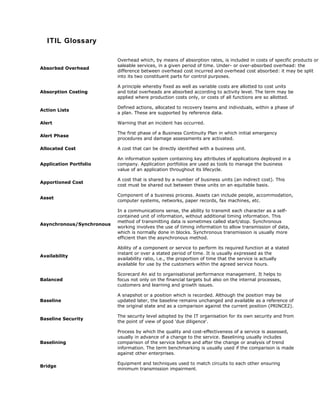
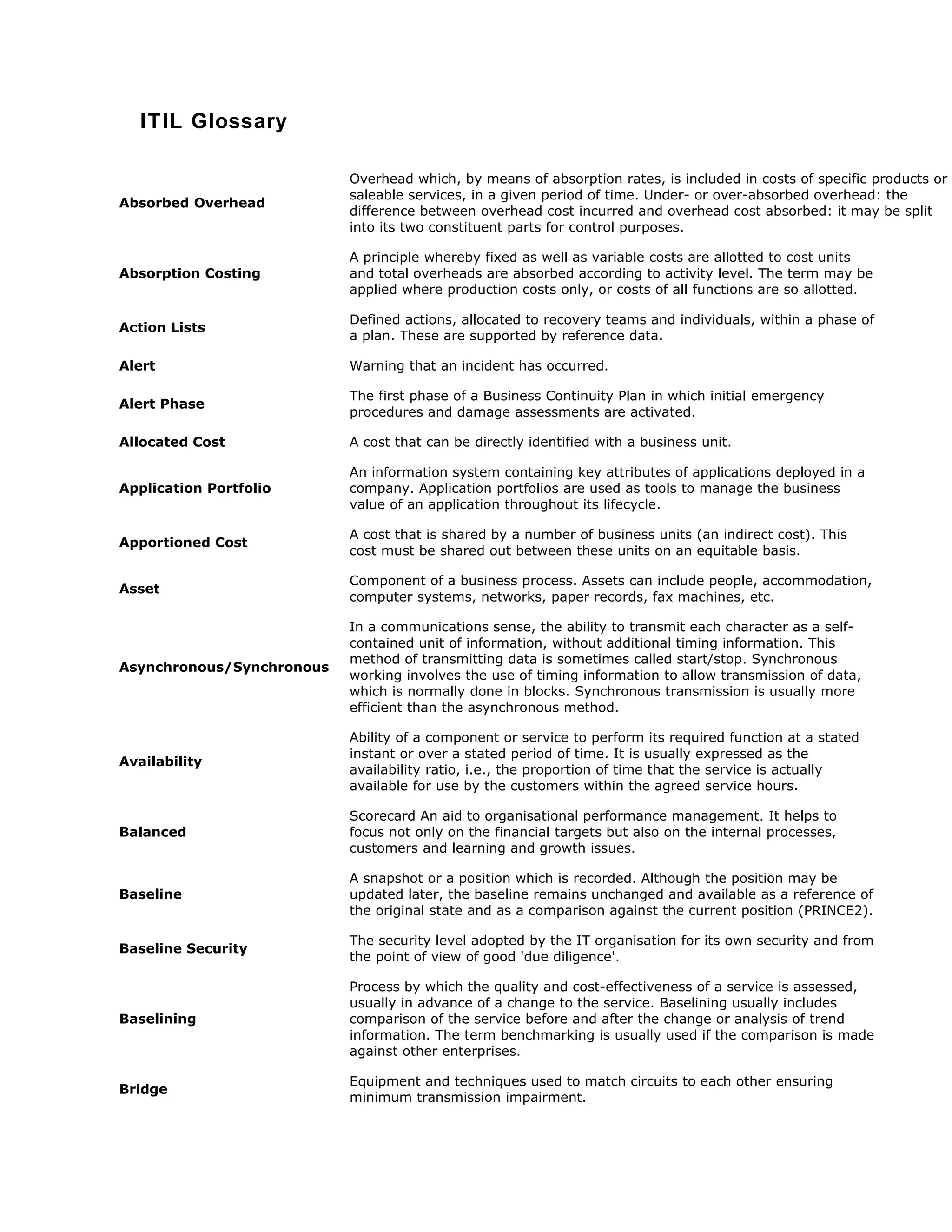
                           Overhead which, by means of absorption rates, is included in costs of specific products or
                           saleable services, in a given period of time. Under- or over-absorbed overhead: the
Absorbed Overhead
                           difference between overhead cost incurred and overhead cost absorbed: it may be split
                           into its two constituent parts for control purposes.

                           A principle whereby fixed as well as variable costs are allotted to cost units
Absorption Costing         and total overheads are absorbed according to activity level. The term may be
                           applied where production costs only, or costs of all functions are so allotted.

                           Defined actions, allocated to recovery teams and individuals, within a phase of
Action Lists
                           a plan. These are supported by reference data.

Alert                      Warning that an incident has occurred.

                           The first phase of a Business Continuity Plan in which initial emergency
Alert Phase
                           procedures and damage assessments are activated.

Allocated Cost             A cost that can be directly identified with a business unit.

                           An information system containing key attributes of applications deployed in a
Application Portfolio      company. Application portfolios are used as tools to manage the business
                           value of an application throughout its lifecycle.

                           A cost that is shared by a number of business units (an indirect cost). This
Apportioned Cost
                           cost must be shared out between these units on an equitable basis.

                           Component of a business process. Assets can include people, accommodation,
Asset
                           computer systems, networks, paper records, fax machines, etc.

                           In a communications sense, the ability to transmit each character as a self-
                           contained unit of information, without additional timing information. This
                           method of transmitting data is sometimes called start/stop. Synchronous
Asynchronous/Synchronous
                           working involves the use of timing information to allow transmission of data,
                           which is normally done in blocks. Synchronous transmission is usually more
                           efficient than the asynchronous method.

                           Ability of a component or service to perform its required function at a stated
                           instant or over a stated period of time. It is usually expressed as the
Availability
                           availability ratio, i.e., the proportion of time that the service is actually
                           available for use by the customers within the agreed service hours.

                           Scorecard An aid to organisational performance management. It helps to
Balanced                   focus not only on the financial targets but also on the internal processes,
                           customers and learning and growth issues.

                           A snapshot or a position which is recorded. Although the position may be
Baseline                   updated later, the baseline remains unchanged and available as a reference of
                           the original state and as a comparison against the current position (PRINCE2).

                           The security level adopted by the IT organisation for its own security and from
Baseline Security
                           the point of view of good 'due diligence'.

                           Process by which the quality and cost-effectiveness of a service is assessed,
                           usually in advance of a change to the service. Baselining usually includes
Baselining                 comparison of the service before and after the change or analysis of trend
                           information. The term benchmarking is usually used if the comparison is made
                           against other enterprises.

                           Equipment and techniques used to match circuits to each other ensuring
Bridge
                           minimum transmission impairment.
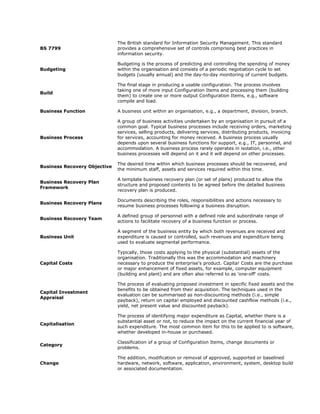
The British standard for Information Security Management. This standard
BS 7799                       provides a comprehensive set of controls comprising best practices in
                              information security.

                              Budgeting is the process of predicting and controlling the spending of money
Budgeting                     within the organisation and consists of a periodic negotiation cycle to set
                              budgets (usually annual) and the day-to-day monitoring of current budgets.

                              The final stage in producing a usable configuration. The process involves
                              taking one of more input Configuration Items and processing them (building
Build
                              them) to create one or more output Configuration Items, e.g., software
                              compile and load.

Business Function             A business unit within an organisation, e.g., a department, division, branch.

                              A group of business activities undertaken by an organisation in pursuit of a
                              common goal. Typical business processes include receiving orders, marketing
                              services, selling products, delivering services, distributing products, invoicing
Business Process              for services, accounting for money received. A business process usually
                              depends upon several business functions for support, e.g., IT, personnel, and
                              accommodation. A business process rarely operates in isolation, i.e., other
                              business processes will depend on it and it will depend on other processes.

                              The desired time within which business processes should be recovered, and
Business Recovery Objective
                              the minimum staff, assets and services required within this time.

                              A template business recovery plan (or set of plans) produced to allow the
Business Recovery Plan
                              structure and proposed contents to be agreed before the detailed business
Framework
                              recovery plan is produced.

                              Documents describing the roles, responsibilities and actions necessary to
Business Recovery Plans
                              resume business processes following a business disruption.

                              A defined group of personnel with a defined role and subordinate range of
Business Recovery Team
                              actions to facilitate recovery of a business function or process.

                              A segment of the business entity by which both revenues are received and
Business Unit                 expenditure is caused or controlled, such revenues and expenditure being
                              used to evaluate segmental performance.

                              Typically, those costs applying to the physical (substantial) assets of the
                              organisation. Traditionally this was the accommodation and machinery
Capital Costs                 necessary to produce the enterprise's product. Capita! Costs are the purchase
                              or major enhancement of fixed assets, for example, computer equipment
                              (building and plant) and are often also referred to as 'one-off' costs.

                              The process of evaluating proposed investment in specific fixed assets and the
                              benefits to be obtained from their acquisition. The techniques used in the
Capital Investment
                              evaluation can be summarised as non-discounting methods (i.e., simple
Appraisal
                              payback), return on capita! employed and discounted cashflow methods (i.e.,
                              yield, net present value and discounted payback).

                              The process of identifying major expenditure as Capital, whether there is a
                              substantial asset or not, to reduce the impact on the current financial year of
Capitalisation
                              such expenditure. The most common item for this to be applied to is software,
                              whether developed in-house or purchased.

                              Classification of a group of Configuration Items, change documents or
Category
                              problems.

                              The addition, modification or removal of approved, supported or baselined
Change                        hardware, network, software, application, environment, system, desktop build
                              or associated documentation.
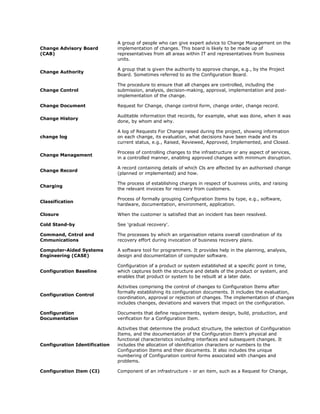
A group of people who can give expert advice to Change Management on the
Change Advisory Board          implementation of changes. This board is likely to be made up of
(CAB)                          representatives from all areas within IT and representatives from business
                               units.

                               A group that is given the authority to approve change, e.g., by the Project
Change Authority
                               Board. Sometimes referred to as the Configuration Board.

                               The procedure to ensure that all changes are controlled, including the
Change Control                 submission, analysis, decision-making, approval, implementation and post-
                               implementation of the change.

Change Document                Request for Change, change control form, change order, change record.

                               Auditable information that records, for example, what was done, when it was
Change History
                               done, by whom and why.

                               A log of Requests For Change raised during the project, showing information
change log                     on each change, its evaluation, what decisions have been made and its
                               current status, e.g., Raised, Reviewed, Approved, Implemented, and Closed.

                               Process of controlling changes to the infrastructure or any aspect of services,
Change Management
                               in a controlled manner, enabling approved changes with minimum disruption.

                               A record containing details of which Cls are affected by an authorised change
Change Record
                               (planned or implemented) and how.

                               The process of establishing charges in respect of business units, and raising
Charging
                               the relevant invoices for recovery from customers.

                               Process of formally grouping Configuration Items by type, e.g., software,
Classification
                               hardware, documentation, environment, application.

Closure                        When the customer is satisfied that an incident has been resolved.

Cold Stand-by                  See 'gradual recovery'.

Command, Cntrol and            The processes by which an organisation retains overall coordination of its
Cmmunications                  recovery effort during invocation of business recovery plans.

Computer-Aided Systems         A software tool for programmers. It provides help in the planning, analysis,
Engineering (CASE)             design and documentation of computer software.

                               Configuration of a product or system established at a specific point in time,
Configuration Baseline         which captures both the structure and details of the product or system, and
                               enables that product or system to be rebuilt at a later date.

                               Activities comprising the control of changes to Configuration Items after
                               formally establishing its configuration documents. It includes the evaluation,
Configuration Control
                               coordination, approval or rejection of changes. The implementation of changes
                               includes changes, deviations and waivers that impact on the configuration.

Configuration                  Documents that define requirements, system design, build, production, and
Documentation                  verification for a Configuration Item.

                               Activities that determine the product structure, the selection of Configuration
                               Items, and the documentation of the Configuration Item's physical and
                               functional characteristics including interfaces and subsequent changes. It
Configuration Identification   includes the allocation of identification characters or numbers to the
                               Configuration Items and their documents. It also includes the unique
                               numbering of Configuration control forms associated with changes and
                               problems.

Configuration Item (CI)        Component of an infrastructure - or an item, such as a Request for Change,
associated with an infrastructure - which is (or is to be) under the control of
                           Configuration Management. Cls may vary widely in complexity, size and type -
                           from an entire system (including all hardware, software and documentation)
                           to a single module or a minor hardware component.

                           The process of identifying and defining the Configuration Items in a system,
                           recording and reporting the status of Configuration Items and Requests For
Configuration Management
                           Change, and verifying the completeness and correctness of Configuration
                           Items.

Configuration Management   A database which contains all relevant details of each CI and details of the
Database (CMDB)            important relationships between Cls.

Configuration Management   Document setting out the organisation and procedures for the Configuration
Plan                       Management of a specific product, project, system, support group or service.

Configuration Management   A software product providing automatic support for change: Configuration or
Tool (CM Tool)             version control.

Configuration Structure    A hierarchy of all the Cls that comprise a configuration.

                           Planning to address unwanted occurrences that may happen at a later time.
Contingency Planning       Traditionally, the term has been used to refer to planning for the recovery of
                           IT systems rather than entire business processes.

                           An ongoing formal programme undertaken within an organisation to identify
Continuous Service
                           and introduce measurable improvements within a specified work area or work
Improvement Programme
                           process.

                           The amount of expenditure (actual or notional) incurred on, or attributable to,
Cost
                           a specific activity or business unit.

                           Ensuring that there is a proper balance between the Quality of Service on the
                           one side and expenditure on the other. Any investment that increases the
Cost-Effectiveness
                           costs of providing IT services should always result in enhancement to service
                           quality or quantity.

                           All the procedures, tasks and deliverables that are needed to fulfill an
Cost Management
                           organisation's costing and charging requirements.

                           A technique used to evaluate and measure the cost of failed actions and
                           activities. It can be measured as a total within a period or an average per
Cost of Failure
                           failure. An example would be 'the cost of failed changes per month' or 'the
                           average cost of a failed change'.

                           In the context of CSBC the cost unit is a functional cost unit which establishes
Cost Unit                  standard cost per workload element of activity, based on calculated activity
                           ratios converted to cost ratios.

                           The process of identifying the costs of the business and of breaking them
Costing
                           down and relating them to the various activities of the organisation.

                           A check or restraint on the service designed to enhance security by reducing
                           the risk of an attack (by reducing either the threat or the vulnerability),
Countermeasure
                           reducing the impact of an attack, detecting the occurrence of an attack and/or
                           assisting in the recovery from an attack.

                           The UK Government's Risk Analysis and Management Method. Further
CRAMM                      information is available from www.insight.co.uk/cramm/ or tel. 01932
                           241000.

                           The processes by which an organisation manages the wider impact of a
Crisis Management
                           disaster, such as adverse media coverage.
A measure of success or maturity of a project or process. It can be a state, a
Critical Success Factor (CSF)   deliverable or a milestone. An example of a CSF would be `the production of
                                an overall technology strategy'.

                                Recipient of the service; usually the customer management has responsibility
Customer                        for the cost of the service, either directly through charging or indirectly in
                                terms of demonstrable business need.

                                The length of time taken for a block or sector of data to be read from or
Data Transfer Time
                                written to an I/O device, such as a disk or tape.

                                The library in which the definitive authorised versions of all software Cls are
                                stored and protected. It is a physical library or storage repository where
                                master copies of software versions are placed. This one logical storage area
                                may, in reality, consist of one or more physical software libraries or filestores.
                                They should be separate from development and test filestore areas. The DSL
Definitive Software Library
                                may also include a physical store to hold master copies of bought-in software,
(DSL)
                                e.g., fireproof safe. Only authorised software should be accepted into the DSL,
                                strictly controlled by Change and Release Management. The DSL exists not
                                directly because of the needs of the Configuration Management process, but
                                as a common base for the Release Management and Configuration
                                Management processes.

                                A Delta, or partial. Release is one that includes only those Cls within the
                                Release unit that have actually changed or are new since the last full or Delta
                                Release. For example, if the Release unit is the program, a Delta Release
Delta Release
                                contains only those modules that have changed, or are new, since the last Full
                                Release of the program or the last Delta Release of the modules. See also ‘Full
                                Release’.

Dependency                      The reliance, either direct or indirect, of one process or activity upon another.

                                The loss in value of an asset due to its use and/or the passage of time. The
                                annual depreciation charge in accounts represents the amount of capital
                                assets used up in the accounting period. It is charged in the cost accounts to
                                ensure that the cost of capital equipment is reflected in the unit costs of the
Depreciation
                                services provided using the equipment. There are various methods of
                                calculating depreciation for the period, but the Treasury usually recommends
                                the use of current cost asset valuation as the basis for the depreciation
                                charge.

                                Charging business customers different rates for the same work, typically to
Differential Charging           dampen demand or to generate revenue for spare capacity. This can also be
                                used to encourage off-peak or nighttime running.

                                A cost that is incurred for, and can be traced in full to a product, service, cost
Direct Cost                     centre or department. This is an allocated cost. Direct costs are direct
                                materials, direct wages and direct expenses. See also `indirect cost'.

                                A series of processes that focus only upon the recovery processes, principally
Disaster Recovery Planning
                                in response to physical disasters, which are contained within BCM.

                                An evaluation of the future net cashflows generated by a capital project by
                                discounting them to their present-day value. The two methods most
                                commonly used are:
Discounted Cashflow             Yield method, for which the calculation determines the internal rate of return
                                (IRR) in the form of a percentage;
                                Net Present Value (NPV) method, in which the discount rate is chosen and the
                                answer is a sum of money.

                                The offering to business customers of reduced rates for the use of off-peak
Discounting
                                resources. See also 'surcharging'.
Memory that is used to store blocks of data that have been read from the disk
                         devices connected to them. If a subsequent I/O requires a record that is still
Disk Cache Controller
                         resident in the cache memory, it will be picked up from there, thus saving
                         another physical I/O.

                         Total period that a service or component is not operational, within agreed
Downtime
                         service times.

                         Full duplex line/channel allows simultaneous transmission in both directions.
Duplex (full and half)   Half duplex line/channel is capable of transmitting in both directions, but only
                         in one direction at a time.

                         A reflection of the transmitted signal from the receiving end; a visual method
Echoing                  of error detection in which the signal from the originating device is looped
                         back to that device so that it can be displayed.

                         The constituent parts of costs according to the factors upon which expenditure
Elements of Cost
                         is incurred viz., materials. labour and expenses.

End User                 See `User’.

                         A collection of hardware, software, network communications and procedures
                         that work together to provide a discrete type of computer service. There may
Environment              be one or more environments on a physical platform, e.g., test, production.
                         An environment has unique features and characteristics that dictate how they
                         are administered in similar, yet diverse manners.

Expert User              See 'Super User'.

                         One of the measures against which a delivered IT service is compared,
External Target
                         expressed in terms of the customer's business.

Financial Year           An accounting period covering 12 consecutive months.

                         Service Desk call logging and resolution (on agreed areas, for example, MS
First-Line Support
                         Word).

                         Commonly used metric, used to define incidents resolved at the first point of
                         contact between a customer and the Service Provider, without delay or
First Time Fix Rate
                         referral, generally by a front line support group such as a help desk or Service
                         Desk. First time fixes are a subset of remote fixes.

                         Contains details of all the changes approved for implementation and their
                         proposed implementation dates. It should be agreed with the customers and
Forward Schedule of      the business, Service Level Management, the Service Desk and Availability
Changes (FSC)            Management. Once agreed, the Service Desk should communicate to the user
                         community at large any planned additional downtime arising from
                         implementing the changes, using the most effective methods available.

                         The total cost of all the resources used in supplying a service, i.e., the sum of
                         the direct costs of producing the output, a proportional share of overhead
Full Cost                costs and any selling and distribution expenses. Both cash costs and notional
                         (non-cash) costs should be included, including the cost of capital. See also
                         `Total Cost of Ownership'.

                         All components of the Release unit are built, tested, distributed and
Full Release
                         implemented together. See also `Delta Release'.

                         Equipment which is used to interface networks so that a terminal on one
Gateway
                         network can communicate with services or a terminal on another.

Gradual Recovery         Previously called `cold stand-by', this is applicable to organisations that do
                         not need immediate restoration of business processes and can function for a
period of up to 72 hours, or longer, without a re-establishment of full IT
                           facilities. This may include the provision of empty accommodation fully
                           equipped with power, environmental controls and local network cabling
                           infrastructure, telecommunications connections, and available in a disaster
                           situation for an organisation to install its own computer equipment.

                           Descriptive of a situation where, within an organisation, actual funds are
Hard Charging              transferred from the customer to the IT organisation in payment for the
                           delivery of IT services.

                           The situation in a virtual memory system when the required page of code or
                           data that a program was using has been redeployed by the operating system
Hard Fault                 for some other purpose. This means that another piece of memory must be
                           found to accommodate the code or data, and will involve physical
                           reading/writing of pages to the page file.

                           A host computer comprises the central hardware and software resources of a
                           computer complex; e.g., CPU, memory, channels, disk and magnetic tape I0
Host
                           subsystems plus operating and applications software. The term is used to
                           denote all non-network items.

Hot stand-by               See 'immediate recovery'.

                           The convergence of Information Technology, Telecommunications and Data
ICT
                           Networking Technologies into a single technology.

                           Previously called 'hot stand-by', provides for the immediate restoration of
                           services following any irrecoverable incident. It is important to distinguish
                           between the previous definition of `hot stand-by' and `immediate recovery'.
Immediate recovery
                           Hot stand-by typically referred to availability of services within a short time-
                           scale such as 2 or 4 hours whereas immediate recovery implies the instant
                           availability of services.

                           Measure of the business criticality of an incident. Often equal to the extent to
Impact
                           which an incident leads to distortion of agreed or expected Service Levels.

                           The identification of critical business processes, and the potential damage or
Impact Analysis            loss that may be caused to the organisation resulting from a disruption to
                           those processes.

                           Simple code assigned to incidents and problems, reflecting the degree of
Impact Code                impact upon the customer's business processes. It is the major means of
                           assigning priority for dealing with incidents.

                           Description of the type of impact on the business that could follow a business
Impact Scenario            disruption. Usually related to a business process and will always refer to a
                           period of time, e.g., customer services will be unable to operate for two days.

                           Any event which is not part of the standard operation of a service and which
Incident                   causes, or may cause, an interruption to, or a reduction in, the quality of that
                           service.

                           The process of identifying, recording, classifying and progressing incidents
Incident Control
                           until affected services return to normal operation.

                           A cost incurred in the course of making a product providing a service or
                           running a cost centre or department, but which cannot be traced directly and
                           in full to the product, service or department, because it has been incurred for
Indirect Cost
                           a number of cost centres or cost units. These costs are apportioned to cost
                           centres/cost units. Indirect costs are also referred to as overheads. See also
                           'direct cost'.

Information Systems (IS)   The means of delivering information from one person to another; ICT is the
technical apparatus for doing so.

                          An individual, team or group with functional responsibility within an
                          organisation for ensuring that spend on IS/IT is directed to best effect, i.e.,
                          that the business is receiving value for money and continues to achieve the
                          most beneficial outcome. In order to fulfill its role the 'Informed' customer
                          function must gain clarity of vision in relation to the business plans and
                          ensure that suitable strategies are devised and maintained for achieving
                          business goals. The 'informed' customer function ensures that the needs of
Informed Customer         the business are effectively translated into a business requirements
                          specification, that IT investment is both efficiently and economically directed,
                          and that progress towards effective business solutions is monitored. The
                          `informed' customer should play an active role in the procurement process,
                          e.g., in relation to business case development, and also in ensuring that the
                          services and solutions obtained are used effectively within the organisation to
                          achieve maximum business benefits. The term is often used in relation to the
                          outsourcing of IT/IS. Sometimes also called `intelligent customer'.

                          Physical or functional interaction at the boundary between Configuration
Interface
                          Items.

                          Previously called `warm stand-by', typically involves the reestablishment of
                          the critical systems and services within a 24 to 72 hour period, and is used by
Intermediate Recovery
                          organisations that need to recover IT facilities within a predetermined time to
                          prevent impacts to the business process.

                          One of the measures against which supporting processes for the IT service are
Internal target           compared. Usually expressed in technical terms relating directly to the
                          underpinning service being measured.

Invocation (of business
                          Putting business recovery plans into operation after a business disruption.
recovery plans)

Invocation (of stand-by   Putting stand-by arrangements into operation as part of business recovery
arrangements)             activities.

Invocation and Recovery
                          The second phase of a business recovery plan.
Phase

                          The internationally accepted set of standards concerning Quality Management
IS09001
                          Systems.

                          The set of processes that enable the IT organisation to account fully for the
IT accounting             way money is spent (particularly the ability to identify costs by customer, by
                          service and by activity).

                          The part of an organisation charged with developing and delivering the IT
IT directorate
                          services.

                          The sum of an organisation's IT related hardware, software, data
IT Infrastructure
                          telecommunication facilities, procedures and documentation.

                          A described set of facilities. IT and non-IT, supported by the IT Service
IT service                Provider that fulfils one or more needs of the customer and that is perceived
                          by the customer as a coherent whole.

                          The role of (T Service Provider is performed by any organisational units,
IT Service Provider       whether internal or external, that deliver and support IT services to a
                          customer.

                          The OGC IT Infrastructure Library - a set of guides on the management and
ITIL
                          provision of operational IT services.
The attributes of a business function that drive the behaviour and
Key Business Drivers        implementation of that business function in order to achieve the strategic
                            business goals of the company.

                            A measurable quantity against which specific Performance Criteria can be set
Key Performance Indicator
                            when drawing up the SLA.

                            A measurement of success or maturity of a project or process. See also
Key Success Indicator
                            'Critical Success Factor'.

                            Discipline within an organisation that ensures that the intellectual capabilities
Knowledge Management
                            of an organisation are shared, maintained and institutionalised.

                            An incident or problem for which the root cause is known and for which a
                            temporary Work-around or a permanent alternative has been identified. If a
Known Error
                            business case exists, an RFC will be raised, but, in any event, it remains a
                            known error unless it is permanently fixed by a change.

                            The elapsed time from the moment when a seek was completed on a disk
                            device to the point when the required data is positioned under the read/write
Latency
                            heads. It is normally defined by manufacturers as being half the disk rotation
                            time.

                            A series of states, connected by allowable transitions. The lifecycle represents
Lifecycle                   an approval process for Configuration Items, problem reports and change
                            documents.

                            A read or write request by a program. That request may, or may not,
                            necessitate a physical IO. For example, on a read request the required record
Logical I/O
                            may already be in a memory buffer and therefore a physical I0 is not
                            necessary.

                            The cost of providing the service now, based upon the investment already
Marginal Cost
                            made.

                            The degree to which BCM activities and processes have become standard
Maturity Level/Milestone
                            business practice within an organisation.

Metric                      Measurable element of a service process or function.

                            Those costs resulting from the day-to-day running of the IT services section,
                            e.g., staff costs, hardware maintenance and electricity; and relating to
Operational Costs
                            repeating payments whose effects can be measured within a short time-
                            frame, usually less than the 12-month financial year.

Operational Level           An internal agreement covering the delivery of services which support the IT
Agreement (OLA)             organisation in their delivery of services.

                            All activities and measures to enable and/or maintain the intended use of the
Operations
                            ICT infrastructure.

                            The value of a benefit sacrificed in favour of an alternative course of action.
Opportunity Cost (or True   That is the cost of using resources in a particular operation expressed in terms
Cost)                       of forgoing the benefit that could be derived from the best alternative use of
                            those resources.

                            The process by which functions performed by the organisation are contracted
Outsourcing
                            out for operation, on the organisation's behalf, by third parties.

Overheads                   The total of indirect materials, wages and expenses.

Package                     A device that permits terminals, which do not have an interface suitable for
Assembly/Disassembly        direct connection to a packet switched network, to Device access such a
network. A PAD converts data to/from packets and handles call set-up and
(PAD)
                         addressing.

                         A program interruption that occurs when a page that is marked 'not in real
Page Fault
                         memory' is referred to by an active page.

                         The I/O necessary to read and write to and from the paging disks: real (not
                         virtual) memory is needed to process data. With insufficient real memory, the
Paging
                         operating system writes old pages to disk, and reads new pages from disk, so
                         that the required data and instructions are in real memory.

                         Alternative title for the BSI publication 'A Code of Practice for IT Service
PD0005
                         Management'.

                         The amount of time that a hardware device is busy over a given period of
Percentage Utilisation   time. For example, if the CPU is busy for 1800 seconds in a one-hour period,
                         its utilisation is said to be 50%.

                         The expected levels of achievement which are set within the SLA against
Performance Criteria
                         specific Key Performance Indicators.

                         A communications error reported by a computer system that is not detected
                         by network monitoring equipment. It is often caused by changes to the
Phantom Line Error
                         circuits and network equipment (e.g., re-routeing circuits at the physical level
                         on a backbone network) while data communications is in progress.

                         A read or write request from a program has necessitated a physical read or
Physical I/O
                         write operation on an IO device.

                         The total cost of direct materials, direct labour and direct expenses. The term
                         prime cost is commonly restricted to direct production costs only and so does
Prime Cost
                         not customarily include direct costs of marketing or research and
                         development.

                         The standard UK government method for Project Management. PRINCE2
PRINCE2®                 (Third Edition 2002) is the current version of PRINCE. PRINCE is a registered
                         trademark of the Office of Government Commerce (OGC).

                         Sequence in which an incident or problem needs to be resolved, based on
Priority
                         impact and urgency.

Problem                  Unknown underlying cause of one or more incidents.

                         Process that minimises the effect on customer(s) of defects in services and
Problem Management
                         within the infrastructure, human errors and external events.

                         A connected series of actions, activities, changes, etc. performed by agents
Process
                         with the intent of satisfying a purpose or achieving a goal.

                         The process of planning and regulating, with the objective of performing the
Process Control
                         process in an effective and efficient way.

                         A collection of activities and projects that collectively implement a new
Programme
                         corporate requirement or function.

Provider                 The organisation concerned with the provision of IT services.

                         An agreed or contracted level of service between a service customer and a
Quality of Service
                         Service Provider.

                         Queuing time is incurred when the device, which a program wishes to use, is
Queuing Time             already busy. The program therefore has to wait in a queue to obtain service
                         from that device.
A mechanism for providing data resilience for computer systems using
RAID (Redundant Array of
                             mirrored arrays of magnetic disks. Different levels of RAID can be applied to
Inexpensive Disks)
                             provide for greater resilience.

                             Information that supports the plans and action lists, such as names and
Reference Data
                             addresses or inventories, which is indexed within the plan.

                             A collection of new and/or changed Cls which are tested and introduced into
Release
                             the live environment together.

                             Incidents or problems resolved without a member of the support staff visiting
                             the physical location of the problems. Note: Fixing incidents or problems
Remote Fixes
                             remotely minimises the delay before the service is back to normal and is
                             therefore usually cost-effective.

                             Form, or screen, used to record details of a request for a change to any CI
Request For Change (RFC)     within an infrastructure or to procedures and items associated with the
                             infrastructure.

Resolution                   Action which will resolve an incident. This may be a Work-around.

                             The amount of machine resource that a given task consumes. This resource is
Resource Cost                usually expressed in seconds for the CPU or the number of I/Os for a disk or
                             tape device.

                             The total resource costs that are consumed by an individual on-line
Resource Profile             transaction, batch job or program. It is usually expressed in terms of CPU
                             seconds, number of I/Os and memory usage.

                             Resource units may be calculated on a standard cost basis to identify the
                             expected (standard) cost for using a particular resource. Because computer
                             resources come in many shapes and forms, units have to be established by
                             logical groupings. Examples are:
Resource Unit Costs
                             (*) CPU time or instructions
                             (*) disk I/Os
                             (*) print lines
                             (*) communication transactions.

                             The IT services section needs to provide the customers with the required
Resources                    services. The resources are typically computer and related equipment,
                             software. facilities or organisational (People).

                             The ratio of the cost of implementing a project, product or service and the
                             savings as a result of completing the activity in terms of either internal
                             savings, increased external revenue or a combination of the two. For instance,
Return On Investment (ROI)
                             in simplistic terms if the internal cost of ICT cabling of office moves is
                             $100,000 per annum and a structured cabling system can be installed for
                             $300,000, then an ROI will be achieved after approximately three years.

                             The phase within a business recovery plan which re-establishes normal
Return to Normal Phase
                             operations.

                             A measure of the exposure to which an organisation may be subjected. This is
Risk                         a combination of the likelihood of a business disruption occurring and the
                             possible loss that may result from such business disruption.

                             The identification and assessment of the level (measure) of the risks
Risk Analysis                calculated from the assessed values of assets and the assessed levels of
                             threats to, and vulnerabilities of, those assets.

                             The identification, selection and adoption of countermeasures justified by the
Risk Management              identified risks to assets in terms of their potential impact upon services if
                             failure occurs, and the reduction of those risks to an acceptable level.
Measures taken to reduce the likelihood or consequences of a business
Risk reduction measure
                              disruption occurring (as opposed to planning to recover after a disruption).

Role                          A set of responsibilities, activities and authorisations.

Roll In, Roll Out (RIRO)      Used on some systems to describe swapping.

                              A facility which is employed on most mainframes and some minicomputers.
                              When a seek has been initiated the system can free the path from a disk drive
Rotational Position Sensing   to a controller for use by another disk drive, while it is waiting for the required
                              data to come under the read/write heads (latency). This facility usually
                              improves the overall performance of the I/0 subsystem.

                              Where the fault cannot be resolved by first-line support or requires time to be
Second-line Support
                              resolved or local attendance.

                              The process of managing a defined level of security on information and
Security Management
                              services.

                              The Security Manager is the role that is responsible for the Security
                              Management process in the Service Provider organisation. The person is
Security Manager              responsible for fulfilling the security demands as specified in the SLA, either
                              directly or through delegation by the Service Level Manager. The Security
                              Officer and the Security Manager work closely together.

                              The Security Officer is responsible for assessing the business risks and setting
                              the security policy. As such, this role is the counterpart of the Security
Security Officer
                              Manager and resides in the customer's business organisation. The Security
                              Officer and the Security Manager work closely together.

                              When the disk read/write heads are not positioned on the required track. !t
Seek Time Occurs
                              describes the elapsed time taken to move heads to the right track.

                              Separation of the management or execution of certain duties or of areas of
Segregation of Duties         responsibility is required in order to prevent and reduce opportunities for
                              unauthorised modification or misuse of data or service.

                              A decision to bear the losses that could result from a disruption to the
Self-Insurance
                              business as opposed to taking insurance cover on the Risk.

Service                       One or more IT systems which enable a business process.

                              The actual Service Levels delivered by the IT organisation to a customer
Service achievement
                              within a defined fife span.

Service Catalogue             Written statement of IT services, default levels and options.

                              Modelling Technique used to gain insight in the interdependency between an
Service Dependency
                              IT service and the Configuration ltems that make up that service.

Service Desk                  The single point of contact within the IT organisation for users of IT services.

Service Level                 The expression of an aspect of a service in definitive and quantifiable terms.

                              Written agreement between a Service Provider and the (SLA) customer(s)
Service Level Agreement
                              that documents agreed Service Levels for a service.

Service Level Management      The process of defining. agreeing, documenting and managing the levels of
(SLM)                         customer IT service, that are required and cost justified.

Service Management            Management of Services to meet the customer's requirements.

Service Provider              Third-party organisation supplying services or products to customers.
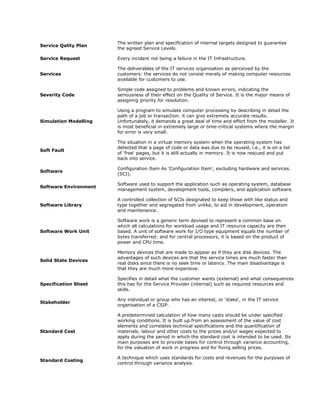
The written plan and specification of internal targets designed to guarantee
Service Qality Plan
                       the agreed Service Levels.

Service Request        Every incident not being a failure in the IT Infrastructure.

                       The deliverables of the IT services organisation as perceived by the
Services               customers: the services do not consist merely of making computer resources
                       available for customers to use.

                       Simple code assigned to problems and known errors, indicating the
Severity Code          seriousness of their effect on the Quality of Service. It is the major means of
                       assigning priority for resolution.

                       Using a program to simulate computer processing by describing in detail the
                       path of a job or transaction. it can give extremely accurate results.
Simulation Modelling   Unfortunately, it demands a great deal of time and effort from the modeller. It
                       is most beneficial in extremely large or time-critical systems where the margin
                       for error is very small.

                       The situation in a virtual memory system when the operating system has
                       detected that a page of code or data was due to be reused, i.e., it is on a list
Soft Fault
                       of 'free' pages, but it is still actually in memory. It is now rescued and put
                       back into service.

                       Configuration Item As 'Configuration Item', excluding hardware and services.
Software
                       (SCI).

                       Software used to support the application such as operating system, database
Software Environment
                       management system, development tools, compilers, and application software.

                       A controlled collection of SCIs designated to keep those with like status and
Software Library       type together and segregated from unlike, to aid in development, operation
                       and maintenance.

                       Software work is a generic term devised to represent a common base on
                       which all calculations for workload usage and IT resource capacity are then
Software Work Unit     based. A unit of software work for I/O type equipment equals the number of
                       bytes transferred: and for central processors, it is based on the product of
                       power and CPU time.

                       Memory devices that are made to appear as if they are disk devices. The
                       advantages of such devices are that the service times are much faster than
Solid State Devices
                       real disks since there is no seek time or latency. The main disadvantage is
                       that they are much more expensive.

                       Specifies in detail what the customer wants (external) and what consequences
Specification Sheet    this has for the Service Provider (internal) such as required resources and
                       skills.

                       Any individual or group who has an interest, or 'stake', in the IT service
Stakeholder
                       organisation of a CSIP.

                       A predetermined calculation of how many casts should be under specified
                       working conditions. It is built up from an assessment of the value of cost
                       elements and correlates technical specifications and the quantification of
Standard Cost          materials. labour and other costs to the prices and/or wages expected to
                       apply during the period in which the standard cost is intended to be used. Its
                       main purposes are to provide bases for control through variance accounting,
                       for the valuation of work in progress and for fixing selling prices.

                       A technique which uses standards for costs and revenues for the purposes of
Standard Costing
                       control through variance analysis.
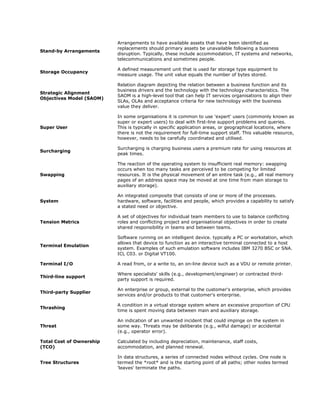
Arrangements to have available assets that have been identified as
                          replacements should primary assets be unavailable following a business
Stand-by Arrangements
                          disruption. Typically, these include accommodation, IT systems and networks,
                          telecommunications and sometimes people.

                          A defined measurement unit that is used far storage type equipment to
Storage Occupancy
                          measure usage. The unit value equals the number of bytes stored.

                          Relation diagram depicting the relation between a business function and its
                          business drivers and the technology with the technology characteristics. The
Strategic Alignment
                          SAOM is a high-level tool that can help IT services organisations to align their
Objectives Model (SAOM)
                          SLAs, OLAs and acceptance criteria for new technology with the business
                          value they deliver.

                          In some organisations it is common to use 'expert' users (commonly known as
                          super or expert users) to deal with first-line support problems and queries.
Super User                This is typically in specific application areas, or geographical locations, where
                          there is not the requirement for full-time support staff. This valuable resource,
                          however, needs to be carefully coordinated and utilised.

                          Surcharging is charging business users a premium rate for using resources at
Surcharging
                          peak times.

                          The reaction of the operating system to insufficient real memory: swapping
                          occurs when too many tasks are perceived to be competing for limited
Swapping                  resources. It is the physical movement of an entire task (e.g., all real memory
                          pages of an address space may be moved at one time from main storage to
                          auxiliary storage).

                          An integrated composite that consists of one or more of the processes.
System                    hardware, software, facilities and people, which provides a capability to satisfy
                          a stated need or objective.

                          A set of objectives for individual team members to use to balance conflicting
Tension Metrics           roles and conflicting project and organisational objectives in order to create
                          shared responsibility in teams and between teams.

                          Software running on an intelligent device. typically a PC or workstation, which
                          allows that device to function as an interactive terminal connected to a host
Terminal Emulation
                          system. Examples of such emulation software includes IBM 3270 BSC or SNA.
                          ICL C03. or Digital VT100.

Terminal I/O              A read from, or a write to, an on-line device such as a VDU or remote printer.

                          Where specialists' skills (e.g., development/engineer) or contracted third-
Third-line support
                          party support is required.

                          An enterprise or group, external to the customer's enterprise, which provides
Third-party Supplier
                          services and/or products to that customer's enterprise.

                          A condition in a virtual storage system where an excessive proportion of CPU
Thrashing
                          time is spent moving data between main and auxiliary storage.

                          An indication of an unwanted incident that could impinge on the system in
Threat                    some way. Threats may be deliberate (e.g., wilful damage) or accidental
                          (e.g., operator error).

Total Cost of Ownership   Calculated by including depreciation, maintenance, staff costs,
(TCO)                     accommodation, and planned renewal.

                          In data structures, a series of connected nodes without cycles. One node is
Tree Structures           termed the *root* and is the starting point of all paths; other nodes termed
                          'leaves' terminate the paths.
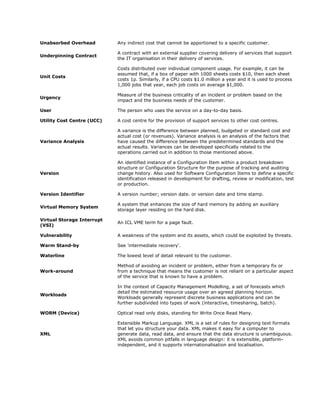
Unabsorbed Overhead         Any indirect cost that cannot be apportioned to a specific customer.

                            A contract with an external supplier covering delivery of services that support
Underpinning Contract
                            the IT organisation in their delivery of services.

                            Costs distributed over individual component usage. For example, it can be
                            assumed that, if a box of paper with 1000 sheets costs $10, then each sheet
Unit Costs
                            costs 1p. Similarly, if a CPU costs $1.0 million a year and it is used to process
                            1,000 jobs that year, each job costs on average $1,000.

                            Measure of the business criticality of an incident or problem based on the
Urgency
                            impact and the business needs of the customer.

User                        The person who uses the service on a day-to-day basis.

Utility Cost Centre (UCC)   A cost centre for the provision of support services to other cost centres.

                            A variance is the difference between planned, budgeted or standard cost and
                            actual cost (or revenues). Variance analysis is an analysis of the factors that
Variance Analysis           have caused the difference between the predetermined standards and the
                            actual results. Variances can be developed specifically related to the
                            operations carried out in addition to those mentioned above.

                            An identified instance of a Configuration Item within a product breakdown
                            structure or Configuration Structure for the purpose of tracking and auditing
Version                     change history. Also used for Software Configuration Items to define a specific
                            identification released in development for drafting, review or modification, test
                            or production.

Version Identifier          A version number; version date. or version date and time stamp.

                            A system that enhances the size of hard memory by adding an auxiliary
Virtual Memory System
                            storage layer residing on the hard disk.

Virtual Storage Interrupt
                            An ICL VME term for a page fault.
(VSI)

Vulnerability               A weakness of the system and its assets, which could be exploited by threats.

Warm Stand-by               See 'intermediate recovery'.

Waterline                   The lowest level of detail relevant to the customer.

                            Method of avoiding an incident or problem, either from a temporary fix or
Work-around                 from a technique that means the customer is not reliant on a particular aspect
                            of the service that is known to have a problem.

                            In the context of Capacity Management Modelling, a set of forecasts which
                            detail the estimated resource usage over an agreed planning horizon.
Workloads
                            Workloads generally represent discrete business applications and can be
                            further subdivided into types of work (interactive, timesharing, batch).

WORM (Device)               Optical read only disks, standing for Write Once Read Many.

                            Extensible Markup Language. XML is a set of rules for designing text formats
                            that let you structure your data. XML makes it easy for a computer to
XML                         generate data, read data, and ensure that the data structure is unambiguous.
                            XML avoids common pitfalls in language design: it is extensible, platform-
                            independent, and it supports internationalisation and localisation.

Itil glossary

  • 1.
    ITIL Glossary Overhead which, by means of absorption rates, is included in costs of specific products or saleable services, in a given period of time. Under- or over-absorbed overhead: the Absorbed Overhead difference between overhead cost incurred and overhead cost absorbed: it may be split into its two constituent parts for control purposes. A principle whereby fixed as well as variable costs are allotted to cost units Absorption Costing and total overheads are absorbed according to activity level. The term may be applied where production costs only, or costs of all functions are so allotted. Defined actions, allocated to recovery teams and individuals, within a phase of Action Lists a plan. These are supported by reference data. Alert Warning that an incident has occurred. The first phase of a Business Continuity Plan in which initial emergency Alert Phase procedures and damage assessments are activated. Allocated Cost A cost that can be directly identified with a business unit. An information system containing key attributes of applications deployed in a Application Portfolio company. Application portfolios are used as tools to manage the business value of an application throughout its lifecycle. A cost that is shared by a number of business units (an indirect cost). This Apportioned Cost cost must be shared out between these units on an equitable basis. Component of a business process. Assets can include people, accommodation, Asset computer systems, networks, paper records, fax machines, etc. In a communications sense, the ability to transmit each character as a self- contained unit of information, without additional timing information. This method of transmitting data is sometimes called start/stop. Synchronous Asynchronous/Synchronous working involves the use of timing information to allow transmission of data, which is normally done in blocks. Synchronous transmission is usually more efficient than the asynchronous method. Ability of a component or service to perform its required function at a stated instant or over a stated period of time. It is usually expressed as the Availability availability ratio, i.e., the proportion of time that the service is actually available for use by the customers within the agreed service hours. Scorecard An aid to organisational performance management. It helps to Balanced focus not only on the financial targets but also on the internal processes, customers and learning and growth issues. A snapshot or a position which is recorded. Although the position may be Baseline updated later, the baseline remains unchanged and available as a reference of the original state and as a comparison against the current position (PRINCE2). The security level adopted by the IT organisation for its own security and from Baseline Security the point of view of good 'due diligence'. Process by which the quality and cost-effectiveness of a service is assessed, usually in advance of a change to the service. Baselining usually includes Baselining comparison of the service before and after the change or analysis of trend information. The term benchmarking is usually used if the comparison is made against other enterprises. Equipment and techniques used to match circuits to each other ensuring Bridge minimum transmission impairment.
  • 2.
    The British standardfor Information Security Management. This standard BS 7799 provides a comprehensive set of controls comprising best practices in information security. Budgeting is the process of predicting and controlling the spending of money Budgeting within the organisation and consists of a periodic negotiation cycle to set budgets (usually annual) and the day-to-day monitoring of current budgets. The final stage in producing a usable configuration. The process involves taking one of more input Configuration Items and processing them (building Build them) to create one or more output Configuration Items, e.g., software compile and load. Business Function A business unit within an organisation, e.g., a department, division, branch. A group of business activities undertaken by an organisation in pursuit of a common goal. Typical business processes include receiving orders, marketing services, selling products, delivering services, distributing products, invoicing Business Process for services, accounting for money received. A business process usually depends upon several business functions for support, e.g., IT, personnel, and accommodation. A business process rarely operates in isolation, i.e., other business processes will depend on it and it will depend on other processes. The desired time within which business processes should be recovered, and Business Recovery Objective the minimum staff, assets and services required within this time. A template business recovery plan (or set of plans) produced to allow the Business Recovery Plan structure and proposed contents to be agreed before the detailed business Framework recovery plan is produced. Documents describing the roles, responsibilities and actions necessary to Business Recovery Plans resume business processes following a business disruption. A defined group of personnel with a defined role and subordinate range of Business Recovery Team actions to facilitate recovery of a business function or process. A segment of the business entity by which both revenues are received and Business Unit expenditure is caused or controlled, such revenues and expenditure being used to evaluate segmental performance. Typically, those costs applying to the physical (substantial) assets of the organisation. Traditionally this was the accommodation and machinery Capital Costs necessary to produce the enterprise's product. Capita! Costs are the purchase or major enhancement of fixed assets, for example, computer equipment (building and plant) and are often also referred to as 'one-off' costs. The process of evaluating proposed investment in specific fixed assets and the benefits to be obtained from their acquisition. The techniques used in the Capital Investment evaluation can be summarised as non-discounting methods (i.e., simple Appraisal payback), return on capita! employed and discounted cashflow methods (i.e., yield, net present value and discounted payback). The process of identifying major expenditure as Capital, whether there is a substantial asset or not, to reduce the impact on the current financial year of Capitalisation such expenditure. The most common item for this to be applied to is software, whether developed in-house or purchased. Classification of a group of Configuration Items, change documents or Category problems. The addition, modification or removal of approved, supported or baselined Change hardware, network, software, application, environment, system, desktop build or associated documentation.
  • 3.
    A group ofpeople who can give expert advice to Change Management on the Change Advisory Board implementation of changes. This board is likely to be made up of (CAB) representatives from all areas within IT and representatives from business units. A group that is given the authority to approve change, e.g., by the Project Change Authority Board. Sometimes referred to as the Configuration Board. The procedure to ensure that all changes are controlled, including the Change Control submission, analysis, decision-making, approval, implementation and post- implementation of the change. Change Document Request for Change, change control form, change order, change record. Auditable information that records, for example, what was done, when it was Change History done, by whom and why. A log of Requests For Change raised during the project, showing information change log on each change, its evaluation, what decisions have been made and its current status, e.g., Raised, Reviewed, Approved, Implemented, and Closed. Process of controlling changes to the infrastructure or any aspect of services, Change Management in a controlled manner, enabling approved changes with minimum disruption. A record containing details of which Cls are affected by an authorised change Change Record (planned or implemented) and how. The process of establishing charges in respect of business units, and raising Charging the relevant invoices for recovery from customers. Process of formally grouping Configuration Items by type, e.g., software, Classification hardware, documentation, environment, application. Closure When the customer is satisfied that an incident has been resolved. Cold Stand-by See 'gradual recovery'. Command, Cntrol and The processes by which an organisation retains overall coordination of its Cmmunications recovery effort during invocation of business recovery plans. Computer-Aided Systems A software tool for programmers. It provides help in the planning, analysis, Engineering (CASE) design and documentation of computer software. Configuration of a product or system established at a specific point in time, Configuration Baseline which captures both the structure and details of the product or system, and enables that product or system to be rebuilt at a later date. Activities comprising the control of changes to Configuration Items after formally establishing its configuration documents. It includes the evaluation, Configuration Control coordination, approval or rejection of changes. The implementation of changes includes changes, deviations and waivers that impact on the configuration. Configuration Documents that define requirements, system design, build, production, and Documentation verification for a Configuration Item. Activities that determine the product structure, the selection of Configuration Items, and the documentation of the Configuration Item's physical and functional characteristics including interfaces and subsequent changes. It Configuration Identification includes the allocation of identification characters or numbers to the Configuration Items and their documents. It also includes the unique numbering of Configuration control forms associated with changes and problems. Configuration Item (CI) Component of an infrastructure - or an item, such as a Request for Change,
  • 4.
    associated with aninfrastructure - which is (or is to be) under the control of Configuration Management. Cls may vary widely in complexity, size and type - from an entire system (including all hardware, software and documentation) to a single module or a minor hardware component. The process of identifying and defining the Configuration Items in a system, recording and reporting the status of Configuration Items and Requests For Configuration Management Change, and verifying the completeness and correctness of Configuration Items. Configuration Management A database which contains all relevant details of each CI and details of the Database (CMDB) important relationships between Cls. Configuration Management Document setting out the organisation and procedures for the Configuration Plan Management of a specific product, project, system, support group or service. Configuration Management A software product providing automatic support for change: Configuration or Tool (CM Tool) version control. Configuration Structure A hierarchy of all the Cls that comprise a configuration. Planning to address unwanted occurrences that may happen at a later time. Contingency Planning Traditionally, the term has been used to refer to planning for the recovery of IT systems rather than entire business processes. An ongoing formal programme undertaken within an organisation to identify Continuous Service and introduce measurable improvements within a specified work area or work Improvement Programme process. The amount of expenditure (actual or notional) incurred on, or attributable to, Cost a specific activity or business unit. Ensuring that there is a proper balance between the Quality of Service on the one side and expenditure on the other. Any investment that increases the Cost-Effectiveness costs of providing IT services should always result in enhancement to service quality or quantity. All the procedures, tasks and deliverables that are needed to fulfill an Cost Management organisation's costing and charging requirements. A technique used to evaluate and measure the cost of failed actions and activities. It can be measured as a total within a period or an average per Cost of Failure failure. An example would be 'the cost of failed changes per month' or 'the average cost of a failed change'. In the context of CSBC the cost unit is a functional cost unit which establishes Cost Unit standard cost per workload element of activity, based on calculated activity ratios converted to cost ratios. The process of identifying the costs of the business and of breaking them Costing down and relating them to the various activities of the organisation. A check or restraint on the service designed to enhance security by reducing the risk of an attack (by reducing either the threat or the vulnerability), Countermeasure reducing the impact of an attack, detecting the occurrence of an attack and/or assisting in the recovery from an attack. The UK Government's Risk Analysis and Management Method. Further CRAMM information is available from www.insight.co.uk/cramm/ or tel. 01932 241000. The processes by which an organisation manages the wider impact of a Crisis Management disaster, such as adverse media coverage.
  • 5.
    A measure ofsuccess or maturity of a project or process. It can be a state, a Critical Success Factor (CSF) deliverable or a milestone. An example of a CSF would be `the production of an overall technology strategy'. Recipient of the service; usually the customer management has responsibility Customer for the cost of the service, either directly through charging or indirectly in terms of demonstrable business need. The length of time taken for a block or sector of data to be read from or Data Transfer Time written to an I/O device, such as a disk or tape. The library in which the definitive authorised versions of all software Cls are stored and protected. It is a physical library or storage repository where master copies of software versions are placed. This one logical storage area may, in reality, consist of one or more physical software libraries or filestores. They should be separate from development and test filestore areas. The DSL Definitive Software Library may also include a physical store to hold master copies of bought-in software, (DSL) e.g., fireproof safe. Only authorised software should be accepted into the DSL, strictly controlled by Change and Release Management. The DSL exists not directly because of the needs of the Configuration Management process, but as a common base for the Release Management and Configuration Management processes. A Delta, or partial. Release is one that includes only those Cls within the Release unit that have actually changed or are new since the last full or Delta Release. For example, if the Release unit is the program, a Delta Release Delta Release contains only those modules that have changed, or are new, since the last Full Release of the program or the last Delta Release of the modules. See also ‘Full Release’. Dependency The reliance, either direct or indirect, of one process or activity upon another. The loss in value of an asset due to its use and/or the passage of time. The annual depreciation charge in accounts represents the amount of capital assets used up in the accounting period. It is charged in the cost accounts to ensure that the cost of capital equipment is reflected in the unit costs of the Depreciation services provided using the equipment. There are various methods of calculating depreciation for the period, but the Treasury usually recommends the use of current cost asset valuation as the basis for the depreciation charge. Charging business customers different rates for the same work, typically to Differential Charging dampen demand or to generate revenue for spare capacity. This can also be used to encourage off-peak or nighttime running. A cost that is incurred for, and can be traced in full to a product, service, cost Direct Cost centre or department. This is an allocated cost. Direct costs are direct materials, direct wages and direct expenses. See also `indirect cost'. A series of processes that focus only upon the recovery processes, principally Disaster Recovery Planning in response to physical disasters, which are contained within BCM. An evaluation of the future net cashflows generated by a capital project by discounting them to their present-day value. The two methods most commonly used are: Discounted Cashflow Yield method, for which the calculation determines the internal rate of return (IRR) in the form of a percentage; Net Present Value (NPV) method, in which the discount rate is chosen and the answer is a sum of money. The offering to business customers of reduced rates for the use of off-peak Discounting resources. See also 'surcharging'.
  • 6.
    Memory that isused to store blocks of data that have been read from the disk devices connected to them. If a subsequent I/O requires a record that is still Disk Cache Controller resident in the cache memory, it will be picked up from there, thus saving another physical I/O. Total period that a service or component is not operational, within agreed Downtime service times. Full duplex line/channel allows simultaneous transmission in both directions. Duplex (full and half) Half duplex line/channel is capable of transmitting in both directions, but only in one direction at a time. A reflection of the transmitted signal from the receiving end; a visual method Echoing of error detection in which the signal from the originating device is looped back to that device so that it can be displayed. The constituent parts of costs according to the factors upon which expenditure Elements of Cost is incurred viz., materials. labour and expenses. End User See `User’. A collection of hardware, software, network communications and procedures that work together to provide a discrete type of computer service. There may Environment be one or more environments on a physical platform, e.g., test, production. An environment has unique features and characteristics that dictate how they are administered in similar, yet diverse manners. Expert User See 'Super User'. One of the measures against which a delivered IT service is compared, External Target expressed in terms of the customer's business. Financial Year An accounting period covering 12 consecutive months. Service Desk call logging and resolution (on agreed areas, for example, MS First-Line Support Word). Commonly used metric, used to define incidents resolved at the first point of contact between a customer and the Service Provider, without delay or First Time Fix Rate referral, generally by a front line support group such as a help desk or Service Desk. First time fixes are a subset of remote fixes. Contains details of all the changes approved for implementation and their proposed implementation dates. It should be agreed with the customers and Forward Schedule of the business, Service Level Management, the Service Desk and Availability Changes (FSC) Management. Once agreed, the Service Desk should communicate to the user community at large any planned additional downtime arising from implementing the changes, using the most effective methods available. The total cost of all the resources used in supplying a service, i.e., the sum of the direct costs of producing the output, a proportional share of overhead Full Cost costs and any selling and distribution expenses. Both cash costs and notional (non-cash) costs should be included, including the cost of capital. See also `Total Cost of Ownership'. All components of the Release unit are built, tested, distributed and Full Release implemented together. See also `Delta Release'. Equipment which is used to interface networks so that a terminal on one Gateway network can communicate with services or a terminal on another. Gradual Recovery Previously called `cold stand-by', this is applicable to organisations that do not need immediate restoration of business processes and can function for a
  • 7.
    period of upto 72 hours, or longer, without a re-establishment of full IT facilities. This may include the provision of empty accommodation fully equipped with power, environmental controls and local network cabling infrastructure, telecommunications connections, and available in a disaster situation for an organisation to install its own computer equipment. Descriptive of a situation where, within an organisation, actual funds are Hard Charging transferred from the customer to the IT organisation in payment for the delivery of IT services. The situation in a virtual memory system when the required page of code or data that a program was using has been redeployed by the operating system Hard Fault for some other purpose. This means that another piece of memory must be found to accommodate the code or data, and will involve physical reading/writing of pages to the page file. A host computer comprises the central hardware and software resources of a computer complex; e.g., CPU, memory, channels, disk and magnetic tape I0 Host subsystems plus operating and applications software. The term is used to denote all non-network items. Hot stand-by See 'immediate recovery'. The convergence of Information Technology, Telecommunications and Data ICT Networking Technologies into a single technology. Previously called 'hot stand-by', provides for the immediate restoration of services following any irrecoverable incident. It is important to distinguish between the previous definition of `hot stand-by' and `immediate recovery'. Immediate recovery Hot stand-by typically referred to availability of services within a short time- scale such as 2 or 4 hours whereas immediate recovery implies the instant availability of services. Measure of the business criticality of an incident. Often equal to the extent to Impact which an incident leads to distortion of agreed or expected Service Levels. The identification of critical business processes, and the potential damage or Impact Analysis loss that may be caused to the organisation resulting from a disruption to those processes. Simple code assigned to incidents and problems, reflecting the degree of Impact Code impact upon the customer's business processes. It is the major means of assigning priority for dealing with incidents. Description of the type of impact on the business that could follow a business Impact Scenario disruption. Usually related to a business process and will always refer to a period of time, e.g., customer services will be unable to operate for two days. Any event which is not part of the standard operation of a service and which Incident causes, or may cause, an interruption to, or a reduction in, the quality of that service. The process of identifying, recording, classifying and progressing incidents Incident Control until affected services return to normal operation. A cost incurred in the course of making a product providing a service or running a cost centre or department, but which cannot be traced directly and in full to the product, service or department, because it has been incurred for Indirect Cost a number of cost centres or cost units. These costs are apportioned to cost centres/cost units. Indirect costs are also referred to as overheads. See also 'direct cost'. Information Systems (IS) The means of delivering information from one person to another; ICT is the
  • 8.
    technical apparatus fordoing so. An individual, team or group with functional responsibility within an organisation for ensuring that spend on IS/IT is directed to best effect, i.e., that the business is receiving value for money and continues to achieve the most beneficial outcome. In order to fulfill its role the 'Informed' customer function must gain clarity of vision in relation to the business plans and ensure that suitable strategies are devised and maintained for achieving business goals. The 'informed' customer function ensures that the needs of Informed Customer the business are effectively translated into a business requirements specification, that IT investment is both efficiently and economically directed, and that progress towards effective business solutions is monitored. The `informed' customer should play an active role in the procurement process, e.g., in relation to business case development, and also in ensuring that the services and solutions obtained are used effectively within the organisation to achieve maximum business benefits. The term is often used in relation to the outsourcing of IT/IS. Sometimes also called `intelligent customer'. Physical or functional interaction at the boundary between Configuration Interface Items. Previously called `warm stand-by', typically involves the reestablishment of the critical systems and services within a 24 to 72 hour period, and is used by Intermediate Recovery organisations that need to recover IT facilities within a predetermined time to prevent impacts to the business process. One of the measures against which supporting processes for the IT service are Internal target compared. Usually expressed in technical terms relating directly to the underpinning service being measured. Invocation (of business Putting business recovery plans into operation after a business disruption. recovery plans) Invocation (of stand-by Putting stand-by arrangements into operation as part of business recovery arrangements) activities. Invocation and Recovery The second phase of a business recovery plan. Phase The internationally accepted set of standards concerning Quality Management IS09001 Systems. The set of processes that enable the IT organisation to account fully for the IT accounting way money is spent (particularly the ability to identify costs by customer, by service and by activity). The part of an organisation charged with developing and delivering the IT IT directorate services. The sum of an organisation's IT related hardware, software, data IT Infrastructure telecommunication facilities, procedures and documentation. A described set of facilities. IT and non-IT, supported by the IT Service IT service Provider that fulfils one or more needs of the customer and that is perceived by the customer as a coherent whole. The role of (T Service Provider is performed by any organisational units, IT Service Provider whether internal or external, that deliver and support IT services to a customer. The OGC IT Infrastructure Library - a set of guides on the management and ITIL provision of operational IT services.
  • 9.
    The attributes ofa business function that drive the behaviour and Key Business Drivers implementation of that business function in order to achieve the strategic business goals of the company. A measurable quantity against which specific Performance Criteria can be set Key Performance Indicator when drawing up the SLA. A measurement of success or maturity of a project or process. See also Key Success Indicator 'Critical Success Factor'. Discipline within an organisation that ensures that the intellectual capabilities Knowledge Management of an organisation are shared, maintained and institutionalised. An incident or problem for which the root cause is known and for which a temporary Work-around or a permanent alternative has been identified. If a Known Error business case exists, an RFC will be raised, but, in any event, it remains a known error unless it is permanently fixed by a change. The elapsed time from the moment when a seek was completed on a disk device to the point when the required data is positioned under the read/write Latency heads. It is normally defined by manufacturers as being half the disk rotation time. A series of states, connected by allowable transitions. The lifecycle represents Lifecycle an approval process for Configuration Items, problem reports and change documents. A read or write request by a program. That request may, or may not, necessitate a physical IO. For example, on a read request the required record Logical I/O may already be in a memory buffer and therefore a physical I0 is not necessary. The cost of providing the service now, based upon the investment already Marginal Cost made. The degree to which BCM activities and processes have become standard Maturity Level/Milestone business practice within an organisation. Metric Measurable element of a service process or function. Those costs resulting from the day-to-day running of the IT services section, e.g., staff costs, hardware maintenance and electricity; and relating to Operational Costs repeating payments whose effects can be measured within a short time- frame, usually less than the 12-month financial year. Operational Level An internal agreement covering the delivery of services which support the IT Agreement (OLA) organisation in their delivery of services. All activities and measures to enable and/or maintain the intended use of the Operations ICT infrastructure. The value of a benefit sacrificed in favour of an alternative course of action. Opportunity Cost (or True That is the cost of using resources in a particular operation expressed in terms Cost) of forgoing the benefit that could be derived from the best alternative use of those resources. The process by which functions performed by the organisation are contracted Outsourcing out for operation, on the organisation's behalf, by third parties. Overheads The total of indirect materials, wages and expenses. Package A device that permits terminals, which do not have an interface suitable for Assembly/Disassembly direct connection to a packet switched network, to Device access such a
  • 10.
    network. A PADconverts data to/from packets and handles call set-up and (PAD) addressing. A program interruption that occurs when a page that is marked 'not in real Page Fault memory' is referred to by an active page. The I/O necessary to read and write to and from the paging disks: real (not virtual) memory is needed to process data. With insufficient real memory, the Paging operating system writes old pages to disk, and reads new pages from disk, so that the required data and instructions are in real memory. Alternative title for the BSI publication 'A Code of Practice for IT Service PD0005 Management'. The amount of time that a hardware device is busy over a given period of Percentage Utilisation time. For example, if the CPU is busy for 1800 seconds in a one-hour period, its utilisation is said to be 50%. The expected levels of achievement which are set within the SLA against Performance Criteria specific Key Performance Indicators. A communications error reported by a computer system that is not detected by network monitoring equipment. It is often caused by changes to the Phantom Line Error circuits and network equipment (e.g., re-routeing circuits at the physical level on a backbone network) while data communications is in progress. A read or write request from a program has necessitated a physical read or Physical I/O write operation on an IO device. The total cost of direct materials, direct labour and direct expenses. The term prime cost is commonly restricted to direct production costs only and so does Prime Cost not customarily include direct costs of marketing or research and development. The standard UK government method for Project Management. PRINCE2 PRINCE2® (Third Edition 2002) is the current version of PRINCE. PRINCE is a registered trademark of the Office of Government Commerce (OGC). Sequence in which an incident or problem needs to be resolved, based on Priority impact and urgency. Problem Unknown underlying cause of one or more incidents. Process that minimises the effect on customer(s) of defects in services and Problem Management within the infrastructure, human errors and external events. A connected series of actions, activities, changes, etc. performed by agents Process with the intent of satisfying a purpose or achieving a goal. The process of planning and regulating, with the objective of performing the Process Control process in an effective and efficient way. A collection of activities and projects that collectively implement a new Programme corporate requirement or function. Provider The organisation concerned with the provision of IT services. An agreed or contracted level of service between a service customer and a Quality of Service Service Provider. Queuing time is incurred when the device, which a program wishes to use, is Queuing Time already busy. The program therefore has to wait in a queue to obtain service from that device.
  • 11.
    A mechanism forproviding data resilience for computer systems using RAID (Redundant Array of mirrored arrays of magnetic disks. Different levels of RAID can be applied to Inexpensive Disks) provide for greater resilience. Information that supports the plans and action lists, such as names and Reference Data addresses or inventories, which is indexed within the plan. A collection of new and/or changed Cls which are tested and introduced into Release the live environment together. Incidents or problems resolved without a member of the support staff visiting the physical location of the problems. Note: Fixing incidents or problems Remote Fixes remotely minimises the delay before the service is back to normal and is therefore usually cost-effective. Form, or screen, used to record details of a request for a change to any CI Request For Change (RFC) within an infrastructure or to procedures and items associated with the infrastructure. Resolution Action which will resolve an incident. This may be a Work-around. The amount of machine resource that a given task consumes. This resource is Resource Cost usually expressed in seconds for the CPU or the number of I/Os for a disk or tape device. The total resource costs that are consumed by an individual on-line Resource Profile transaction, batch job or program. It is usually expressed in terms of CPU seconds, number of I/Os and memory usage. Resource units may be calculated on a standard cost basis to identify the expected (standard) cost for using a particular resource. Because computer resources come in many shapes and forms, units have to be established by logical groupings. Examples are: Resource Unit Costs (*) CPU time or instructions (*) disk I/Os (*) print lines (*) communication transactions. The IT services section needs to provide the customers with the required Resources services. The resources are typically computer and related equipment, software. facilities or organisational (People). The ratio of the cost of implementing a project, product or service and the savings as a result of completing the activity in terms of either internal savings, increased external revenue or a combination of the two. For instance, Return On Investment (ROI) in simplistic terms if the internal cost of ICT cabling of office moves is $100,000 per annum and a structured cabling system can be installed for $300,000, then an ROI will be achieved after approximately three years. The phase within a business recovery plan which re-establishes normal Return to Normal Phase operations. A measure of the exposure to which an organisation may be subjected. This is Risk a combination of the likelihood of a business disruption occurring and the possible loss that may result from such business disruption. The identification and assessment of the level (measure) of the risks Risk Analysis calculated from the assessed values of assets and the assessed levels of threats to, and vulnerabilities of, those assets. The identification, selection and adoption of countermeasures justified by the Risk Management identified risks to assets in terms of their potential impact upon services if failure occurs, and the reduction of those risks to an acceptable level.
  • 12.
    Measures taken toreduce the likelihood or consequences of a business Risk reduction measure disruption occurring (as opposed to planning to recover after a disruption). Role A set of responsibilities, activities and authorisations. Roll In, Roll Out (RIRO) Used on some systems to describe swapping. A facility which is employed on most mainframes and some minicomputers. When a seek has been initiated the system can free the path from a disk drive Rotational Position Sensing to a controller for use by another disk drive, while it is waiting for the required data to come under the read/write heads (latency). This facility usually improves the overall performance of the I/0 subsystem. Where the fault cannot be resolved by first-line support or requires time to be Second-line Support resolved or local attendance. The process of managing a defined level of security on information and Security Management services. The Security Manager is the role that is responsible for the Security Management process in the Service Provider organisation. The person is Security Manager responsible for fulfilling the security demands as specified in the SLA, either directly or through delegation by the Service Level Manager. The Security Officer and the Security Manager work closely together. The Security Officer is responsible for assessing the business risks and setting the security policy. As such, this role is the counterpart of the Security Security Officer Manager and resides in the customer's business organisation. The Security Officer and the Security Manager work closely together. When the disk read/write heads are not positioned on the required track. !t Seek Time Occurs describes the elapsed time taken to move heads to the right track. Separation of the management or execution of certain duties or of areas of Segregation of Duties responsibility is required in order to prevent and reduce opportunities for unauthorised modification or misuse of data or service. A decision to bear the losses that could result from a disruption to the Self-Insurance business as opposed to taking insurance cover on the Risk. Service One or more IT systems which enable a business process. The actual Service Levels delivered by the IT organisation to a customer Service achievement within a defined fife span. Service Catalogue Written statement of IT services, default levels and options. Modelling Technique used to gain insight in the interdependency between an Service Dependency IT service and the Configuration ltems that make up that service. Service Desk The single point of contact within the IT organisation for users of IT services. Service Level The expression of an aspect of a service in definitive and quantifiable terms. Written agreement between a Service Provider and the (SLA) customer(s) Service Level Agreement that documents agreed Service Levels for a service. Service Level Management The process of defining. agreeing, documenting and managing the levels of (SLM) customer IT service, that are required and cost justified. Service Management Management of Services to meet the customer's requirements. Service Provider Third-party organisation supplying services or products to customers.
  • 13.
    The written planand specification of internal targets designed to guarantee Service Qality Plan the agreed Service Levels. Service Request Every incident not being a failure in the IT Infrastructure. The deliverables of the IT services organisation as perceived by the Services customers: the services do not consist merely of making computer resources available for customers to use. Simple code assigned to problems and known errors, indicating the Severity Code seriousness of their effect on the Quality of Service. It is the major means of assigning priority for resolution. Using a program to simulate computer processing by describing in detail the path of a job or transaction. it can give extremely accurate results. Simulation Modelling Unfortunately, it demands a great deal of time and effort from the modeller. It is most beneficial in extremely large or time-critical systems where the margin for error is very small. The situation in a virtual memory system when the operating system has detected that a page of code or data was due to be reused, i.e., it is on a list Soft Fault of 'free' pages, but it is still actually in memory. It is now rescued and put back into service. Configuration Item As 'Configuration Item', excluding hardware and services. Software (SCI). Software used to support the application such as operating system, database Software Environment management system, development tools, compilers, and application software. A controlled collection of SCIs designated to keep those with like status and Software Library type together and segregated from unlike, to aid in development, operation and maintenance. Software work is a generic term devised to represent a common base on which all calculations for workload usage and IT resource capacity are then Software Work Unit based. A unit of software work for I/O type equipment equals the number of bytes transferred: and for central processors, it is based on the product of power and CPU time. Memory devices that are made to appear as if they are disk devices. The advantages of such devices are that the service times are much faster than Solid State Devices real disks since there is no seek time or latency. The main disadvantage is that they are much more expensive. Specifies in detail what the customer wants (external) and what consequences Specification Sheet this has for the Service Provider (internal) such as required resources and skills. Any individual or group who has an interest, or 'stake', in the IT service Stakeholder organisation of a CSIP. A predetermined calculation of how many casts should be under specified working conditions. It is built up from an assessment of the value of cost elements and correlates technical specifications and the quantification of Standard Cost materials. labour and other costs to the prices and/or wages expected to apply during the period in which the standard cost is intended to be used. Its main purposes are to provide bases for control through variance accounting, for the valuation of work in progress and for fixing selling prices. A technique which uses standards for costs and revenues for the purposes of Standard Costing control through variance analysis.
  • 14.
    Arrangements to haveavailable assets that have been identified as replacements should primary assets be unavailable following a business Stand-by Arrangements disruption. Typically, these include accommodation, IT systems and networks, telecommunications and sometimes people. A defined measurement unit that is used far storage type equipment to Storage Occupancy measure usage. The unit value equals the number of bytes stored. Relation diagram depicting the relation between a business function and its business drivers and the technology with the technology characteristics. The Strategic Alignment SAOM is a high-level tool that can help IT services organisations to align their Objectives Model (SAOM) SLAs, OLAs and acceptance criteria for new technology with the business value they deliver. In some organisations it is common to use 'expert' users (commonly known as super or expert users) to deal with first-line support problems and queries. Super User This is typically in specific application areas, or geographical locations, where there is not the requirement for full-time support staff. This valuable resource, however, needs to be carefully coordinated and utilised. Surcharging is charging business users a premium rate for using resources at Surcharging peak times. The reaction of the operating system to insufficient real memory: swapping occurs when too many tasks are perceived to be competing for limited Swapping resources. It is the physical movement of an entire task (e.g., all real memory pages of an address space may be moved at one time from main storage to auxiliary storage). An integrated composite that consists of one or more of the processes. System hardware, software, facilities and people, which provides a capability to satisfy a stated need or objective. A set of objectives for individual team members to use to balance conflicting Tension Metrics roles and conflicting project and organisational objectives in order to create shared responsibility in teams and between teams. Software running on an intelligent device. typically a PC or workstation, which allows that device to function as an interactive terminal connected to a host Terminal Emulation system. Examples of such emulation software includes IBM 3270 BSC or SNA. ICL C03. or Digital VT100. Terminal I/O A read from, or a write to, an on-line device such as a VDU or remote printer. Where specialists' skills (e.g., development/engineer) or contracted third- Third-line support party support is required. An enterprise or group, external to the customer's enterprise, which provides Third-party Supplier services and/or products to that customer's enterprise. A condition in a virtual storage system where an excessive proportion of CPU Thrashing time is spent moving data between main and auxiliary storage. An indication of an unwanted incident that could impinge on the system in Threat some way. Threats may be deliberate (e.g., wilful damage) or accidental (e.g., operator error). Total Cost of Ownership Calculated by including depreciation, maintenance, staff costs, (TCO) accommodation, and planned renewal. In data structures, a series of connected nodes without cycles. One node is Tree Structures termed the *root* and is the starting point of all paths; other nodes termed 'leaves' terminate the paths.
  • 15.
    Unabsorbed Overhead Any indirect cost that cannot be apportioned to a specific customer. A contract with an external supplier covering delivery of services that support Underpinning Contract the IT organisation in their delivery of services. Costs distributed over individual component usage. For example, it can be assumed that, if a box of paper with 1000 sheets costs $10, then each sheet Unit Costs costs 1p. Similarly, if a CPU costs $1.0 million a year and it is used to process 1,000 jobs that year, each job costs on average $1,000. Measure of the business criticality of an incident or problem based on the Urgency impact and the business needs of the customer. User The person who uses the service on a day-to-day basis. Utility Cost Centre (UCC) A cost centre for the provision of support services to other cost centres. A variance is the difference between planned, budgeted or standard cost and actual cost (or revenues). Variance analysis is an analysis of the factors that Variance Analysis have caused the difference between the predetermined standards and the actual results. Variances can be developed specifically related to the operations carried out in addition to those mentioned above. An identified instance of a Configuration Item within a product breakdown structure or Configuration Structure for the purpose of tracking and auditing Version change history. Also used for Software Configuration Items to define a specific identification released in development for drafting, review or modification, test or production. Version Identifier A version number; version date. or version date and time stamp. A system that enhances the size of hard memory by adding an auxiliary Virtual Memory System storage layer residing on the hard disk. Virtual Storage Interrupt An ICL VME term for a page fault. (VSI) Vulnerability A weakness of the system and its assets, which could be exploited by threats. Warm Stand-by See 'intermediate recovery'. Waterline The lowest level of detail relevant to the customer. Method of avoiding an incident or problem, either from a temporary fix or Work-around from a technique that means the customer is not reliant on a particular aspect of the service that is known to have a problem. In the context of Capacity Management Modelling, a set of forecasts which detail the estimated resource usage over an agreed planning horizon. Workloads Workloads generally represent discrete business applications and can be further subdivided into types of work (interactive, timesharing, batch). WORM (Device) Optical read only disks, standing for Write Once Read Many. Extensible Markup Language. XML is a set of rules for designing text formats that let you structure your data. XML makes it easy for a computer to XML generate data, read data, and ensure that the data structure is unambiguous. XML avoids common pitfalls in language design: it is extensible, platform- independent, and it supports internationalisation and localisation.