The owners’ concerns
Define the scope of security and
 why it is important
Group Policies
Network Access Protection (NAP)
Snort Intrusion Detection System
 (SIDS)
Snort Intrusion Prevention System
 (SIPS )
 The Brooklyn Circus owner does not
   want confidential files stolen. For this
   reason, the network administrator has
   configured essential security tools on
   Windows Server 2008 which maintains
   the integrity of the businesses data.
 One of the major concerns are the
   constant changes to files and financial
   information currently housed on
   Windows Server 2008 has been a major
   testament to its’ success and growth.
 The prime importance of securing
   Brooklyn Circus’ network is to
   prevent loss, through misuse of
   data.
 The main threats which may erupt if
   network security is at risk are
    Breaches of confidentiality
    Data corruption
    Data manipulation
Group & Account Policies
            Group Policies                                       Account Policies
   A group policy is a way to provide consistent        Account Policies are security measures set up
    security to Windows Server 2008 and the               in those group policies and governs all three
    clients who are connected to it.
                                                          domains through an established Kerberos
   Group policies reduce surface attacks and can         Transitive Trust Relationship.
    be expanded in the future. The primary domain
    controller in New York will replicate those
    policies and securities to the other domains.
                                                         RMSs are security rights which provide security
                                                          for file types created by applications. RMS
   In Windows Server 2008, security settings are         determines who can have rights to manage,
    one of the newly added categories of Group            read, copy, save, print, and forward data
    Policy                                                between networks.
        Regulate access to storage devices and who
         installs those devices
Account Lockout Policy & IP Security (IPsec)
     Account Lockout Policy                                  IP Security (IPsec)
   An account lockout policy is set in place to       IPsec is a secured IP-based communication
    prohibit access to a specific account after a       and encryption standard created between
    number of unsuccessful login attempts.              each client in and around the network.
   The first line of defense for these policies       Each computer is enabled to exchange
    are reversible encrypted passwords. Users           certificates and authenticate the receiver
    are required to change their passwords              and sender.
    every 45 to 90 days.
Network Access Protection
(NAP)

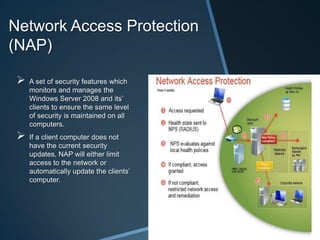
    A set of security features which
     monitors and manages the
     Windows Server 2008 and its’
     clients to ensure the same level
     of security is maintained on all
     computers.
    If a client computer does not
     have the current security
     updates, NAP will either limit
     access to the network or
     automatically update the clients’
     computer.
Snort Intrusion Detection Systems
                           (SIDS)
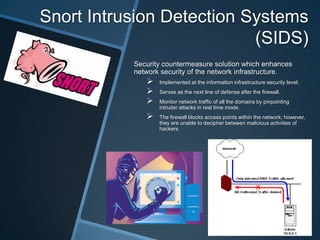
           Security countermeasure solution which enhances
           network security of the network infrastructure.
                 Implemented at the information infrastructure security level.
                 Serves as the next line of defense after the firewall.
                 Monitor network traffic of all the domains by pinpointing
                  intruder attacks in real time mode.
                 The firewall blocks access points within the network; however,
                  they are unable to decipher between malicious activities of
                  hackers.
Approaches
                                 Network-
Host-Based                       Based
                                                              to Snort
(SHIDS)                          (SNIDS)                     Intrusion
                              
    SHIDS offers the
    administrator the
                                   SNIDS assist in
                                   detecting attacks on     Detection
    benefit of being able          the network level.
    to detect attacks
    directed at the host
                                                             Systems


Both perform automated checks on log files,
file checksums, file and directory permissions,
local network port activity, and other basic
host security items.
   Prevent attacks
   Decrease their impact
   Acts a sniffer to respond to security breaches.
   The IPS configured on Windows Server 2008
    is a highly advanced security system.
   IPSs have the ability to take immediate action,
    based on protocols established by the network
    administrator.
   Informs the firewall about the location (IP
    address) where the attack originated.
   The firewall will block the specified address.

The Brooklyn Circus’ Secured Network

  • 2.
    The owners’ concerns Definethe scope of security and why it is important Group Policies Network Access Protection (NAP) Snort Intrusion Detection System (SIDS) Snort Intrusion Prevention System (SIPS )
  • 3.
     The BrooklynCircus owner does not want confidential files stolen. For this reason, the network administrator has configured essential security tools on Windows Server 2008 which maintains the integrity of the businesses data.  One of the major concerns are the constant changes to files and financial information currently housed on Windows Server 2008 has been a major testament to its’ success and growth.
  • 4.
     The primeimportance of securing Brooklyn Circus’ network is to prevent loss, through misuse of data.  The main threats which may erupt if network security is at risk are  Breaches of confidentiality  Data corruption  Data manipulation
  • 6.
    Group & AccountPolicies Group Policies Account Policies  A group policy is a way to provide consistent  Account Policies are security measures set up security to Windows Server 2008 and the in those group policies and governs all three clients who are connected to it. domains through an established Kerberos  Group policies reduce surface attacks and can Transitive Trust Relationship. be expanded in the future. The primary domain controller in New York will replicate those policies and securities to the other domains.  RMSs are security rights which provide security for file types created by applications. RMS  In Windows Server 2008, security settings are determines who can have rights to manage, one of the newly added categories of Group read, copy, save, print, and forward data Policy between networks.  Regulate access to storage devices and who installs those devices
  • 7.
    Account Lockout Policy& IP Security (IPsec) Account Lockout Policy IP Security (IPsec)  An account lockout policy is set in place to  IPsec is a secured IP-based communication prohibit access to a specific account after a and encryption standard created between number of unsuccessful login attempts. each client in and around the network.  The first line of defense for these policies  Each computer is enabled to exchange are reversible encrypted passwords. Users certificates and authenticate the receiver are required to change their passwords and sender. every 45 to 90 days.
  • 8.
    Network Access Protection (NAP)  A set of security features which monitors and manages the Windows Server 2008 and its’ clients to ensure the same level of security is maintained on all computers.  If a client computer does not have the current security updates, NAP will either limit access to the network or automatically update the clients’ computer.
  • 9.
    Snort Intrusion DetectionSystems (SIDS) Security countermeasure solution which enhances network security of the network infrastructure.  Implemented at the information infrastructure security level.  Serves as the next line of defense after the firewall.  Monitor network traffic of all the domains by pinpointing intruder attacks in real time mode.  The firewall blocks access points within the network; however, they are unable to decipher between malicious activities of hackers.
  • 10.
    Approaches Network- Host-Based Based to Snort (SHIDS) (SNIDS) Intrusion   SHIDS offers the administrator the SNIDS assist in detecting attacks on Detection benefit of being able the network level. to detect attacks directed at the host Systems Both perform automated checks on log files, file checksums, file and directory permissions, local network port activity, and other basic host security items.
  • 11.
    Prevent attacks  Decrease their impact  Acts a sniffer to respond to security breaches.  The IPS configured on Windows Server 2008 is a highly advanced security system.  IPSs have the ability to take immediate action, based on protocols established by the network administrator.  Informs the firewall about the location (IP address) where the attack originated.  The firewall will block the specified address.