Infosys BPO
Point of View


                   All the Right Moves
                   Part II – Delivering Transformation by Creating the Right Internal Utilities
                   Abhijit Ghosh


                www.infosysbpo.com
The financial crisis left a lasting impression on the structure
of participants in the financial services market and almost
all players, large and small, were impacted in one way or
the other. Significant consolidation resulted in fewer players
dominating the market. The change was evident across
banks, broker-dealers and custodians, amongst others; but it
was more evident amongst the global investment banks and
custodians. This was due to greater focus on risk, controls, and
shrinking margins – they were the first ones to adopt newer
operating models in the form of process utilities.

The creation of a utility makes perfect business sense for
financial institutions, but its success will depend on choosing
the right kind of utility, and taking the right approach and
managing internal change. An internal utility, if implemented
the right way, holds the promise of delivering significant
bottom-line benefits, robust controls and unified view of risk.

This paper highlights the critical building blocks which
financial service institutions will need in creating the right
internal utilities and the benefits associated with the same.
Utilities Move Up the Value                                                                  An internal
                                                                                               utility is a
Chain                                                                                        centralized
                                                                                           facility across
The financial crisis left a lasting impression on the structure of several
industries, with almost all players – large and small – absorbing the impact          business lines or
in one way or the other. Nowhere is the change more evident than banking              products for the
and financial services – due to greater focus on risk, controls, and shrinking
margins. They have been the first ones to adopt newer operating models in
                                                                                      timely, accurate,
the form of process utilities.                                                                  and cost-
Process utilities are of two kinds:                                                   effective delivery
Internal utility — Servicing different lines of business within a client                of services, and
                   organization
                                                                                        is supported by
External utility — Servicing multiple clients                                          a common suite
External utilities are more complex to implement and manage, as they                      of technology
require effective collaboration and participation of multiple financial
institutions for a defined business area. While it is rare to see such utilities,
                                                                                          platforms and
most large banks and financial institutions are making, or have made, rapid                   operations
strides in adopting internal utilities.                                                            teams.
An internal utility is a centralized facility across business lines or products for
the timely, accurate, and cost-effective delivery of services, and is supported
by a common suite of technology platforms and operations teams. The
primary objective of such a utility solution will be to drive process and cost
efficiencies across lines of business or products by capturing economies of
scale and enabling standardization.

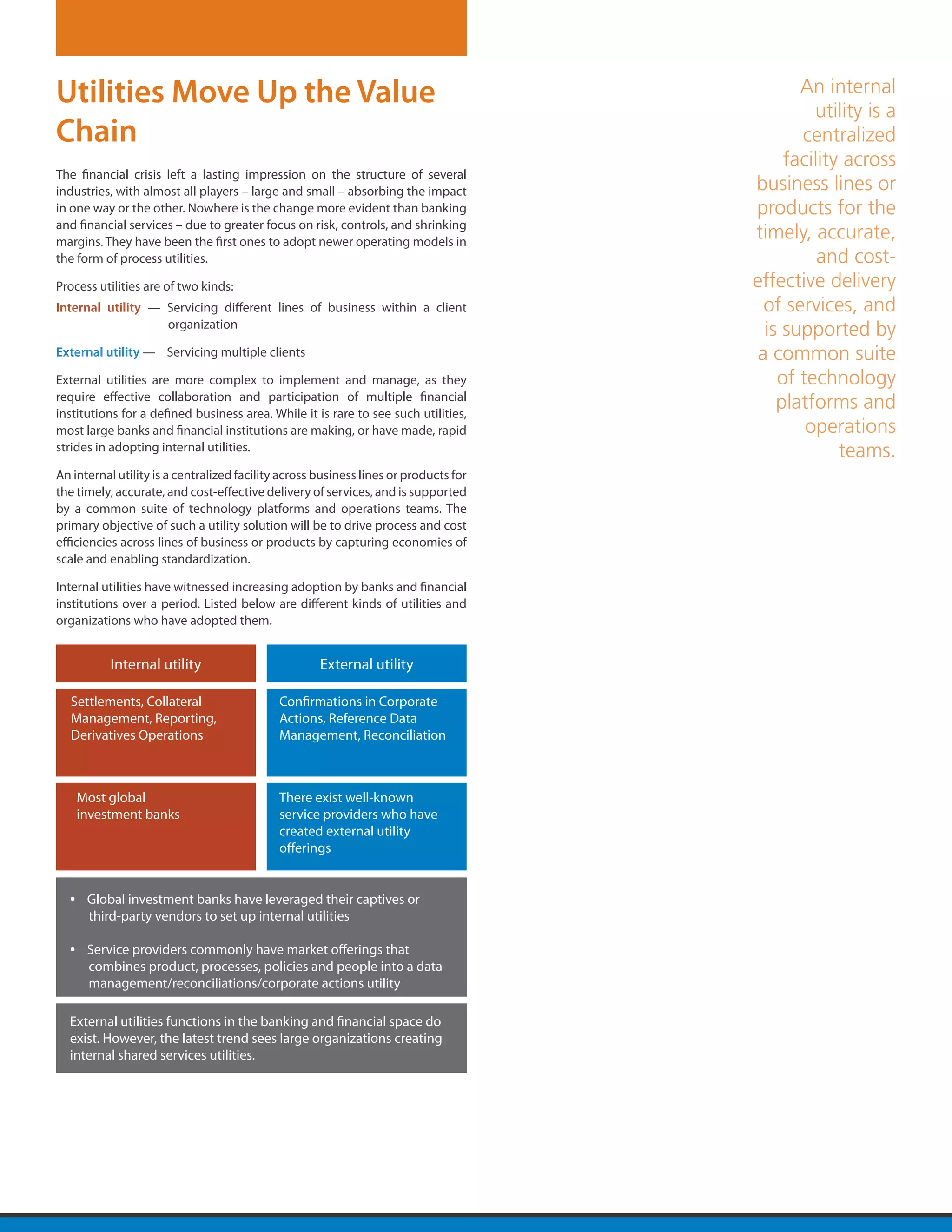
Internal utilities have witnessed increasing adoption by banks and financial
institutions over a period. Listed below are different kinds of utilities and
organizations who have adopted them.


           Internal utility                          External utility

  Settlements, Collateral                    Confirmations in Corporate
  Management, Reporting,                     Actions, Reference Data
  Derivatives Operations                     Management, Reconciliation


      Most global                            There exist well-known
      investment banks                       service providers who have
                                             created external utility
                                             offerings


  •    Global investment banks have leveraged their captives or
       third-party vendors to set up internal utilities

  •    Service providers commonly have market offerings that
       combines product, processes, policies and people into a data
       management/reconciliations/corporate actions utility

  External utilities functions in the banking and financial space do
  exist. However, the latest trend sees large organizations creating
  internal shared services utilities.
Why Utilities, Why Now?                                                                                        Centralizing
                                                                                                             functions in a
Although there are many drivers for the creation of internal utilities, four in particular stand out:
                                                                                                             utility enables
                                                                                                                operational
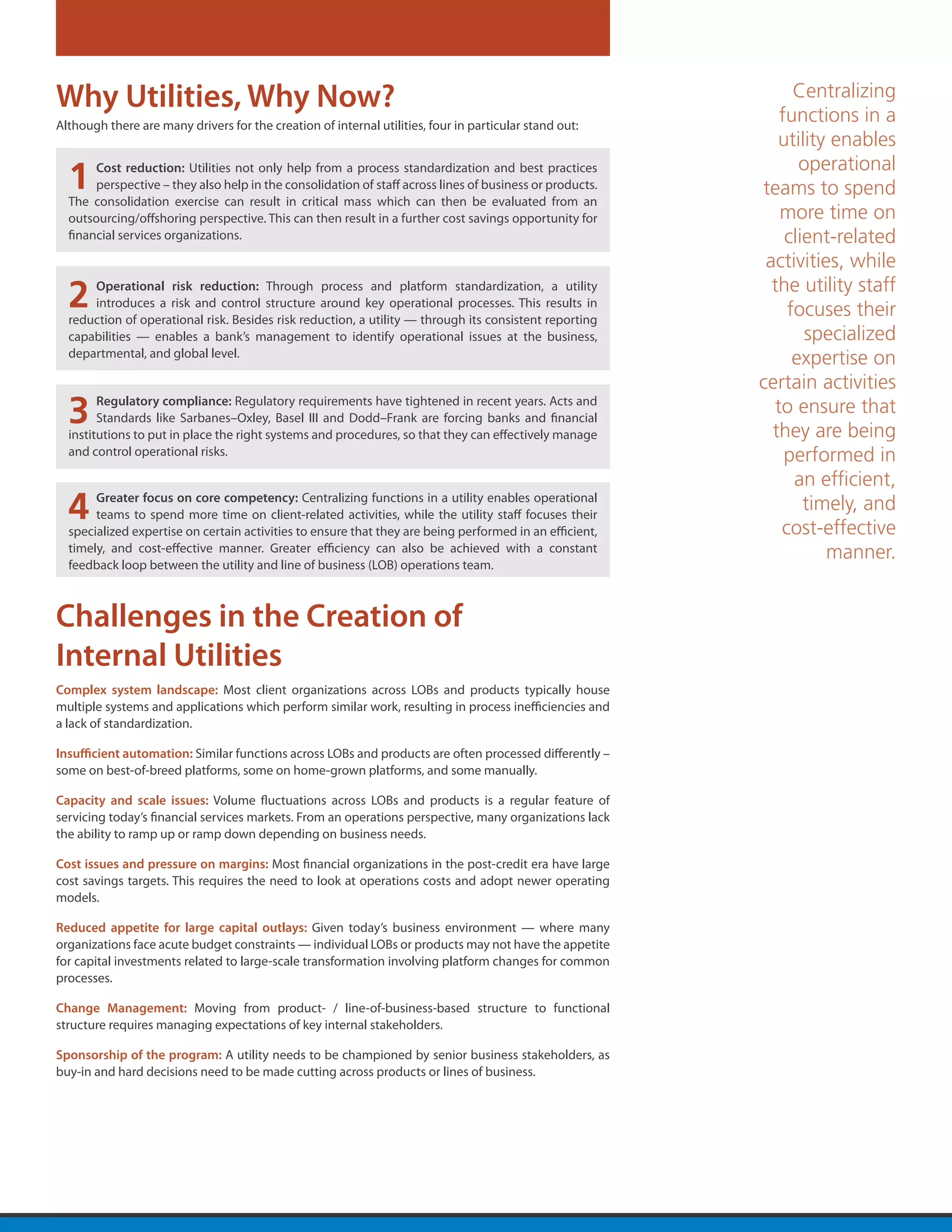
  1    Cost reduction: Utilities not only help from a process standardization and best practices
       perspective – they also help in the consolidation of staff across lines of business or products.
  The consolidation exercise can result in critical mass which can then be evaluated from an
                                                                                                          teams to spend
  outsourcing/offshoring perspective. This can then result in a further cost savings opportunity for         more time on
  financial services organizations.                                                                           client-related
                                                                                                           activities, while
  2   Operational risk reduction: Through process and platform standardization, a utility
      introduces a risk and control structure around key operational processes. This results in
  reduction of operational risk. Besides risk reduction, a utility — through its consistent reporting
                                                                                                            the utility staff
                                                                                                              focuses their
  capabilities — enables a bank’s management to identify operational issues at the business,                     specialized
  departmental, and global level.
                                                                                                               expertise on
                                                                                                          certain activities
  3     Regulatory compliance: Regulatory requirements have tightened in recent years. Acts and
        Standards like Sarbanes–Oxley, Basel III and Dodd–Frank are forcing banks and financial
  institutions to put in place the right systems and procedures, so that they can effectively manage
                                                                                                            to ensure that
                                                                                                            they are being
  and control operational risks.                                                                              performed in
                                                                                                               an efficient,
  4    Greater focus on core competency: Centralizing functions in a utility enables operational
       teams to spend more time on client-related activities, while the utility staff focuses their
  specialized expertise on certain activities to ensure that they are being performed in an efficient,
                                                                                                                 timely, and
                                                                                                             cost-effective
  timely, and cost-effective manner. Greater efficiency can also be achieved with a constant                        manner.
  feedback loop between the utility and line of business (LOB) operations team.


Challenges in the Creation of
Internal Utilities
Complex system landscape: Most client organizations across LOBs and products typically house
multiple systems and applications which perform similar work, resulting in process inefficiencies and
a lack of standardization.

Insufficient automation: Similar functions across LOBs and products are often processed differently –
some on best-of-breed platforms, some on home-grown platforms, and some manually.

Capacity and scale issues: Volume fluctuations across LOBs and products is a regular feature of
servicing today’s financial services markets. From an operations perspective, many organizations lack
the ability to ramp up or ramp down depending on business needs.

Cost issues and pressure on margins: Most financial organizations in the post-credit era have large
cost savings targets. This requires the need to look at operations costs and adopt newer operating
models.

Reduced appetite for large capital outlays: Given today’s business environment — where many
organizations face acute budget constraints — individual LOBs or products may not have the appetite
for capital investments related to large-scale transformation involving platform changes for common
processes.

Change Management: Moving from product- / line-of-business-based structure to functional
structure requires managing expectations of key internal stakeholders.

Sponsorship of the program: A utility needs to be championed by senior business stakeholders, as
buy-in and hard decisions need to be made cutting across products or lines of business.
Delivering Transformation with
Internal Utilities
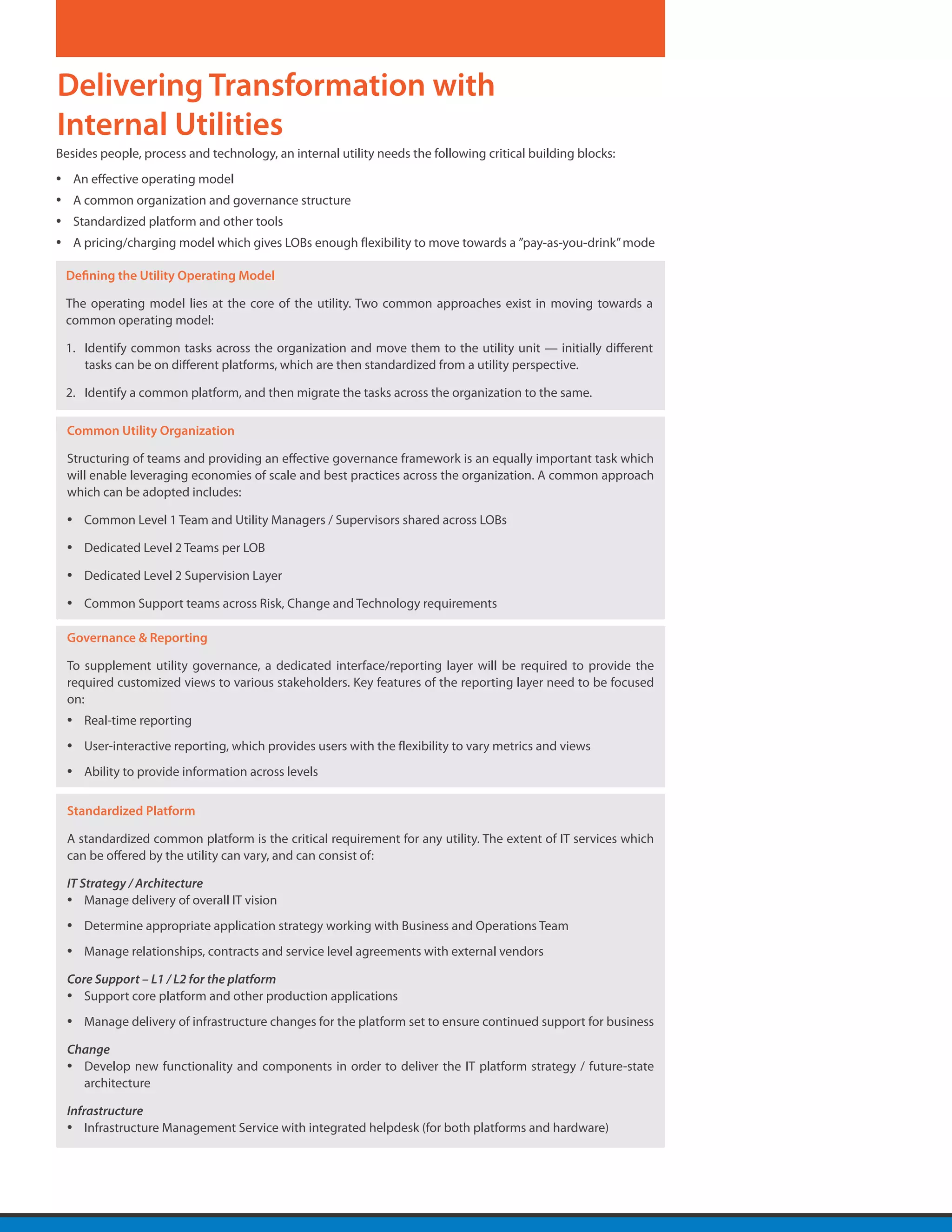
Besides people, process and technology, an internal utility needs the following critical building blocks:
•       An effective operating model
•       A common organization and governance structure
•       Standardized platform and other tools
•       A pricing/charging model which gives LOBs enough flexibility to move towards a ”pay-as-you-drink” mode

    Defining the Utility Operating Model

    The operating model lies at the core of the utility. Two common approaches exist in moving towards a
    common operating model:

    1.	 Identify common tasks across the organization and move them to the utility unit — initially different
        tasks can be on different platforms, which are then standardized from a utility perspective.

    2.	 Identify a common platform, and then migrate the tasks across the organization to the same.

    Common Utility Organization

    Structuring of teams and providing an effective governance framework is an equally important task which
    will enable leveraging economies of scale and best practices across the organization. A common approach
    which can be adopted includes:

    •    Common Level 1 Team and Utility Managers / Supervisors shared across LOBs

    •    Dedicated Level 2 Teams per LOB

    •    Dedicated Level 2 Supervision Layer

    •    Common Support teams across Risk, Change and Technology requirements

    Governance & Reporting

    To supplement utility governance, a dedicated interface/reporting layer will be required to provide the
    required customized views to various stakeholders. Key features of the reporting layer need to be focused
    on:
    •    Real-time reporting
    •    User-interactive reporting, which provides users with the flexibility to vary metrics and views
    •    Ability to provide information across levels

    Standardized Platform

    A standardized common platform is the critical requirement for any utility. The extent of IT services which
    can be offered by the utility can vary, and can consist of:

    IT Strategy / Architecture
    • Manage delivery of overall IT vision
    •    Determine appropriate application strategy working with Business and Operations Team
    •    Manage relationships, contracts and service level agreements with external vendors

    Core Support – L1 / L2 for the platform
    • Support core platform and other production applications
    •    Manage delivery of infrastructure changes for the platform set to ensure continued support for business

    Change
    • Develop new functionality and components in order to deliver the IT platform strategy / future-state
      architecture

    Infrastructure
    • Infrastructure Management Service with integrated helpdesk (for both platforms and hardware)
Why Creating an Internal Utility
is the Right Move
An internal utility has the following benefits over traditional outsourcing and other options:
•   It is usually based on an existing or acquired platform

•   Internal/vendor staff organized into a new operating model to support a global approach

•   Offered as an internal “Centre of Excellence” or “Shared Service” to other LOBs/products within the organization

•   Internal/vendor IT and staffing costs still incurred, but leveraged over a wider consumer population

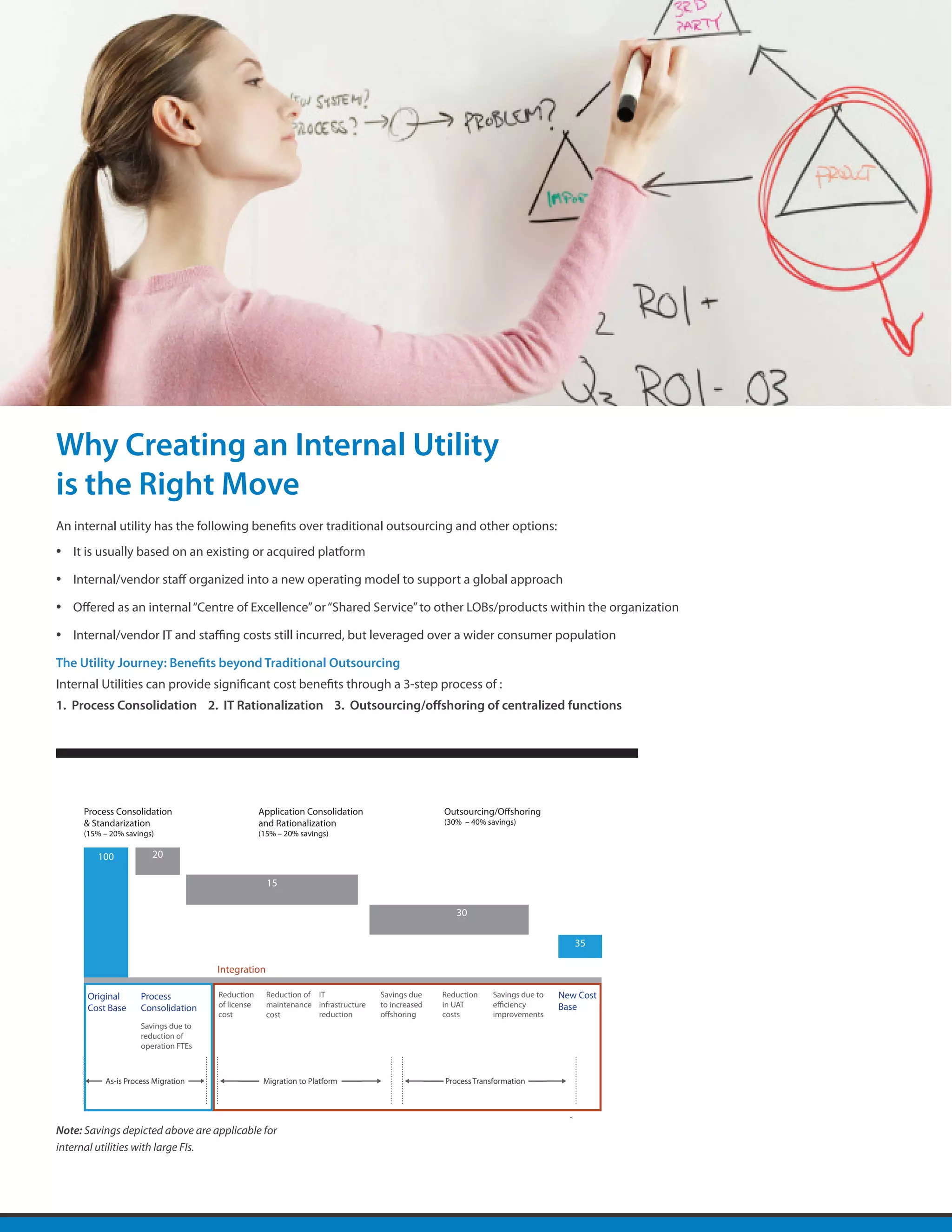
The Utility Journey: Benefits beyond Traditional Outsourcing
Internal Utilities can provide significant cost benefits through a 3-step process of :
1. Process Consolidation 2. IT Rationalization 3. Outsourcing/offshoring of centralized functions


      Process Consolidation                        Application Consolidation                     Outsourcing/Offshoring
      & Standarization                             and Rationalization                           (30% – 40% savings)
      (15% – 20% savings)                          (15% – 20% savings)

         100            20

                                                     15

                                                                                                    30

                                                                                                                                  35

                                      Integration

       Original      Process          Reduction      Reduction of IT              Savings due    Reduction    Savings due to   New Cost
       Cost Base     Consolidation    of license     maintenance infrastructure   to increased   in UAT       efficiency       Base
                                      cost           cost         reduction       offshoring     costs        improvements
                     Savings due to
                     reduction of
                     operation FTEs


           As-is Process Migration                  Migration to Platform                        Process Transformation


                                                                                                                                   Time
Note: Savings depicted above are applicable for
internal utilities with large FIs.
The Way Forward
Internal utilities, which have been not received due attention till date, are now being
viewed in a different light. Financial services organizations realize that key functions
like reconciliations, fraud and payments can be brought under this umbrella; and
that internal utilities present important opportunities for cost savings with improved
controls.
Utilities, if done correctly, represent the next level in outsourcing by combining
IT + Operations, and hold the promise of delivering significant bottom-line and process
impact over a period.


About the Author
                                           Abhijit Ghosh
                                           Principal Consultant, Infosys BPO

                                           Abhijit leads the Financial Services Solution Design team
                                           at Infosys BPO. He has close to 12 years of experience
                                           in the IT/ITES industry. Abhijit has been instrumental
                                           in developing BPO solutions in the Banking & Capital
                                           Markets space, besides handling RFP/RFI responses
                                           and client visits. He is a Post Graduate in Management
                                           with a graduate degree in Physics.
About Infosys BPO
                                                                                                                                Global organizations depend on Infosys BPO Ltd, the
                                                                                                                                business process outsourcing subsidiary of Infosys Limited
                                                                                                                                (NASDAQ: INFY) to deliver measurable business value.
                                                                                                                                Infosys BPO’s strong focus on industry solutions, technology
                                                                                                                                and a consulting based approach has created new engagement
                                                                                                                                models to help clients build tomorrow’s enterprise.

For more information, contact infosysbpo@infosys.com                                                                            www.infosysbpo.com

© 2012 Infosys Limited, Bangalore, India. Infosys believes the information in this publication is accurate as of its publication date; such information is subject to change without notice. Infosys acknowledges the proprietary rights of the
trademarks and product names of other companies mentioned in this document.

Delivering Transformation by creating the right Internal Utilities

  • 1.
    Infosys BPO Point ofView All the Right Moves Part II – Delivering Transformation by Creating the Right Internal Utilities Abhijit Ghosh www.infosysbpo.com
  • 2.
    The financial crisisleft a lasting impression on the structure of participants in the financial services market and almost all players, large and small, were impacted in one way or the other. Significant consolidation resulted in fewer players dominating the market. The change was evident across banks, broker-dealers and custodians, amongst others; but it was more evident amongst the global investment banks and custodians. This was due to greater focus on risk, controls, and shrinking margins – they were the first ones to adopt newer operating models in the form of process utilities. The creation of a utility makes perfect business sense for financial institutions, but its success will depend on choosing the right kind of utility, and taking the right approach and managing internal change. An internal utility, if implemented the right way, holds the promise of delivering significant bottom-line benefits, robust controls and unified view of risk. This paper highlights the critical building blocks which financial service institutions will need in creating the right internal utilities and the benefits associated with the same.
  • 3.
    Utilities Move Upthe Value An internal utility is a Chain centralized facility across The financial crisis left a lasting impression on the structure of several industries, with almost all players – large and small – absorbing the impact business lines or in one way or the other. Nowhere is the change more evident than banking products for the and financial services – due to greater focus on risk, controls, and shrinking margins. They have been the first ones to adopt newer operating models in timely, accurate, the form of process utilities. and cost- Process utilities are of two kinds: effective delivery Internal utility — Servicing different lines of business within a client of services, and organization is supported by External utility — Servicing multiple clients a common suite External utilities are more complex to implement and manage, as they of technology require effective collaboration and participation of multiple financial institutions for a defined business area. While it is rare to see such utilities, platforms and most large banks and financial institutions are making, or have made, rapid operations strides in adopting internal utilities. teams. An internal utility is a centralized facility across business lines or products for the timely, accurate, and cost-effective delivery of services, and is supported by a common suite of technology platforms and operations teams. The primary objective of such a utility solution will be to drive process and cost efficiencies across lines of business or products by capturing economies of scale and enabling standardization. Internal utilities have witnessed increasing adoption by banks and financial institutions over a period. Listed below are different kinds of utilities and organizations who have adopted them. Internal utility External utility Settlements, Collateral Confirmations in Corporate Management, Reporting, Actions, Reference Data Derivatives Operations Management, Reconciliation Most global There exist well-known investment banks service providers who have created external utility offerings • Global investment banks have leveraged their captives or third-party vendors to set up internal utilities • Service providers commonly have market offerings that combines product, processes, policies and people into a data management/reconciliations/corporate actions utility External utilities functions in the banking and financial space do exist. However, the latest trend sees large organizations creating internal shared services utilities.
  • 4.
    Why Utilities, WhyNow? Centralizing functions in a Although there are many drivers for the creation of internal utilities, four in particular stand out: utility enables operational 1 Cost reduction: Utilities not only help from a process standardization and best practices perspective – they also help in the consolidation of staff across lines of business or products. The consolidation exercise can result in critical mass which can then be evaluated from an teams to spend outsourcing/offshoring perspective. This can then result in a further cost savings opportunity for more time on financial services organizations. client-related activities, while 2 Operational risk reduction: Through process and platform standardization, a utility introduces a risk and control structure around key operational processes. This results in reduction of operational risk. Besides risk reduction, a utility — through its consistent reporting the utility staff focuses their capabilities — enables a bank’s management to identify operational issues at the business, specialized departmental, and global level. expertise on certain activities 3 Regulatory compliance: Regulatory requirements have tightened in recent years. Acts and Standards like Sarbanes–Oxley, Basel III and Dodd–Frank are forcing banks and financial institutions to put in place the right systems and procedures, so that they can effectively manage to ensure that they are being and control operational risks. performed in an efficient, 4 Greater focus on core competency: Centralizing functions in a utility enables operational teams to spend more time on client-related activities, while the utility staff focuses their specialized expertise on certain activities to ensure that they are being performed in an efficient, timely, and cost-effective timely, and cost-effective manner. Greater efficiency can also be achieved with a constant manner. feedback loop between the utility and line of business (LOB) operations team. Challenges in the Creation of Internal Utilities Complex system landscape: Most client organizations across LOBs and products typically house multiple systems and applications which perform similar work, resulting in process inefficiencies and a lack of standardization. Insufficient automation: Similar functions across LOBs and products are often processed differently – some on best-of-breed platforms, some on home-grown platforms, and some manually. Capacity and scale issues: Volume fluctuations across LOBs and products is a regular feature of servicing today’s financial services markets. From an operations perspective, many organizations lack the ability to ramp up or ramp down depending on business needs. Cost issues and pressure on margins: Most financial organizations in the post-credit era have large cost savings targets. This requires the need to look at operations costs and adopt newer operating models. Reduced appetite for large capital outlays: Given today’s business environment — where many organizations face acute budget constraints — individual LOBs or products may not have the appetite for capital investments related to large-scale transformation involving platform changes for common processes. Change Management: Moving from product- / line-of-business-based structure to functional structure requires managing expectations of key internal stakeholders. Sponsorship of the program: A utility needs to be championed by senior business stakeholders, as buy-in and hard decisions need to be made cutting across products or lines of business.
  • 5.
    Delivering Transformation with InternalUtilities Besides people, process and technology, an internal utility needs the following critical building blocks: • An effective operating model • A common organization and governance structure • Standardized platform and other tools • A pricing/charging model which gives LOBs enough flexibility to move towards a ”pay-as-you-drink” mode Defining the Utility Operating Model The operating model lies at the core of the utility. Two common approaches exist in moving towards a common operating model: 1. Identify common tasks across the organization and move them to the utility unit — initially different tasks can be on different platforms, which are then standardized from a utility perspective. 2. Identify a common platform, and then migrate the tasks across the organization to the same. Common Utility Organization Structuring of teams and providing an effective governance framework is an equally important task which will enable leveraging economies of scale and best practices across the organization. A common approach which can be adopted includes: • Common Level 1 Team and Utility Managers / Supervisors shared across LOBs • Dedicated Level 2 Teams per LOB • Dedicated Level 2 Supervision Layer • Common Support teams across Risk, Change and Technology requirements Governance & Reporting To supplement utility governance, a dedicated interface/reporting layer will be required to provide the required customized views to various stakeholders. Key features of the reporting layer need to be focused on: • Real-time reporting • User-interactive reporting, which provides users with the flexibility to vary metrics and views • Ability to provide information across levels Standardized Platform A standardized common platform is the critical requirement for any utility. The extent of IT services which can be offered by the utility can vary, and can consist of: IT Strategy / Architecture • Manage delivery of overall IT vision • Determine appropriate application strategy working with Business and Operations Team • Manage relationships, contracts and service level agreements with external vendors Core Support – L1 / L2 for the platform • Support core platform and other production applications • Manage delivery of infrastructure changes for the platform set to ensure continued support for business Change • Develop new functionality and components in order to deliver the IT platform strategy / future-state architecture Infrastructure • Infrastructure Management Service with integrated helpdesk (for both platforms and hardware)
  • 6.
    Why Creating anInternal Utility is the Right Move An internal utility has the following benefits over traditional outsourcing and other options: • It is usually based on an existing or acquired platform • Internal/vendor staff organized into a new operating model to support a global approach • Offered as an internal “Centre of Excellence” or “Shared Service” to other LOBs/products within the organization • Internal/vendor IT and staffing costs still incurred, but leveraged over a wider consumer population The Utility Journey: Benefits beyond Traditional Outsourcing Internal Utilities can provide significant cost benefits through a 3-step process of : 1. Process Consolidation 2. IT Rationalization 3. Outsourcing/offshoring of centralized functions Process Consolidation Application Consolidation Outsourcing/Offshoring & Standarization and Rationalization (30% – 40% savings) (15% – 20% savings) (15% – 20% savings) 100 20 15 30 35 Integration Original Process Reduction Reduction of IT Savings due Reduction Savings due to New Cost Cost Base Consolidation of license maintenance infrastructure to increased in UAT efficiency Base cost cost reduction offshoring costs improvements Savings due to reduction of operation FTEs As-is Process Migration Migration to Platform Process Transformation Time Note: Savings depicted above are applicable for internal utilities with large FIs.
  • 7.
    The Way Forward Internalutilities, which have been not received due attention till date, are now being viewed in a different light. Financial services organizations realize that key functions like reconciliations, fraud and payments can be brought under this umbrella; and that internal utilities present important opportunities for cost savings with improved controls. Utilities, if done correctly, represent the next level in outsourcing by combining IT + Operations, and hold the promise of delivering significant bottom-line and process impact over a period. About the Author Abhijit Ghosh Principal Consultant, Infosys BPO Abhijit leads the Financial Services Solution Design team at Infosys BPO. He has close to 12 years of experience in the IT/ITES industry. Abhijit has been instrumental in developing BPO solutions in the Banking & Capital Markets space, besides handling RFP/RFI responses and client visits. He is a Post Graduate in Management with a graduate degree in Physics.
  • 8.
    About Infosys BPO Global organizations depend on Infosys BPO Ltd, the business process outsourcing subsidiary of Infosys Limited (NASDAQ: INFY) to deliver measurable business value. Infosys BPO’s strong focus on industry solutions, technology and a consulting based approach has created new engagement models to help clients build tomorrow’s enterprise. For more information, contact infosysbpo@infosys.com www.infosysbpo.com © 2012 Infosys Limited, Bangalore, India. Infosys believes the information in this publication is accurate as of its publication date; such information is subject to change without notice. Infosys acknowledges the proprietary rights of the trademarks and product names of other companies mentioned in this document.