Amity School of Business


         Module 6
Key System Applications For
      The Digital Age


                                                1
Amity School of Business

              Module 6
1. Enterprise Systems
2. E-Commerce: Digital Market & Digital
   Goods
3. M-Commerce:          Services                 &
   Applications


                                                       2
Amity School of Business


1. Enterprise Systems –
  •   Supply Chain Management
  •   Customer    Relationship     Management
      Systems


                                                            3
Amity School of Business


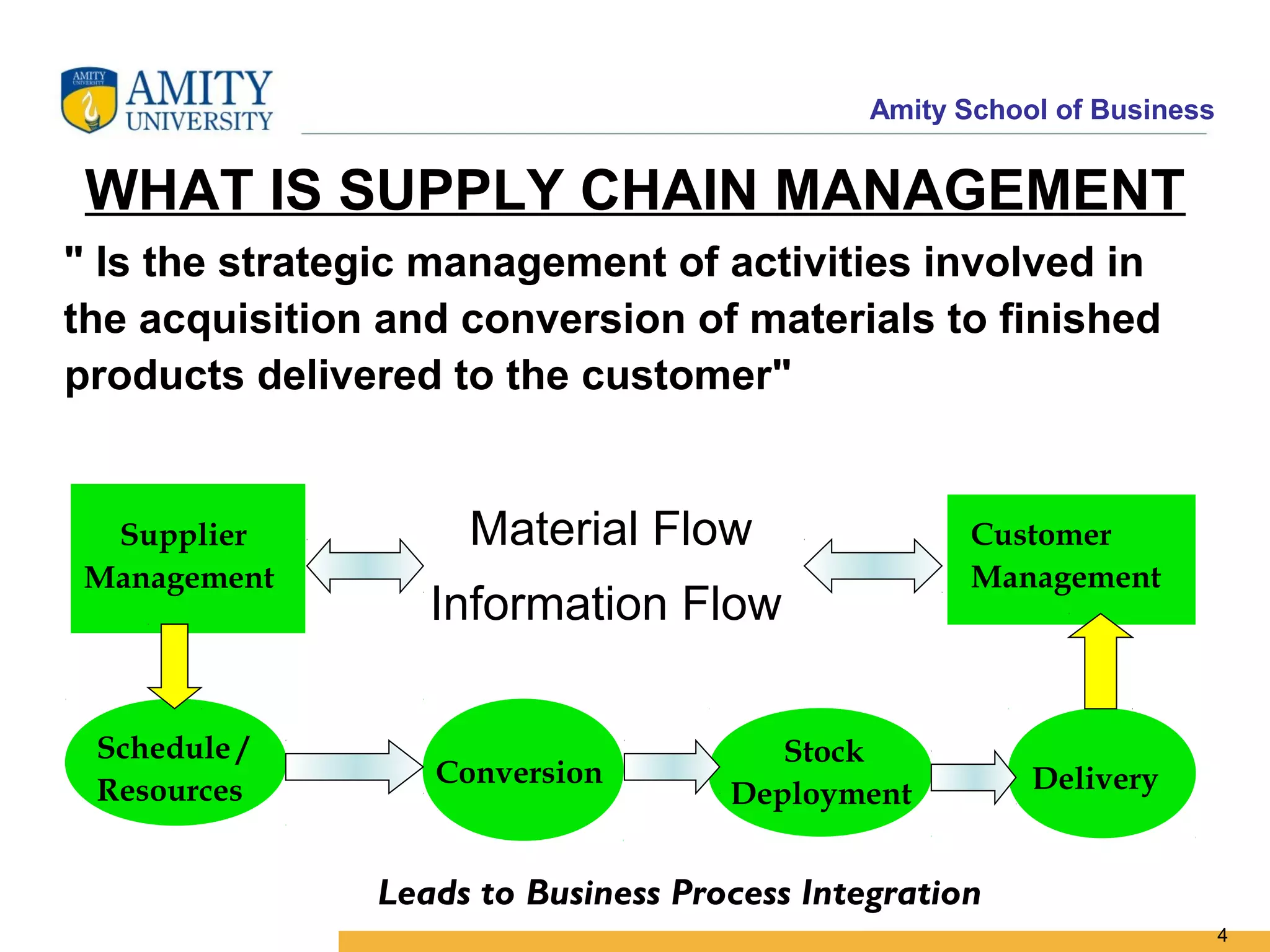
 WHAT IS SUPPLY CHAIN MANAGEMENT
" Is the strategic management of activities involved in
the acquisition and conversion of materials to finished
products delivered to the customer"


  Supplier          Material Flow                   Customer
 Management                                         Management
                  Information Flow

 Schedule /                            Stock
                  Conversion                            Delivery
 Resources                          Deployment


               Leads to Business Process Integration
                                                                        4
Amity School of Business


      SUPPLY CHAIN MANAGEMENT
• Supply chain is the system by which
  organizations source, make and deliver their
  products or services according to market
  demand.
• Supply chain management operations and
  decisions are ultimately triggered by demand
  signals at the ultimate consumer level.
• Supply chain as defined by experienced
  practitioners extends from suppliers’ suppliers to
  customers’ customers.

                                                                5
Amity School of Business


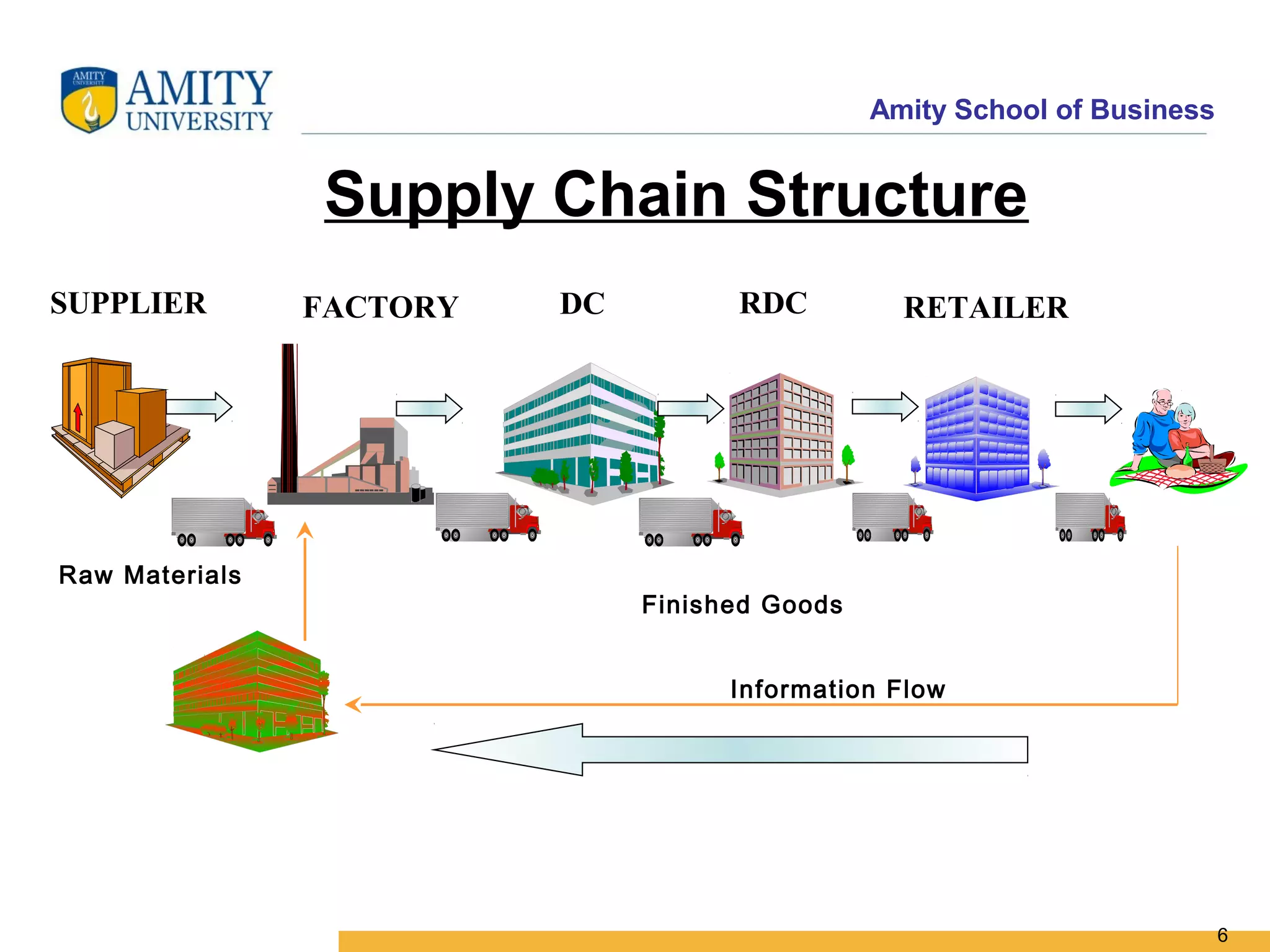
                Supply Chain Structure
SUPPLIER        FACTORY   DC         RDC          RETAILER


Raw Materials
                               Finished Goods


                                     Information Flow


                                                                           6
Amity School of Business


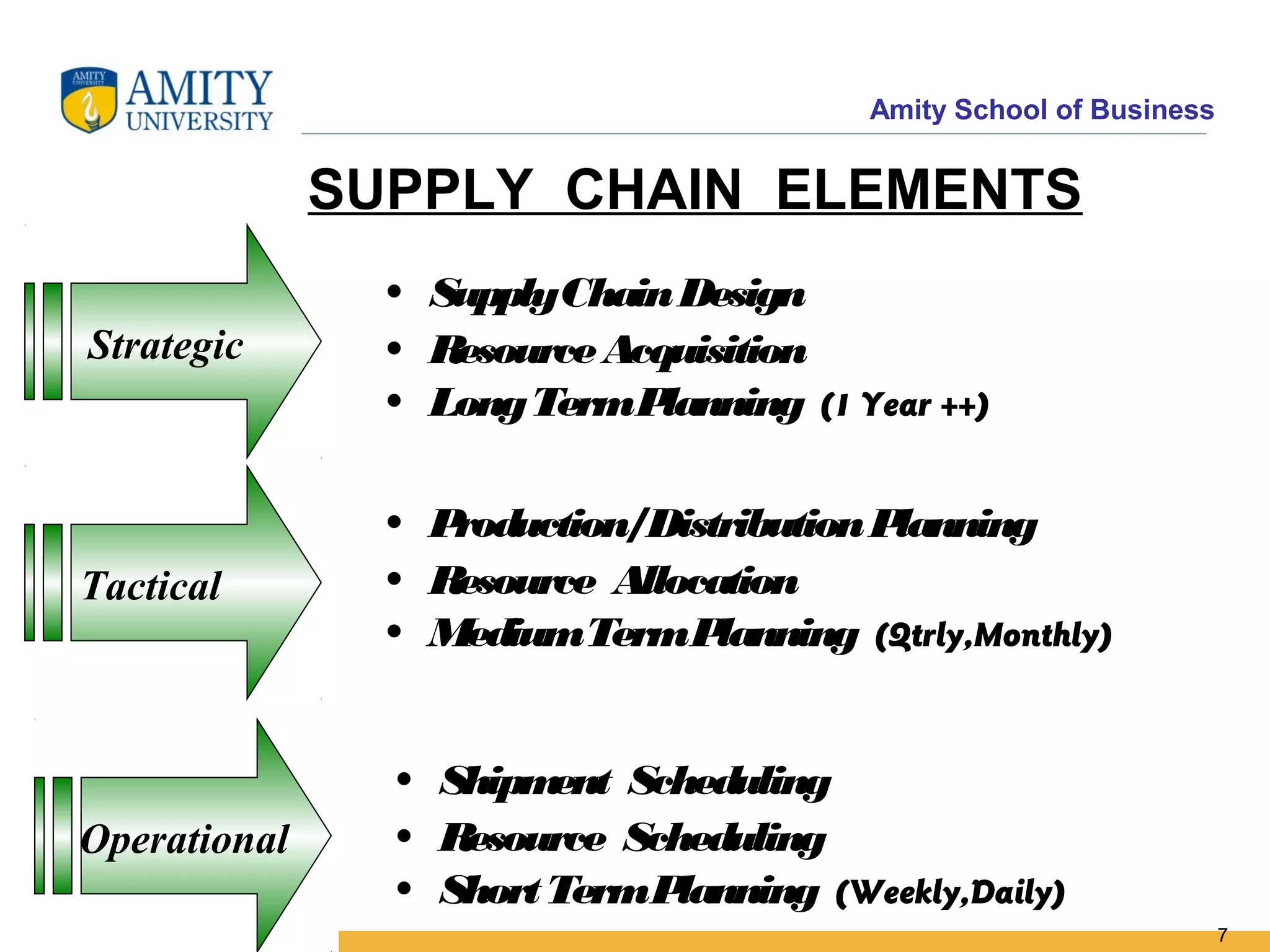
              SUPPLY CHAIN ELEMENTS
                • SupplyChain Design
Strategic       • Resource Acquisition
                • Long TermP  lanning (1 Year ++)

                • P uction/Distribution P
                   rod                    lanning
Tactical        • Resource Allocation
                • MediumTermP    lanning (Qtrly,Monthly)


                • Shipm ent Scheduling
Operational     • Resource Scheduling
                • Short TermP lanning (Weekly,Daily)
                                                                     7
Amity School of Business


• SUPPLY CHAIN INCLUDES :


  – MATERIAL FLOWS


  – INFORMATION FLOWS


  – FINANCIAL FLOWS


                                                       8
Amity School of Business


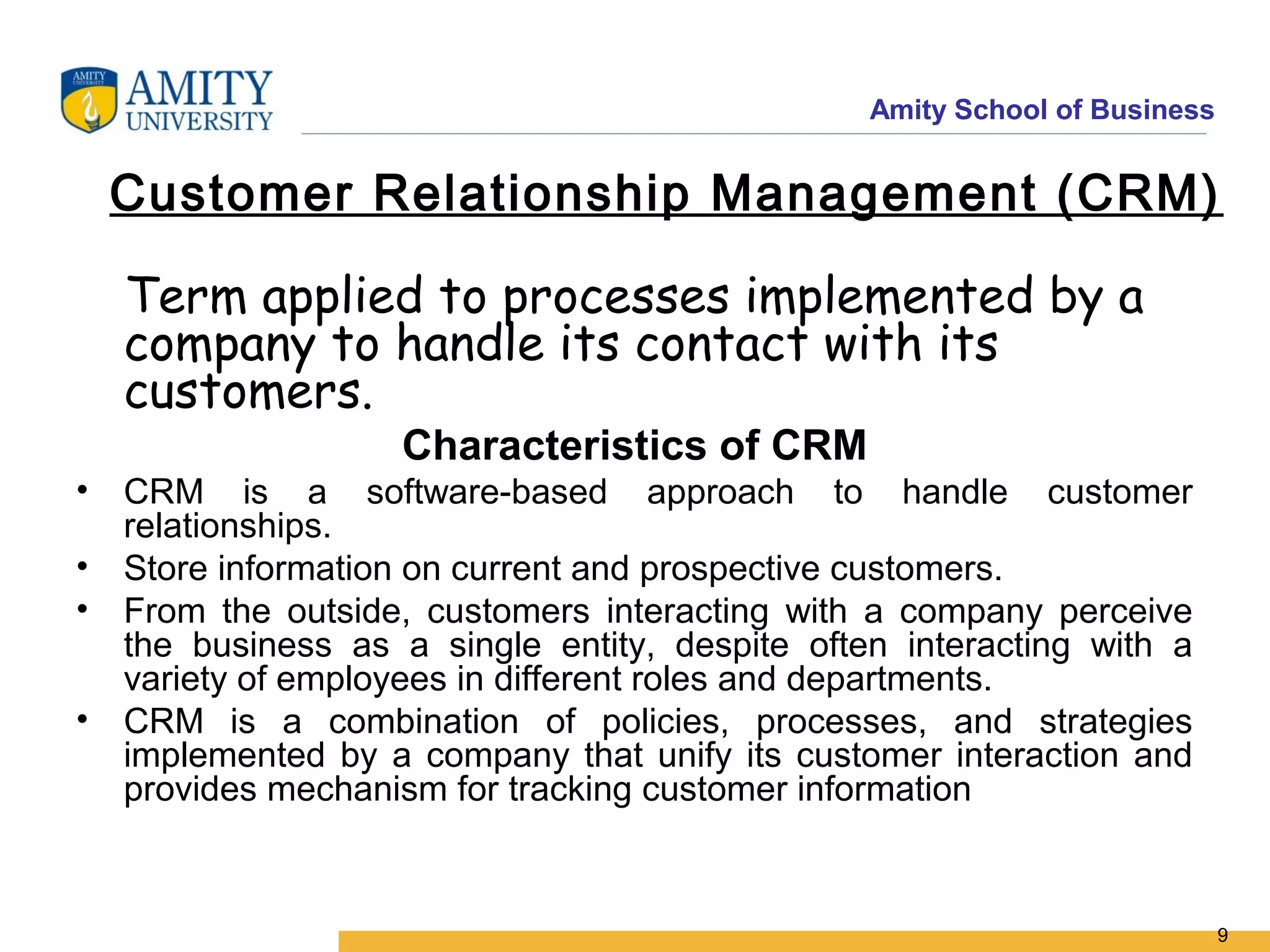
  Customer Relationship Management (CRM)

  Term applied to processes implemented by a
  company to handle its contact with its
  customers.
                   Characteristics of CRM
• CRM is a software-based approach to handle customer
  relationships.
• Store information on current and prospective customers.
• From the outside, customers interacting with a company perceive
  the business as a single entity, despite often interacting with a
  variety of employees in different roles and departments.
• CRM is a combination of policies, processes, and strategies
  implemented by a company that unify its customer interaction and
  provides mechanism for tracking customer information


                                                                          9
Amity School of Business


     Why CRM?
  More companies are beginning to
view customers as their primary
asset.


                                             10
Amity School of Business

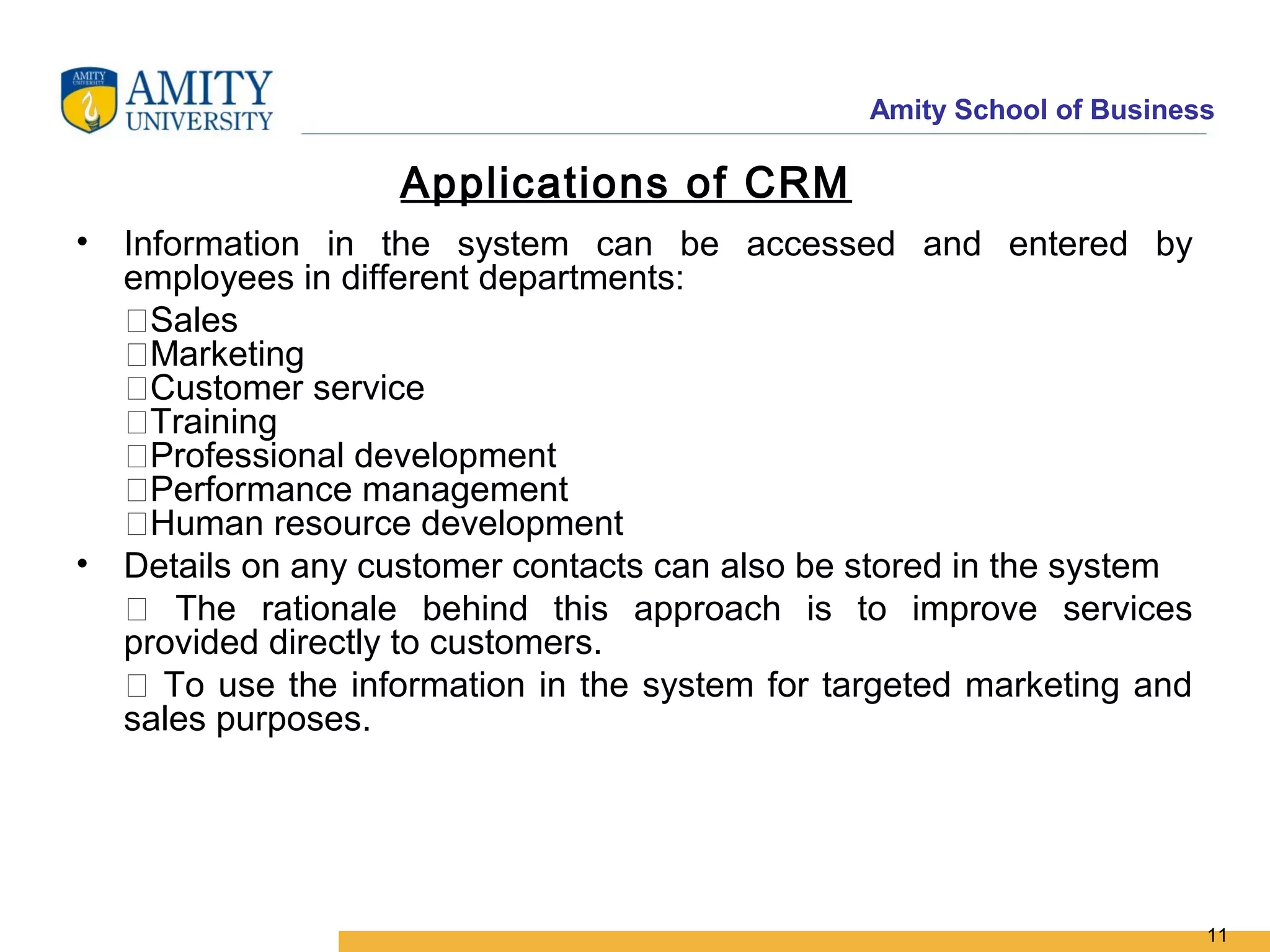
                   Applications of CRM
• Information in the system can be accessed and entered by
  employees in different departments:
  Sales
  Marketing
  Customer service
  Training
  Professional development
  Performance management
  Human resource development
• Details on any customer contacts can also be stored in the system
   The rationale behind this approach is to improve services
  provided directly to customers.
   To use the information in the system for targeted marketing and
  sales purposes.


                                                                      11
Amity School of Business

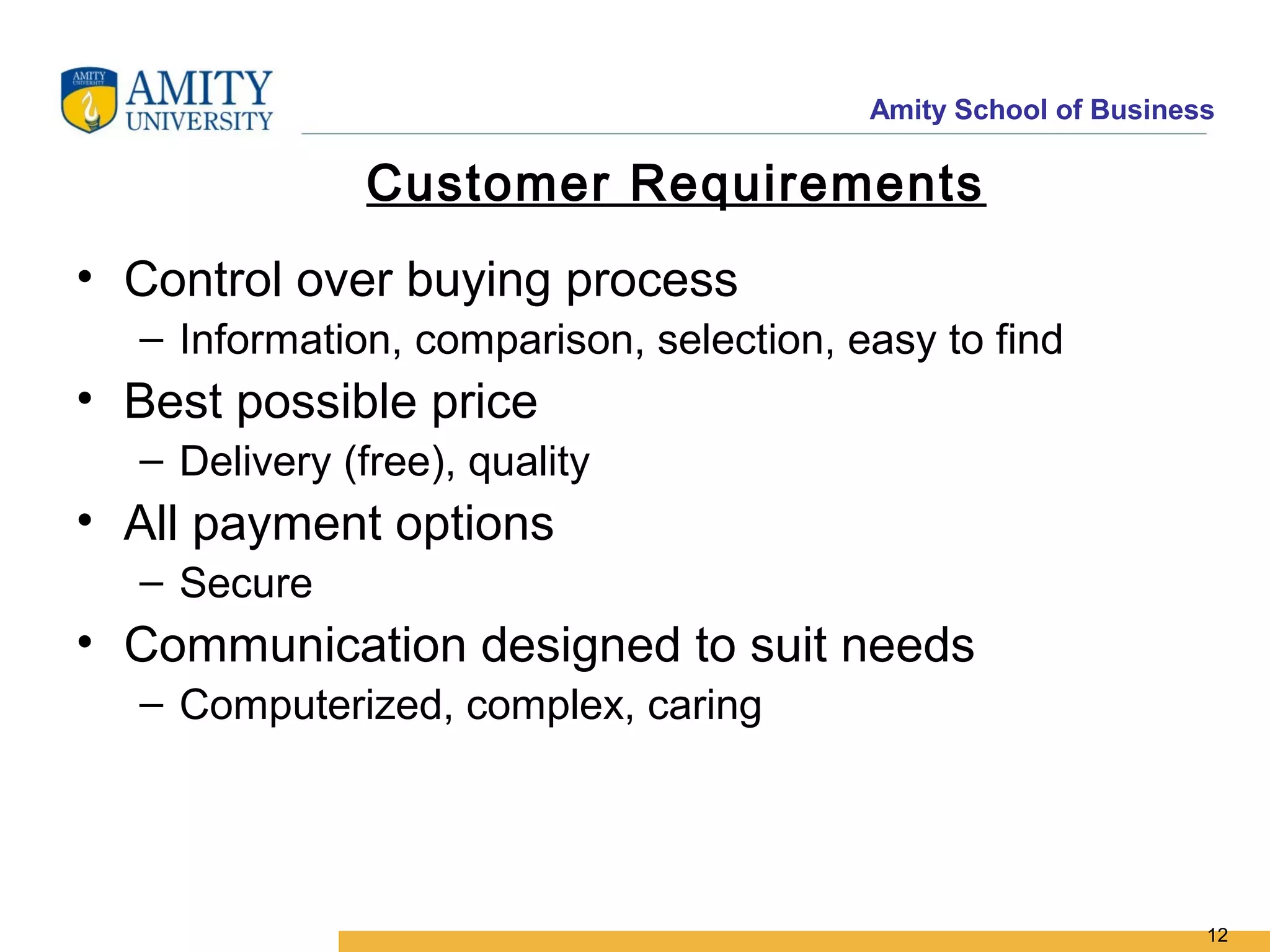
               Customer Requirements
• Control over buying process
  – Information, comparison, selection, easy to find
• Best possible price
  – Delivery (free), quality
• All payment options
  – Secure
• Communication designed to suit needs
  – Computerized, complex, caring


                                                                12
Amity School of Business


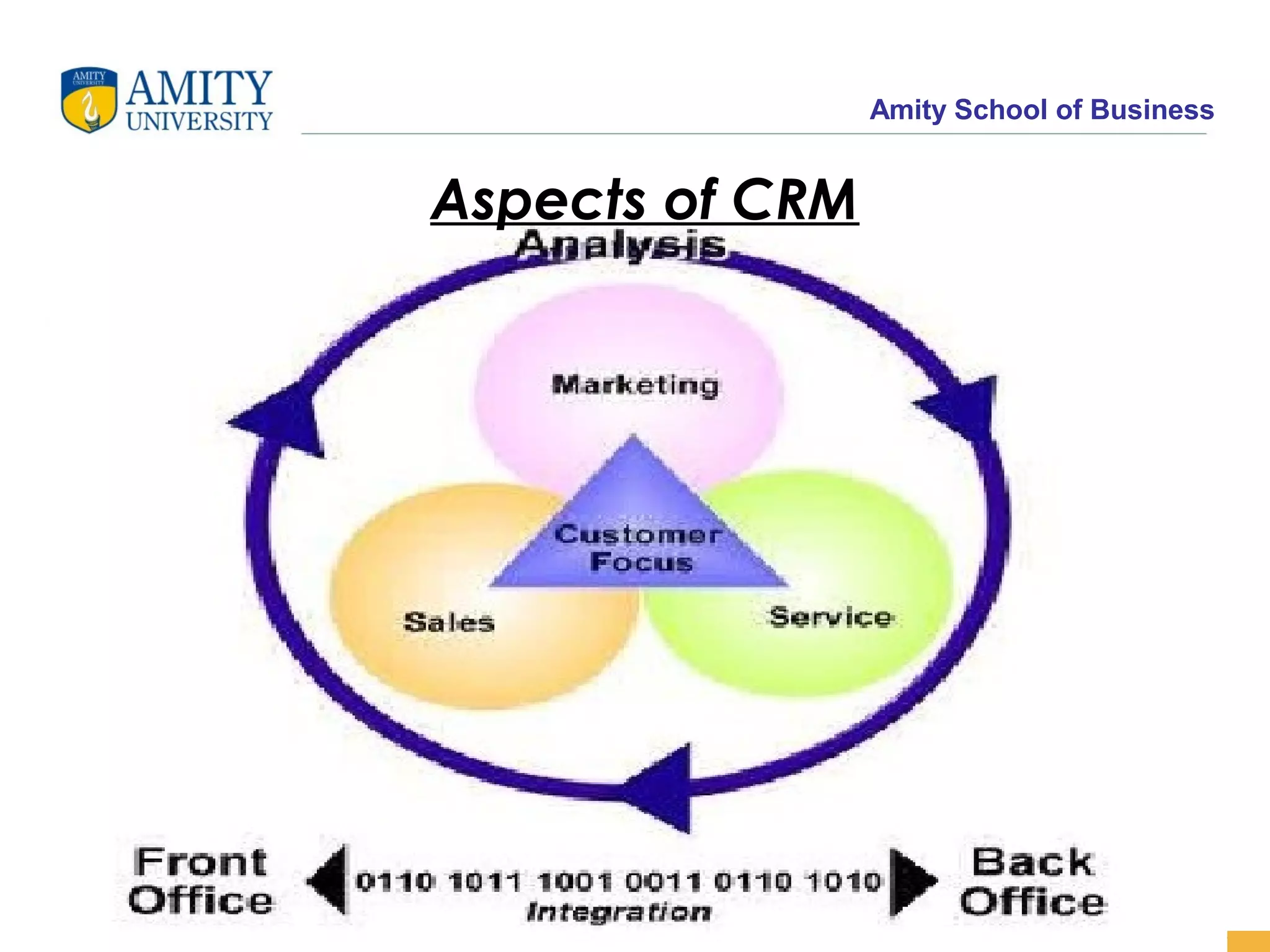
Aspects of CRM


                                        13
Amity School of Business

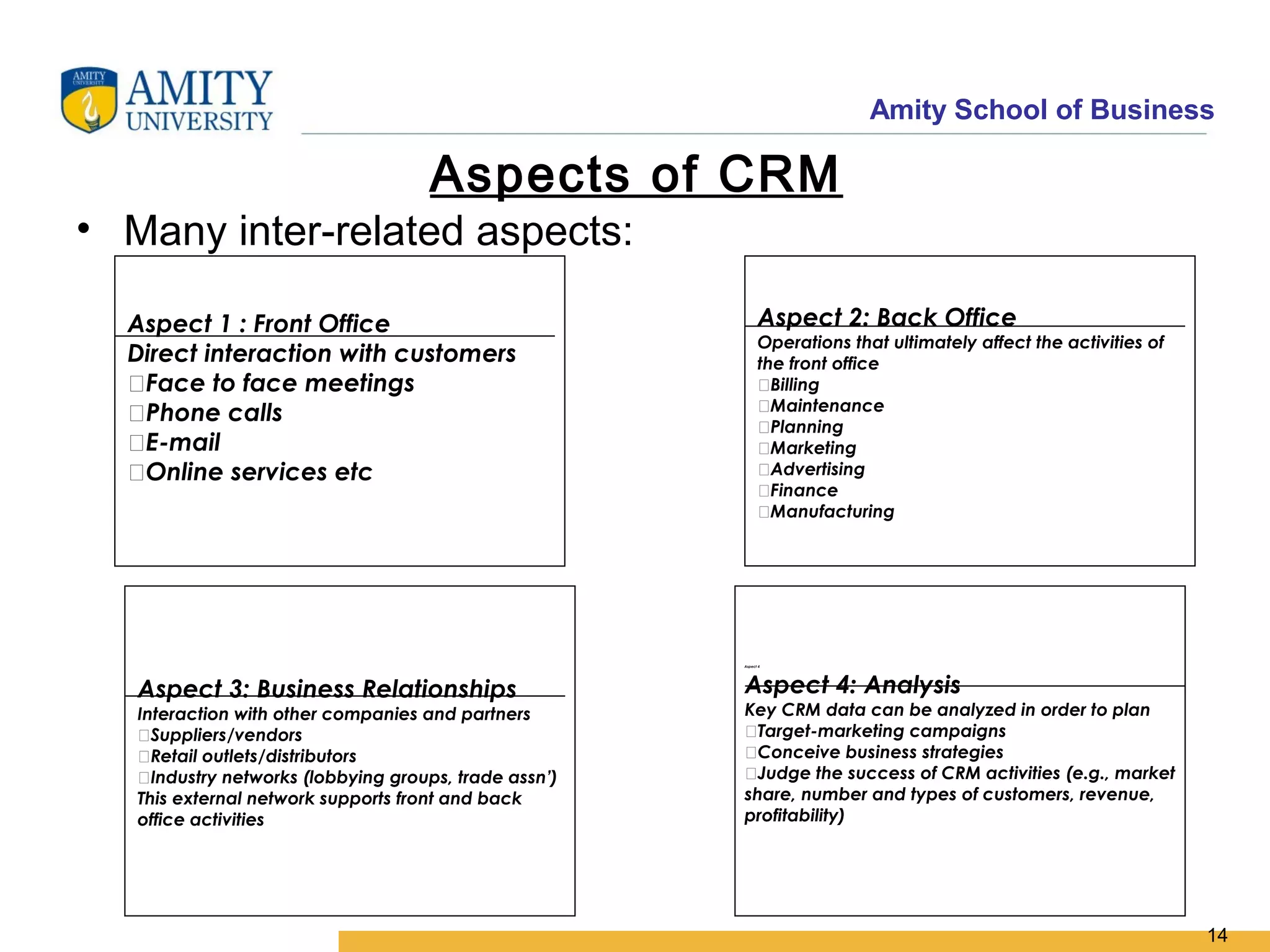
                                     Aspects of CRM
• Many inter-related aspects:

  Aspect 1 : Front Office                                    Aspect 2: Back Office
                                                             Operations that ultimately affect the activities of
  Direct interaction with customers                          the front office
  Face to face meetings                                     Billing
                                                             Maintenance
  Phone calls                                               Planning
  E-mail                                                    Marketing
  Online services etc                                       Advertising
                                                             Finance
                                                             Manufacturing


                                                       Aspect 4


   Aspect 3: Business Relationships                    Aspect 4: Analysis
   Interaction with other companies and partners       Key CRM data can be analyzed in order to plan
   Suppliers/vendors                                  Target-marketing campaigns
   Retail outlets/distributors                        Conceive business strategies
   Industry networks (lobbying groups, trade assn’)   Judge the success of CRM activities (e.g., market
   This external network supports front and back       share, number and types of customers, revenue,
   office activities                                   profitability)


                                                                                                                   14
Amity School of Business


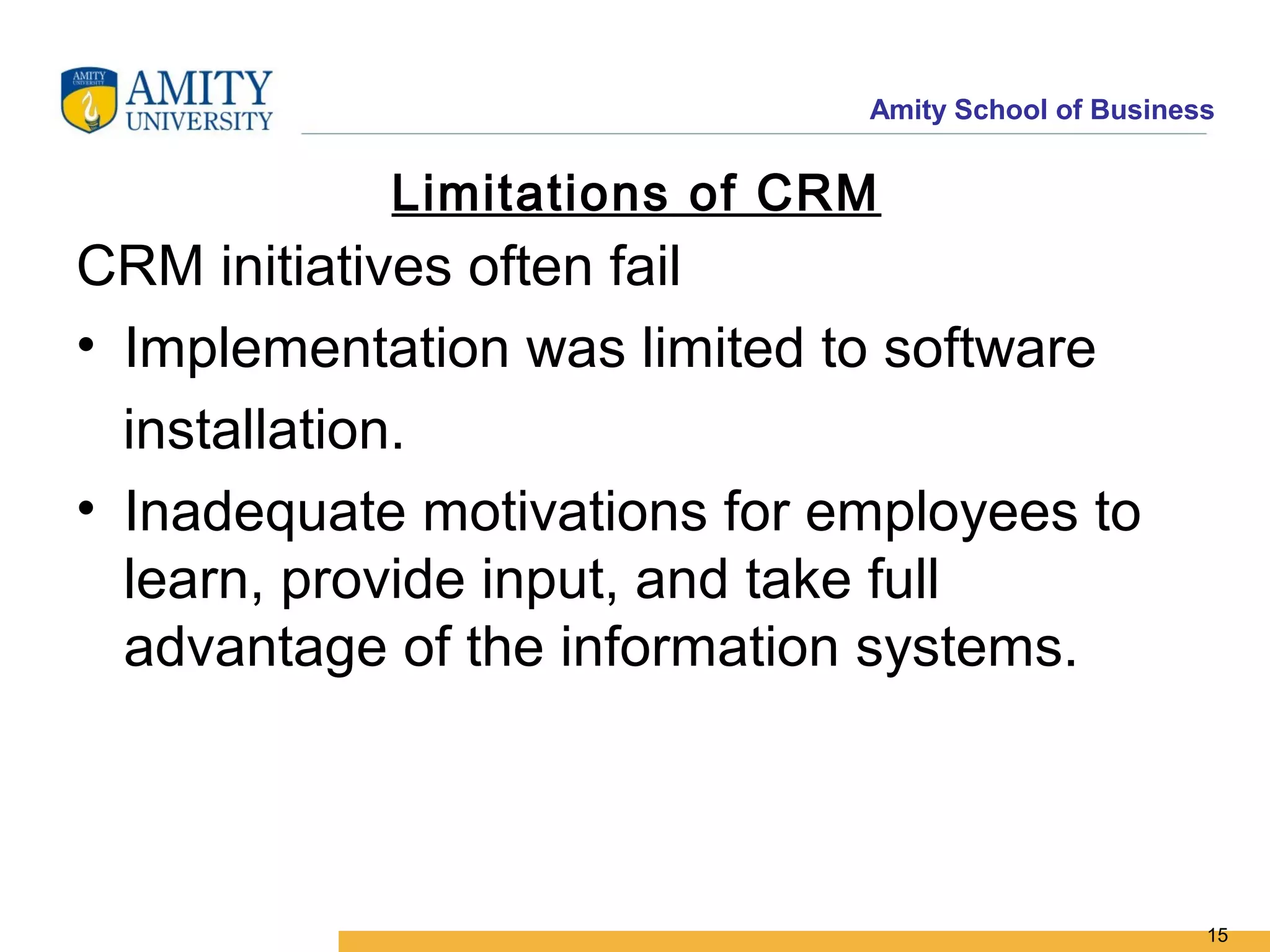
            Limitations of CRM
CRM initiatives often fail
• Implementation was limited to software
  installation.
• Inadequate motivations for employees to
  learn, provide input, and take full
  advantage of the information systems.


                                                     15
Amity School of Business


2. E-Commerce:
 – Digital Market
 – Digital Goods


                                           16
Amity School of Business


                   E-Commerce
• The use of the Internet and the Web to transact business
   – Digitally enabled commercial transactions
   – Exchange of values
• E-commerce is more than just buying and selling
  products online.
• Instead, it encompasses the entire online processes of
  developing, marketing, selling, delivering, and paying for
  products and services purchased by internet worked,
  global market places of customers, with support of
  worldwide network of business partners.
• In using the web as links between the buyers and
  sellers, they can use internet, extranet and intranets.

                                                                 17
Amity School of Business

     Classification of e-commerce
•   Business-to-Business   •   Business –to-Employee
    (B2B) e commerce       •   E-Government
•   Business-to-Consumer   •   E-Learning
    (B2C) e commerce       •   None-Business e-
•   Consumer-to-Business       commerce
    (C2B) e commerce       •   Business-to-Business-to-
•   Consumer-to-               Customer
    Consumer (C2C) e       •   Intra-business e commerce
    commerce
                           •   Exchange-to-Exchange
•   Peer-to-Peer (P2P) e
    commerce               •   Collaborative commerce
•   M-commerce

                                                              18
Amity School of Business


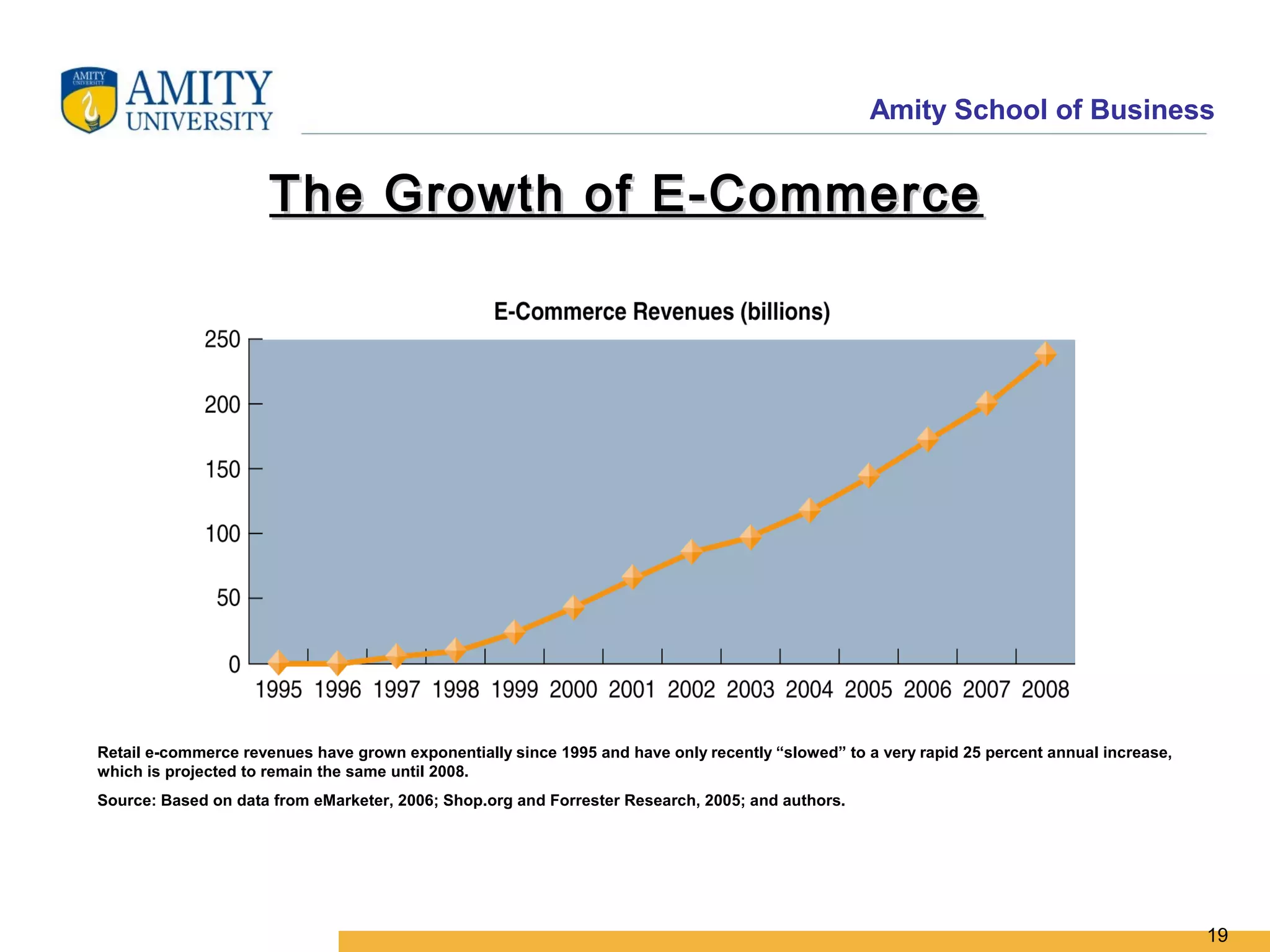
                      The Growth of E-Commerce


Retail e-commerce revenues have grown exponentially since 1995 and have only recently “slowed” to a very rapid 25 percent annual increase,
which is projected to remain the same until 2008.
Source: Based on data from eMarketer, 2006; Shop.org and Forrester Research, 2005; and authors.


                                                                                                                                             19
Amity School of Business


          Digital Market
•   Internet provides a digital environment
  where buyers and sellers can meet,
  search for products, display products, and
  establish prices for those products.
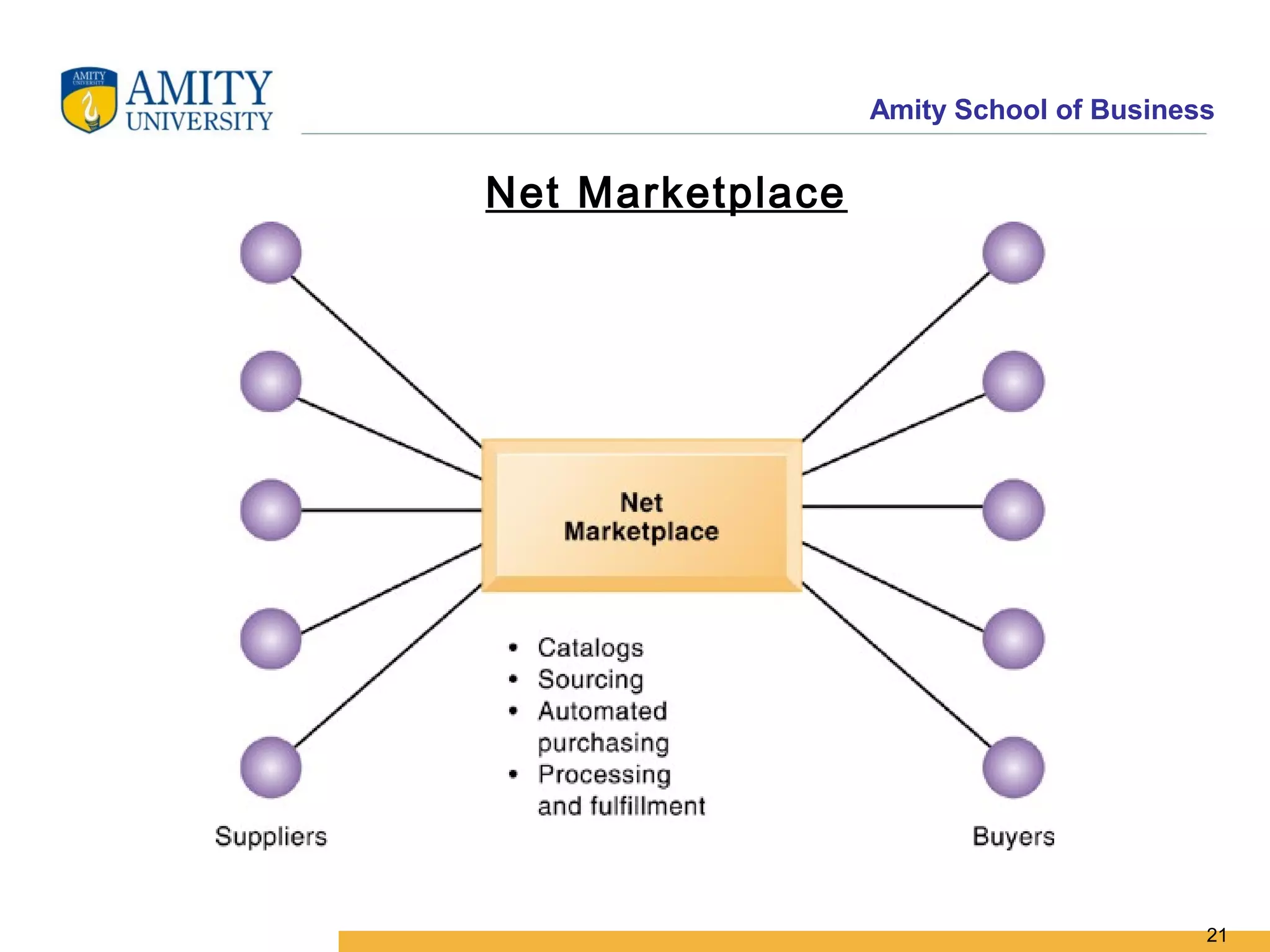
•        Net marketplaces are online
  marketplaces where multiple buyers can
  purchase from multiple sellers.


                                                     20
Amity School of Business


Net Marketplace


                                         21
Amity School of Business


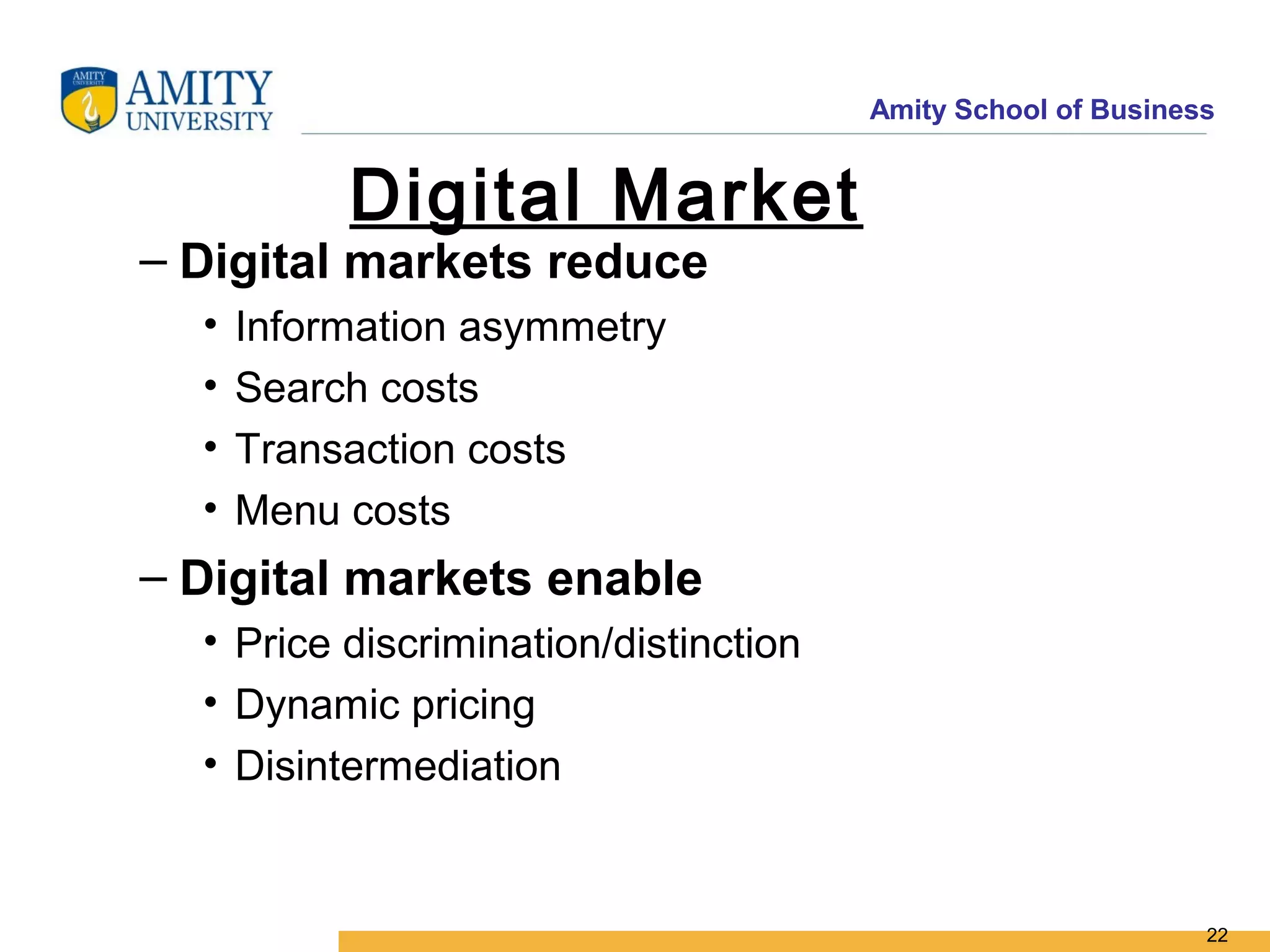
           Digital Market
– Digital markets reduce
  •   Information asymmetry
  •   Search costs
  •   Transaction costs
  •   Menu costs
– Digital markets enable
  • Price discrimination/distinction
  • Dynamic pricing
  • Disintermediation


                                                              22
Amity School of Business

                   Digital Market
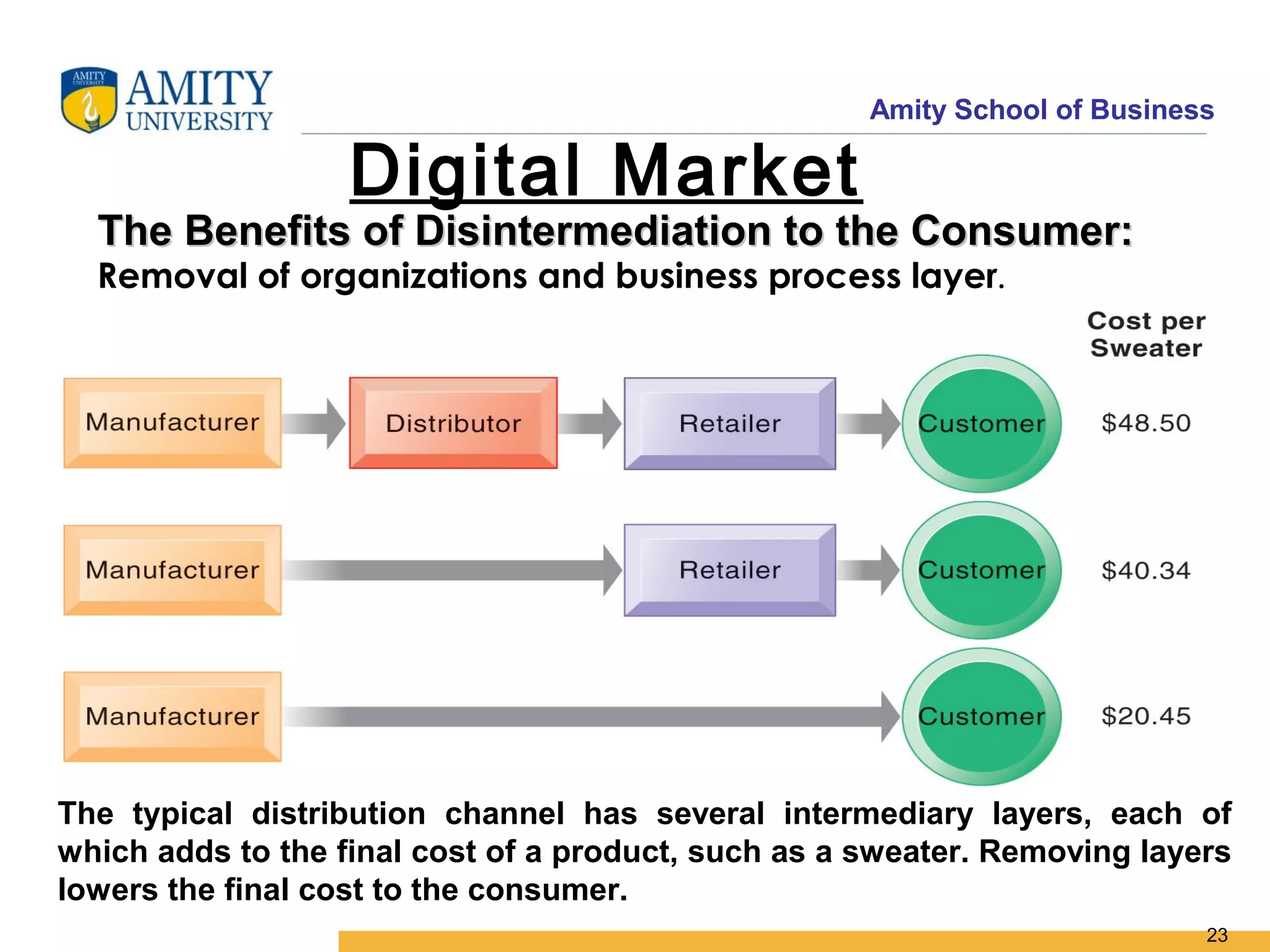
  The Benefits of Disintermediation to the Consumer:
  Removal of organizations and business process layer.


The typical distribution channel has several intermediary layers, each of
which adds to the final cost of a product, such as a sweater. Removing layers
lowers the final cost to the consumer.
                                                                            23
Amity School of Business

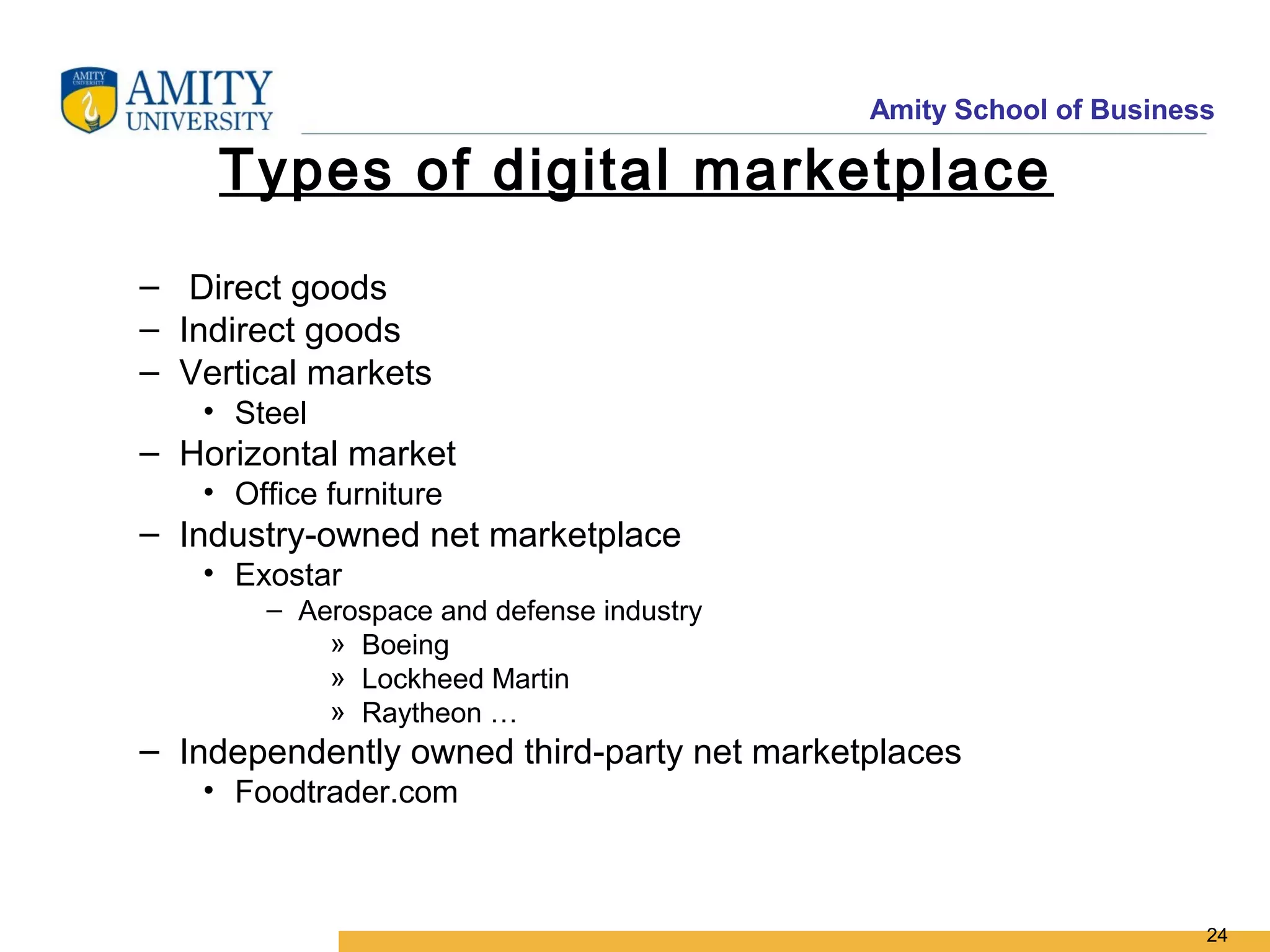
    Types of digital marketplace
– Direct goods
– Indirect goods
– Vertical markets
   • Steel
– Horizontal market
   • Office furniture
– Industry-owned net marketplace
   • Exostar
       – Aerospace and defense industry
           » Boeing
           » Lockheed Martin
           » Raytheon …
– Independently owned third-party net marketplaces
   • Foodtrader.com


                                                                   24
Amity School of Business


 DIGITAL COMMODITIES
Like other commodities, digital commodities
can be durable (in which case we call them
goods) or perishable (in which case we call
them services).
 • Digital goods typically exist in code (software)
 • Digital services typically involve processing
   information without the process itself having any
   permanent existence.


                                                            25
Amity School of Business

                   DIGITAL GOODS

• Definition:
    – Goods that can be delivered over a digital network
    – Intangible goods that are sold through the internet.
    Digital goods may also be called electronic goods or e-goods.
• Examples:
        e-books, music files, software, digital images, Web
      site templates, manuals in electronic format, and any
      item which can be electronically stored in a file or
      multiple files.


                                                                         26
Amity School of Business


  Characteristics of Digital Goods
• In electronic commerce, digital goods is a general term that is used
  to describe any goods that are stored, delivered and used in its
  electronic format.
• Digital goods are shipped electronically to the consumer through e-
  mail or download from the Internet.
• Costs of delivery over the Internet very low
• Marketing costs remain the same; pricing highly variable
• Industries with digital goods are undergoing revolutionary changes
  (publishers, record labels, etc.)
• Usually when you purchase digital goods online, after payment has
  been received the merchant will provide you with your digital item as
  an e-mail attachment or they may provide you with a secure link
  where        you        can       download       the     item.


                                                                          27
Amity School of Business
    Strategic Issues in Markets for Digital
                    Goods
• Indestructibility
   – Innovation or Standardization?
       • “If you don’t cannibalize your own market, someone else will.”
   – Related issues of pricing and market organization
       • Cost structure
       • Market segmentation
• Reproducibility
   – Can you even make a market?
       • Excluding non-payers
       • Copy protection versus customer annoyance
       • Pricing in the face of easy reproducibility
   – Copyright and Intellectual Property
       • How to keep rivals from mimicking your success
       • How to ensure that added value gets compensated


                                                                              28
Amity School of Business


3. M-Commerce:

 – Services
 – Applications


                                         29
Amity School of Business


                    Mobile Commerce
Mobile commerce is a natural result of combining two strongly emerging
trends: electronic commerce and pervasive computing.

     Internet + Wireless + E-Business = M-Business
              Going online anywhere at anytime and using multiple devices
              New business opportunities

M-Commerce represents another wave of the e-commerce invasion that is
changing the nature of business in the 21st century.

     Exponential growth (keeps growing)


                                                                        30
Amity School of Business
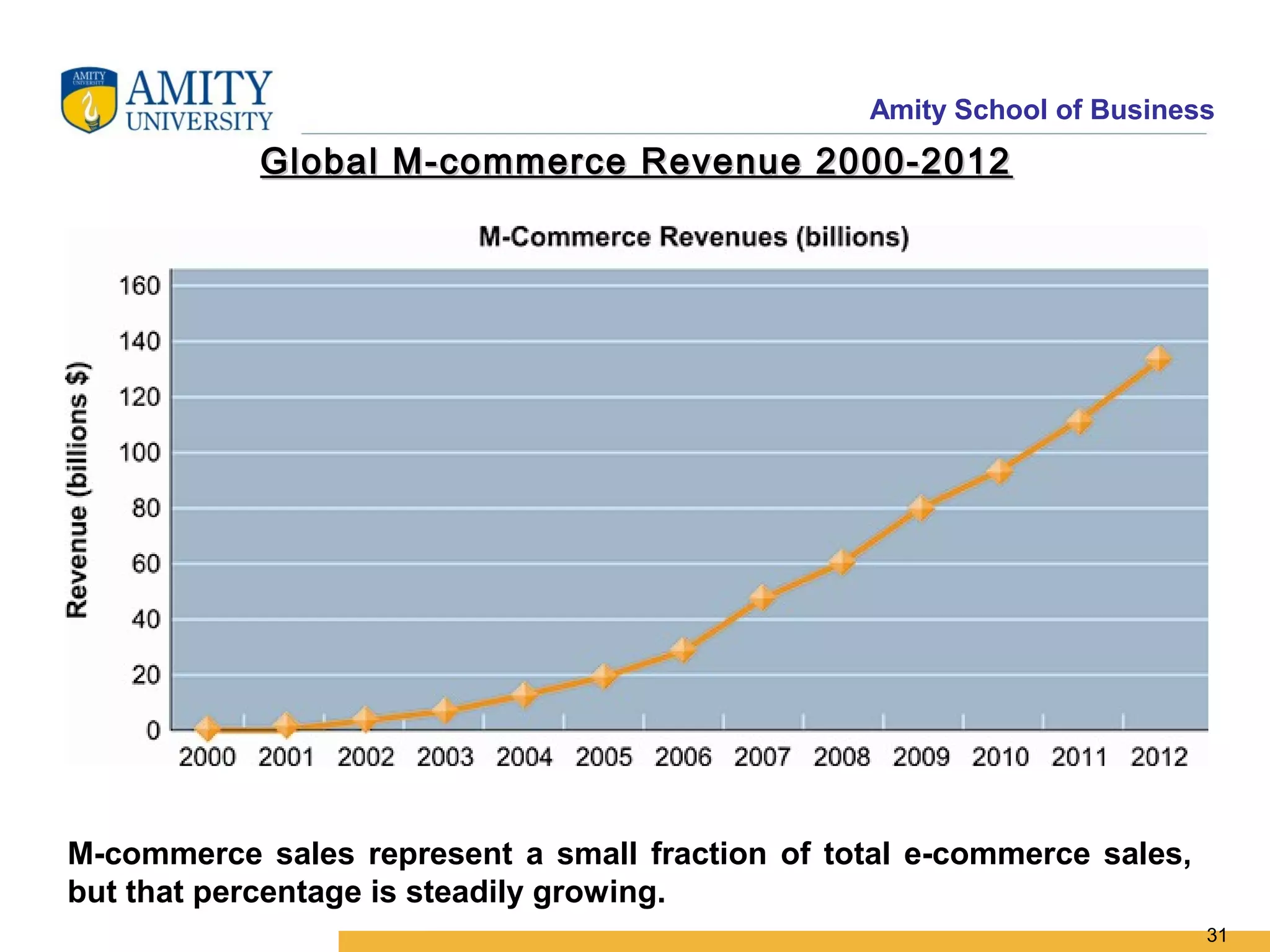
            Global M-commerce Revenue 2000-2012


M-commerce sales represent a small fraction of total e-commerce sales,
but that percentage is steadily growing.
                                                                         31
Amity School of Business
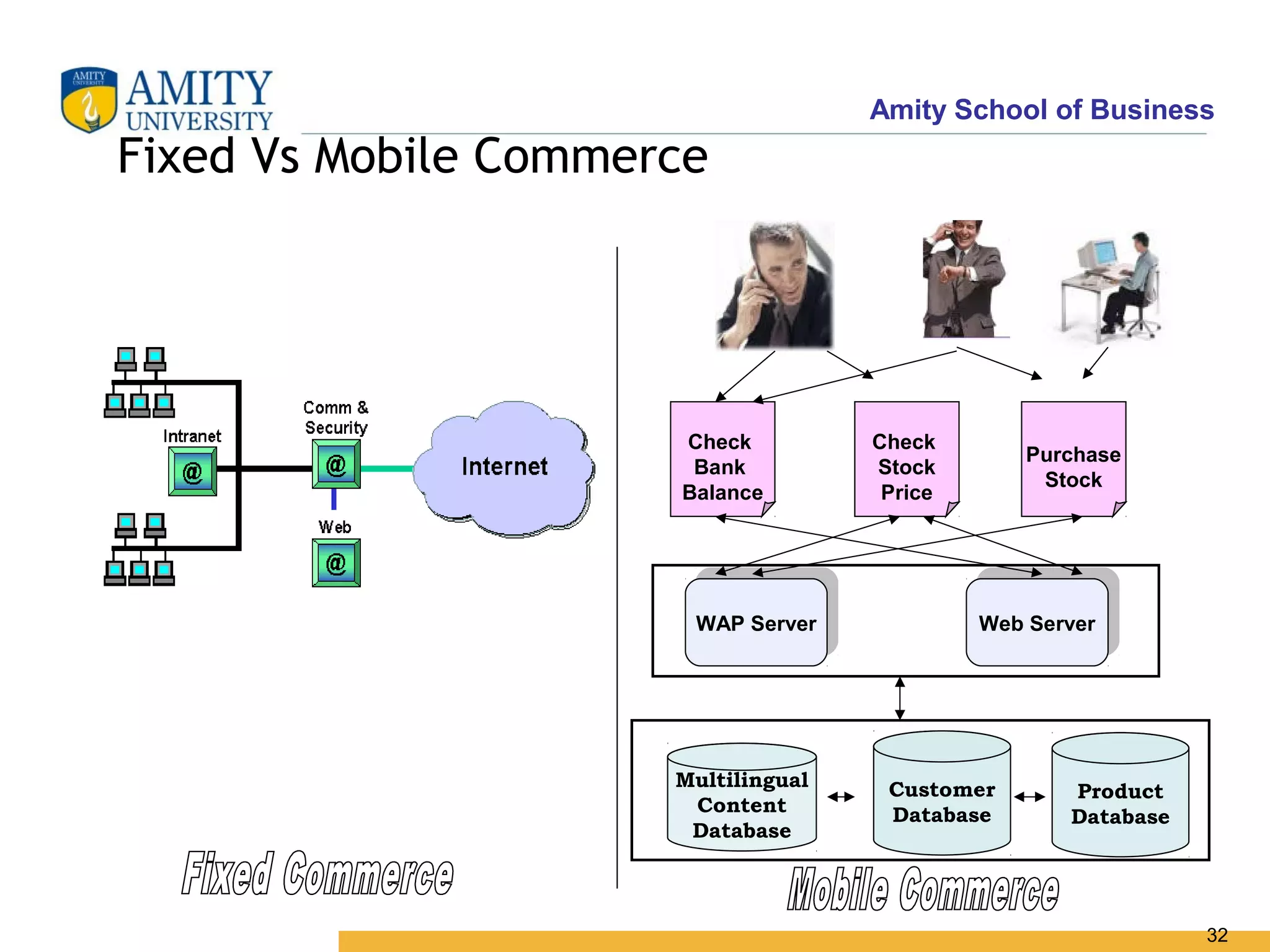
Fixed Vs Mobile Commerce


                      Check          Check
                                                  Purchase
                       Bank          Stock
                                                   Stock
                      Balance         Price


                        WAP Server             Web Server
                       WAP Server             Web Server


                      Multilingual    Customer       Product
                       Content        Database       Database
                       Database


                                                                32
Amity School of Business


         Characteristics of M-Commerce
Ubiquitous computing
    Anywhere, anytime
    Convenient, instant connectivity
Very personal
    Device owner has an exclusive access to the contents/services
    Service providers know who the owner is
 Varied users, usage contexts
    Elementary school students, grandpas, grandmas
    Location & context-sensitive applications and services
 Ambidextrous
    Work & Play: Business purpose + Personal fun
 People seem willing to pay for mobile services


                                                                          33
Amity School of Business

       Requirements for M-Commerce

Hardware technologies for ubiquitous computing
Software infrastructure for ubiquitous computing
Sensing and interaction with the physical world
Graceful integration of human users
Systems considerations, including scalability, security, and
privacy.


                                                                 34
Amity School of Business

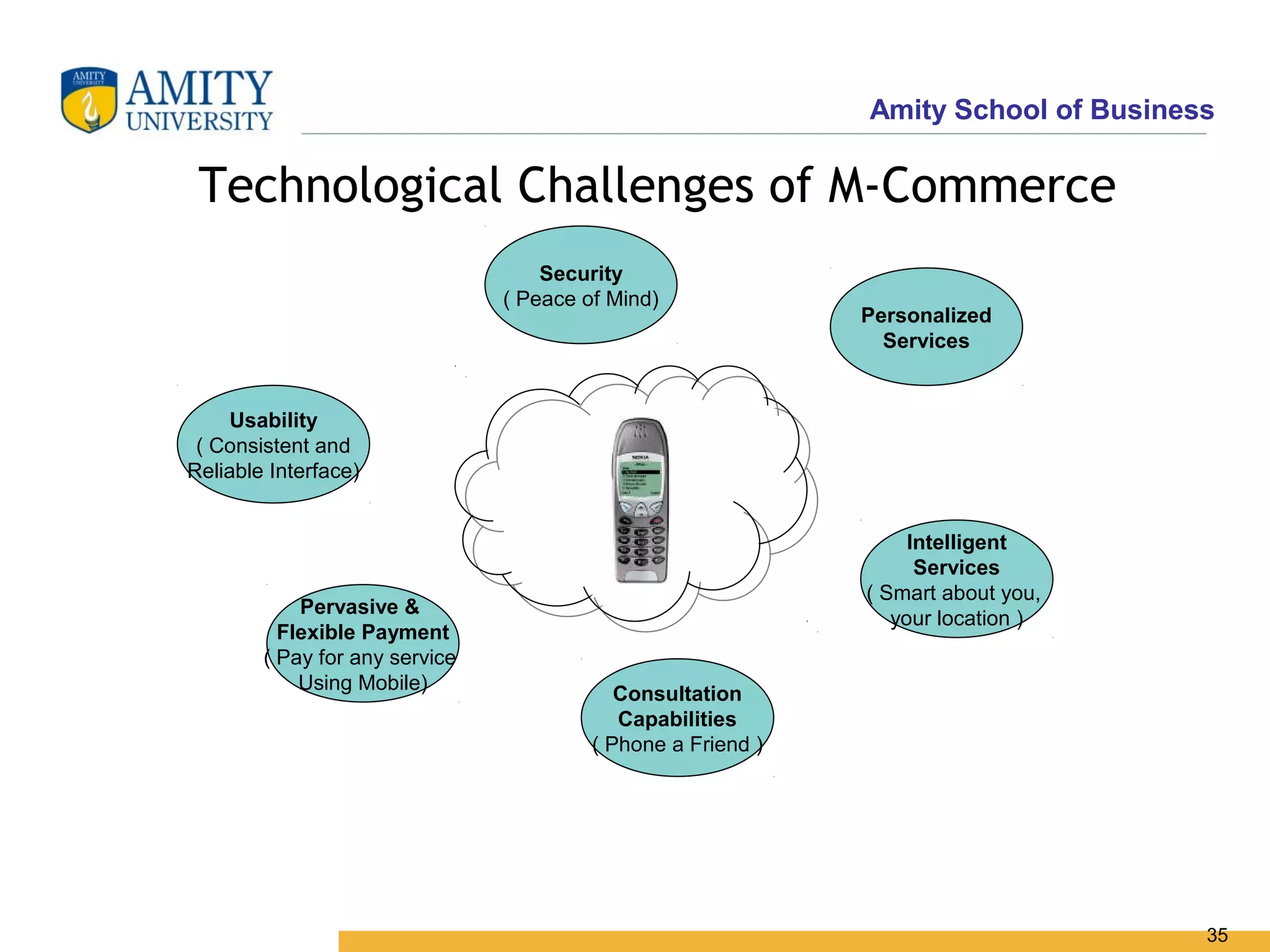
 Technological Challenges of M-Commerce
                                    Security
                                ( Peace of Mind)
                                                              Personalized
                                                                Services


    Usability
 ( Consistent and
Reliable Interface)


                                                                   Intelligent
                                                                    Services
                                                              ( Smart about you,
            Pervasive &
                                                                 your location )
          Flexible Payment
        ( Pay for any service
            Using Mobile)
                                            Consultation
                                            Capabilities
                                         ( Phone a Friend )


                                                                                     35
Amity School of Business
Technological Challenges of M-Commerce (cont’d)

Usability
Intelligent and Personalized Services
    It is useful to determine what the mobile industry considers a service (a set
    of functions offered to a user by an organization)
    Personalized services have access to important user information that
    enables them to tailor their operation to the needs of the served user.
    Examples include speed dialing using personal contact lists or address book

Pervasive and Flexible Payment Mechanisms
   It may be possible to replace credit-cards and paper money by making
   mobile phones act as electronic wallets.
    User’s credit-card details may be stored on the phone or on the user’s
    Subscriber Identity Module (SIM) card.
    “Access Tokens” are assigned when subscribing to a service or requesting to
    buy an item.


                                                                                    36
Amity School of Business


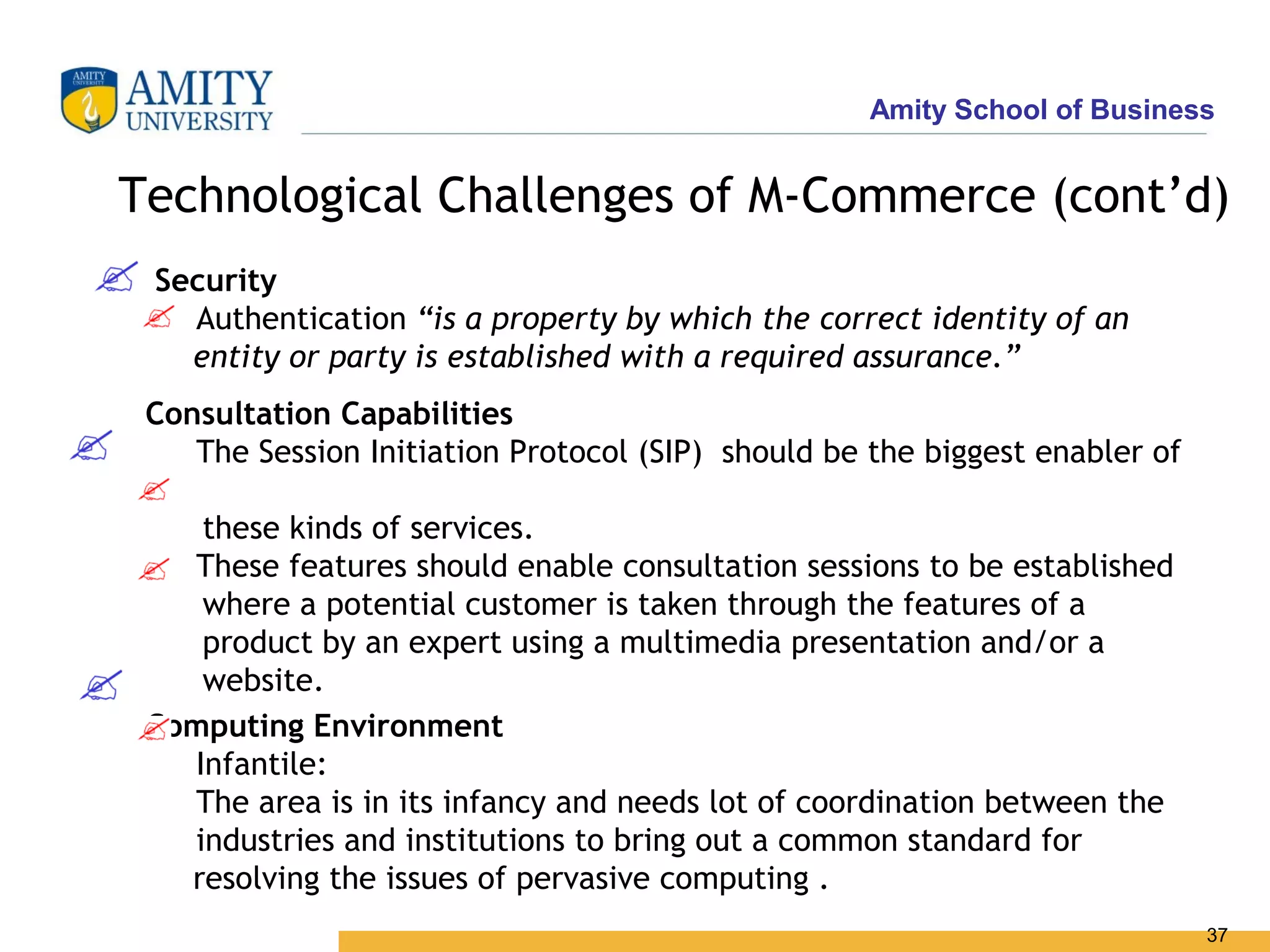
Technological Challenges of M-Commerce (cont’d)
 Security
   Authentication “is a property by which the correct identity of an
   entity or party is established with a required assurance.”
 Consultation Capabilities
    The Session Initiation Protocol (SIP) should be the biggest enabler of

    these kinds of services.
   These features should enable consultation sessions to be established
    where a potential customer is taken through the features of a
    product by an expert using a multimedia presentation and/or a
    website.
 Computing Environment
   Infantile:
   The area is in its infancy and needs lot of coordination between the
   industries and institutions to bring out a common standard for
   resolving the issues of pervasive computing .
                                                                             37
note Address :“Mobile Commerce – Vision and Challenges”, at ITPC 2003 Nepal by Prof. P. Venkataram IISc Bangalore IND
                                                                                Amity School of Business

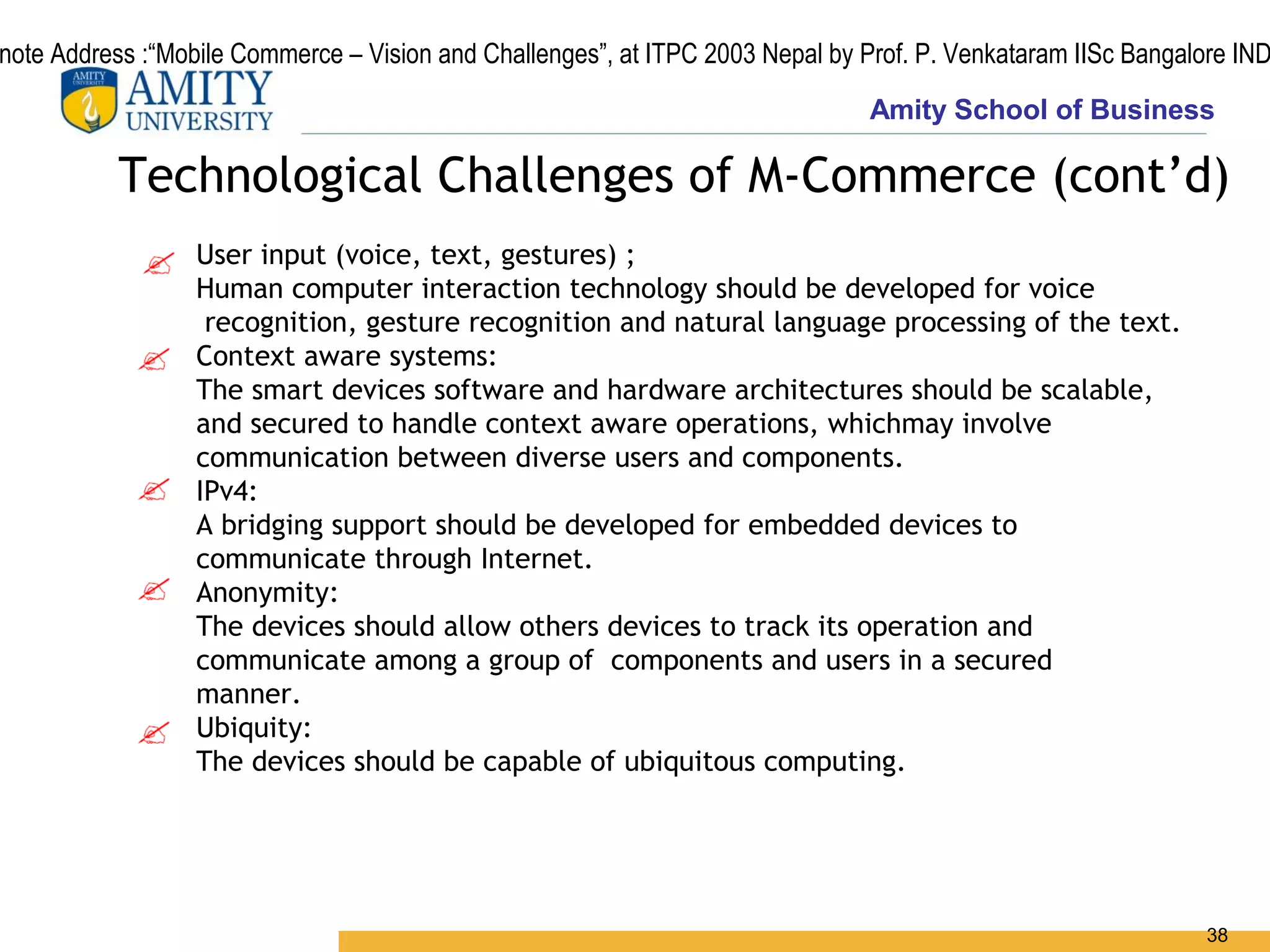
          Technological Challenges of M-Commerce (cont’d)
                  User input (voice, text, gestures) ;
                  Human computer interaction technology should be developed for voice
                   recognition, gesture recognition and natural language processing of the text.
                  Context aware systems:
                  The smart devices software and hardware architectures should be scalable,
                  and secured to handle context aware operations, whichmay involve
                  communication between diverse users and components.
                  IPv4:
                  A bridging support should be developed for embedded devices to
                  communicate through Internet.
                  Anonymity:
                  The devices should allow others devices to track its operation and
                  communicate among a group of components and users in a secured
                  manner.
                  Ubiquity:
                  The devices should be capable of ubiquitous computing.


                                                                                                               38
note Address :“Mobile Commerce – Vision and Challenges”, at ITPC 2003 Nepal by Prof. P. Venkataram IISc Bangalore IND
                                                                                Amity School of Business
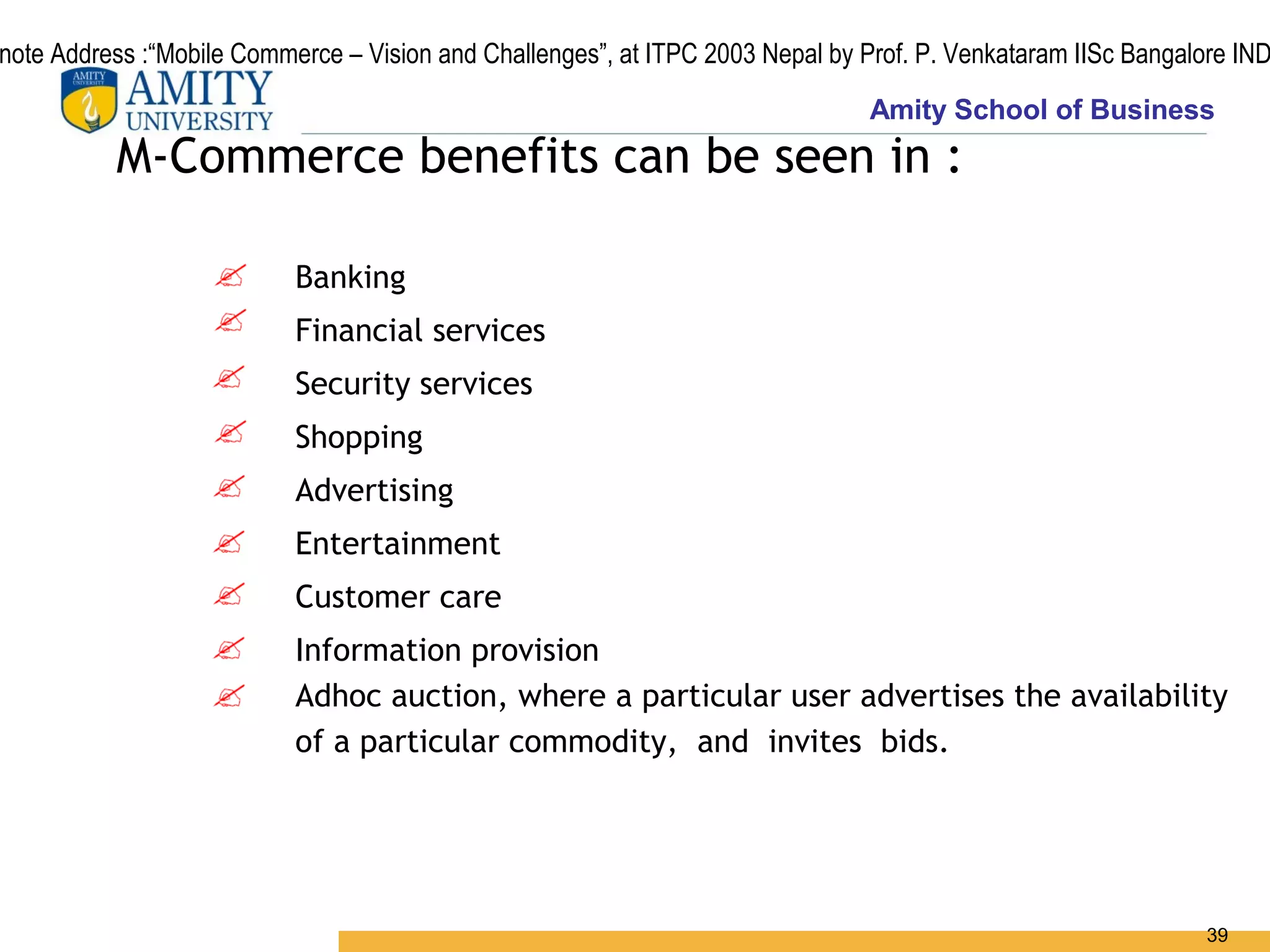
          M-Commerce benefits can be seen in :

                           Banking
                           Financial services
                           Security services
                           Shopping
                           Advertising
                           Entertainment
                           Customer care
                           Information provision
                           Adhoc auction, where a particular user advertises the availability
                           of a particular commodity, and invites bids.


                                                                                                               39
note Address :“Mobile Commerce – Vision and Challenges”, at ITPC 2003 Nepal by Prof. P. Venkataram IISc Bangalore IND
                                                                                Amity School of Business
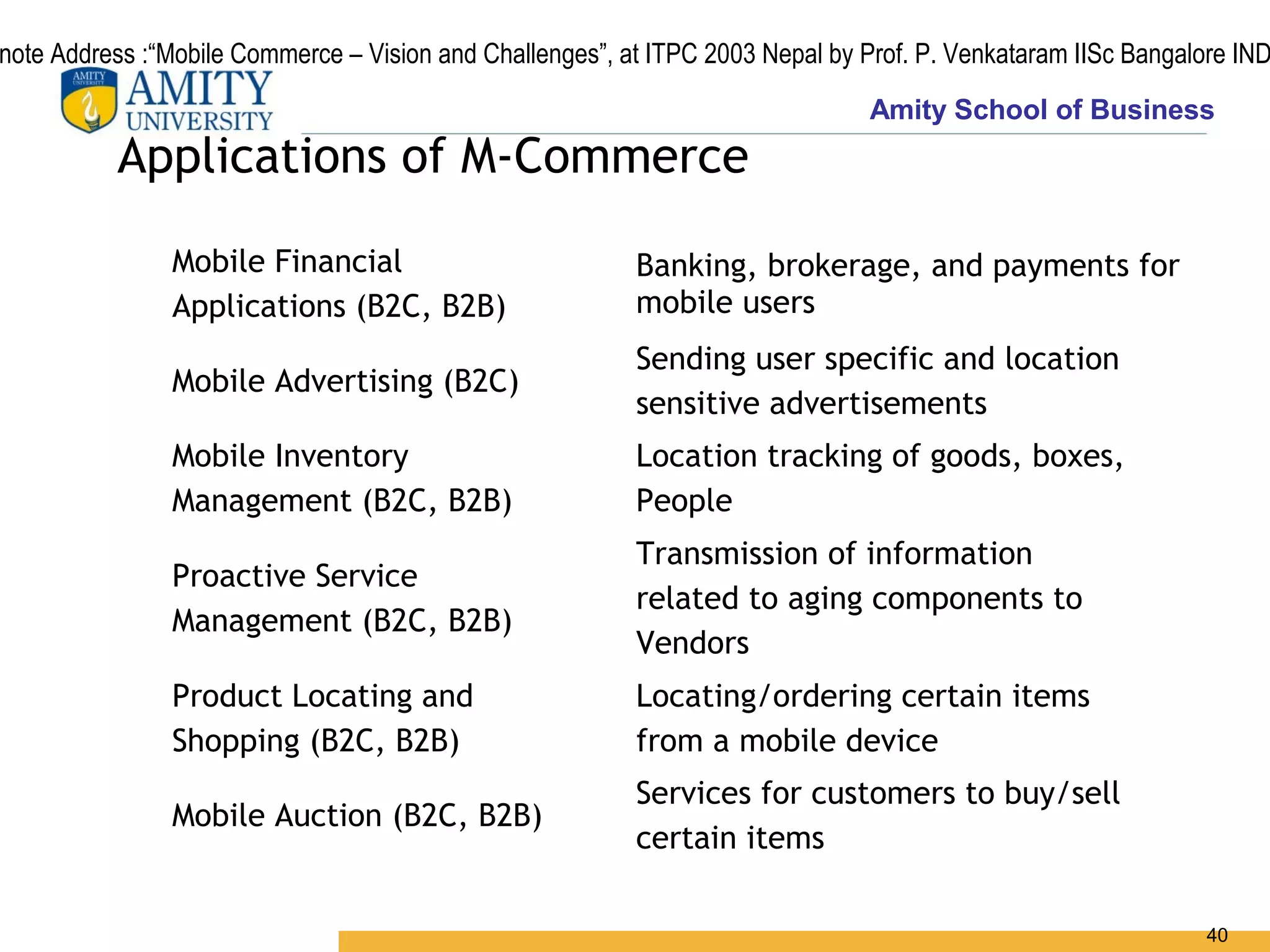
          Applications of M-Commerce

               Mobile Financial                           Banking, brokerage, and payments for
               Applications (B2C, B2B)                    mobile users
                                                          Sending user specific and location
               Mobile Advertising (B2C)
                                                          sensitive advertisements
               Mobile Inventory                           Location tracking of goods, boxes,
               Management (B2C, B2B)                      People
                                                          Transmission of information
               Proactive Service
                                                          related to aging components to
               Management (B2C, B2B)
                                                          Vendors
               Product Locating and                       Locating/ordering certain items
               Shopping (B2C, B2B)                        from a mobile device
                                                          Services for customers to buy/sell
               Mobile Auction (B2C, B2B)
                                                          certain items

                                                                                                               40
note Address :“Mobile Commerce – Vision and Challenges”, at ITPC 2003 Nepal by Prof. P. Venkataram IISc Bangalore IND
                                                                                Amity School of Business
          Applications of M-Commerce (Cont’d)

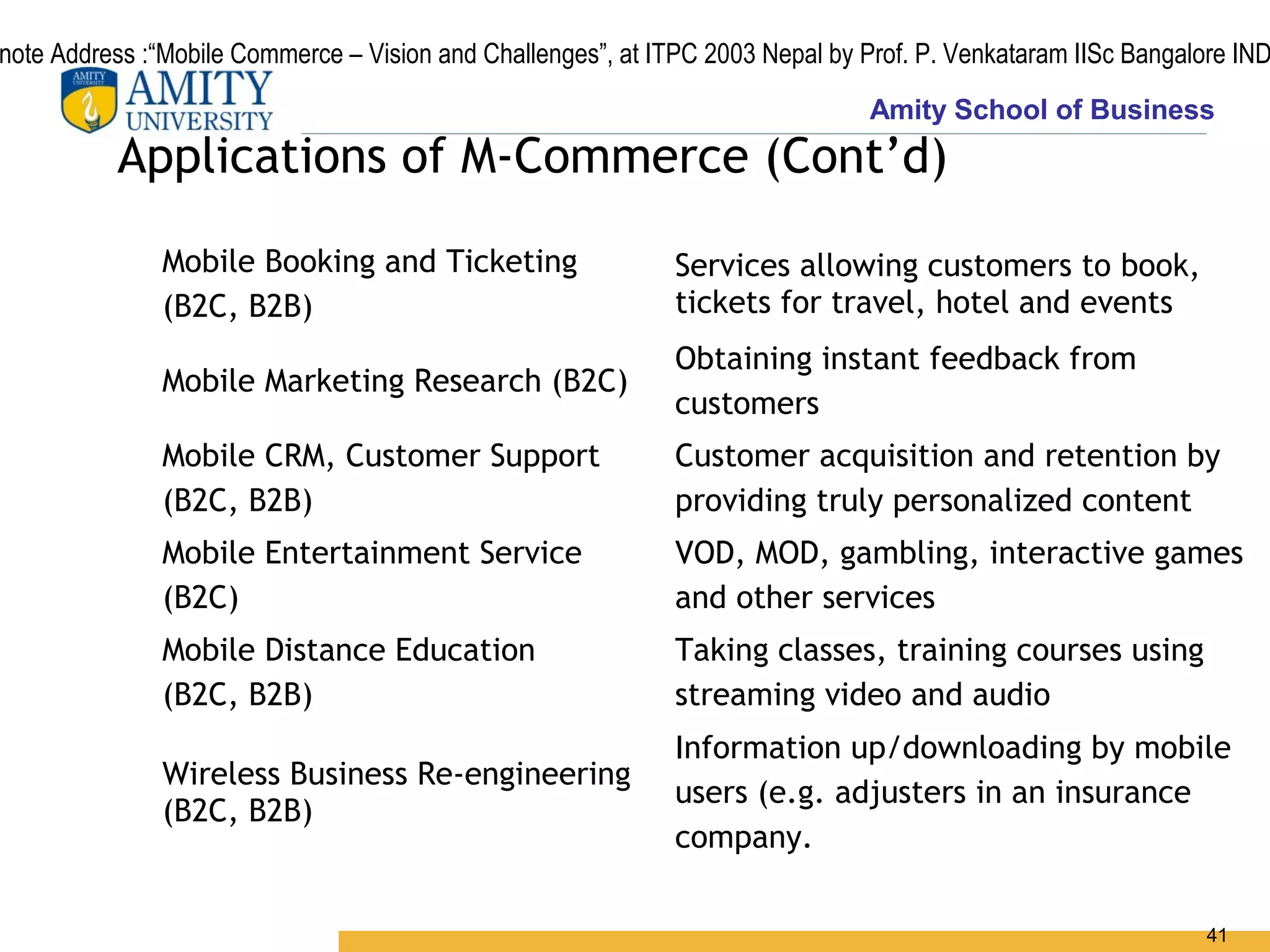
               Mobile Booking and Ticketing                   Services allowing customers to book,
               (B2C, B2B)                                     tickets for travel, hotel and events
                                                              Obtaining instant feedback from
               Mobile Marketing Research (B2C)
                                                              customers
               Mobile CRM, Customer Support                   Customer acquisition and retention by
               (B2C, B2B)                                     providing truly personalized content
               Mobile Entertainment Service                   VOD, MOD, gambling, interactive games
               (B2C)                                          and other services
               Mobile Distance Education                      Taking classes, training courses using
               (B2C, B2B)                                     streaming video and audio
                                                              Information up/downloading by mobile
               Wireless Business Re-engineering
                                                              users (e.g. adjusters in an insurance
               (B2C, B2B)
                                                              company.

                                                                                                               41
note Address :“Mobile Commerce – Vision and Challenges”, at ITPC 2003 Nepal by Prof. P. Venkataram IISc Bangalore IND
                                                                                       Amity School of Business
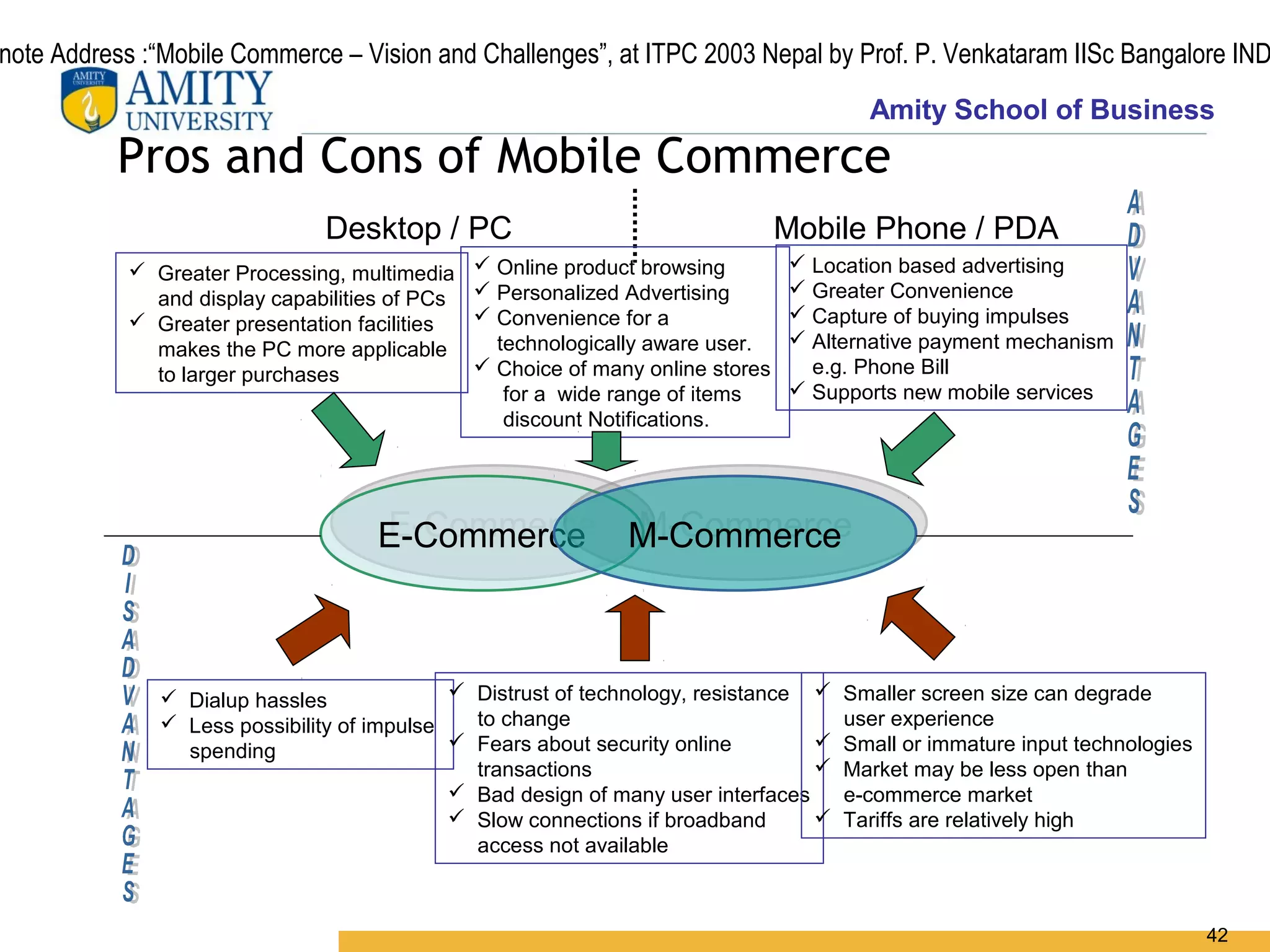
          Pros and Cons of Mobile Commerce
                              Desktop / PC                                      Mobile Phone / PDA
            Greater Processing, multimedia     Online product browsing         Location based advertising
             and display capabilities of PCs    Personalized Advertising        Greater Convenience
            Greater presentation facilities    Convenience for a               Capture of buying impulses
             makes the PC more applicable        technologically aware user.     Alternative payment mechanism
             to larger purchases                Choice of many online stores     e.g. Phone Bill
                                                  for a wide range of items      Supports new mobile services
                                                  discount Notifications.


                                    E-Commerce M-Commerce
                                    E-Commerce M-Commerce


               Dialup hassles               Distrust of technology, resistance    Smaller screen size can degrade
               Less possibility of impulse   to change                              user experience
                spending                     Fears about security online           Small or immature input technologies
                                              transactions                          Market may be less open than
                                             Bad design of many user interfaces     e-commerce market
                                             Slow connections if broadband         Tariffs are relatively high
                                              access not available


                                                                                                                            42

Management Information System 6

  • 1.
    Amity School ofBusiness Module 6 Key System Applications For The Digital Age 1
  • 2.
    Amity School ofBusiness Module 6 1. Enterprise Systems 2. E-Commerce: Digital Market & Digital Goods 3. M-Commerce: Services & Applications 2
  • 3.
    Amity School ofBusiness 1. Enterprise Systems – • Supply Chain Management • Customer Relationship Management Systems 3
  • 4.
    Amity School ofBusiness WHAT IS SUPPLY CHAIN MANAGEMENT " Is the strategic management of activities involved in the acquisition and conversion of materials to finished products delivered to the customer" Supplier Material Flow Customer Management Management Information Flow Schedule / Stock Conversion Delivery Resources Deployment Leads to Business Process Integration 4
  • 5.
    Amity School ofBusiness SUPPLY CHAIN MANAGEMENT • Supply chain is the system by which organizations source, make and deliver their products or services according to market demand. • Supply chain management operations and decisions are ultimately triggered by demand signals at the ultimate consumer level. • Supply chain as defined by experienced practitioners extends from suppliers’ suppliers to customers’ customers. 5
  • 6.
    Amity School ofBusiness Supply Chain Structure SUPPLIER FACTORY DC RDC RETAILER Raw Materials Finished Goods Information Flow 6
  • 7.
    Amity School ofBusiness SUPPLY CHAIN ELEMENTS • SupplyChain Design Strategic • Resource Acquisition • Long TermP lanning (1 Year ++) • P uction/Distribution P rod lanning Tactical • Resource Allocation • MediumTermP lanning (Qtrly,Monthly) • Shipm ent Scheduling Operational • Resource Scheduling • Short TermP lanning (Weekly,Daily) 7
  • 8.
    Amity School ofBusiness • SUPPLY CHAIN INCLUDES : – MATERIAL FLOWS – INFORMATION FLOWS – FINANCIAL FLOWS 8
  • 9.
    Amity School ofBusiness Customer Relationship Management (CRM) Term applied to processes implemented by a company to handle its contact with its customers. Characteristics of CRM • CRM is a software-based approach to handle customer relationships. • Store information on current and prospective customers. • From the outside, customers interacting with a company perceive the business as a single entity, despite often interacting with a variety of employees in different roles and departments. • CRM is a combination of policies, processes, and strategies implemented by a company that unify its customer interaction and provides mechanism for tracking customer information 9
  • 10.
    Amity School ofBusiness Why CRM? More companies are beginning to view customers as their primary asset. 10
  • 11.
    Amity School ofBusiness Applications of CRM • Information in the system can be accessed and entered by employees in different departments: Sales Marketing Customer service Training Professional development Performance management Human resource development • Details on any customer contacts can also be stored in the system  The rationale behind this approach is to improve services provided directly to customers.  To use the information in the system for targeted marketing and sales purposes. 11
  • 12.
    Amity School ofBusiness Customer Requirements • Control over buying process – Information, comparison, selection, easy to find • Best possible price – Delivery (free), quality • All payment options – Secure • Communication designed to suit needs – Computerized, complex, caring 12
  • 13.
    Amity School ofBusiness Aspects of CRM 13
  • 14.
    Amity School ofBusiness Aspects of CRM • Many inter-related aspects: Aspect 1 : Front Office Aspect 2: Back Office Operations that ultimately affect the activities of Direct interaction with customers the front office Face to face meetings Billing Maintenance Phone calls Planning E-mail Marketing Online services etc Advertising Finance Manufacturing Aspect 4 Aspect 3: Business Relationships Aspect 4: Analysis Interaction with other companies and partners Key CRM data can be analyzed in order to plan Suppliers/vendors Target-marketing campaigns Retail outlets/distributors Conceive business strategies Industry networks (lobbying groups, trade assn’) Judge the success of CRM activities (e.g., market This external network supports front and back share, number and types of customers, revenue, office activities profitability) 14
  • 15.
    Amity School ofBusiness Limitations of CRM CRM initiatives often fail • Implementation was limited to software installation. • Inadequate motivations for employees to learn, provide input, and take full advantage of the information systems. 15
  • 16.
    Amity School ofBusiness 2. E-Commerce: – Digital Market – Digital Goods 16
  • 17.
    Amity School ofBusiness E-Commerce • The use of the Internet and the Web to transact business – Digitally enabled commercial transactions – Exchange of values • E-commerce is more than just buying and selling products online. • Instead, it encompasses the entire online processes of developing, marketing, selling, delivering, and paying for products and services purchased by internet worked, global market places of customers, with support of worldwide network of business partners. • In using the web as links between the buyers and sellers, they can use internet, extranet and intranets. 17
  • 18.
    Amity School ofBusiness Classification of e-commerce • Business-to-Business • Business –to-Employee (B2B) e commerce • E-Government • Business-to-Consumer • E-Learning (B2C) e commerce • None-Business e- • Consumer-to-Business commerce (C2B) e commerce • Business-to-Business-to- • Consumer-to- Customer Consumer (C2C) e • Intra-business e commerce commerce • Exchange-to-Exchange • Peer-to-Peer (P2P) e commerce • Collaborative commerce • M-commerce 18
  • 19.
    Amity School ofBusiness The Growth of E-Commerce Retail e-commerce revenues have grown exponentially since 1995 and have only recently “slowed” to a very rapid 25 percent annual increase, which is projected to remain the same until 2008. Source: Based on data from eMarketer, 2006; Shop.org and Forrester Research, 2005; and authors. 19
  • 20.
    Amity School ofBusiness Digital Market • Internet provides a digital environment where buyers and sellers can meet, search for products, display products, and establish prices for those products. • Net marketplaces are online marketplaces where multiple buyers can purchase from multiple sellers. 20
  • 21.
    Amity School ofBusiness Net Marketplace 21
  • 22.
    Amity School ofBusiness Digital Market – Digital markets reduce • Information asymmetry • Search costs • Transaction costs • Menu costs – Digital markets enable • Price discrimination/distinction • Dynamic pricing • Disintermediation 22
  • 23.
    Amity School ofBusiness Digital Market The Benefits of Disintermediation to the Consumer: Removal of organizations and business process layer. The typical distribution channel has several intermediary layers, each of which adds to the final cost of a product, such as a sweater. Removing layers lowers the final cost to the consumer. 23
  • 24.
    Amity School ofBusiness Types of digital marketplace – Direct goods – Indirect goods – Vertical markets • Steel – Horizontal market • Office furniture – Industry-owned net marketplace • Exostar – Aerospace and defense industry » Boeing » Lockheed Martin » Raytheon … – Independently owned third-party net marketplaces • Foodtrader.com 24
  • 25.
    Amity School ofBusiness DIGITAL COMMODITIES Like other commodities, digital commodities can be durable (in which case we call them goods) or perishable (in which case we call them services). • Digital goods typically exist in code (software) • Digital services typically involve processing information without the process itself having any permanent existence. 25
  • 26.
    Amity School ofBusiness DIGITAL GOODS • Definition: – Goods that can be delivered over a digital network – Intangible goods that are sold through the internet. Digital goods may also be called electronic goods or e-goods. • Examples: e-books, music files, software, digital images, Web site templates, manuals in electronic format, and any item which can be electronically stored in a file or multiple files. 26
  • 27.
    Amity School ofBusiness Characteristics of Digital Goods • In electronic commerce, digital goods is a general term that is used to describe any goods that are stored, delivered and used in its electronic format. • Digital goods are shipped electronically to the consumer through e- mail or download from the Internet. • Costs of delivery over the Internet very low • Marketing costs remain the same; pricing highly variable • Industries with digital goods are undergoing revolutionary changes (publishers, record labels, etc.) • Usually when you purchase digital goods online, after payment has been received the merchant will provide you with your digital item as an e-mail attachment or they may provide you with a secure link where you can download the item. 27
  • 28.
    Amity School ofBusiness Strategic Issues in Markets for Digital Goods • Indestructibility – Innovation or Standardization? • “If you don’t cannibalize your own market, someone else will.” – Related issues of pricing and market organization • Cost structure • Market segmentation • Reproducibility – Can you even make a market? • Excluding non-payers • Copy protection versus customer annoyance • Pricing in the face of easy reproducibility – Copyright and Intellectual Property • How to keep rivals from mimicking your success • How to ensure that added value gets compensated 28
  • 29.
    Amity School ofBusiness 3. M-Commerce: – Services – Applications 29
  • 30.
    Amity School ofBusiness Mobile Commerce Mobile commerce is a natural result of combining two strongly emerging trends: electronic commerce and pervasive computing. Internet + Wireless + E-Business = M-Business Going online anywhere at anytime and using multiple devices New business opportunities M-Commerce represents another wave of the e-commerce invasion that is changing the nature of business in the 21st century. Exponential growth (keeps growing) 30
  • 31.
    Amity School ofBusiness Global M-commerce Revenue 2000-2012 M-commerce sales represent a small fraction of total e-commerce sales, but that percentage is steadily growing. 31
  • 32.
    Amity School ofBusiness Fixed Vs Mobile Commerce Check Check Purchase Bank Stock Stock Balance Price WAP Server Web Server WAP Server Web Server Multilingual Customer Product Content Database Database Database 32
  • 33.
    Amity School ofBusiness Characteristics of M-Commerce Ubiquitous computing Anywhere, anytime Convenient, instant connectivity Very personal Device owner has an exclusive access to the contents/services Service providers know who the owner is Varied users, usage contexts Elementary school students, grandpas, grandmas Location & context-sensitive applications and services Ambidextrous Work & Play: Business purpose + Personal fun People seem willing to pay for mobile services 33
  • 34.
    Amity School ofBusiness Requirements for M-Commerce Hardware technologies for ubiquitous computing Software infrastructure for ubiquitous computing Sensing and interaction with the physical world Graceful integration of human users Systems considerations, including scalability, security, and privacy. 34
  • 35.
    Amity School ofBusiness Technological Challenges of M-Commerce Security ( Peace of Mind) Personalized Services Usability ( Consistent and Reliable Interface) Intelligent Services ( Smart about you, Pervasive & your location ) Flexible Payment ( Pay for any service Using Mobile) Consultation Capabilities ( Phone a Friend ) 35
  • 36.
    Amity School ofBusiness Technological Challenges of M-Commerce (cont’d) Usability Intelligent and Personalized Services It is useful to determine what the mobile industry considers a service (a set of functions offered to a user by an organization) Personalized services have access to important user information that enables them to tailor their operation to the needs of the served user. Examples include speed dialing using personal contact lists or address book Pervasive and Flexible Payment Mechanisms It may be possible to replace credit-cards and paper money by making mobile phones act as electronic wallets. User’s credit-card details may be stored on the phone or on the user’s Subscriber Identity Module (SIM) card. “Access Tokens” are assigned when subscribing to a service or requesting to buy an item. 36
  • 37.
    Amity School ofBusiness Technological Challenges of M-Commerce (cont’d) Security Authentication “is a property by which the correct identity of an entity or party is established with a required assurance.” Consultation Capabilities The Session Initiation Protocol (SIP) should be the biggest enabler of these kinds of services. These features should enable consultation sessions to be established where a potential customer is taken through the features of a product by an expert using a multimedia presentation and/or a website. Computing Environment Infantile: The area is in its infancy and needs lot of coordination between the industries and institutions to bring out a common standard for resolving the issues of pervasive computing . 37
  • 38.
    note Address :“MobileCommerce – Vision and Challenges”, at ITPC 2003 Nepal by Prof. P. Venkataram IISc Bangalore IND Amity School of Business Technological Challenges of M-Commerce (cont’d) User input (voice, text, gestures) ; Human computer interaction technology should be developed for voice recognition, gesture recognition and natural language processing of the text. Context aware systems: The smart devices software and hardware architectures should be scalable, and secured to handle context aware operations, whichmay involve communication between diverse users and components. IPv4: A bridging support should be developed for embedded devices to communicate through Internet. Anonymity: The devices should allow others devices to track its operation and communicate among a group of components and users in a secured manner. Ubiquity: The devices should be capable of ubiquitous computing. 38
  • 39.
    note Address :“MobileCommerce – Vision and Challenges”, at ITPC 2003 Nepal by Prof. P. Venkataram IISc Bangalore IND Amity School of Business M-Commerce benefits can be seen in : Banking Financial services Security services Shopping Advertising Entertainment Customer care Information provision Adhoc auction, where a particular user advertises the availability of a particular commodity, and invites bids. 39
  • 40.
    note Address :“MobileCommerce – Vision and Challenges”, at ITPC 2003 Nepal by Prof. P. Venkataram IISc Bangalore IND Amity School of Business Applications of M-Commerce Mobile Financial Banking, brokerage, and payments for Applications (B2C, B2B) mobile users Sending user specific and location Mobile Advertising (B2C) sensitive advertisements Mobile Inventory Location tracking of goods, boxes, Management (B2C, B2B) People Transmission of information Proactive Service related to aging components to Management (B2C, B2B) Vendors Product Locating and Locating/ordering certain items Shopping (B2C, B2B) from a mobile device Services for customers to buy/sell Mobile Auction (B2C, B2B) certain items 40
  • 41.
    note Address :“MobileCommerce – Vision and Challenges”, at ITPC 2003 Nepal by Prof. P. Venkataram IISc Bangalore IND Amity School of Business Applications of M-Commerce (Cont’d) Mobile Booking and Ticketing Services allowing customers to book, (B2C, B2B) tickets for travel, hotel and events Obtaining instant feedback from Mobile Marketing Research (B2C) customers Mobile CRM, Customer Support Customer acquisition and retention by (B2C, B2B) providing truly personalized content Mobile Entertainment Service VOD, MOD, gambling, interactive games (B2C) and other services Mobile Distance Education Taking classes, training courses using (B2C, B2B) streaming video and audio Information up/downloading by mobile Wireless Business Re-engineering users (e.g. adjusters in an insurance (B2C, B2B) company. 41
  • 42.
    note Address :“MobileCommerce – Vision and Challenges”, at ITPC 2003 Nepal by Prof. P. Venkataram IISc Bangalore IND Amity School of Business Pros and Cons of Mobile Commerce Desktop / PC Mobile Phone / PDA  Greater Processing, multimedia  Online product browsing  Location based advertising and display capabilities of PCs  Personalized Advertising  Greater Convenience  Greater presentation facilities  Convenience for a  Capture of buying impulses makes the PC more applicable technologically aware user.  Alternative payment mechanism to larger purchases  Choice of many online stores e.g. Phone Bill for a wide range of items  Supports new mobile services discount Notifications. E-Commerce M-Commerce E-Commerce M-Commerce  Dialup hassles  Distrust of technology, resistance  Smaller screen size can degrade  Less possibility of impulse to change user experience spending  Fears about security online  Small or immature input technologies transactions  Market may be less open than  Bad design of many user interfaces e-commerce market  Slow connections if broadband  Tariffs are relatively high access not available 42