MICTURITION
1- Physiologic Anatomy
2- MicturitionReflex
3- Abnormalities
1
Check Your Self
1- What type of muscle “Detrusor” is ?
2- Out of 2 sphincters of bladder which one is not a true sphincter
& why?
3- Where from the major nerve supply to Bladder comes?
4- Which part in Kidney has inherent pace maker activity?
5- Why Pudendal Nerve is so important?
6- What initiates “Micturition Reflex”?
7- What is “Atonic Bladder”?
8- What is “Tabetic Bladder”?
9 What is “Uretero-Renal-Reflex”?
10- What is “Vesico-Ureteral-Reflux”?
2
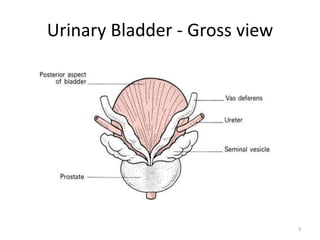
Urinary Bladder - Gross view
3
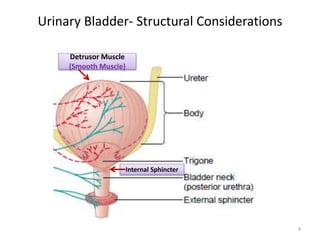
Urinary Bladder- Structural Considerations
Detrusor Muscle
(Smooth Muscle)
Internal Sphincter
4
Anatomical considerations to remember
• The lower part of bladder neck is called as posterior urethra.
The ureters pass obliquely through the bladder wall (Lower
part).
• The oblique passage tends to keep the ureters closed except
during peristaltic waves (There is no ureteral sphincter).
• Bladder wall is composed of detrusor muscle (Smooth Muscle)
• Detrusor muscle is mainly responsible for emptying of
bladder during urination.
• Internal sphincter- is not a true sphincter as it does not
surround the neck (But is a thickening of SM in this area).
By Dr. ATUL TIWARI 5
Anatomical considerations to remember
• Beyond the posterior urethra, the urethra passes through the
urogenital diaphragm.
• Which contains a layer of muscle (external sphincter).
• It is sphincter of skeletal muscles. It encircles membranous
urethra.
• It is supplied with somatic nerve fiber (voluntary control) .
•
• Muscles of Internal sphincter & Bladder are smooth &
involuntary but have some elastic fibers.
By Dr. ATUL TIWARI 6
Micturition
• It is a process by which bladder empties its urine out
when it is filled with.
• It includes 2 steps
• 1- Filling of bladder till stretching of its wall creates
threshold tension in bladder & Filling of Urethra.
• 2- This stretching initiates Micturition Reflex.
• Though it is an autonomic spinal reflex but it could be
inhibited or facilitated by voluntary centers of brain.
By Dr. ATUL TIWARI 7
About Nerve Supply
• Pelvic nerves connected to S2 & S3 (& S4) are both sensory &
Motor.
• Motor nerves to bladder are Parasympathetic.
• They terminate in ganglion located in wall of bladder.
• Short postganglionic fibers supply detrusor muscle.
• In addition to the pelvic nerves, two other types of
Innervations are important in bladder function.
By Dr. ATUL TIWARI 8
Two nerves other than Pelvic Nerves
• A- Most important are the skeletal motor fibers transmitted
through the pudendal nerve -S2, S3 (& S4- Ganong) to the
external sphincter of bladder. These are somatic nerve fibers
that innervate and control the voluntary skeletal muscle of
the sphincter (Cortical Control).
• B- Sympathetic innervations from the sympathetic chain
through (Inferior mesenteric – Ganong) hypogastric nerves,
connecting mainly with the L-2 segment (L1 & L3 are also
involved- Ganong) of the spinal cord.
• These sympathetic fibers stimulate mainly the blood vessels
By Dr. ATUL TIWARI 9
Physiologic Anatomy - Bladder
By Dr. ATUL TIWARI 10
EMPTYING OF THE BLADDER
• Emptying of the bladder is basically a reflex
action called the micturition reflex, which is
controlled by supraspinal centres and is
assisted by contraction of perineal and
abdominal muscles.
• Micturition reflex,
• Voluntary control of micturition and
• Role of perineal and abdominal muscles in
micturition.
By Dr. ATUL TIWARI 11
Pressure in bladder adjust to its radius
1- Initially there is increase in pressure with filling of bladder.
2- Due to rugae bladder expands.
3- With filling 35 to 50 ml of urine pressure increases to 10 Cms
of water.
4- Pressure increase is slight for further increase in volume
(Laplace’s Law), until filling exceeds 300 to 400 ml in adult
bladder
5- At this amount bladder can no more adjust with increasing
volume of urine.
By Dr. ATUL TIWARI 12
Micturition reflex
• Initiation. Micturition reflex is initiated by the stimulation of the stretch
receptors located in the wall of urinary bladder.
• Stimulus. Filling of bladder by 300–400 mL of urine in adults constitutes
the adequate stimulus for the micturition reflex to occur.
• Afferents. The afferents from the stretch receptors in the detrusor muscle
and urethra travel along the pelvic splanchnic nerves and enter the spinal
cord through dorsal roots S2, S3 and S4 segments to reach the sacral
micturition centre.
• Sacral micturition centre is formed by the sacral detrusor nucleus and
sacral pudendal nucleus.
• Efferents. Efferents arising from the sacral detrusor nucleus are the
preganglionic parasympathetic fibres, which relay in the ganglia near or
within bladder and urethra .The post-ganglionic parasympathetic fibres are
excitatory to the detrusor muscle and inhibitory to the internal sphincter.
By Dr. ATUL TIWARI 13
• Response. Once micturition reflex is initiated, it is self regenerative,
i.e. initial contraction of the bladder wall further activates the
receptors to increase the sensory impulses (afferents) from the
bladder and urethra which cause further increase in the reflex
contraction of detrusor muscle of the bladder.
• The cycle thus keeps on repeating itself again and again until the
bladder has reached a strong degree of contraction.
• Once the micturition reflex becomes powerful enough, this causes
another reflex which passes through pudendal nerves to external
sphincter to cause its inhibition.
• If this inhibition is more potent than the voluntary constrictor
signals from brain, then urination will not occur.
• If not so, urination will not occur unless the bladder fills still more
and micturition reflex becomes more powerful.
By Dr. ATUL TIWARI 14
Voluntary control of micturition
• Role of supraspinal centres
• The micturition reflex is fundamentally a spinal reflex
facilitated and inhibited by higher brain centres
(supraspinal centres) and, is subjected to voluntary
facilitation and inhibition.
• In infants and young children,micturition is purely a
reflex action.
• Voluntary control is gradually acquired as a learned
ability of the toilet training.
• Once voluntary control is acquired, the supraspinal
control centres exert final control of micturition.
By Dr. ATUL TIWARI 15
• The higher centres keep the micturition reflex partially inhibited all the time
except when it is desired to micturate.
• When the convenient time to urinate present, the higher centres facilitate the
sacral micturition centre (SMC) to initiate a micturition reflex and inhibit the
external urinary sphincter so that urination can occur.
• Supraspinal control centres which control the micturition reflex include the
pontine micturition centre (PMC) and suprapontine centres.
• Pontine micturition centre, corresponds to the locus ceruleus of the rostral pons.
Neurons from PMC descend in the reticulospinal tract and exert control over the
SMC and thoracolumbar sympathetics. Function of PMC is coordination of detrusor
contraction and sphincter relaxation, which is important for proper micturition.
• Suprapontine centres which relay their influence on the sacral micturition centre
through the PMC are:
• Cerebral cortex
• Basal ganglion
• Limbic system
By Dr. ATUL TIWARI 16
Role of perineal and abdominal
muscles in micturition
• At the onset of micturition, the levator ani and perineal muscles are
relaxed, thereby shortening the post-urethra and decreasing the
urethral resistance.
• The diaphragm descends and
• The abdominal muscles contract, accelerating the flow of urine by
raising intra-abdominal pressure which in turn secondarily increase
the intravesical pressure thereby increasing the flow of urine.
• A voiding contraction, once initiated, is normally maintained until
all the urine has been discharged from the urinary bladder. This is a
function of facilitating impulses from the higher centres. However, if
required so, the micturition can be voluntarily stopped in between
by inhibitory impulses from the higher centres.
By Dr. ATUL TIWARI 17
Atonic Bladder (Overflow incontinence)
• 1- Sensory fiber are destroyed (Spinal Crush Injury).
• 2- In absence of sensory signals, tonic Motor signals are also not
transmitted to bladder.
• 3- Person loses control on bladder & urine spills as few drops
when bladder is full (Though other connections are normal).
• 4- A disease syphilis - can cause constrictive fibrosis around the
dorsal root nerve fibers, & destroying them.
• 5- This condition is called tabes dorsalis, and the resulting bladder
condition is called tabetic bladder.
By Dr. ATUL TIWARI 18
Automatic Bladder (Spastic Neurogenic)
1- Occurs when spinal injury occurs above sacral segments but sacral
segments are intact. Bladder works as per stretch reflex. When
Pressure is enough high in Bladder to stimulate Post. Urethra,
Micturition reflex in initiated. It reflexly contracts without any
warning & micturition occurs.
2- Initially there is loss of reflex due to spinal shock.
3- This phase Could be passed by periodical catheterization to prevent
over stretching of bladder
4- Than bladder regains full micturition reflex (Un announced).
5- Some patients can still manage it by scratching or tingling skin in
genital region / thigh to elicit micturition reflex.
6- Please note that it is return of emptying reflex without any
voluntary control.
By Dr. ATUL TIWARI 19
Uninhibited Neurogenic Bladder
1- Condition occurs due to injury in cord or brain stem structures
which interrupt inhibitory signals for micturition from higher
brain areas. (Sensory impulses still reaching Brain)
2- So excitatory signal keeps sacral areas excited.
3- This elicits uncontrollable micturition reflex with slight filling of
bladder.
4- That results in increased frequency of micturition (Because
sensory impulses would still reach in brain to make patient
realize about desire to micturate)
By Dr. ATUL TIWARI 20
Vesico-Ureteral reflux.
• In some people
• 1- Ureters do not traverse long through DETRUSOR muscle
while reaching bladder.
• 2- So during contraction of Detrusor, ureters are not occluded
completely.
• 3- This results in back flow of urine from bladder to Ureter
during contraction of bladder.
• 4- This backflow increases amount of urine in Ureter &
Ureters may enlarge.
• 5- In sever cases it may cause damage to renal calyces also.
• 6- Since this reflux arises from Vesicle & effects Ureter, it is
called as “Vesico- Ureteral Reflux”
By Dr. ATUL TIWARI 21
Ureterorenal Reflex
• 1- Ureter is well supplied with pain fibers.
• 2- If Ureter is blocked (Ureteral Stone) it causes sever reflex
constriction in Ureter associated with sever pain.
• 3- This pain causes a sympathetic reflex .
• 4- This reflex goes back to Renal Arterioles & constricts
them.
• 5- This constriction of arterioles reduces the amount of filtrate
to reduce the amount of fluid in ureters.
• 6- This decreases excessive amount of urine to flow from a
blocked Ureter. STONES CAN DAMAGE CALYCES TOO.
• 7- This reflex arise in Ureter & goes back to Kidneys, it is called
as “Ureterorenal Reflex”
By Dr. ATUL TIWARI 22
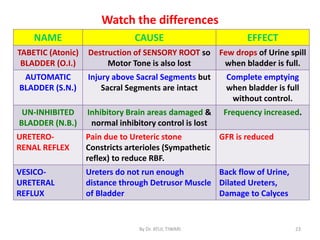
Watch the differences
NAME CAUSE EFFECT
TABETIC (Atonic)
BLADDER (O.I.)
Destruction of SENSORY ROOT so
Motor Tone is also lost
Few drops of Urine spill
when bladder is full.
AUTOMATIC
BLADDER (S.N.)
Injury above Sacral Segments but
Sacral Segments are intact
Complete emptying
when bladder is full
without control.
UN-INHIBITED
BLADDER (N.B.)
Inhibitory Brain areas damaged &
normal inhibitory control is lost
Frequency increased.
URETERO-
RENAL REFLEX
Pain due to Ureteric stone
Constricts arterioles (Sympathetic
reflex) to reduce RBF.
GFR is reduced
VESICO-
URETERAL
REFLUX
Ureters do not run enough
distance through Detrusor Muscle
of Bladder
Back flow of Urine,
Dilated Ureters,
Damage to Calyces
By Dr. ATUL TIWARI 23
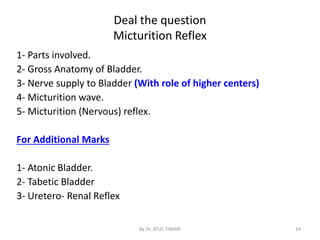
Deal the question
Micturition Reflex
1- Parts involved.
2- Gross Anatomy of Bladder.
3- Nerve supply to Bladder (With role of higher centers)
4- Micturition wave.
5- Micturition (Nervous) reflex.
For Additional Marks
1- Atonic Bladder.
2- Tabetic Bladder
3- Uretero- Renal Reflex
By Dr. ATUL TIWARI 24
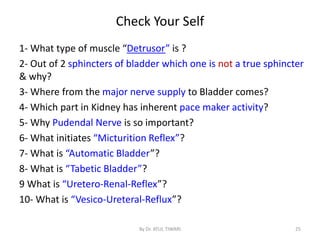
Check Your Self
1- What type of muscle “Detrusor” is ?
2- Out of 2 sphincters of bladder which one is not a true sphincter
& why?
3- Where from the major nerve supply to Bladder comes?
4- Which part in Kidney has inherent pace maker activity?
5- Why Pudendal Nerve is so important?
6- What initiates “Micturition Reflex”?
7- What is “Automatic Bladder”?
8- What is “Tabetic Bladder”?
9 What is “Uretero-Renal-Reflex”?
10- What is “Vesico-Ureteral-Reflux”?
By Dr. ATUL TIWARI 25
QUIZ - 1
1- Pudendal nerve causes-
A- Constriction of Internal Sphincter.
B- Contraction of Detrusor muscle.
C- Constriction of External Sphincter.
D- Inhibition of External Sphincter.
2- Micturition occurs due to -
A- Effect of gravity.
B- Superimposed contraction on Inherent pace maker activity of Calyces.
C- Negative pressure in Bladder.
D- Contractions in Bladder.
3- Tabetic Bladder is caused due to -
A- Injury to Sensory root of Spinal Cord.
B- Injury to Parasympathetic motor fibers.
C- Injury to Sympathetic motor fibers..
D- Stone in Ureter.
By Dr. ATUL TIWARI 26
QUIZ - 2
1- Failure of Ureters to traverse Detrusor muscles results in -
A- Vesico – Ureteral Reflex .
B- Vesico – Ureteral Reflux .
C- Autonomic Bladder.
D- Atonic Bladder.
2- Frequency of Micturition increases in -
A- Vesico – Ureteral Reflux .
B- Atonic Bladder.
C- Uninhibited Neurogenic bladder.
D- Uretero -Renal Reflex.
3- Emptying reflex without any voluntary control occurs in
A- Atonic Bladder.
B- Automatic Bladder.
C- Tabetic Bladder .
D- Uninhibited Neurogenic bladder.
By Dr. ATUL TIWARI 27

Micturation Reflex (2).pptx

  • 1.
    MICTURITION 1- Physiologic Anatomy 2-MicturitionReflex 3- Abnormalities 1
  • 2.
    Check Your Self 1-What type of muscle “Detrusor” is ? 2- Out of 2 sphincters of bladder which one is not a true sphincter & why? 3- Where from the major nerve supply to Bladder comes? 4- Which part in Kidney has inherent pace maker activity? 5- Why Pudendal Nerve is so important? 6- What initiates “Micturition Reflex”? 7- What is “Atonic Bladder”? 8- What is “Tabetic Bladder”? 9 What is “Uretero-Renal-Reflex”? 10- What is “Vesico-Ureteral-Reflux”? 2
  • 3.
    Urinary Bladder -Gross view 3
  • 4.
    Urinary Bladder- StructuralConsiderations Detrusor Muscle (Smooth Muscle) Internal Sphincter 4
  • 5.
    Anatomical considerations toremember • The lower part of bladder neck is called as posterior urethra. The ureters pass obliquely through the bladder wall (Lower part). • The oblique passage tends to keep the ureters closed except during peristaltic waves (There is no ureteral sphincter). • Bladder wall is composed of detrusor muscle (Smooth Muscle) • Detrusor muscle is mainly responsible for emptying of bladder during urination. • Internal sphincter- is not a true sphincter as it does not surround the neck (But is a thickening of SM in this area). By Dr. ATUL TIWARI 5
  • 6.
    Anatomical considerations toremember • Beyond the posterior urethra, the urethra passes through the urogenital diaphragm. • Which contains a layer of muscle (external sphincter). • It is sphincter of skeletal muscles. It encircles membranous urethra. • It is supplied with somatic nerve fiber (voluntary control) . • • Muscles of Internal sphincter & Bladder are smooth & involuntary but have some elastic fibers. By Dr. ATUL TIWARI 6
  • 7.
    Micturition • It isa process by which bladder empties its urine out when it is filled with. • It includes 2 steps • 1- Filling of bladder till stretching of its wall creates threshold tension in bladder & Filling of Urethra. • 2- This stretching initiates Micturition Reflex. • Though it is an autonomic spinal reflex but it could be inhibited or facilitated by voluntary centers of brain. By Dr. ATUL TIWARI 7
  • 8.
    About Nerve Supply •Pelvic nerves connected to S2 & S3 (& S4) are both sensory & Motor. • Motor nerves to bladder are Parasympathetic. • They terminate in ganglion located in wall of bladder. • Short postganglionic fibers supply detrusor muscle. • In addition to the pelvic nerves, two other types of Innervations are important in bladder function. By Dr. ATUL TIWARI 8
  • 9.
    Two nerves otherthan Pelvic Nerves • A- Most important are the skeletal motor fibers transmitted through the pudendal nerve -S2, S3 (& S4- Ganong) to the external sphincter of bladder. These are somatic nerve fibers that innervate and control the voluntary skeletal muscle of the sphincter (Cortical Control). • B- Sympathetic innervations from the sympathetic chain through (Inferior mesenteric – Ganong) hypogastric nerves, connecting mainly with the L-2 segment (L1 & L3 are also involved- Ganong) of the spinal cord. • These sympathetic fibers stimulate mainly the blood vessels By Dr. ATUL TIWARI 9
  • 10.
    Physiologic Anatomy -Bladder By Dr. ATUL TIWARI 10
  • 11.
    EMPTYING OF THEBLADDER • Emptying of the bladder is basically a reflex action called the micturition reflex, which is controlled by supraspinal centres and is assisted by contraction of perineal and abdominal muscles. • Micturition reflex, • Voluntary control of micturition and • Role of perineal and abdominal muscles in micturition. By Dr. ATUL TIWARI 11
  • 12.
    Pressure in bladderadjust to its radius 1- Initially there is increase in pressure with filling of bladder. 2- Due to rugae bladder expands. 3- With filling 35 to 50 ml of urine pressure increases to 10 Cms of water. 4- Pressure increase is slight for further increase in volume (Laplace’s Law), until filling exceeds 300 to 400 ml in adult bladder 5- At this amount bladder can no more adjust with increasing volume of urine. By Dr. ATUL TIWARI 12
  • 13.
    Micturition reflex • Initiation.Micturition reflex is initiated by the stimulation of the stretch receptors located in the wall of urinary bladder. • Stimulus. Filling of bladder by 300–400 mL of urine in adults constitutes the adequate stimulus for the micturition reflex to occur. • Afferents. The afferents from the stretch receptors in the detrusor muscle and urethra travel along the pelvic splanchnic nerves and enter the spinal cord through dorsal roots S2, S3 and S4 segments to reach the sacral micturition centre. • Sacral micturition centre is formed by the sacral detrusor nucleus and sacral pudendal nucleus. • Efferents. Efferents arising from the sacral detrusor nucleus are the preganglionic parasympathetic fibres, which relay in the ganglia near or within bladder and urethra .The post-ganglionic parasympathetic fibres are excitatory to the detrusor muscle and inhibitory to the internal sphincter. By Dr. ATUL TIWARI 13
  • 14.
    • Response. Oncemicturition reflex is initiated, it is self regenerative, i.e. initial contraction of the bladder wall further activates the receptors to increase the sensory impulses (afferents) from the bladder and urethra which cause further increase in the reflex contraction of detrusor muscle of the bladder. • The cycle thus keeps on repeating itself again and again until the bladder has reached a strong degree of contraction. • Once the micturition reflex becomes powerful enough, this causes another reflex which passes through pudendal nerves to external sphincter to cause its inhibition. • If this inhibition is more potent than the voluntary constrictor signals from brain, then urination will not occur. • If not so, urination will not occur unless the bladder fills still more and micturition reflex becomes more powerful. By Dr. ATUL TIWARI 14
  • 15.
    Voluntary control ofmicturition • Role of supraspinal centres • The micturition reflex is fundamentally a spinal reflex facilitated and inhibited by higher brain centres (supraspinal centres) and, is subjected to voluntary facilitation and inhibition. • In infants and young children,micturition is purely a reflex action. • Voluntary control is gradually acquired as a learned ability of the toilet training. • Once voluntary control is acquired, the supraspinal control centres exert final control of micturition. By Dr. ATUL TIWARI 15
  • 16.
    • The highercentres keep the micturition reflex partially inhibited all the time except when it is desired to micturate. • When the convenient time to urinate present, the higher centres facilitate the sacral micturition centre (SMC) to initiate a micturition reflex and inhibit the external urinary sphincter so that urination can occur. • Supraspinal control centres which control the micturition reflex include the pontine micturition centre (PMC) and suprapontine centres. • Pontine micturition centre, corresponds to the locus ceruleus of the rostral pons. Neurons from PMC descend in the reticulospinal tract and exert control over the SMC and thoracolumbar sympathetics. Function of PMC is coordination of detrusor contraction and sphincter relaxation, which is important for proper micturition. • Suprapontine centres which relay their influence on the sacral micturition centre through the PMC are: • Cerebral cortex • Basal ganglion • Limbic system By Dr. ATUL TIWARI 16
  • 17.
    Role of perinealand abdominal muscles in micturition • At the onset of micturition, the levator ani and perineal muscles are relaxed, thereby shortening the post-urethra and decreasing the urethral resistance. • The diaphragm descends and • The abdominal muscles contract, accelerating the flow of urine by raising intra-abdominal pressure which in turn secondarily increase the intravesical pressure thereby increasing the flow of urine. • A voiding contraction, once initiated, is normally maintained until all the urine has been discharged from the urinary bladder. This is a function of facilitating impulses from the higher centres. However, if required so, the micturition can be voluntarily stopped in between by inhibitory impulses from the higher centres. By Dr. ATUL TIWARI 17
  • 18.
    Atonic Bladder (Overflowincontinence) • 1- Sensory fiber are destroyed (Spinal Crush Injury). • 2- In absence of sensory signals, tonic Motor signals are also not transmitted to bladder. • 3- Person loses control on bladder & urine spills as few drops when bladder is full (Though other connections are normal). • 4- A disease syphilis - can cause constrictive fibrosis around the dorsal root nerve fibers, & destroying them. • 5- This condition is called tabes dorsalis, and the resulting bladder condition is called tabetic bladder. By Dr. ATUL TIWARI 18
  • 19.
    Automatic Bladder (SpasticNeurogenic) 1- Occurs when spinal injury occurs above sacral segments but sacral segments are intact. Bladder works as per stretch reflex. When Pressure is enough high in Bladder to stimulate Post. Urethra, Micturition reflex in initiated. It reflexly contracts without any warning & micturition occurs. 2- Initially there is loss of reflex due to spinal shock. 3- This phase Could be passed by periodical catheterization to prevent over stretching of bladder 4- Than bladder regains full micturition reflex (Un announced). 5- Some patients can still manage it by scratching or tingling skin in genital region / thigh to elicit micturition reflex. 6- Please note that it is return of emptying reflex without any voluntary control. By Dr. ATUL TIWARI 19
  • 20.
    Uninhibited Neurogenic Bladder 1-Condition occurs due to injury in cord or brain stem structures which interrupt inhibitory signals for micturition from higher brain areas. (Sensory impulses still reaching Brain) 2- So excitatory signal keeps sacral areas excited. 3- This elicits uncontrollable micturition reflex with slight filling of bladder. 4- That results in increased frequency of micturition (Because sensory impulses would still reach in brain to make patient realize about desire to micturate) By Dr. ATUL TIWARI 20
  • 21.
    Vesico-Ureteral reflux. • Insome people • 1- Ureters do not traverse long through DETRUSOR muscle while reaching bladder. • 2- So during contraction of Detrusor, ureters are not occluded completely. • 3- This results in back flow of urine from bladder to Ureter during contraction of bladder. • 4- This backflow increases amount of urine in Ureter & Ureters may enlarge. • 5- In sever cases it may cause damage to renal calyces also. • 6- Since this reflux arises from Vesicle & effects Ureter, it is called as “Vesico- Ureteral Reflux” By Dr. ATUL TIWARI 21
  • 22.
    Ureterorenal Reflex • 1-Ureter is well supplied with pain fibers. • 2- If Ureter is blocked (Ureteral Stone) it causes sever reflex constriction in Ureter associated with sever pain. • 3- This pain causes a sympathetic reflex . • 4- This reflex goes back to Renal Arterioles & constricts them. • 5- This constriction of arterioles reduces the amount of filtrate to reduce the amount of fluid in ureters. • 6- This decreases excessive amount of urine to flow from a blocked Ureter. STONES CAN DAMAGE CALYCES TOO. • 7- This reflex arise in Ureter & goes back to Kidneys, it is called as “Ureterorenal Reflex” By Dr. ATUL TIWARI 22
  • 23.
    Watch the differences NAMECAUSE EFFECT TABETIC (Atonic) BLADDER (O.I.) Destruction of SENSORY ROOT so Motor Tone is also lost Few drops of Urine spill when bladder is full. AUTOMATIC BLADDER (S.N.) Injury above Sacral Segments but Sacral Segments are intact Complete emptying when bladder is full without control. UN-INHIBITED BLADDER (N.B.) Inhibitory Brain areas damaged & normal inhibitory control is lost Frequency increased. URETERO- RENAL REFLEX Pain due to Ureteric stone Constricts arterioles (Sympathetic reflex) to reduce RBF. GFR is reduced VESICO- URETERAL REFLUX Ureters do not run enough distance through Detrusor Muscle of Bladder Back flow of Urine, Dilated Ureters, Damage to Calyces By Dr. ATUL TIWARI 23
  • 24.
    Deal the question MicturitionReflex 1- Parts involved. 2- Gross Anatomy of Bladder. 3- Nerve supply to Bladder (With role of higher centers) 4- Micturition wave. 5- Micturition (Nervous) reflex. For Additional Marks 1- Atonic Bladder. 2- Tabetic Bladder 3- Uretero- Renal Reflex By Dr. ATUL TIWARI 24
  • 25.
    Check Your Self 1-What type of muscle “Detrusor” is ? 2- Out of 2 sphincters of bladder which one is not a true sphincter & why? 3- Where from the major nerve supply to Bladder comes? 4- Which part in Kidney has inherent pace maker activity? 5- Why Pudendal Nerve is so important? 6- What initiates “Micturition Reflex”? 7- What is “Automatic Bladder”? 8- What is “Tabetic Bladder”? 9 What is “Uretero-Renal-Reflex”? 10- What is “Vesico-Ureteral-Reflux”? By Dr. ATUL TIWARI 25
  • 26.
    QUIZ - 1 1-Pudendal nerve causes- A- Constriction of Internal Sphincter. B- Contraction of Detrusor muscle. C- Constriction of External Sphincter. D- Inhibition of External Sphincter. 2- Micturition occurs due to - A- Effect of gravity. B- Superimposed contraction on Inherent pace maker activity of Calyces. C- Negative pressure in Bladder. D- Contractions in Bladder. 3- Tabetic Bladder is caused due to - A- Injury to Sensory root of Spinal Cord. B- Injury to Parasympathetic motor fibers. C- Injury to Sympathetic motor fibers.. D- Stone in Ureter. By Dr. ATUL TIWARI 26
  • 27.
    QUIZ - 2 1-Failure of Ureters to traverse Detrusor muscles results in - A- Vesico – Ureteral Reflex . B- Vesico – Ureteral Reflux . C- Autonomic Bladder. D- Atonic Bladder. 2- Frequency of Micturition increases in - A- Vesico – Ureteral Reflux . B- Atonic Bladder. C- Uninhibited Neurogenic bladder. D- Uretero -Renal Reflex. 3- Emptying reflex without any voluntary control occurs in A- Atonic Bladder. B- Automatic Bladder. C- Tabetic Bladder . D- Uninhibited Neurogenic bladder. By Dr. ATUL TIWARI 27