MEMBERS
Kindly write yournames and matric number according to this format:
1) Aboluwoye Olubukola Esther - NSC/2021/002
2) Adenusi Moyinoluwa Aminat - NCS/2022/005
3) Nwosu Tochi Anita - NSC/2022/001
4) Dada Mofopefoluwa Omolade - NSC/2021/041
5) Mmuojekwu Mirabel - NSC/2022/006
6) Adebayo Oluwadamilola Joy - NSC/2022/009
7) Aluko Oluwatunmise - NSC/2022/008
8) Olutanwa Esther - NSC/2022/010
9) Fayemi Ajibola - NSC/2021/032
10) Sorunke Emmanuel Pelumi - NSC/2022/007
3.
OUTLINE
• - Introduction
•- Types
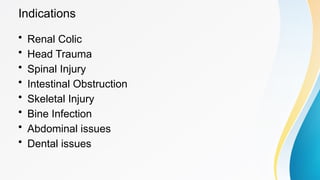
• - Indications
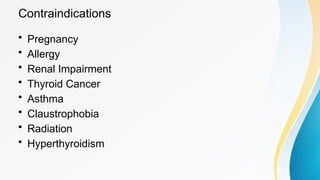
• - Contraindications
• - The Procedure
• - Patient preparation
• - Nursing responsibilities before, during, and after the procedure
• - Complications
4.
Introduction.
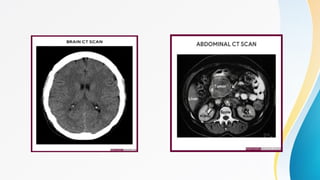
• A computedtomography scan (CT scan), formerly called computed axial
tomography scan (CAT scan), is a medical imaging technique used to obtain
detailed internal images of the body. The personnel that perform CT scans
are called radiographers or radiology technologists. CT scanners use a
rotating X-ray tube and a row of detectors placed in a gantry to measure X-
ray attenuations by different tissues inside the body. The multiple X-ray
measurements taken from different angles are then processed on a computer
using tomographic reconstruction algorithms to produce tomographic (cross-
sectional) images (virtual "slices") of a body. CT scans can be used in
patients with metallic implants or pacemakers, for whom magnetic resonance
imaging (MRI) is contraindicated.
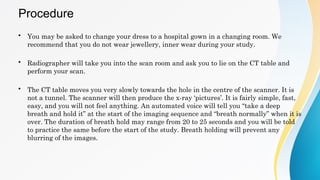
Procedure
• You maybe asked to change your dress to a hospital gown in a changing room. We
recommend that you do not wear jewellery, inner wear during your study.
• Radiographer will take you into the scan room and ask you to lie on the CT table and
perform your scan.
• The CT table moves you very slowly towards the hole in the centre of the scanner. It is
not a tunnel. The scanner will then produce the x-ray ‘pictures’. It is fairly simple, fast,
easy, and you will not feel anything. An automated voice will tell you “take a deep
breath and hold it” at the start of the imaging sequence and “breath normally” when it is
over. The duration of breath hold may range from 20 to 25 seconds and you will be told
to practice the same before the start of the study. Breath holding will prevent any
blurring of the images.
10.
Nurses Responsibilities
• InformedConsent. Obtain an informed consent properly signed.
• Look for allergies. Assess for any history of allergies to iodinated dye or shellfish if contrast media is to
be used.
• Get health history. Ask the patient about any recent illnesses or other medical conditions and current
medications being taken. The specific type of CT scan determines the need for an oral or I.V. contrast
medium
• Check for NPO status. Instruct the patient to not to eat or drink for a period amount of time especially if
a contrast material will be used.
• Get dressed up. Instruct the patient to wear comfortable, loose-fitting clothing during the exam.
• Provide information about the contrast medium. Tell the patient that a mild transient pain from the
needle puncture and a flushed sensation from an I.V. contrast medium will be experienced.
• Instruct the patient to remain still. During the examination, tell the patient to remain still and to
immediately report symptoms of itching, difficulty breathing or swallowing, nausea, vomiting, dizziness,
and headache.
• Inform about the duration of the procedure. Inform the patient that the procedure takes from five (5)
minutes to one (1) hour depending on the type of CT scan and his ability to relax and remain still.
11.
Nursing Responsibilities
• Thenurse should be aware of these post-procedure
nursing interventions after computed tomography (CT)
scan:
• Diet as usual. Instruct the patient to resume the usual diet
and activities unless otherwise ordered.
• Encourage the patient to increase fluid intake (if a
contrast is given). This is so to promote excretion of the
dye.
12.
Complications
• Radiation Exposure
•CT scans use ionizing radiation, which in high doses can potentially increase the risk of cancer. However, the radiation dose from a single CT scan is
relatively low. The risk is thought to be very small, with the chances of developing a fatal cancer due to a CT scan estimated at about 1 in 2,000.
• It’s important to note that the benefits of a medically necessary CT scan typically outweigh the small potential risk from radiation exposure. Modern CT
scanners are designed to use the lowest radiation dose possible while still producing high-quality images.
• Contrast Material Reactions
• If your CT scan requires contrast material, there's a small risk of an allergic reaction. Most reactions are mild, causing symptoms like itchiness or a rash.
Some people may experience side effects from the contrast material, including:
• Nausea and vomiting
• Headaches
• Dizziness
• A warm, flushed sensation
• A metallic taste in the mouth
• These effects are usually temporary and resolve on their own. In rare cases, more severe allergic reactions can occur.
• Kidney Issues
• In rare cases, the contrast material used in CT scans can affect kidney function, particularly in people with pre-existing kidney problems or diabetes. Your
doctor will assess your kidney function before administering contrast material if there's any concern.