Microscopic
Examination of Urine
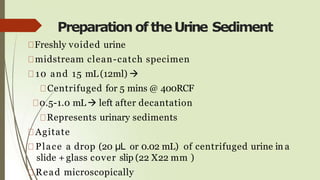
Preparation oftheUrine Sediment
Freshly voided urine
midstream clean-catch specimen
10 and 15 mL (12ml) 
Centrifuged for 5 mins @ 400RCF
0.5-1.0 mL  left after decantation
Represents urinary sediments
Agitate
Place a drop (20 μL or 0.02 mL) of centrifuged urine in a
slide + glass cover slip (22 X22 mm )
Read microscopically
Examination oftheUrine Sediment
Observe minimum of 10 fields [both low & high PF]
LPF (10x) 
detect casts and to ascertain the general
composition of the sediment
HPF (40x) 
Identification
casts have a tendency to locate near the edges of
the cover slip (LPFscanning around the cover slip
perimeter)
Examination oftheUrine Sediment
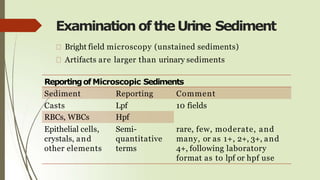
Bright field microscopy (unstained sediments)
Artifacts are larger than urinary sediments
Reportingof Microscopic Sediments
Sediment Reporting Comment
Casts Lpf 10 fields
RBCs, WBCs Hpf
Epithelial cells,
crystals, and
other elements
Semi-
quantitative
terms
rare, few, moderate, and
many, or as 1+, 2+, 3+, and
4+, following laboratory
format as to lpf or hpf use
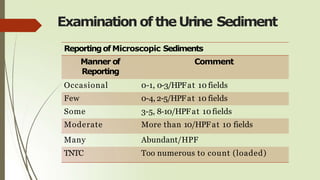
Reportingof Microscopic Sediments
Manner of Comment
Reporting
Occasional 0-1, 0-3/HPFat 10 fields
Few 0-4, 2-5/HPFat 10 fields
Some 3-5, 8-10/HPFat 10fields
Moderate More than 10/HPFat 10 fields
Many Abundant/HPF
TNTC Too numerous to count (loaded)
Examination of theUrine Sediment
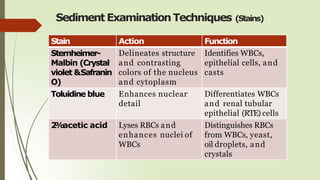
Sediment ExaminationTechniques (Stains)
Stain Action Function
Sternheimer-
Malbin (Crystal
violet &Safranin
O)
Delineates structure
and contrasting
colors of the nucleus
and cytoplasm
Identifies WBCs,
epithelial cells, and
casts
Toluidine blue Enhances nuclear
detail
Differentiates WBCs
and renal tubular
epithelial (RTE) cells
2
%
acetic acid Lyses RBCs and
enhances nuclei of
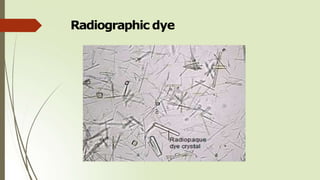
WBCs
Distinguishes RBCs
from WBCs, yeast,
oil droplets, and
crystals
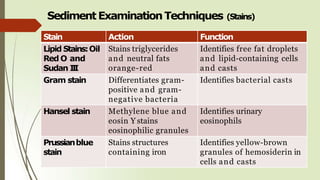
Sediment ExaminationTechniques (Stains)
Stain Action Function
Lipid Stains:Oil
Red O and
Sudan I
I
I
Stains triglycerides
and neutral fats
orange-red
Identifies free fat droplets
and lipid-containing cells
and casts
Gram stain Differentiates gram-
positive and gram-
negative bacteria
Identifies bacterial casts
Hansel stain Methylene blue and
eosin Y stains
eosinophilic granules
Identifies urinary
eosinophils
Prussianblue
stain
Stains structures
containing iron
Identifies yellow-brown
granules of hemosiderin in
cells and casts
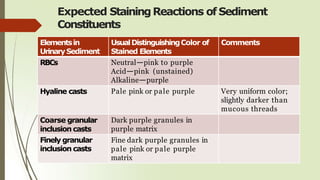
Expected StainingReactions of Sediment
Constituents
Elementsin
UrinarySediment
UsualDistinguishingColor of
Stained Elements
Comments
RBCs Neutral—pink to purple
Acid—pink (unstained)
Alkaline—purple
Hyaline casts Pale pink or pale purple Very uniform color;
slightly darker than
mucous threads
Coarse granular
inclusion casts
Dark purple granules in
purple matrix
Finely granular
inclusion casts
Fine dark purple granules in
pale pink or pale purple
matrix
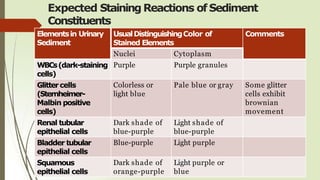
Expected Staining Reactions of Sediment
Constituents
Elementsin Urinary
Sediment
UsualDistinguishingColor of
Stained Elements
Comments
Nuclei Cytoplasm
WBCs(dark-staining
cells)
Purple Purple granules
Glittercells
(Sternheimer-
Malbin positive
cells)
Colorless or
light blue
Pale blue or gray Some glitter
cells exhibit
brownian
movement
Renal tubular
epithelial cells
Dark shade of
blue-purple
Light shade of
blue-purple
Bladder tubular
epithelial cells
Blue-purple Light purple
Squamous
epithelial cells
Dark shade of
orange-purple
Light purple or
blue
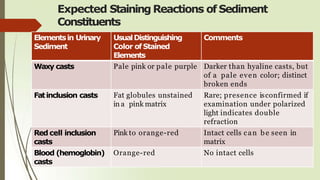
Expected Staining Reactions of Sediment
Constituents
Elementsin Urinary
Sediment
UsualDistinguishing
Color ofStained
Elements
Comments
Waxy casts Pale pink or pale purple Darker than hyaline casts, but
of a pale even color; distinct
broken ends
Fatinclusion casts Fat globules unstained
in a pink matrix
Rare; presence isconfirmed if
examination under polarized
light indicates double
refraction
Red cell inclusion
casts
Pink to orange-red Intact cells can be seen in
matrix
Blood (hemoglobin)
casts
Orange-red No intact cells
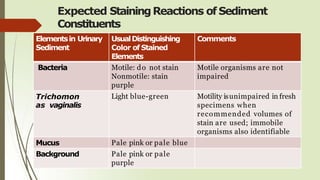
Expected StainingReactions of Sediment
Constituents
Elementsin Urinary
Sediment
UsualDistinguishing
Color ofStained
Elements
Comments
Bacteria Motile: do not stain
Nonmotile: stain
purple
Motile organisms are not
impaired
Trichomon
as vaginalis
Light blue-green Motility isunimpaired in fresh
specimens when
recommended volumes of
stain are used; immobile
organisms also identifiable
Mucus Pale pink or pale blue
Background Pale pink or pale
purple
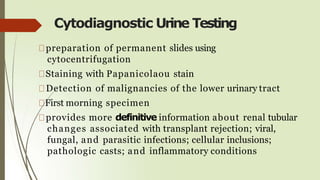
Cytodiagnostic Urine Testing
preparation of permanent slides using
cytocentrifugation
Staining with Papanicolaou stain
Detection of malignancies of the lower urinary tract
First morning specimen
provides more definitive information about renal tubular
changes associated with transplant rejection; viral,
fungal, and parasitic infections; cellular inclusions;
pathologic casts; and inflammatory conditions
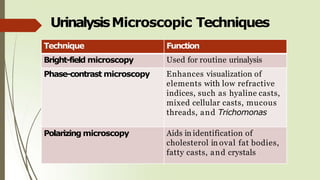
UrinalysisMicroscopic Techniques
Technique Function
Bright-field microscopy Used for routine urinalysis
Phase-contrast microscopy Enhances visualization of
elements with low refractive
indices, such as hyaline casts,
mixed cellular casts, mucous
threads, and Trichomonas
Polarizing microscopy Aids in identification of
cholesterol in oval fat bodies,
fatty casts, and crystals
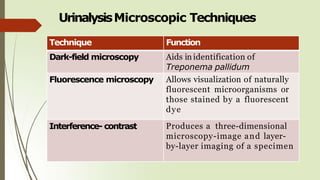
UrinalysisMicroscopic Techniques
Technique Function
Dark-field microscopy Aids in identification of
Treponema pallidum
Fluorescence microscopy Allows visualization of naturally
fluorescent microorganisms or
those stained by a fluorescent
dye
Interference- contrast Produces a three-dimensional
microscopy-image and layer-
by-layer imaging of a specimen
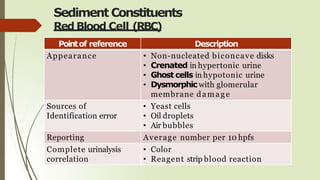
Sediment Constituents
Red Blood Cell (RBC)
Pointof reference Description
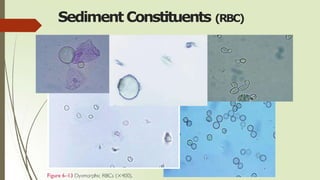
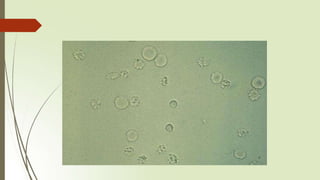
Appearance • Non-nucleated biconcave disks
• Crenated in hypertonic urine
• Ghost cells in hypotonic urine
• Dysmorphicwith glomerular
membrane damage
Sources of
Identification error
• Yeast cells
• Oil droplets
• Air bubbles
Reporting Average number per 10 hpfs
Complete urinalysis
correlation
• Color
• Reagent strip blood reaction
Sediment Constituents (RBC)
Sediment Constituents
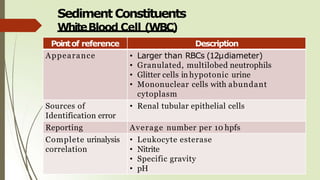
WhiteBlood Cell (WBC)
Pointof reference Description
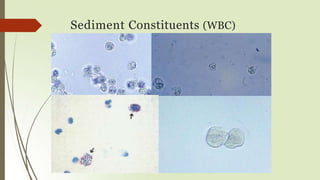
Appearance • Larger than RBCs (12μdiameter)
• Granulated, multilobed neutrophils
• Glitter cells in hypotonic urine
• Mononuclear cells with abundant
cytoplasm
Sources of
Identification error
• Renal tubular epithelial cells
Reporting Average number per 10 hpfs
Complete urinalysis
correlation
• Leukocyte esterase
• Nitrite
• Specific gravity
• pH
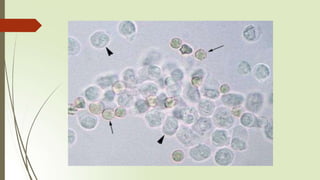
Sediment Constituents (WBC)
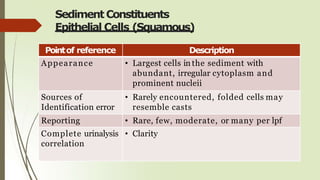
Sediment Constituents
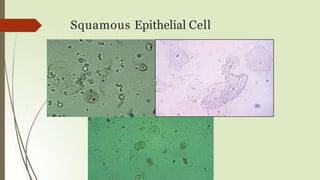
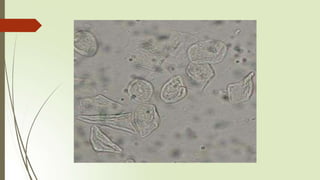
Epithelial Cells (Squamous)
Pointof reference Description
Appearance • Largest cells in the sediment with
abundant, irregular cytoplasm and
prominent nucleii
Sources of
Identification error
• Rarely encountered, folded cells may
resemble casts
Reporting • Rare, few, moderate, or many per lpf
Complete urinalysis
correlation
• Clarity
Squamous Epithelial Cell
Sediment Constituents
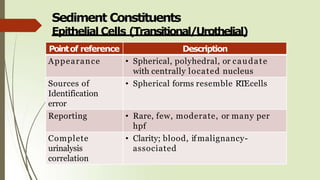
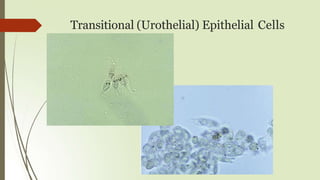
Epithelial Cells (Transitional/Urothelial)
Pointof reference Description
Appearance • Spherical, polyhedral, or caudate
with centrally located nucleus
Sources of
Identification
error
• Spherical forms resemble RTEcells
Reporting • Rare, few, moderate, or many per
hpf
Complete
urinalysis
correlation
• Clarity; blood, ifmalignancy-
associated
Transitional (Urothelial) Epithelial Cells
Sediment Constituents
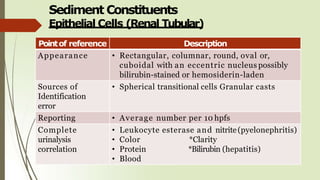
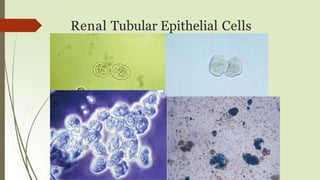
Epithelial Cells (Renal Tubular)
Pointof reference Description
Appearance • Rectangular, columnar, round, oval or,
cuboidal with an eccentric nucleus possibly
bilirubin-stained or hemosiderin-laden
Sources of
Identification
error
• Spherical transitional cells Granular casts
Reporting • Average number per 10 hpfs
Complete
urinalysis
correlation
• Leukocyte esterase and nitrite(pyelonephritis)
• Color *Clarity
• Protein *Bilirubin (hepatitis)
• Blood
Renal Tubular Epithelial Cells
Sediment Constituents
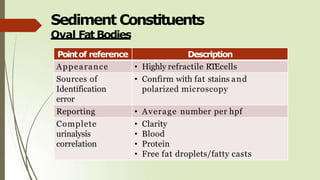
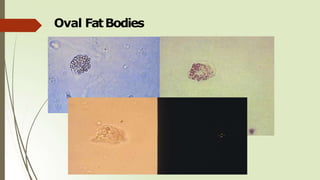
Oval Fat Bodies
Pointof reference Description
Appearance • Highly refractile RTEcells
Sources of
Identification
error
• Confirm with fat stains and
polarized microscopy
Reporting • Average number per hpf
Complete
urinalysis
correlation
• Clarity
• Blood
• Protein
• Free fat droplets/fatty casts
Oval FatBodies
Sediment Constituents
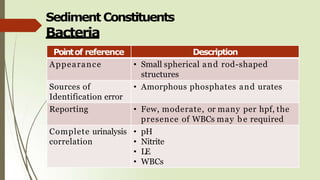
Bacteria
Pointof reference Description
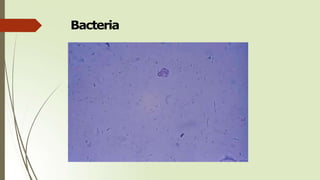
Appearance • Small spherical and rod-shaped
structures
Sources of
Identification error
• Amorphous phosphates and urates
Reporting • Few, moderate, or many per hpf, the
presence of WBCs may be required
Complete urinalysis
correlation
• pH
• Nitrite
• LE
• WBCs
Bacteria
Sediment Constituents
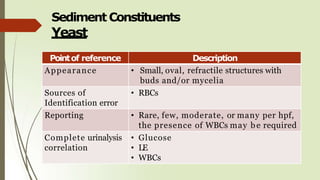
Yeast
Pointof reference Description
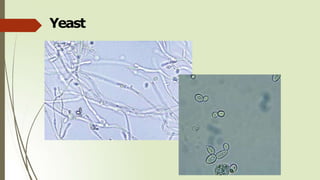
Appearance • Small, oval, refractile structures with
buds and/or mycelia
Sources of
Identification error
• RBCs
Reporting • Rare, few, moderate, or many per hpf,
the presence of WBCs may be required
Complete urinalysis
correlation
• Glucose
• LE
• WBCs
Yeast
Sediment Constituents
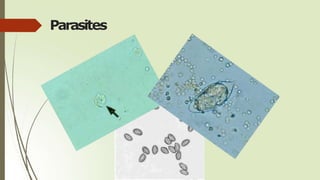
Parasites (Trichomonas)
Pointof reference Description
Appearance • Pear-shaped, motile, flagellated
Sources of
Identification error
• WBCs
• renal tubular epithelial cells
Reporting • Rare, few, moderate, or many per
hpf
Complete
urinalysis
correlation
• LE
• WBCs
Parasites
Sediment Constituents
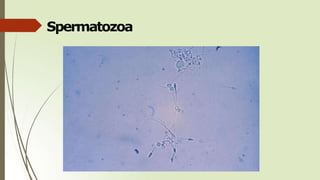
Spermatozoa
Pointof reference Description
Appearance • Tapered oval head with long, thin
tail
Sources of
Identification error
• None
Reporting • Present, based on laboratory
protocol
Complete
urinalysis
correlation
• Protein
Spermatozoa
Sediment Constituents
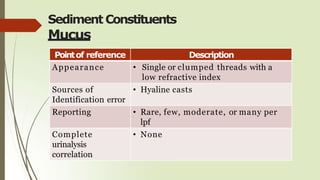
Mucus
Pointof reference Description
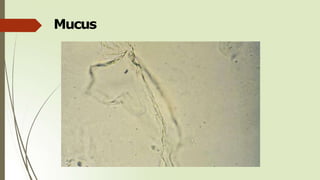
Appearance • Single or clumped threads with a
low refractive index
Sources of
Identification error
• Hyaline casts
Reporting • Rare, few, moderate, or many per
lpf
Complete
urinalysis
correlation
• None
Mucus
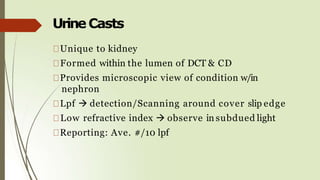
UrineCasts
Unique to kidney
Formed within the lumen of DCT & CD
Provides microscopic view of condition w/in
nephron
Lpf  detection/Scanning around cover slip edge
Low refractive index  observe in subdued light
Reporting: Ave. #/10 lpf
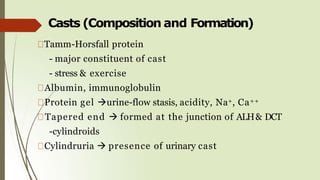
Casts (Composition and Formation)
Tamm-Horsfall protein
- major constituent of cast
- stress & exercise
Albumin, immunoglobulin
Protein gel urine-flow stasis, acidity, Na+, Ca++
Tapered end  formed at the junction of ALH& DCT
-cylindroids
Cylindruria  presence of urinary cast
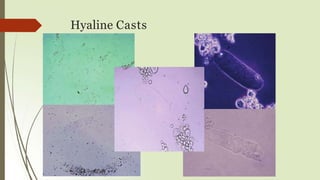
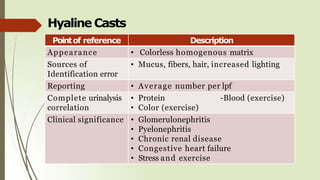
Hyaline Casts
Pointof reference Description
Appearance • Colorless homogenous matrix
Sources of
Identification error
• Mucus, fibers, hair, increased lighting
Reporting • Average number per lpf
Complete urinalysis
correlation
• Protein -Blood (exercise)
• Color (exercise)
Clinical significance • Glomerulonephritis
• Pyelonephritis
• Chronic renal disease
• Congestive heart failure
• Stress and exercise
Hyaline Casts
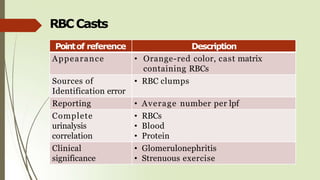
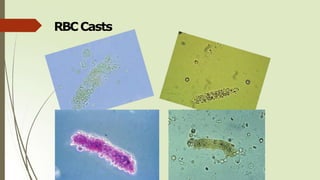
RBCCasts
Pointof reference Description
Appearance • Orange-red color, cast matrix
containing RBCs
Sources of
Identification error
• RBC clumps
Reporting • Average number per lpf
Complete
urinalysis
correlation
• RBCs
• Blood
• Protein
Clinical
significance
• Glomerulonephritis
• Strenuous exercise
RBCCasts
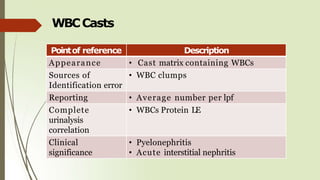
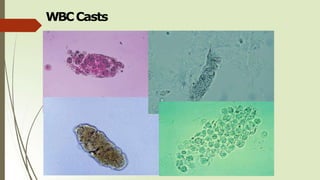
WBCCasts
Pointof reference Description
Appearance • Cast matrix containing WBCs
Sources of
Identification error
• WBC clumps
Reporting • Average number per lpf
Complete
urinalysis
correlation
• WBCs Protein LE
Clinical
significance
• Pyelonephritis
• Acute interstitial nephritis
WBCCasts
Bacterial Casts
Pointof reference Description
Appearance • Bacilli bound to protein matrix
Sources of
Identification error
• Granular casts
Reporting • Average number per lpf
Complete
urinalysis
correlation
• WBC cast -WBCs
• LE -Nitrite
• Protein -Bacteria
Clinical
significance
• Pyelonephritis
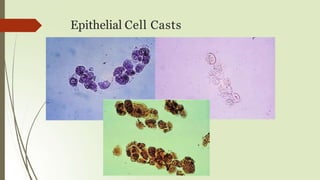
EpithelialCell Casts
Pointof reference Description
Appearance • RTEcells attached to protein matrix
Sources of
Identification error
• WBC cast
Reporting • Average number per lpf
Complete
urinalysis
correlation
• Protein RTEcells
Clinical
significance
• Renal tubular damage
Epithelial Cell Casts
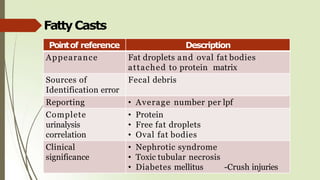
FattyCasts
Pointof reference Description
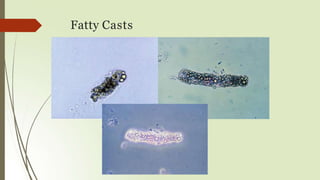
Appearance Fat droplets and oval fat bodies
attached to protein matrix
Sources of
Identification error
Fecal debris
Reporting • Average number per lpf
Complete
urinalysis
correlation
• Protein
• Free fat droplets
• Oval fat bodies
Clinical
significance
• Nephrotic syndrome
• Toxic tubular necrosis
• Diabetes mellitus -Crush injuries
Fatty Casts
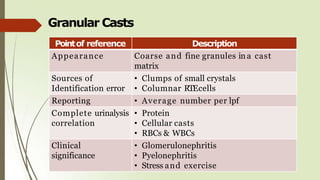
Granular Casts
Pointof reference Description
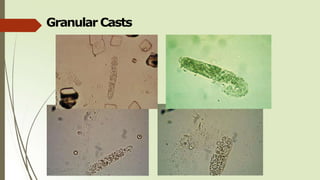
Appearance Coarse and fine granules in a cast
matrix
Sources of
Identification error
• Clumps of small crystals
• Columnar RTEcells
Reporting • Average number per lpf
Complete urinalysis
correlation
• Protein
• Cellular casts
• RBCs & WBCs
Clinical
significance
• Glomerulonephritis
• Pyelonephritis
• Stress and exercise
Granular Casts
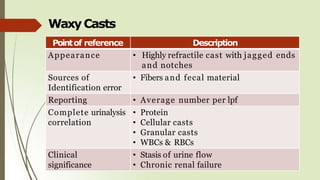
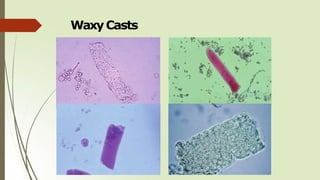
WaxyCasts
Pointof reference Description
Appearance • Highly refractile cast with jagged ends
and notches
Sources of
Identification error
• Fibers and fecal material
Reporting • Average number per lpf
Complete urinalysis
correlation
• Protein
• Cellular casts
• Granular casts
• WBCs & RBCs
Clinical
significance
• Stasis of urine flow
• Chronic renal failure
WaxyCasts
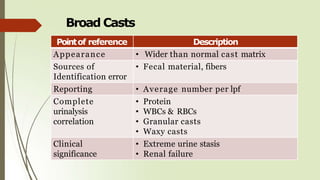
Broad Casts
Pointof reference Description
Appearance • Wider than normal cast matrix
Sources of
Identification error
• Fecal material, fibers
Reporting • Average number per lpf
Complete
urinalysis
correlation
• Protein
• WBCs & RBCs
• Granular casts
• Waxy casts
Clinical
significance
• Extreme urine stasis
• Renal failure
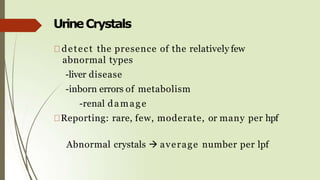
UrineCrystals
detect the presence of the relatively few
abnormal types
-liver disease
-inborn errors of metabolism
-renal damage
Reporting: rare, few, moderate, or many per hpf
Abnormal crystals  average number per lpf
UrineCrystals
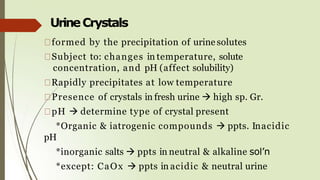
formed by the precipitation of urine solutes
Subject to: changes in temperature, solute
concentration, and pH (affect solubility)
Rapidly precipitates at low temperature
Presence of crystals in fresh urine  high sp. Gr.
pH  determine type of crystal present
*Organic & iatrogenic compounds  ppts. Inacidic
pH
*inorganic salts  ppts in neutral & alkaline sol’n
*except: CaOx  ppts in acidic & neutral urine
Normal Crystal Seen inAcidic Urine
Crystal Color &Shape Solubility Appearnce
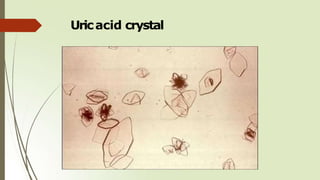
Uric Acid Yellow-brown
(rhombic/4-
sided/rosette)
Alkali
Soluble
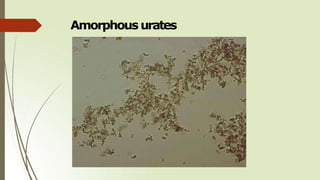
Amorphous
urates
Brick dust or
yellow brown
granules
Alkali and
heat
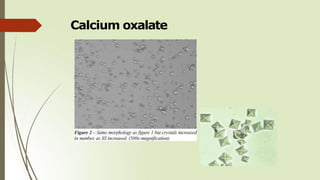
Calcium
oxalate
[Acid/neutral
(alkaline)]
Colorless
(envelopes, oval,
dumbbell,
octahedral)
Dilute HCl
Uricacid crystal
Amorphous urates
Calcium oxalate
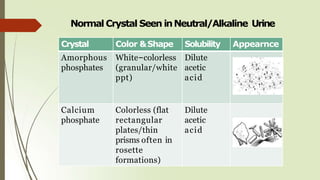
Normal Crystal Seen inNeutral/Alkaline Urine
Crystal Color &Shape Solubility Appearnce
Amorphous
phosphates
White–colorless
(granular/white
ppt)
Dilute
acetic
acid
Calcium
phosphate
Colorless (flat
rectangular
plates/thin
prisms often in
rosette
formations)
Dilute
acetic
acid
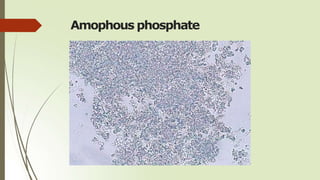
Amophous phosphate
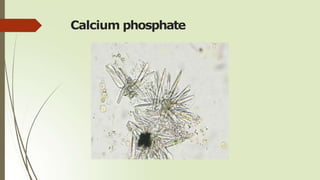
Calcium phosphate
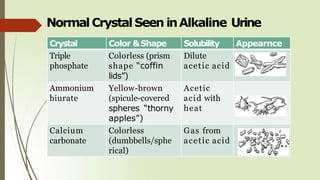
Normal Crystal Seen inAlkaline Urine
Crystal Color &Shape Solubility Appearnce
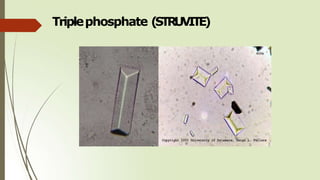
Triple
phosphate
Colorless (prism
shape “coffin
lids”)
Dilute
acetic acid
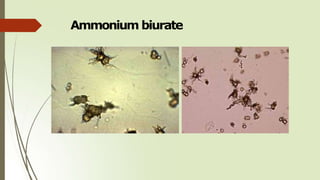
Ammonium
biurate
Yellow-brown
(spicule-covered
spheres “thorny
apples”)
Acetic
acid with
heat
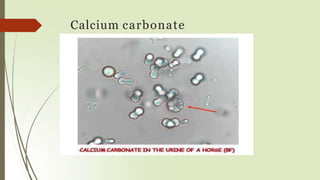
Calcium
carbonate
Colorless
(dumbbells/sphe
rical)
Gas from
acetic acid
Triplephosphate (STRUVITE)
Ammonium biurate
Calcium carbonate
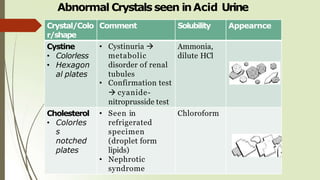
Abnormal Crystals seen inAcid Urine
Crystal/Colo
r/shape
Comment Solubility Appearnce
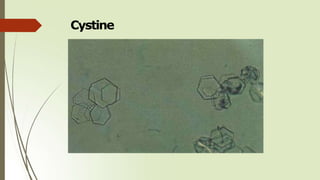
Cystine
• Colorless
• Hexagon
al plates
• Cystinuria 
metabolic
disorder of renal
tubules
• Confirmation test
 cyanide-
nitroprusside test
Ammonia,
dilute HCl
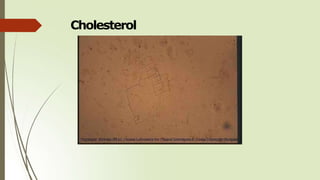
Cholesterol
• Colorles
s
notched
plates
• Seen in
refrigerated
specimen
(droplet form
lipids)
• Nephrotic
syndrome
Chloroform
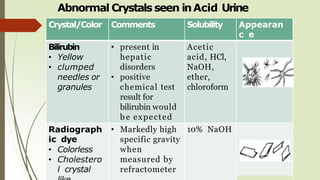
Crystal/Color Comments Solubility Appearan
c e
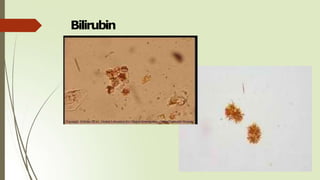
Bilirubin
• Yellow
• clumped
needles or
granules
• present in
hepatic
disorders
• positive
chemical test
result for
bilirubin would
be expected
Acetic
acid, HCl,
NaOH,
ether,
chloroform
Radiograph
ic dye
• Colorless
• Cholestero
l crystal
• Markedly high
specific gravity
when
measured by
refractometer
10% NaOH
Abnormal Crystals seen inAcid Urine
Cystine
Cholesterol
Bilirubin
Radiographic dye
Abnormal Crystalsseen inAcid/Neutral Urine
Crystal/Color Comments Solubility Appearance
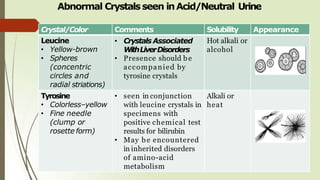
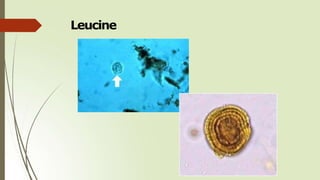
Leucine
• Yellow-brown
• Spheres
(concentric
circles and
radial striations)
• Crystals Associated
WithLiverDisorders
• Presence should be
accompanied by
tyrosine crystals
Hot alkali or
alcohol
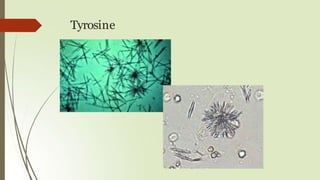
Tyrosine
• Colorless–yellow
• Fine needle
(clump or
rosette form)
• seen in conjunction
with leucine crystals in
specimens with
positive chemical test
results for bilirubin
• May be encountered
in inherited disorders
of amino-acid
metabolism
Alkali or
heat
Abnormal Crystals seen inAcid/Neutral Urine
Crystal/Color Comments Solubility Appearance
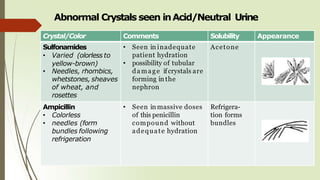
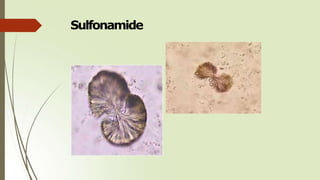
Sulfonamides
• Varied (olorless to
yellow-brown)
• Needles, rhombics,
whetstones, sheaves
of wheat, and
rosettes
• Seen in inadequate
patient hydration
• possibility of tubular
damage ifcrystals are
forming in the
nephron
Acetone
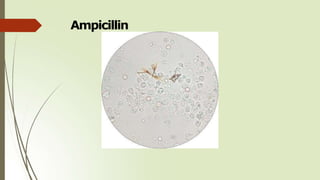
Ampicillin
• Colorless
• needles (form
bundles following
refrigeration
• Seen in massive doses
of this penicillin
compound without
adequate hydration
Refrigera-
tion forms
bundles
Leucine
Tyrosine
Sulfonamide
Ampicillin
UrinarySediment Artifacts
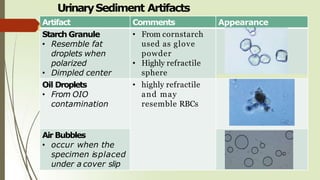
Contaminants from improper collection
starch, oil droplets, air bubbles, pollen grains,
fibers, and fecal contamination
often very highly refractile or occur in a different
microscopic plane
Not necessarily to be reported
UrinarySediment Artifacts
Artifact Comments Appearance
Starch Granule
• Resemble fat
droplets when
polarized
• Dimpled center
• From cornstarch
used as glove
powder
• Highly refractile
sphere
Oil Droplets
• From OIO
contamination
• highly refractile
and may
resemble RBCs
Air Bubbles
• occur when the
specimen isplaced
under a cover slip
t
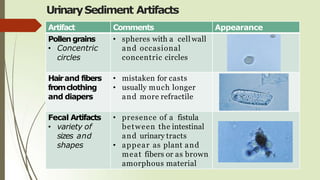
UrinarySediment Artifacts
Artifact Comments Appearance
Pollen grains
• Concentric
circles
• spheres with a cell wall
and occasional
concentric circles
Hairand fibers
fromclothing
and diapers
• mistaken for casts
• usually much longer
and more refractile
Fecal Artifacts
• variety of
sizes and
shapes
• presence of a fistula
between the intestinal
and urinary tracts
• appear as plant and
meat fibers or as brown
amorphous material
END

Microscopic_Examination_of_Urine_pdf (1).pptx

  • 1.
  • 2.
    Preparation oftheUrine Sediment Freshlyvoided urine midstream clean-catch specimen 10 and 15 mL (12ml)  Centrifuged for 5 mins @ 400RCF 0.5-1.0 mL  left after decantation Represents urinary sediments Agitate Place a drop (20 μL or 0.02 mL) of centrifuged urine in a slide + glass cover slip (22 X22 mm ) Read microscopically
  • 3.
    Examination oftheUrine Sediment Observeminimum of 10 fields [both low & high PF] LPF (10x)  detect casts and to ascertain the general composition of the sediment HPF (40x)  Identification casts have a tendency to locate near the edges of the cover slip (LPFscanning around the cover slip perimeter)
  • 4.
    Examination oftheUrine Sediment Brightfield microscopy (unstained sediments) Artifacts are larger than urinary sediments Reportingof Microscopic Sediments Sediment Reporting Comment Casts Lpf 10 fields RBCs, WBCs Hpf Epithelial cells, crystals, and other elements Semi- quantitative terms rare, few, moderate, and many, or as 1+, 2+, 3+, and 4+, following laboratory format as to lpf or hpf use
  • 5.
    Reportingof Microscopic Sediments Mannerof Comment Reporting Occasional 0-1, 0-3/HPFat 10 fields Few 0-4, 2-5/HPFat 10 fields Some 3-5, 8-10/HPFat 10fields Moderate More than 10/HPFat 10 fields Many Abundant/HPF TNTC Too numerous to count (loaded) Examination of theUrine Sediment
  • 6.
    Sediment ExaminationTechniques (Stains) StainAction Function Sternheimer- Malbin (Crystal violet &Safranin O) Delineates structure and contrasting colors of the nucleus and cytoplasm Identifies WBCs, epithelial cells, and casts Toluidine blue Enhances nuclear detail Differentiates WBCs and renal tubular epithelial (RTE) cells 2 % acetic acid Lyses RBCs and enhances nuclei of WBCs Distinguishes RBCs from WBCs, yeast, oil droplets, and crystals
  • 7.
    Sediment ExaminationTechniques (Stains) StainAction Function Lipid Stains:Oil Red O and Sudan I I I Stains triglycerides and neutral fats orange-red Identifies free fat droplets and lipid-containing cells and casts Gram stain Differentiates gram- positive and gram- negative bacteria Identifies bacterial casts Hansel stain Methylene blue and eosin Y stains eosinophilic granules Identifies urinary eosinophils Prussianblue stain Stains structures containing iron Identifies yellow-brown granules of hemosiderin in cells and casts
  • 8.
    Expected StainingReactions ofSediment Constituents Elementsin UrinarySediment UsualDistinguishingColor of Stained Elements Comments RBCs Neutral—pink to purple Acid—pink (unstained) Alkaline—purple Hyaline casts Pale pink or pale purple Very uniform color; slightly darker than mucous threads Coarse granular inclusion casts Dark purple granules in purple matrix Finely granular inclusion casts Fine dark purple granules in pale pink or pale purple matrix
  • 9.
    Expected Staining Reactionsof Sediment Constituents Elementsin Urinary Sediment UsualDistinguishingColor of Stained Elements Comments Nuclei Cytoplasm WBCs(dark-staining cells) Purple Purple granules Glittercells (Sternheimer- Malbin positive cells) Colorless or light blue Pale blue or gray Some glitter cells exhibit brownian movement Renal tubular epithelial cells Dark shade of blue-purple Light shade of blue-purple Bladder tubular epithelial cells Blue-purple Light purple Squamous epithelial cells Dark shade of orange-purple Light purple or blue
  • 10.
    Expected Staining Reactionsof Sediment Constituents Elementsin Urinary Sediment UsualDistinguishing Color ofStained Elements Comments Waxy casts Pale pink or pale purple Darker than hyaline casts, but of a pale even color; distinct broken ends Fatinclusion casts Fat globules unstained in a pink matrix Rare; presence isconfirmed if examination under polarized light indicates double refraction Red cell inclusion casts Pink to orange-red Intact cells can be seen in matrix Blood (hemoglobin) casts Orange-red No intact cells
  • 11.
    Expected StainingReactions ofSediment Constituents Elementsin Urinary Sediment UsualDistinguishing Color ofStained Elements Comments Bacteria Motile: do not stain Nonmotile: stain purple Motile organisms are not impaired Trichomon as vaginalis Light blue-green Motility isunimpaired in fresh specimens when recommended volumes of stain are used; immobile organisms also identifiable Mucus Pale pink or pale blue Background Pale pink or pale purple
  • 12.
    Cytodiagnostic Urine Testing preparationof permanent slides using cytocentrifugation Staining with Papanicolaou stain Detection of malignancies of the lower urinary tract First morning specimen provides more definitive information about renal tubular changes associated with transplant rejection; viral, fungal, and parasitic infections; cellular inclusions; pathologic casts; and inflammatory conditions
  • 13.
    UrinalysisMicroscopic Techniques Technique Function Bright-fieldmicroscopy Used for routine urinalysis Phase-contrast microscopy Enhances visualization of elements with low refractive indices, such as hyaline casts, mixed cellular casts, mucous threads, and Trichomonas Polarizing microscopy Aids in identification of cholesterol in oval fat bodies, fatty casts, and crystals
  • 14.
    UrinalysisMicroscopic Techniques Technique Function Dark-fieldmicroscopy Aids in identification of Treponema pallidum Fluorescence microscopy Allows visualization of naturally fluorescent microorganisms or those stained by a fluorescent dye Interference- contrast Produces a three-dimensional microscopy-image and layer- by-layer imaging of a specimen
  • 15.
    Sediment Constituents Red BloodCell (RBC) Pointof reference Description Appearance • Non-nucleated biconcave disks • Crenated in hypertonic urine • Ghost cells in hypotonic urine • Dysmorphicwith glomerular membrane damage Sources of Identification error • Yeast cells • Oil droplets • Air bubbles Reporting Average number per 10 hpfs Complete urinalysis correlation • Color • Reagent strip blood reaction
  • 16.
  • 18.
    Sediment Constituents WhiteBlood Cell(WBC) Pointof reference Description Appearance • Larger than RBCs (12μdiameter) • Granulated, multilobed neutrophils • Glitter cells in hypotonic urine • Mononuclear cells with abundant cytoplasm Sources of Identification error • Renal tubular epithelial cells Reporting Average number per 10 hpfs Complete urinalysis correlation • Leukocyte esterase • Nitrite • Specific gravity • pH
  • 19.
  • 21.
    Sediment Constituents Epithelial Cells(Squamous) Pointof reference Description Appearance • Largest cells in the sediment with abundant, irregular cytoplasm and prominent nucleii Sources of Identification error • Rarely encountered, folded cells may resemble casts Reporting • Rare, few, moderate, or many per lpf Complete urinalysis correlation • Clarity
  • 22.
  • 24.
    Sediment Constituents Epithelial Cells(Transitional/Urothelial) Pointof reference Description Appearance • Spherical, polyhedral, or caudate with centrally located nucleus Sources of Identification error • Spherical forms resemble RTEcells Reporting • Rare, few, moderate, or many per hpf Complete urinalysis correlation • Clarity; blood, ifmalignancy- associated
  • 25.
  • 26.
    Sediment Constituents Epithelial Cells(Renal Tubular) Pointof reference Description Appearance • Rectangular, columnar, round, oval or, cuboidal with an eccentric nucleus possibly bilirubin-stained or hemosiderin-laden Sources of Identification error • Spherical transitional cells Granular casts Reporting • Average number per 10 hpfs Complete urinalysis correlation • Leukocyte esterase and nitrite(pyelonephritis) • Color *Clarity • Protein *Bilirubin (hepatitis) • Blood
  • 27.
  • 28.
    Sediment Constituents Oval FatBodies Pointof reference Description Appearance • Highly refractile RTEcells Sources of Identification error • Confirm with fat stains and polarized microscopy Reporting • Average number per hpf Complete urinalysis correlation • Clarity • Blood • Protein • Free fat droplets/fatty casts
  • 29.
  • 30.
    Sediment Constituents Bacteria Pointof referenceDescription Appearance • Small spherical and rod-shaped structures Sources of Identification error • Amorphous phosphates and urates Reporting • Few, moderate, or many per hpf, the presence of WBCs may be required Complete urinalysis correlation • pH • Nitrite • LE • WBCs
  • 31.
  • 32.
    Sediment Constituents Yeast Pointof referenceDescription Appearance • Small, oval, refractile structures with buds and/or mycelia Sources of Identification error • RBCs Reporting • Rare, few, moderate, or many per hpf, the presence of WBCs may be required Complete urinalysis correlation • Glucose • LE • WBCs
  • 33.
  • 34.
    Sediment Constituents Parasites (Trichomonas) Pointofreference Description Appearance • Pear-shaped, motile, flagellated Sources of Identification error • WBCs • renal tubular epithelial cells Reporting • Rare, few, moderate, or many per hpf Complete urinalysis correlation • LE • WBCs
  • 35.
  • 36.
    Sediment Constituents Spermatozoa Pointof referenceDescription Appearance • Tapered oval head with long, thin tail Sources of Identification error • None Reporting • Present, based on laboratory protocol Complete urinalysis correlation • Protein
  • 37.
  • 38.
    Sediment Constituents Mucus Pointof referenceDescription Appearance • Single or clumped threads with a low refractive index Sources of Identification error • Hyaline casts Reporting • Rare, few, moderate, or many per lpf Complete urinalysis correlation • None
  • 39.
  • 40.
    UrineCasts Unique to kidney Formedwithin the lumen of DCT & CD Provides microscopic view of condition w/in nephron Lpf  detection/Scanning around cover slip edge Low refractive index  observe in subdued light Reporting: Ave. #/10 lpf
  • 41.
    Casts (Composition andFormation) Tamm-Horsfall protein - major constituent of cast - stress & exercise Albumin, immunoglobulin Protein gel urine-flow stasis, acidity, Na+, Ca++ Tapered end  formed at the junction of ALH& DCT -cylindroids Cylindruria  presence of urinary cast
  • 42.
    Hyaline Casts Pointof referenceDescription Appearance • Colorless homogenous matrix Sources of Identification error • Mucus, fibers, hair, increased lighting Reporting • Average number per lpf Complete urinalysis correlation • Protein -Blood (exercise) • Color (exercise) Clinical significance • Glomerulonephritis • Pyelonephritis • Chronic renal disease • Congestive heart failure • Stress and exercise
  • 43.
  • 44.
    RBCCasts Pointof reference Description Appearance• Orange-red color, cast matrix containing RBCs Sources of Identification error • RBC clumps Reporting • Average number per lpf Complete urinalysis correlation • RBCs • Blood • Protein Clinical significance • Glomerulonephritis • Strenuous exercise
  • 45.
  • 46.
    WBCCasts Pointof reference Description Appearance• Cast matrix containing WBCs Sources of Identification error • WBC clumps Reporting • Average number per lpf Complete urinalysis correlation • WBCs Protein LE Clinical significance • Pyelonephritis • Acute interstitial nephritis
  • 47.
  • 48.
    Bacterial Casts Pointof referenceDescription Appearance • Bacilli bound to protein matrix Sources of Identification error • Granular casts Reporting • Average number per lpf Complete urinalysis correlation • WBC cast -WBCs • LE -Nitrite • Protein -Bacteria Clinical significance • Pyelonephritis
  • 49.
    EpithelialCell Casts Pointof referenceDescription Appearance • RTEcells attached to protein matrix Sources of Identification error • WBC cast Reporting • Average number per lpf Complete urinalysis correlation • Protein RTEcells Clinical significance • Renal tubular damage
  • 50.
  • 51.
    FattyCasts Pointof reference Description AppearanceFat droplets and oval fat bodies attached to protein matrix Sources of Identification error Fecal debris Reporting • Average number per lpf Complete urinalysis correlation • Protein • Free fat droplets • Oval fat bodies Clinical significance • Nephrotic syndrome • Toxic tubular necrosis • Diabetes mellitus -Crush injuries
  • 52.
  • 53.
    Granular Casts Pointof referenceDescription Appearance Coarse and fine granules in a cast matrix Sources of Identification error • Clumps of small crystals • Columnar RTEcells Reporting • Average number per lpf Complete urinalysis correlation • Protein • Cellular casts • RBCs & WBCs Clinical significance • Glomerulonephritis • Pyelonephritis • Stress and exercise
  • 54.
  • 55.
    WaxyCasts Pointof reference Description Appearance• Highly refractile cast with jagged ends and notches Sources of Identification error • Fibers and fecal material Reporting • Average number per lpf Complete urinalysis correlation • Protein • Cellular casts • Granular casts • WBCs & RBCs Clinical significance • Stasis of urine flow • Chronic renal failure
  • 56.
  • 57.
    Broad Casts Pointof referenceDescription Appearance • Wider than normal cast matrix Sources of Identification error • Fecal material, fibers Reporting • Average number per lpf Complete urinalysis correlation • Protein • WBCs & RBCs • Granular casts • Waxy casts Clinical significance • Extreme urine stasis • Renal failure
  • 58.
    UrineCrystals detect the presenceof the relatively few abnormal types -liver disease -inborn errors of metabolism -renal damage Reporting: rare, few, moderate, or many per hpf Abnormal crystals  average number per lpf
  • 59.
    UrineCrystals formed by theprecipitation of urine solutes Subject to: changes in temperature, solute concentration, and pH (affect solubility) Rapidly precipitates at low temperature Presence of crystals in fresh urine  high sp. Gr. pH  determine type of crystal present *Organic & iatrogenic compounds  ppts. Inacidic pH *inorganic salts  ppts in neutral & alkaline sol’n *except: CaOx  ppts in acidic & neutral urine
  • 60.
    Normal Crystal SeeninAcidic Urine Crystal Color &Shape Solubility Appearnce Uric Acid Yellow-brown (rhombic/4- sided/rosette) Alkali Soluble Amorphous urates Brick dust or yellow brown granules Alkali and heat Calcium oxalate [Acid/neutral (alkaline)] Colorless (envelopes, oval, dumbbell, octahedral) Dilute HCl
  • 61.
  • 62.
  • 63.
  • 64.
    Normal Crystal SeeninNeutral/Alkaline Urine Crystal Color &Shape Solubility Appearnce Amorphous phosphates White–colorless (granular/white ppt) Dilute acetic acid Calcium phosphate Colorless (flat rectangular plates/thin prisms often in rosette formations) Dilute acetic acid
  • 65.
  • 66.
  • 67.
    Normal Crystal SeeninAlkaline Urine Crystal Color &Shape Solubility Appearnce Triple phosphate Colorless (prism shape “coffin lids”) Dilute acetic acid Ammonium biurate Yellow-brown (spicule-covered spheres “thorny apples”) Acetic acid with heat Calcium carbonate Colorless (dumbbells/sphe rical) Gas from acetic acid
  • 68.
  • 69.
  • 70.
  • 71.
    Abnormal Crystals seeninAcid Urine Crystal/Colo r/shape Comment Solubility Appearnce Cystine • Colorless • Hexagon al plates • Cystinuria  metabolic disorder of renal tubules • Confirmation test  cyanide- nitroprusside test Ammonia, dilute HCl Cholesterol • Colorles s notched plates • Seen in refrigerated specimen (droplet form lipids) • Nephrotic syndrome Chloroform
  • 72.
    Crystal/Color Comments SolubilityAppearan c e Bilirubin • Yellow • clumped needles or granules • present in hepatic disorders • positive chemical test result for bilirubin would be expected Acetic acid, HCl, NaOH, ether, chloroform Radiograph ic dye • Colorless • Cholestero l crystal • Markedly high specific gravity when measured by refractometer 10% NaOH Abnormal Crystals seen inAcid Urine
  • 73.
  • 74.
  • 75.
  • 76.
  • 77.
    Abnormal Crystalsseen inAcid/NeutralUrine Crystal/Color Comments Solubility Appearance Leucine • Yellow-brown • Spheres (concentric circles and radial striations) • Crystals Associated WithLiverDisorders • Presence should be accompanied by tyrosine crystals Hot alkali or alcohol Tyrosine • Colorless–yellow • Fine needle (clump or rosette form) • seen in conjunction with leucine crystals in specimens with positive chemical test results for bilirubin • May be encountered in inherited disorders of amino-acid metabolism Alkali or heat
  • 78.
    Abnormal Crystals seeninAcid/Neutral Urine Crystal/Color Comments Solubility Appearance Sulfonamides • Varied (olorless to yellow-brown) • Needles, rhombics, whetstones, sheaves of wheat, and rosettes • Seen in inadequate patient hydration • possibility of tubular damage ifcrystals are forming in the nephron Acetone Ampicillin • Colorless • needles (form bundles following refrigeration • Seen in massive doses of this penicillin compound without adequate hydration Refrigera- tion forms bundles
  • 79.
  • 80.
  • 81.
  • 82.
  • 83.
    UrinarySediment Artifacts Contaminants fromimproper collection starch, oil droplets, air bubbles, pollen grains, fibers, and fecal contamination often very highly refractile or occur in a different microscopic plane Not necessarily to be reported
  • 84.
    UrinarySediment Artifacts Artifact CommentsAppearance Starch Granule • Resemble fat droplets when polarized • Dimpled center • From cornstarch used as glove powder • Highly refractile sphere Oil Droplets • From OIO contamination • highly refractile and may resemble RBCs Air Bubbles • occur when the specimen isplaced under a cover slip t
  • 85.
    UrinarySediment Artifacts Artifact CommentsAppearance Pollen grains • Concentric circles • spheres with a cell wall and occasional concentric circles Hairand fibers fromclothing and diapers • mistaken for casts • usually much longer and more refractile Fecal Artifacts • variety of sizes and shapes • presence of a fistula between the intestinal and urinary tracts • appear as plant and meat fibers or as brown amorphous material
  • 86.