Barium Studies
Barium Swallow (BS)
Rad. Aminu Abubakar Abubakar
Radiography Department
Bayero University Kano
October, 2020
• By the end of this lecture student will be able to;
• Describe the anatomy and physiology of Esophagus
• Describe the methodology of BS.
• List the indications and contraindications of BS.
• Describe patient care prior, during and after the
procedure
• Describe the imaging procedure (Single or double
contrast).
• Describe the routine and alternative positioning.
• Film critique; positioning, image quality, radiographic
anatomy and pathology
• Describe other alternative imaging modalities.
Learning Objectives
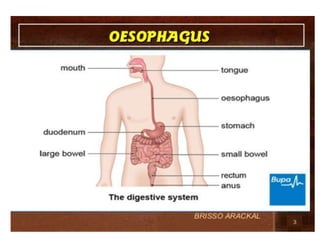
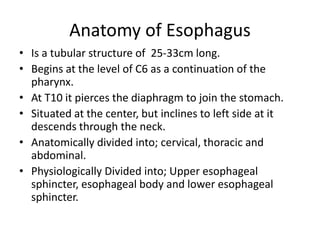
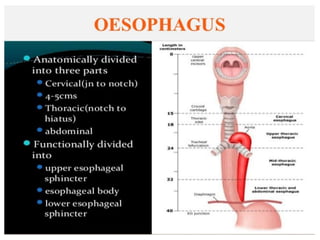
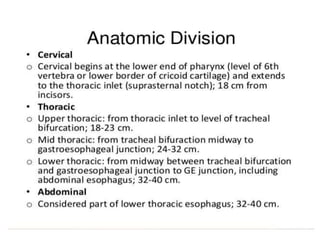
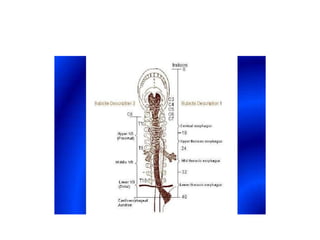
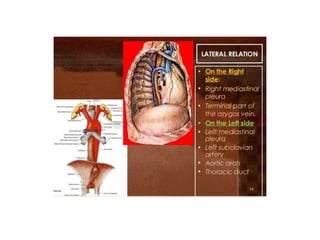
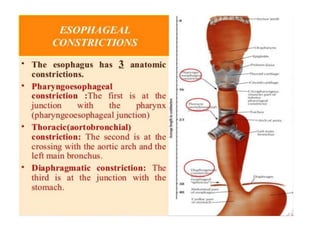
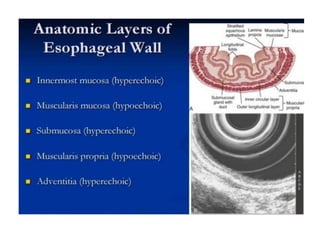
Anatomy of Esophagus
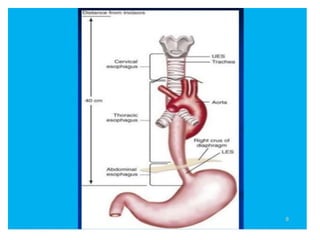
• Is a tubular structure of 25-33cm long.
• Begins at the level of C6 as a continuation of the
pharynx.
• At T10 it pierces the diaphragm to join the stomach.
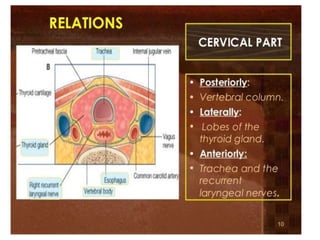
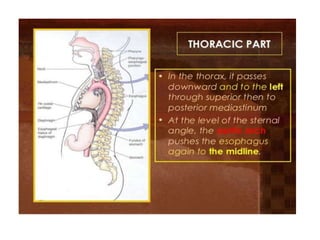
• Situated at the center, but inclines to left side at it
descends through the neck.
• Anatomically divided into; cervical, thoracic and
abdominal.
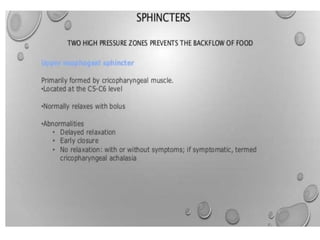
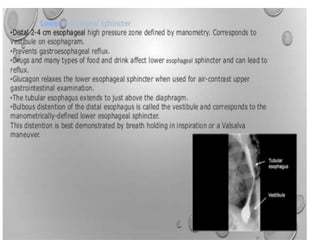
• Physiologically Divided into; Upper esophageal
sphincter, esophageal body and lower esophageal
sphincter.
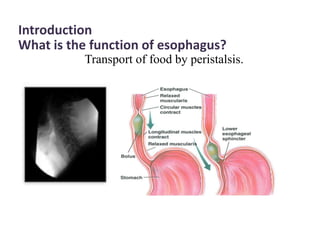
Introduction
What is the function of esophagus?
Transport of food by peristalsis.
Introduction
• BS; Special radiologic contrast examination that involves the oral
cavity to the fundus of the stomach.
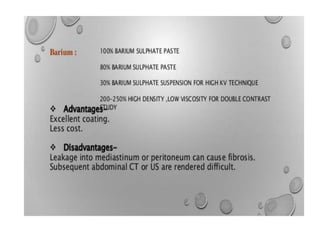
• Barium Sulpahate used as contrast.
• Digital fluoroscopy
• Spot films
• Double or single contrast studies
• Barium flows from the mouth to the stomach
• Erect or recumbent
Indications
• Dysphagia
• Odynophagia
• Heart burn
• Regurgitation
• Hiatus hernia
• Reflux Esophagitis
• Achalasia
• Strictures
• Diffuse esophageal
spasms
• Zenker’s Diverticulum
• Esophageal Atresia
• Tracheoesophageal
fistulae
• E. stenosis
• E. cyst
• Tracheobranchail
remnant
• Barretts’ E
Preparation
• No patient preparation is needed for an esophagram, unless it is to be followed
by an UGI.
• Greet the patient.
• Take History.
• (If the patient is female, then a menstrual history must be obtained . Irradiation
of an early pregnancy is one of the most hazardous situations in diagnostic
radiography.)
• Remove jewelry, check attire, snaps, pins, NG tubes, etc.
• Explain the exam in layman’s terms.
• Questions?
• Set technique before positioning.
• Control films.
Examination
Single Contrast Study
• Esophagrams begin under fluoroscopy, in the upright position.
• The patient holds a cup of barium, with a straw, In the right hand.
• Instructs the patient to drink, and films in the AP, RPO, and LPO positions.
• The patient is often put into an RAO before the table is lowered to horizontal. The
examination continues in the recumbent position.
• The patient is instructed to take three large bolus swallows.
• On the fourth, breathing is suspended and the exposure is made at the moment
the patient swallows.
• A shallow trendelenburg position will help keep the esophagus full.
Anterior Posterior Projection (Neck)
Erect
• Patient stands erect with back against the FT
• MSP perpendicular to the film
• Chin elevated slightly
• Images are recorded as the patients swallows a
mouthful of barium
• The horizontal central ray is centered in the
midline at the level of the T5
• DR acquisition or a split 14x17” lengthwise film
can be used
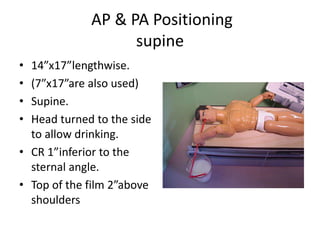
AP & PA Positioning
supine
• 14”x17”lengthwise.
• (7”x17”are also used)
• Supine.
• Head turned to the side
to allow drinking.
• CR 1”inferior to the
sternal angle.
• Top of the film 2”above
shoulders
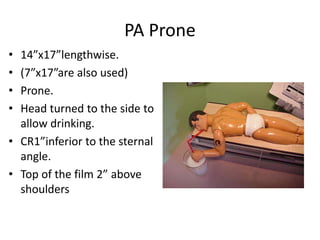
PA Prone
• 14”x17”lengthwise.
• (7”x17”are also used)
• Prone.
• Head turned to the side to
allow drinking.
• CR1”inferior to the sternal
angle.
• Top of the film 2” above
shoulders
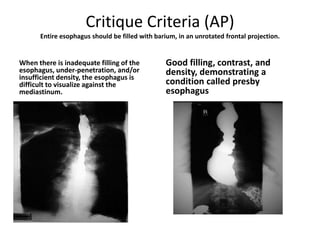
Critique Criteria (AP)
Entire esophagus should be filled with barium, in an unrotated frontal projection.
When there is inadequate filling of the
esophagus, under-penetration, and/or
insufficient density, the esophagus is
difficult to visualize against the
mediastinum.
Good filling, contrast, and
density, demonstrating a
condition called presby
esophagus
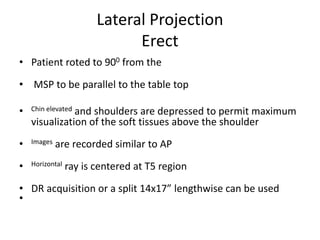
Lateral Projection
Erect
• Patient roted to 900 from the
• MSP to be parallel to the table top
• Chin elevated and shoulders are depressed to permit maximum
visualization of the soft tissues above the shoulder
• Images are recorded similar to AP
• Horizontal ray is centered at T5 region
• DR acquisition or a split 14x17” lengthwise can be used
•
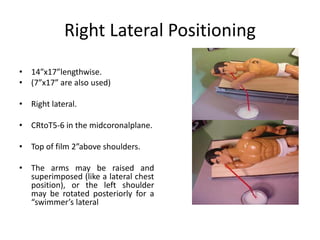
Right Lateral Positioning
• 14”x17”lengthwise.
• (7”x17” are also used)
• Right lateral.
• CRtoT5-6 in the midcoronalplane.
• Top of film 2”above shoulders.
• The arms may be raised and
superimposed (like a lateral chest
position), or the left shoulder
may be rotated posteriorly for a
“swimmer’s lateral
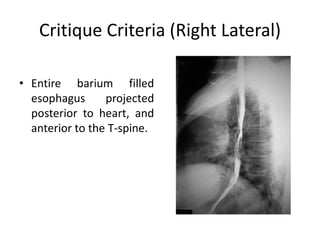
Critique Criteria (Right Lateral)
• Entire barium filled
esophagus projected
posterior to heart, and
anterior to the T-spine.
Left Posterior Oblique (LPO)
Erect
• From the AP is rotated to 20-300 on the left
side under the control of F control until the OS
is projected clear off the spine
• Cenral ray
• 35x35cm film can demonstrate the entire OS
Critique Criteria (LAO)
• The LAO may provide
valuable diagnostic
information, but:
Contrasts the esophagus
against the hilar area of the
right lung.
Foreshortens the abdominal
esophagus at the
gasteroesophageal junction
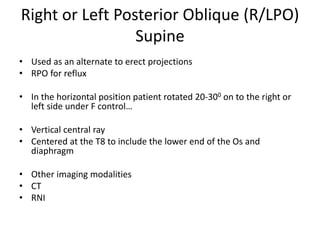
Right or Left Posterior Oblique (R/LPO)
Supine
• Used as an alternate to erect projections
• RPO for reflux
• In the horizontal position patient rotated 20-300 on to the right or
left side under F control…
• Vertical central ray
• Centered at the T8 to include the lower end of the Os and
diaphragm
• Other imaging modalities
• CT
• RNI
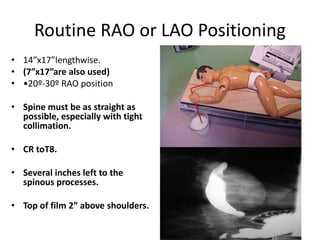
Routine RAO or LAO Positioning
• 14”x17”lengthwise.
• (7”x17”are also used)
• •20º-30º RAO position
• Spine must be as straight as
possible, especially with tight
collimation.
• CR toT8.
• Several inches left to the
spinous processes.
• Top of film 2” above shoulders.
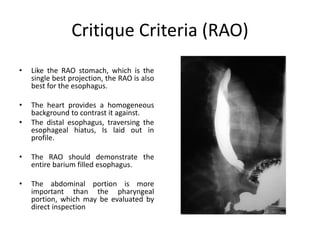
Critique Criteria (RAO)
• Like the RAO stomach, which is the
single best projection, the RAO is also
best for the esophagus.
• The heart provides a homogeneous
background to contrast it against.
• The distal esophagus, traversing the
esophageal hiatus, Is laid out in
profile.
• The RAO should demonstrate the
entire barium filled esophagus.
• The abdominal portion is more
important than the pharyngeal
portion, which may be evaluated by
direct inspection
Examination
Double Contrast (DC)
• Similar to SC except patient is given an
effervescent agent prior to the administration
of the barium
• IV hypotonic agent may also be given
• Patient is then instructed to drink several
mouthfuls of barium rapidly and is examined
using a similar protocol to that of SC

Barium studies aminu abubakar a

  • 1.
    Barium Studies Barium Swallow(BS) Rad. Aminu Abubakar Abubakar Radiography Department Bayero University Kano October, 2020
  • 2.
    • By theend of this lecture student will be able to; • Describe the anatomy and physiology of Esophagus • Describe the methodology of BS. • List the indications and contraindications of BS. • Describe patient care prior, during and after the procedure • Describe the imaging procedure (Single or double contrast). • Describe the routine and alternative positioning. • Film critique; positioning, image quality, radiographic anatomy and pathology • Describe other alternative imaging modalities. Learning Objectives
  • 4.
    Anatomy of Esophagus •Is a tubular structure of 25-33cm long. • Begins at the level of C6 as a continuation of the pharynx. • At T10 it pierces the diaphragm to join the stomach. • Situated at the center, but inclines to left side at it descends through the neck. • Anatomically divided into; cervical, thoracic and abdominal. • Physiologically Divided into; Upper esophageal sphincter, esophageal body and lower esophageal sphincter.
  • 15.
    Introduction What is thefunction of esophagus? Transport of food by peristalsis.
  • 20.
    Introduction • BS; Specialradiologic contrast examination that involves the oral cavity to the fundus of the stomach. • Barium Sulpahate used as contrast. • Digital fluoroscopy • Spot films • Double or single contrast studies • Barium flows from the mouth to the stomach • Erect or recumbent
  • 21.
    Indications • Dysphagia • Odynophagia •Heart burn • Regurgitation • Hiatus hernia • Reflux Esophagitis • Achalasia • Strictures • Diffuse esophageal spasms • Zenker’s Diverticulum • Esophageal Atresia • Tracheoesophageal fistulae • E. stenosis • E. cyst • Tracheobranchail remnant • Barretts’ E
  • 28.
    Preparation • No patientpreparation is needed for an esophagram, unless it is to be followed by an UGI. • Greet the patient. • Take History. • (If the patient is female, then a menstrual history must be obtained . Irradiation of an early pregnancy is one of the most hazardous situations in diagnostic radiography.) • Remove jewelry, check attire, snaps, pins, NG tubes, etc. • Explain the exam in layman’s terms. • Questions? • Set technique before positioning. • Control films.
  • 29.
    Examination Single Contrast Study •Esophagrams begin under fluoroscopy, in the upright position. • The patient holds a cup of barium, with a straw, In the right hand. • Instructs the patient to drink, and films in the AP, RPO, and LPO positions. • The patient is often put into an RAO before the table is lowered to horizontal. The examination continues in the recumbent position. • The patient is instructed to take three large bolus swallows. • On the fourth, breathing is suspended and the exposure is made at the moment the patient swallows. • A shallow trendelenburg position will help keep the esophagus full.
  • 30.
    Anterior Posterior Projection(Neck) Erect • Patient stands erect with back against the FT • MSP perpendicular to the film • Chin elevated slightly • Images are recorded as the patients swallows a mouthful of barium • The horizontal central ray is centered in the midline at the level of the T5 • DR acquisition or a split 14x17” lengthwise film can be used
  • 31.
    AP & PAPositioning supine • 14”x17”lengthwise. • (7”x17”are also used) • Supine. • Head turned to the side to allow drinking. • CR 1”inferior to the sternal angle. • Top of the film 2”above shoulders
  • 32.
    PA Prone • 14”x17”lengthwise. •(7”x17”are also used) • Prone. • Head turned to the side to allow drinking. • CR1”inferior to the sternal angle. • Top of the film 2” above shoulders
  • 33.
    Critique Criteria (AP) Entireesophagus should be filled with barium, in an unrotated frontal projection. When there is inadequate filling of the esophagus, under-penetration, and/or insufficient density, the esophagus is difficult to visualize against the mediastinum. Good filling, contrast, and density, demonstrating a condition called presby esophagus
  • 34.
    Lateral Projection Erect • Patientroted to 900 from the • MSP to be parallel to the table top • Chin elevated and shoulders are depressed to permit maximum visualization of the soft tissues above the shoulder • Images are recorded similar to AP • Horizontal ray is centered at T5 region • DR acquisition or a split 14x17” lengthwise can be used •
  • 35.
    Right Lateral Positioning •14”x17”lengthwise. • (7”x17” are also used) • Right lateral. • CRtoT5-6 in the midcoronalplane. • Top of film 2”above shoulders. • The arms may be raised and superimposed (like a lateral chest position), or the left shoulder may be rotated posteriorly for a “swimmer’s lateral
  • 36.
    Critique Criteria (RightLateral) • Entire barium filled esophagus projected posterior to heart, and anterior to the T-spine.
  • 37.
    Left Posterior Oblique(LPO) Erect • From the AP is rotated to 20-300 on the left side under the control of F control until the OS is projected clear off the spine • Cenral ray • 35x35cm film can demonstrate the entire OS
  • 38.
    Critique Criteria (LAO) •The LAO may provide valuable diagnostic information, but: Contrasts the esophagus against the hilar area of the right lung. Foreshortens the abdominal esophagus at the gasteroesophageal junction
  • 39.
    Right or LeftPosterior Oblique (R/LPO) Supine • Used as an alternate to erect projections • RPO for reflux • In the horizontal position patient rotated 20-300 on to the right or left side under F control… • Vertical central ray • Centered at the T8 to include the lower end of the Os and diaphragm • Other imaging modalities • CT • RNI
  • 40.
    Routine RAO orLAO Positioning • 14”x17”lengthwise. • (7”x17”are also used) • •20º-30º RAO position • Spine must be as straight as possible, especially with tight collimation. • CR toT8. • Several inches left to the spinous processes. • Top of film 2” above shoulders.
  • 41.
    Critique Criteria (RAO) •Like the RAO stomach, which is the single best projection, the RAO is also best for the esophagus. • The heart provides a homogeneous background to contrast it against. • The distal esophagus, traversing the esophageal hiatus, Is laid out in profile. • The RAO should demonstrate the entire barium filled esophagus. • The abdominal portion is more important than the pharyngeal portion, which may be evaluated by direct inspection
  • 42.
    Examination Double Contrast (DC) •Similar to SC except patient is given an effervescent agent prior to the administration of the barium • IV hypotonic agent may also be given • Patient is then instructed to drink several mouthfuls of barium rapidly and is examined using a similar protocol to that of SC

Editor's Notes

  • #5 Upper=Anatomical :Cricopharyngeal spinter formed by inferior pharyngeal constrictor. Lower=Physiological: Gastroesophageal , cardiac s, cardioesophageal s…gastroesophageal reflux…damage to the esophageal muscle
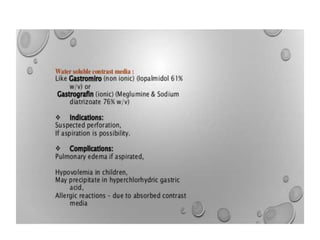
  • #23 Water soluble non-ionic contrast
  • #43 Effervescent