


‫بسم‬‫بسم‬‫ا‬‫ا‬‫الرحمن‬‫الرحمن‬
‫الرحيم‬‫الرحيم‬
InterpretatIo
n of urIne
cytology
nashwa emara m.D.,phD
ass. prof. pathology
functIon
• Majority of UT malignancies
are urothelial CA.
• The main function of urine
cytology is diagnosis of UC.
InDIcatIons
Diagnosis of symptomatic patientsDiagnosis of symptomatic patients
(hematuria).(hematuria).
Screen high risk patients (industrialScreen high risk patients (industrial
chemicals, metals, etc.)chemicals, metals, etc.)
Follow-up patients with UT neoplasia.Follow-up patients with UT neoplasia.
Complementary to cystoscopy and biopsy:Complementary to cystoscopy and biopsy:
detect small and hidden lesions (diverticuli,detect small and hidden lesions (diverticuli,
ureters, renal pelvis)..ureters, renal pelvis)..
Urine cytology is the most reliable methodUrine cytology is the most reliable method
for detecting urothelial CIS (>biopsies).for detecting urothelial CIS (>biopsies).
types of specImens
Voided urineVoided urine (avoid 1st morning(avoid 1st morning
specimens)specimens)
Catheterized urineCatheterized urine (in Females)(in Females)
Washings/BrushingsWashings/Brushings
Superior to voided urine butSuperior to voided urine but
localized, may not sample upperlocalized, may not sample upper
urinary tract and urethraurinary tract and urethra
Ileal conduit urineIleal conduit urine
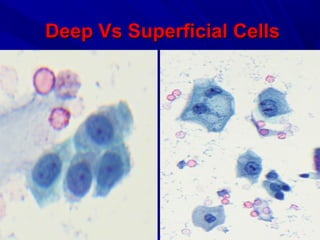
Deep Vs Superficial CellsDeep Vs Superficial Cells
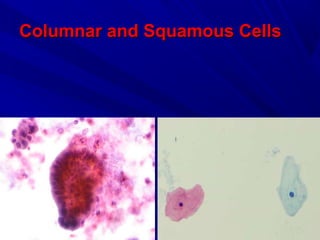
Columnar and Squamous CellsColumnar and Squamous Cells
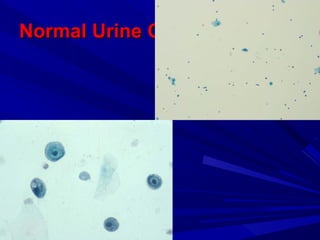
Normal Urine CytologyNormal Urine Cytology
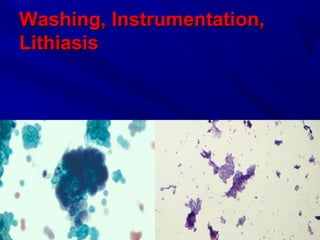
Washing, Instrumentation,Washing, Instrumentation,
LithiasisLithiasis
Diagnostic
accuracy
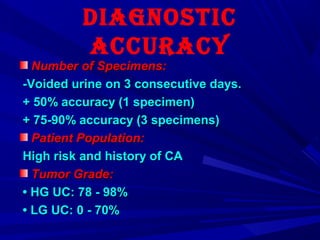
Number of Specimens:Number of Specimens:
-Voided urine on 3 consecutive days.-Voided urine on 3 consecutive days.
+ 50% accuracy (1 specimen)+ 50% accuracy (1 specimen)
+ 75-90% accuracy (3 specimens)+ 75-90% accuracy (3 specimens)
Patient Population:Patient Population:
High risk and history of CAHigh risk and history of CA
Tumor Grade:Tumor Grade:
•• HG UC: 78 - 98%HG UC: 78 - 98%
•• LG UC: 0 - 70%LG UC: 0 - 70%
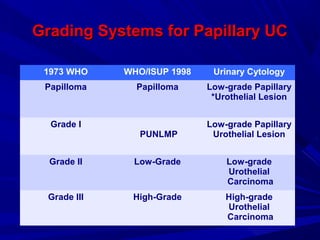
Grading Systems for Papillary UCGrading Systems for Papillary UC
1973 WHO 1998WHO/ISUP Urinary Cytology
Papilloma Papilloma Low-grade Papillary
Urothelial Lesion*
Grade I
PUNLMP
Low-grade Papillary
Urothelial Lesion
Grade II Low-Grade Low-grade
Urothelial
Carcinoma
Grade III High-Grade High-grade
Urothelial
Carcinoma
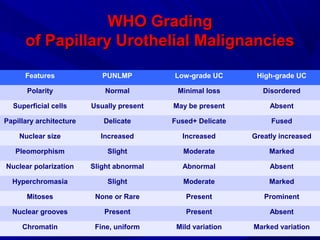
WHO GradingWHO Grading
of Papillary Urothelial Malignanciesof Papillary Urothelial Malignancies
Features PUNLMP Low-grade UC High-grade UC
Polarity Normal Minimal loss Disordered
Superficial cells Usually present May be present Absent
Papillary architecture Delicate Fused+ Delicate Fused
Nuclear size Increased Increased Greatly increased
Pleomorphism Slight Moderate Marked
Nuclear polarization Slight abnormal Abnormal Absent
Hyperchromasia Slight Moderate Marked
Mitoses None or Rare Present Prominent
Nuclear grooves Present Present Absent
Chromatin Fine, uniform Mild variation Marked variation
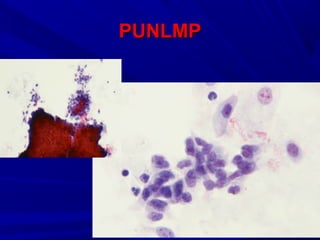
PUNLMPPUNLMP
Low-graDe
urotheLiaL
carcinomaCytologic diagnosis of LG PUC isCytologic diagnosis of LG PUC is
problematicproblematic
Minimal shedding of neoplastic cellsMinimal shedding of neoplastic cells
Subtle cytologic alterationsSubtle cytologic alterations
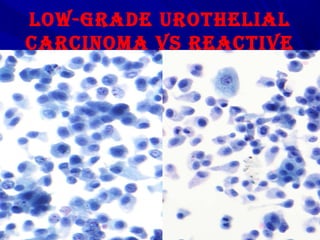
Difficult to distinguish from reactiveDifficult to distinguish from reactive
changes, i.e. stones, instrumentationchanges, i.e. stones, instrumentation
Cytologic overlap between PUNLMPCytologic overlap between PUNLMP
and LG UC, some casesand LG UC, some cases
indistinguishableindistinguishable
Low-graDe urotheLiaL
carcinoma vs reactive
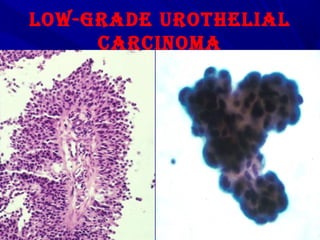
Low-graDe urotheLiaL
carcinoma
Diff. Diag. of LgUC
Reactive/reparative changesReactive/reparative changes
Instrumentation effectInstrumentation effect
LithiasisLithiasis
Upper urinary tract samplingUpper urinary tract sampling
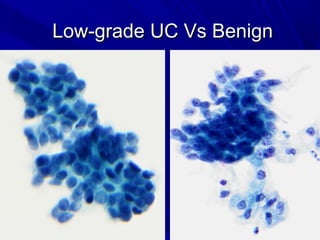
Low-grade UC Vs BenignLow-grade UC Vs Benign
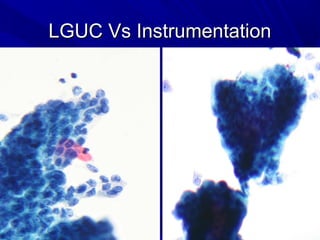
LGUC Vs InstrumentationLGUC Vs Instrumentation
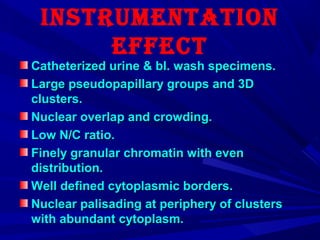
instrUmentation
effeCt
Catheterized urine & bl. wash specimens.Catheterized urine & bl. wash specimens.
Large pseudopapillary groups and 3DLarge pseudopapillary groups and 3D
clusters.clusters.
Nuclear overlap and crowding.Nuclear overlap and crowding.
Low N/C ratio.Low N/C ratio.
Finely granular chromatin with evenFinely granular chromatin with even
distribution.distribution.
Well defined cytoplasmic borders.Well defined cytoplasmic borders.
Nuclear palisading at periphery of clustersNuclear palisading at periphery of clusters
with abundant cytoplasm.with abundant cytoplasm.
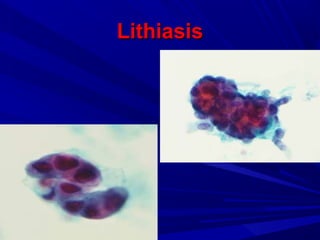
LithiasisLithiasis
CytoLogy of Upper Urinary
traCt speCimens
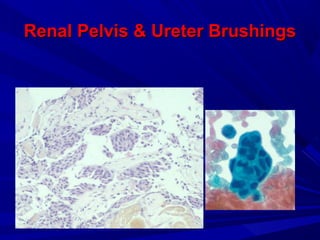
Direct sampling of upper UT is effective inDirect sampling of upper UT is effective in
detecting HG UC, but poor for low gradedetecting HG UC, but poor for low grade
lesionslesions
Normal upper UT epithelium shows moreNormal upper UT epithelium shows more
atypia than lower UT and occasionally moreatypia than lower UT and occasionally more
than LG UCthan LG UC
High N/C ratio, enlarged nuclei, nuclearHigh N/C ratio, enlarged nuclei, nuclear
membrane irregularitiesmembrane irregularities
Often present in papillary clustersOften present in papillary clusters
Almost impossible to distinguish low gradeAlmost impossible to distinguish low grade
UC from upper tract benign changesUC from upper tract benign changes
Renal Pelvis & Ureter BrushingsRenal Pelvis & Ureter Brushings
HigH-graDe
UrotHeLiaL
CarCinoma
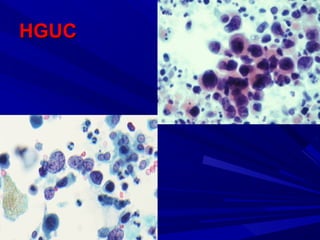
Often invasive, 70 mortality.Often invasive, 70 mortality.
Can not reliably separate CIS fromCan not reliably separate CIS from
invasive high-grade UC.invasive high-grade UC.
High diagnostic accuracy of cytology:High diagnostic accuracy of cytology:
- Sensitivity 80 %.- Sensitivity 80 %.
- Specificity > 95%.- Specificity > 95%.
HGUCHGUC
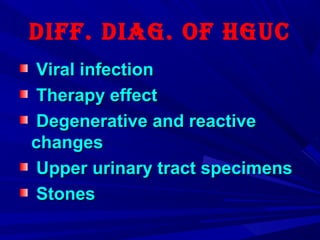
Diff. Diag. of HgUC
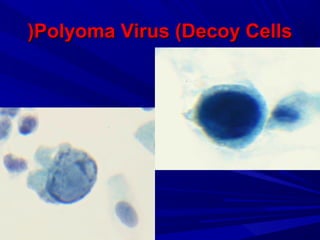
Viral infectionViral infection
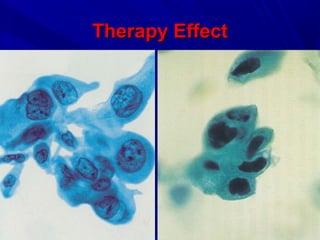
Therapy effectTherapy effect
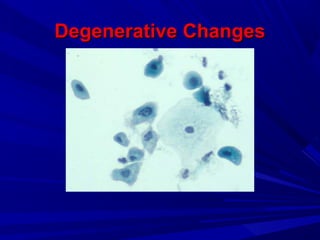
Degenerative and reactiveDegenerative and reactive
changeschanges
Upper urinary tract specimensUpper urinary tract specimens
StonesStones
Polyoma Virus (Decoy CellsPolyoma Virus (Decoy Cells((
Therapy EffectTherapy Effect
Degenerative ChangesDegenerative Changes
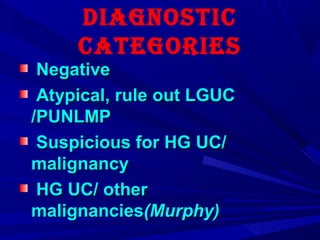
DiagnostiC
Categories
NegativeNegative
Atypical, rule out LGUCAtypical, rule out LGUC
/PUNLMP/PUNLMP
Suspicious for HG UC/Suspicious for HG UC/
malignancymalignancy
HG UC/ otherHG UC/ other
malignanciesmalignancies(Murphy)(Murphy)
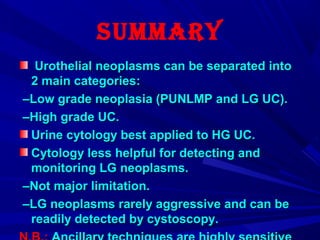
sUmmary
Urothelial neoplasms can be separated intoUrothelial neoplasms can be separated into
2 main categories:2 main categories:
––Low grade neoplasia (PUNLMP and LG UC(.Low grade neoplasia (PUNLMP and LG UC(.
––High grade UC.High grade UC.
Urine cytology best applied to HG UC.Urine cytology best applied to HG UC.
Cytology less helpful for detecting andCytology less helpful for detecting and
monitoring LG neoplasms.monitoring LG neoplasms.
––Not major limitation.Not major limitation.
––LG neoplasms rarely aggressive and can beLG neoplasms rarely aggressive and can be
readily detected by cystoscopy.readily detected by cystoscopy.
gooD LUCKgooD LUCK…..…..

Urine.cytology

  • 1.
  • 2.
    InterpretatIo n of urIne cytology nashwaemara m.D.,phD ass. prof. pathology
  • 3.
    functIon • Majority ofUT malignancies are urothelial CA. • The main function of urine cytology is diagnosis of UC.
  • 4.
    InDIcatIons Diagnosis of symptomaticpatientsDiagnosis of symptomatic patients (hematuria).(hematuria). Screen high risk patients (industrialScreen high risk patients (industrial chemicals, metals, etc.)chemicals, metals, etc.) Follow-up patients with UT neoplasia.Follow-up patients with UT neoplasia. Complementary to cystoscopy and biopsy:Complementary to cystoscopy and biopsy: detect small and hidden lesions (diverticuli,detect small and hidden lesions (diverticuli, ureters, renal pelvis)..ureters, renal pelvis).. Urine cytology is the most reliable methodUrine cytology is the most reliable method for detecting urothelial CIS (>biopsies).for detecting urothelial CIS (>biopsies).
  • 5.
    types of specImens VoidedurineVoided urine (avoid 1st morning(avoid 1st morning specimens)specimens) Catheterized urineCatheterized urine (in Females)(in Females) Washings/BrushingsWashings/Brushings Superior to voided urine butSuperior to voided urine but localized, may not sample upperlocalized, may not sample upper urinary tract and urethraurinary tract and urethra Ileal conduit urineIleal conduit urine
  • 6.
    Deep Vs SuperficialCellsDeep Vs Superficial Cells
  • 7.
    Columnar and SquamousCellsColumnar and Squamous Cells
  • 8.
  • 9.
  • 10.
    Diagnostic accuracy Number of Specimens:Numberof Specimens: -Voided urine on 3 consecutive days.-Voided urine on 3 consecutive days. + 50% accuracy (1 specimen)+ 50% accuracy (1 specimen) + 75-90% accuracy (3 specimens)+ 75-90% accuracy (3 specimens) Patient Population:Patient Population: High risk and history of CAHigh risk and history of CA Tumor Grade:Tumor Grade: •• HG UC: 78 - 98%HG UC: 78 - 98% •• LG UC: 0 - 70%LG UC: 0 - 70%
  • 11.
    Grading Systems forPapillary UCGrading Systems for Papillary UC 1973 WHO 1998WHO/ISUP Urinary Cytology Papilloma Papilloma Low-grade Papillary Urothelial Lesion* Grade I PUNLMP Low-grade Papillary Urothelial Lesion Grade II Low-Grade Low-grade Urothelial Carcinoma Grade III High-Grade High-grade Urothelial Carcinoma
  • 12.
    WHO GradingWHO Grading ofPapillary Urothelial Malignanciesof Papillary Urothelial Malignancies Features PUNLMP Low-grade UC High-grade UC Polarity Normal Minimal loss Disordered Superficial cells Usually present May be present Absent Papillary architecture Delicate Fused+ Delicate Fused Nuclear size Increased Increased Greatly increased Pleomorphism Slight Moderate Marked Nuclear polarization Slight abnormal Abnormal Absent Hyperchromasia Slight Moderate Marked Mitoses None or Rare Present Prominent Nuclear grooves Present Present Absent Chromatin Fine, uniform Mild variation Marked variation
  • 13.
  • 14.
    Low-graDe urotheLiaL carcinomaCytologic diagnosis ofLG PUC isCytologic diagnosis of LG PUC is problematicproblematic Minimal shedding of neoplastic cellsMinimal shedding of neoplastic cells Subtle cytologic alterationsSubtle cytologic alterations Difficult to distinguish from reactiveDifficult to distinguish from reactive changes, i.e. stones, instrumentationchanges, i.e. stones, instrumentation Cytologic overlap between PUNLMPCytologic overlap between PUNLMP and LG UC, some casesand LG UC, some cases indistinguishableindistinguishable
  • 15.
  • 16.
  • 17.
    Diff. Diag. ofLgUC Reactive/reparative changesReactive/reparative changes Instrumentation effectInstrumentation effect LithiasisLithiasis Upper urinary tract samplingUpper urinary tract sampling
  • 18.
    Low-grade UC VsBenignLow-grade UC Vs Benign
  • 19.
    LGUC Vs InstrumentationLGUCVs Instrumentation
  • 20.
    instrUmentation effeCt Catheterized urine &bl. wash specimens.Catheterized urine & bl. wash specimens. Large pseudopapillary groups and 3DLarge pseudopapillary groups and 3D clusters.clusters. Nuclear overlap and crowding.Nuclear overlap and crowding. Low N/C ratio.Low N/C ratio. Finely granular chromatin with evenFinely granular chromatin with even distribution.distribution. Well defined cytoplasmic borders.Well defined cytoplasmic borders. Nuclear palisading at periphery of clustersNuclear palisading at periphery of clusters with abundant cytoplasm.with abundant cytoplasm.
  • 21.
  • 22.
    CytoLogy of UpperUrinary traCt speCimens Direct sampling of upper UT is effective inDirect sampling of upper UT is effective in detecting HG UC, but poor for low gradedetecting HG UC, but poor for low grade lesionslesions Normal upper UT epithelium shows moreNormal upper UT epithelium shows more atypia than lower UT and occasionally moreatypia than lower UT and occasionally more than LG UCthan LG UC High N/C ratio, enlarged nuclei, nuclearHigh N/C ratio, enlarged nuclei, nuclear membrane irregularitiesmembrane irregularities Often present in papillary clustersOften present in papillary clusters Almost impossible to distinguish low gradeAlmost impossible to distinguish low grade UC from upper tract benign changesUC from upper tract benign changes
  • 23.
    Renal Pelvis &Ureter BrushingsRenal Pelvis & Ureter Brushings
  • 24.
    HigH-graDe UrotHeLiaL CarCinoma Often invasive, 70mortality.Often invasive, 70 mortality. Can not reliably separate CIS fromCan not reliably separate CIS from invasive high-grade UC.invasive high-grade UC. High diagnostic accuracy of cytology:High diagnostic accuracy of cytology: - Sensitivity 80 %.- Sensitivity 80 %. - Specificity > 95%.- Specificity > 95%.
  • 25.
  • 26.
    Diff. Diag. ofHgUC Viral infectionViral infection Therapy effectTherapy effect Degenerative and reactiveDegenerative and reactive changeschanges Upper urinary tract specimensUpper urinary tract specimens StonesStones
  • 27.
    Polyoma Virus (DecoyCellsPolyoma Virus (Decoy Cells((
  • 28.
  • 29.
  • 30.
    DiagnostiC Categories NegativeNegative Atypical, rule outLGUCAtypical, rule out LGUC /PUNLMP/PUNLMP Suspicious for HG UC/Suspicious for HG UC/ malignancymalignancy HG UC/ otherHG UC/ other malignanciesmalignancies(Murphy)(Murphy)
  • 31.
    sUmmary Urothelial neoplasms canbe separated intoUrothelial neoplasms can be separated into 2 main categories:2 main categories: ––Low grade neoplasia (PUNLMP and LG UC(.Low grade neoplasia (PUNLMP and LG UC(. ––High grade UC.High grade UC. Urine cytology best applied to HG UC.Urine cytology best applied to HG UC. Cytology less helpful for detecting andCytology less helpful for detecting and monitoring LG neoplasms.monitoring LG neoplasms. ––Not major limitation.Not major limitation. ––LG neoplasms rarely aggressive and can beLG neoplasms rarely aggressive and can be readily detected by cystoscopy.readily detected by cystoscopy.
  • 32.