
PHLEBOTOMY
MARIETA S. ASILO
51654
PHLEBOTOMY
 A procedure in which a needle is inserted in a vein to take blood,
usually used for laboratory testing
 Also known as venipuncture or blood draw
 Can also be done to remove extra red blood cells from the blood for
treatment of certain blood disorder
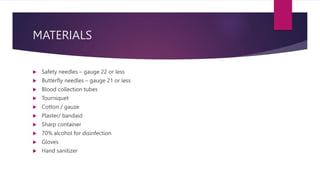
MATERIALS
 Safety needles – gauge 22 or less
 Butterfly needles – gauge 21 or less
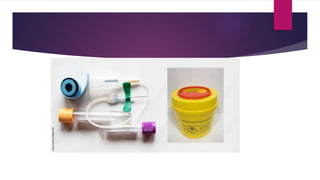
 Blood collection tubes
 Tourniquet
 Cotton / gauze
 Plaster/ bandaid
 Sharp container
 70% alcohol for disinfection
 Gloves
 Hand sanitizer
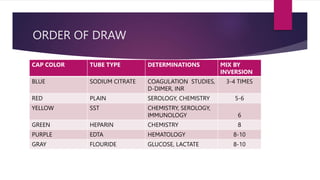
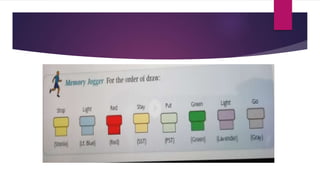
ORDER OF DRAW
CAP COLOR TUBE TYPE DETERMINATIONS MIX BY
INVERSION
BLUE SODIUM CITRATE COAGULATION STUDIES,
D-DIMER, INR
3-4 TIMES
RED PLAIN SEROLOGY, CHEMISTRY 5-6
YELLOW SST CHEMISTRY, SEROLOGY,
IMMUNOLOGY 6
GREEN HEPARIN CHEMISTRY 8
PURPLE EDTA HEMATOLOGY 8-10
GRAY FLOURIDE GLUCOSE, LACTATE 8-10
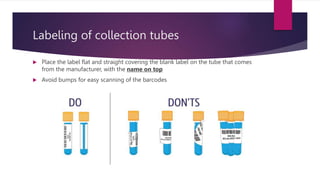
Labeling of collection tubes
 Place the label flat and straight covering the blank label on the tube that comes
from the manufacturer, with the name on top
 Avoid bumps for easy scanning of the barcodes
 Patient’s name
 Hospital ID number
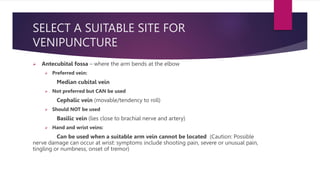
SELECT A SUITABLE SITE FOR
VENIPUNCTURE
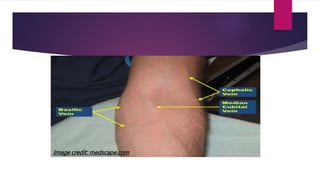
 Antecubital fossa – where the arm bends at the elbow
 Preferred vein:
Median cubital vein
 Not preferred but CAN be used
Cephalic vein (movable/tendency to roll)
 Should NOT be used
Basilic vein (lies close to brachial nerve and artery)
 Hand and wrist veins:
Can be used when a suitable arm vein cannot be located (Caution: Possible
nerve damage can occur at wrist: symptoms include shooting pain, severe or unusual pain,
tingling or numbness, onset of tremor)
Image credit: medscape.com
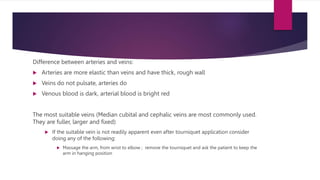
Difference between arteries and veins:
 Arteries are more elastic than veins and have thick, rough wall
 Veins do not pulsate, arteries do
 Venous blood is dark, arterial blood is bright red
The most suitable veins (Median cubital and cephalic veins are most commonly used.
They are fuller, larger and fixed)
 If the suitable vein is not readily apparent even after tourniquet application consider
doing any of the following:
 Massage the arm, from wrist to elbow ; remove the tourniquet and ask the patient to keep the
arm in hanging position
Procedure:
 Patient comfort.
Is the seating comfortable and has the patient been seated for at least 5
minutes to avoid being rushed or confused?
 Carry out hand hygiene before and after each patient procedure, before putting
on and after removing gloves.
 Identify the patient using two different identifiers, asking open ended questions
such as, "What is your name?" and "What is your date of birth?"
 Assess the patient's physical disposition (i.e. diet, exercise, stress, basal state/hours
of fasting).
 Check the requisition form for requested tests, patient information, and any
special requirements.
 Recognize complications associated with the phlebotomy procedure.
 Hematoma, Fainting (most common)
 Assess the need for sample recollection and/or rejection.
 Safely discard potentially infectious materials.
 Promptly send the specimens with the requisition to the laboratory
FACTORS TO CONSIDER WHEN
SELECTING THE VEIN
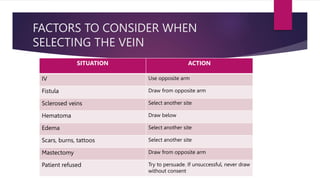
SITUATION ACTION
IV Use opposite arm
Fistula Draw from opposite arm
Sclerosed veins Select another site
Hematoma Draw below
Edema Select another site
Scars, burns, tattoos Select another site
Mastectomy Draw from opposite arm
Patient refused Try to persuade. If unsuccessful, never draw
without consent
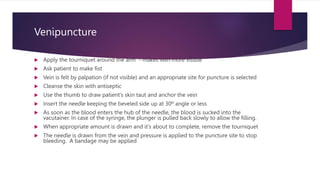
 Apply the tourniquet around the arm - makes vein more visible
 Ask patient to make fist
 Vein is felt by palpation (if not visible) and an appropriate site for puncture is selected
 Cleanse the skin with antiseptic
 Use the thumb to draw patient’s skin taut and anchor the vein
 Insert the needle keeping the beveled side up at 30º angle or less
 As soon as the blood enters the hub of the needle, the blood is sucked into the
vacutainer. In case of the syringe, the plunger is pulled back slowly to allow the filling.
 When appropriate amount is drawn and it’s about to complete, remove the tourniquet
 The needle is drawn from the vein and pressure is applied to the puncture site to stop
bleeding. A bandage may be applied
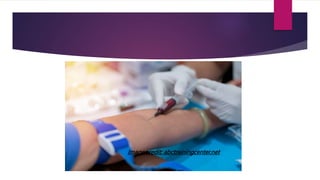
Venipuncture
Image credit: abctrainingcenter.net
PHLEBOTOMY SOURCES OF ERROR
ERROR POSSIBLE EFFECT
Misidentification of patient Treatment error
Possibility of transfusion fatality
Drawing at incorrect time Treatment error if samples for certain tests aren’t drawn at
appropriate time (e.g., analytes are affected by recent eating
/drinking
Improper disinfection Infection at site of puncture
Contamination of blood cultures and blood components
Isopropyl alcohol wipes can contaminate samples for blood
alcohol
Drawing from edematous site Dilution of sample with tissue fluid
Fist pumping during
venipuncture
K+ , Lactic acid, Ca++ , Phosphorus, pH
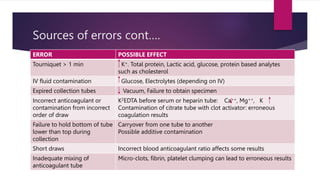
Sources of errors cont….
ERROR POSSIBLE EFFECT
Tourniquet > 1 min K+. Total protein, Lactic acid, glucose, protein based analytes
such as cholesterol
IV fluid contamination Glucose, Electrolytes (depending on IV)
Expired collection tubes Vacuum, Failure to obtain specimen
Incorrect anticoagulant or
contamination from incorrect
order of draw
K2EDTA before serum or heparin tube: Ca++, Mg++, K
Contamination of citrate tube with clot activator: erroneous
coagulation results
Failure to hold bottom of tube
lower than top during
collection
Carryover from one tube to another
Possible additive contamination
Short draws Incorrect blood anticoagulant ratio affects some results
Inadequate mixing of
anticoagulant tube
Micro-clots, fibrin, platelet clumping can lead to erroneous results
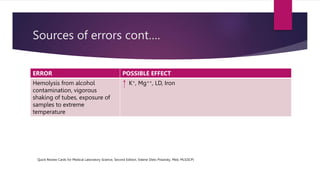
Sources of errors cont….
ERROR POSSIBLE EFFECT
Hemolysis from alcohol
contamination, vigorous
shaking of tubes, exposure of
samples to extreme
temperature
K+, Mg++, LD, Iron
Quick Review Cards for Medical Laboratory Science, Second Edition, Valerie Dietz Polansky, Med, MLS(SCP)
REFERENCES:
http://lug.hfhs.org
WHO Guidelines on drawing of blood: best practices on phlebotomy
https://webpath.med.utah.edu/TUTORIAL/PHLEB/PHLEB.html
Quick Review Cards for Medical Laboratory Science - Second edition
Polansky, Valerie Dietz
https://www.labce.com
Let’s do it right this time!
Thank you!

The best PHLEBOTOMY powerpoint presentation

  • 1.
  • 2.
    PHLEBOTOMY  A procedurein which a needle is inserted in a vein to take blood, usually used for laboratory testing  Also known as venipuncture or blood draw  Can also be done to remove extra red blood cells from the blood for treatment of certain blood disorder
  • 3.
    MATERIALS  Safety needles– gauge 22 or less  Butterfly needles – gauge 21 or less  Blood collection tubes  Tourniquet  Cotton / gauze  Plaster/ bandaid  Sharp container  70% alcohol for disinfection  Gloves  Hand sanitizer
  • 5.
    ORDER OF DRAW CAPCOLOR TUBE TYPE DETERMINATIONS MIX BY INVERSION BLUE SODIUM CITRATE COAGULATION STUDIES, D-DIMER, INR 3-4 TIMES RED PLAIN SEROLOGY, CHEMISTRY 5-6 YELLOW SST CHEMISTRY, SEROLOGY, IMMUNOLOGY 6 GREEN HEPARIN CHEMISTRY 8 PURPLE EDTA HEMATOLOGY 8-10 GRAY FLOURIDE GLUCOSE, LACTATE 8-10
  • 7.
    Labeling of collectiontubes  Place the label flat and straight covering the blank label on the tube that comes from the manufacturer, with the name on top  Avoid bumps for easy scanning of the barcodes  Patient’s name  Hospital ID number
  • 8.
    SELECT A SUITABLESITE FOR VENIPUNCTURE  Antecubital fossa – where the arm bends at the elbow  Preferred vein: Median cubital vein  Not preferred but CAN be used Cephalic vein (movable/tendency to roll)  Should NOT be used Basilic vein (lies close to brachial nerve and artery)  Hand and wrist veins: Can be used when a suitable arm vein cannot be located (Caution: Possible nerve damage can occur at wrist: symptoms include shooting pain, severe or unusual pain, tingling or numbness, onset of tremor)
  • 9.
  • 10.
    Difference between arteriesand veins:  Arteries are more elastic than veins and have thick, rough wall  Veins do not pulsate, arteries do  Venous blood is dark, arterial blood is bright red The most suitable veins (Median cubital and cephalic veins are most commonly used. They are fuller, larger and fixed)  If the suitable vein is not readily apparent even after tourniquet application consider doing any of the following:  Massage the arm, from wrist to elbow ; remove the tourniquet and ask the patient to keep the arm in hanging position
  • 11.
    Procedure:  Patient comfort. Isthe seating comfortable and has the patient been seated for at least 5 minutes to avoid being rushed or confused?  Carry out hand hygiene before and after each patient procedure, before putting on and after removing gloves.  Identify the patient using two different identifiers, asking open ended questions such as, "What is your name?" and "What is your date of birth?"  Assess the patient's physical disposition (i.e. diet, exercise, stress, basal state/hours of fasting).  Check the requisition form for requested tests, patient information, and any special requirements.
  • 12.
     Recognize complicationsassociated with the phlebotomy procedure.  Hematoma, Fainting (most common)  Assess the need for sample recollection and/or rejection.  Safely discard potentially infectious materials.  Promptly send the specimens with the requisition to the laboratory
  • 13.
    FACTORS TO CONSIDERWHEN SELECTING THE VEIN SITUATION ACTION IV Use opposite arm Fistula Draw from opposite arm Sclerosed veins Select another site Hematoma Draw below Edema Select another site Scars, burns, tattoos Select another site Mastectomy Draw from opposite arm Patient refused Try to persuade. If unsuccessful, never draw without consent
  • 14.
     Apply thetourniquet around the arm - makes vein more visible  Ask patient to make fist  Vein is felt by palpation (if not visible) and an appropriate site for puncture is selected  Cleanse the skin with antiseptic  Use the thumb to draw patient’s skin taut and anchor the vein  Insert the needle keeping the beveled side up at 30º angle or less  As soon as the blood enters the hub of the needle, the blood is sucked into the vacutainer. In case of the syringe, the plunger is pulled back slowly to allow the filling.  When appropriate amount is drawn and it’s about to complete, remove the tourniquet  The needle is drawn from the vein and pressure is applied to the puncture site to stop bleeding. A bandage may be applied Venipuncture
  • 15.
  • 16.
    PHLEBOTOMY SOURCES OFERROR ERROR POSSIBLE EFFECT Misidentification of patient Treatment error Possibility of transfusion fatality Drawing at incorrect time Treatment error if samples for certain tests aren’t drawn at appropriate time (e.g., analytes are affected by recent eating /drinking Improper disinfection Infection at site of puncture Contamination of blood cultures and blood components Isopropyl alcohol wipes can contaminate samples for blood alcohol Drawing from edematous site Dilution of sample with tissue fluid Fist pumping during venipuncture K+ , Lactic acid, Ca++ , Phosphorus, pH
  • 17.
    Sources of errorscont…. ERROR POSSIBLE EFFECT Tourniquet > 1 min K+. Total protein, Lactic acid, glucose, protein based analytes such as cholesterol IV fluid contamination Glucose, Electrolytes (depending on IV) Expired collection tubes Vacuum, Failure to obtain specimen Incorrect anticoagulant or contamination from incorrect order of draw K2EDTA before serum or heparin tube: Ca++, Mg++, K Contamination of citrate tube with clot activator: erroneous coagulation results Failure to hold bottom of tube lower than top during collection Carryover from one tube to another Possible additive contamination Short draws Incorrect blood anticoagulant ratio affects some results Inadequate mixing of anticoagulant tube Micro-clots, fibrin, platelet clumping can lead to erroneous results
  • 18.
    Sources of errorscont…. ERROR POSSIBLE EFFECT Hemolysis from alcohol contamination, vigorous shaking of tubes, exposure of samples to extreme temperature K+, Mg++, LD, Iron Quick Review Cards for Medical Laboratory Science, Second Edition, Valerie Dietz Polansky, Med, MLS(SCP)
  • 19.
    REFERENCES: http://lug.hfhs.org WHO Guidelines ondrawing of blood: best practices on phlebotomy https://webpath.med.utah.edu/TUTORIAL/PHLEB/PHLEB.html Quick Review Cards for Medical Laboratory Science - Second edition Polansky, Valerie Dietz https://www.labce.com
  • 20.
    Let’s do itright this time! Thank you!