INTRODUCTION
8086Microprocessor is an enhanced version of 8085Microprocessor that
was designed by Intel in 1976.
It is a 16-bit Microprocessor having 20 address lines and16 data lines
that provides up to 1MB storage.
It consists of powerful instruction set, which provides operations like
multiplication and division easily.
3.
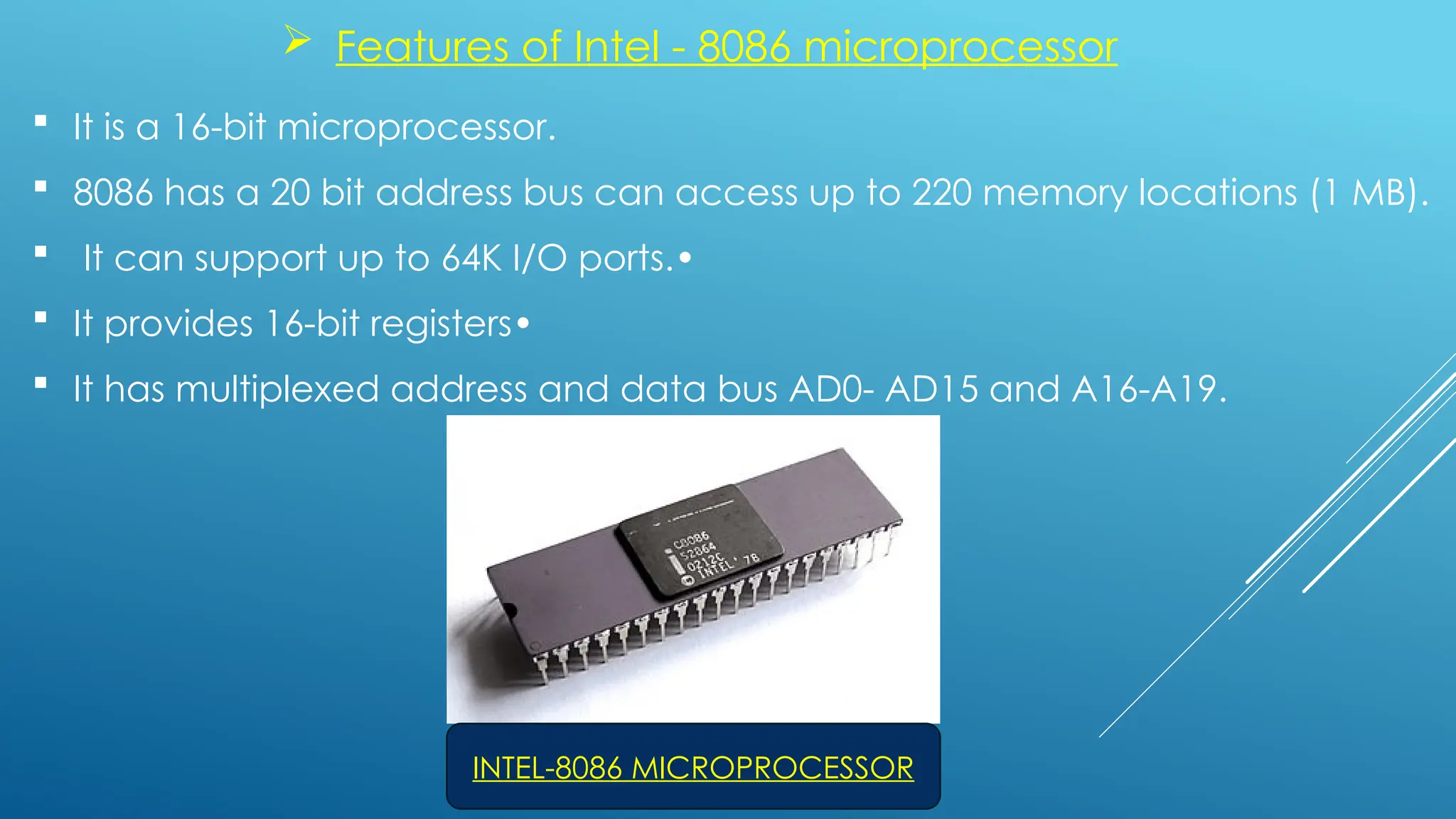
Features ofIntel - 8086 microprocessor
It is a 16-bit microprocessor.
8086 has a 20 bit address bus can access up to 220 memory locations (1 MB).
It can support up to 64K I/O ports.•
It provides 16-bit registers•
It has multiplexed address and data bus AD0- AD15 and A16-A19.
INTEL-8086 MICROPROCESSOR
4.
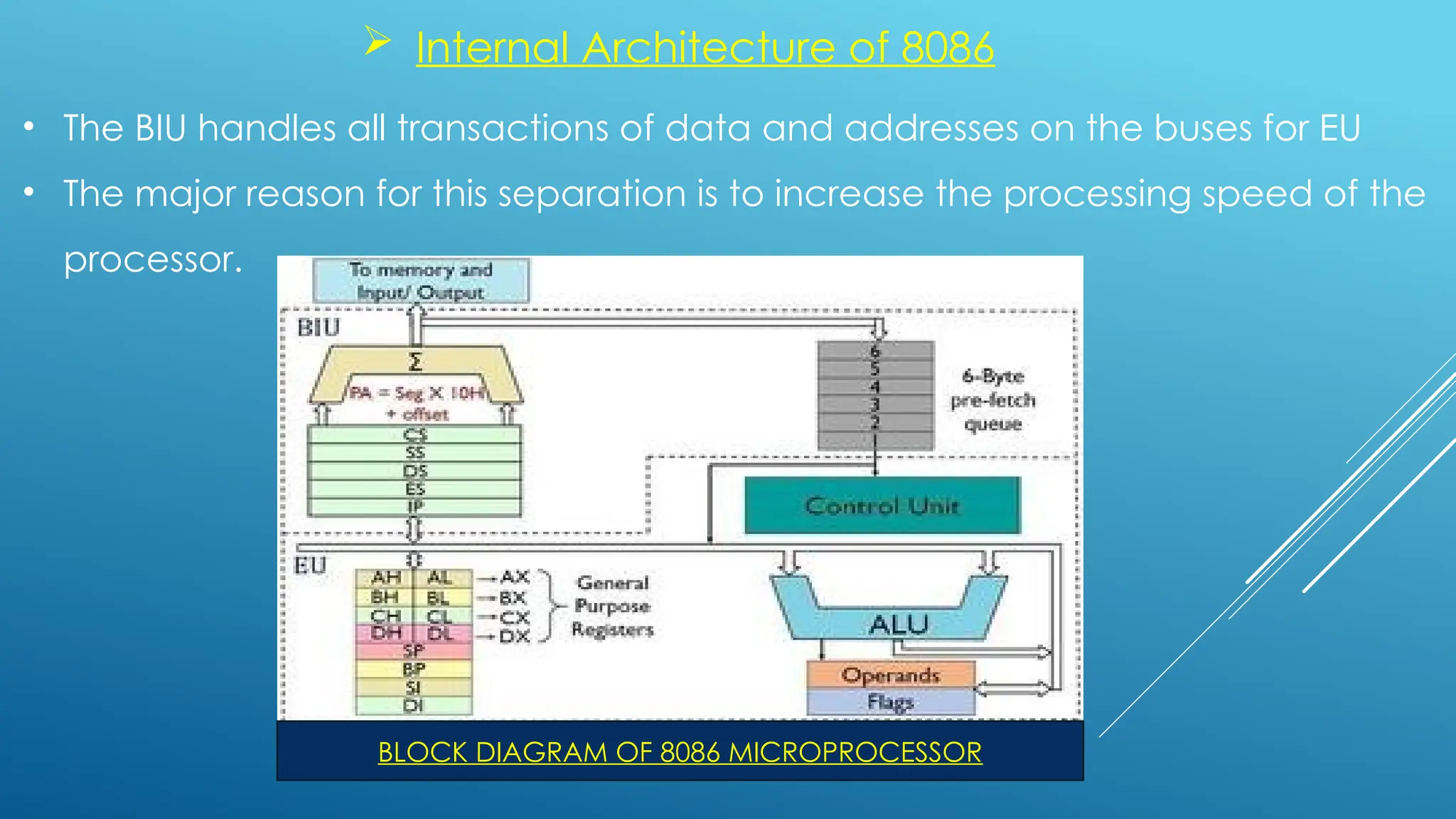
MAIN FUNCTIONALUNITS
Bus Interface Unit (BIU):
• Handles instruction fetching, reading/writing memory, and computes
the 20-bitphysical address.
• Stores pre-fetched instructions in the instruction queue (6 bytes).
• Interfaces with memory and I/O devices.
Execution Unit (EU):
• Decodes and executes instructions.
• Contains General Purpose Registers (AX, BX, CX, DX).
• Uses Arithmetic Logic Unit (ALU) for computations.
• Controls Flags to indicate results of operations
5.
Internal Architectureof 8086
• The BIU handles all transactions of data and addresses on the buses for EU
• The major reason for this separation is to increase the processing speed of the
processor.
BLOCK DIAGRAM OF 8086 MICROPROCESSOR
6.
Applications andLegacy
Powered early personal computers like the IBM PC, establishing a
dominant platform.
Laid the foundation for subsequent Intel x86 architectures (80286,
80386, etc.).
Influenced the design of many modern microprocessors.
Continues to be used in embedded systems and educational
contexts.
Conclusion
The 8086 was a pivotal microprocessor that shaped the course of
computing history, paving the way for the powerful processors we use
today.



![Mpmc_8086[1][1].pptx gdsagagdccdf](https://cdn.slidesharecdn.com/ss_thumbnails/mpmc808611-251207163857-69fadc07-thumbnail.jpg?width=640&height=640&fit=bounds)


