Microprocessor Assembly
Programming (CSE0613209)
Shamima Nasrin
Sr. Lecturer, UU
2
Microprocessor
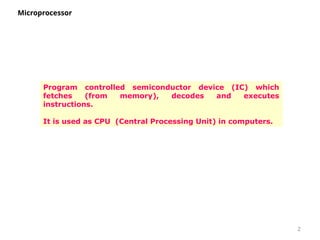
Program controlled semiconductor device (IC) which
fetches (from memory), decodes and executes
instructions.
It is used as CPU (Central Processing Unit) in computers.
3
Microprocessor
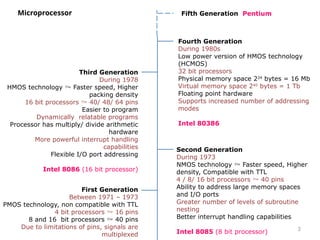
First Generation
Between 1971 – 1973
PMOS technology, non compatible with TTL
4 bit processors  16 pins
8 and 16 bit processors  40 pins
Due to limitations of pins, signals are
multiplexed
Second Generation
During 1973
NMOS technology  Faster speed, Higher
density, Compatible with TTL
4 / 8/ 16 bit processors  40 pins
Ability to address large memory spaces
and I/O ports
Greater number of levels of subroutine
nesting
Better interrupt handling capabilities
Intel 8085 (8 bit processor)
Third Generation
During 1978
HMOS technology  Faster speed, Higher
packing density
16 bit processors  40/ 48/ 64 pins
Easier to program
Dynamically relatable programs
Processor has multiply/ divide arithmetic
hardware
More powerful interrupt handling
capabilities
Flexible I/O port addressing
Intel 8086 (16 bit processor)
Fourth Generation
During 1980s
Low power version of HMOS technology
(HCMOS)
32 bit processors
Physical memory space 224
bytes = 16 Mb
Virtual memory space 240
bytes = 1 Tb
Floating point hardware
Supports increased number of addressing
modes
Intel 80386
Fifth Generation Pentium
4
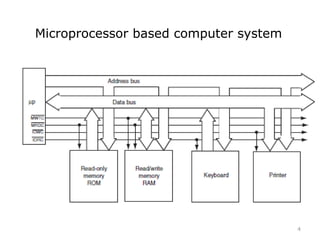
Microprocessor based computer system
5
Different kind of Buses
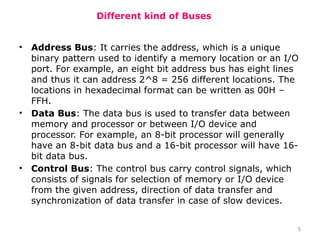
• Address Bus: It carries the address, which is a unique
binary pattern used to identify a memory location or an I/O
port. For example, an eight bit address bus has eight lines
and thus it can address 2^8 = 256 different locations. The
locations in hexadecimal format can be written as 00H –
FFH.
• Data Bus: The data bus is used to transfer data between
memory and processor or between I/O device and
processor. For example, an 8-bit processor will generally
have an 8-bit data bus and a 16-bit processor will have 16-
bit data bus.
• Control Bus: The control bus carry control signals, which
consists of signals for selection of memory or I/O device
from the given address, direction of data transfer and
synchronization of data transfer in case of slow devices.
6
Types of Peripheral Devices
Computer Peripheral
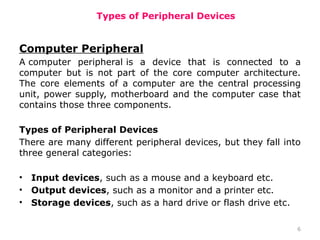
A computer peripheral is a device that is connected to a
computer but is not part of the core computer architecture.
The core elements of a computer are the central processing
unit, power supply, motherboard and the computer case that
contains those three components.
Types of Peripheral Devices
There are many different peripheral devices, but they fall into
three general categories:
• Input devices, such as a mouse and a keyboard etc.
• Output devices, such as a monitor and a printer etc.
• Storage devices, such as a hard drive or flash drive etc.
7
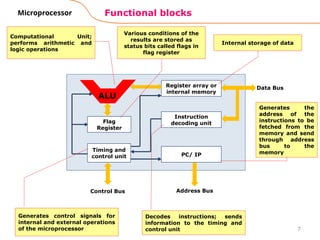
Functional blocks
Microprocessor
Flag
Register
Timing and
control unit
Register array or
internal memory
Instruction
decoding unit
PC/ IP
ALU
Control Bus Address Bus
Data Bus
Computational Unit;
performs arithmetic and
logic operations
Various conditions of the
results are stored as
status bits called flags in
flag register
Internal storage of data
Generates the
address of the
instructions to be
fetched from the
memory and send
through address
bus to the
memory
Decodes instructions; sends
information to the timing and
control unit
Generates control signals for
internal and external operations
of the microprocessor
8085 Microprocessor
9
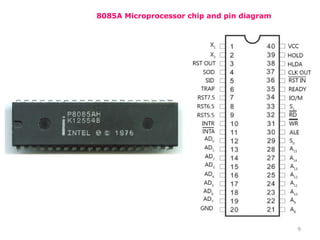
8085A Microprocessor chip and pin diagram
10
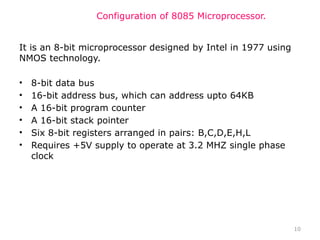
Configuration of 8085 Microprocessor.
It is an 8-bit microprocessor designed by Intel in 1977 using
NMOS technology.
• 8-bit data bus
• 16-bit address bus, which can address upto 64KB
• A 16-bit program counter
• A 16-bit stack pointer
• Six 8-bit registers arranged in pairs: B,C,D,E,H,L
• Requires +5V supply to operate at 3.2 MHZ single phase
clock
8086 Microprocessor
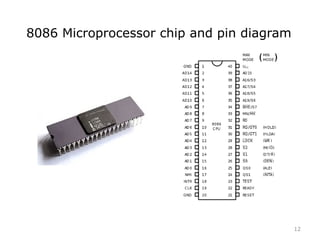
12
8086 Microprocessor chip and pin diagram
13
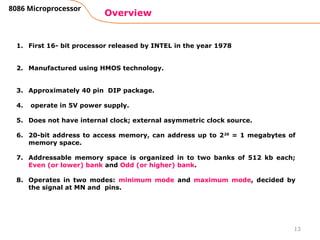
Overview
8086 Microprocessor
1. First 16- bit processor released by INTEL in the year 1978
2. Manufactured using HMOS technology.
3. Approximately 40 pin DIP package.
4. operate in 5V power supply.
5. Does not have internal clock; external asymmetric clock source.
6. 20-bit address to access memory, can address up to 220
= 1 megabytes of
memory space.
7. Addressable memory space is organized in to two banks of 512 kb each;
Even (or lower) bank and Odd (or higher) bank.
8. Operates in two modes: minimum mode and maximum mode, decided by
the signal at MN and pins.
END

Microprocessor introduction 8085 &8086 .pptx

  • 1.
  • 2.
    2 Microprocessor Program controlled semiconductordevice (IC) which fetches (from memory), decodes and executes instructions. It is used as CPU (Central Processing Unit) in computers.
  • 3.
    3 Microprocessor First Generation Between 1971– 1973 PMOS technology, non compatible with TTL 4 bit processors  16 pins 8 and 16 bit processors  40 pins Due to limitations of pins, signals are multiplexed Second Generation During 1973 NMOS technology  Faster speed, Higher density, Compatible with TTL 4 / 8/ 16 bit processors  40 pins Ability to address large memory spaces and I/O ports Greater number of levels of subroutine nesting Better interrupt handling capabilities Intel 8085 (8 bit processor) Third Generation During 1978 HMOS technology  Faster speed, Higher packing density 16 bit processors  40/ 48/ 64 pins Easier to program Dynamically relatable programs Processor has multiply/ divide arithmetic hardware More powerful interrupt handling capabilities Flexible I/O port addressing Intel 8086 (16 bit processor) Fourth Generation During 1980s Low power version of HMOS technology (HCMOS) 32 bit processors Physical memory space 224 bytes = 16 Mb Virtual memory space 240 bytes = 1 Tb Floating point hardware Supports increased number of addressing modes Intel 80386 Fifth Generation Pentium
  • 4.
  • 5.
    5 Different kind ofBuses • Address Bus: It carries the address, which is a unique binary pattern used to identify a memory location or an I/O port. For example, an eight bit address bus has eight lines and thus it can address 2^8 = 256 different locations. The locations in hexadecimal format can be written as 00H – FFH. • Data Bus: The data bus is used to transfer data between memory and processor or between I/O device and processor. For example, an 8-bit processor will generally have an 8-bit data bus and a 16-bit processor will have 16- bit data bus. • Control Bus: The control bus carry control signals, which consists of signals for selection of memory or I/O device from the given address, direction of data transfer and synchronization of data transfer in case of slow devices.
  • 6.
    6 Types of PeripheralDevices Computer Peripheral A computer peripheral is a device that is connected to a computer but is not part of the core computer architecture. The core elements of a computer are the central processing unit, power supply, motherboard and the computer case that contains those three components. Types of Peripheral Devices There are many different peripheral devices, but they fall into three general categories: • Input devices, such as a mouse and a keyboard etc. • Output devices, such as a monitor and a printer etc. • Storage devices, such as a hard drive or flash drive etc.
  • 7.
    7 Functional blocks Microprocessor Flag Register Timing and controlunit Register array or internal memory Instruction decoding unit PC/ IP ALU Control Bus Address Bus Data Bus Computational Unit; performs arithmetic and logic operations Various conditions of the results are stored as status bits called flags in flag register Internal storage of data Generates the address of the instructions to be fetched from the memory and send through address bus to the memory Decodes instructions; sends information to the timing and control unit Generates control signals for internal and external operations of the microprocessor
  • 8.
  • 9.
  • 10.
    10 Configuration of 8085Microprocessor. It is an 8-bit microprocessor designed by Intel in 1977 using NMOS technology. • 8-bit data bus • 16-bit address bus, which can address upto 64KB • A 16-bit program counter • A 16-bit stack pointer • Six 8-bit registers arranged in pairs: B,C,D,E,H,L • Requires +5V supply to operate at 3.2 MHZ single phase clock
  • 11.
  • 12.
  • 13.
    13 Overview 8086 Microprocessor 1. First16- bit processor released by INTEL in the year 1978 2. Manufactured using HMOS technology. 3. Approximately 40 pin DIP package. 4. operate in 5V power supply. 5. Does not have internal clock; external asymmetric clock source. 6. 20-bit address to access memory, can address up to 220 = 1 megabytes of memory space. 7. Addressable memory space is organized in to two banks of 512 kb each; Even (or lower) bank and Odd (or higher) bank. 8. Operates in two modes: minimum mode and maximum mode, decided by the signal at MN and pins.
  • 14.

Editor's Notes

  • #13 DIP- Dual Inline Package