Microprocessor
8085
Unit 1
SY BTech. Sem I
Marks 4
1
Prof. S S Kirte BMIT, Solapur
Contents
•Introduction
•Pin Diagram
•Feature
•Architecture
2
Prof. S S Kirte BMIT, Solapur
What is 8085 Microprocessor?
• The 8085 microprocessor is the
most commonly used 8-bit
microprocessor architecture in early
computer systems and embedded
devices.
• The 8085 offers a range of
instructions for arithmetic, logical,
and control operations, making it
suitable for a wide range of
applications.
Prof. S S Kirte BMIT, Solapur 3
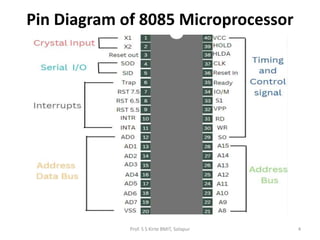
Pin Diagram of 8085 Microprocessor
Prof. S S Kirte BMIT, Solapur 4
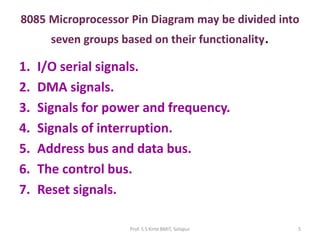
8085 Microprocessor Pin Diagram may be divided into
seven groups based on their functionality.
1. I/O serial signals.
2. DMA signals.
3. Signals for power and frequency.
4. Signals of interruption.
5. Address bus and data bus.
6. The control bus.
7. Reset signals.
Prof. S S Kirte BMIT, Solapur 5
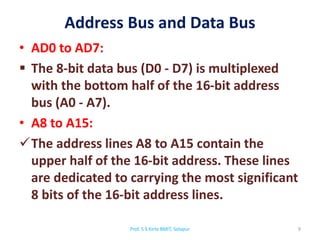
Serial I/O Ports
• SID (Serial I/P Data): This input signal takes serial
data from an external device bit by bit.
• SOD (Serial O/P Data): This is an output signal
that allows serial data to be sent bit by bit to an
external device.
Direct Memory Access(DMA) Signal
HOLD: This signal indicates that another master
has requested access to the address, data, and
control buses.
HLDA: The HLDA signal is used to acknowledge a
HOLD request.
Prof. S S Kirte BMIT, Solapur 6
Power Supply and Clock Frequency
• Vcc: A single +5 V power supply is required.
• Vss: Ground reference.
• X1 and X2: A tuned circuit such as an LC, RC,
or crystal is linked at these two points.
Because the internal clock generator divides
the oscillator frequency by two, a system
operating at 3 MHz requires a crystal with a
frequency of 6 MHz
• CLK OUT: This signal is utilized by other
devices as a system clock. Its frequency is half
that of the oscillator.
Prof. S S Kirte BMIT, Solapur 7
Interrupts and Peripheral Initiated
Signals
• RST 5.5
• RST 6.5
• RST 7.5
• TRAP
• INTR
Prof. S S Kirte BMIT, Solapur 8
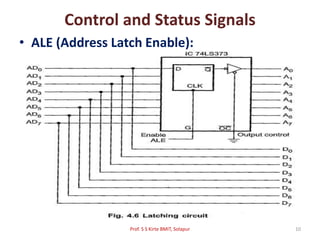
Address Bus and Data Bus
• AD0 to AD7:
 The 8-bit data bus (D0 - D7) is multiplexed
with the bottom half of the 16-bit address
bus (A0 - A7).
• A8 to A15:
The address lines A8 to A15 contain the
upper half of the 16-bit address. These lines
are dedicated to carrying the most significant
8 bits of the 16-bit address lines.
Prof. S S Kirte BMIT, Solapur 9
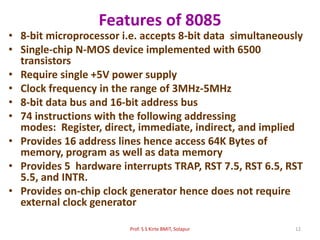
Control and Status Signals
• ALE (Address Latch Enable):
Prof. S S Kirte BMIT, Solapur 10
.
Prof. S S Kirte BMIT, Solapur 11
RD and WR: These signals regulate the data flow
between the CPU and the memory or I/O device/port.
A low RD value indicates that data must be read
through the data bus from the designated memory
location or I/O port. A low WR indicates that the data
must be written via the data bus into the designated
memory location or I/O port.
IO/M, S0, and S1: IO/M shows if an I/O or memory
operation is being performed. S1 and S0 show the type
of machine cycle currently in use.
These signals are used to identify the nature of
operation.
There are 3 control signal and 3 status signals. Three
control signals are RD, WR & ALE.
Features of 8085
• 8-bit microprocessor i.e. accepts 8-bit data simultaneously
• Single-chip N-MOS device implemented with 6500
transistors
• Require single +5V power supply
• Clock frequency in the range of 3MHz-5MHz
• 8-bit data bus and 16-bit address bus
• 74 instructions with the following addressing
modes: Register, direct, immediate, indirect, and implied
• Provides 16 address lines hence access 64K Bytes of
memory, program as well as data memory
• Provides 5 hardware interrupts TRAP, RST 7.5, RST 6.5, RST
5.5, and INTR.
• Provides on-chip clock generator hence does not require
external clock generator
Prof. S S Kirte BMIT, Solapur 12
Features of 8085
• Perform arithmetic and logical operations
• Provides control signals to control the bus cycles
• Provides two serials I/O lines viz SOD and SID hence
serial peripherals can be interfaced with 8085 directly
• Supports mechanism that allows 8085 to increase its
interrupt handling capacity
• Provides 8-bit accumulator , flag register , 6 general-
purpose register(B,C,D,E,H,L) , 2 special purpose 16-bit
registers(SP,PC)
• The data bus(D0-D7) multiplexed with lower 8-bit
address bus(A0-A7) hence requires external hardware
to separate data lines from the address line
Prof. S S Kirte BMIT, Solapur 13
Prof. S S Kirte BMIT, Solapur 14
Functional Units of 8085 Microprocessor
.These units include the following:
 Arithmetic Logic Unit (ALU)
 The ALU is responsible for performing arithmetic and
logical operations on data.
 It can perform operations such as addition, subtraction,
logical AND, logical OR, and more.
 The ALU operates on 8-bit data and provides flags to
indicate conditions such as zero, carry, sign, and parity.
 Control Unit (CU)
 The Control Unit coordinates and controls the activities
of the other functional units within the microprocessor.
 It generates timing and control signals to synchronize the
execution of instructions and manage data transfer
between different units.
Prof. S S Kirte BMIT, Solapur 15
Functional Units of 8085 Microprocessor
Instruction Decoder
 The Instruction Decoder decodes the
instructions fetched from memory.
 It determines the type of instruction being
executed and generates control signals
accordingly.
 The decoded instructions guide the
microprocessor in executing the appropriate
operations.
Prof. S S Kirte BMIT, Solapur 16
The 8085 microprocessor registers :
• Accumulator (A): The Accumulator is an 8-bit
register used for storing intermediate results
during arithmetic and logical operations.
• General Purpose Registers (B, C, D, E, H, L):
These are six 8-bit registers that can be used for
various purposes, including storing data and
performing operations.
• Special Purpose Registers (SP, PC): The Stack
Pointer (SP) is used to manage the stack in
memory and the program counter (PC) keeps
track of the memory address of the following
instruction for fetching.
Prof. S S Kirte BMIT, Solapur 17
Address and Data Bus
• The microprocessor uses a bidirectional address
bus to specify the memory location or I/O
device it wants to access. Similarly, it employs
an 8-bit bidirectional data bus for transferring
data between the microprocessor and memory
or I/O devices.
Timing and Control Unit
• The Timing and Control Unit generates the
necessary timing signals to synchronize the
activities of the microprocessor. It produces
signals such as RD (Read), WR (Write), and
various control signals required for instruction
execution.
Prof. S S Kirte BMIT, Solapur 18
Interrupt Control Unit
• The Interrupt Control Unit manages interrupts in
the 8085 microprocessor. It handles external
interrupt signals and facilitates interrupt-driven
operations by interrupting the normal execution
flow of the program and branching to specific
interrupt service routines.
Memory Interface
• The Memory Interface connects the
microprocessor to the memory system. It
manages the address and data transfers
between the microprocessor and the memory
chips, including Read and Write operations.
Prof. S S Kirte BMIT, Solapur 19
Prof. S S Kirte BMIT, Solapur 20

Unit 1 Microprocessor 8085.pptx

  • 1.
    Microprocessor 8085 Unit 1 SY BTech.Sem I Marks 4 1 Prof. S S Kirte BMIT, Solapur
  • 2.
  • 3.
    What is 8085Microprocessor? • The 8085 microprocessor is the most commonly used 8-bit microprocessor architecture in early computer systems and embedded devices. • The 8085 offers a range of instructions for arithmetic, logical, and control operations, making it suitable for a wide range of applications. Prof. S S Kirte BMIT, Solapur 3
  • 4.
    Pin Diagram of8085 Microprocessor Prof. S S Kirte BMIT, Solapur 4
  • 5.
    8085 Microprocessor PinDiagram may be divided into seven groups based on their functionality. 1. I/O serial signals. 2. DMA signals. 3. Signals for power and frequency. 4. Signals of interruption. 5. Address bus and data bus. 6. The control bus. 7. Reset signals. Prof. S S Kirte BMIT, Solapur 5
  • 6.
    Serial I/O Ports •SID (Serial I/P Data): This input signal takes serial data from an external device bit by bit. • SOD (Serial O/P Data): This is an output signal that allows serial data to be sent bit by bit to an external device. Direct Memory Access(DMA) Signal HOLD: This signal indicates that another master has requested access to the address, data, and control buses. HLDA: The HLDA signal is used to acknowledge a HOLD request. Prof. S S Kirte BMIT, Solapur 6
  • 7.
    Power Supply andClock Frequency • Vcc: A single +5 V power supply is required. • Vss: Ground reference. • X1 and X2: A tuned circuit such as an LC, RC, or crystal is linked at these two points. Because the internal clock generator divides the oscillator frequency by two, a system operating at 3 MHz requires a crystal with a frequency of 6 MHz • CLK OUT: This signal is utilized by other devices as a system clock. Its frequency is half that of the oscillator. Prof. S S Kirte BMIT, Solapur 7
  • 8.
    Interrupts and PeripheralInitiated Signals • RST 5.5 • RST 6.5 • RST 7.5 • TRAP • INTR Prof. S S Kirte BMIT, Solapur 8
  • 9.
    Address Bus andData Bus • AD0 to AD7:  The 8-bit data bus (D0 - D7) is multiplexed with the bottom half of the 16-bit address bus (A0 - A7). • A8 to A15: The address lines A8 to A15 contain the upper half of the 16-bit address. These lines are dedicated to carrying the most significant 8 bits of the 16-bit address lines. Prof. S S Kirte BMIT, Solapur 9
  • 10.
    Control and StatusSignals • ALE (Address Latch Enable): Prof. S S Kirte BMIT, Solapur 10
  • 11.
    . Prof. S SKirte BMIT, Solapur 11 RD and WR: These signals regulate the data flow between the CPU and the memory or I/O device/port. A low RD value indicates that data must be read through the data bus from the designated memory location or I/O port. A low WR indicates that the data must be written via the data bus into the designated memory location or I/O port. IO/M, S0, and S1: IO/M shows if an I/O or memory operation is being performed. S1 and S0 show the type of machine cycle currently in use. These signals are used to identify the nature of operation. There are 3 control signal and 3 status signals. Three control signals are RD, WR & ALE.
  • 12.
    Features of 8085 •8-bit microprocessor i.e. accepts 8-bit data simultaneously • Single-chip N-MOS device implemented with 6500 transistors • Require single +5V power supply • Clock frequency in the range of 3MHz-5MHz • 8-bit data bus and 16-bit address bus • 74 instructions with the following addressing modes: Register, direct, immediate, indirect, and implied • Provides 16 address lines hence access 64K Bytes of memory, program as well as data memory • Provides 5 hardware interrupts TRAP, RST 7.5, RST 6.5, RST 5.5, and INTR. • Provides on-chip clock generator hence does not require external clock generator Prof. S S Kirte BMIT, Solapur 12
  • 13.
    Features of 8085 •Perform arithmetic and logical operations • Provides control signals to control the bus cycles • Provides two serials I/O lines viz SOD and SID hence serial peripherals can be interfaced with 8085 directly • Supports mechanism that allows 8085 to increase its interrupt handling capacity • Provides 8-bit accumulator , flag register , 6 general- purpose register(B,C,D,E,H,L) , 2 special purpose 16-bit registers(SP,PC) • The data bus(D0-D7) multiplexed with lower 8-bit address bus(A0-A7) hence requires external hardware to separate data lines from the address line Prof. S S Kirte BMIT, Solapur 13
  • 14.
    Prof. S SKirte BMIT, Solapur 14
  • 15.
    Functional Units of8085 Microprocessor .These units include the following:  Arithmetic Logic Unit (ALU)  The ALU is responsible for performing arithmetic and logical operations on data.  It can perform operations such as addition, subtraction, logical AND, logical OR, and more.  The ALU operates on 8-bit data and provides flags to indicate conditions such as zero, carry, sign, and parity.  Control Unit (CU)  The Control Unit coordinates and controls the activities of the other functional units within the microprocessor.  It generates timing and control signals to synchronize the execution of instructions and manage data transfer between different units. Prof. S S Kirte BMIT, Solapur 15
  • 16.
    Functional Units of8085 Microprocessor Instruction Decoder  The Instruction Decoder decodes the instructions fetched from memory.  It determines the type of instruction being executed and generates control signals accordingly.  The decoded instructions guide the microprocessor in executing the appropriate operations. Prof. S S Kirte BMIT, Solapur 16
  • 17.
    The 8085 microprocessorregisters : • Accumulator (A): The Accumulator is an 8-bit register used for storing intermediate results during arithmetic and logical operations. • General Purpose Registers (B, C, D, E, H, L): These are six 8-bit registers that can be used for various purposes, including storing data and performing operations. • Special Purpose Registers (SP, PC): The Stack Pointer (SP) is used to manage the stack in memory and the program counter (PC) keeps track of the memory address of the following instruction for fetching. Prof. S S Kirte BMIT, Solapur 17
  • 18.
    Address and DataBus • The microprocessor uses a bidirectional address bus to specify the memory location or I/O device it wants to access. Similarly, it employs an 8-bit bidirectional data bus for transferring data between the microprocessor and memory or I/O devices. Timing and Control Unit • The Timing and Control Unit generates the necessary timing signals to synchronize the activities of the microprocessor. It produces signals such as RD (Read), WR (Write), and various control signals required for instruction execution. Prof. S S Kirte BMIT, Solapur 18
  • 19.
    Interrupt Control Unit •The Interrupt Control Unit manages interrupts in the 8085 microprocessor. It handles external interrupt signals and facilitates interrupt-driven operations by interrupting the normal execution flow of the program and branching to specific interrupt service routines. Memory Interface • The Memory Interface connects the microprocessor to the memory system. It manages the address and data transfers between the microprocessor and the memory chips, including Read and Write operations. Prof. S S Kirte BMIT, Solapur 19
  • 20.
    Prof. S SKirte BMIT, Solapur 20